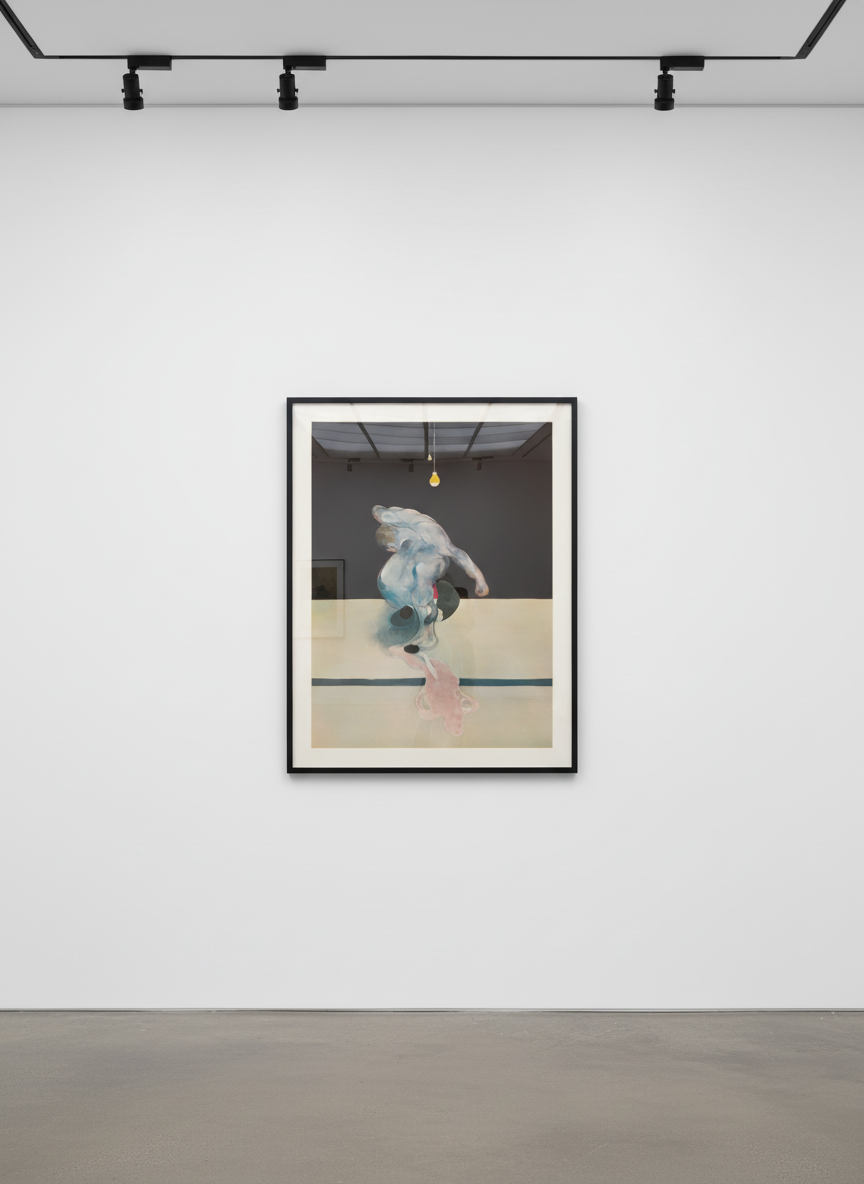
Edition of 150
1 work

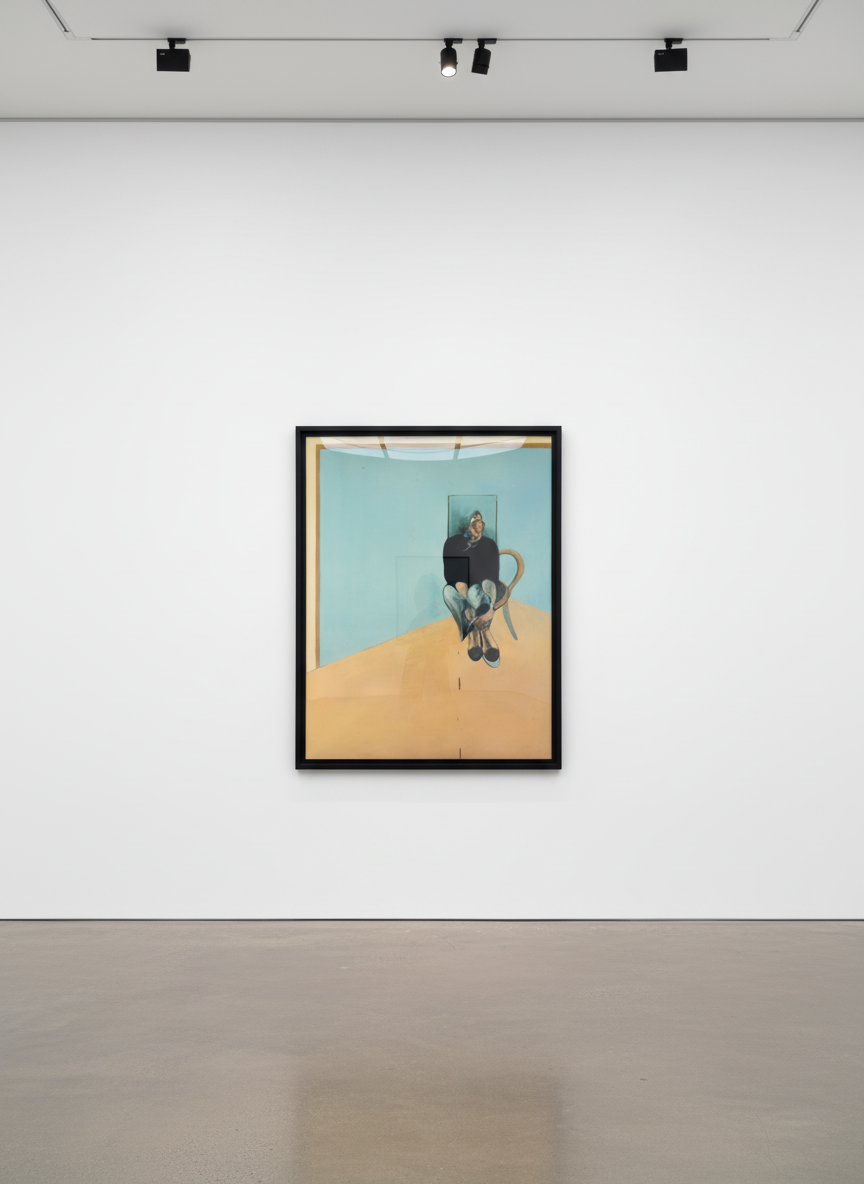
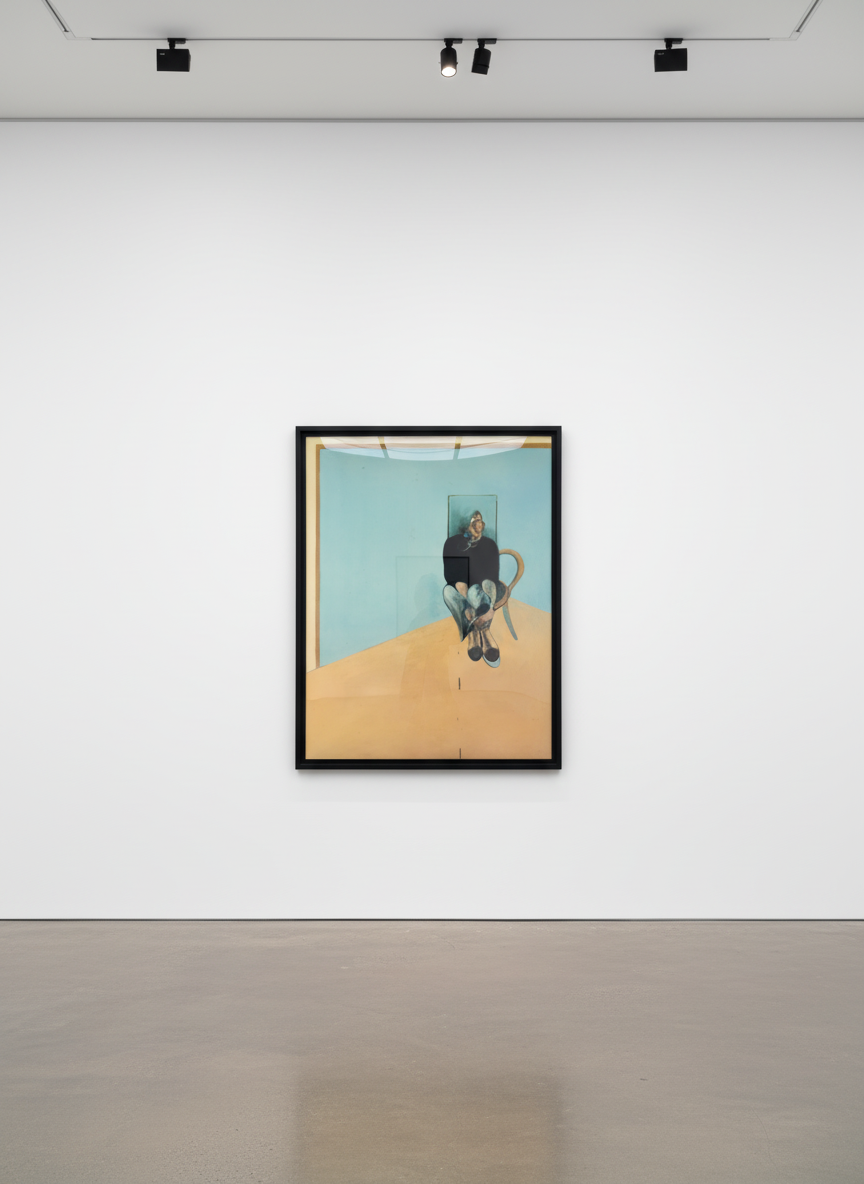
Study for Self Portrait , after Study for Self Portrait 1982, 1984
Offset lithograph on Wove paper
37 1/8 x 25 5/8 in 94 x 65 cm
Edition of 182
Francis Bacon’s After Study for Self-Portrait presents a striking shift in tone from the raw, convulsive energy that characterizes much of his earlier work. Here, the figure—presumably Bacon himself—is seated in a pose that feels less tortured and more contemplative. The body language is relaxed, almost meditative, set within a liminal, undefined space that resists any specific temporal or spatial anchoring. The palette, composed of soft blues and sandy yellows, imparts a sense of calm introspection rather than existential violence.Throughout his career, Bacon frequently placed his figures within rigid geometric structures—frames, boxes, and architectural enclosures that heightened the sense of psychological and physical confinement. In this print, however, those formal barriers have softened, if not dissolved entirely. The figure seems suspended in a space that is open yet quietly bounded—more suggestive than architectural. This visual openness implies a loosening of internal constraints, replacing earlier sensations of claustrophobia with a more reflective, introspective atmosphere.The composition still retains some of Bacon’s hallmark traits: the chair, the subtle framing devices, the isolated figure. Yet these elements are presented with a newfound restraint. The figure is not howling or writhing in anguish; rather, it appears absorbed in thought, caught in a moment of stillness that is rare in Bacon’s oeuvre. This softening is echoed in the gentle tonal contrasts and the almost pastel-like handling of color, which shift the emotional register from violent confrontation to subdued rumination.This quieter mood does not signal an abandonment of Bacon’s core themes. Rather, it suggests an evolution in how he engages them. The face, as in many of his self-portraits, remains slightly blurred, partially erased—its features indistinct and ghostlike. This loss of clarity does not obscure identity; instead, it reinforces Bacon’s meditation on impermanence, time, and the erasure of the self. The ambiguity of the features invites the viewer to reflect not only on Bacon’s identity, but on the ephemeral nature of existence itself.Though less overtly brutal than his earlier works, After Study for Self-Portrait remains haunted by Bacon’s preoccupations with mortality, decay, and the disintegration of the self. The soft edges and desaturated tones may suggest a gentler engagement with these ideas, but they do not lessen their emotional weight. Instead, they allow for a more intimate, even tender confrontation with the fragility of life. There is no dramatic collapse or scream here—just the quiet, persistent hum of transience.The relaxed pose and subtle gestures further underscore this introspective tone. The figure does not resist its environment but inhabits it. This sense of psychological surrender—of acceptance, perhaps—marks a departure from the raw urgency of Bacon’s earlier self-portraits. It is as if, later in life, the artist has turned from external conflict to internal reckoning. The absence of overt violence does not suggest peace, but rather a deep, contemplative understanding of the body and self as mutable, aging, and finite.In this light, After Study for Self-Portrait can be read not as a diminishment of Bacon’s intensity, but as a refinement of his vision. It captures a quieter form of existential reflection—no less powerful, but more meditative in its approach. The work continues to grapple with the artist’s enduring themes—mortality, identity, and the passage of time—yet it does so with a sense of dignity and restraint, as though the figure has ceased struggling against the void and begun to coexist with it.Ultimately, this self-portrait speaks to the late phase of Bacon’s artistic journey. It is less a scream than a murmur—no less poignant, and perhaps more profound. It invites the viewer not into a spectacle of anguish, but into a quiet space of contemplation, where the distortions of the flesh and the soft dissolution of identity gently echo the universal truths of aging, memory, and the inevitable fading of self.For more information on Francis Bacon’s After Study for Self-Portrait or to buy After Study for Self-Portrait contact our galleries using the form below.
Price on Application
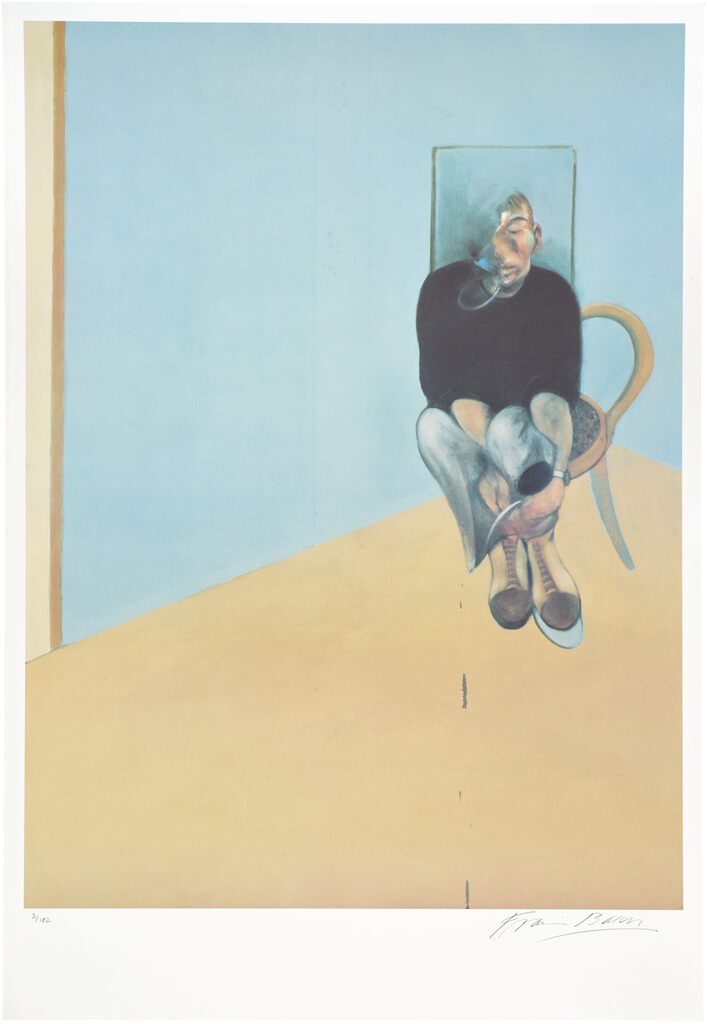
Study for Self-Portrait (after, Study for Self-Portrait 1982) (S. 35, T. 16) · Francis Bacon · Phillips · 2026-02 · $14,190
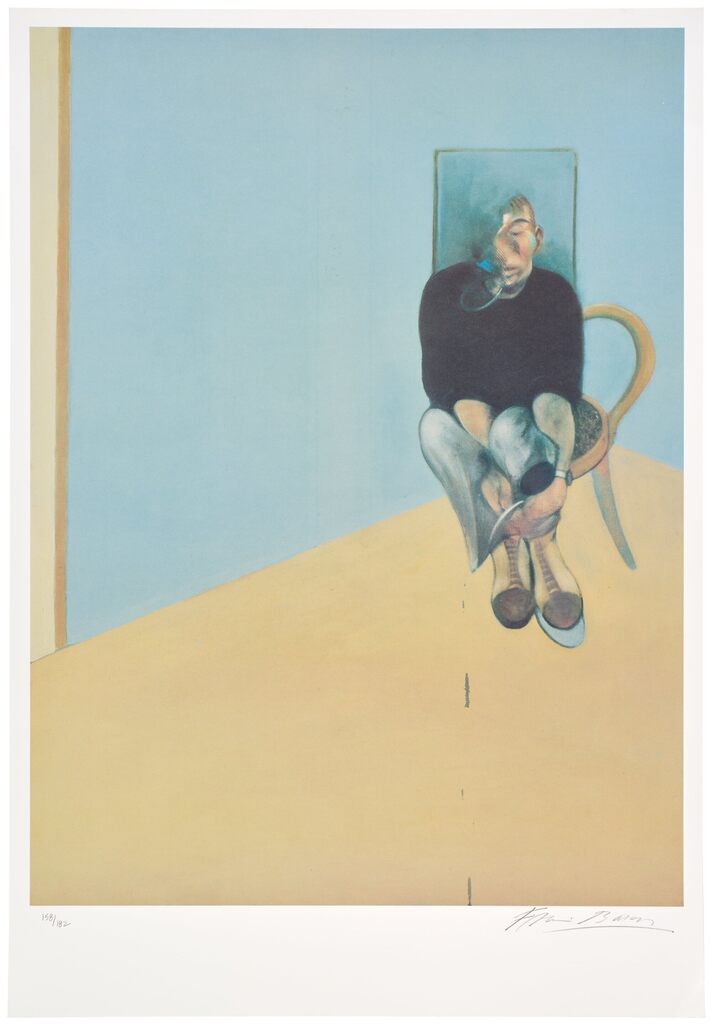
Study for Self-Portrait (after, Study for Self-Portrait 1982) (S. 35, T. 16) · Francis Bacon · Phillips · 2026-01 · $15,387
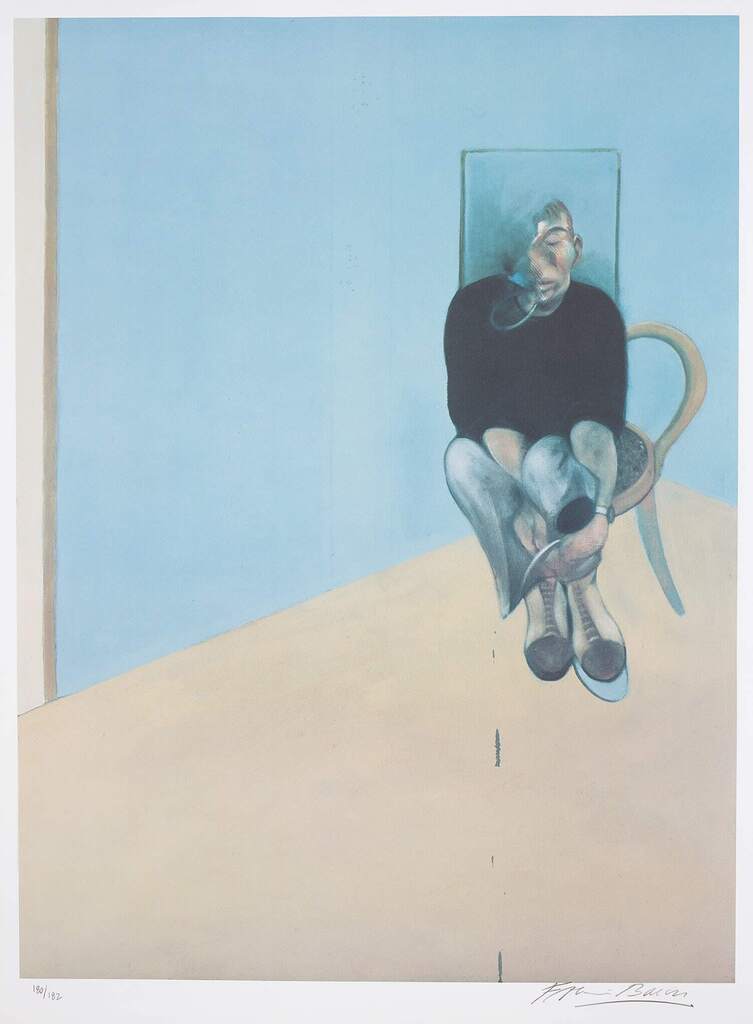
Study for Self-Portrait (after, Study for Self-Portrait 1982) · Francis Bacon · Phillips · 2020-09 · $30,143
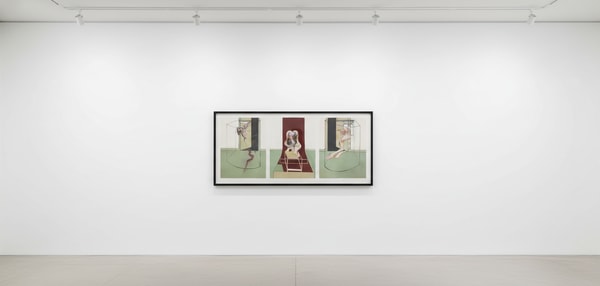
Francis Bacon
after Triptych (1981) inspired by the Oresteia of Aeschylus, 1981
1981
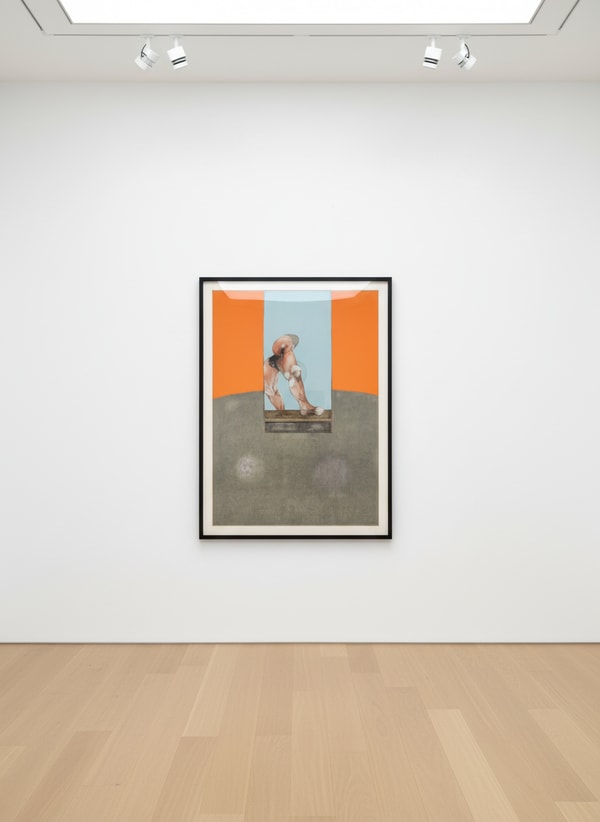
Francis Bacon
Etude de Tauromachie
1987
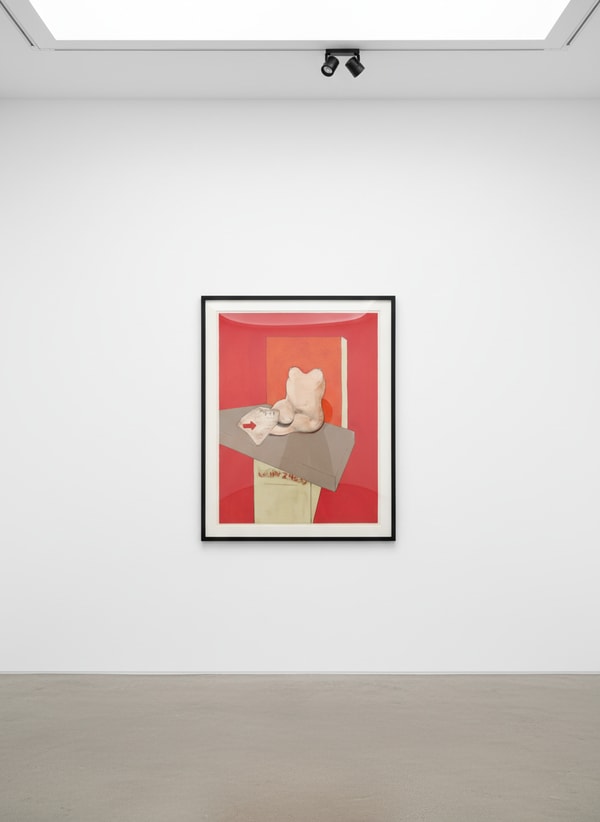
Francis Bacon
Ètude du Corps Humain d'après Ingres , afterStudy of a Human Body after Ingres 1982
1984

Francis Bacon
Hommage à Van Gogh , after Hommage à Van Gogh 1985
1989
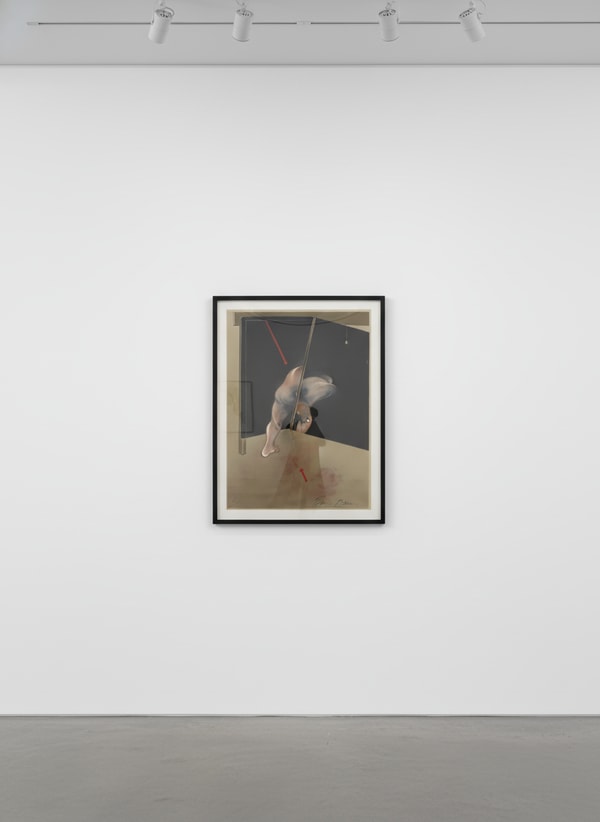
Francis Bacon
Logique de la sensation , after Study from the Human Body 1981
1981
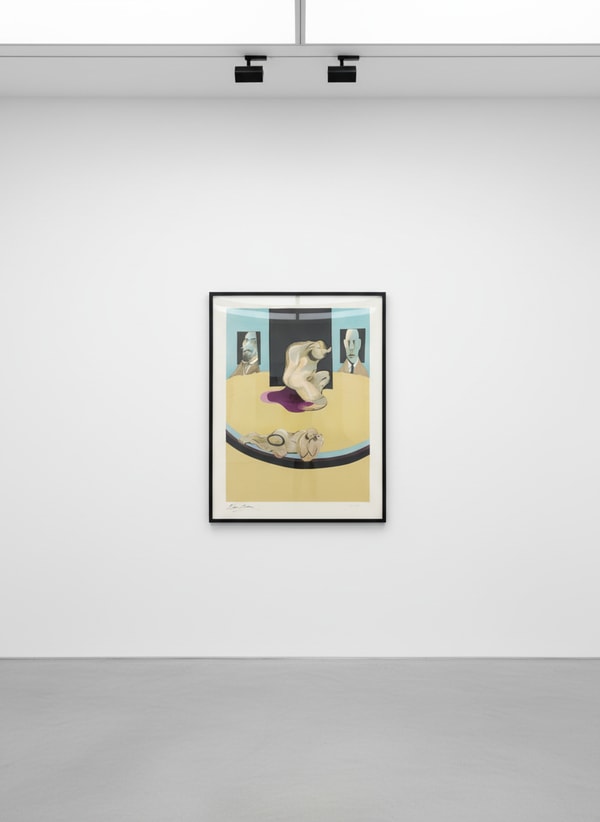
Francis Bacon
Metropolitan Museum of Art
1975
Francis Bacon
Mirroir de la Tauromachie
1990
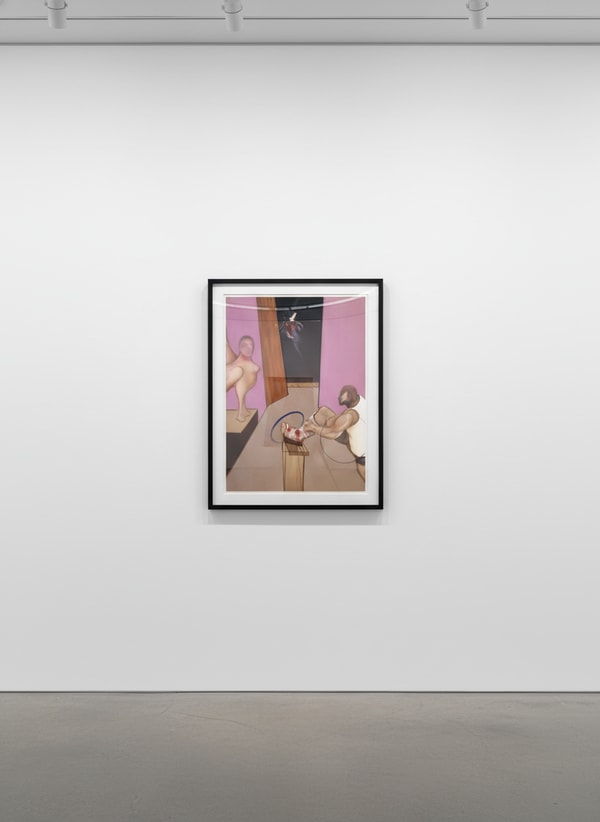
Francis Bacon
Oedipe et Le Sphinx d'après Ingres , after Oedipus and the Sphinx after Ingres 1983
1984
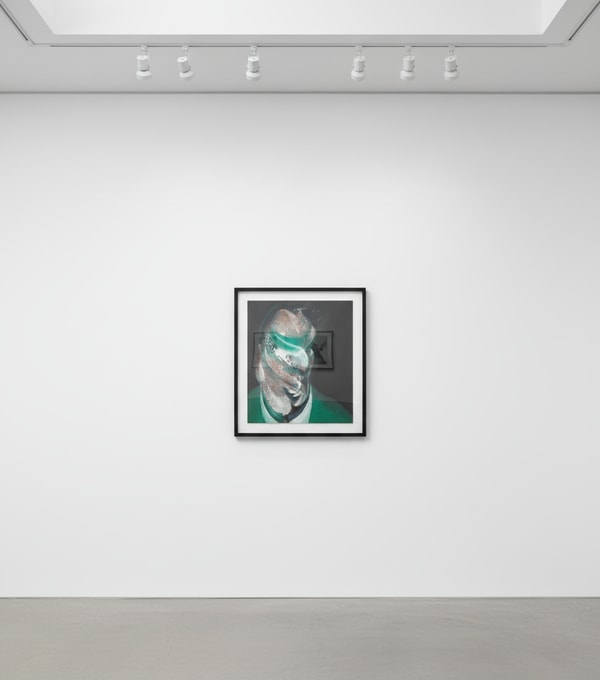
Francis Bacon
Portrait of Freud
1967
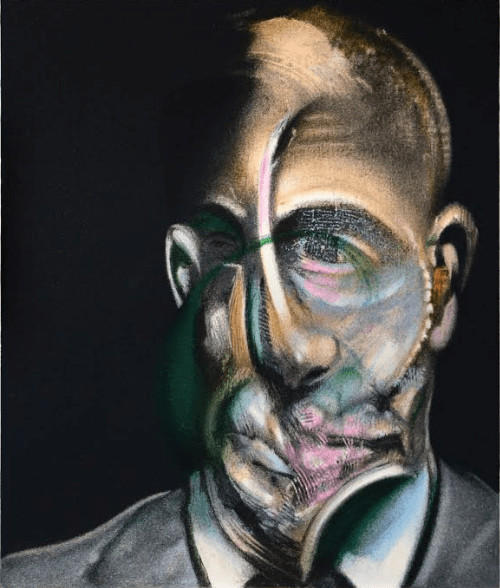
Francis Bacon
Portrait of Michel Leiris from Miroir de la Tauromachie
1990
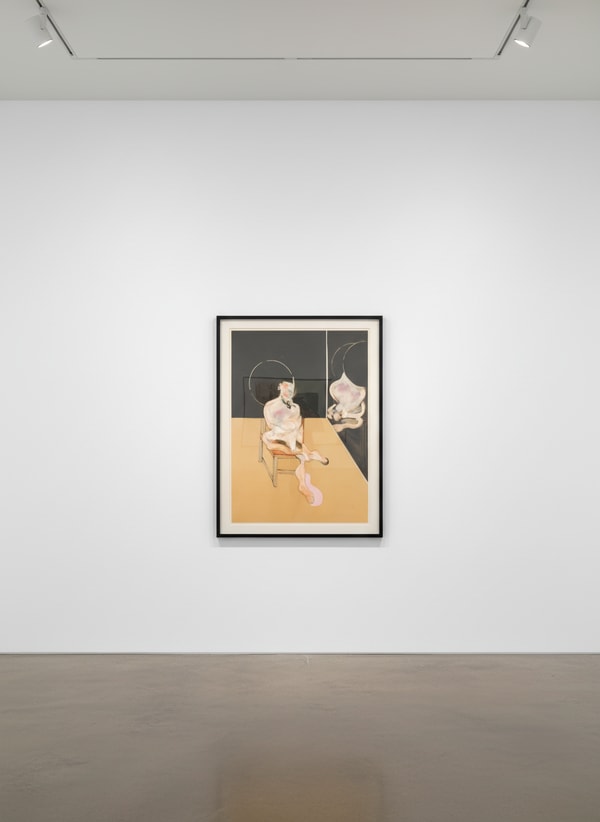
Francis Bacon
Seated Figure
1983
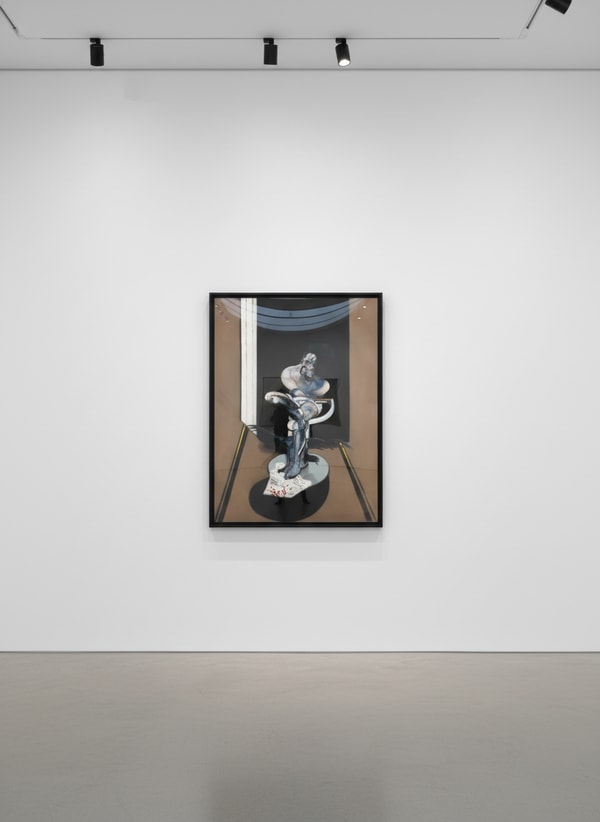
Francis Bacon
Seated Figure , after Seated Figure 1977
1992
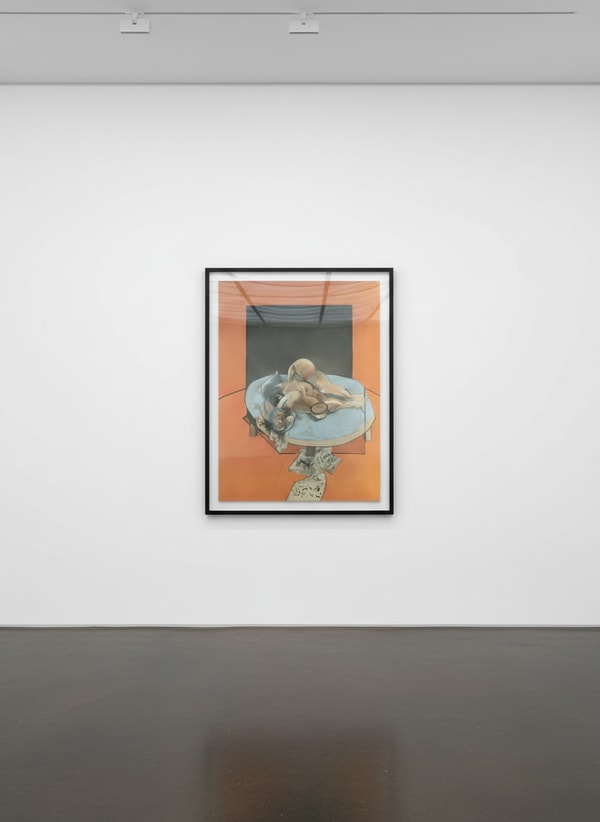
Francis Bacon
Studies of the Human Body , after the Central Panel of the Triptych Studies of the Human Body 1979
1980
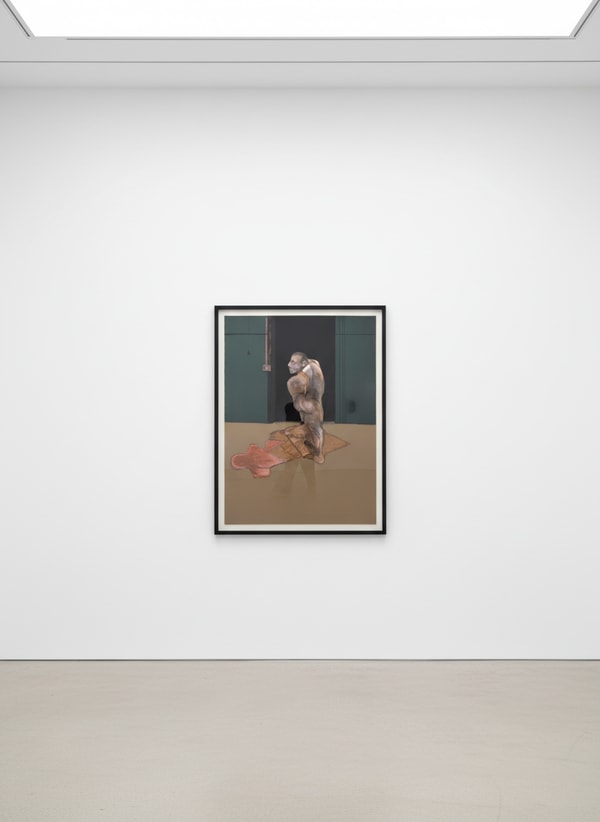
Francis Bacon
Study For A Portrait of John Edwards
1987
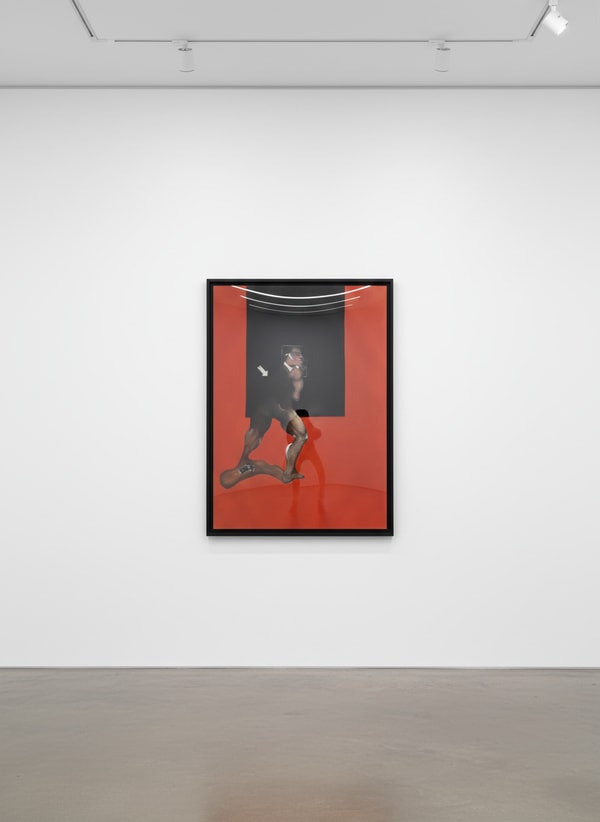
Francis Bacon
Study from Human Body , after Study from Human Body 1987
1992
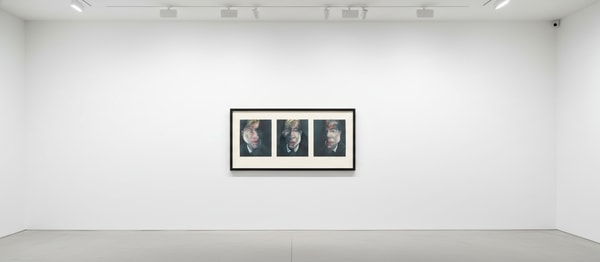
Francis Bacon
Three Studies For A Self Portrait
1983-1990
Francis Bacon (1909–1992) is among the most important figurative painters of the twentieth century, an artist whose raw, visceral canvases locate the human body in conditions of extreme psychological tension and transform painterly convention into a vehicle for existential confrontation. Born in Dublin to English parents, Bacon was largely self-taught — he received no formal art education and came to painting in his late twenties after years of drifting through London and Europe. His breakthrough came with the 1944 triptych Three Studies for Figures at the Base of a Crucifixion, which shocked a wartime London audience with its images of distorted, screaming hybrid creatures and established his reputation as an artist of unsettling and uncompromising vision.
Bacon's mature practice was built around a small number of recurrent subjects and formal devices. His Screaming Popes — a long series of works derived from Velázquez's portrait of Pope Innocent X — dissolve the authority of the Renaissance original into images of anguish and constraint, the figure screaming behind glass or pinned within a geometric cage. His portraits of his intimate circle — Lucian Freud, George Dyer, Isabel Rawsthorne, Peter Lacy — are among the most psychologically penetrating likenesses in the history of art, the faces smeared and turned and displaced in ways that feel both violently distorted and deeply faithful to the sitter's interior life. His self-portraits are equally compulsive: self-scrutiny carried to the point of self-laceration. Through all these works runs a consistent formal vocabulary: figures isolated in shallow, airless spaces; geometric frameworks of lines and bars that imprison or frame; meat-like surfaces of dragged and flung paint; glass and velvet chosen as ground materials to intensify the sense of both exposure and entrapment.
Bacon's market stands among the highest of any twentieth-century figurative artist. Three Studies of Lucian Freud (1969) achieved $142,400,000 at Christie's New York in 2013 — the world auction record at the time — while Triptych, 1976 reached $86,000,000 at Sotheby's New York in 2014, and Triptych Inspired by the Oresteia of Aeschylus (1981) achieved $84,600,000 at Sotheby's in 2020. Works on paper, prints, lithographs, and screenprints derived from his iconic paintings represent more accessible entry points to his market and are actively sought by collectors worldwide.
Bacon's work is held at Tate Modern, the Museum of Modern Art, the Metropolitan Museum of Art, the Solomon R. Guggenheim Museum, the Art Institute of Chicago, the Centre Pompidou, the Museo Nacional del Prado, and Museum Ludwig, among other major institutions globally.
Guy Hepner offers expert guidance on Francis Bacon prints, editions, and works on paper from our gallery at 177 Tenth Avenue, New York. Given the seriousness of the Bacon market and the importance of authentication, we approach every transaction with the utmost rigour. We offer free, confidential valuations for works in private collections and connections to qualified buyers worldwide.