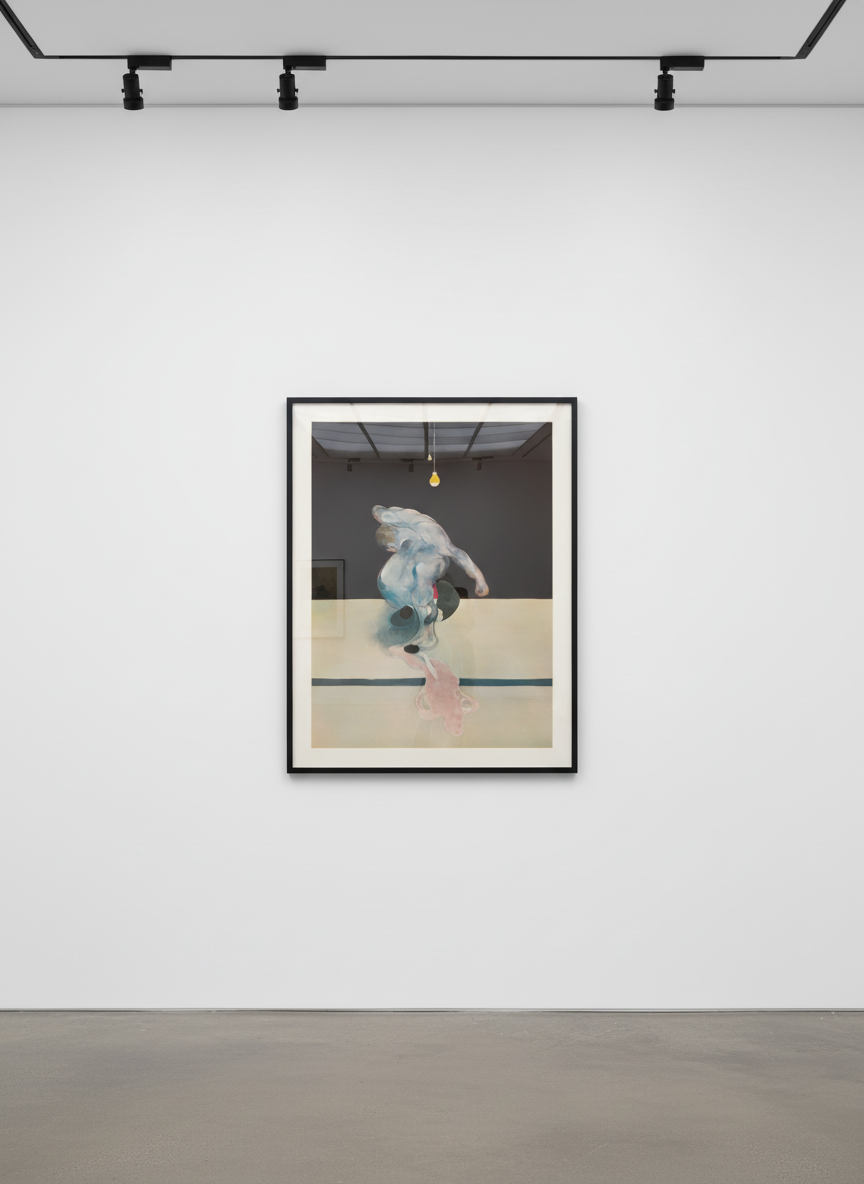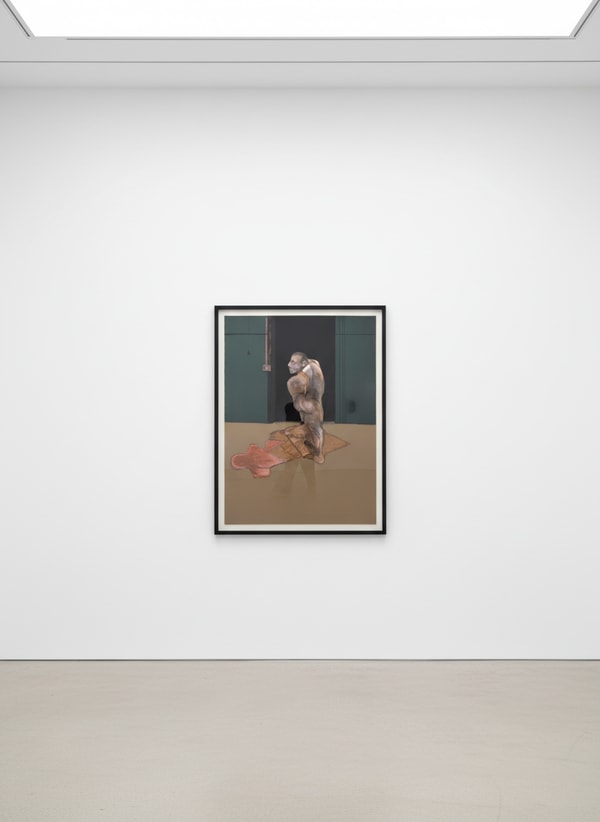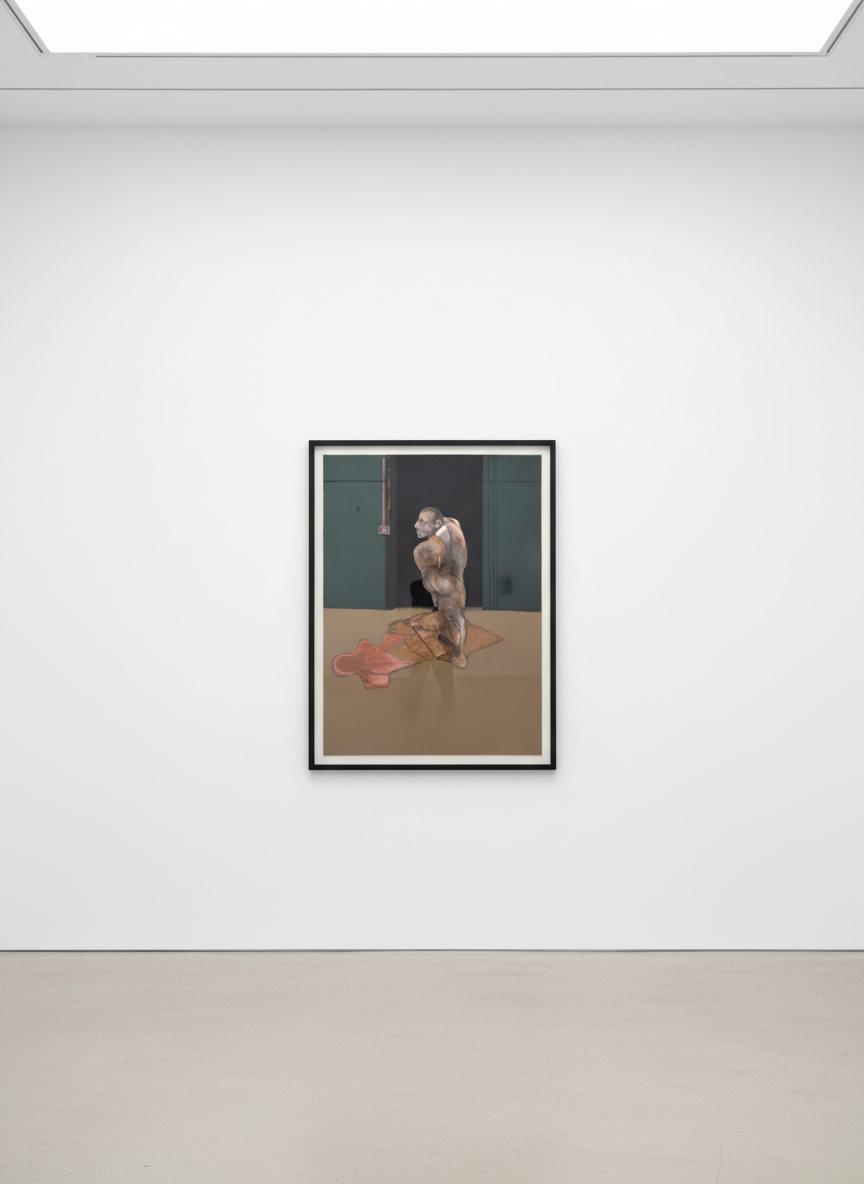
Prints & Editions
17 works

Francis Bacon (1909–1992) is among the most important figurative painters of the twentieth century, an artist whose raw, visceral canvases locate the human body in conditions of extreme psychological tension and transform painterly convention into a vehicle for existential confrontation. Born in Dublin to English parents, Bacon was largely self-taught — he received no formal art education and came to painting in his late twenties after years of drifting through London and Europe. His breakth
2 series total
Three Studies of Lucian Freud
Christie's · Nov 2013
$142,405,000
Triptych Inspired by the Oresteia of Aeschylus
Sotheby's · Jun 2020
$84,551,500
Study for Portrait of Lucian Freud
Sotheby's · Jun 2022
$57,830,700
Study For A Head
Sotheby's · May 2019
$52,854,570
Portrait of George Dyer Crouching
Sotheby's · May 2024
$27,730,000
Portrait of a Dwarf
Sotheby's · Oct 2025
$17,631,639
Source: Public auction records. Prices include buyer's premium.
25+
Years in the Market
NY & LDN
Gallery Locations
Global
Collector Network
Guy Hepner Gallery offers complimentary, confidential valuations for collectors looking to sell or consign work by Francis Bacon. Drawing on 25 years of experience in the post-war and contemporary market, we provide accurate, up-to-date assessments based on the latest auction results and private sale data.
Francis Bacon is among the most significant figurative painters of the twentieth century, and one of the most consistently valuable names at auction. His Three Studies of Lucian Freud sold for US$142,405,000 at Christie's in 2013, and his triptychs and single-panel portraits regularly achieve eight- and nine-figure results at Sotheby's and Christie's evening sales.
Whether you own a painting, drawing or work on paper, Guy Hepner can provide a current market valuation based on recent auction results, condition, provenance and authentication status.
Bacon's major paintings and triptychs command tens to hundreds of millions of dollars at the top of the market, with portraits of his close circle — George Dyer, Lucian Freud, Isabel Rawsthorne — among the most sought-after subjects. Works on paper and smaller studies occupy a lower but still significant price band. We provide comprehensive valuations based on current market data.
Our gallery draws on two decades of relationships across the post-war and contemporary market to connect consignors with the right buyers, advisors and specialist auction contacts for exceptional works of this calibre.
Sell / Appraisal
Francis Bacon stands as a titans of the post-war art market, consistently commanding some of the highest prices ever achieved for a 20th-century artist. His work is revered by institutions and sought after by an elite cadre of global collectors, establishing him firmly in the blue-chip tier. The market for Bacon's major canvases, particularly his iconic triptychs and psychologically charged portraits, is characterised by intense demand and robust appreciation, driven by their scarcity, profound artistic impact, and undeniable cultural significance. Investment in a Bacon work is often considered a cornerstone for serious contemporary art collections, offering both prestigious ownership and a strong track record of value growth.
Bacon’s auction results are frequently record-breaking. In 2013, his seminal Three Studies of Lucian Freud (1969) achieved an astonishing $142.4 million at Christie's New York, setting a new world record at the time for any artwork sold at auction. Further cementing his market dominance, his monumental Triptych, 1976 fetched $86 million at Sotheby's New York in 2014, while Triptych Inspired by the Oresteia of Aeschylus (1981) realised $84.6 million at Sotheby's in 2020. These figures underscore the exceptional value placed on his large-scale, intensely personal compositions, which are considered masterpieces of modern art.
Beyond these headline-grabbing sums for major oils, the market for Francis Bacon’s work encompasses a broader range, including significant unique works on paper, studies, and his coveted limited edition prints. These editions, often lithographs or screenprints derived from his most celebrated paintings, provide discerning collectors with an opportunity to acquire a tangible piece of Bacon’s legacy at varying price points. This segment of the market has also demonstrated consistent strength and appreciation, making works on paper and editions valuable entry points and sound investments for those looking to engage with Bacon's powerful oeuvre. The rarity, provenance, and condition are paramount factors driving collector demand across all mediums.
Francis Bacon was born in Dublin, Ireland, in 1909 to English parents, and spent much of his youth moving between Ireland and England. A self-taught artist with no formal art education, Bacon’s early career saw him explore interior design and furniture making in London during the late 1920s, an experience that subtly informed his later architectural framing devices in his paintings. His unconventional entry into the art world allowed him to develop a fiercely original and unconstrained artistic vision, free from academic conventions. His early work remained largely unseen until his breakthrough moment, which radically shifted the landscape of post-war British art.
The defining moment in Bacon’s career arrived with the exhibition of Three Studies for Figures at the Base of a Crucifixion in 1944. This triptych, depicting distorted, screaming biomorphic figures on orange grounds, irrevocably established his mature style and thematic concerns. From this point forward, Bacon dedicated himself to the human figure, rendered with a visceral intensity that explored the psychological depths of existence. He drew inspiration from diverse sources, including the screaming figure in Sergei Eisenstein’s film Battleship Potemkin, Eadweard Muybridge’s photographic studies of figures in motion, and classical art, most famously Velázquez’s Portrait of Pope Innocent X, which he reinterpreted in his iconic 'Screaming Popes' series.
Bacon's signature style is characterised by his vigorous, often brutal, application of paint, creating blurred, smeared, and highly expressive surfaces. His figures are frequently isolated within geometric cages, glass boxes, or stark, undefined interiors, amplifying their sense of vulnerability, anguish, and existential dread. Themes of isolation, suffering, mortality, and the raw physicality of the human body pervade his work. He was obsessed with capturing the fleeting sensation and the "brutality of fact," seeking to convey reality through profound distortion rather than direct representation, delving into the subconscious and primal aspects of human experience.
Throughout his prolific career, Bacon continued to refine and expand his complex compositions, increasingly focusing on portraits of his intimate circle, including Lucian Freud, George Dyer, and Isabel Rawsthorne, as well as a significant body of self-portraits. These were not mere likenesses but intense psychological explorations, often rendered as flesh rather than spirit, exposing the inner turmoil of his subjects. His later works often featured monumental triptychs, which allowed him to unfold a narrative or explore multiple facets of a single theme or figure. Francis Bacon died in Madrid in 1992, leaving behind an unparalleled legacy as one of the 20th century's most powerful and influential figurative painters, whose unflinching gaze into the human condition continues to resonate profoundly.
Bacon’s oeuvre can be broadly categorised by several recurring motifs and series that encapsulate his singular artistic vision. The 'Crucifixion' series, beginning most notably with his pivotal 1944 triptych, serves as a recurring metaphor not for religious piety, but for the inherent suffering and existential anguish of humanity. These works are powerful explorations of agony and distortion, setting the tone for his lifelong engagement with the darker aspects of the human condition. Simultaneously, his 'Screaming Popes' series, initiated in the late 1940s and inspired by Velázquez’s masterful Portrait of Pope Innocent X, transforms a symbol of temporal authority into a figure of trapped, silent torment, exploring themes of power, isolation, and psychological torment through his signature blurring and smearing techniques.
Another central pillar of Bacon’s practice is his extensive body of 'Portraits', particularly those of his close friends and lovers such as Lucian Freud, George Dyer, and Isabel Rawsthorne, as well as his numerous 'Self-Portraits'. These are not conventional portrayals but rather deeply unsettling and intimate psychological examinations, where the physical form is often distorted to reveal an inner emotional landscape. The development of the 'Triptych' format became increasingly significant for Bacon, allowing him to present multiple viewpoints, narrative sequences, or fragmented images of a single subject across three panels. These large-scale works amplify the emotional and visual impact, becoming some of his most ambitious and highly sought-after compositions in the market.
While his monumental oil paintings dominate art historical discourse, Francis Bacon also produced a significant, though more select, body of 'Works on Paper' and 'Limited Edition Prints'. These include lithographs and screenprints, often created in collaboration with master printmakers, which translate the raw intensity and thematic concerns of his oil paintings into print form. These editions, whether based on his famous popes, self-portraits, or animal studies, offer a distinctive entry point into Bacon’s aesthetic. Highly collectible for their rarity, quality, and direct connection to his iconic imagery, these works on paper provide a nuanced perspective on his artistic process and are prized by collectors seeking authentic expressions of his genius beyond the canvas.
Francis Bacon’s profound impact on 20th-century art is reflected in the numerous prestigious museum collections that house his work worldwide. The Tate Modern in London holds an exceptional collection, including pivotal works like Three Studies for Figures at the Base of a Crucifixion (1944) and several important triptychs and portraits. In the United States, his works are prominently featured at institutions such as the Museum of Modern Art (MoMA) and The Metropolitan Museum of Art in New York, the Solomon R. Guggenheim Museum in New York, and the Art Institute of Chicago.
Beyond these, significant examples of Bacon's oeuvre can be found in the collections of the Centre Pompidou in Paris, the Museo Nacional del Prado in Madrid, the Hirshhorn Museum and Sculpture Garden in Washington D.C., and the Museum Ludwig in Cologne, among many others. This extensive institutional presence underscores Francis Bacon's enduring legacy and his undisputed status as one of the most influential and celebrated artists of the modern era, with his works continually acquired and exhibited by leading cultural institutions globally.
Guy Hepner Gallery stands as a premier resource for collectors seeking to acquire or divest works by Francis Bacon. With a distinguished focus on prints, editions, and works on paper by leading post-war and contemporary artists, our gallery offers unparalleled expertise and access to the secondary market for this titan of British art. We pride ourselves on our deep understanding of Bacon’s market dynamics, authentication protocols, and the nuanced value drivers across his various mediums, ensuring a seamless and informed experience for our clients.
Whether you are looking to acquire a rare lithograph from one of Bacon’s iconic series, a unique work on paper, or seeking expert guidance on the broader market for his oeuvre, Guy Hepner provides tailored advice and discreet access to significant works. For collectors looking to sell, our gallery offers comprehensive valuation services and employs a global network of discerning buyers, ensuring optimal placement and confidentiality. Engage with Guy Hepner to navigate the complex world of Francis Bacon's art with confidence, supported by our dedication to transparency, authenticity, and superior client service.
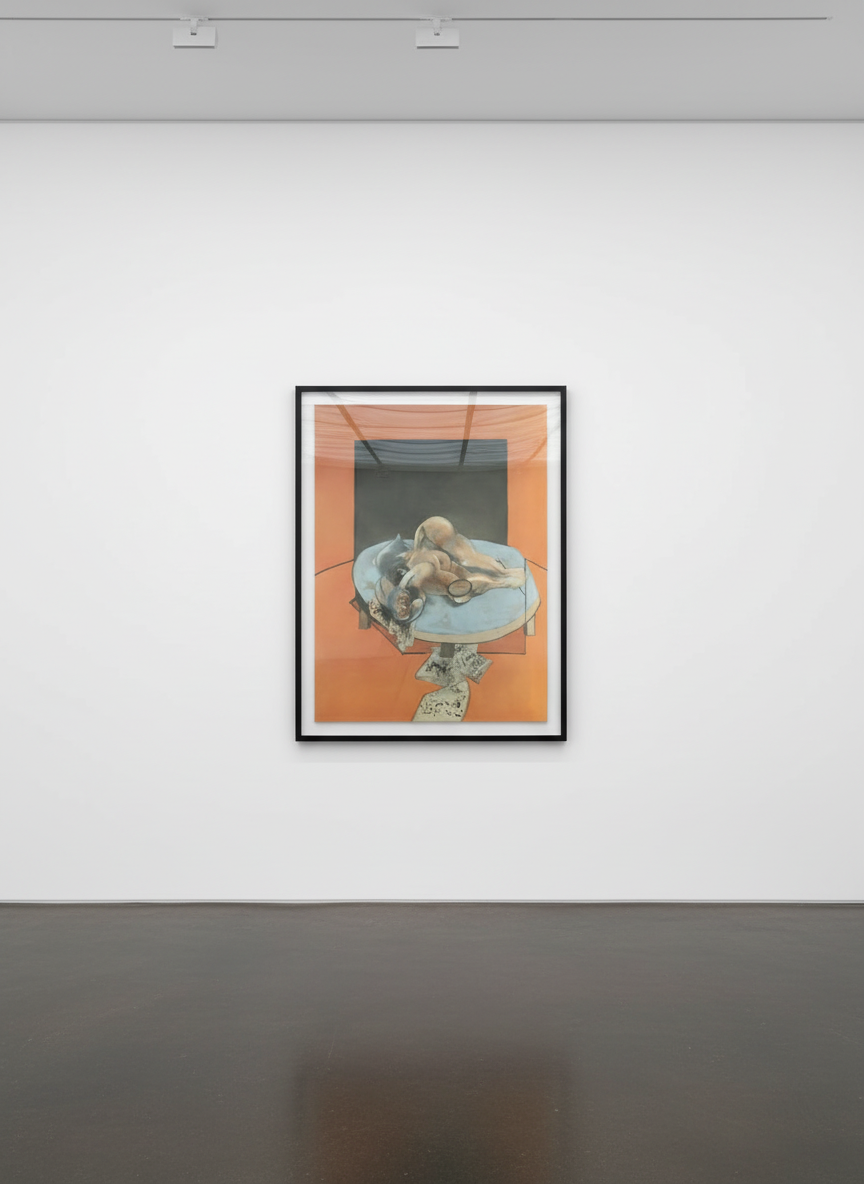
Frequently Asked Questions
Francis Bacon prints and original works for sale are available at Guy Hepner Gallery, 529 West 20th Street, New York (by appointment). Our gallery specialises in authenticated Francis Bacon editions with full provenance documentation sourced from the secondary market.
Francis Bacon artwork prices vary significantly by medium, edition size, date, and condition. Signed and numbered prints from key series are the most accessible entry point. Contact Guy Hepner Gallery for a free valuation and current market pricing on specific works.
Authenticating Francis Bacon art requires catalogue raisonné references, provenance documentation, and where applicable, foundation authentication records. Guy Hepner Gallery provides full provenance for every work we offer for sale.