
Guy Hepner Gallery

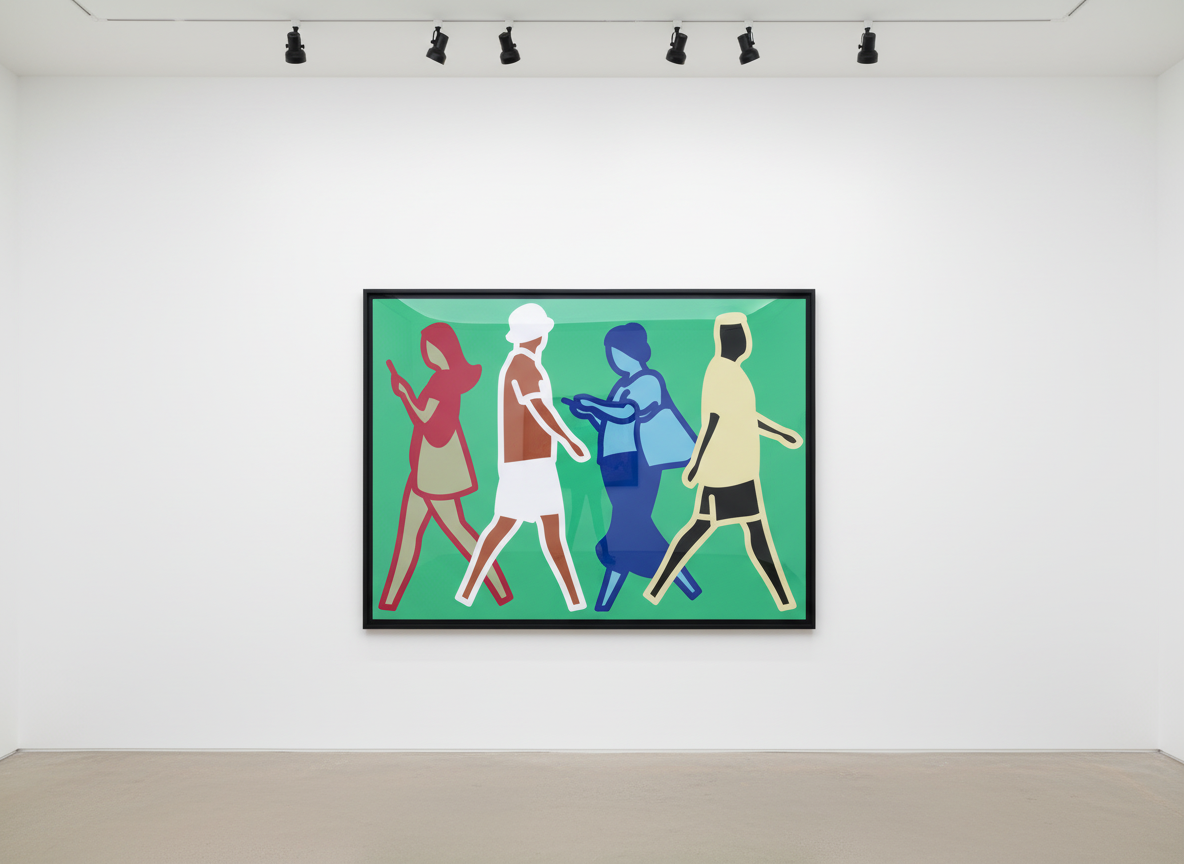
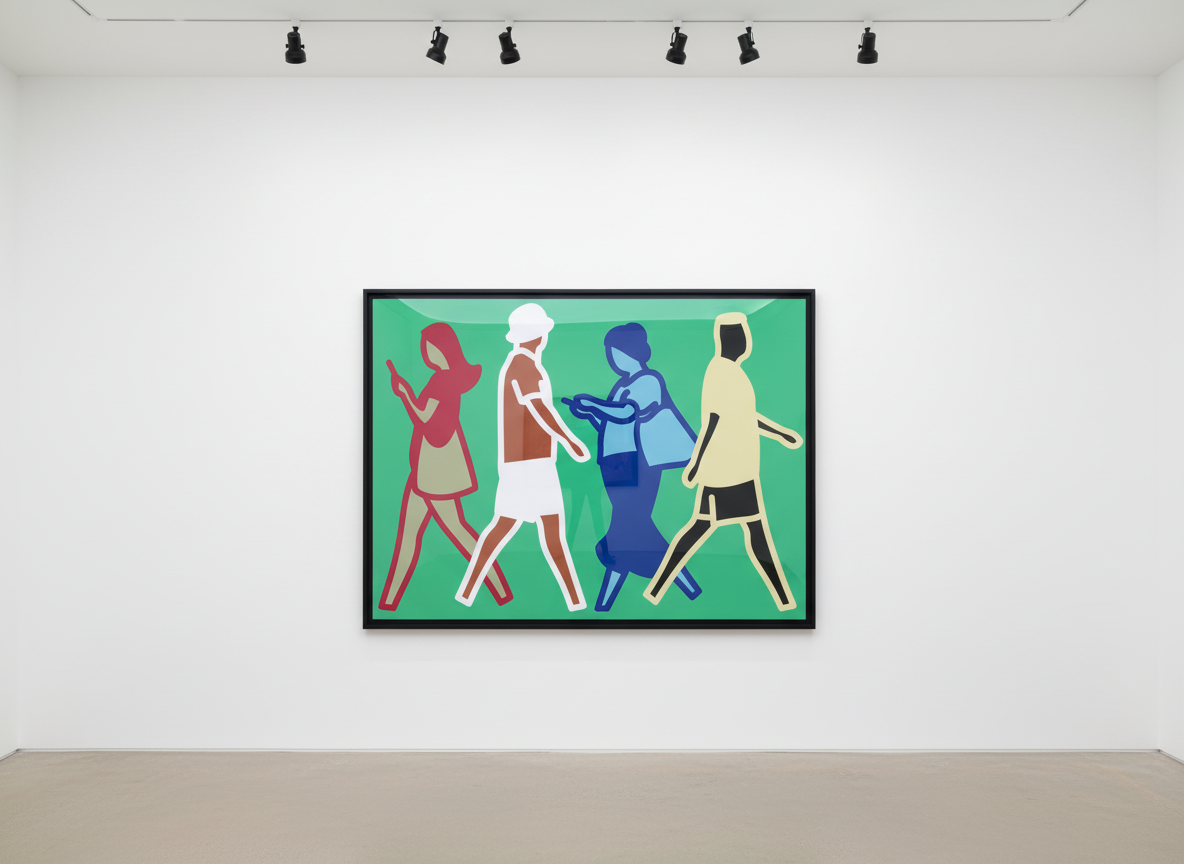
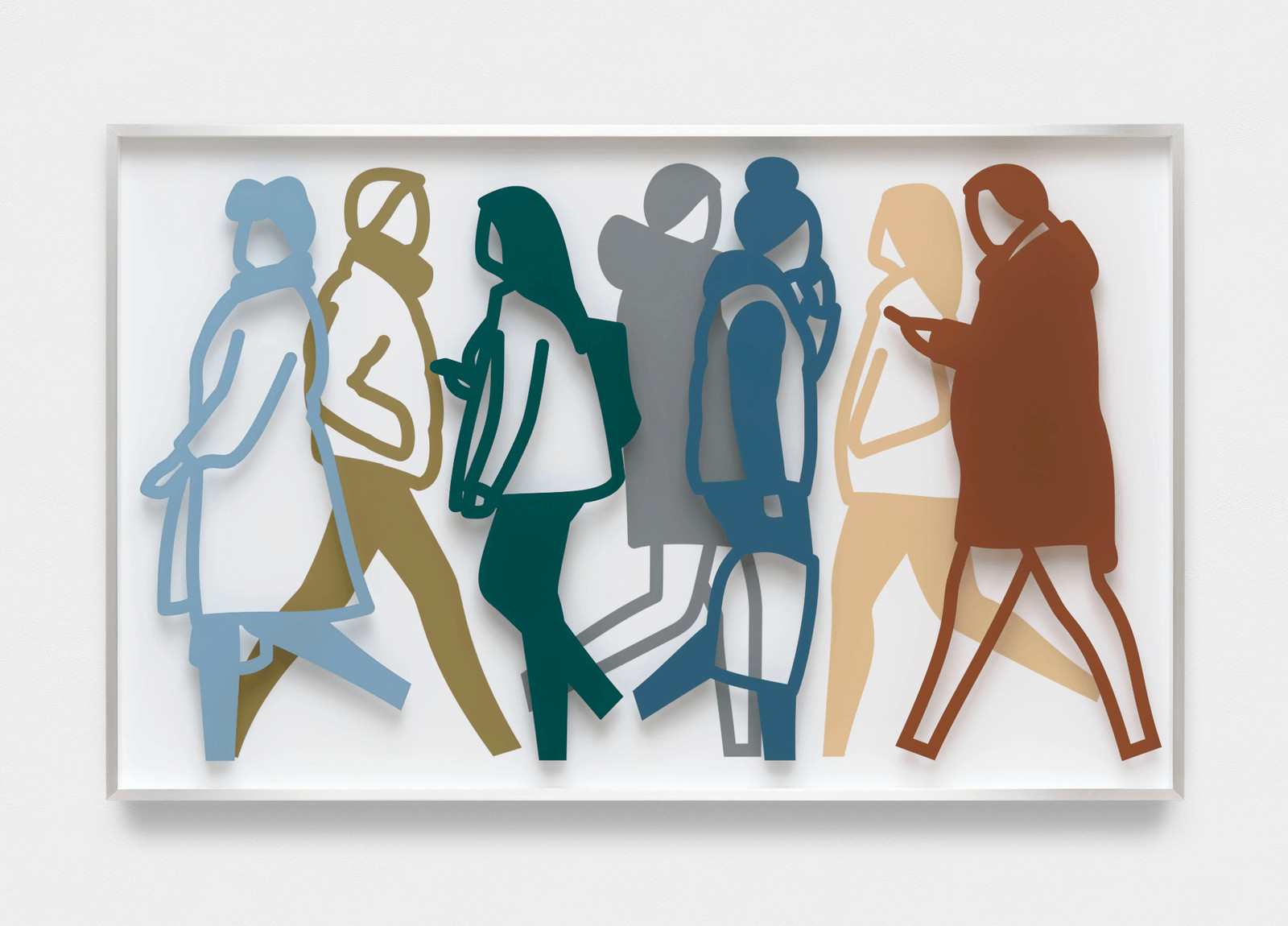
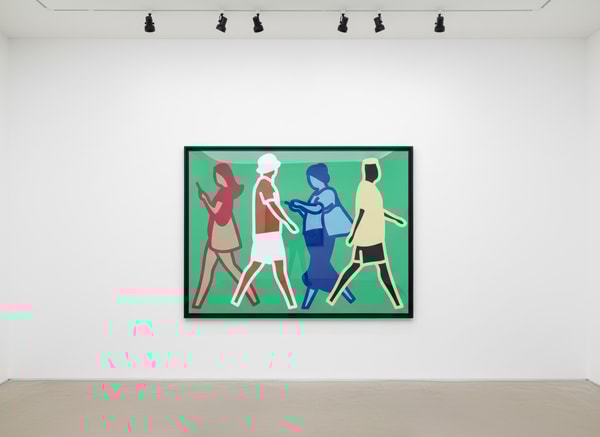
Julian Opie Walking in Busan 1 For Sale

Julian Opie
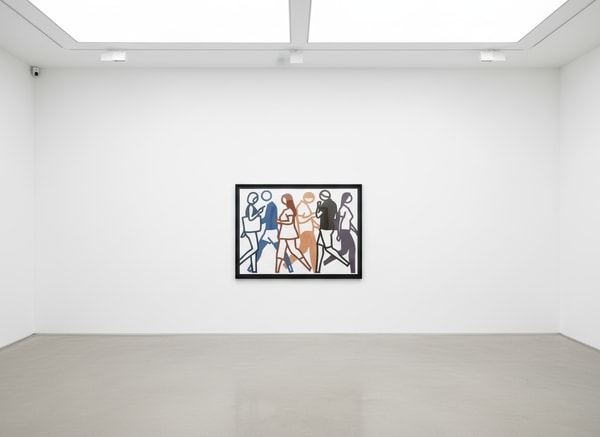
Julian Opie - Walking in Busan 1, 2023, Auto paint on aluminum

Walking in Busan 1, 2023

Auto paint on aluminum

82 5/8 x 114 1/8 in 210 x 290 cm

About this work

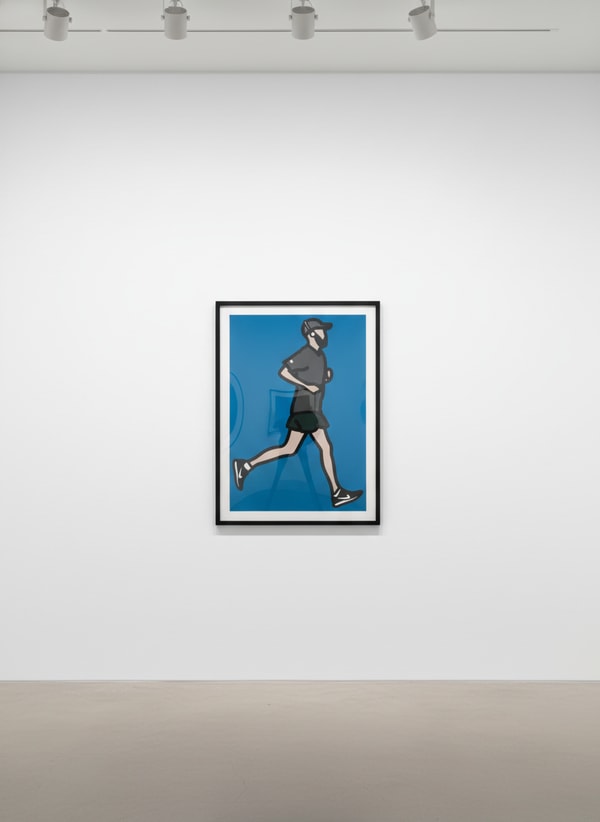
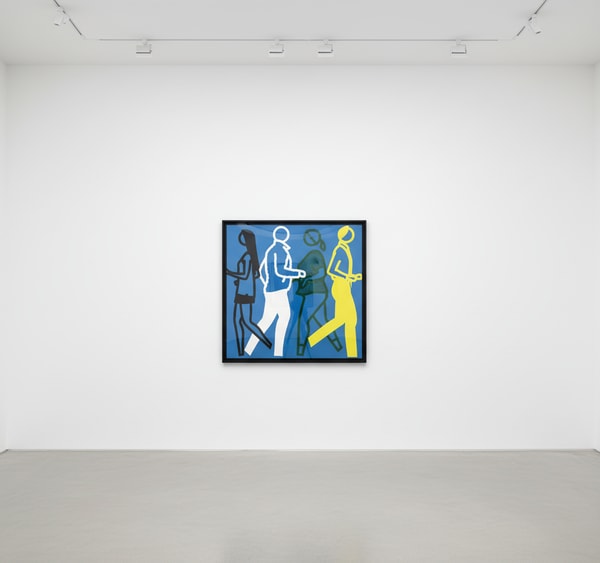
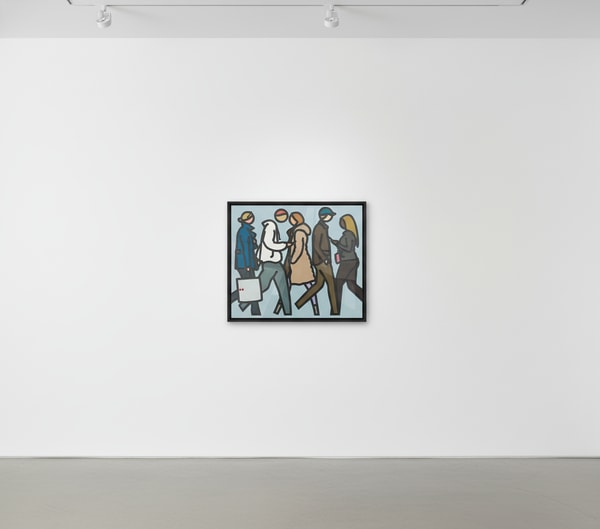
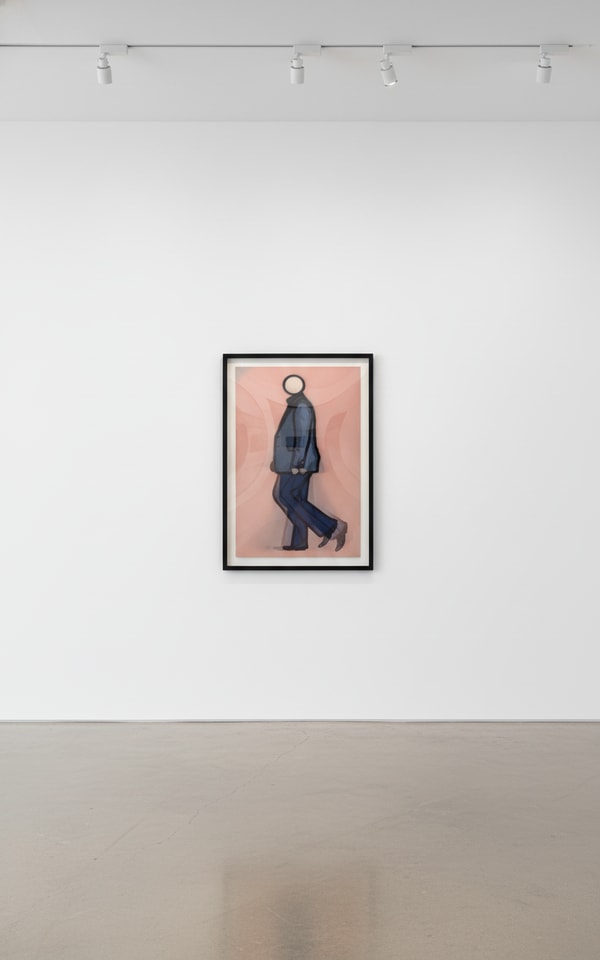
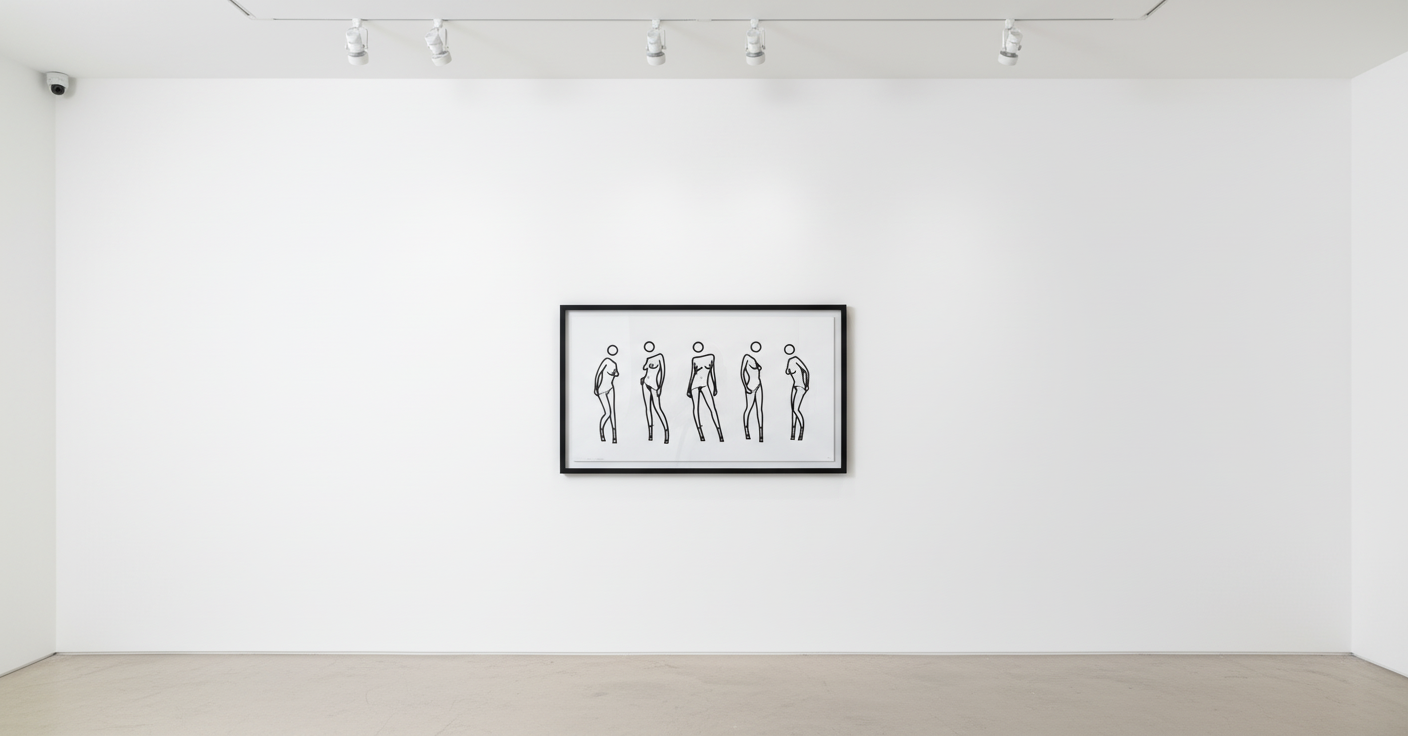
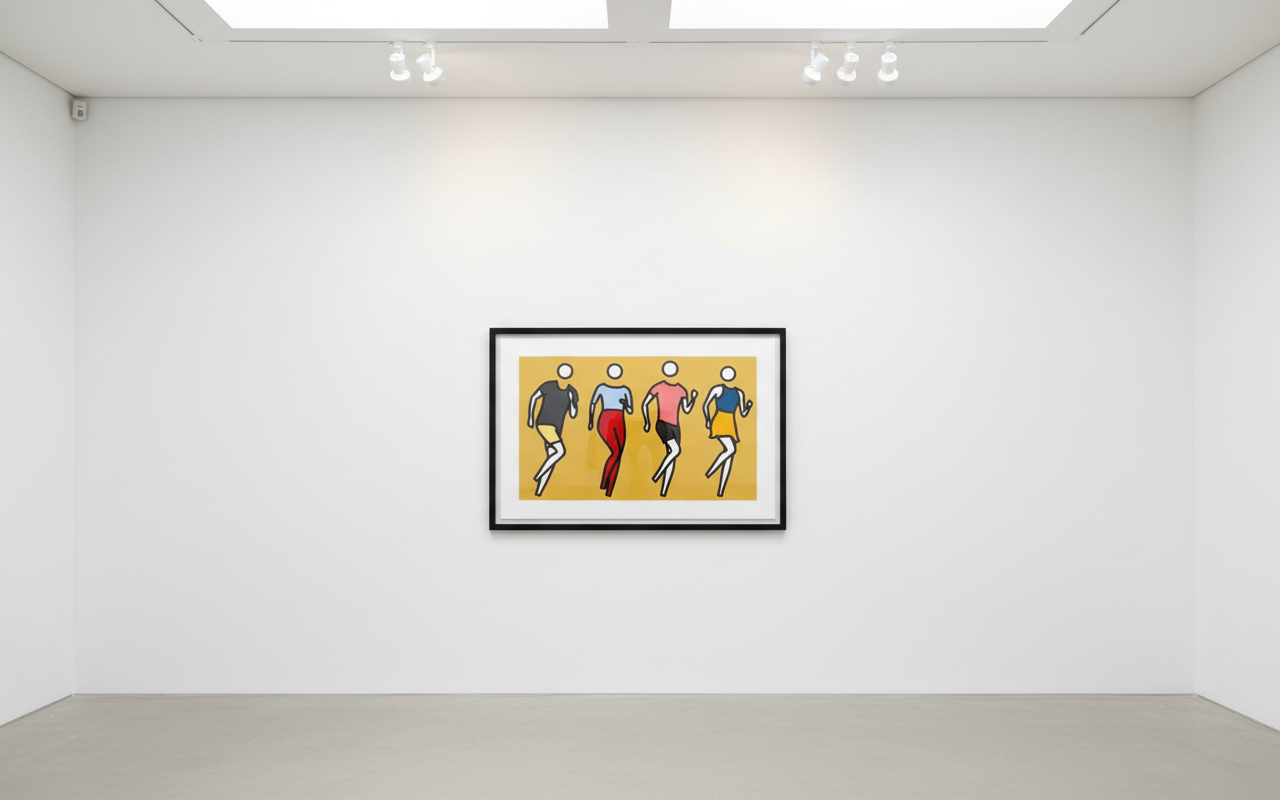
**Walking in Busan 1** This large-scale work presents a rhythmic procession of simplified human figures against a vivid teal background, characteristic of Opie's distinctive visual language. Created using auto paint on aluminum, the piece demonstrates the artist's mastery of industrial materials to achieve a smooth, graphic surface. The figures are rendered in bold black silhouettes with minimal detail, their repetitive stride creating a sense of urban movement and contemporary life. The technique produces a luminous, screen-like quality that bridges traditional painting and digital aesthetics. Opie's work continues to be highly sought after by major collectors and institutions worldwide for its immediate accessibility combined with conceptual depth. This 2023 piece represents the artist's ongoing exploration of movement and modern urban experience, themes central to his internationally recognized practice. The substantial scale and striking palette make it an ideal statement work for prominent residential or corporate collections. Available for purchase — enquire for price and availability.

Price on Application
Auction History

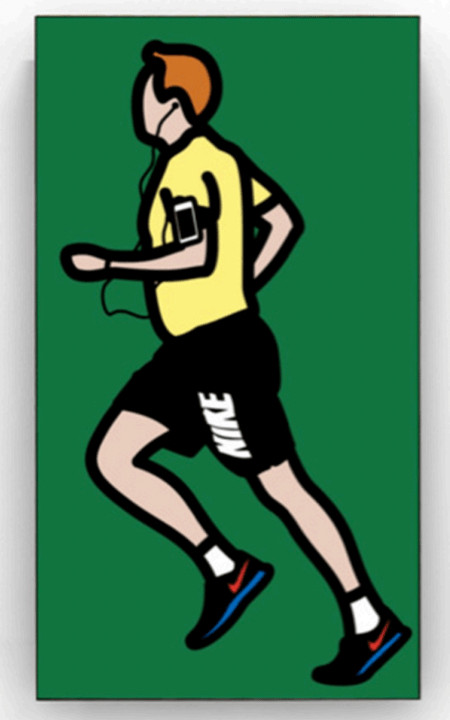
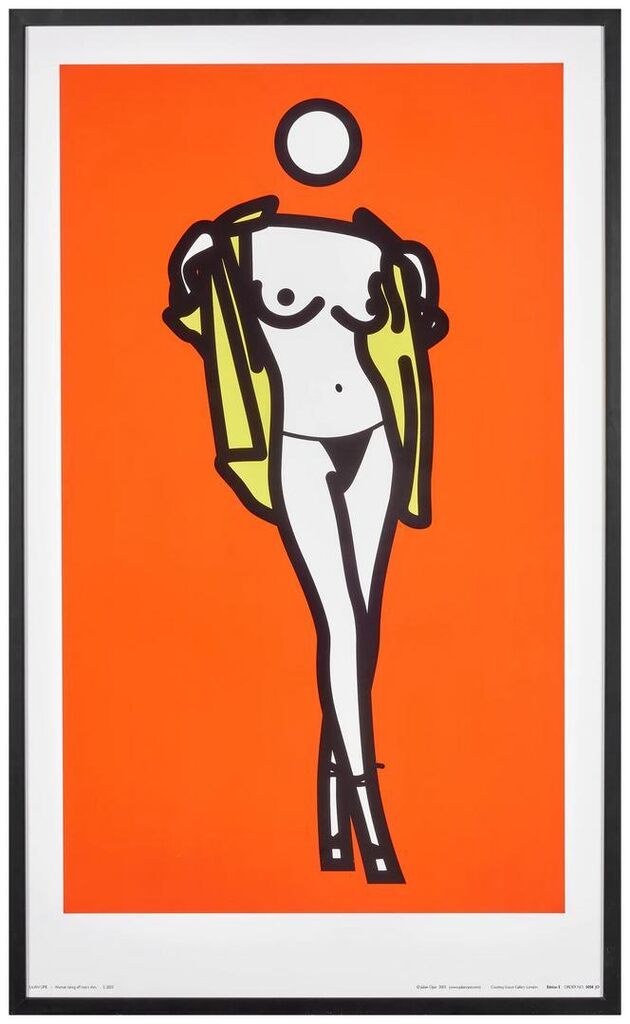
Julian Opie - Woman Taking Off a Man's Shirt 5

Woman Taking Off a Man's Shirt 5 · Julian Opie · Artcurial · 2025-05 · $4,377
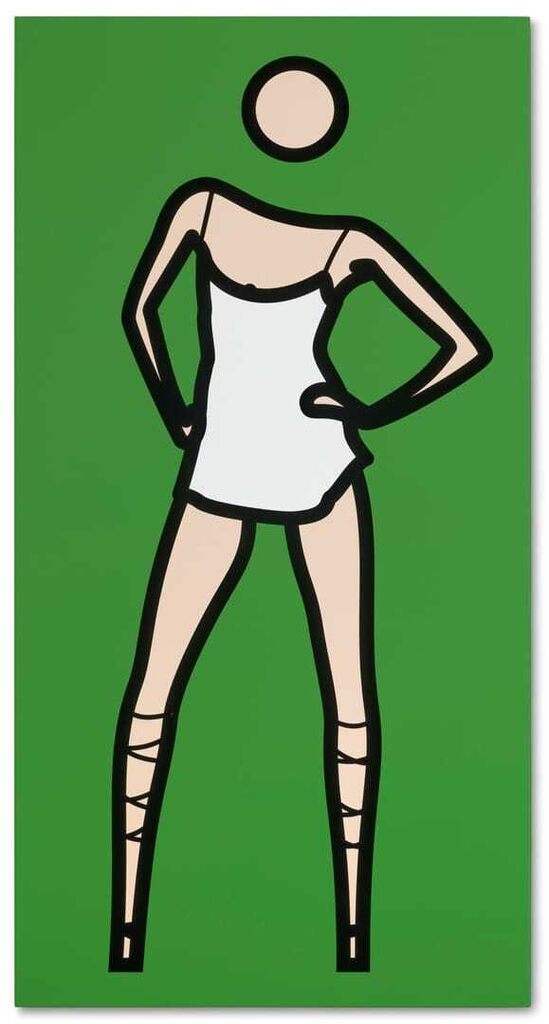
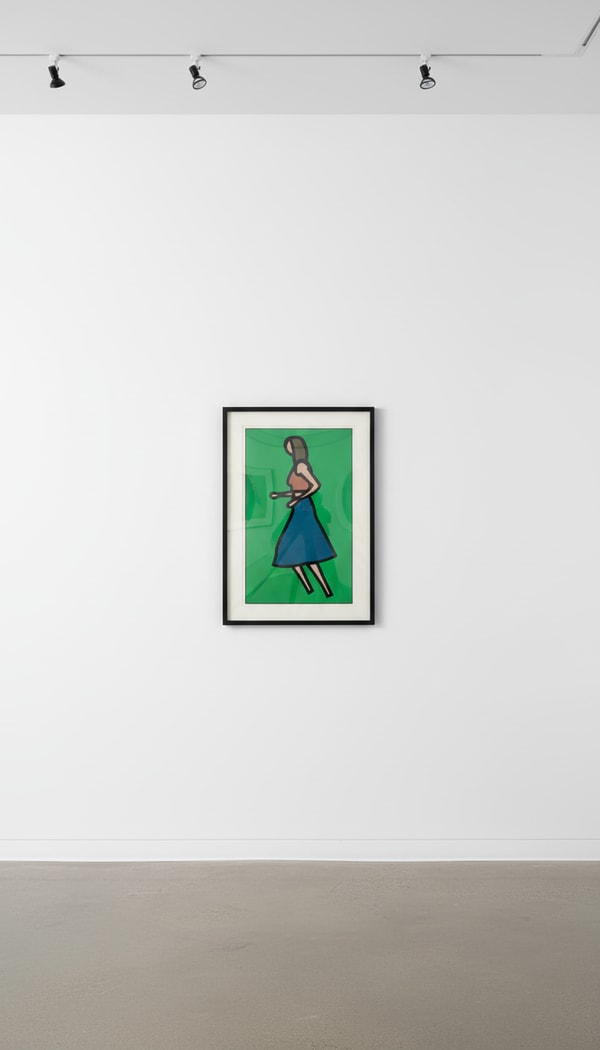
Julian Opie - Shahnoza dancing in white dress, right

Shahnoza dancing in white dress, right · Julian Opie · Christie's · 2026-03 · $55,011
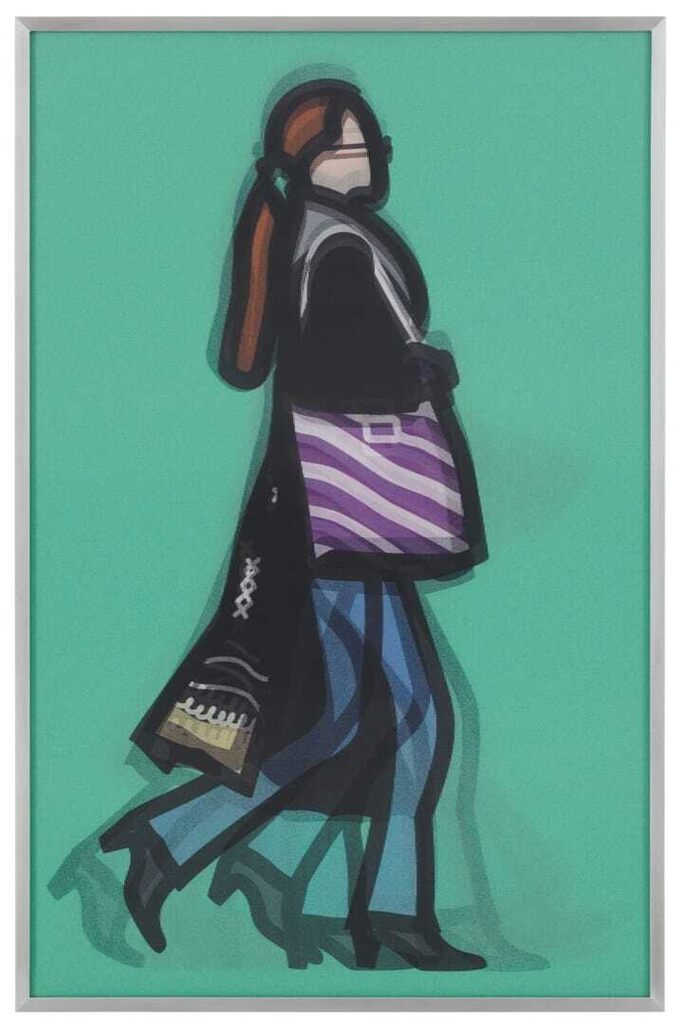
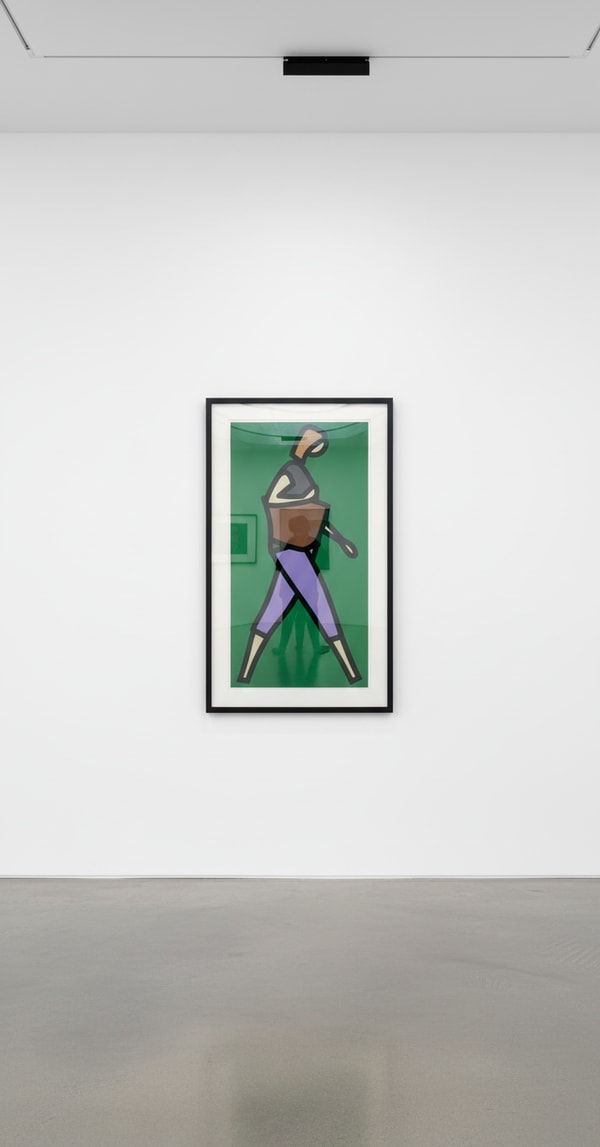
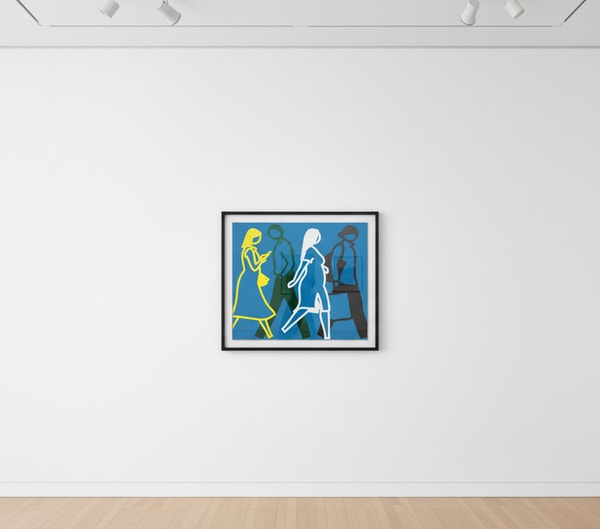
Julian Opie - Musician, from Walking in London 2

Musician, from Walking in London 2 · Julian Opie · Christie's · 2026-02 · $16,510
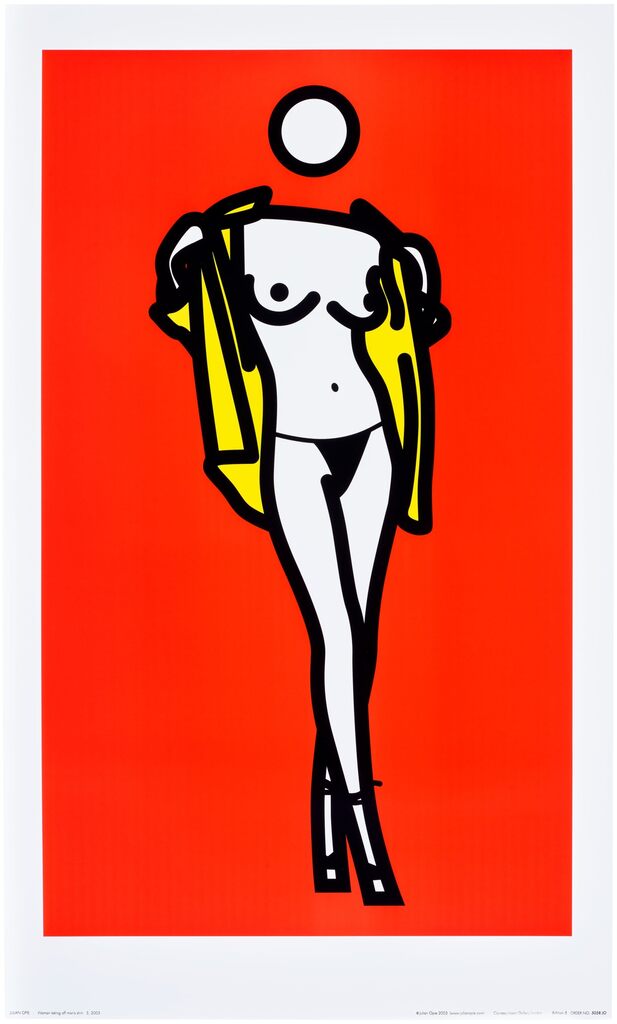
Julian Opie - Woman Taking Off Man's Shirt

Woman Taking Off Man's Shirt · Julian Opie · Phillips · 2026-01 · $2,277
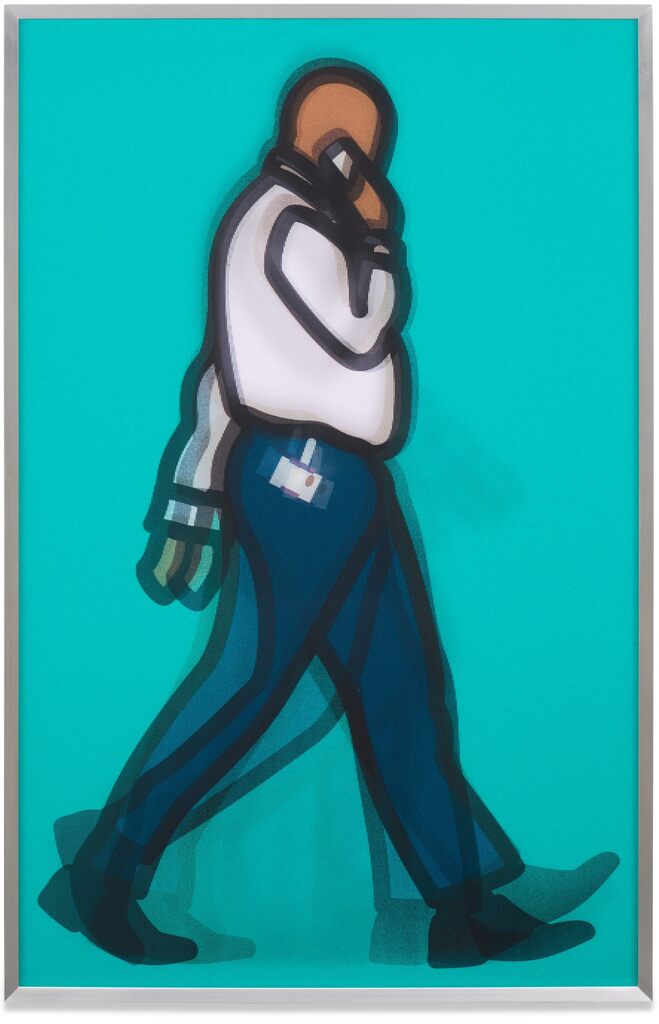
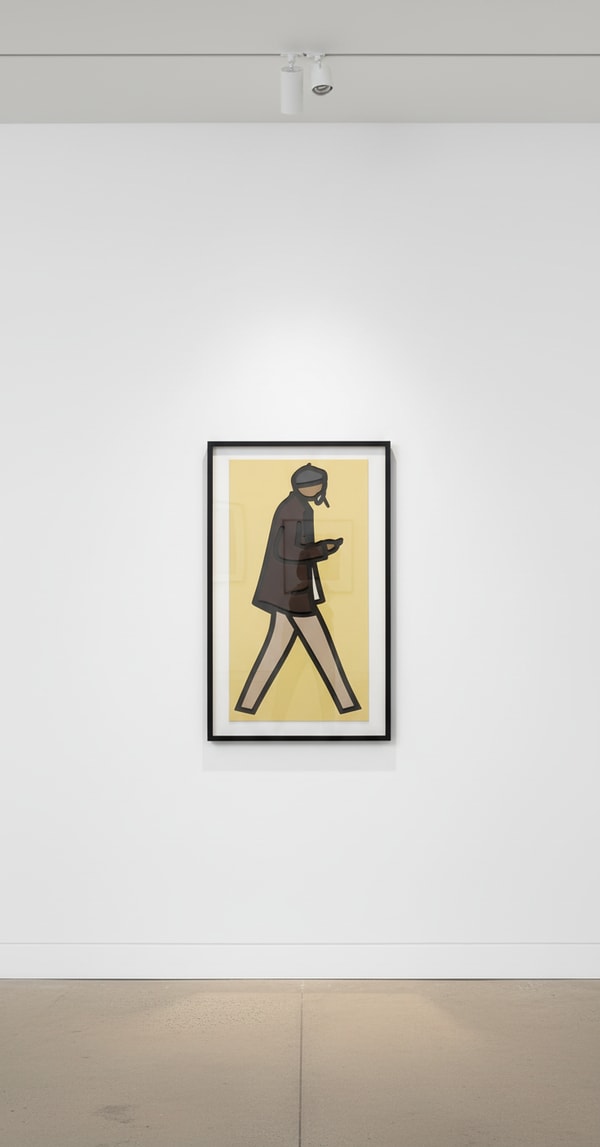
Julian Opie - Detective, from Walking in London 1 (C. 259)

Detective, from Walking in London 1 (C. 259) · Julian Opie · Phillips · 2026-01 · $16,571
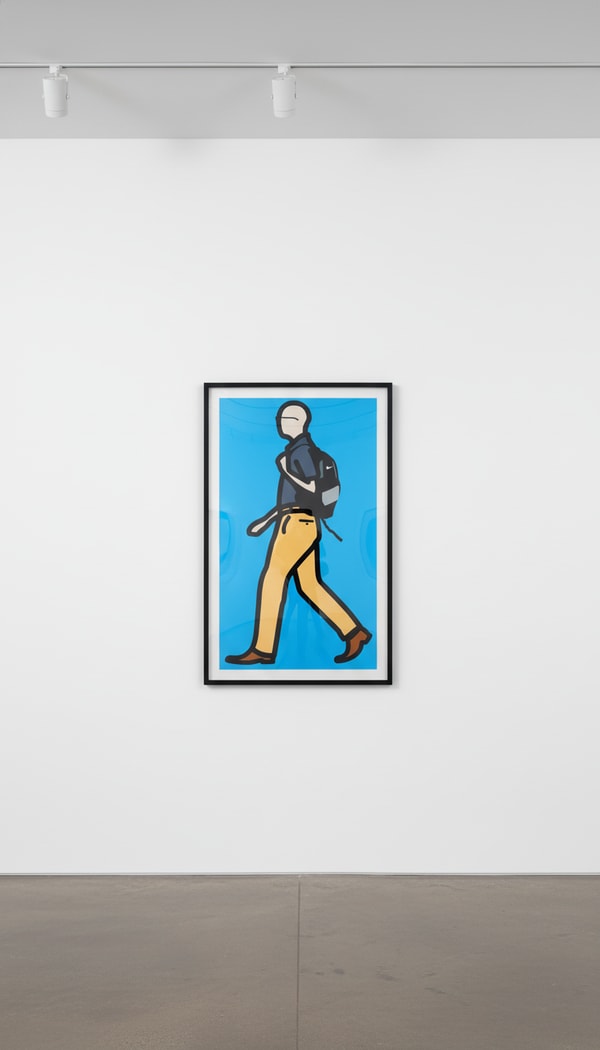
More from this series

More series by Julian Opie

About the Original Works Series

Julian Opie's "Original Works" series represents the artist at his most refined and immediate, offering collectors an exceptional opportunity to acquire pieces that embody the full spectrum of his distinctive visual language. Throughout a career spanning more than four decades, Opie has developed an unmistakable aesthetic that distills the complexity of contemporary existence into bold, graphic forms that feel simultaneously ancient and urgently modern. This carefully curated collection brings together works that demonstrate why Opie has become one of the most recognizable and influential figures in contemporary art, with each piece serving as a testament to his extraordinary ability to capture the essence of human presence and urban experience through radical simplification.

What distinguishes this particular series within Opie's broader practice is its focus on original works that showcase the artist's direct engagement with his subjects, from the intimate portraiture of pieces like "Diamond Earring" and "This Is Keira 03" to the dynamic urban observations captured in "Walking in Busan 1" and "Walking in New York 6." These are not reproductions or editions but singular artistic statements that carry the full weight of Opie's creative vision. The portraits in this collection exemplify his signature approach to human representation, where faces are rendered with an economy of means that paradoxically intensifies rather than diminishes their individuality. In "Diamond Earring," for instance, the subject emerges through Opie's characteristic reduction of features to essential lines and shapes, yet the personality and presence of the individual remains powerfully intact, a quality that has made his portraits so compelling to collectors and institutions worldwide.

The urban landscape works within this series, including "Old Street August 12" and "Old Street June 3," reveal Opie's ongoing fascination with the built environment and its relationship to those who inhabit it. Old Street, situated in the heart of London's creative district, becomes in Opie's hands a study in geometric harmony and chromatic clarity. These works strip away the visual noise of contemporary city life to reveal underlying structures and rhythms that typically escape conscious attention. The specificity of the titles, anchoring each work to a particular moment in time, introduces a documentary dimension that enriches the formal qualities of the images. Opie transforms the mundane into the monumental, inviting viewers to reconsider spaces they might otherwise pass through without notice.

The walking figures that appear throughout this collection represent perhaps Opie's most iconic contribution to contemporary visual culture. Works such as "Walking in Busan 1" and "Walking in New York 6" continue his celebrated exploration of human movement, depicting anonymous pedestrians captured mid-stride with a fluidity that belies the apparent simplicity of his technique. These figures, rendered in flat planes of color bounded by bold black outlines, recall everything from ancient Egyptian reliefs to contemporary digital animation, yet they remain distinctly of their moment. Opie's walkers have appeared on album covers, public installations, and museum walls around the world, yet each original work retains a singular presence that mass reproduction cannot replicate. The choice of locations spanning from South Korea to New York underscores the universality of Opie's vision while acknowledging the subtle differences in posture, dress, and attitude that distinguish one urban population from another.

"Academic 2" and "Big Bag" further demonstrate the range contained within this series, with each work approaching its subject through Opie's distinctive lens of simplification and clarification. Whether depicting a scholarly figure or focusing on the everyday object of a bag, Opie applies the same rigorous attention to form and color that characterizes his most ambitious projects. This democratic approach to subject matter, treating the ordinary with the same formal seriousness typically reserved for traditional artistic subjects, has been central to Opie's practice since his emergence in the 1980s London art scene alongside contemporaries who would come to define the YBA generation. Yet unlike many of his peers, Opie has remained committed to a visual language that prioritizes accessibility without sacrificing intellectual depth.

The works gathered in this series share a quality of quiet intensity that rewards extended viewing. What initially appears straightforward reveals increasing complexity upon sustained attention, as viewers begin to appreciate the precision of Opie's color choices, the subtle variations in line weight, and the careful compositional decisions that govern each piece. His art operates at the intersection of representation and abstraction, figuration and design, fine art and popular culture. This liminal position has made Opie's work particularly resonant in an age saturated with images, offering a mode of seeing that cuts through visual clutter to arrive at something essential and enduring.

Guy Hepner is pleased to offer collectors in New York and beyond the opportunity to acquire works from Julian Opie's "Original Works" series, and interested parties are invited to inquire directly for availability, pricing, and additional information about bringing these exceptional pieces into their collections.

View full series →
Walking in Busan 1

About Julian Opie

Julian Opie (b. 1958, London) is one of the most recognisable and widely exhibited British artists of his generation, a painter, sculptor, and printmaker whose stripped-back figurative language has achieved both the commercial viability of design and the conceptual seriousness of fine art — a combination that few artists of any era have managed with equal confidence. Opie studied at Goldsmiths College under Michael Craig-Martin, graduating in 1982, and was representing by a major London gallery almost immediately. He has been a significant presence in the international art world for over four decades.

Opie's visual language is built from a small number of radical formal decisions: bold black outlines, flat unmodulated colour fields, the elimination of shadow, texture, and incidental detail, and a scale and graphic authority that draws openly on Egyptian hieroglyphics, Japanese woodblock printing, public signage, and the simplified conventions of digital interfaces. The result is a style of immediate recognisability — when you encounter a Julian Opie figure, you know it instantly — that nonetheless contains real formal thought about how images communicate, how representation functions, and what remains when almost everything is removed. His Walking Figures series, in which anonymous pedestrians in continuous motion are rendered in his signature distilled vocabulary and presented as both print editions and LED wall sculptures, has become one of the most compelling ongoing investigations in contemporary art into the relationship between the ancient idea of the frieze, the vernacular language of the public sign, and the aesthetic possibilities of the LED screen.

In 2000, Opie created the cover artwork for Blur's Best Of compilation — four simplified band portraits in his trademark style — bringing his visual language to an audience of millions and cementing his profile as an artist operating meaningfully across the boundary between fine art and popular culture. His portrait series, his landscape works, and his permanent public installations — including major commissions at Queen Elizabeth Olympic Park in London — extend the reach of his practice into civic and architectural contexts. At the major auction houses, significant Opie works have traded in the £200,000–£500,000 range at Christie's and Sotheby's, while his print editions range from thousands to tens of thousands of pounds, providing entry points across a wide spectrum of collector budgets. His work is held in the Tate Collection, among other public institutions.

His media range is notably broad: silkscreen prints, vinyl paintings, LED panels, lenticular works, and public sculptures are all produced with equal technical rigour and formal clarity.

Guy Hepner maintains strong inventory and expertise in Julian Opie's print editions and LED works. Our gallery at 177 Tenth Avenue, New York offers collectors expert guidance on acquisition and valuation. We provide free, confidential valuations for those looking to sell Opie works and active connections to buyers engaged with this market.
View all works →