Basketball

August 18, 2026
When Jonas Wood prints began commanding six-figure results at auction in 2021, seasoned dealers barely raised an eyebrow. Those who had watched his trajectory from the beginning—from small Los Angeles group shows to museum retrospectives at MOCA and the Dallas Museum of Art—understood that something fundamental had shifted in how contemporary collectors valued graphic work. Here was an artist whose screenprints and lithographs weren't diminished echoes of his paintings but fully realized statements in their own right, works that translated his obsessive vision of domestic life with startling fidelity. The question was no longer whether Jonas Wood art belonged in serious collections, but rather which works to pursue and how to navigate an increasingly competitive market.
This guide is written for collectors who recognize that opportunity. Whether you're encountering Wood's plant-filled Interiors for the first time or seeking to deepen an existing collection with rare states and variants, understanding his practice—its sources, its techniques, its internal logic—makes all the difference between acquiring thoughtfully and buying blind.
Jonas Wood was born in Boston in 1977, but his artistic sensibility belongs entirely to Los Angeles, where he has lived and worked since completing his MFA at the University of Washington in 2002. His undergraduate degree, notably, was in psychology from Hobart and William Smith Colleges—a detail that feels significant when you consider how carefully his paintings attend to the emotional temperature of domestic spaces. Before there were plants and Pots and Basketball courts, there was an observer training himself to notice what most people overlook.
The move to LA proved decisive. Wood arrived in a city where design consciousness permeates everyday life, where midcentury architecture and contemporary art exist in easy conversation, where the quality of light through a kitchen window becomes a legitimate subject for sustained attention. He found his way into a community of artists—including his wife, the ceramicist Shio Kusaka—who shared his commitment to craft and his resistance to the conceptual posturing that dominated art schools of the period. Los Angeles gave Wood permission to be earnest about beauty.
His working method emerged gradually. Photographs became essential early on—not as documentation but as raw material for collage-based studies in which images get broken apart and reassembled. Wood might start with an iPhone snapshot of his studio corner, combine it with an old magazine clipping of a fern, add his daughter's drawing from the refrigerator, and slowly construct a composite scene that feels both invented and deeply familiar. The process mirrors memory itself: selective, recombinant, faithful in spirit if not in fact.
Jonas Wood paints what he loves—and what he loves is everywhere around him. The interior of his Culver City studio. The ceramic pots Shio Kusaka shapes by hand. Houseplants scaled to absurd, joyful proportions. Basketball courts remembered from a Boston childhood spent shooting hoops with his brother. Tennis courts observed during family vacations. The intimacy of these subjects distinguishes Wood from artists who treat domesticity ironically. There's no distance in his work, no postmodern air quotes around the pleasures of home.
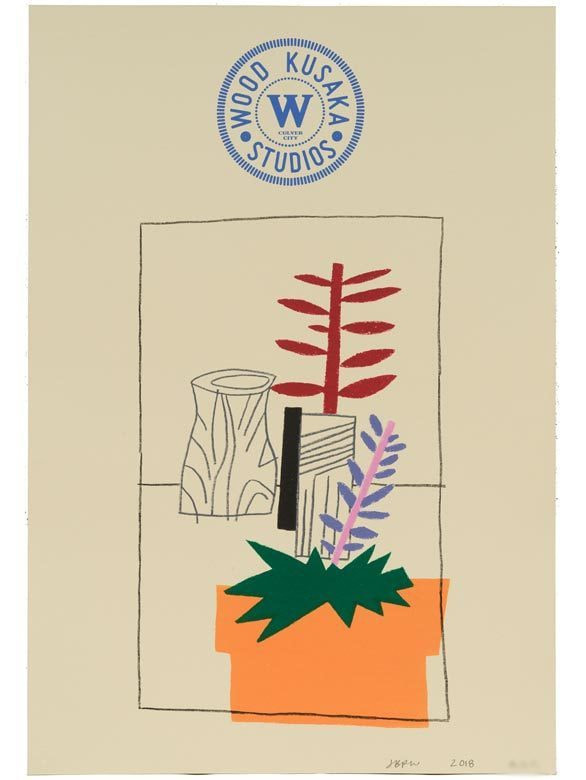
The Jonas Wood pots that appear throughout his paintings and prints are almost exclusively Kusaka's work, transforming his images into love letters that document a creative partnership. When Wood paints a shelf crowded with striped vessels and checkered bowls, he's also painting years of marriage, shared studio visits, conversations about glaze chemistry. The pots function simultaneously as formal elements—their patterns activating the surface, their curves punctuating rectilinear compositions—and as biographical markers, specific objects with specific histories.
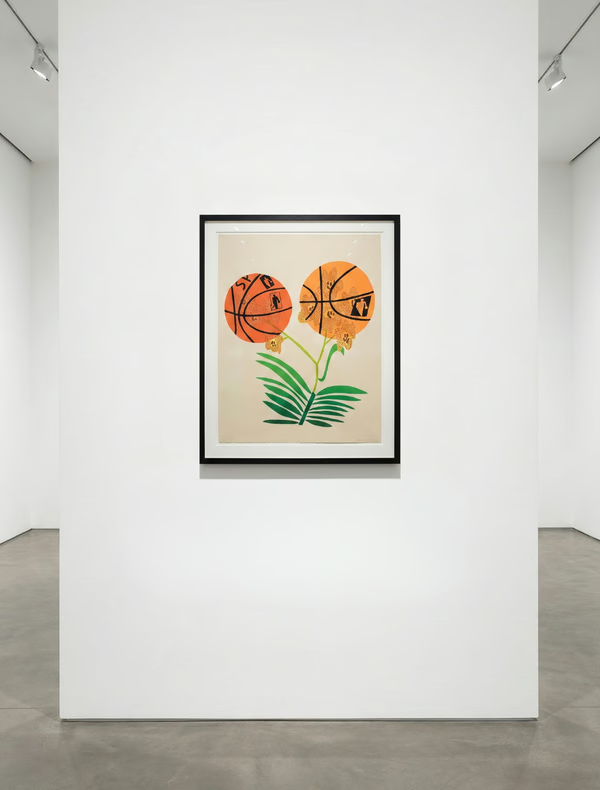
Jonas Wood, Double Basketball Orchid (State I), mixed media. Available at Guy Hepner, New York.
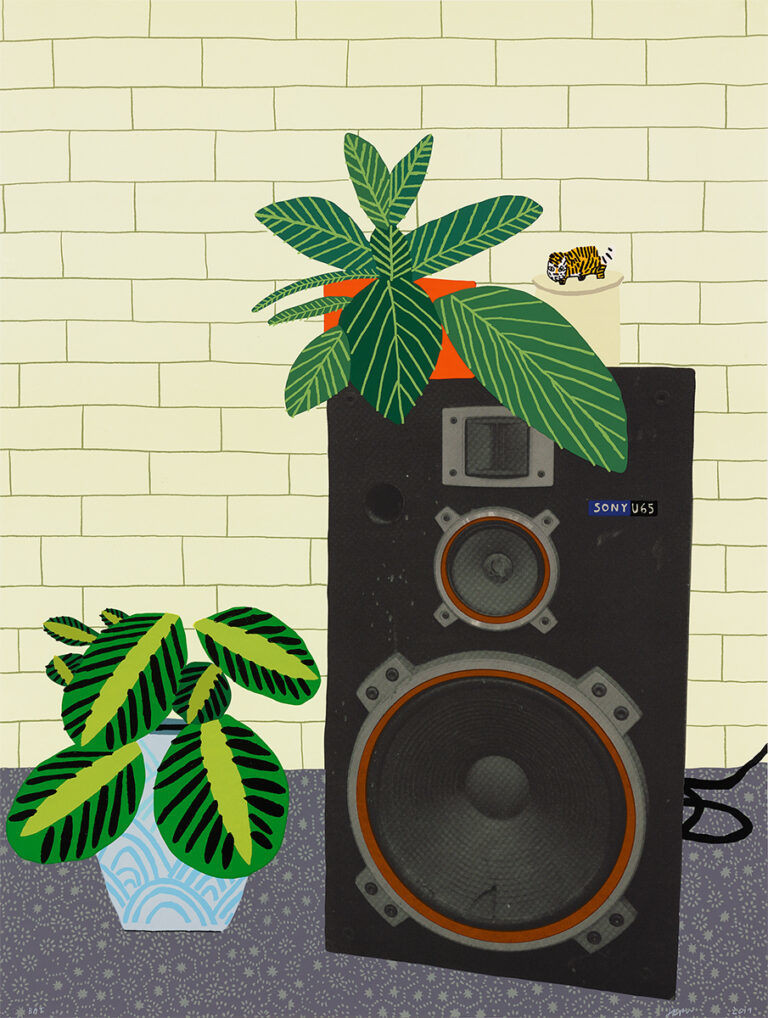
Jonas Wood plants deserve particular attention because they reveal his formal intelligence at its sharpest. A simple rubber tree becomes, in Wood's hands, a cascade of overlapping ellipses, each leaf a distinct color slightly shifted from its neighbors. A bird of paradise explodes into architectural geometry. These aren't botanical illustrations—Wood has no interest in taxonomic accuracy—but rather studies in how flat shapes can conjure volume, how pattern can generate depth without conventional modeling. The debt to Matisse is obvious and openly acknowledged, but Wood pushes further into abstraction while maintaining the legibility of his subjects.
The Jonas Wood interiors expand this logic to encompass entire rooms. Kitchen scenes, living rooms, studio corners become stages where every object contributes to an intricate visual rhythm. A checkered tablecloth rhymes with a ceramic vessel's stripes; a window frame echoes a picture frame on the adjacent wall; houseplant leaves create syncopated patterns against flat backgrounds. Wood's psychology training may explain his sensitivity to how we actually experience domestic space—not as a neutral container but as an accumulation of chosen things, each carrying its own emotional weight.
For many contemporary painters, printmaking is an afterthought—a way to generate accessible inventory between major exhibitions. Jonas Wood approaches his editions with entirely different intentions. Working with master printers at Tamarind Institute, Gemini G.E.L., and especially Mixografía, he treats each project as an opportunity to push technical boundaries while maintaining the visual density of his paintings.
The numbers tell part of the story. A Jonas Wood lithograph might involve twenty-five separate color runs, each requiring perfect registration. A Jonas Wood screenprint builds up thirty or more layers of ink, creating a surface that rewards close inspection in ways a photographic reproduction cannot suggest. These are works produced over months of collaboration with printmakers, with Wood present for proofing sessions, adjusting colors, approving states. The care shows.
Mixografía deserves special mention because the Los Angeles workshop developed techniques specifically suited to Wood's aesthetic goals. Their proprietary cast-paper process creates raised surfaces that give his flat forms an unexpected tactile dimension. Running your hand across a Mixografía Wood—something collectors are generally advised not to do, but the temptation is real—you feel the boundary between media categories dissolving. These are neither prints nor reliefs but something genuinely hybrid.
The most sought-after Jonas Wood editions often exist in multiple states, each representing a distinct stage in the proofing process. State I of a work might feature colors that were subsequently revised; State II might show the artist's final vision before the full edition was printed. Collectors who understand this hierarchy can pursue variant states as significant works in their own right, not merely study pieces but rather windows into Wood's decision-making process.
Jonas Wood for sale appears across multiple channels, each with its own advantages and risks. Primary market access through his gallery representation—Gagosian for paintings, with prints released through Pace Prints, Karma, and specialized publishers—remains the most desirable path for serious collectors. Waiting lists exist, relationships matter, and patience is rewarded. But the secondary market has become increasingly active, with auction results providing transparent pricing data that illuminates collector appetite.
Jonas Wood auction results over the past five years demonstrate remarkable consistency. While some contemporary artists experience volatile swings—a record-breaking evening sale followed by passed lots the next season—Wood's market shows steady appreciation without the speculation-driven bubbles that eventually correct. His collector base skews toward patient accumulators rather than flippers, which suggests sustainable demand rather than momentum trading.
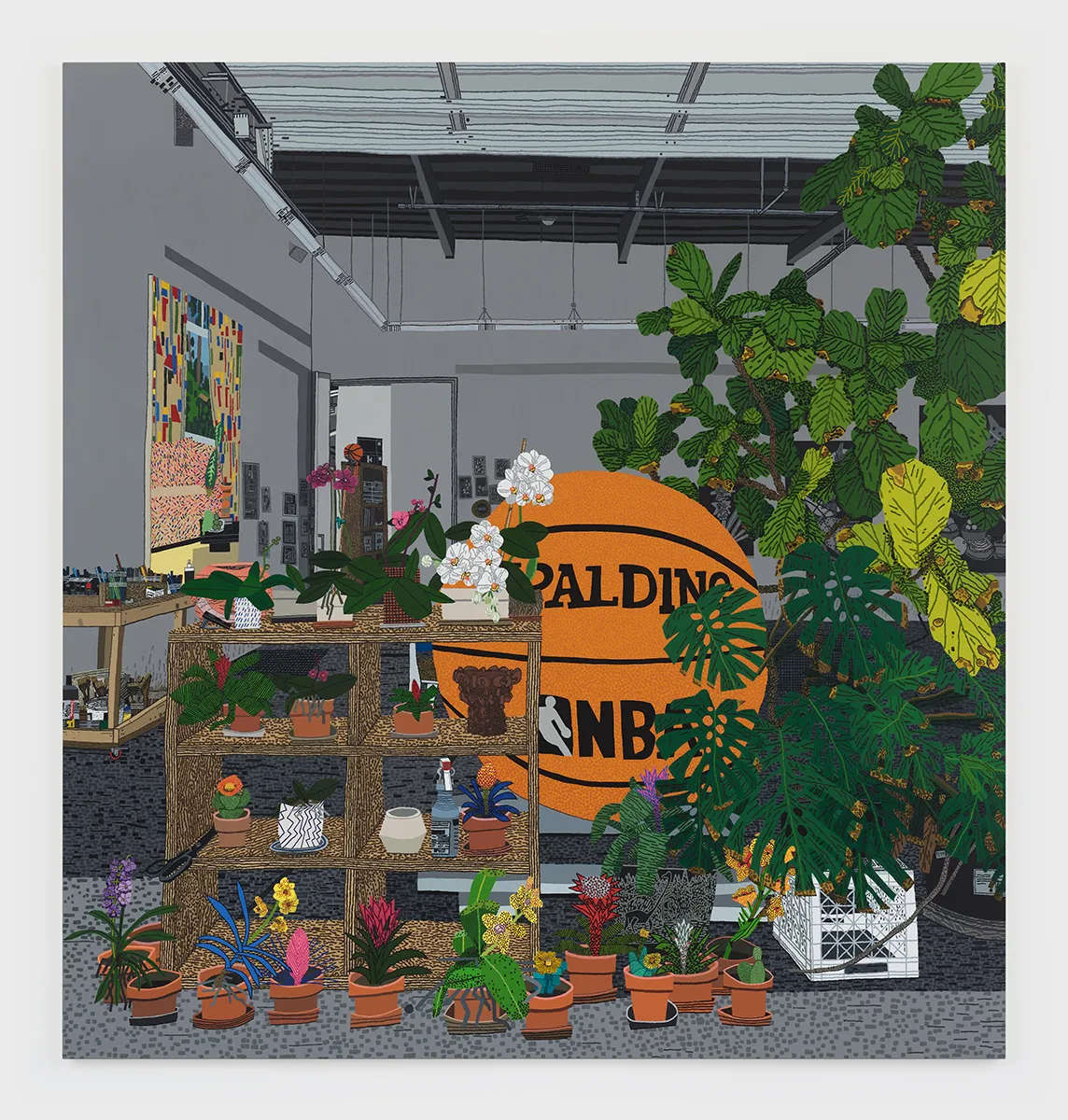
“BBall Studio,” 2021, oil and acrylic on canvas. Photo: Marten Elder
Is Jonas Wood a good investment? The question deserves a careful answer. His work currently occupies an interesting position: established enough to appear in major museum collections (MoMA, the Whitney, the Guggenheim, the Met) but young enough that his career trajectory remains unfinished. Collectors buying today are betting on continued institutional recognition, art historical staying power, and the artist's sustained productivity. Given Wood's disciplined studio practice and his demonstrated ability to evolve while maintaining recognizable vision, these seem reasonable bets—though no one should approach art primarily as a financial instrument.
Jonas Wood edition prices vary significantly depending on complexity, size, publisher, and edition size. A simple lithograph in a larger edition might be accessible around $3,000-5,000, while elaborate multi-color screenprints from major publishers command $15,000-40,000 in the primary market and higher at auction. The Double Basketball Orchid works, which combine his basketball and floral subjects in surreal hybrids, have proven especially desirable. His 8 Pots print and related pot compositions attract collectors who respond to the collaborative dimension of his practice with Kusaka.
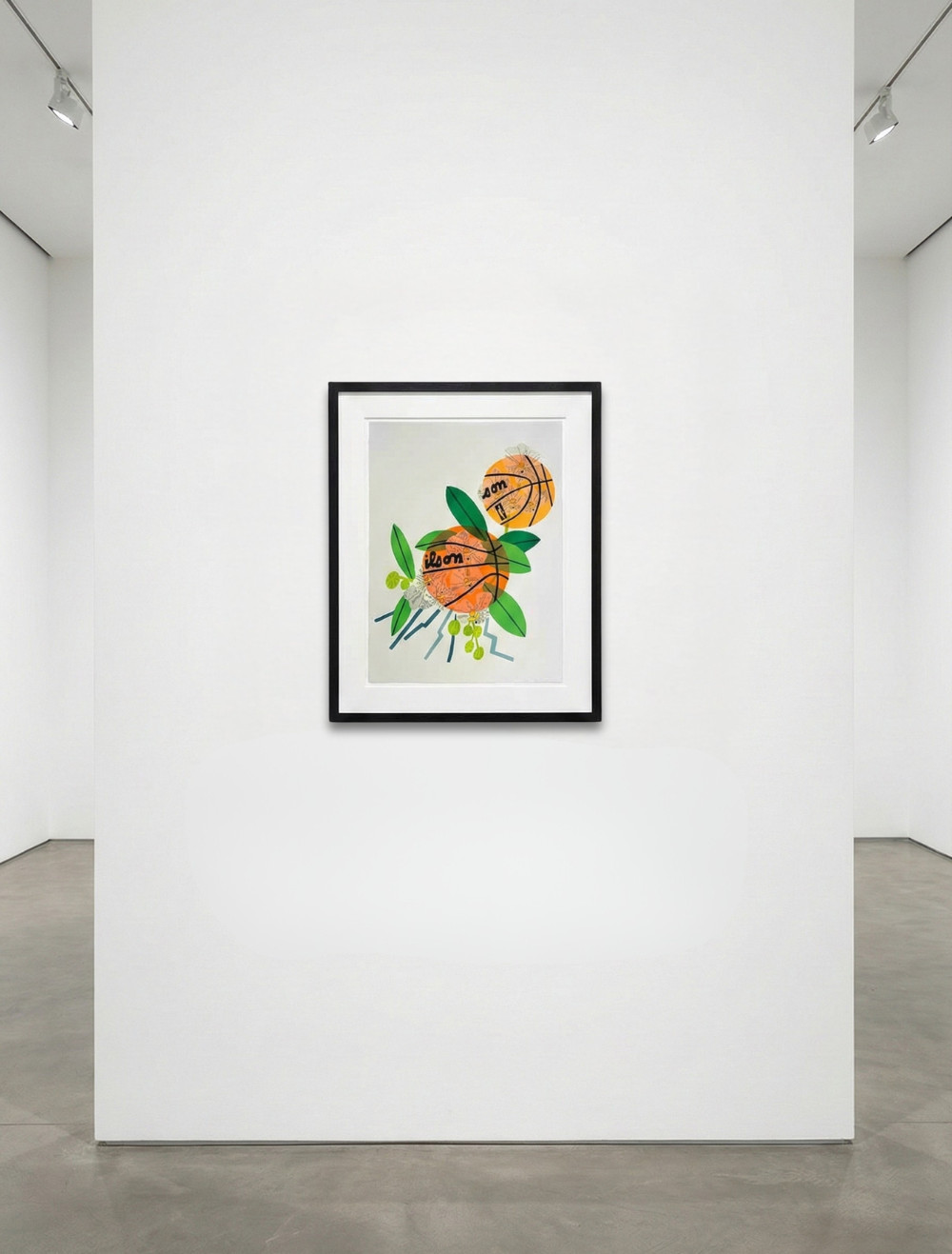
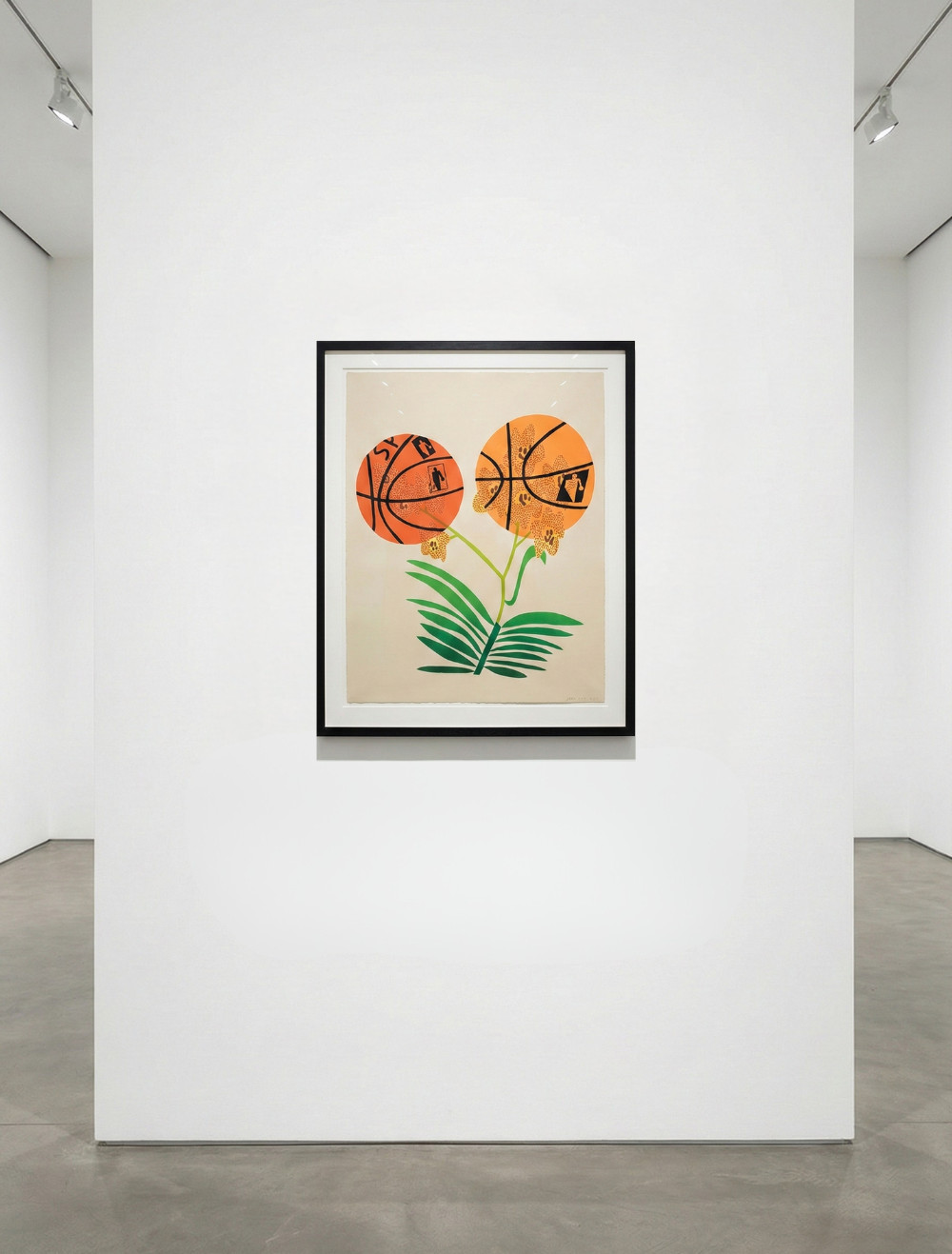
The Jonas Wood basketball orchid represents one of his most distinctive inventions: actual basketballs transformed into flower blooms, sprouting on stems from ceramic pots, their familiar orange surface patterns suddenly botanical rather than athletic. These works bridge his personal history—years of playing and watching basketball—with his present-day attention to houseplants and domestic life. The surrealism is gentle rather than disorienting, funny without being merely jokey.
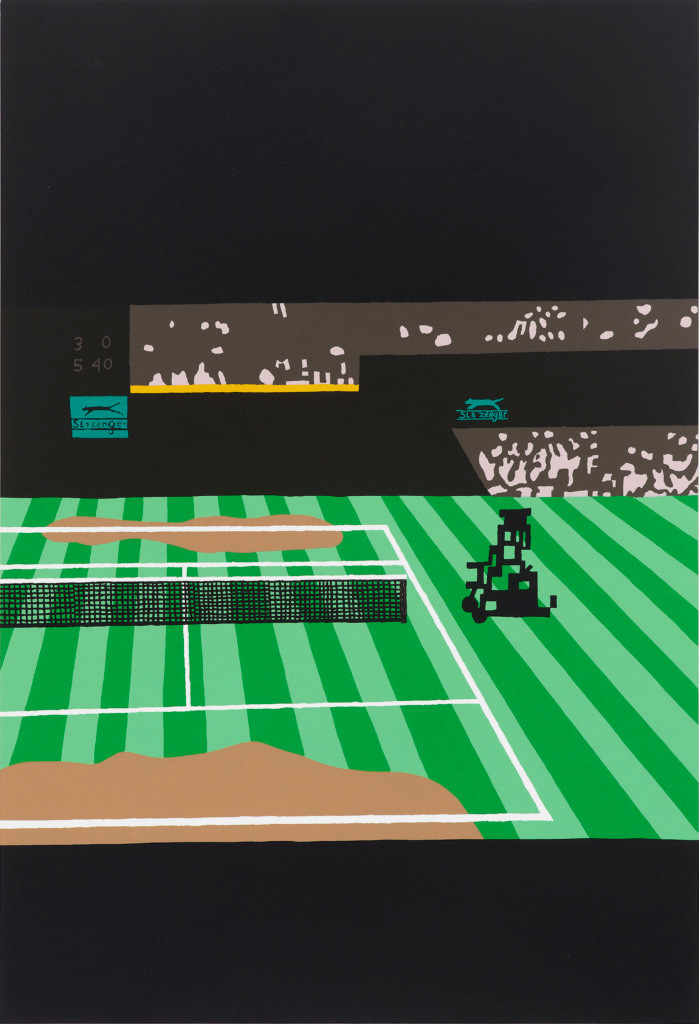
Beyond the hybrid orchids, Wood has produced extensive series devoted to basketball courts and tennis courts viewed from above, their geometric patterns abstracted into near-pure compositions. The Four Majors tennis prints depict Grand Slam courts—Wimbledon's grass, Roland Garros's clay, the hard courts of the US and Australian Opens—each with its distinctive palette and surface texture. Sports fans and design enthusiasts overlap significantly in these works' collector base.
Jonas Wood plant prints encompass everything from modest clippings in jam jars to monumental philodendrons filling entire compositions. The Clippings series, exhibited at Lever House in New York in 2013, established his ability to find grandeur in the most humble subjects—a few snipped stems propped in water become occasions for intricate pattern-making and subtle color relationships. More recent plant works have grown increasingly complex, with multiple species overlapping in compositions that approach horror vacui without tipping into chaos.
Collectors interested in this category should pay attention to the Bonsai works, which add cultural resonance to Wood's botanical interests. His engagement with Japanese aesthetics—evident throughout his work but explicit in the bonsai images—connects to a long history of American artists finding inspiration in Asian visual traditions. The pairing of his work with Shio Kusaka's ceramics in exhibitions further emphasizes this cross-cultural dimension.
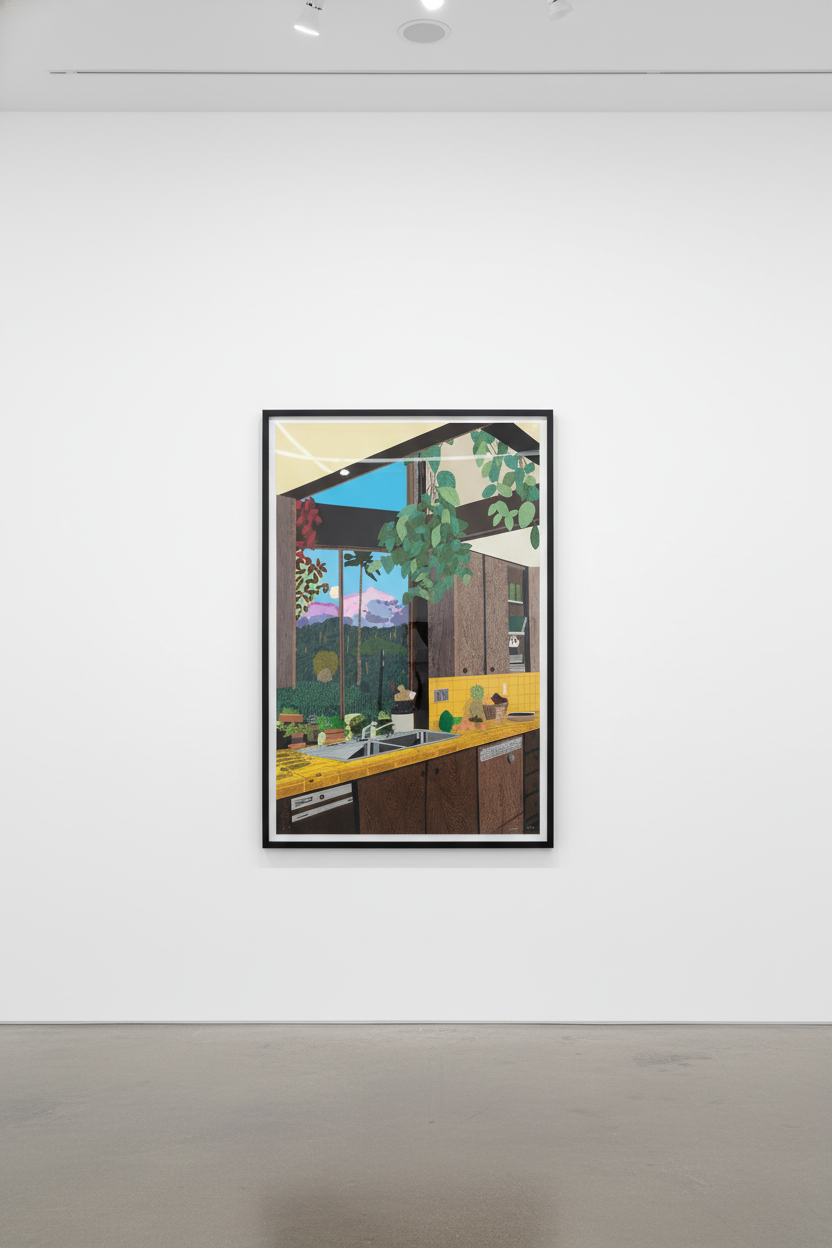
Jonas Wood, Kitchen Interior, archival print. Available at Guy Hepner, New York.
Jonas Wood interiors represent perhaps his most ambitious undertaking: entire rooms rendered as interlocking pattern fields, every surface contributing to visual rhythm. A kitchen view through a window might reveal landscape beyond, creating spatial depth through overlapping planes rather than conventional perspective. These works reward extended looking—there's always another detail to notice, another rhyme between elements across the composition.
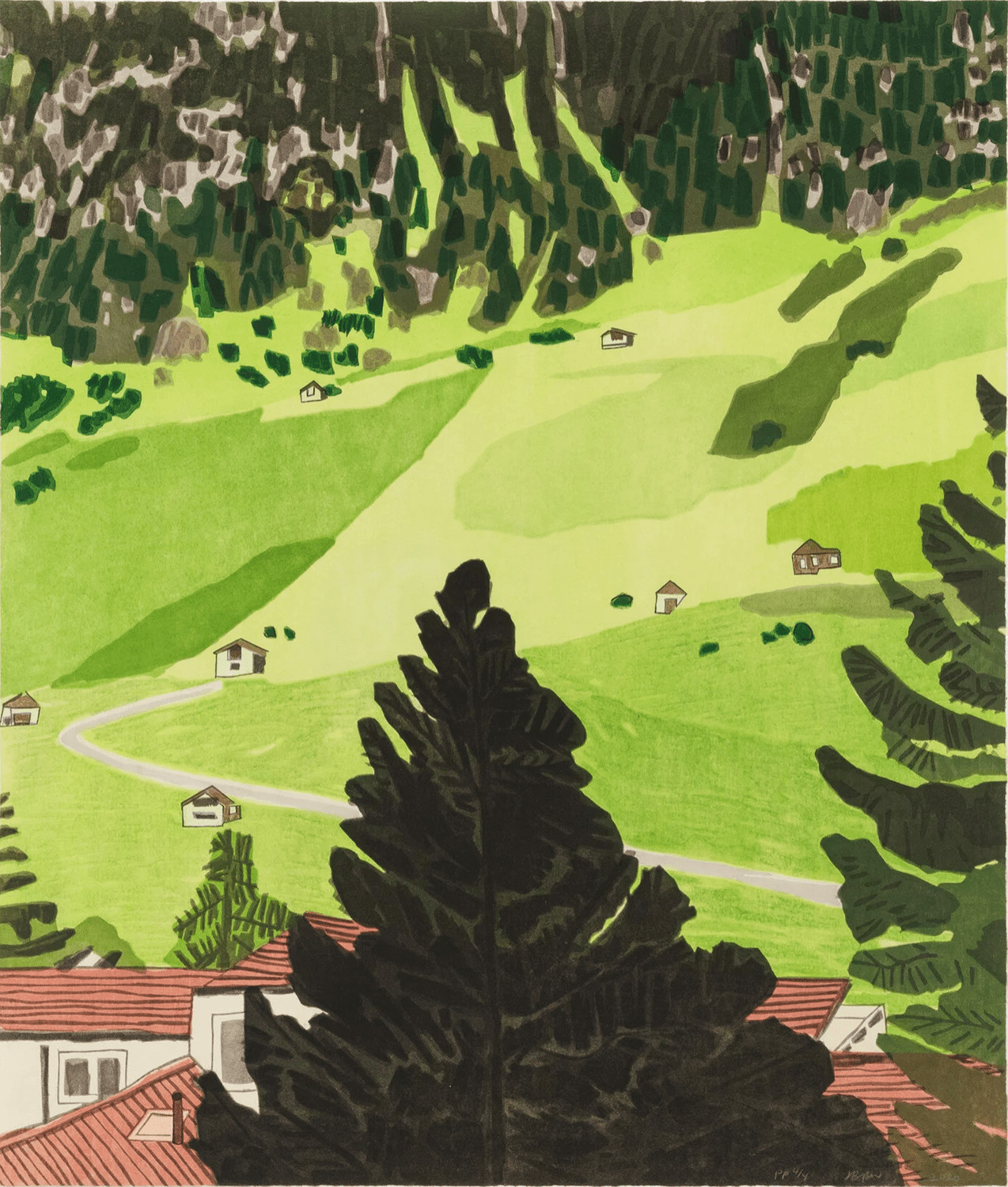
The landscape works proper extend his vision beyond domestic confines. Views through windows, scenes from travel, remembered places from childhood all receive the same flattening, pattern-izing treatment that defines his interiors. The consistency of approach across subjects reinforces the sense that Wood isn't documenting the world so much as translating it into his own visual language.
Given his marriage to Shio Kusaka, it's unsurprising that ceramic vessels appear throughout Jonas Wood's work. But the pots function on multiple levels: as formal elements (their curved shapes punctuating rectilinear compositions), as biographical markers (specific objects from his actual home), and as homage to a parallel artistic practice. The Jonas Wood 8 Pots and similar multi-vessel compositions have proven especially popular with collectors who respond to this layered meaning.
Kusaka's own work has gained significant recognition—her ceramics are held by major museums and command serious prices in their own right. This creates an interesting collecting opportunity: assembling works by both artists allows collectors to document an ongoing creative dialogue. Several institutional collections have pursued exactly this strategy.
The Notepad Doodle series, developed in collaboration with Ed Ruscha, represents Wood's most explicitly process-oriented work. These images depict actual notepad pages covered with small drawings—preliminary sketches, idle marks, the kind of visual thinking that happens in margins. For collectors interested in artistic process, the Notepad Doodles offer unusual access to Wood's generative methods.
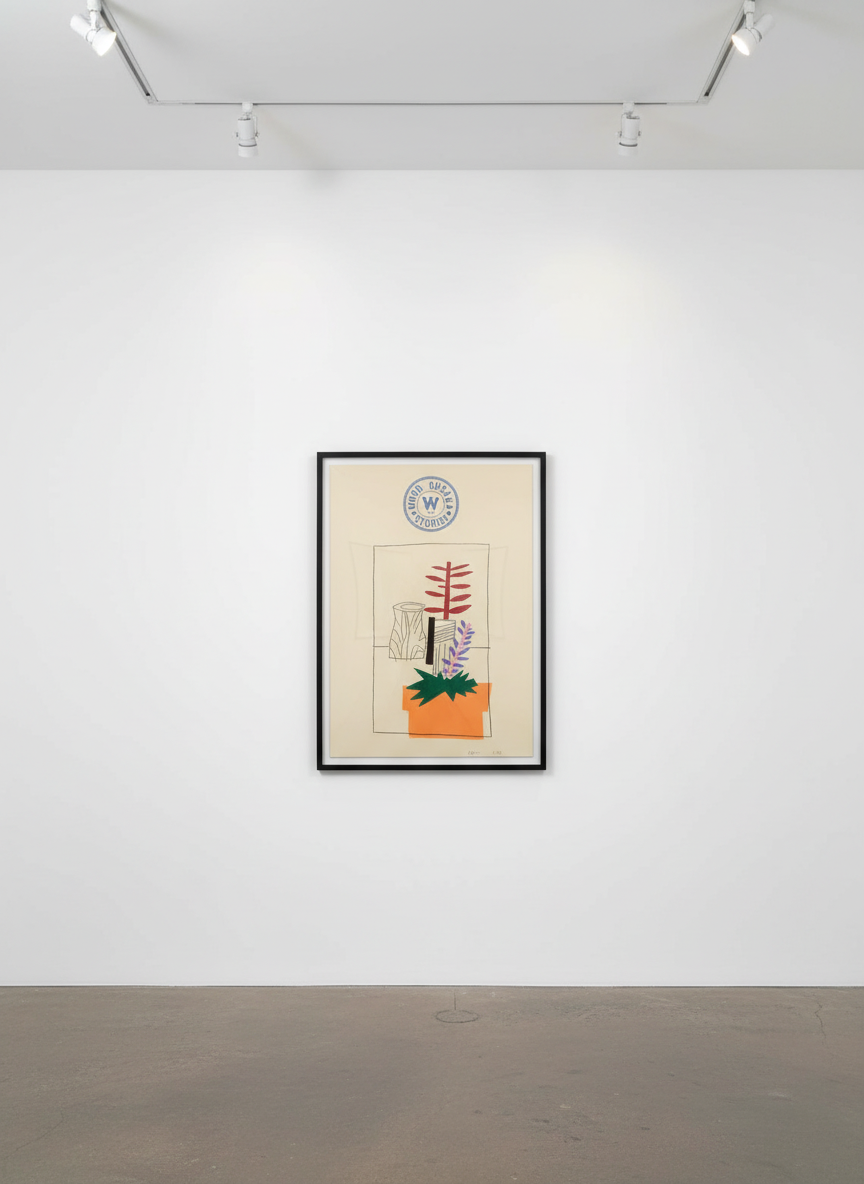
Jonas Wood, Notepad Doodle II (State 1), archival print. Available at Guy Hepner, New York.
Beginning collectors often ask where to start. The honest answer depends on budget, wall space, and personal response to different subjects. But a few principles apply broadly:
Navigating print terminology can confuse new collectors. Here's what matters:
Wood's museum presence legitimizes collector interest. His work currently resides in permanent collections including the Broad (Los Angeles), Hammer Museum (Los Angeles), Hirshhorn Museum and Sculpture Garden (Washington, DC), Metropolitan Museum of Art (New York), Museum of Modern Art (New York), San Francisco Museum of Modern Art, Solomon R. Guggenheim Museum (New York), and Whitney Museum of American Art (New York). This institutional footprint reflects curatorial consensus that Wood represents a significant voice in contemporary painting.
Major solo exhibitions have included the Museum of Contemporary Art Los Angeles (2016-18), Dallas Museum of Art (2019), and multiple gallery presentations at Gagosian's New York, London, and Hong Kong locations. His 2024 London exhibition generated substantial critical attention, confirming ongoing relevance in the conversation about contemporary figuration.
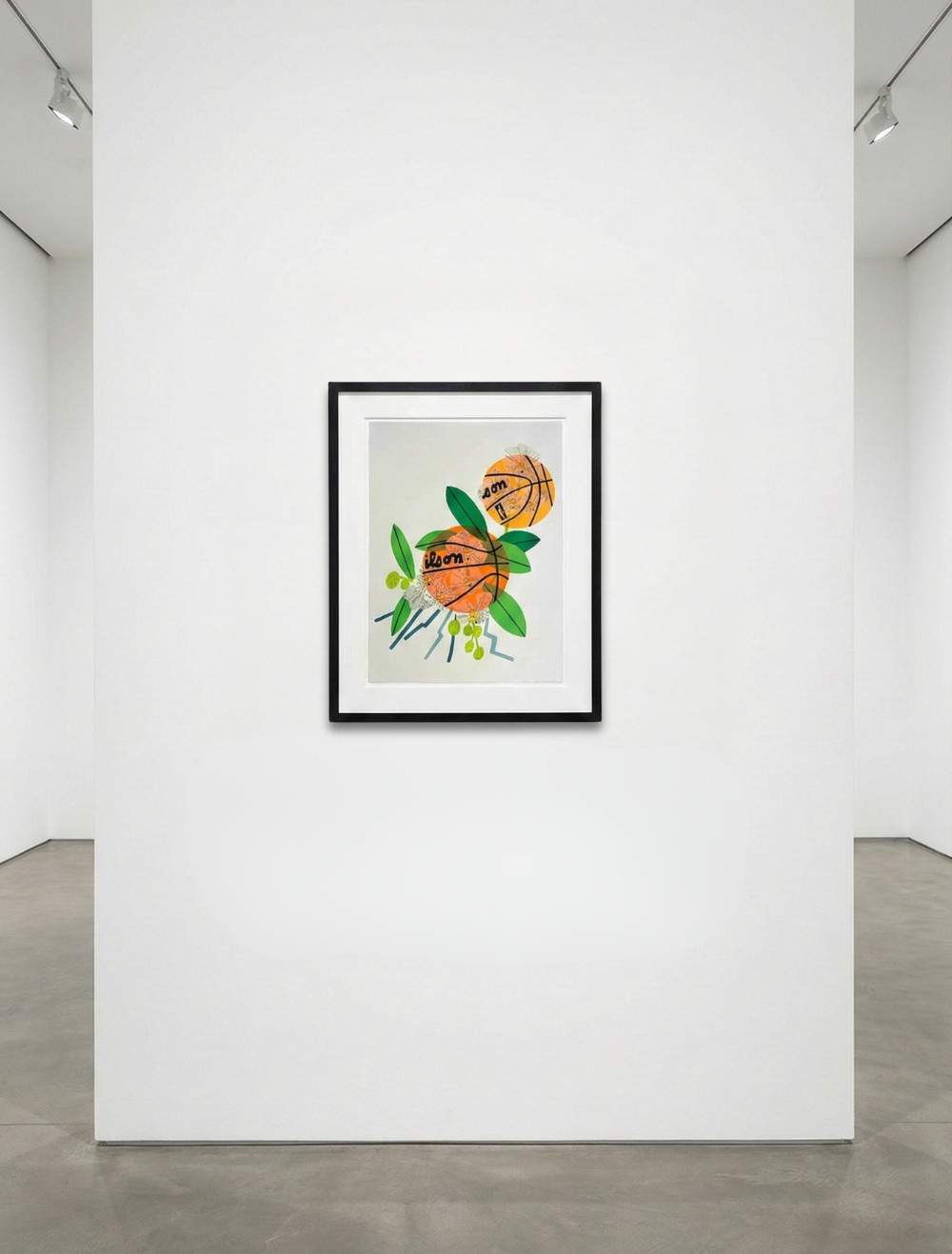
Jonas Wood, Basketball Orchid, mixed media. Available at Guy Hepner, New York.
Where does Jonas Wood fit in contemporary art history? Several lineages converge in his work. The flattened spaces and decorative intensity recall Matisse's late cut-outs. The attention to domestic subjects echoes Vuillard and the Nabis painters. The graphic quality of his compositions connects to Hockney's prints and Alex Katz's economical portraits. The obsessive patterning aligns with Japanese woodblock traditions, particularly the kimono fabrics and screen paintings that appear as citations throughout his work.
But Wood has synthesized these influences into something recognizably his own. His Los Angeles sensibility—bright, design-conscious, simultaneously casual and precise—distinguishes him from East Coast predecessors. His subjects, rooted in actual lived experience rather than appropriated imagery, give the work an emotional directness that much contemporary painting avoids. He makes beautiful pictures without ironic distance, which sounds simple but proves surprisingly rare.
Critics have occasionally questioned whether this beauty amounts to decoration rather than art. The objection misses the point. Wood's visual pleasure is the content, not a distraction from it. His paintings propose that sustained attention to the texture of daily life—the plants we tend, the vessels we collect, the rooms we inhabit—constitutes a legitimate artistic project. Given how rarely contemporary art offers this kind of unguarded warmth, the success seems well-earned.
Guy Hepner Gallery maintains an active inventory of Jonas Wood prints and editions across his major series. Our 529 West 20th Street location in New York provides collectors opportunity to view works in person, assess condition firsthand, and discuss acquisition strategies with knowledgeable staff. We work with both established collectors expanding existing holdings and newcomers building their first positions in Wood's market.
Current availability spans basketball orchid variants, pot compositions, plant works, interior scenes, and landscape prints. Specific inventory changes regularly as works sell and new acquisitions arrive, so collectors with particular interests should inquire directly rather than relying on online listings alone. We also assist clients in sourcing works not currently in inventory, leveraging our network of relationships across the secondary market.
For collectors considering Jonas Wood, the fundamentals remain compelling: museum-quality work, demonstrated market stability, a practice that continues evolving without abandoning core strengths. Whether you're drawn to the botanical works, the sports imagery, the domestic interiors, or the collaborative ceramics, there's a point of entry suited to nearly any collecting vision. Contact Guy Hepner to discuss availability and explore how Jonas Wood might fit within your collection.
Explore Jonas Wood prints for sale at Guy Hepner: Basketball, Four Majors, Interiors, Landscapes, Notepad Doodles.
Related Series