Prints

May 20, 2026
Of all the artists who emerged in the great flowering of American Pop Art in the early 1960s, Tom Wesselmann is perhaps the most persistently underestimated — and therefore, from a collector's perspective, among the most interesting. Where Andy Warhol's legacy has been endlessly codified and Lichtenstein's place in the canon is uncontested, Wesselmann occupies a more complex position: recognised as a central figure by every serious student of the period, yet somehow still surprising to those encountering his work for the first time. The Great American Nude series he began in 1961 and continued for over four decades remains one of the most sustained and formally rigorous projects in postwar American art. For collectors looking to engage seriously with Pop Art beyond the most celebrated names, Wesselmann's prints, studies, and steel cut-outs represent both artistic significance and genuine collector value.
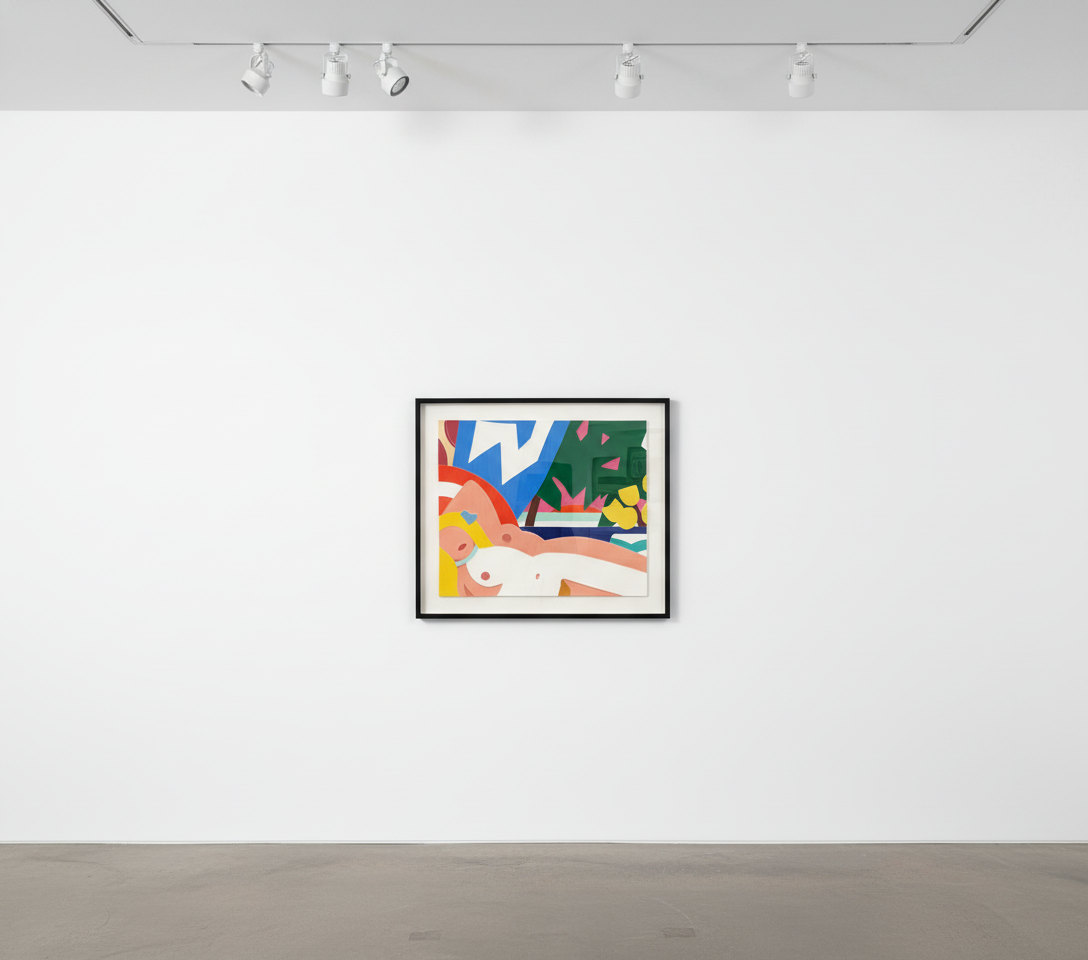
Sunset Nude with Yellow Tulips, 2004 — Tom Wesselmann. Available at Guy Hepner, New York.
Wesselmann was born in Cincinnati in 1931 and came to New York in the late 1950s, initially as a cartoonist, before encountering the work of Cézanne and Matisse in a way that redirected his practice entirely. Where Warhol was drawn to seriality and celebrity, and Lichtenstein to the language of comics, Wesselmann found his subject in the domestic interior and the female body — the spaces and people of everyday American life rendered in the flat, bold colour vocabulary of advertising and commercial design. His Nudes are not erotic in the conventional sense. They are formal studies in which the human body becomes a shape among shapes, a flat plane of colour in dialogue with wallpaper patterns, still-life arrangements, and consumer goods. The effect is simultaneously sensuous and analytical — which is exactly what made him one of Pop Art's most technically sophisticated practitioners.
Wesselmann began the Great American Nude series in 1961 and it became the central thread of his entire career. At its outset, the series took the form of large mixed-media assemblages that incorporated real objects — telephones, televisions, bottle caps, advertising imagery — alongside painted passages of bright, flat colour. The nude figure was rendered without face, without individual identity, as a pure formal element: curves and flat colours in relationship to the domestic environment she inhabited. It was simultaneously a homage to the American vernacular and a rigorous formal investigation in the tradition of Matisse.
As the series evolved across the 1960s, 70s, 80s, and into the 2000s, Wesselmann refined and radicalised the vocabulary. The assemblages gave way to more purely painted works; the scale shifted; the formal concerns became simultaneously more focused and more complex. The Sunset Nude works — which appear across the print output available at Guy Hepner — represent a late crystallisation of everything the series had discovered: a nude in a warm, golden light, typically in relationship with flowers or other domestic still-life elements, rendered in a flat graphic style of supreme elegance. These are works where fifty years of formal thinking are contained in what looks like effortless simplicity.
The translation of this practice into prints was not, for Wesselmann, a secondary activity. He was deeply engaged with printmaking as a primary medium, and the screenprints and etchings he produced carry the full weight of the painting practice. Edition prints allowed wider distribution of the work and engaged the specific technical possibilities of silkscreen — the ability to achieve perfectly flat colour fields, clean edges, and complex layering — in ways that extended rather than simply replicated the painted works.
The screenprint output that collectors can access through Guy Hepner spans the late 1990s and early 2000s, representing mature Wesselmann at the height of his technical command. Still Life With Blowing Curtain (Red) (1999, silkscreen) is a characteristic work: the domestic interior as formal poetry, a bold red ground, a curtain caught in motion, the flat shapes pressing against each other with the visual intelligence of a Matisse interior. The silkscreen medium gives the red a particular saturation and intensity that would be extremely difficult to achieve in painting — a richness that is specific to the multiple.
Bedroom Blonde (1998, screenprint) represents another key thread in the print output — the Bedroom Blonde series that ran across Wesselmann's late career, in which the nude figure is typically glimpsed in a domestic interior, the body and the space in equal dialogue. The screenprint translates this into the clarity of flat colour and precise line that is the hallmark of Wesselmann's graphic vocabulary.
The Sunset Nude prints are the series most immediately available and most actively collected. Sunset Nude with Yellow Tulips (2004, screenprint) brings together all the characteristic elements — the golden warmth of the light, the flowers as still-life counterpoint, the nude as formal element — in a composition of remarkable resolution. Works like this one, produced in the final period of Wesselmann's career (he died in 2004), carry the weight of a lifetime's formal investigation.
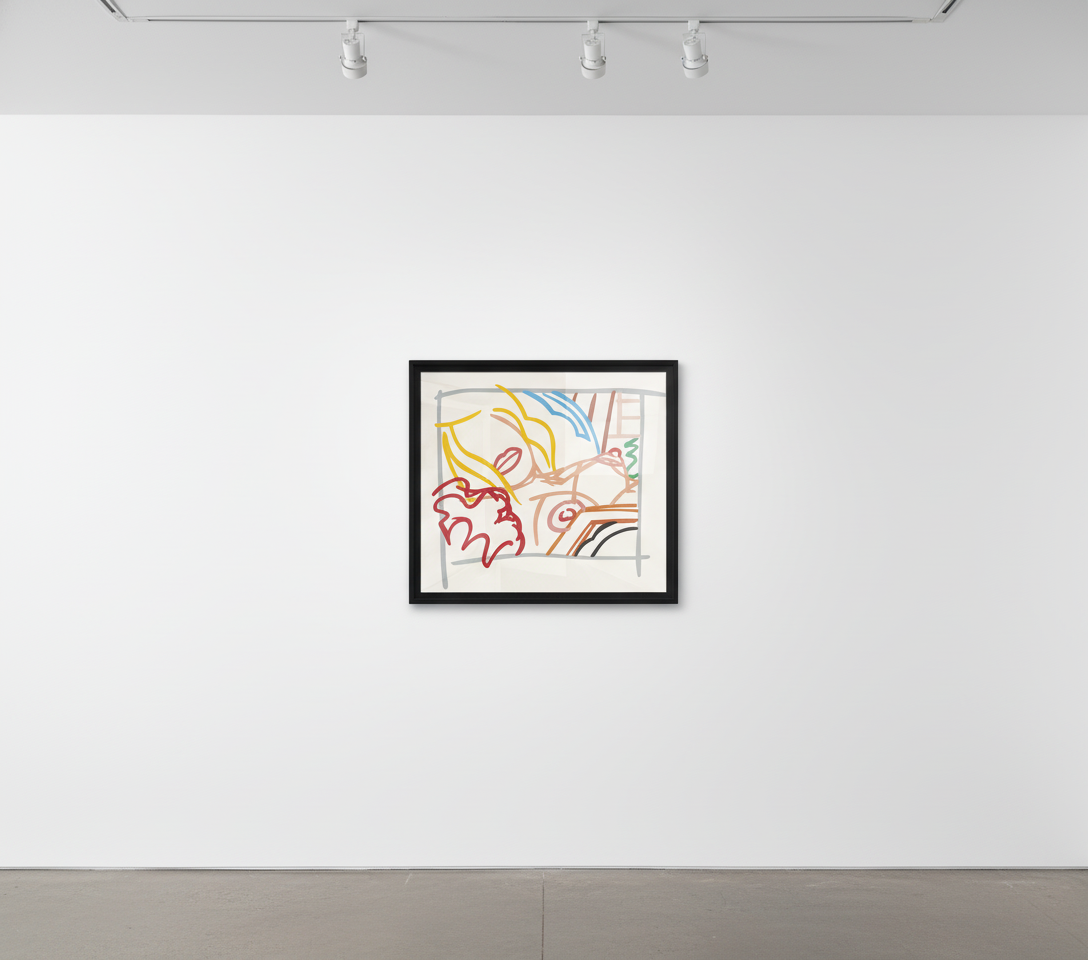Bedroom Blonde, 1998 — Tom Wesselmann. Available at Guy Hepner, New York.
Collectors approaching the screenprints should be attentive to edition sizes and condition. Wesselmann's prints were produced in editions typically ranging from 60 to 250, with many works also including artist's proofs and printer's proofs. The paper, in most cases archival rag stock, has aged well. Works in fine condition with full documentation represent the most secure collector acquisitions.
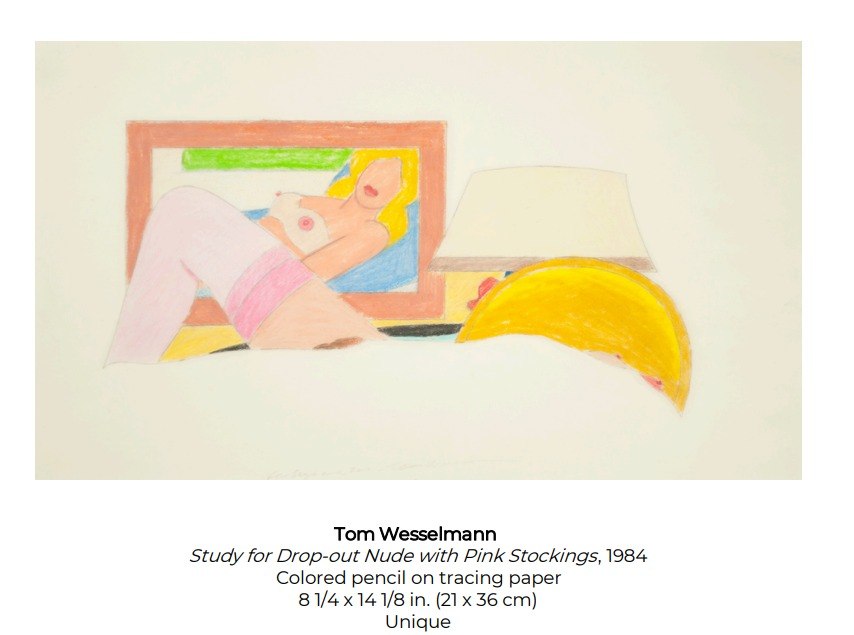
Among the most compelling acquisitions available from Wesselmann's output are the unique works on paper — the drawings and studies that track the development of individual compositions. These are not prints. They are one-of-a-kind works, made by hand, often in a combination of media that reflects Wesselmann's exploratory approach to problem-solving in his art.
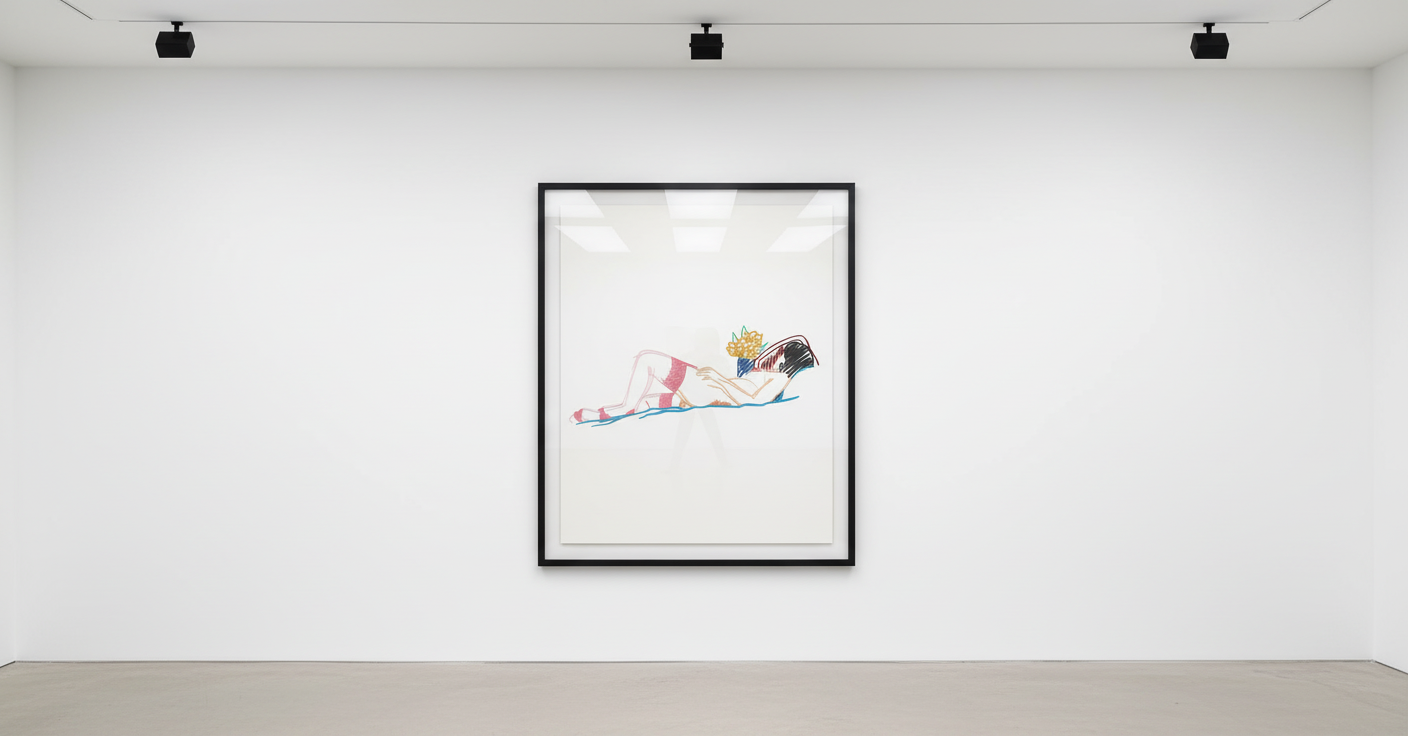
Study for Sunset Nude With Picasso Vase (2004, ink and coloured pencil on rag paper) is a fine example of what these works offer. The study follows the final composition closely but carries the marks of its making — the pencil pressure, the quality of line, the way the colour is built up in layers. Looking at a study, you are looking at the artist thinking. You are seeing the formal decisions being made in real time, the adjustments and refinements that led to the final image.
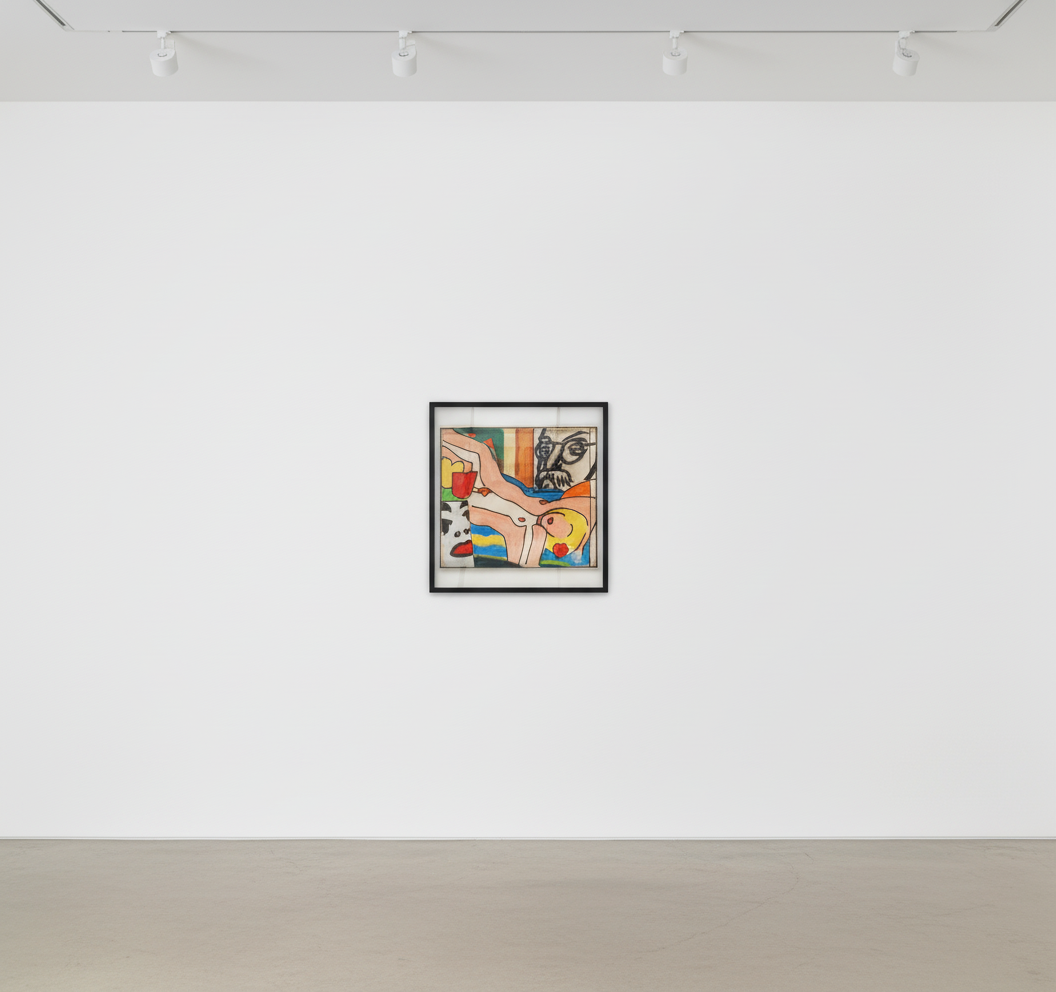Study for Sunset Nude With Picasso Vase, 2004 — Tom Wesselmann. Available at Guy Hepner, New York.
The Study for Bedroom Blonde with Lavender Wallpaper (1985, colour pencil and Liquitex on ragboard) dates from the middle of Wesselmann's career, when the Bedroom Blonde series was in active development. This particular study is technically complex — the combination of coloured pencil's delicacy with the opacity of Liquitex gives the surface a layered richness quite different from the flat clarity of the final screenprints. It shows Wesselmann thinking through how to achieve the wallpaper's colour and pattern, how to balance the figure against the decorative ground.
For serious collectors, the studies often represent more significant acquisitions than the prints, precisely because they are unique. The art market consistently places a premium on uniqueness — a work that cannot be duplicated, that carries the direct physical engagement of the artist. Studies by major artists are sometimes undervalued relative to the prints they generated, because they are less frequently exhibited and less immediately legible as finished works. For informed collectors, this creates genuine opportunity.
The most dramatically three-dimensional works in Wesselmann's output are the steel cut-outs — works in which the flat graphic vocabulary of the prints and paintings is translated into laser-cut steel forms, typically painted with alkyd oil in the colours characteristic of the artist's palette. These are sculptural objects that carry the visual logic of painting while occupying physical space in a fundamentally different way.
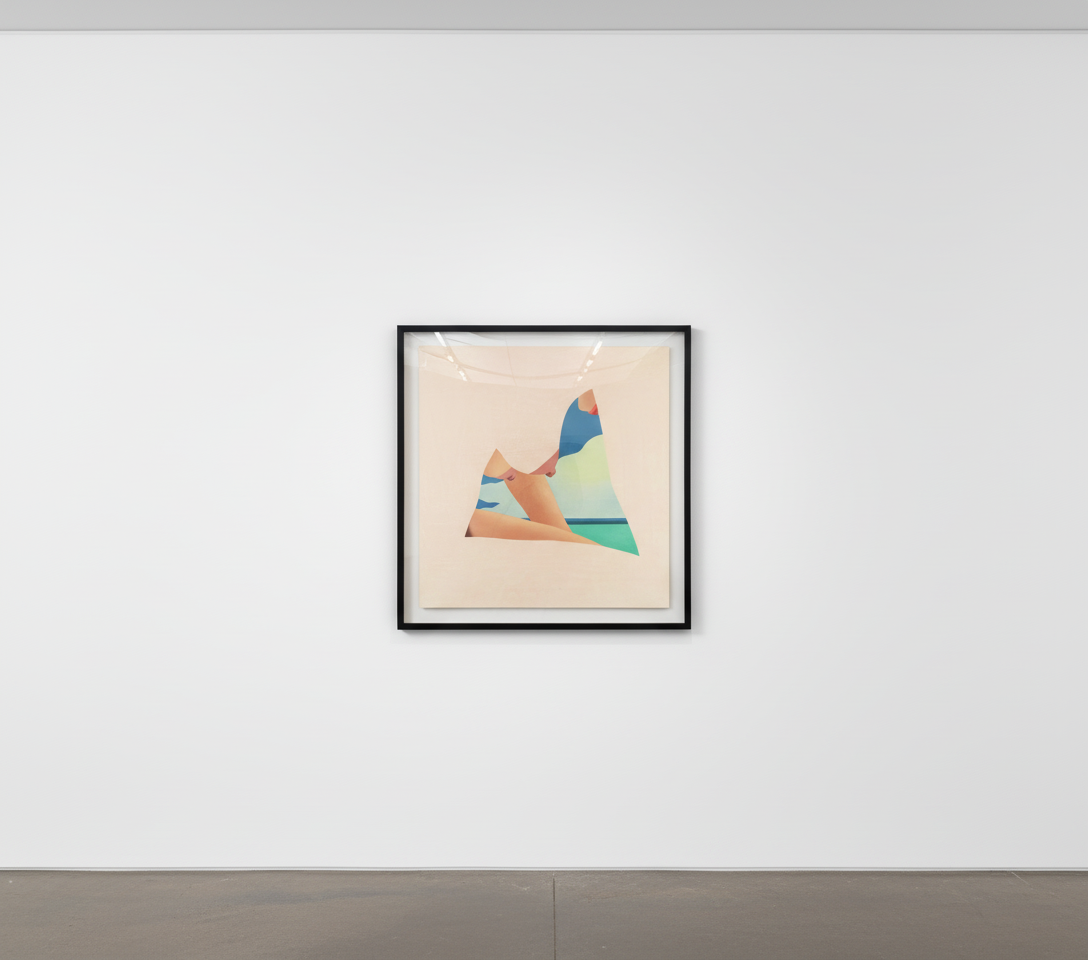
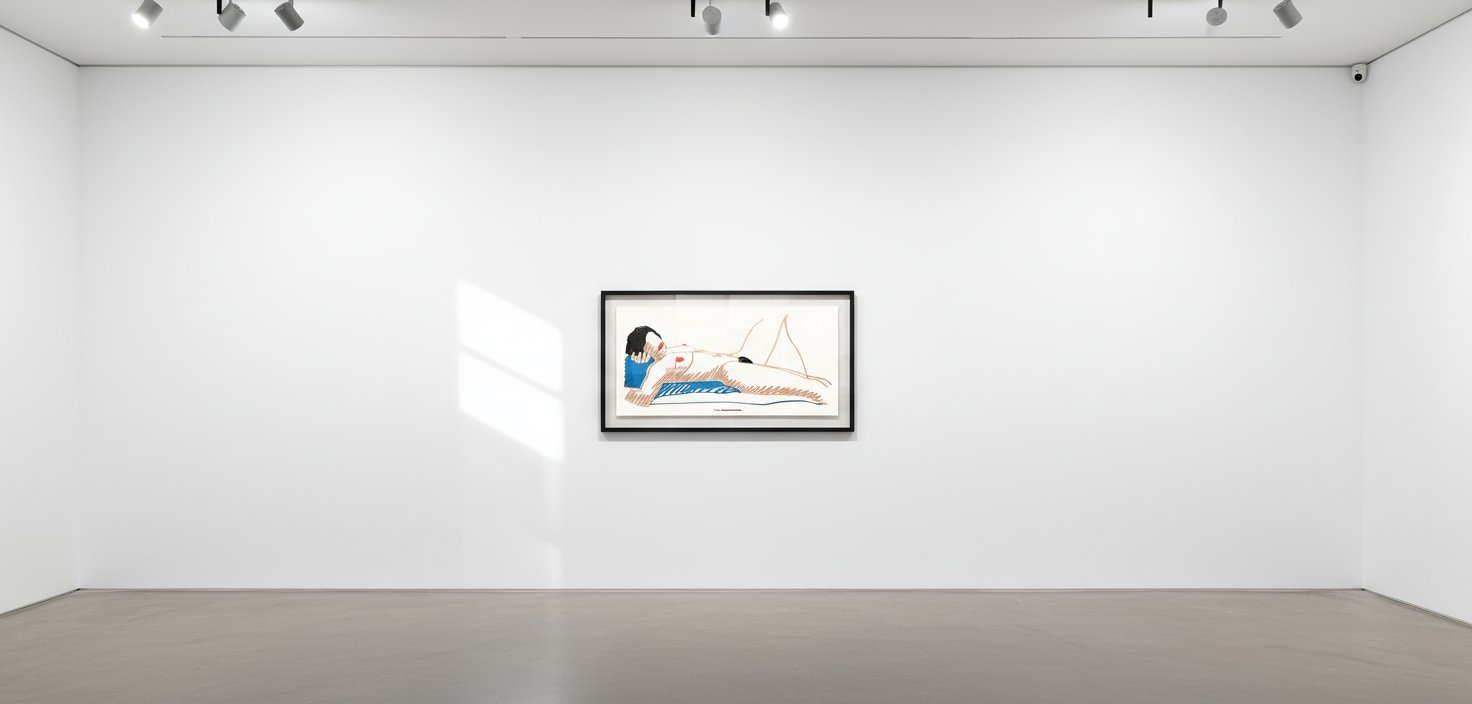Monica Lying On Her Back, 1988–97 — Tom Wesselmann. Available at Guy Hepner, New York.
Monica Lying On Her Back (1988–97, alkyd oil on cut-out steel) is the available steel work that most immediately demonstrates what Wesselmann achieves with the medium. The Monica series depicted his muse Monica Majewski, whom he married in 1981, in a range of poses and contexts. The steel cut-out literalises the flat, graphic quality of the drawn and painted figure — the form is defined by its silhouette, by the relationship between the steel object and the wall or floor behind it, by the shadow it casts. It is simultaneously image and object, picture and thing.
The steel cut-outs were made across the 1980s and 1990s and represent a significant body of work within Wesselmann's overall output. They occupy a particular position in the collecting landscape: more spatially demanding than a framed print or study, and typically commanding prices reflective of their unique character. For collectors with the space, they are among the most physically compelling works Wesselmann produced.
One of the things that distinguishes Wesselmann from his Pop Art contemporaries is the seriousness of his engagement with art history. Where Warhol was interested in celebrity and consumer culture, and Lichtenstein in the language of comics and reproduction, Wesselmann was explicitly and consciously in dialogue with the Western tradition of painting — particularly with Matisse, Cézanne, and Picasso. This is not incidental. It is the foundation of his practice.
The references to Picasso that appear in specific works — Reclining Nude With Picasso, Study for Sunset Nude With Picasso Vase — are direct acknowledgements of this dialogue. Wesselmann is placing his nudes in conversation with Picasso's nudes, his still lifes in conversation with Cubist still life. He is asking what the flat, graphic vocabulary of Pop Art does when it engages with the same formal problems that preoccupied Cubism. The answer is that the Pop flatness and the Cubist simultaneity produce something genuinely new — a space that is neither one nor the other, but partakes of both traditions.
The still life works — Still Life With Blowing Curtain (Red) and the many studies involving flowers, curtains, household objects — similarly engage the Dutch and French still life traditions at the level of subject while transforming them completely at the level of technique. Wesselmann is not painting a traditional still life. He is proposing that the formal concerns of the tradition — the organisation of objects in space, the relationship between colour and light, the tension between presence and representation — remain alive and vital when translated into a Pop graphic vocabulary.
The Tom Wesselmann market is well-established and internationally active, supported by consistent institutional representation and a recognised position in the Pop Art canon. Works at auction regularly achieve prices that reflect his historical importance. For collectors approaching the market now, the key decisions are between print editions, unique works on paper, and steel cut-outs — three categories with quite different price points and collector considerations.
Edition screenprints represent the most accessible entry to the Wesselmann market — works by a confirmed major figure at prices accessible to collectors who are building holdings in postwar American art. The edition context means that comparable works will occasionally appear at auction, providing price reference and liquidity. For new collectors, the screenprints are a sound starting point, particularly the Sunset Nude and Bedroom Blonde series from the 1990s and early 2000s.
Unique works on paper — the studies, drawings, and mixed-media works — sit at a different level and warrant consideration on an individual basis. They are, in the strictest sense, more significant acquisitions: unique objects that carry the full authority of the artist's direct engagement. The studies from the 1985–2004 period are particularly well-regarded.
Guy Hepner currently offers 78 Tom Wesselmann works across prints, unique studies, and steel cut-outs — a comprehensive representation of his output and the most substantial single-gallery selection currently available. For collectors looking to build a meaningful Wesselmann holding, or to make a single significant acquisition, this breadth of choice is unusual and worth engaging with directly.
To explore all available Tom Wesselmann works and to inquire about specific pieces, visit Guy Hepner's Tom Wesselmann page. The gallery team can provide full documentation, condition reports, and acquisition support for any work in the collection.
Explore Tom Wesselmann prints for sale at Guy Hepner: Steel Cuts.
Related Series