Early Works
May 20, 2026
There is a child in Yoshitomo Nara's work who has been staring at the world for over three decades, and she has not blinked. She stands alone — usually against a plain ground, her head slightly oversized for her body, her eyes enormous and darkened with an expression that oscillates between sullen defiance and something approaching threat. She holds a knife, or she holds a cigarette, or she holds nothing, just her own contained fury. She is instantly recognisable. She is one of the most significant images in contemporary art, and she belongs to one of the most significant Japanese artists working internationally today.
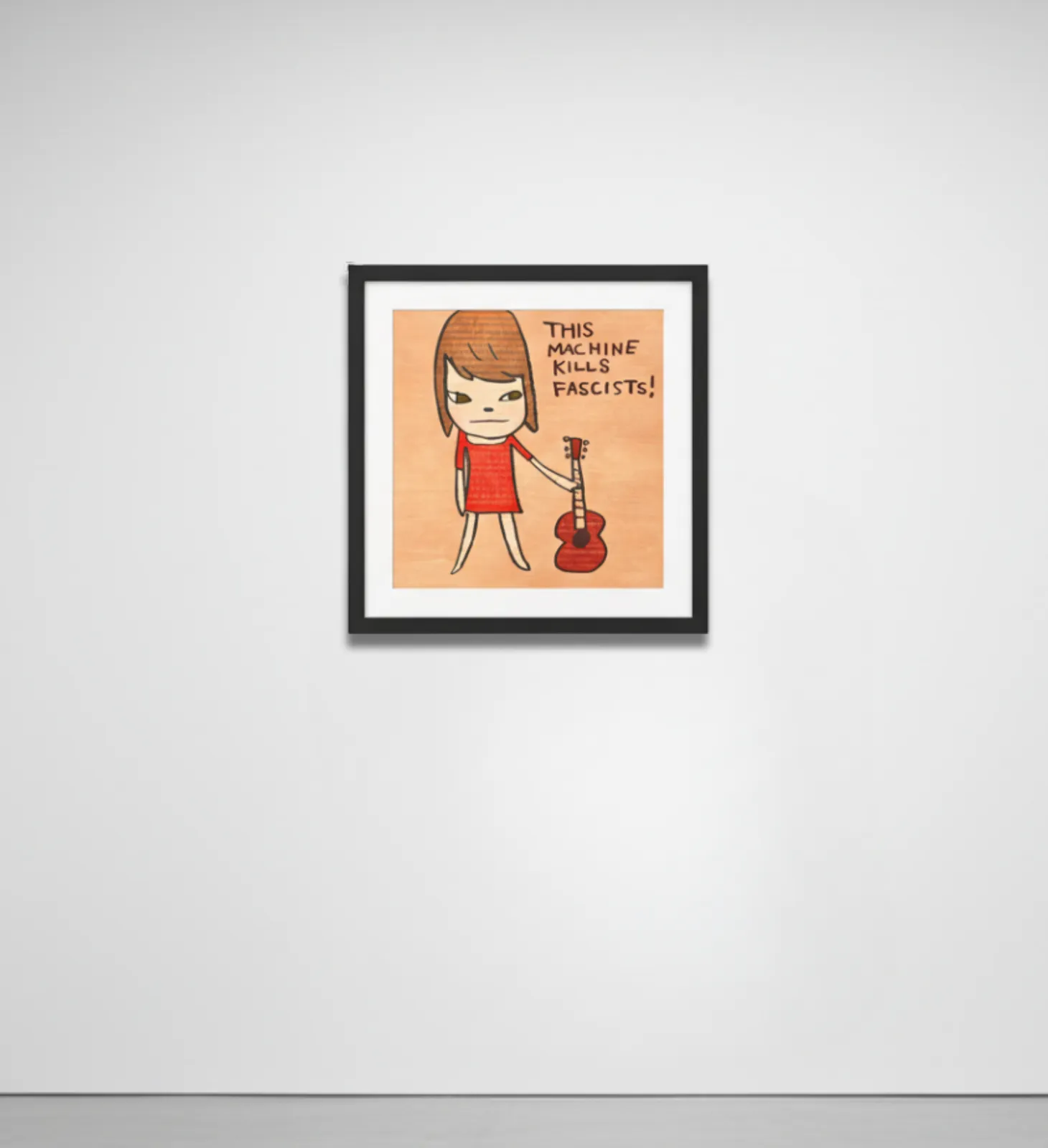
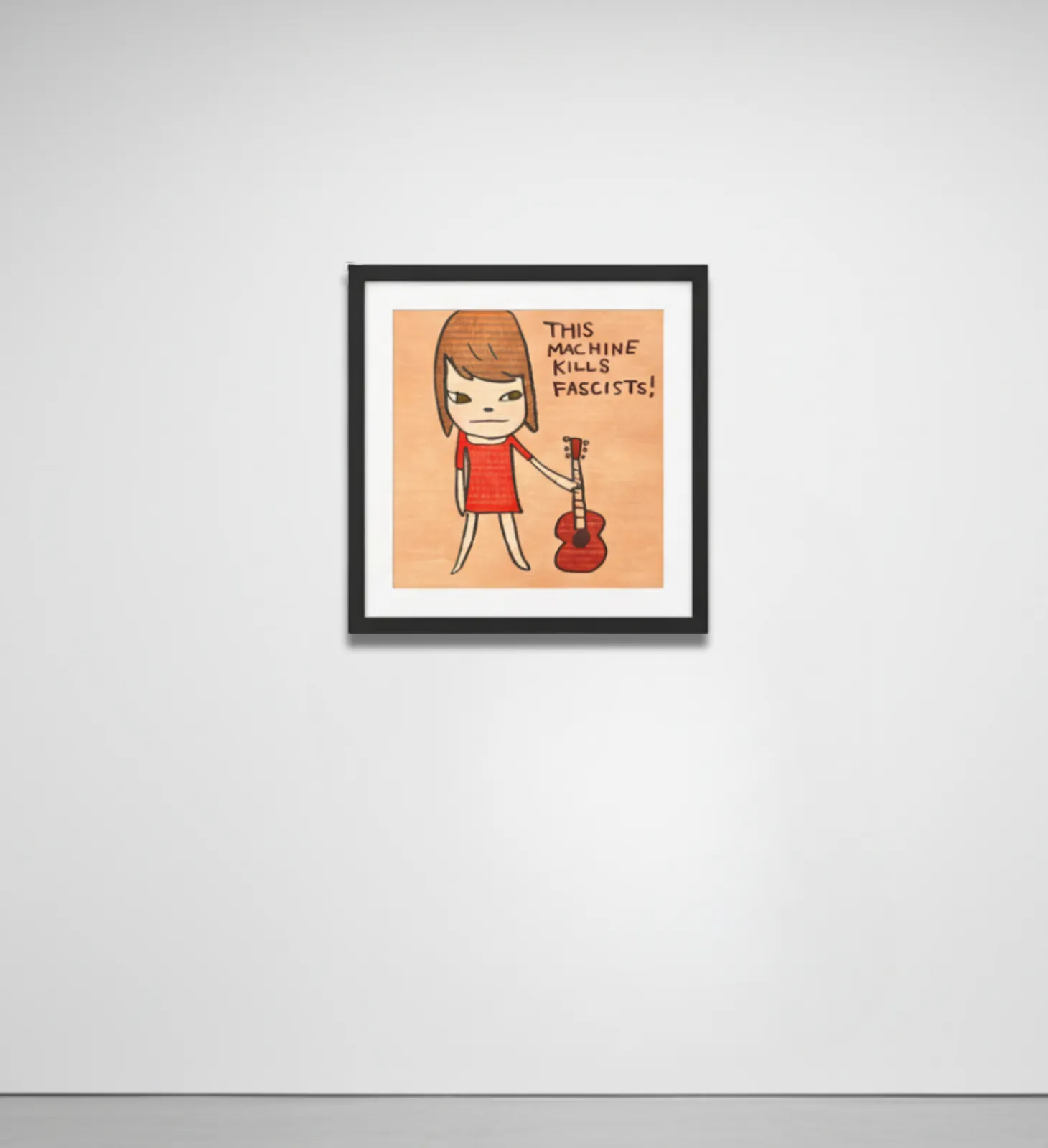
This Machine Kills Fascists, 2022 — Yoshitomo Nara. Available at Guy Hepner, New York.
Yoshitomo Nara was born in Hirosaki, in northern Japan, in 1959. He studied at the Aichi Prefectural University of Arts before moving to Düsseldorf in 1988, where he spent twelve years at the Kunstakademie — an experience that grounded him deeply in the Western art historical tradition while sharpening his sense of what made his own cultural perspective distinctive. He returned to Japan in 2000, by which point his international reputation was already established. His inclusion in the Superflat movement, associated with fellow Japanese artist Takashi Murakami, placed his work in a theoretical context that drew on the flat surface of Japanese animation and manga, the legacy of ukiyo-e woodblock printing, and the aesthetics of consumer culture. But Nara's work always resisted easy categorisation. Where Murakami embraced the kawaii and the spectacular, Nara remained committed to something more interior, more ambivalent, more emotionally complex.
The global collector demand for Nara's work is substantial, consistent, and shows no sign of abating. His paintings have achieved major auction prices at leading international houses. His prints and works on paper — 75 of which are available through Guy Hepner, spanning Lithographs, Woodblock Prints, and early editions — offer collectors at multiple levels the opportunity to engage with one of the defining visual imaginations of the last three decades.
For a Japanese artist of Nara's generation, printmaking is not merely a subsidiary activity or a means of generating accessible editions. It sits within one of the richest print traditions in world art history. The ukiyo-e woodblock print tradition — Hokusai, Hiroshige, Utamaro — represents a body of formal and technical achievement that any serious Japanese artist must engage with, consciously or otherwise. Nara engages with it consciously and directly, particularly in the 2022 woodblock series discussed below.
But the print tradition also serves a democratic function that Nara explicitly values. His work has always had a relationship with popular culture — with rock and punk music, with the aesthetics of bedroom culture, with the sense that art should be accessible to people who don't visit institutions. Prints allow wider distribution of the work, lower prices of access, and the possibility that someone who cannot acquire a Nara painting can nonetheless live with a Nara image. This is not a compromise. For Nara, it is consistent with the emotional logic of the work itself: the child figure he paints is not an elite image. She is a figure of universal recognition.
The technical quality of Nara's print output is high. Whether lithography, which allows soft edges and tonal range consonant with the painting practice, or the more recent woodblock works with their registration demands and physical presence, Nara's prints are made with the seriousness of an artist who understands what each medium can do and chooses accordingly.
The core of Nara's print output available at Guy Hepner consists of lithographs from the 2015–2019 period — 58 works spanning some of the most significant of his print editions. These works translate the painting vocabulary — the isolated child figure, the plain ground, the large eyes, the contained emotional intensity — into the specific possibilities of lithography. Litho allows a softness and tonal range that silkscreen does not: the edges can breathe, the line can have weight and modulation, the ground can shift in tone in ways that add atmosphere. Where silkscreen produces flatness, lithography produces depth.
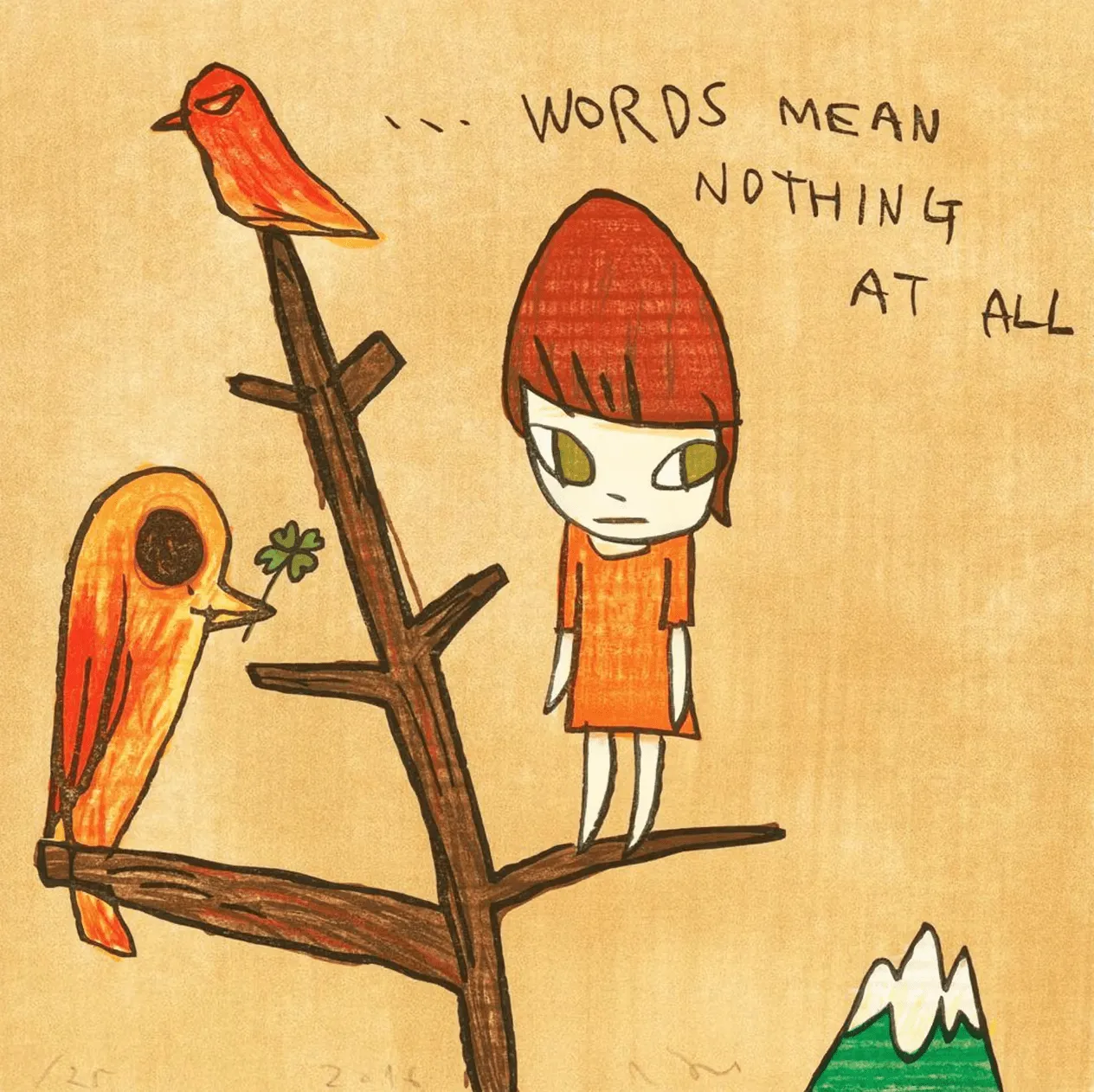Words Mean Nothing At All, 2016 — Yoshitomo Nara. Available at Guy Hepner, New York.
Words Mean Nothing At All (2016, lithograph) is characteristic of how Nara uses the medium in this period. The child figure appears against a soft ground, her expression — sullen, closed, slightly defiant — reading with the emotional clarity of the paintings. The lithographic process gives the image a warmth and integration that suits the psychological register of the work: these are not hard-edged Pop images, they are images of interior states. The title — "Words Mean Nothing At All" — carries the ambivalence typical of Nara's textual interventions. Is it dismissal? Is it an admission of failure? Is it a kid's refusal to be told what to think? All of these simultaneously.
The Real One (2019, lithograph) dates from the end of this period and represents Nara at his most distilled. The figure is small against a large, soft ground. The title insists on authenticity — real, genuine, not a copy. The work carries a kind of defiant sincerity that feels emblematic of Nara's project as a whole: the claim, made with complete seriousness, that this child figure is not kawaii decoration or cultural product, but a genuine expression of something real and deeply felt.
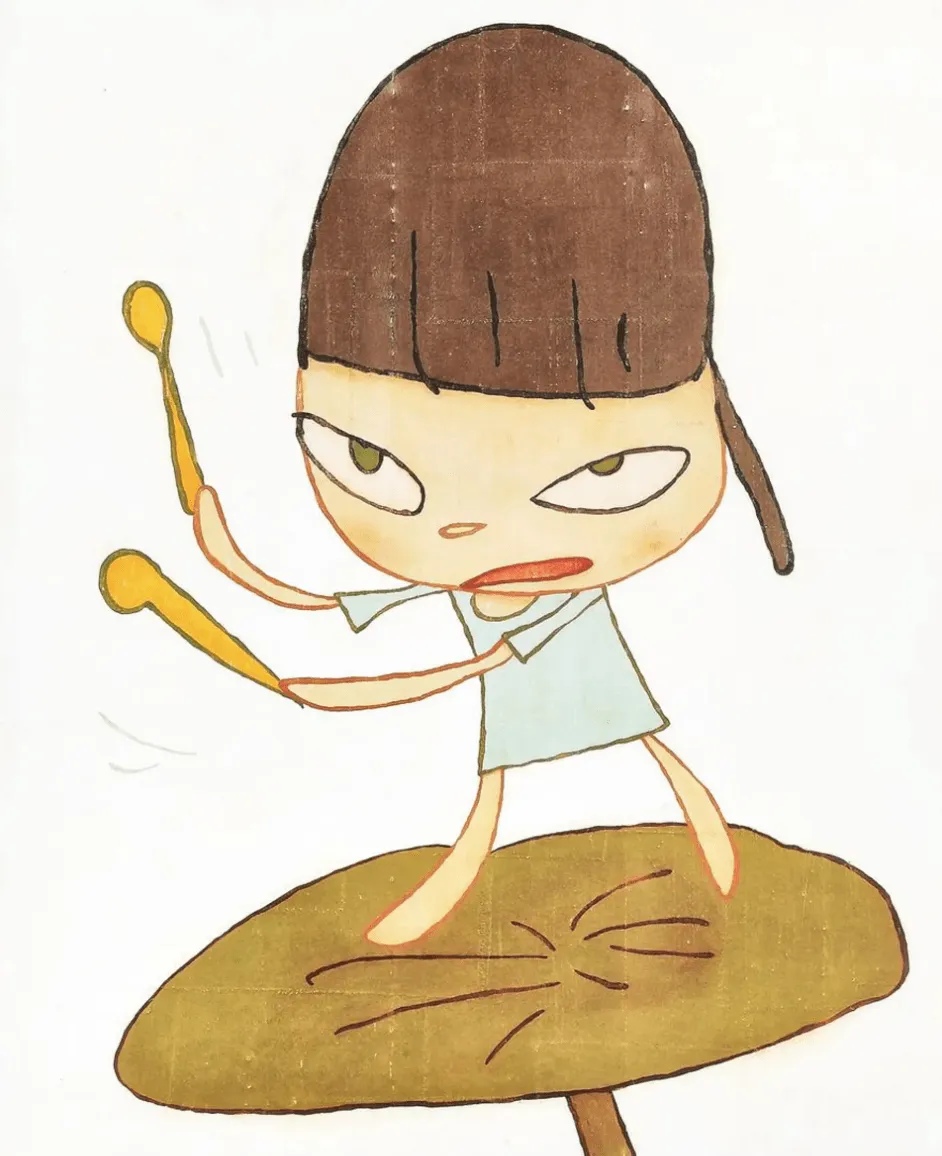Marching On A Butterbur Leaf, 2019 — Yoshitomo Nara. Available at Guy Hepner, New York.
Marching On A Butterbur Leaf (2019, lithograph) is among the most formally inventive of the available lithographs. The image places the figure in an unusual relationship to a natural element — the large butterbur leaf providing both a setting and a formal counterpoint to the figure. The leaf's organic curve contrasts with the figure's upright insistence. The title's verb — marching — gives the image a purposefulness that is almost comical in its determination, and yet entirely earnest. This is a child who marches on whatever ground is available. The lithographic rendering gives both the figure and the leaf a tonal richness that rewards close looking.
Across the 2015–2019 lithograph series, Nara demonstrates a painter's understanding of how to translate his practice into print. He does not simply reproduce paintings as editions. He makes prints that use the lithographic medium's specific qualities — the soft edge, the tonal range, the warmth — to produce images that could only exist as lithographs. This is the mark of an artist who takes printmaking seriously as a primary medium, not as a secondary activity.
In 2022, Nara returned to the most historically and culturally charged medium available to a Japanese artist: the woodblock print. The resulting series — including This Machine Kills Fascists, Knife, and Sprout In The Hand Mirror — represents the most explicitly Japan-engaged work of his career, a direct dialogue with the ukiyo-e tradition that his broader practice has always referenced but never so directly engaged.
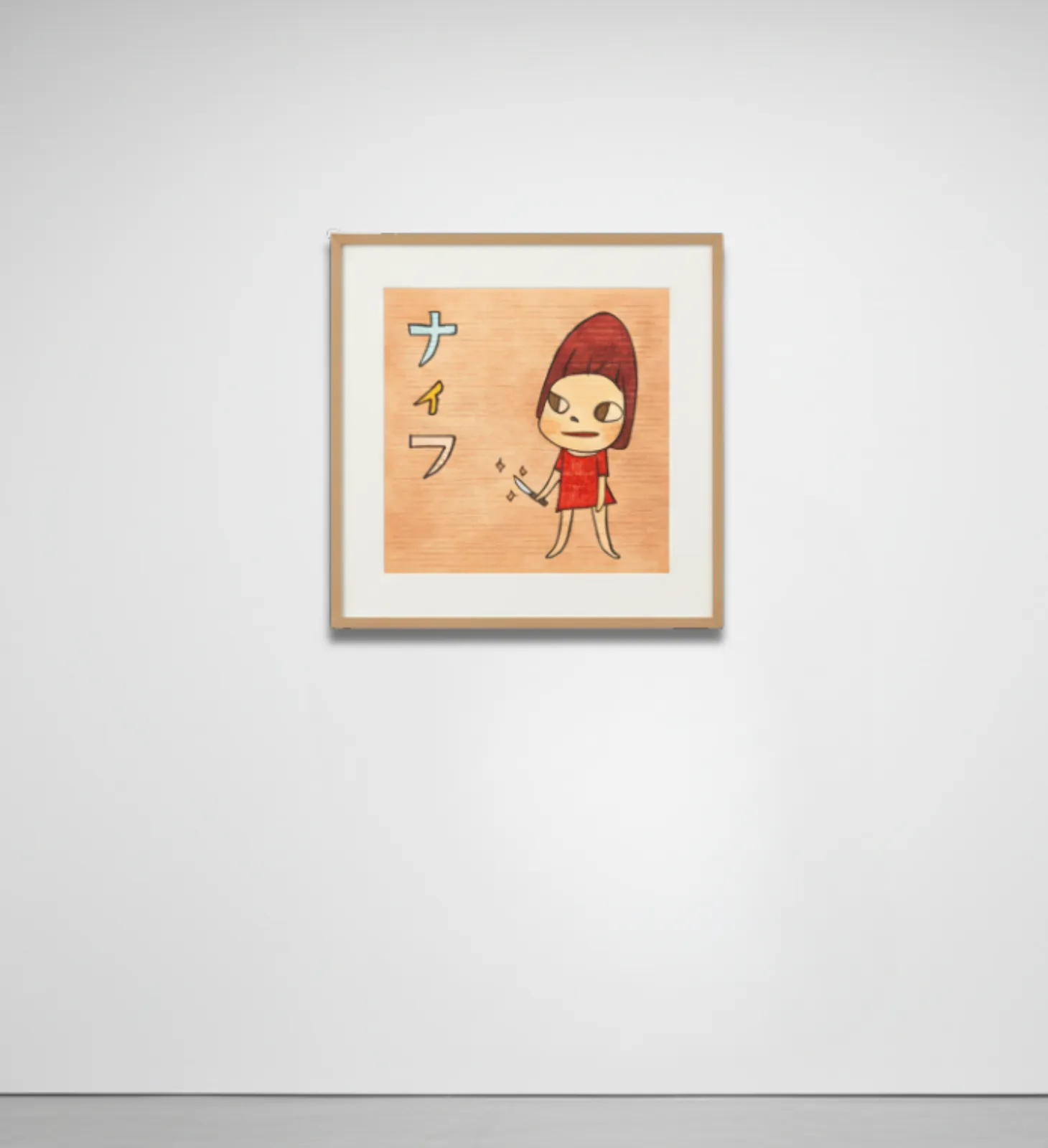Knife, 2022 — Yoshitomo Nara. Available at Guy Hepner, New York.
The woodblock process is technically demanding in ways that lithography is not. The registration of multiple colour blocks requires precision. The cutting of the blocks requires skill and physical engagement. The hand printing requires experience and sensitivity. The result, when achieved, has a physical presence and a texture — the slight impression of the block, the quality of ink on paper — that no other printmaking process can replicate. For Japanese artists and collectors, this physical quality carries enormous cultural weight.
This Machine Kills Fascists (2022, woodblock print) is, in title and content, among the most explicitly political works Nara has produced. The phrase is borrowed from Woody Guthrie's guitar slogan — a piece of American folk music heritage now deployed by a Japanese artist in woodblock, the most Japanese of print media. The collision of references is deliberate and charged. Nara's child figure, holding the instrument or implying its threat, is framed within a tradition of political art-making that runs from Guthrie through punk to contemporary anti-authoritarian culture. The work looks innocent. It is not innocent at all.
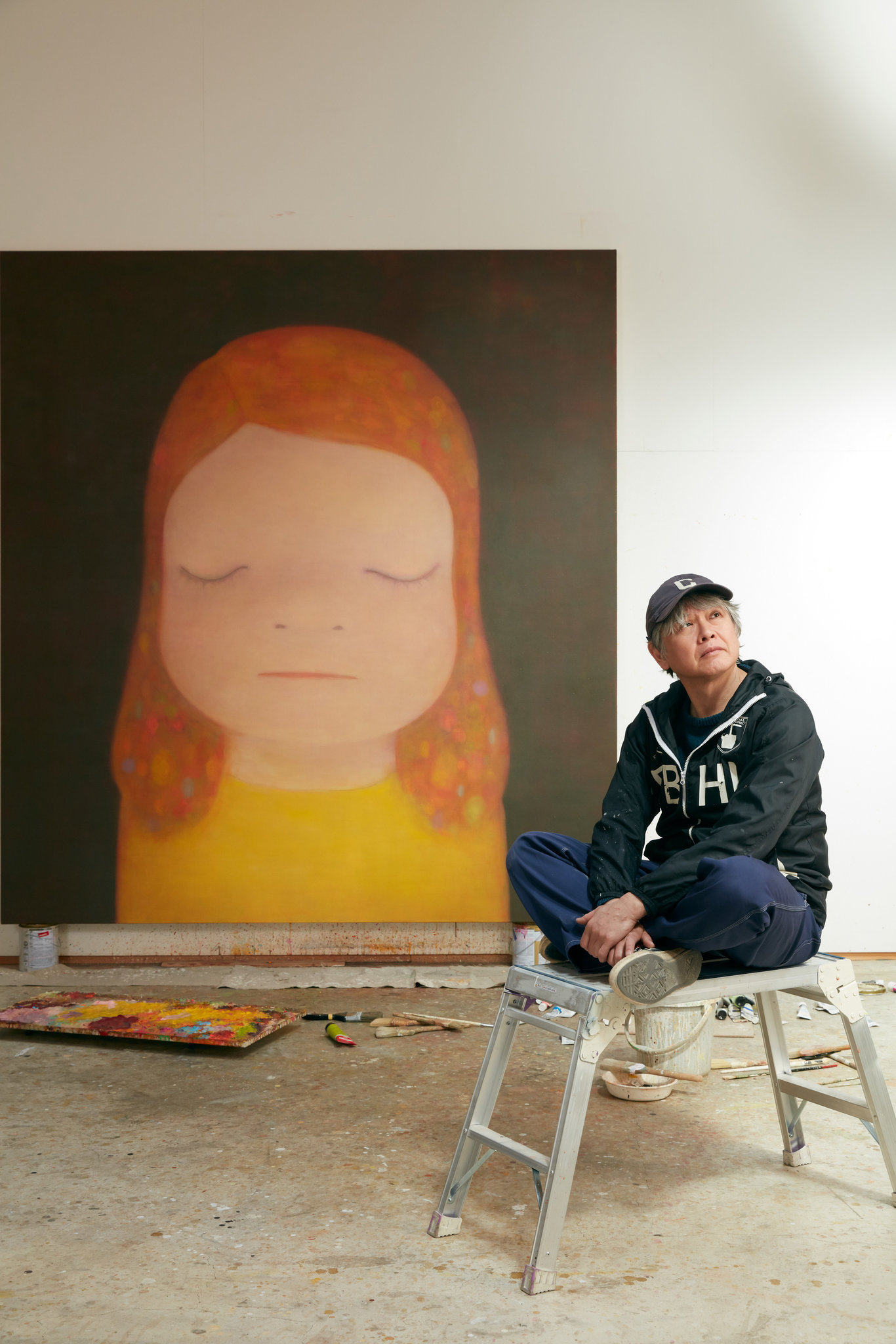Knife (2022, woodblock print) is starker — the child figure and the knife, the confrontational image that has been one of the most frequently referenced in discussions of Nara's practice. The woodblock process gives the work a quality that lithography cannot achieve: a printed texture, a physical weight, a connection to the craft tradition of the medium. The knife in Nara's work is rarely a simple threat. It is also a tool, a means of making, and — in the context of Japanese craft culture — an object of respect. The image holds all these readings simultaneously.
Sprout In The Hand Mirror (2022, woodblock print) offers a different register within the series — quieter, more reflective, the child examining something growing in a mirror. The hand mirror is a traditional motif in Japanese art and culture, associated with self-examination, with the question of what is seen when one looks. The sprout — small, new, growing — suggests hope or possibility held under scrutiny. The woodblock rendering gives the image a formal clarity that suits its contemplative mood.
The 2022 woodblock series was produced in limited editions, and demand has been strong since release. For collectors, these are works that combine the broader international significance of Nara's practice with the specific cultural authority of the Japanese woodblock tradition. They are, of all the available Nara prints, the most directly engaged with the question of what it means for a Japanese artist to work in Japan's most historically significant print medium. Their limited edition status makes them among the most urgently collectable works in Guy Hepner's current inventory.
Among the historically significant works available through Guy Hepner are early Nara editions from 2001 — a year that marks a pivotal moment in his international trajectory. By 2001, Nara had returned from Düsseldorf and was beginning to reach the broader international audience that his work would come to command. The works produced in this period — Peace Flag, Girl In A Box, and others — are documents of that moment.
Peace Flag (2001) positions the child figure in relation to a peace symbol — the anti-war politics that have always been present in Nara's work are here explicitly foregrounded. The work was made in the aftermath of significant global political events and carries their weight. For Nara, the anti-war position is not merely a political position; it is personal, rooted in the experience of growing up in postwar Japan, in a culture that had lived through the consequences of militarism and its defeat.
Girl In A Box (2001) is characteristic of the formal vocabulary Nara was developing at this moment: the figure contained, isolated, defined by the boundary of the box. The box as a spatial device — limiting, defining, protecting — recurs throughout Nara's work. The figure inside it is both constrained and secure, both imprisoned and sheltered. This ambiguity is characteristic of the emotional register Nara works in: nothing is simply one thing.
For collectors, the significance of the 2001 editions is historical. These are works from the period of Nara's emergence as a genuinely international figure — the first moment when his work began to reach audiences far beyond Japan and Germany. Early editions by artists who subsequently achieve major international recognition consistently command premiums on the secondary market, and the 2001 Nara editions are no exception. They are also, in the most literal sense, earlier: they reflect the practice at a specific moment of development that subsequent works do not.
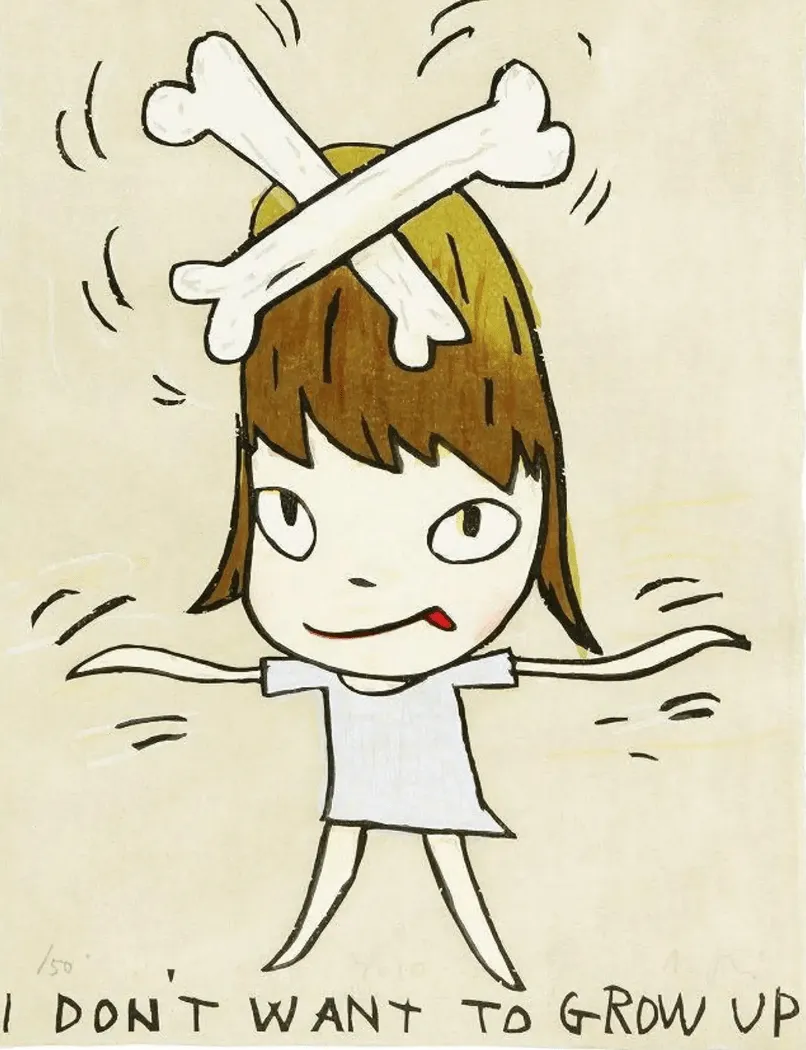
The child figure that anchors almost all of Nara's work rewards extended and serious reading. The figure is typically a girl, though sometimes ambiguously gendered. She is alone. Her head is large, her body small — proportions borrowed from manga and anime conventions, but deployed in a way that gives the figure a quality of interiority and emotional weight quite different from the kawaii tradition. The eyes are the primary means of communication: large, dark, sometimes with slit pupils, sometimes entirely black, they carry the full range of Nara's emotional vocabulary. The expression oscillates between sullen and dangerous, between lonely and furious, between vulnerable and threatening.
This ambivalence is not accidental. Nara has spoken in interviews about his own experience of childhood — of being a solitary child in a provincial Japanese city, left largely to his own devices, constructing an interior life from music (especially Western rock and punk), from comics and animation, from a sense of being slightly outside the social mainstream. The child figure in his work is not a generic symbol of innocence or its corruption. She is a specific experience of childhood made universal through the power of the image.
The political undertones that run through the work — the knife, the anti-war titles, the punk cultural references, the title "This Machine Kills Fascists" — are rooted in a deep anti-authoritarian sensibility. Nara grew up in a Japan that was grappling with its postwar identity, that was simultaneously American-influenced and self-consciously Japanese, that was building a consumer culture on the foundations of a militarist catastrophe. The anti-authority stance of Western punk rock resonated with a Japanese audience that had its own reasons to be suspicious of authority. Nara's work has always held this political dimension within the apparently simple form of a child's face.
The influence of anime and manga on Nara's visual vocabulary is real and acknowledged. But it is balanced, in equal measure, by deep engagement with Western painting — with Van Gogh, with Klimt, with the German Expressionist tradition he encountered during his years in Düsseldorf. The simplicity of his imagery is hard-won: it is the simplicity that comes from resolving multiple, sometimes contradictory influences into a visual language of complete economy. Every element that remains in a Nara image is there because it needs to be.
The market for Yoshitomo Nara prints and works on paper is active, internationally significant, and driven by both institutional collectors and sophisticated individual buyers. Nara's paintings have consistently achieved record prices at major auction houses over the past decade, and the print market has firmed accordingly. Edition sizes for Nara prints are typically in the range of 50 to 200, with some series in smaller editions that command significant secondary market premiums.
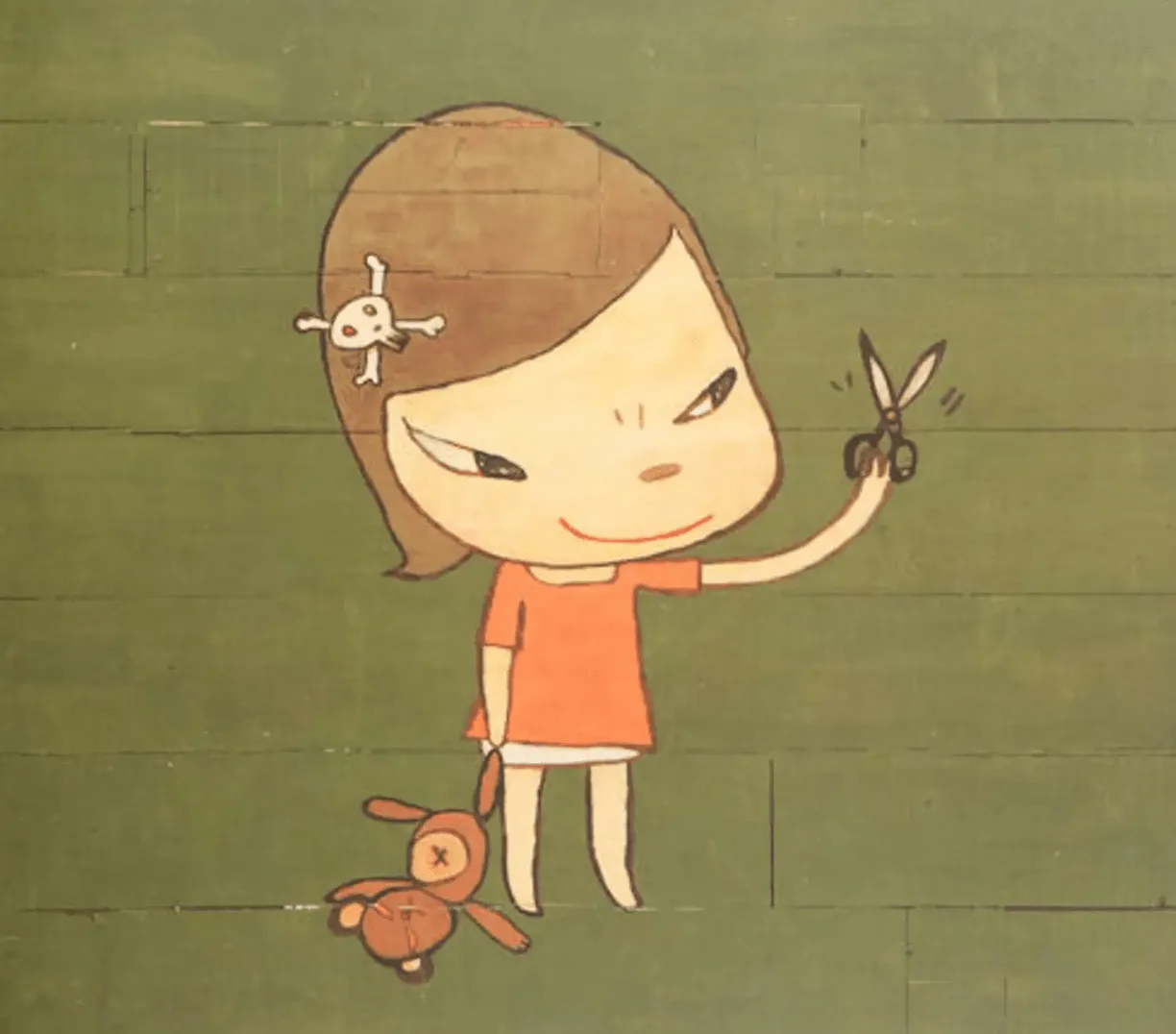The Real One, 2019 — Yoshitomo Nara. Available at Guy Hepner, New York.
Authentication is a critical consideration for any Nara acquisition. The global demand for his work has generated a secondary market in which authentication documentation is essential. All Nara works available through Guy Hepner are accompanied by full provenance and documentation. Collectors should ensure, for any acquisition, that the work comes with appropriate documentation, preferably including the publisher's certificate of authenticity where applicable.
The relationship between Nara's prints and his paintings is worth understanding from a market perspective. The paintings — oils on canvas — are typically available only through major auction and represent investment-level acquisitions. The prints offer access to the same visual intelligence, the same formal vocabulary, the same emotional register, at prices that reflect their edition status. For collectors building a Nara holding, the prints are not substitutes for the paintings. They are a distinct body of work that stands on its own terms.
Within the prints, there is a clear hierarchy: the 2022 woodblock prints, with their limited editions and technical ambition, sit at the top of the print market. The 2015–2019 lithographs — the core of the available holding — represent the most extensive access to Nara's print practice across this significant period. The 2001 early editions carry historical premium. All three categories warrant attention from collectors building a representative Nara collection.
Guy Hepner currently offers 75 Yoshitomo Nara works across woodblock prints, lithographs, and early editions — the most extensive single-gallery holding of Nara prints available, representing all major series and periods from 2001 through 2022. For collectors seeking to build a serious Nara print collection, or to make a single significant acquisition from one of the most important artists working today, this breadth of available work is exceptional.
To explore all available Yoshitomo Nara works and to inquire about specific pieces, visit Guy Hepner's Yoshitomo Nara page. Given the consistent and active demand for Nara's print work, we recommend acting promptly on any work that engages your collection vision.
Explore Yoshitomo Nara prints for sale at Guy Hepner: Early Works, Lithographs, Woodblock Prints.
Related Series