Ads

May 15, 2026
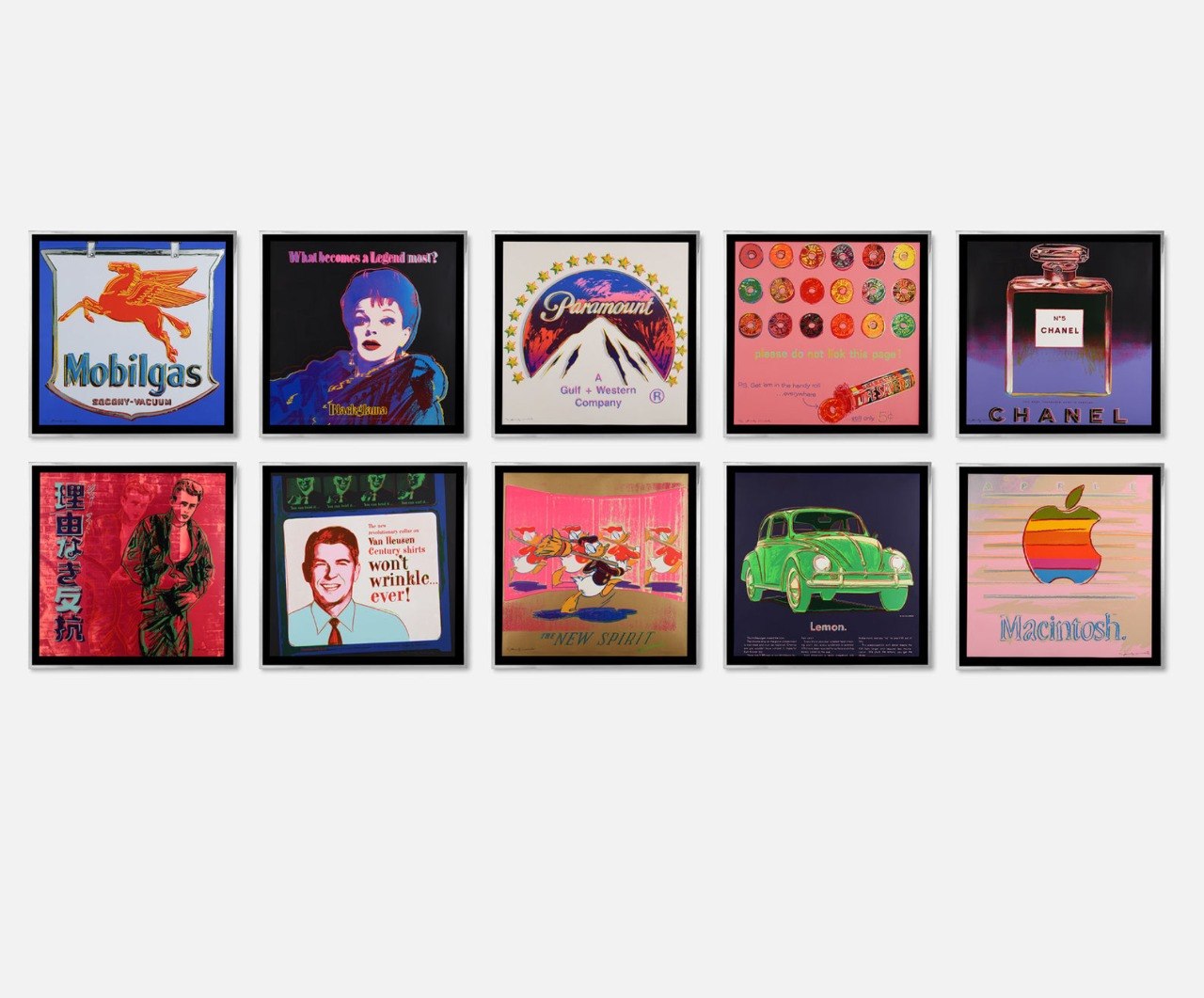
In 1985, two years before his death, Andy Warhol produced one of the most pointed statements of his career. The Ads portfolio — ten screenprints depicting iconic American advertising imagery, from Chanel No.5 to Volkswagen to Ronald Reagan selling shirts — distilled forty years of Pop Art thinking into a single suite. Where the early Campbell's Soup Cans had been provocative and new, Ads was a culmination: a late-career reckoning with the culture Warhol had spent his life both celebrating and dissecting. For collectors seeking Andy Warhol Ads prints for sale, understanding this context — and the technical execution, edition structure, and market performance — is essential before any acquisition.
Inquire About Available Ads Prints Browse the complete Ads portfolio and individual prints currently available through Guy Hepner, New York.
Andy Warhol began his professional life as a commercial illustrator. Before the Factory, before the Velvet Underground, before the silk-screened Marilyns and Maos, he drew shoe advertisements for Glamour magazine and window displays for Bonwit Teller. The craft of advertising — its cheerful reduction of complex human desires into a single, legible image — was the grammar he learned before he made art.
The Ads portfolio, commissioned by Ronald Feldman Fine Arts in New York and published in 1985, returned him to that starting point with thirty years of distance. The ten images he selected were not random consumer goods but a precise edit: brands and cultural icons that had shaped American identity in the twentieth century. A wartime Disney propaganda film. The president of the United States posing in a collar ad. The most famous bottle of perfume in the world. A car synonymous with the counterculture. A candy that had been in production since 1913.
Each subject carries its own freight. Warhol's contribution was to treat them all with the same flat, colour-saturated, photographic equanimity — no hierarchy, no irony declared, no verdict rendered. The viewer supplies whatever they bring to it.
Andy Warhol, Ads Complete Portfolio (F.S. II.350–359), 1985. Ten screenprints on Lenox Museum Board. Available at Guy Hepner, New York.
The Ads portfolio was printed on Lenox Museum Board, an American machine-made cotton paper with a smooth, slightly absorbent surface that holds screenprint ink cleanly and holds its condition well over time. Each print measures 38 × 38 inches (96.5 × 96.5 cm) — the square format Warhol favoured throughout his print career, from the 1967 Marilyn to the 1970 Flowers.
Catalogue designation: Feldman & Schellmann F.S. II.350–359
Edition structure:
Each impression is signed by Warhol in pencil and numbered. The publisher's blind stamp of Ronald Feldman Fine Arts, Inc., New York, and the artist's copyright stamp appear on the verso.
The Trial Proof edition (30 impressions) deserves particular attention. Trial Proofs are produced during the proofing process — before the final numbered edition is printed — and are considered by many collectors to represent the freshest, sharpest impressions, when the screens are at their peak. In the Ads market, Trial Proofs command a clear and consistent premium over numbered edition impressions.
Publisher: Ronald Feldman Fine Arts, Inc., New York Printer: Rupert Jasen Smith, New York City
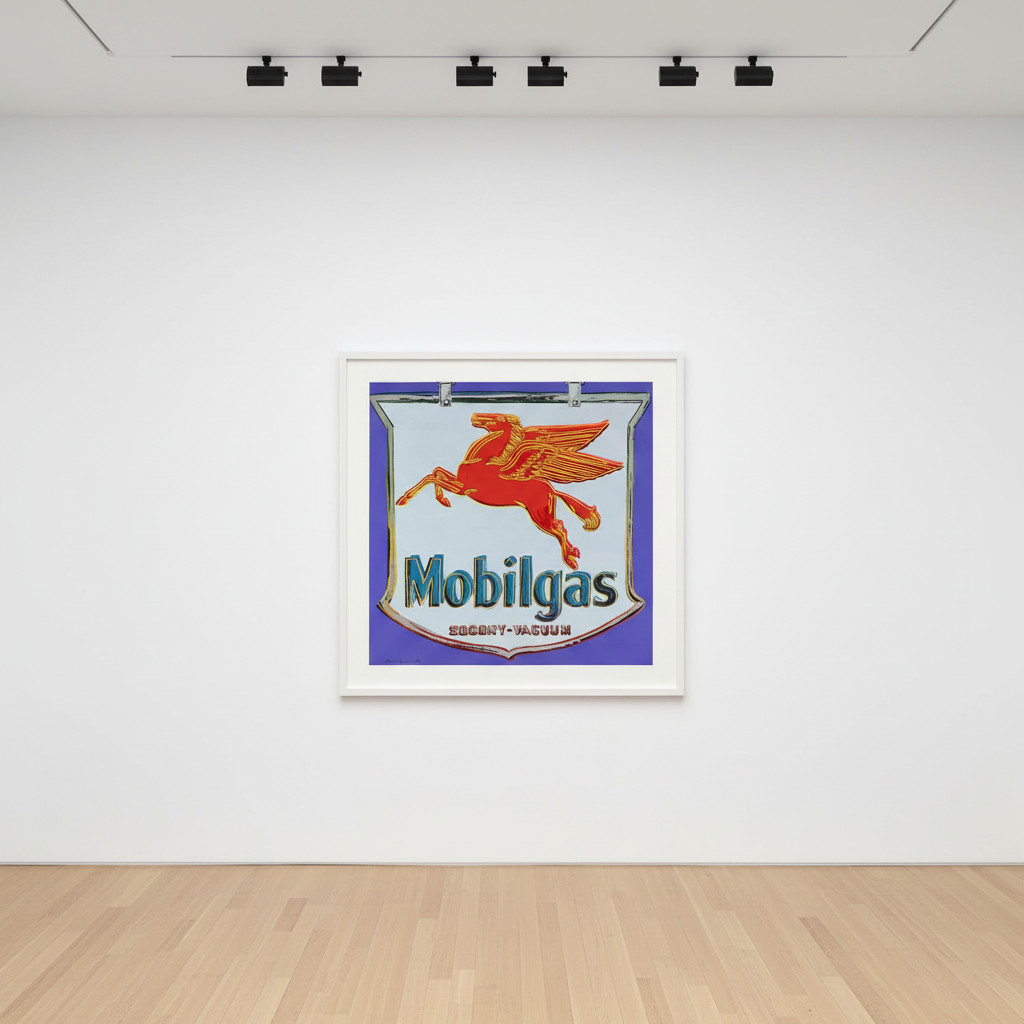 Andy Warhol, Mobilgas (F.S. II.350), 1985. Screenprint on Lenox Museum Board, 38 × 38 inches. Available at Guy Hepner, New York.
F.S. II.350 — Mobilgas The winged red Pegasus of Mobil Oil, one of the most recognisable corporate symbols in American commercial history. Warhol renders it against a flat ground, stripped of its original context — neither petroleum company nor roadside station, just a flying horse in candy red against white, a logo become icon.
F.S. II.351 — Blackglama (Judy Garland)
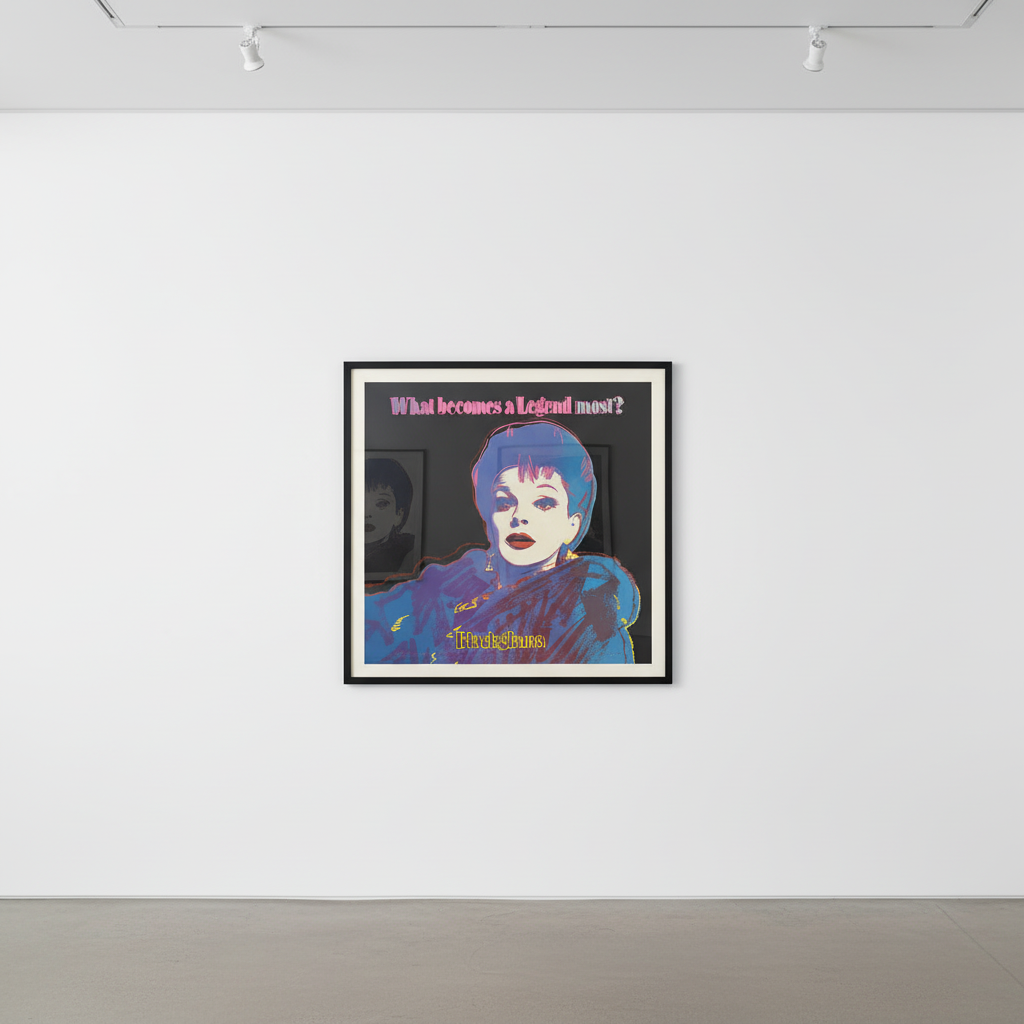
Andy Warhol, Blackglama (F.S. II.351), 1985. Screenprint on Lenox Museum Board, 38 × 38 inches. Available at Guy Hepner, New York.
Blackglama was an American mink fur brand whose What Becomes a Legend Most? advertising campaign ran from 1968 through the 1990s, featuring celebrities photographed draped in fur. Judy Garland was among the first subjects, photographed shortly before her death in 1969. Warhol's inclusion of Garland — gay icon, survivor, tragic figure — gave the print layers of meaning no advertising brief had intended.
F.S. II.352 — Paramount
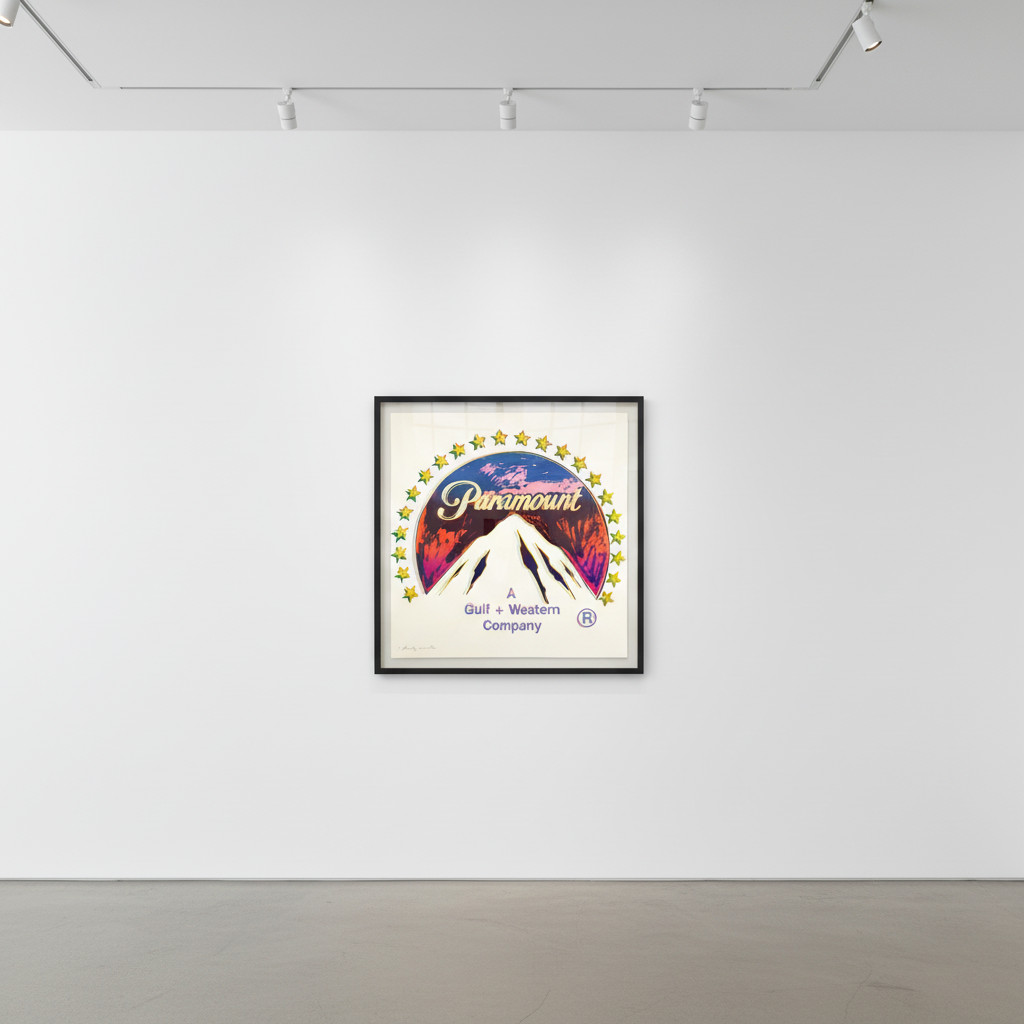 Andy Warhol, Paramount (F.S. II.352), 1985. Screenprint on Lenox Museum Board, 38 × 38 inches. Available at Guy Hepner, New York.
The Paramount mountain — twenty-two stars encircling a peak — is among Hollywood's most enduring symbols. In Warhol's hands it becomes a pure graphic object, the machinery of the dream factory reduced to geometry and colour.
F.S. II.353 — Life Savers
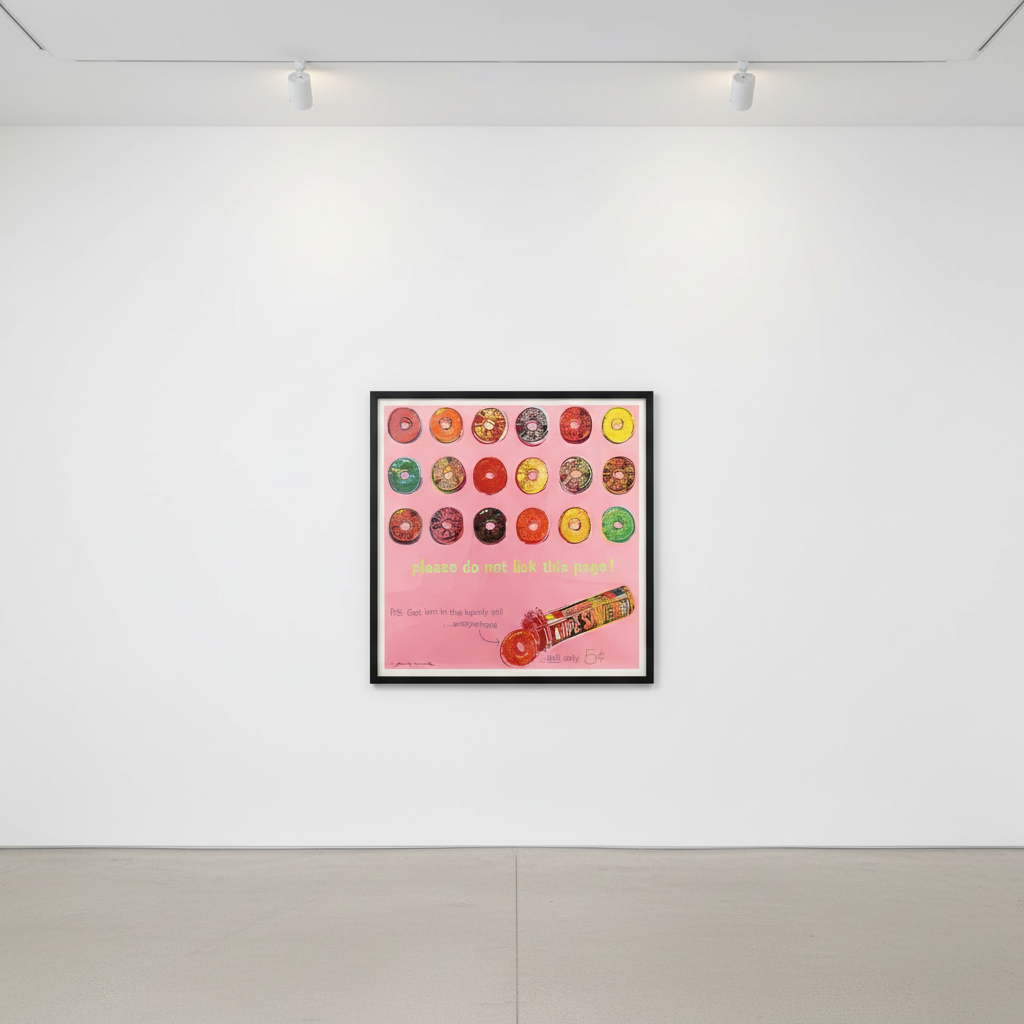 Andy Warhol, Life Savers (F.S. II.353), 1985. Screenprint on Lenox Museum Board, 38 × 38 inches. Available at Guy Hepner, New York.
The Life Savers roll of candy — in production since 1912, its hole designed to prevent choking — becomes under Warhol's treatment a column of chromatic variation, each disc a different colour. The print is one of the most visually arresting in the portfolio, its vertical rhythm and saturated palette making it a natural centrepiece in any installation of the suite.
F.S. II.354 — Chanel
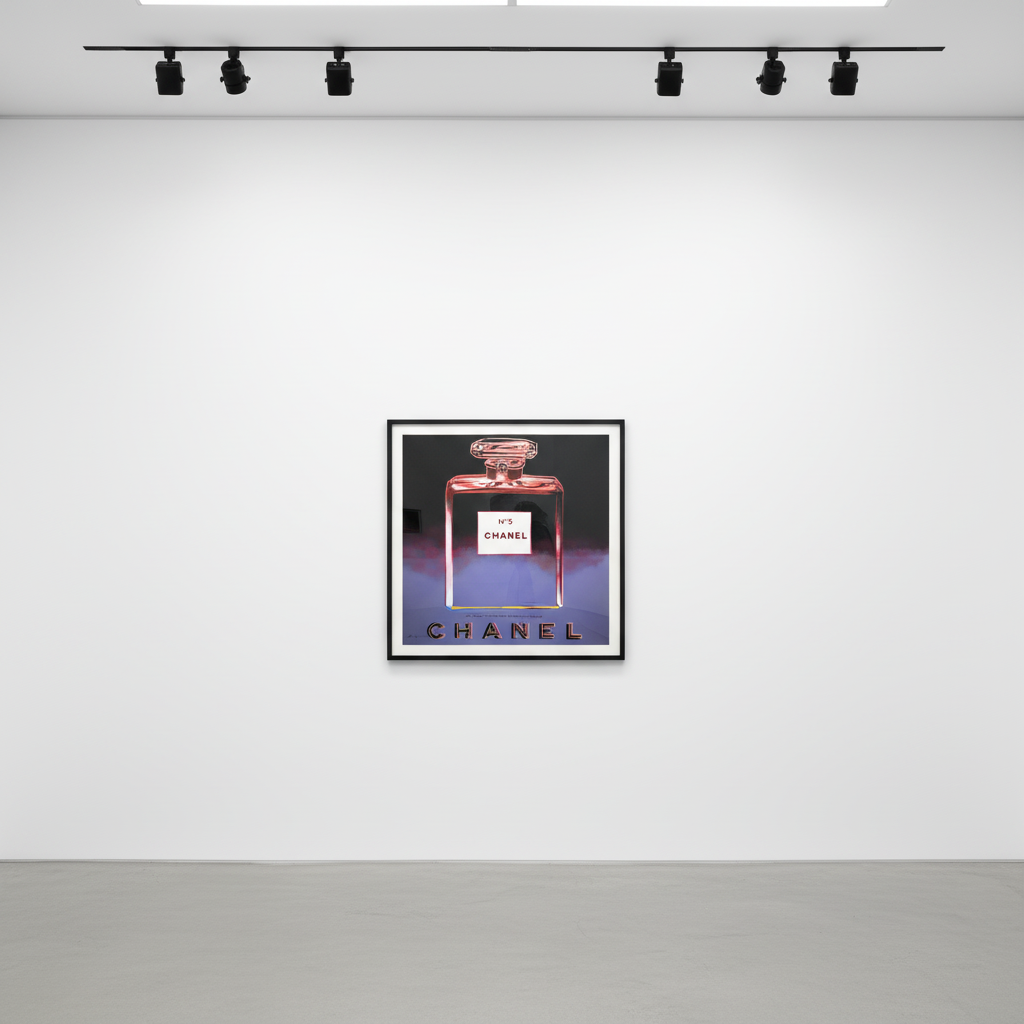 Andy Warhol, Chanel (F.S. II.354), 1985. Screenprint on Lenox Museum Board, 38 × 38 inches. Available at Guy Hepner, New York.
Chanel No.5, introduced in 1921, is the world's most famous perfume — its bottle design, its name, and its advertising history all objects of sustained cultural study. Warhol had depicted luxury goods throughout his career; the Chanel print connects the Ads portfolio to broader conversations about desire, femininity, and the aesthetics of aspiration. It is consistently among the most sought-after individual prints in the series.
F.S. II.355 — Rebel Without a Cause (James Dean)
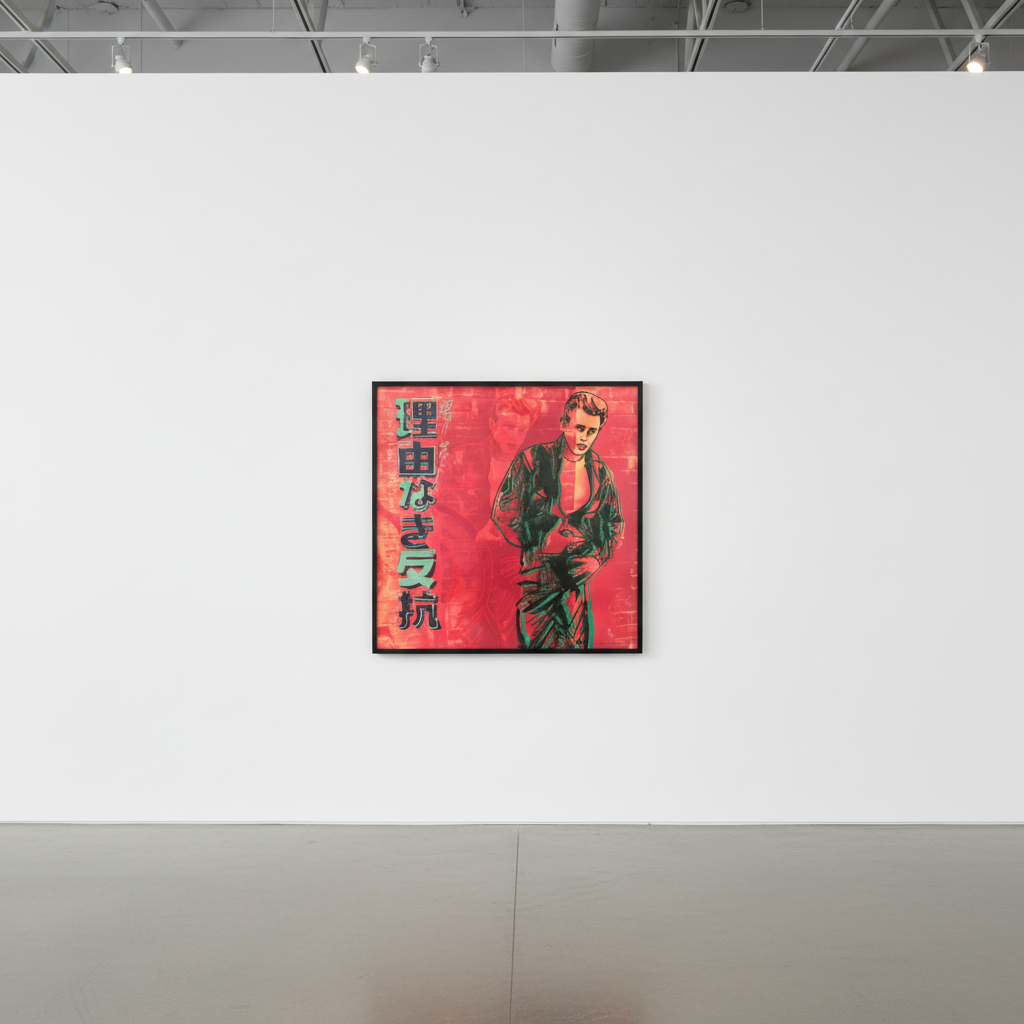 Andy Warhol, Rebel Without a Cause — James Dean (F.S. II.355), 1985. Screenprint on Lenox Museum Board, 38 × 38 inches. Available at Guy Hepner, New York.
James Dean died on 30 September 1955, aged 24, in a car accident in California. The 1955 Rebel Without a Cause film poster — the source image here — had become one of the defining icons of American youth culture. Dean joins Warhol's wider pantheon of beautiful, early-dead celebrities: Elvis, Marilyn, Jackie. The Ads series frames him not as tragedy but as product, a face that could sell a film just as effectively as a logo could sell perfume.
F.S. II.356 — Van Heusen (Ronald Reagan)
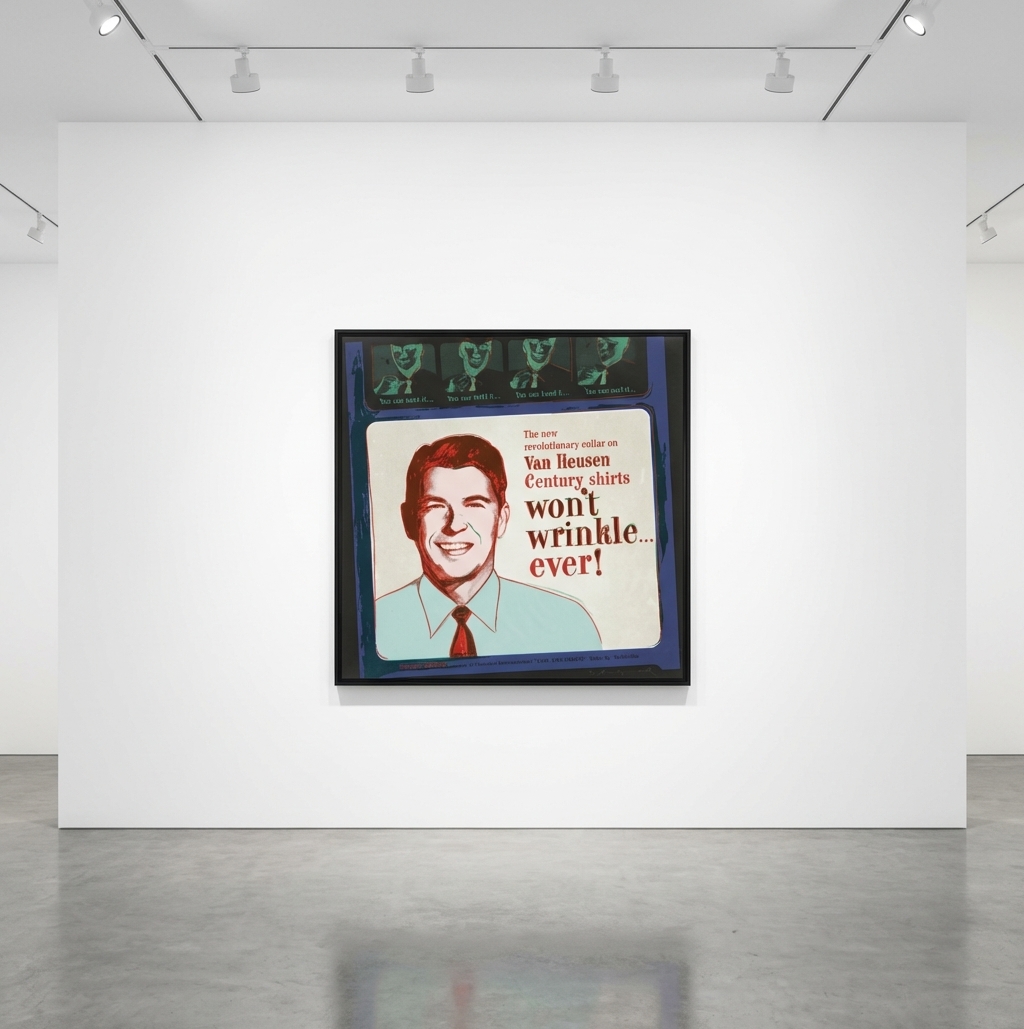 Andy Warhol, Van Heusen — Ronald Reagan (F.S. II.356), 1985. Screenprint on Lenox Museum Board, 38 × 38 inches. Available at Guy Hepner, New York.
Before politics, Ronald Reagan had been an actor — and before acting had made him famous, he had modelled shirts. The Van Heusen collar ad, sourced from Reagan's pre-presidential career, shows him not as Commander-in-Chief but as pitchman. In 1985, when Warhol made this print, Reagan was four years into his presidency. The temporal layering — the young actor, the mature politician, the Pop Art treatment — gives this print a charge that the others in the series do not have.
F.S. II.357 — The New Spirit (Donald Duck)
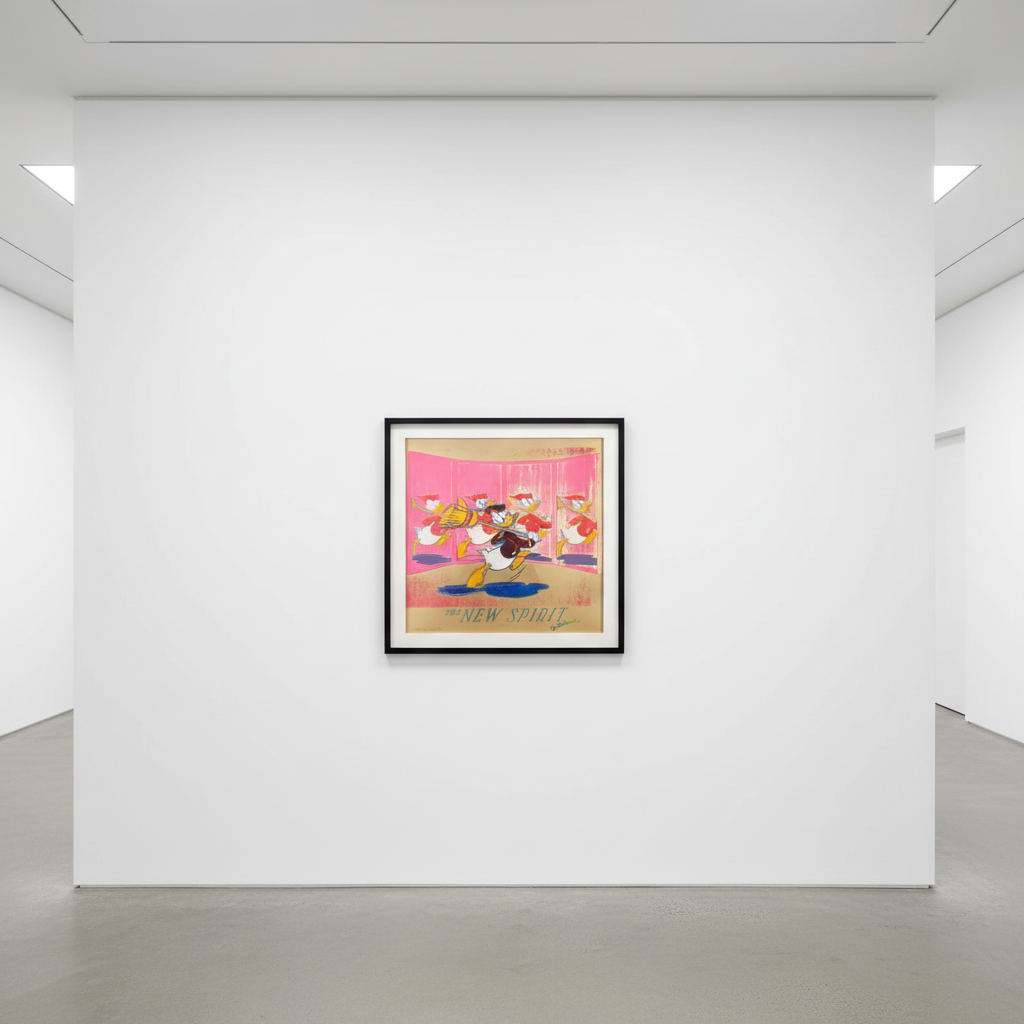 Andy Warhol, The New Spirit — Donald Duck (F.S. II.357), 1985. Screenprint on Lenox Museum Board, 38 × 38 inches. Available at Guy Hepner, New York.
The New Spirit was a 1942 Walt Disney wartime propaganda film, commissioned by the US Treasury Department, in which Donald Duck pays his income taxes to support the war effort. The film reached 32 million Americans in its first five weeks. Warhol's choice of this source — Disney in the service of the government, entertainment in the service of compliance — sits oddly against the cheerful image of Donald in a cape, and is perhaps the most politically layered print in the suite.
F.S. II.358 — Volkswagen
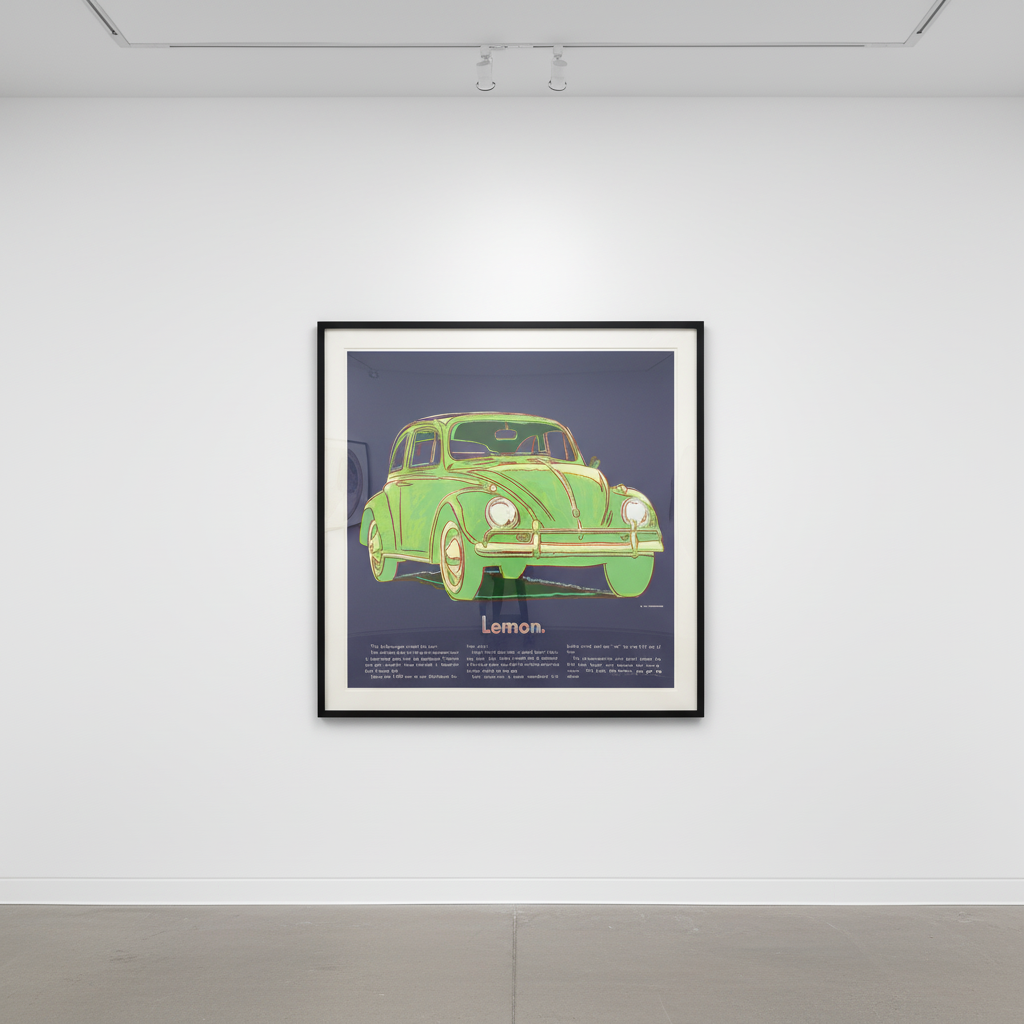 Andy Warhol, Volkswagen (F.S. II.358), 1985. Screenprint on Lenox Museum Board, 38 × 38 inches. Available at Guy Hepner, New York.
The Volkswagen Beetle — designed in 1930s Germany, embraced by the American counterculture in the 1960s, made the subject of one of the most celebrated advertising campaigns in history by the agency Doyle Dane Bernbach. The Think Small campaign, launched in 1959, had sold a German car to a nation that had fought Germany fifteen years earlier. Warhol's Volkswagen print reframes this history: the car as object, the advertisement as art, the foreign as domestic.
F.S. II.359 — Apple
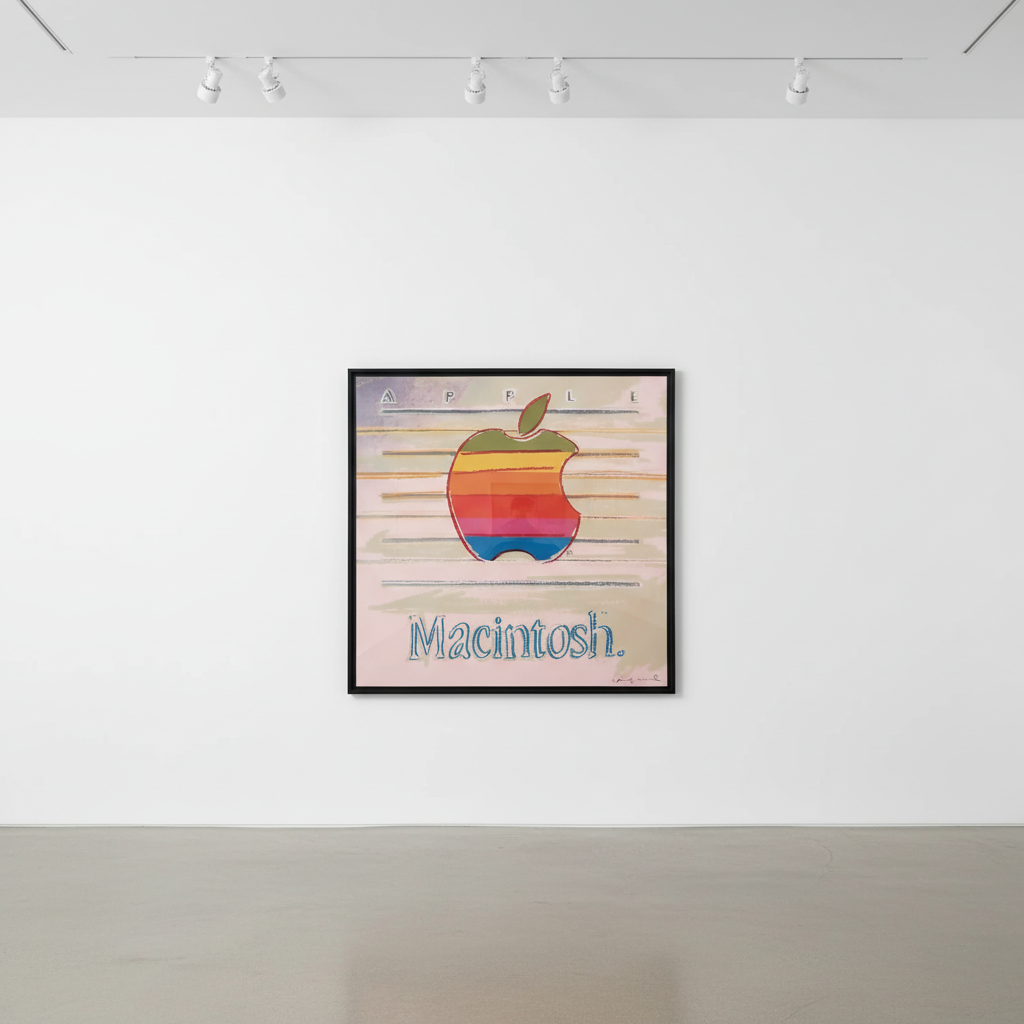 Andy Warhol, Apple (F.S. II.359), 1985. Screenprint on Lenox Museum Board, 38 × 38 inches. Available at Guy Hepner, New York.
The Apple Macintosh had launched in January 1984 — one year before Warhol made this print. The 1984 Super Bowl advertisement, directed by Ridley Scott, had already made Apple's bitten-apple logo one of the most recognised corporate symbols in the world. Warhol was ahead of much of the art world in understanding what Apple represented: not just a computer company, but a new grammar of desire, of aesthetic aspiration, of technology as lifestyle. The Apple print is the most forward-looking image in the portfolio, and its cultural relevance has only increased in the decades since.
Speak With a Specialist Contact Guy Hepner to discuss available Ads prints, Trial Proof availability, and acquisition strategy.
The Ads series has a deep and well-documented auction record — MyArtBroker records 352 auction appearances across the suite — with a clear hierarchy of value that reflects both rarity and cultural resonance.
Trial Proofs vs Numbered Edition
The most significant determinant of price within the Ads market is edition type. Trial Proofs (30 impressions) consistently achieve premiums of 40–100% over comparable numbered edition impressions. Recent results demonstrate this clearly:
Life Savers (F.S. II.353)
The spread between the Trial Proof market ($165,000–$175,000) and the numbered edition market (~$87,500) illustrates the premium collectors place on impression freshness and scarcity within this series.
Mobil (F.S. II.350)
Volkswagen (F.S. II.358)
Van Heusen (Ronald Reagan) (F.S. II.356)
Blackglama (F.S. II.351)
Market context
The Ads series sits in the mid-tier of the Warhol print market — above the signed multiples and smaller editions, below the major portfolio series such as Marilyn or Mao, which command six figures per numbered impression and can exceed seven figures for exceptional proofs. The Ads market has shown consistency rather than dramatic movement: Trial Proof results in the $130,000–$180,000 range and numbered edition results in the $50,000–$100,000 range have held across 2020–2025, suggesting a stable and liquid market rather than speculative pricing.
Authentication
The Andy Warhol Authentication Board (AWAB) closed in 2012 and no longer issues opinions on Warhol's work. For the Ads portfolio, authentication relies on:
Works from the numbered edition of 190 are the most straightforward to authenticate. Trial Proofs require additional verification of the TP numbering against the known range (1/30–30/30).
Condition
Screenprints on Lenox Museum Board are relatively robust, but the following factors affect value significantly:
Complete portfolio vs individual prints
The complete ten-print portfolio (Ads F.S. II.350–359) represents the suite as Warhol conceived it — a coherent argument about American consumer culture, not a collection of disconnected images. Institutional collectors and significant private collections typically seek the complete suite. The portfolio commands a premium over the sum of its individual parts, and complete sets in comparable condition have become increasingly scarce as individual prints are separated over time.
Individual prints are the more accessible entry point. The Chanel, Van Heusen (Ronald Reagan), James Dean, and Apple prints tend to carry the highest demand from collectors who are not buying the complete suite, reflecting their cultural resonance beyond the art market.
Trial Proof vs numbered edition
For collectors with the budget for a Trial Proof, the market case is clear: 30 impressions versus 190 produces a 6:1 scarcity differential, and recent results confirm the premium holds across the suite. For collectors working in the $50,000–$100,000 range, numbered edition impressions in excellent condition represent genuine value given the suite's market consistency.
Condition priority
Across both edition types, condition determines outcome more than any other factor. An excellent numbered impression will outperform a poor Trial Proof at auction and in private sale. Require a condition report from an independent conservator before any significant acquisition, and verify framing history.
What is the Andy Warhol Ads portfolio?
The Ads portfolio is a suite of ten screenprints created by Andy Warhol in 1985, depicting iconic American advertising imagery — Chanel No.5, Mobilgas, Volkswagen, Ronald Reagan for Van Heusen shirts, James Dean in Rebel Without a Cause, and others. Published by Ronald Feldman Fine Arts, New York, and printed by Rupert Jasen Smith. Catalogued as Feldman & Schellmann F.S. II.350–359.
What is an Andy Warhol Ads print worth?
Market value depends primarily on edition type and condition. Trial Proofs (30 impressions per subject) currently achieve $130,000–$180,000 at major salesrooms. Numbered edition impressions (190 copies per subject) range from approximately $50,000 to $100,000 depending on the subject and condition. The Chanel, Van Heusen (Ronald Reagan), James Dean, and Apple prints tend to achieve the upper end of their respective ranges.
Where can I buy Andy Warhol Ads prints?
The Ads series appears regularly at Sotheby's, Christie's, Phillips, and Swann, as well as through specialist Warhol dealers. Guy Hepner Gallery, New York, maintains active inventory across the suite, including both numbered edition and Trial Proof impressions, and handles works from the Ads portfolio through direct private sale.
What is the difference between a Trial Proof and a numbered edition?
Trial Proofs are produced during the proofing stage, before the final numbered edition is printed. They are numbered 1/30–30/30 and are considered by many collectors to represent the earliest, sharpest impressions from each screen. In the Ads market they achieve a consistent premium of 40–100% over comparable numbered edition impressions.
Is the complete Ads portfolio available?
Complete ten-print portfolios in original portfolio boxes are rare and become scarcer as individual prints are separated by successive sales. Guy Hepner maintains relationships with major collectors and can advise on complete portfolio availability. Individual prints from across the suite are more regularly available.
How do I authenticate a Warhol Ads print?
The AWAB closed in 2012. Authentication for Ads prints relies on the pencil signature, the Feldman Fine Arts blind stamp on the verso, catalogue raisonné inclusion (Feldman & Schellmann F.S. II.350–359), and provenance documentation. For any significant acquisition, engage an independent specialist and require full provenance history before purchase.
What are the most valuable prints in the Ads portfolio?
Among individual subjects, the Van Heusen (Ronald Reagan), Life Savers, Mobil, and Volkswagen Trial Proofs have produced the strongest individual results at auction. The Chanel and Apple prints carry strong collector demand from outside the traditional Warhol collector base, reflecting their connection to luxury fashion and technology culture respectively.
Guy Hepner maintains active inventory across the Ads portfolio, including numbered edition impressions and Trial Proofs of multiple subjects. All works are offered with full provenance documentation and condition reports. The gallery is located at 177 Tenth Avenue, New York, and works with collectors internationally.
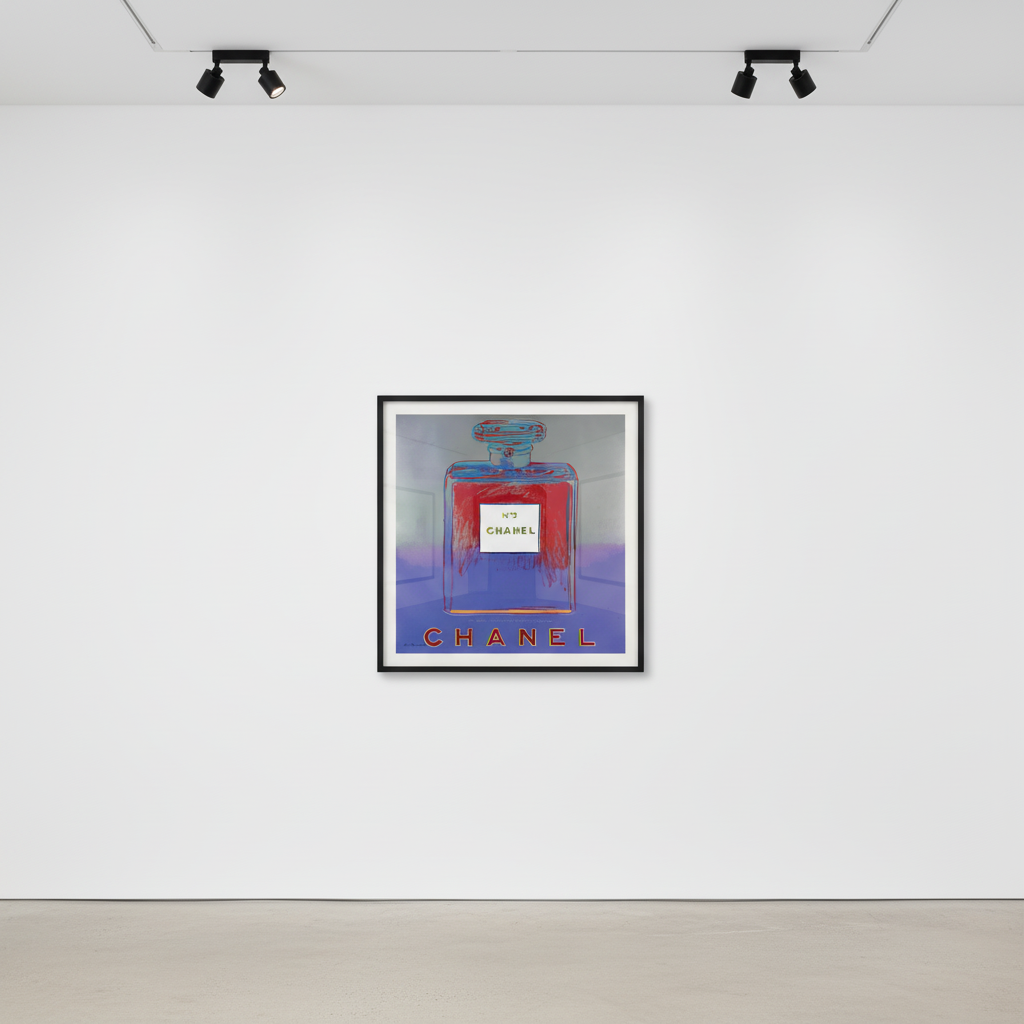 Andy Warhol, Chanel Trial Proof TP 11/30 (F.S. II.354), 1985. Available at Guy Hepner, New York.
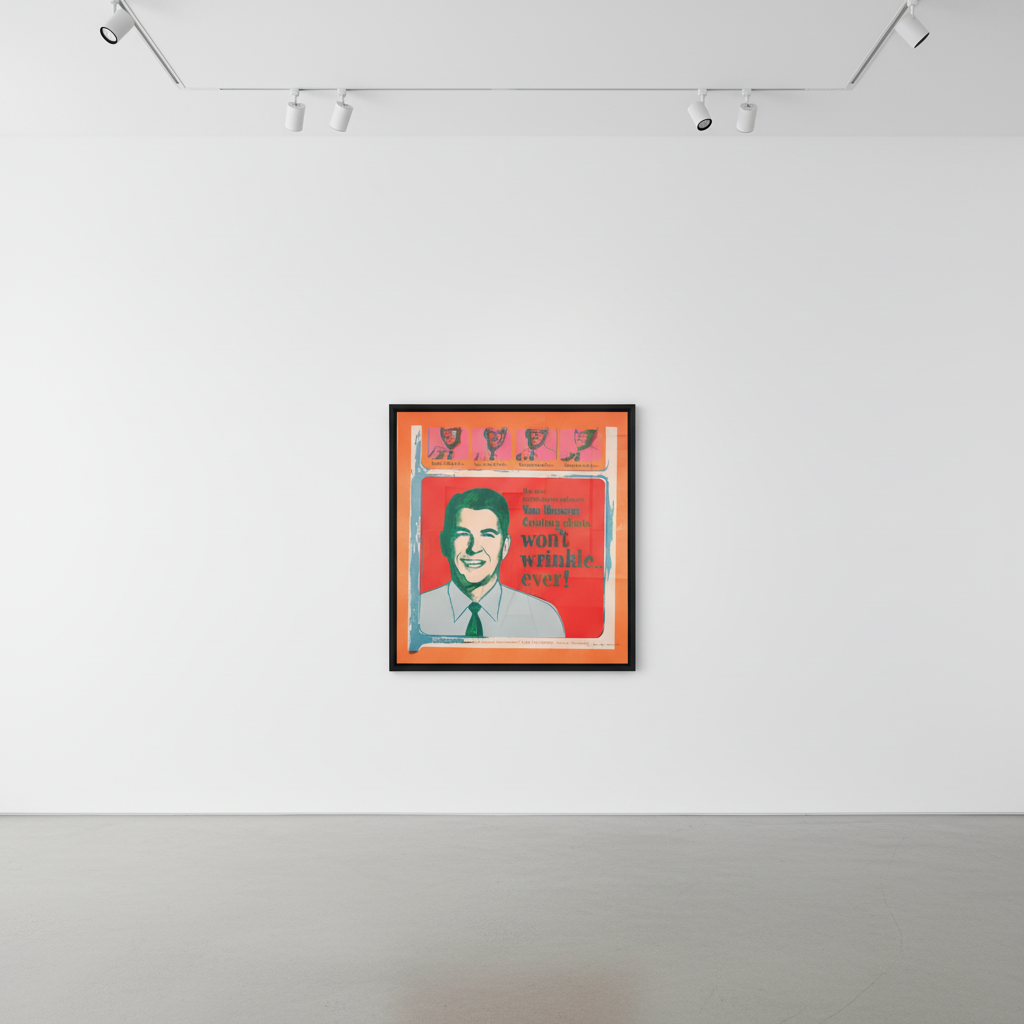 Andy Warhol, Van Heusen — Ronald Reagan Trial Proof 23/30 (F.S. II.356), 1985. Available at Guy Hepner, New York.
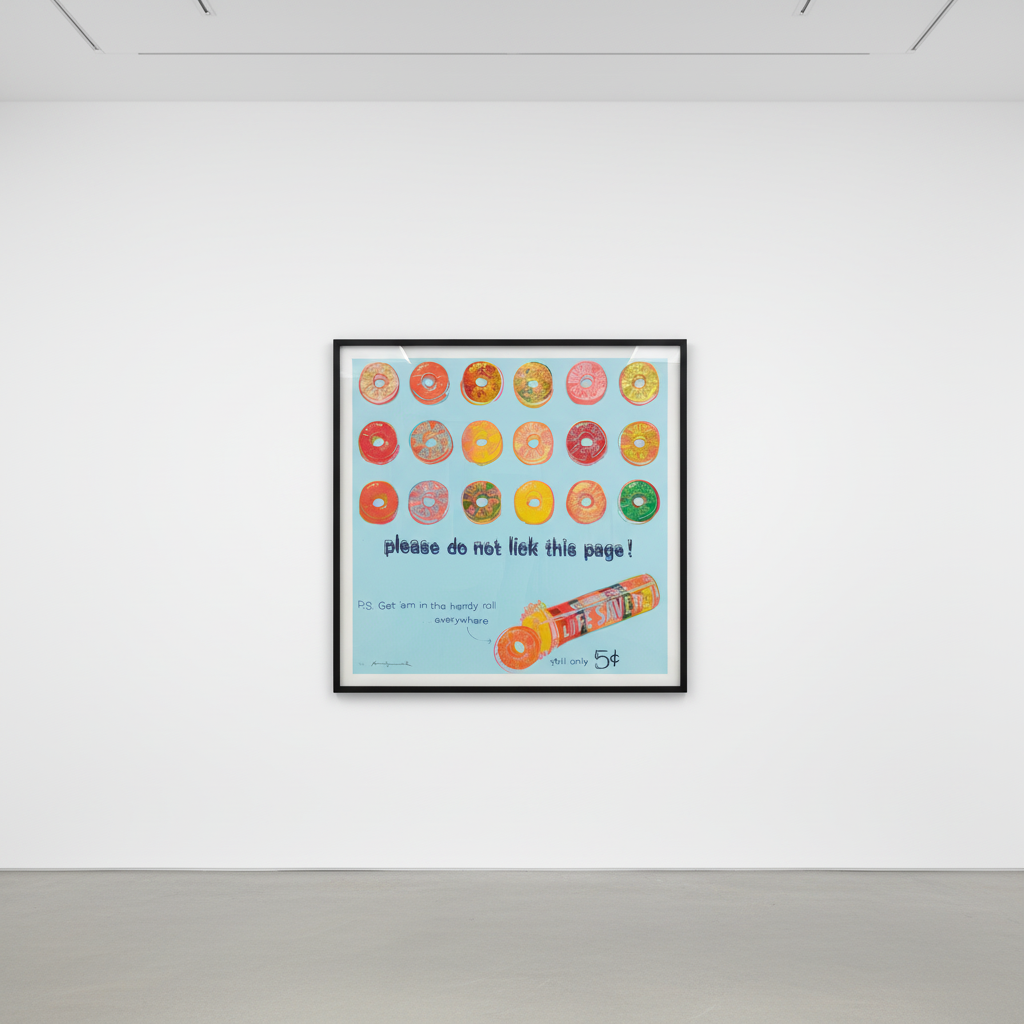 Andy Warhol, Life Savers Trial Proof TP 18/30 (F.S. II.353), 1985. Available at Guy Hepner, New York.
Inquire About Available Ads Prints Browse the complete inventory of Ads prints — numbered editions and Trial Proofs — available through Guy Hepner, New York.
Speak With a Specialist Contact Guy Hepner directly for condition reports, provenance documentation, and acquisition advice on the Ads portfolio.
Guy Hepner | 177 Tenth Avenue, New York
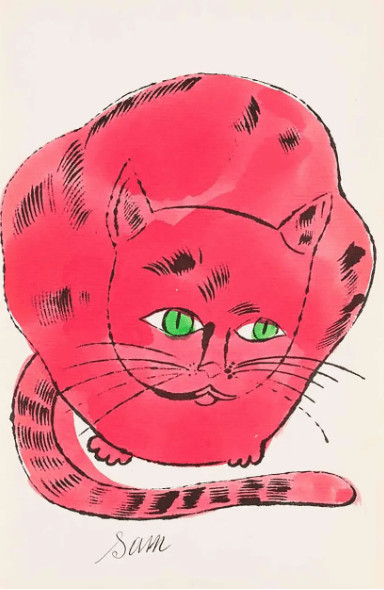
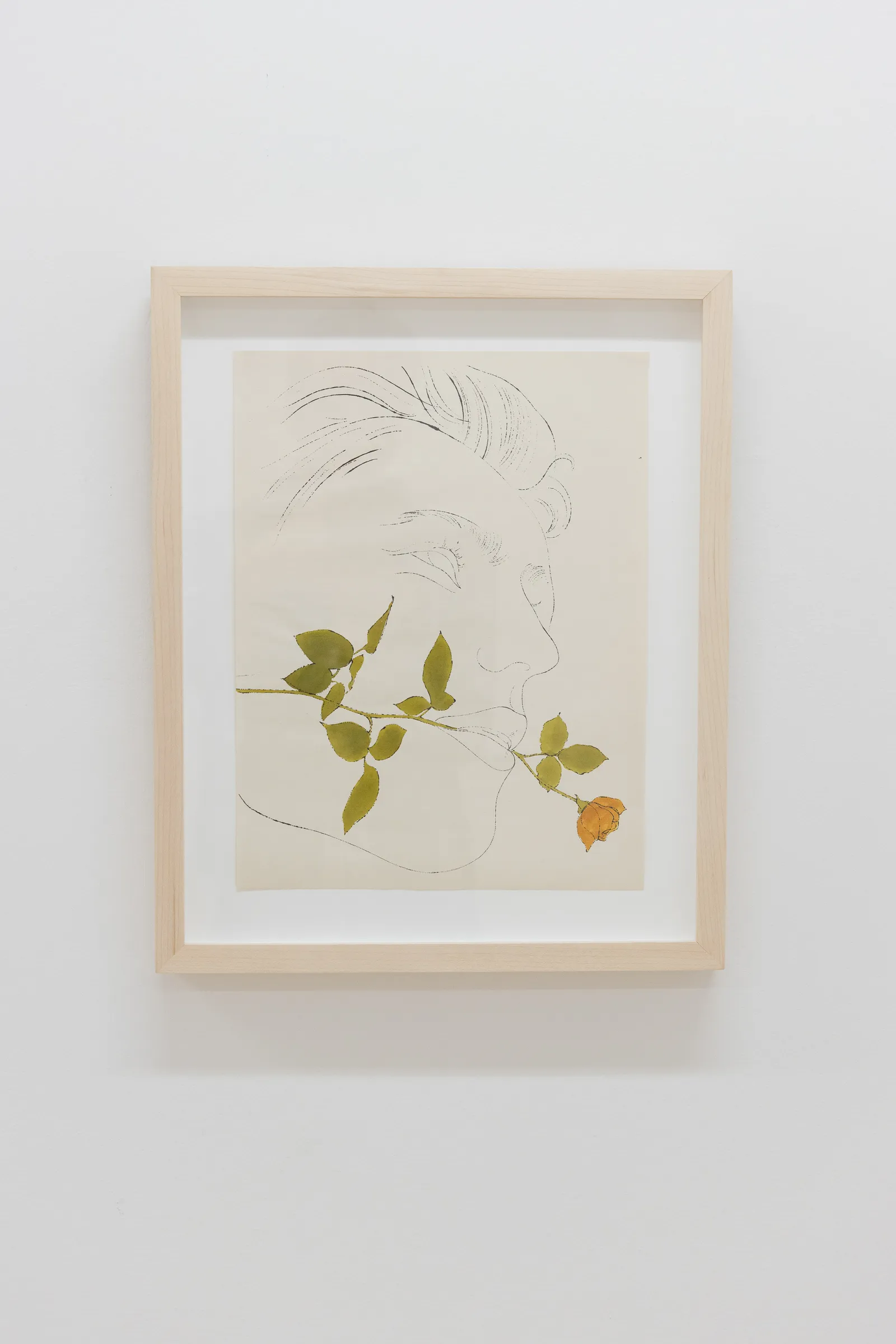
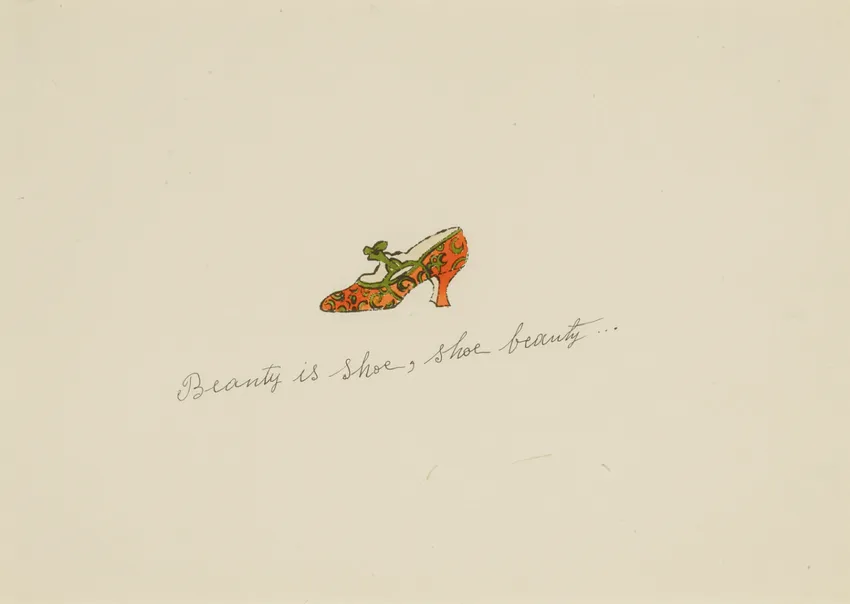
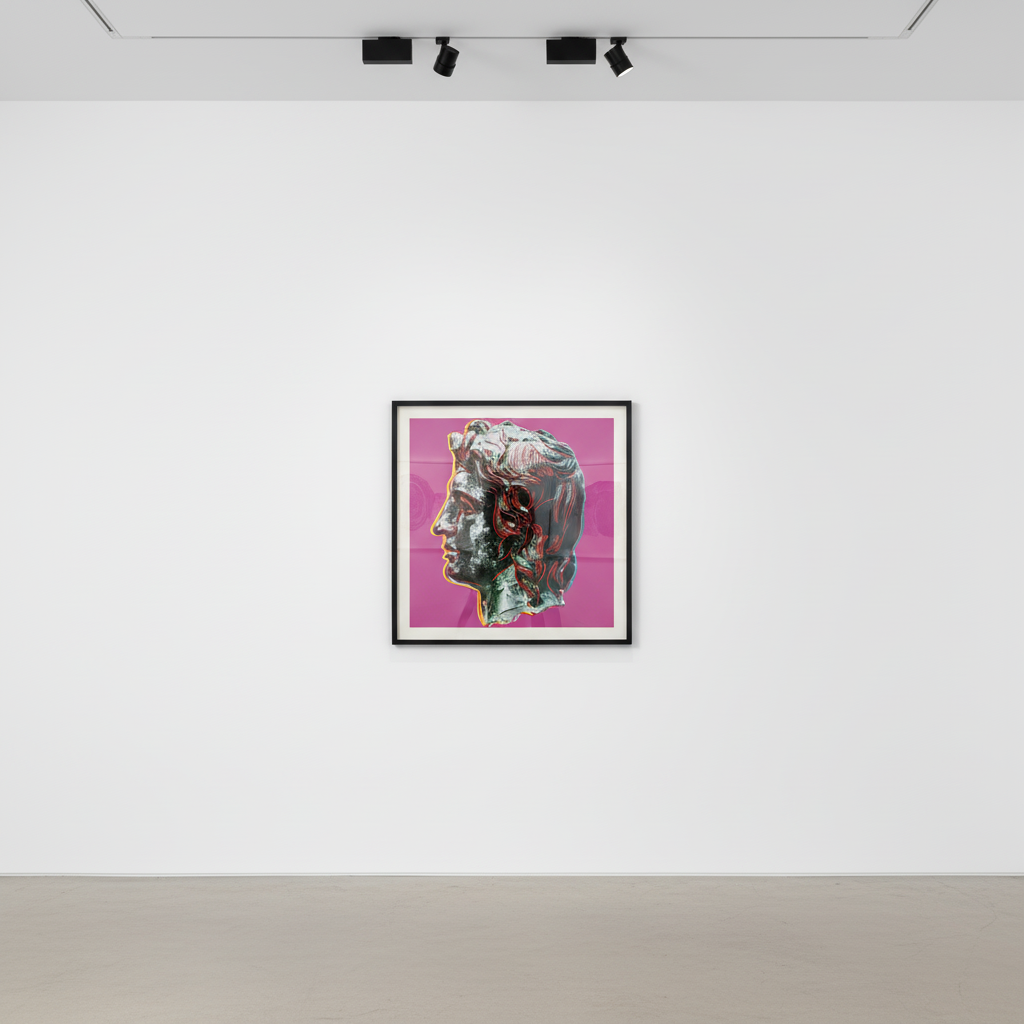
--- **Browse Andy Warhol prints** at Guy Hepner: [Andy Warhol art for sale](/andy-warhol) | [Sell your Warhol](/sell/andy-warhol)Explore Andy Warhol prints for sale at Guy Hepner: 25 Cats Named Sam, A Gold Book, A La Recherche Du Shoe Perdu, Alexander the Great, Banana.
Related Series