Myths

May 15, 2026
There is a self-portrait buried in Andy Warhol's Myths portfolio that most people never notice. The tenth print in the series — The Shadow (F.S. II.267) — depicts not a folkloric witch or a cartoon character but Warhol himself, costumed as the 1930s pulp fiction vigilante whose power was the ability to cloud men's minds. He is barely visible: a dark silhouette, eyes in shadow, half-vanished into the background. The most famous face in the American art world, hiding in plain sight inside a suite of American myths.
It is a typically Warholian move. The Myths portfolio, completed in 1981, is on the surface a celebration of American popular culture — Mickey Mouse, Superman, Dracula, Santa Claus. Look longer, and it becomes something more uncomfortable: an excavation of the images Americans teach their children, the archetypes they use to make sense of power and fear and desire. Warhol understood, better than almost any artist of his generation, that myths are not innocent. They are the operating system of a culture. And in 1981, glittering with diamond dust, he decided to step inside one.
Inquire About Available Myths Prints Individual prints and the complete portfolio available through Guy Hepner, New York.
Myths was commissioned and published by Ronald Feldman Fine Arts, Inc., New York, and printed by Rupert Jasen Smith — the same publisher-printer pairing responsible for the 1985 Ads portfolio. The ten prints were produced in 1981 and are catalogued in Feldman & Schellmann as F.S. II.258–267.
Specifications:
The diamond dust — finely ground reflective particles applied to the surface of the screenprint — is the detail that elevates Myths above most of Warhol's print production. It catches light differently at every angle, giving the prints a quality that reproductions cannot convey: a shimmer that is by turns glamorous and uncanny. Warhol had first used diamond dust in his 1980 Shadows paintings. In Myths, applied to Mickey Mouse and Dracula and Uncle Sam, it does something stranger — it makes the everyday numinous, and the numinous cheap.
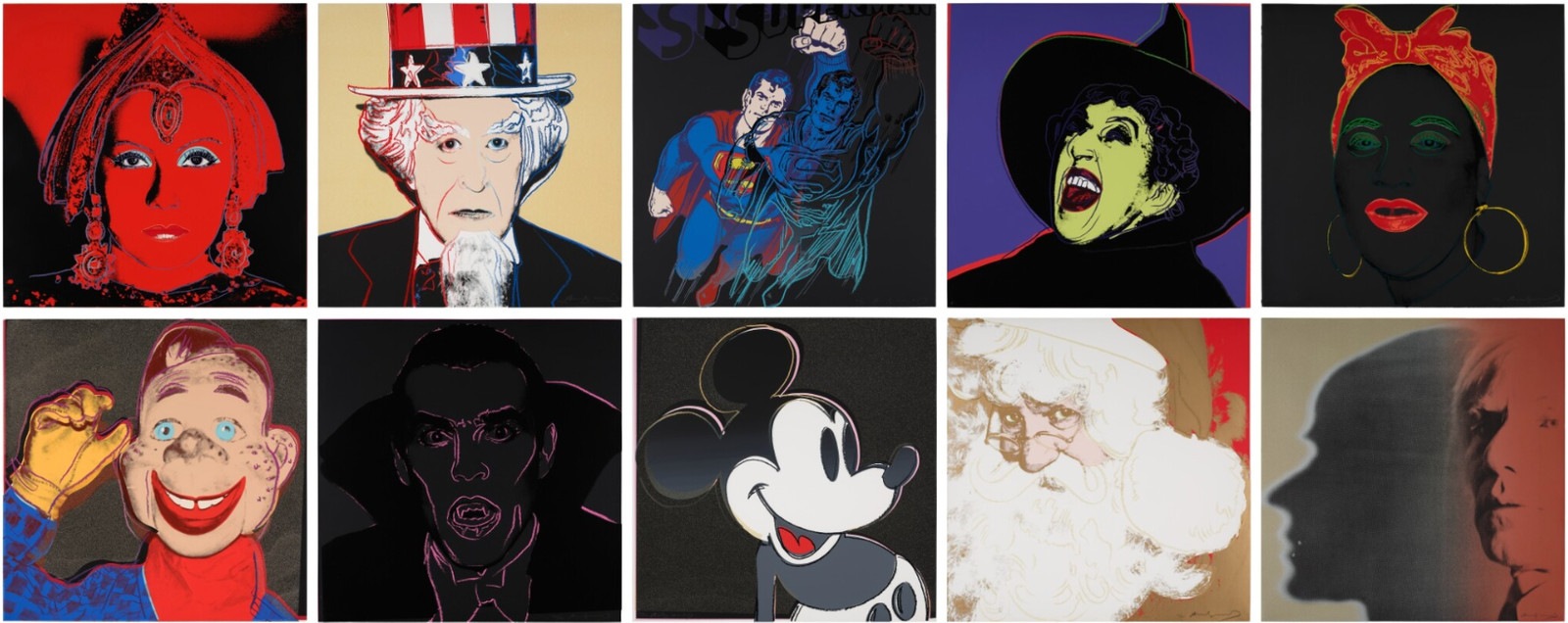
Andy Warhol, Myths (F.S. II.258–267), 1981. Complete portfolio of ten screenprints with diamond dust on Lenox Museum Board. Available at Guy Hepner, New York.
The subjects Warhol selected fall into loose groupings that reveal the series' underlying logic — not a random sampling of popular culture, but a diagnosis of the mythologies Americans live inside.
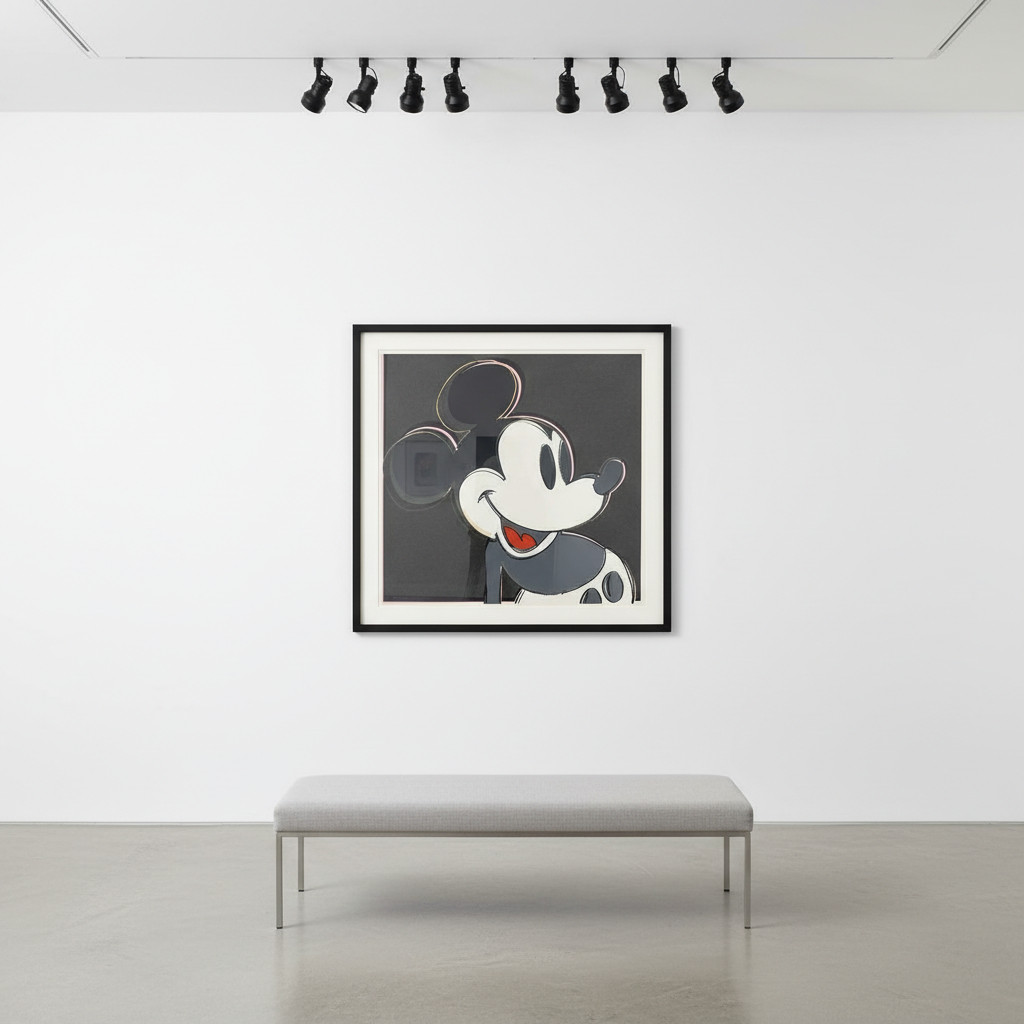 Andy Warhol, Mickey Mouse (F.S. II.265), 1981. Screenprint with diamond dust on Lenox Museum Board, 38 × 38 inches. Available at Guy Hepner, New York.
F.S. II.265 — Mickey Mouse
Mickey Mouse was born in 1928 — the same year as Andy Warhol. This biographical coincidence was not lost on Warhol, who grew up watching Disney's most famous creation and understood what it meant to build an empire on a single image. Mickey's face, reduced by Warhol to its essential components — the ears, the eyes, the grin — is the most immediately legible print in the suite, and the most unsettling. The diamond dust turns Mickey's cheerful red-and-yellow palette into something gilded and strange. It is not quite sinister. But it is not innocent either.
Commercially, Mickey Mouse consistently ranks as the most actively traded print in the Myths series after Superman, with Phillips achieving $201,600 in October 2022 and $326,900 in January 2021.
F.S. II.263 — Howdy Doody
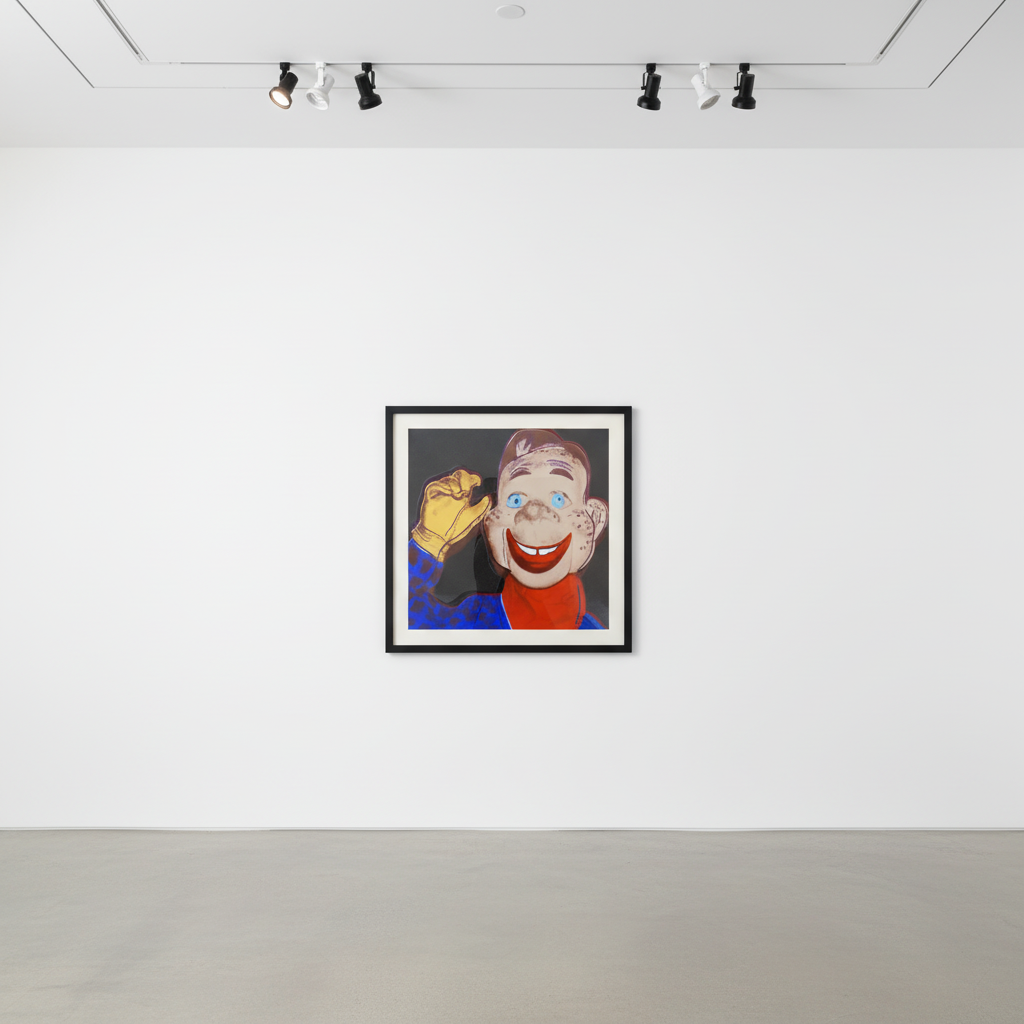 Andy Warhol, Howdy Doody (F.S. II.263), 1981. Screenprint with diamond dust on Lenox Museum Board, 38 × 38 inches. Available at Guy Hepner, New York.
Howdy Doody was the freckled, gap-toothed marionette who hosted one of the first children's television programmes in American history, running from 1947 to 1960. For anyone who grew up with the show, the face is as immediate as a family photograph; for younger collectors, it reads as pure nostalgia at a remove — an image of something that once mattered enormously to people you have never met. That double register — recognition and distance — is precisely where Warhol wanted to be.
F.S. II.266 — Santa Claus
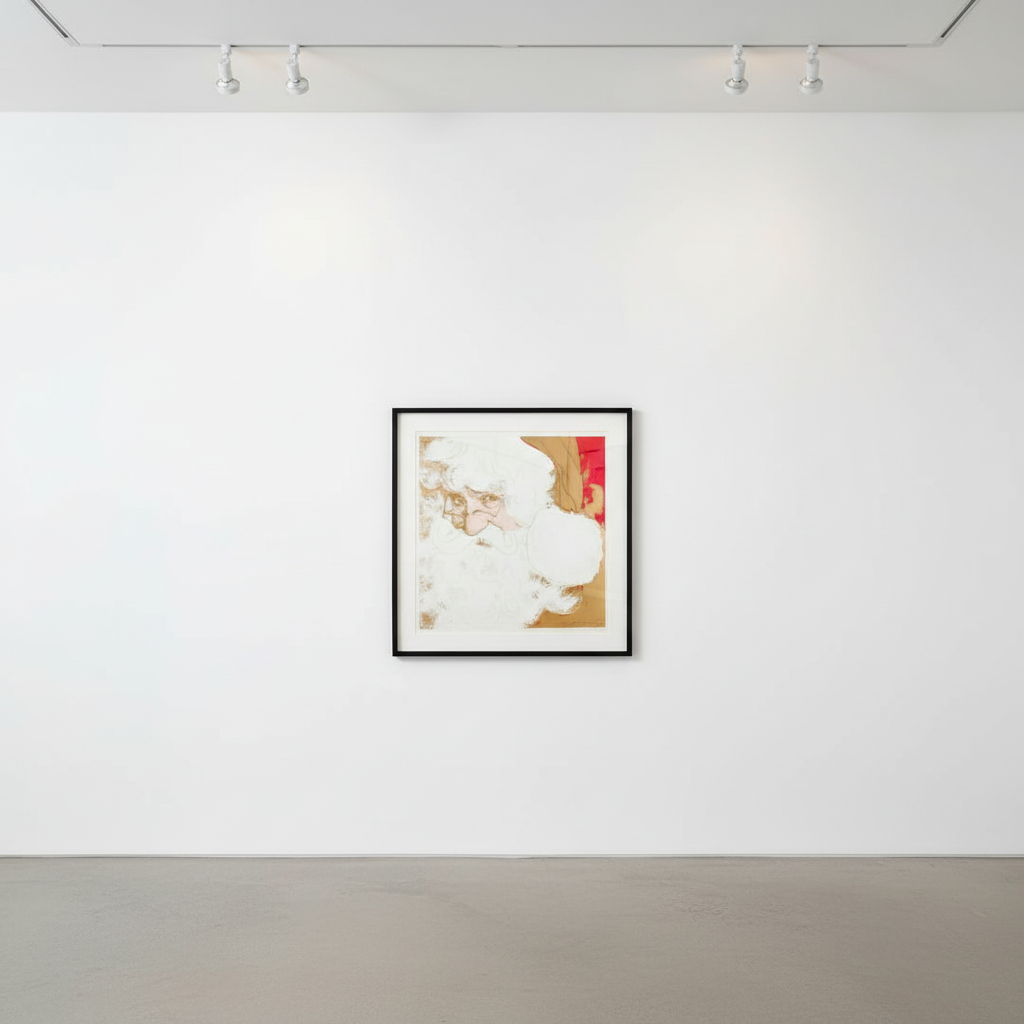 Andy Warhol, Santa Claus (F.S. II.266), 1981. Screenprint with diamond dust on Lenox Museum Board, 38 × 38 inches. Available at Guy Hepner, New York.
The contemporary image of Santa Claus — red suit, white beard, Coca-Cola palette — was substantially shaped by advertising, most notably Haddon Sundblom's illustrations for the Coca-Cola Company from 1931 onwards. In Myths, Warhol presents Santa not as the jolly gift-giver of Christmas cards but as an archetype: the bearded male authority who arrives at night, knows whether you have been good or bad, and distributes rewards accordingly. The diamond dust makes him gleam like a department store window.
F.S. II.259 — Uncle Sam
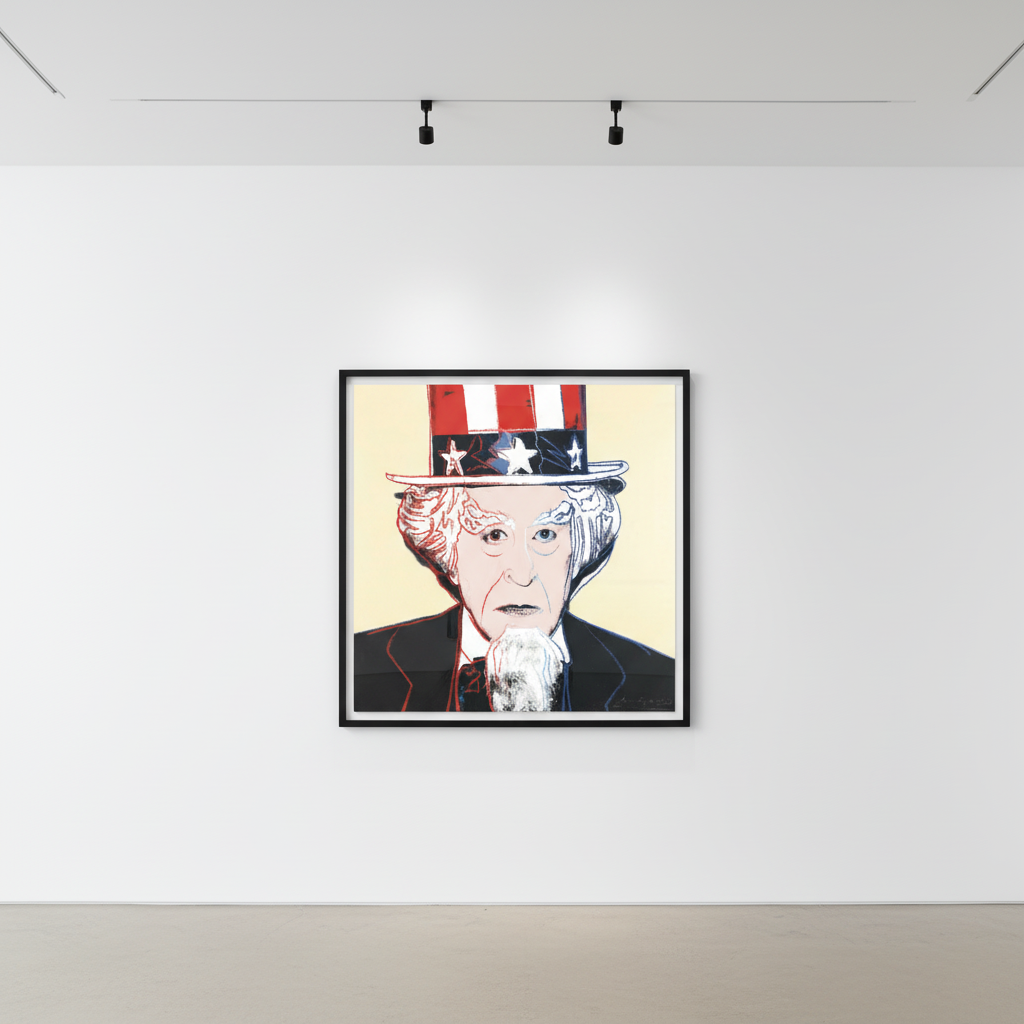 Andy Warhol, Uncle Sam (F.S. II.259), 1981. Screenprint with diamond dust on Lenox Museum Board, 38 × 38 inches. Available at Guy Hepner, New York.
The Uncle Sam image — derived from James Montgomery Flagg's 1917 recruitment poster, itself based on the British Lord Kitchener poster of 1914 — is the American state made flesh: a stern, white-bearded figure in a star-spangled top hat, pointing directly at the viewer. I Want YOU. Warhol's rendition in 1981, Reagan's first year in the White House, was made during a period of pronounced American nationalism. The diamond dust does not soften the pointing finger.
F.S. II.262 — Mammy
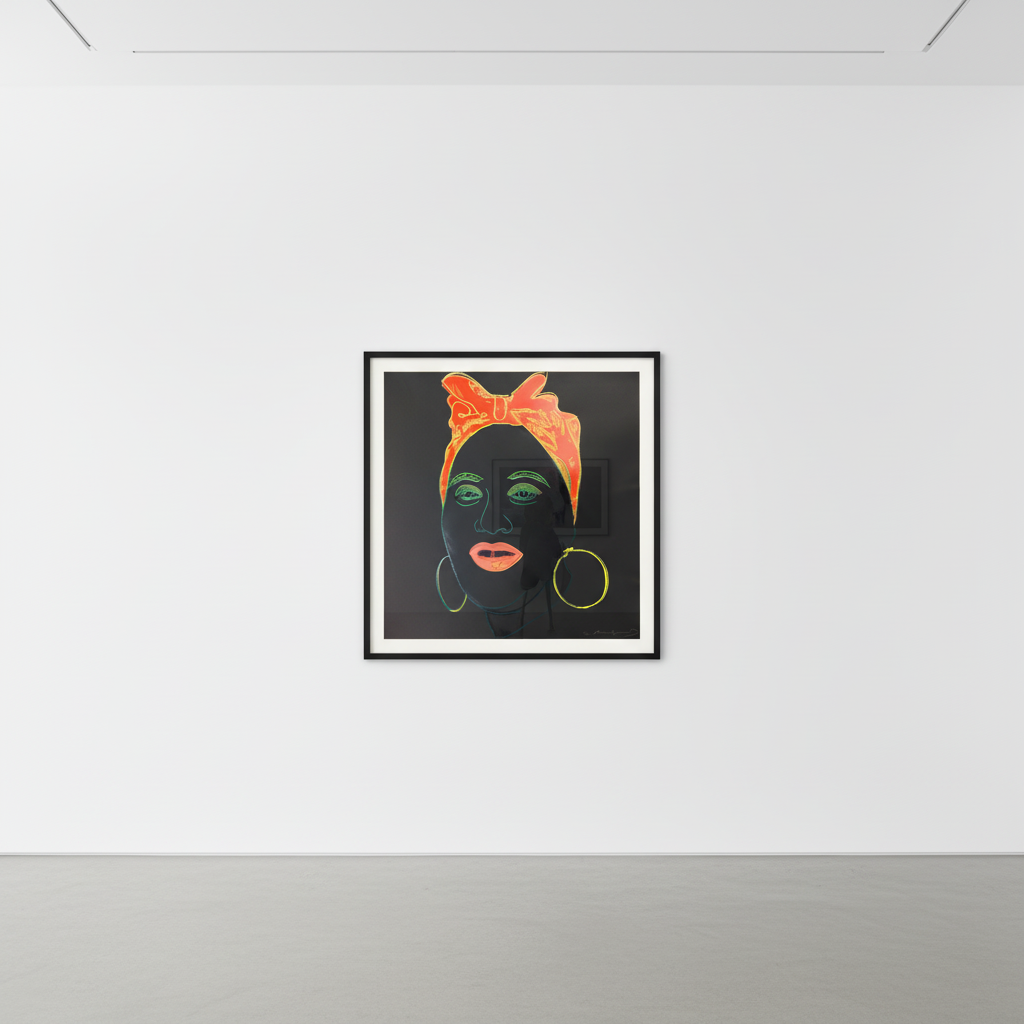 Andy Warhol, Mammy (F.S. II.262), 1981. Screenprint with diamond dust on Lenox Museum Board, 38 × 38 inches. Available at Guy Hepner, New York.
The most contested print in the portfolio. Mammy — the Black domestic caregiver of plantation and post-Civil War American mythology, perpetuated by minstrel shows, advertising, and Hollywood — is a figure with a long and painful history. Warhol's inclusion of Mammy in a suite otherwise populated by entertainment figures and commercial icons raises questions he declined to answer publicly. Whether the image is critique or reproduction has been debated since the portfolio's publication. What is not debated is that it belongs to this particular excavation of American mythology — honestly and uncomfortably.
F.S. II.258 — The Star
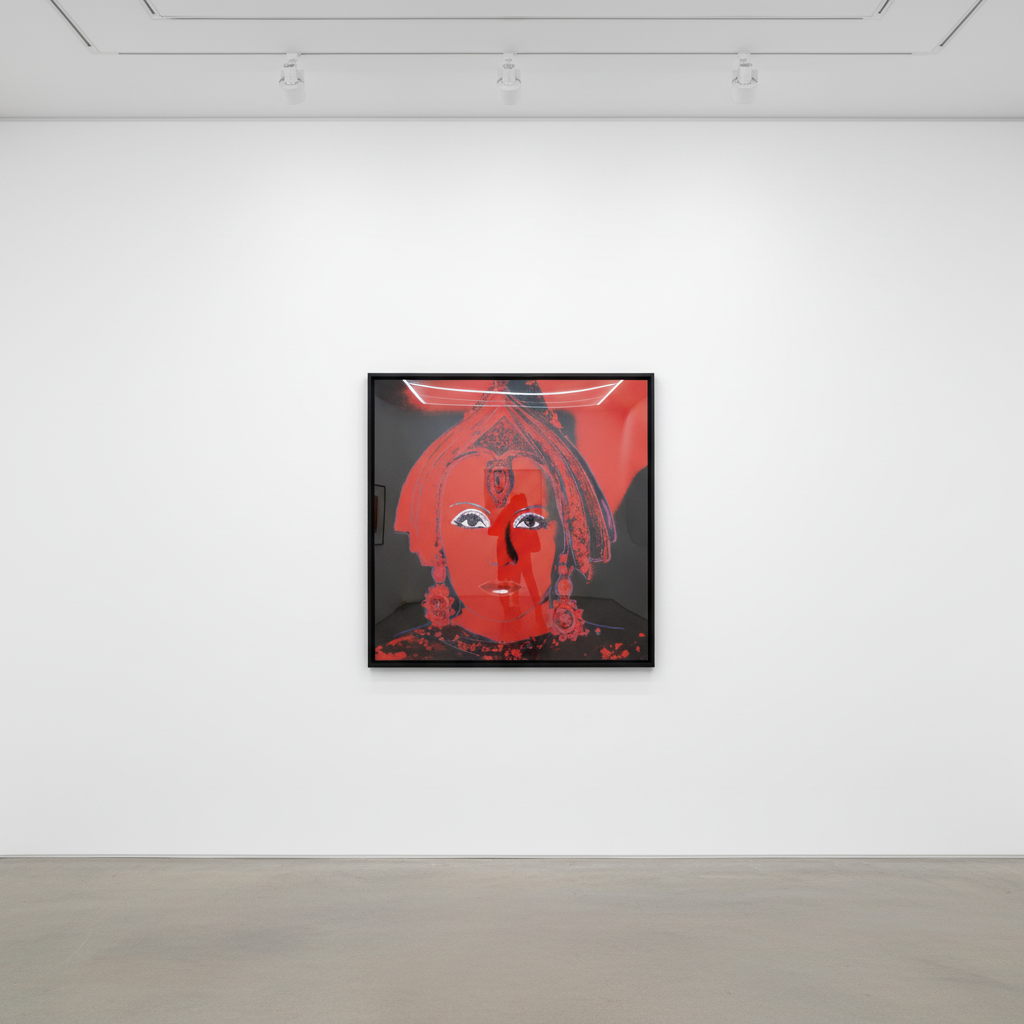 Andy Warhol, The Star (F.S. II.258), 1981. Screenprint with diamond dust on Lenox Museum Board, 38 × 38 inches. Available at Guy Hepner, New York.
The Star depicts Greta Garbo — the Swedish-born actress who became Hollywood's ideal of remote, untouchable glamour, and who then retreated entirely from public life in 1941, aged 35, never to be seen on screen again. She lived another 49 years in near-total seclusion. Diamond dust was invented for images like this: the inaccessible star, glittering and unreachable, made all the more alluring by its distance.
F.S. II.261 — The Witch
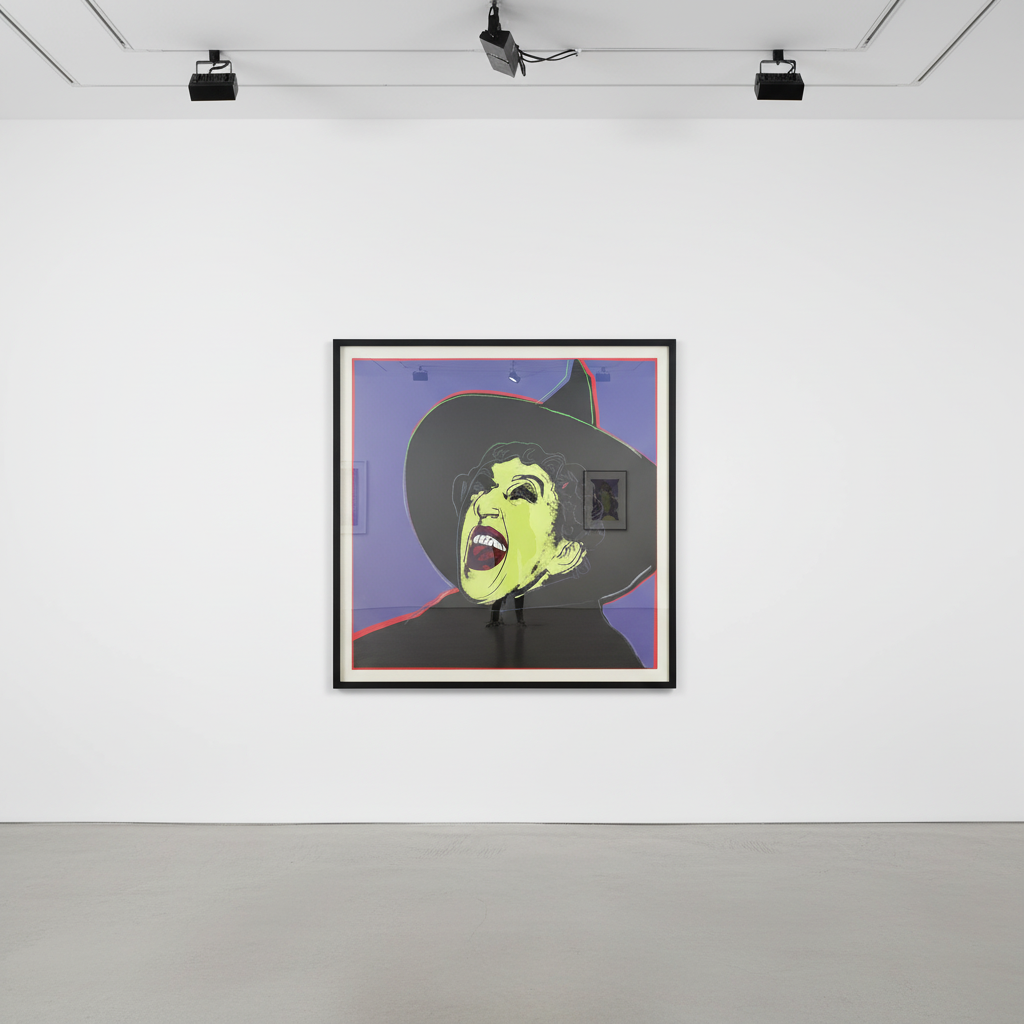 Andy Warhol, The Witch (F.S. II.261), 1981. Screenprint with diamond dust on Lenox Museum Board, 38 × 38 inches. Available at Guy Hepner, New York.
The Witch is derived from Margaret Hamilton's Wicked Witch of the West in The Wizard of Oz (1939): green-faced, black-hatted, malevolent. Children who watched the film in the 1940s and 1950s — when cinema was the primary vehicle of American mythology — were genuinely frightened by her. By 1981, she had become a Halloween archetype, the generic female villain, a fixture on cereal boxes and party costumes. Warhol's diamond dust turns her menace into something glittering and seasonal.
F.S. II.264 — Dracula
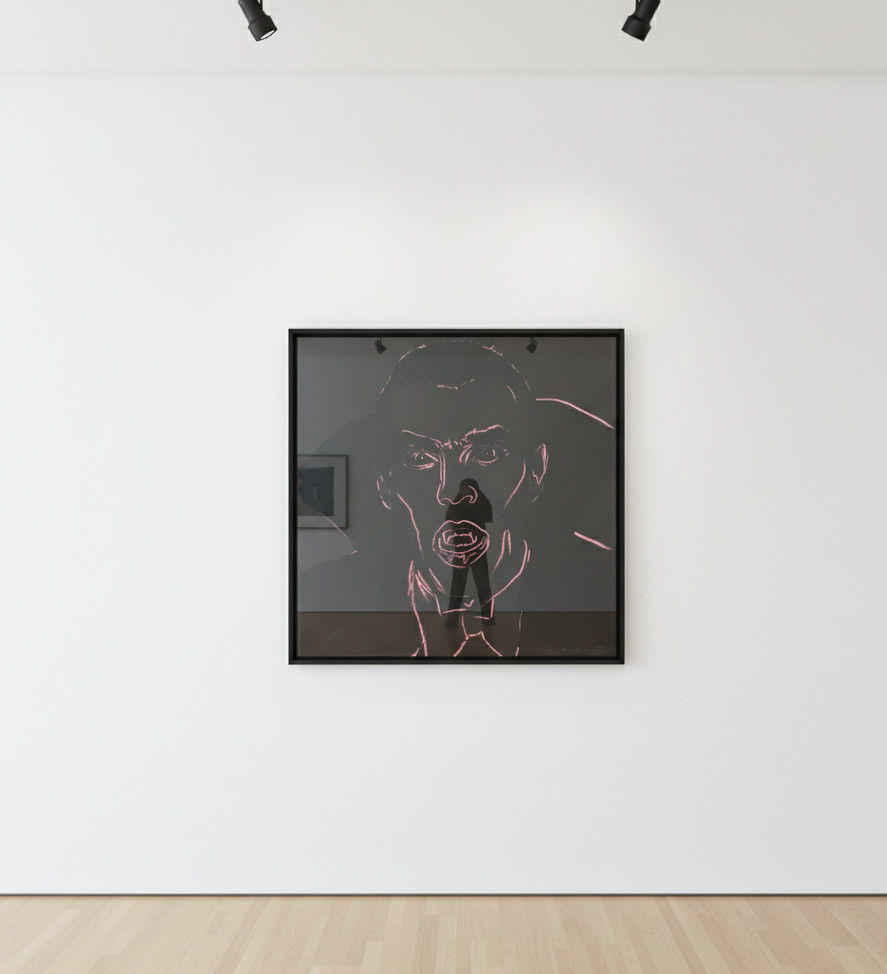 Andy Warhol, Dracula (F.S. II.264), 1981. Screenprint with diamond dust on Lenox Museum Board, 38 × 38 inches. Available at Guy Hepner, New York.
Bram Stoker's Dracula (1897) arrived in American popular consciousness primarily through Bela Lugosi's 1931 film performance — the theatrical cape, the European accent, the widow's peak. Warhol's Dracula is recognisably Lugosi's creature, transplanted into the diamond-dusted lexicon of American myth. It is the only European in the suite, and the only one who predates the twentieth century: an older kind of monster that the American entertainment industry absorbed and made its own.
F.S. II.260 — Superman
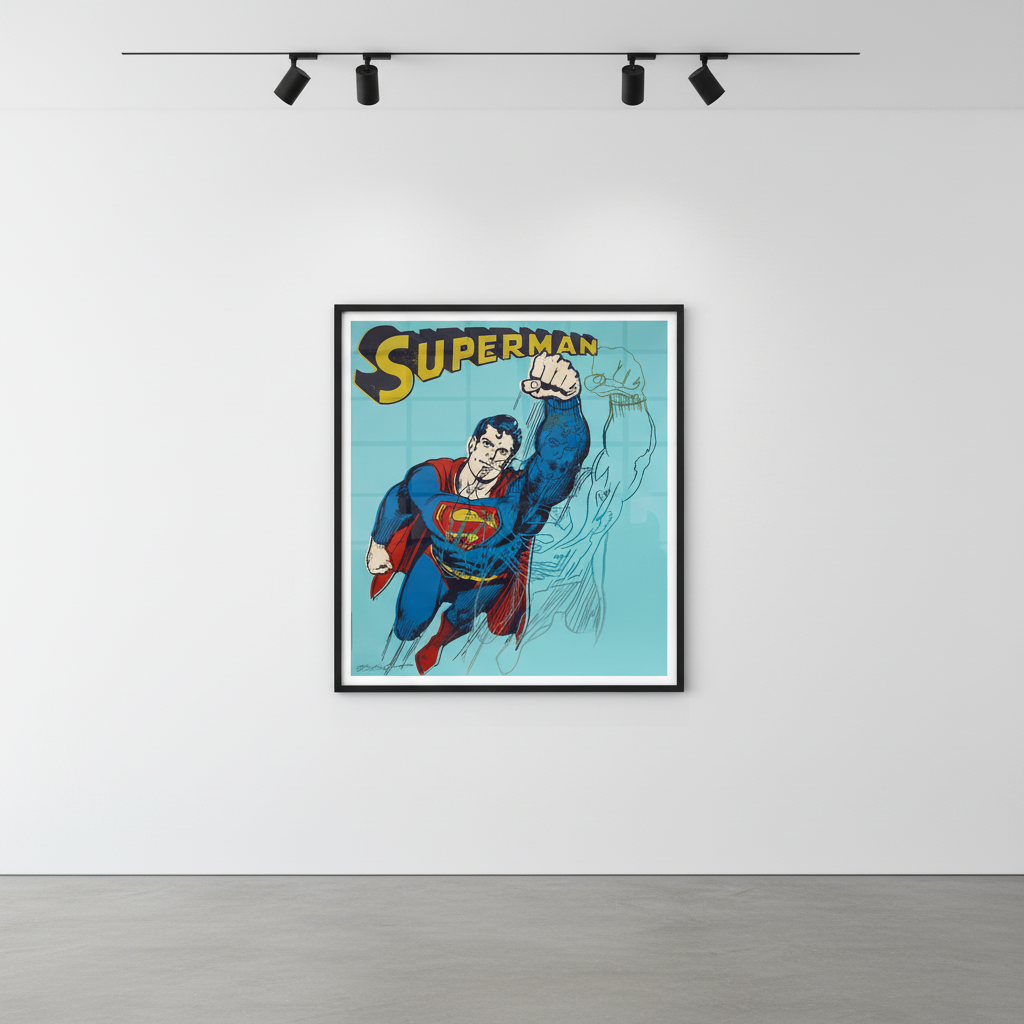
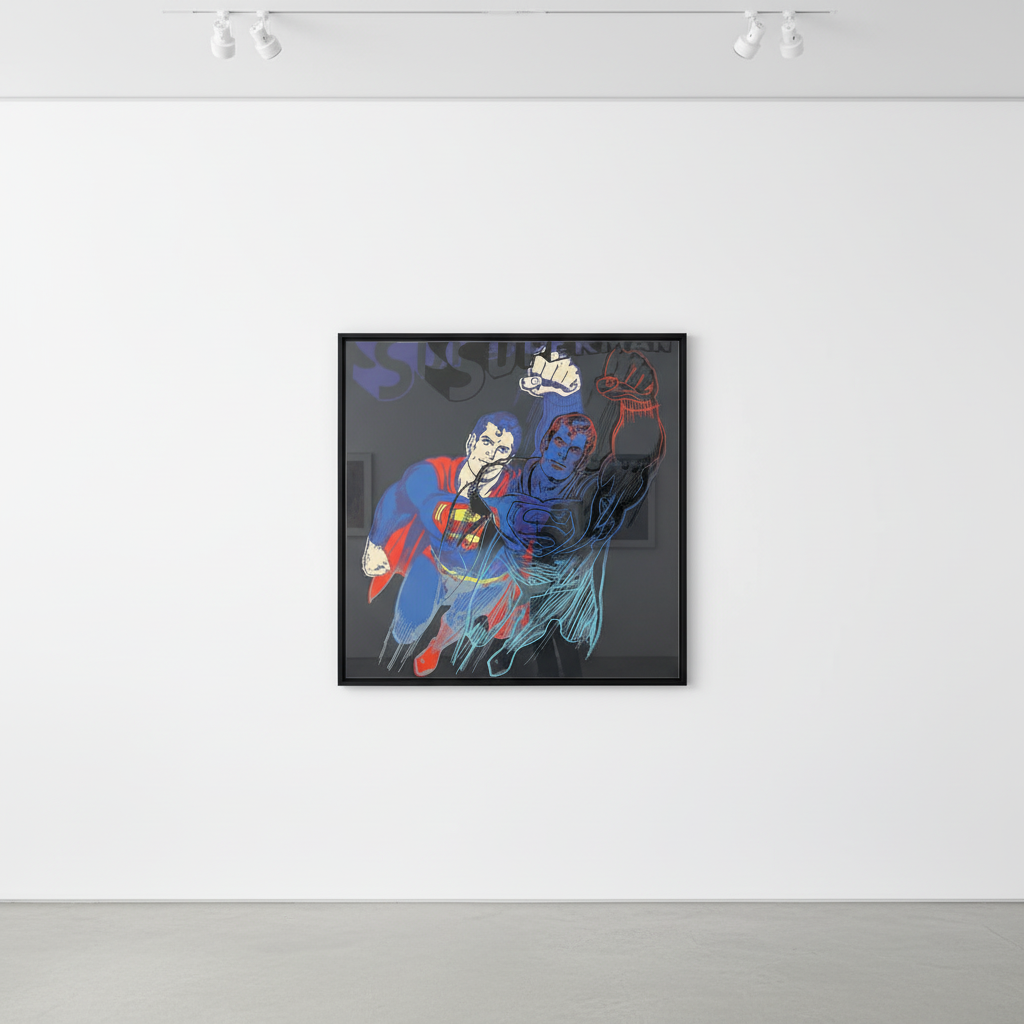 Andy Warhol, Superman (F.S. II.260), 1981. Screenprint with diamond dust on Lenox Museum Board, 38 × 38 inches. Available at Guy Hepner, New York.
Superman — created in 1933 by Jerry Siegel and Joe Shuster, two Jewish teenagers from Cleveland — is the American myth of assimilation made visible. The immigrant outsider who hides his true nature, adopts a new identity, and dedicates himself to the protection of his adopted country. Clark Kent becomes Superman. By 1981, Superman had transcended his comic-book origins to become the American hero archetype: indestructible, just, fundamentally alien pretending to be native. The diamond dust makes him glow.
Superman is also the most commercially significant print in the Myths portfolio by a substantial margin, a fact the market has made unmistakably clear.
F.S. II.267 — The Shadow
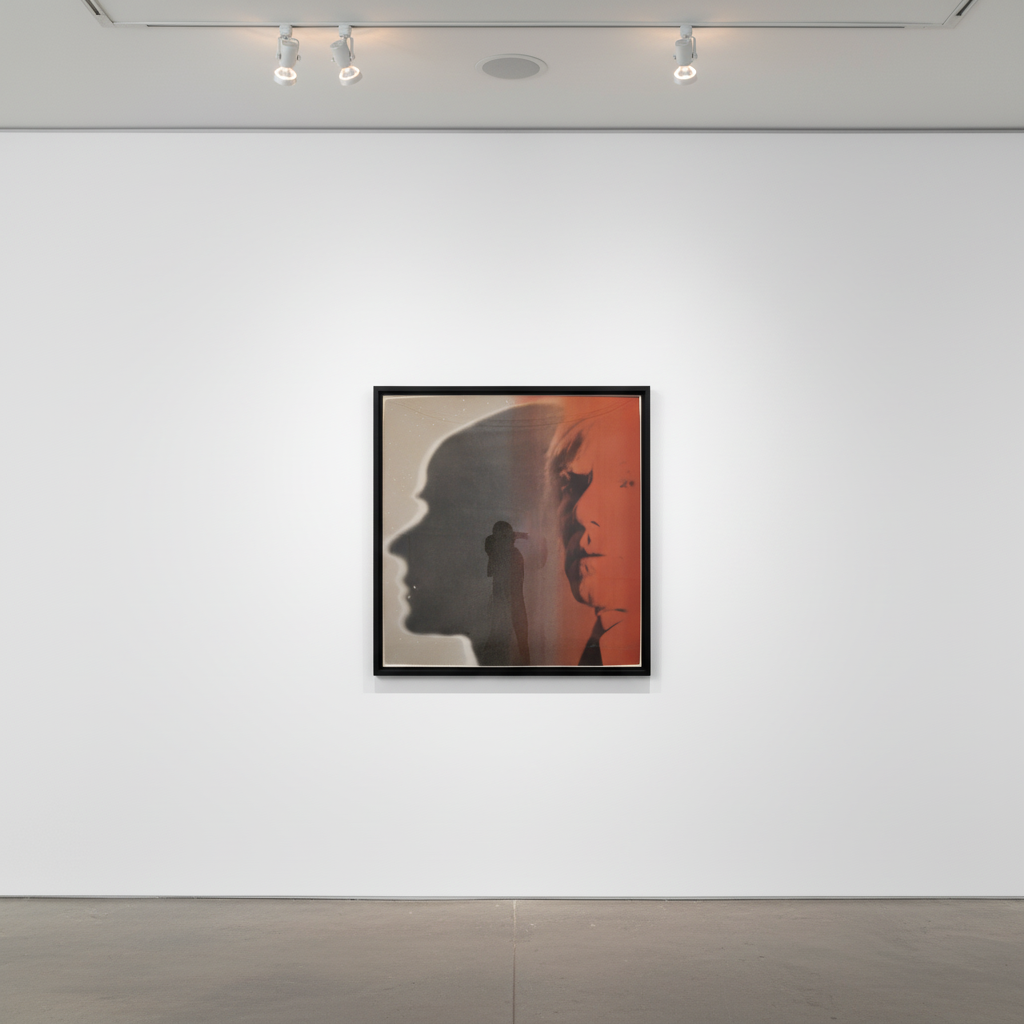 Andy Warhol, The Shadow (F.S. II.267), 1981. Screenprint with diamond dust on Lenox Museum Board, 38 × 38 inches. Available at Guy Hepner, New York.
The Shadow — a character from pulp fiction and radio serials of the 1930s and 40s, whose defining power was the ability to cloud men's minds and become invisible — is Andy Warhol in disguise. It is the only self-portrait in the Myths portfolio, and one of the more self-aware images in Warhol's entire print career. The artist who had spent thirty years perfecting the art of deflection, of hiding behind surface, of being everywhere and nowhere, choosing to depict himself as a figure defined by invisibility. The Shadow does not cloud men's minds. He is the question the whole portfolio asks: what is the relationship between myth and the person who makes it?
The decision to use diamond dust in Myths was not decorative. Warhol had employed the technique in his 1980 Shadows paintings to create works that were both glamorous and hollow — beautiful surfaces with nothing behind them. In Myths, the same material serves a different purpose.
Diamond dust is made from industrial diamonds crushed to a fine powder and applied to the wet ink surface of a screenprint. Under direct light it produces a brilliant shimmer; in ambient light it recedes to a subtle texture. The effect varies dramatically depending on how the work is installed and lit — a Myths print in a dimly lit room is a different object from the same print under gallery lighting.
For collectors, diamond dust has practical implications. It is fragile: improper handling, aggressive cleaning, or poor framing can dislodge particles and diminish the shimmer effect that is central to the works' character. Original framing with UV-protective glazing that does not press against the surface is strongly preferable. Condition reports for Myths prints should specifically address diamond dust retention.
Speak With a Specialist Contact Guy Hepner to discuss available Myths prints, condition, and acquisition strategy.
The Myths series has one of the most clearly stratified markets in the Warhol print catalogue. Superman sits alone at the top; Mickey Mouse follows at a significant distance; the remaining eight prints occupy a broad mid-tier with their own internal variations.
Superman (F.S. II.260) — Market leader
The results speak plainly:
Trial Proofs:
Numbered edition:
No other print in the Myths portfolio comes close to these figures. The gap between Superman and the rest of the suite is one of the larger value asymmetries in Warhol's printed work — a reflection of Superman's unique cultural status as the defining American superhero, and of his particular resonance within Warhol's career (the 1981 Myths Superman is related to Warhol's earlier Superman screenprints of the 1960s).
Mickey Mouse (F.S. II.265)
The mid-tier — The Star, The Witch, Santa Claus, Uncle Sam, Mammy, Howdy Doody, The Shadow
The Star Trial Proofs:
The Witch Trial Proofs:
Santa Claus (F.S. II.266):
Uncle Sam (F.S. II.259):
Mammy (F.S. II.262):
Howdy Doody (F.S. II.263):
The Shadow (F.S. II.267):
Dracula (F.S. II.264):
Within the mid-tier, The Star and The Witch Trial Proofs have shown the most consistent recent strength at $60,000–$83,000. Dracula consistently achieves the lowest results — a reflection not of the print's quality but of the narrower collector appetite for that specific subject.
Complete portfolio
The complete ten-print suite (F.S. II.258–267) appears at auction infrequently. A rare complete portfolio offered at Heritage Auctions in October 2023 carried an estimate of $300,000–$800,000. Complete portfolios in original portfolio boxes, with the colophon page, command a substantial premium over the sum of their parts and are sought primarily by institutional collectors and major private collections.
As with all Warhol print editions, authentication for Myths relies on the pencil signature, the Feldman Fine Arts publisher's blind stamp on the verso, and the artist's copyright stamp. The Andy Warhol Authentication Board closed in 2012 and no longer issues opinions.
The catalogue raisonné — Feldman & Schellmann, Andy Warhol Prints: A Catalogue Raisonné 1962–1987, 4th edition, 2003 — is the primary reference for all ten prints. The F.S. II designation (II.258–267) should correspond precisely to the impression in hand.
For Trial Proofs, verify the TP numbering against the known range of 1/30–30/30, and confirm the publisher's stamp reflects the TP designation rather than the numbered edition. Provenance documentation — ideally a direct chain of sale from Feldman Fine Arts or a documented auction history — substantially reduces authentication risk.
Diamond dust integrity should also be assessed: original condition, uniform coverage, and no evidence of surface disturbance are markers of an impression that has been properly cared for.
Entry points
For collectors approaching Myths for the first time, the mid-tier prints (Uncle Sam, Howdy Doody, The Shadow, Dracula) offer genuine access to one of Warhol's most significant late-career print suites at prices ranging from approximately $25,000 to $55,000 for numbered editions in good condition. The Shadow, as the hidden self-portrait, has an art-historical case for being among the most interesting works in the suite regardless of its current market position.
The Witch and The Star Trial Proofs, currently achieving $60,000–$83,000, represent the strongest value proposition within the mid-tier: limited to 30 impressions, with clear market support and consistent recent results.
Superman and Mickey Mouse
These two subjects operate in a different market tier altogether. For collectors whose budget extends to $200,000 or above, Superman in numbered edition at $241,000–$327,000 and Mickey Mouse in the same range represent the apex of the series. Superman Trial Proofs, having broken $800,000 in 2023, are exceptional works by any measure of the Warhol print market.
The complete portfolio
Assembling the complete portfolio through individual acquisition is possible over time, though the Superman impression will represent the majority of total cost and tends to require patience at the right price point. Acquiring a pre-assembled complete set is rarer and typically involves a premium, but guarantees edition-consistent impressions and eliminates the variability of condition across different provenance chains.
What are the Andy Warhol Myths prints?
Myths is a portfolio of ten screenprints produced by Andy Warhol in 1981, depicting iconic figures from American popular culture and mythology: Mickey Mouse, Superman, Howdy Doody, Santa Claus, The Star (Greta Garbo), Uncle Sam, Mammy, The Witch, Dracula, and The Shadow (Warhol as a self-portrait). Most prints incorporate diamond dust. Published by Ronald Feldman Fine Arts, New York. Catalogued as Feldman & Schellmann F.S. II.258–267.
What is the most valuable Andy Warhol Myths print?
Superman (F.S. II.260) by a significant margin. Trial Proofs have achieved $536,000–$831,500 at Sotheby's in 2023–2025. Numbered edition impressions have sold for $241,000–$327,000 at Phillips and Christie's. Mickey Mouse (F.S. II.265) is the second most valuable, having achieved $201,600–$326,900 at Phillips.
What is diamond dust in a Warhol print?
Diamond dust is finely ground industrial diamond applied to the wet surface of a screenprint. It produces a shimmering effect that varies under different lighting conditions. It is fragile — improper handling or cleaning can cause diamond dust loss. For Myths prints, diamond dust retention and condition is a key factor in value assessment. UV-protective archival framing that does not press against the surface is essential.
How much is an Andy Warhol Myths print worth?
Highly subject-dependent. Superman Trial Proofs: $444,000–$831,500. Mickey Mouse numbered edition: $200,000–$327,000. The Star and The Witch Trial Proofs: $60,000–$83,000. Santa Claus, Uncle Sam, Mammy, Howdy Doody, The Shadow (numbered edition): $25,000–$55,000. Dracula (numbered edition): $20,000–$30,000. All values subject to condition, edition type, and current market.
Is The Shadow in Myths really a Warhol self-portrait?
Yes. The Shadow — a 1930s pulp fiction character with the power to become invisible — is depicted using Warhol's own image. It is the only self-portrait in the Myths portfolio and one of the more quietly self-revelatory works in Warhol's print career. The artist who spent his life perfecting the art of surface and deflection, depicting himself as a figure whose defining characteristic is invisibility.
Where can I find Andy Warhol Myths prints for sale?
The Myths series appears regularly at Sotheby's, Christie's, Phillips, and Swann, and through specialist galleries. Guy Hepner maintains active inventory across multiple subjects and editions, handling both numbered impressions and Trial Proofs. All works are offered with full provenance documentation.
Guy Hepner holds inventory across the Myths portfolio — individual subjects in numbered editions and Trial Proofs, and the complete portfolio. All works come with provenance documentation and condition reports. The gallery is at 177 Tenth Avenue, New York, and works with collectors internationally.
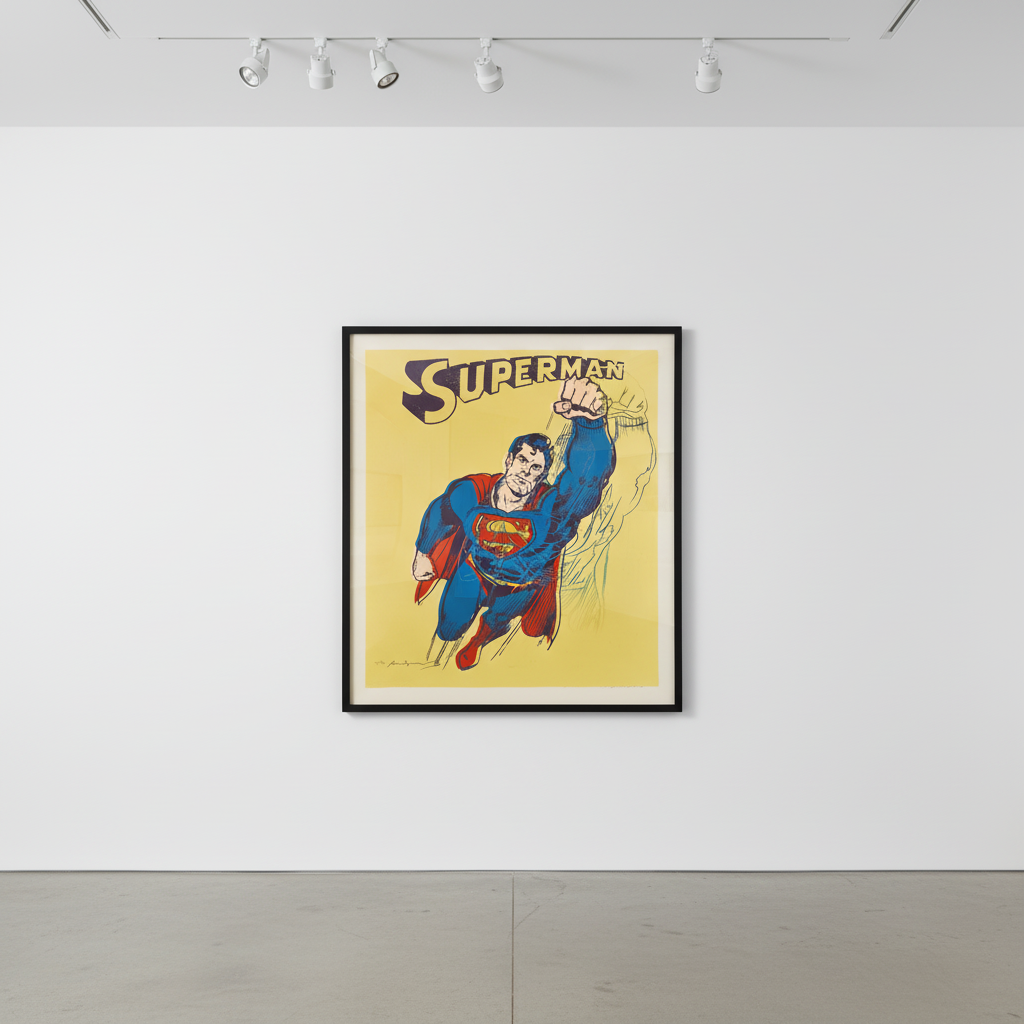 Andy Warhol, Superman Trial Proof TP 19/30 (F.S. II.260), 1981. Screenprint with diamond dust on Lenox Museum Board, 38 × 38 inches. Available at Guy Hepner, New York.
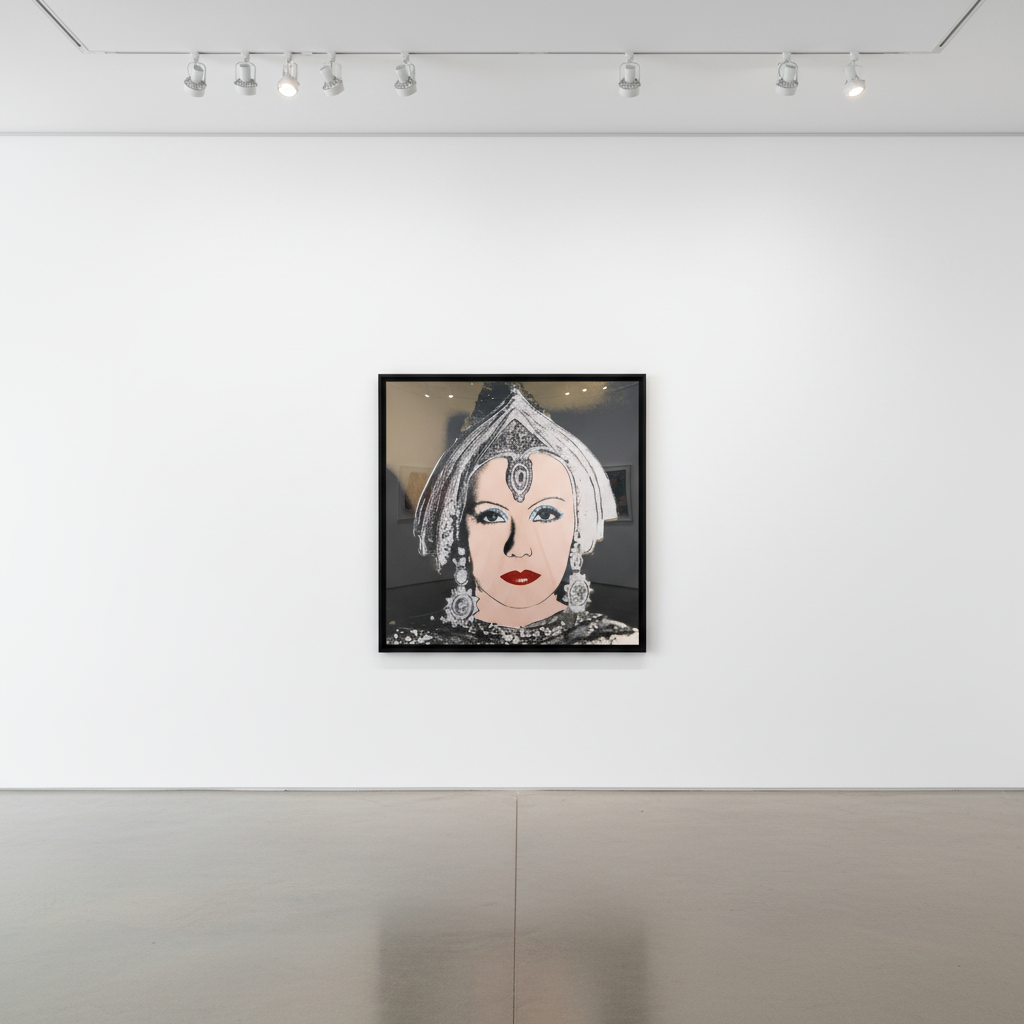 Andy Warhol, The Star Trial Proof TP 6/30 (F.S. II.258), 1981. Screenprint with diamond dust on Lenox Museum Board, 38 × 38 inches. Available at Guy Hepner, New York.
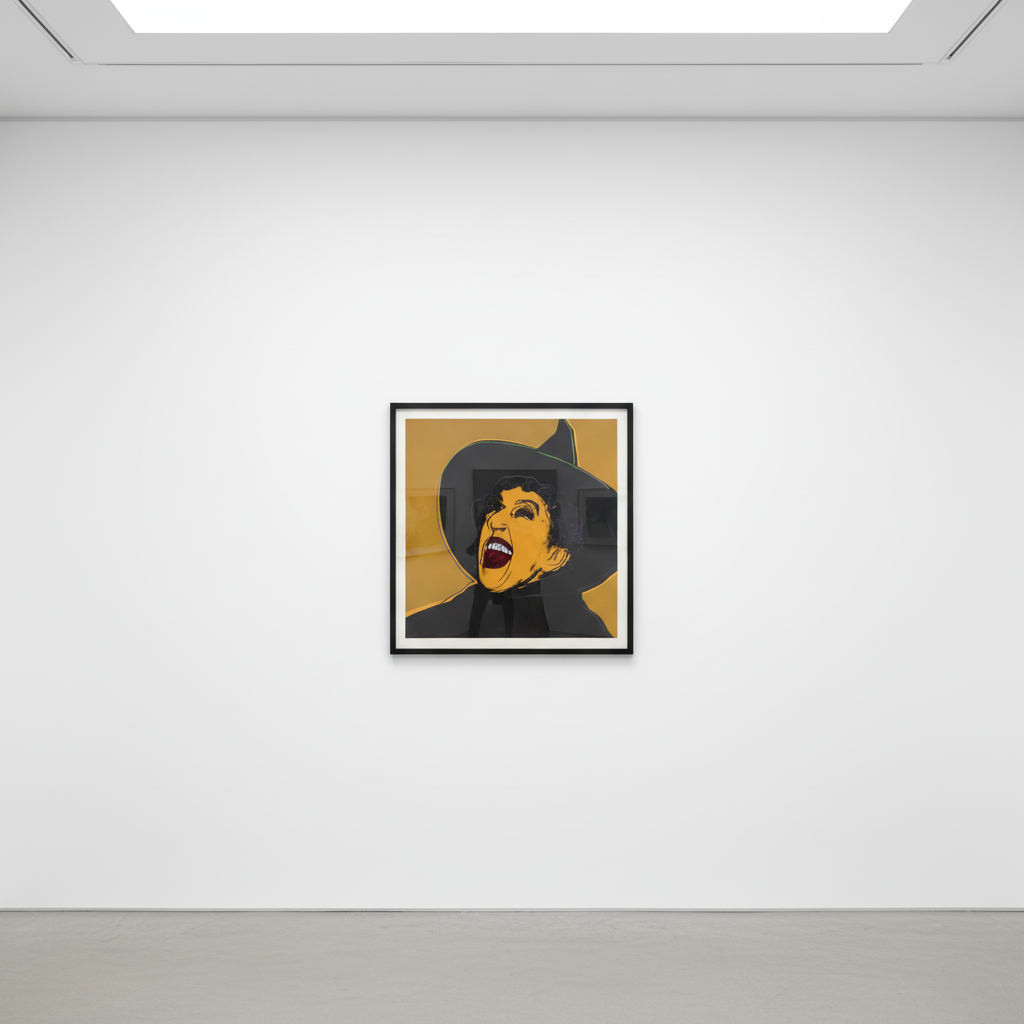 Andy Warhol, The Witch Trial Proof TP 17/30 (F.S. II.261), 1981. Screenprint with diamond dust on Lenox Museum Board, 38 × 38 inches. Available at Guy Hepner, New York.
Browse All Available Myths Prints View the full Myths inventory — numbered editions and Trial Proofs — at Guy Hepner, New York.
Speak With a Specialist For condition reports, provenance documentation, or acquisition advice on the Myths portfolio.
Guy Hepner | 177 Tenth Avenue, New York
--- **Browse Andy Warhol prints** at Guy Hepner: [Andy Warhol art for sale](/andy-warhol) | [Sell your Warhol](/sell/andy-warhol)Explore Andy Warhol prints for sale at Guy Hepner: Myths, 25 Cats Named Sam, A Gold Book, A La Recherche Du Shoe Perdu, Alexander the Great.
Related Series