Interiors

July 30, 2026
In the autumn of 1991, visitors to a new exhibition at Gemini G.E.L. in Los Angeles encountered something unexpected from Roy Lichtenstein. Here was the artist who had built his reputation on the borrowed melodrama of comic book heroines and the explosive energy of fighter jets, now presenting a series of meticulously composed prints depicting empty living rooms, bedrooms, and dens. No figures populated these spaces. No narrative tension animated the scenes. Yet the Roy Lichtenstein Interiors series immediately struck collectors and critics as something essential — a summation of the artist's visual vocabulary applied to the most intimate of subjects: the spaces where we actually live.
Three decades later, the Lichtenstein Interiors series has proven to be among the most enduring achievements of his final decade. These seven prints, created between 1990 and 1992 and published by Gemini G.E.L., command auction prices ranging from $50,000 to well over $200,000, with the most sought-after compositions occasionally exceeding these estimates. For collectors seeking to acquire significant Roy Lichtenstein prints that represent the full maturity of his artistic vision, this Lichtenstein collector's guide offers a comprehensive examination of the series — its origins, its techniques, its critical reception, and its place in today's market.
Before examining the Interiors series in depth, it is worth considering the artistic journey that led Lichtenstein to these meditative compositions. Born in 1923 in New York City, Lichtenstein emerged as a central figure in the Pop Art movement during the early 1960s, alongside Andy Warhol, James Rosenquist, and Claes Oldenburg. His breakthrough paintings — those now-iconic appropriations of comic book panels featuring Ben-Day dots, bold black outlines, and speech bubbles filled with exclamations — established a visual language that would define his career and influence generations of artists to follow.
Yet Lichtenstein was never simply a one-note artist content to repeat his early successes. Throughout the 1970s and 1980s, he systematically expanded his subject matter to include art historical quotations (his reworkings of Picasso, Monet, and Mondrian), Still Lifes, Landscapes, and increasingly, architectural subjects. The Entablature series of the mid-1970s demonstrated his fascination with classical architectural detail, while his Perfect and Imperfect paintings of the late 1980s explored geometric abstraction with characteristically Pop precision. By the time he began the Interiors series in 1990, Lichtenstein had spent three decades refining a visual vocabulary capable of transforming virtually any subject into his distinctive graphic idiom.
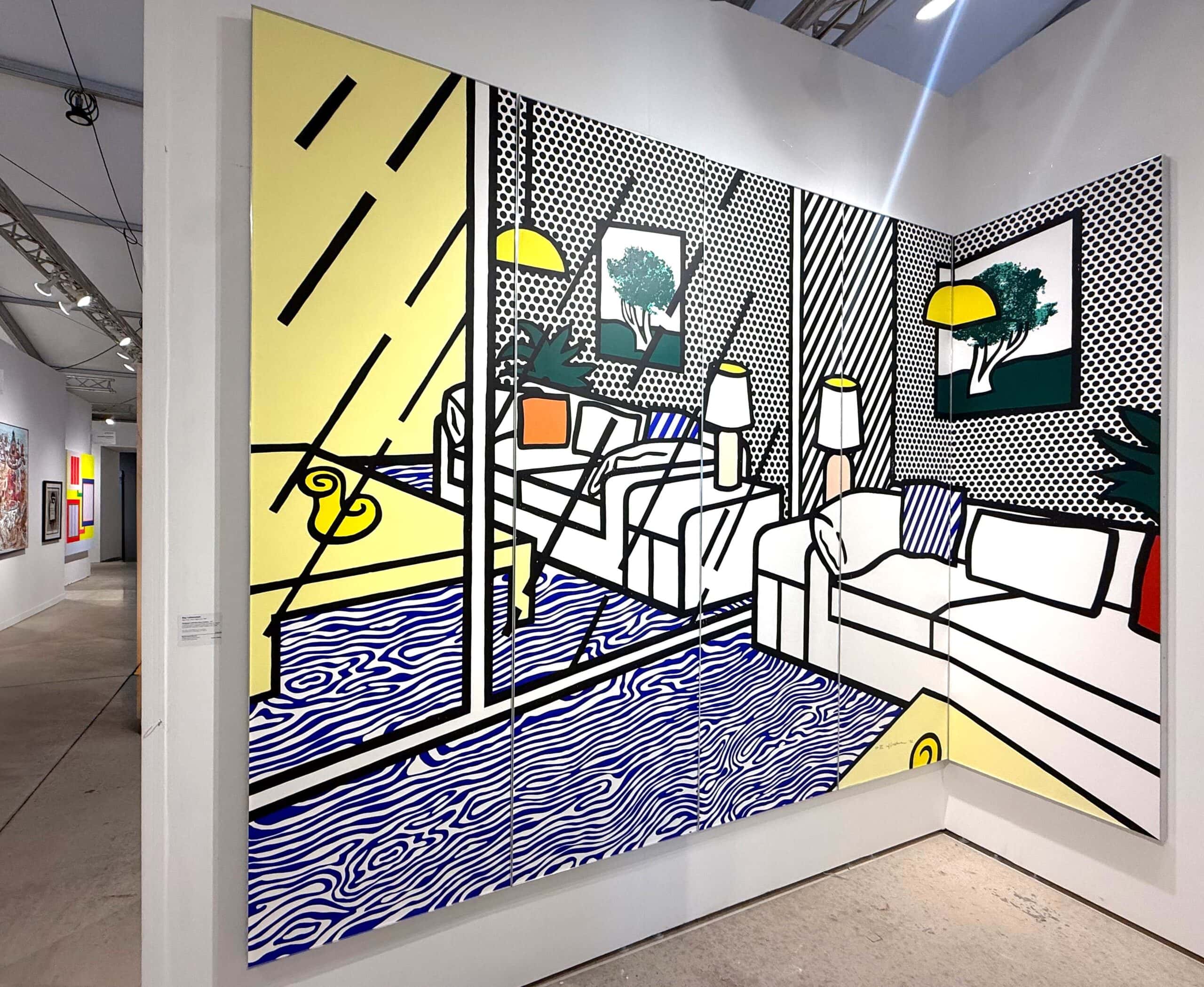
Roy Lichtenstein, Wallpaper with Blue Floor Interior, Screenprint.
The choice to focus on domestic space was characteristically deliberate. Lichtenstein had always been interested in the visual culture of mid-century America — not its fine art traditions, but its commercial ephemera, its advertisements, its mass-produced imagery. The 1930s furniture catalogues and design magazines that served as source material for the Interiors represented precisely the kind of overlooked visual culture he had been elevating throughout his career. In these glossy advertisements for modernist furniture and Art Deco interiors, Lichtenstein found a vocabulary of domestic aspiration perfectly suited to his transformative approach.
The Lichtenstein Interiors series comprises seven principal prints, each identified in Mary Lee Corlett's definitive catalogue raisonné with reference numbers that have become standard in the collecting world. Understanding these works individually is essential for any serious collector, as each offers distinct compositional approaches and varying degrees of market activity.
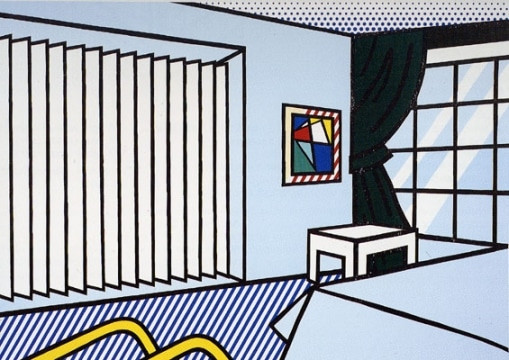
Bedroom (Corlett 247) stands as perhaps the most immediately recognizable Composition in the series. The Lichtenstein Bedroom print presents a dramatically foreshortened view of a modernist sleeping chamber, complete with a simplified bed, geometric wall decorations, and the characteristic patterning that suggests both wallpaper and the mechanical reproduction processes that fascinated the artist. The strong diagonal composition and warm color palette have made this among the most sought-after works in the series.
La Sortie (Corlett 248) introduces an element of narrative suggestion absent from the other compositions. The title, French for "the exit" or "the way out," hints at movement and transition, though the scene itself remains as populated only by furniture and decorative objects as its companions. This work demonstrates Lichtenstein's ability to evoke emotion and implied narrative through purely formal means.
The Den (Corlett 249) and The Living Room (Corlett 250) represent the series at its most architecturally ambitious. Both compositions present fully realized domestic spaces with multiple furniture groupings, complex spatial arrangements, and the kind of all-over surface activation that rewards extended viewing. These larger, more compositionally dense works typically command the highest prices at auction and in the secondary market.
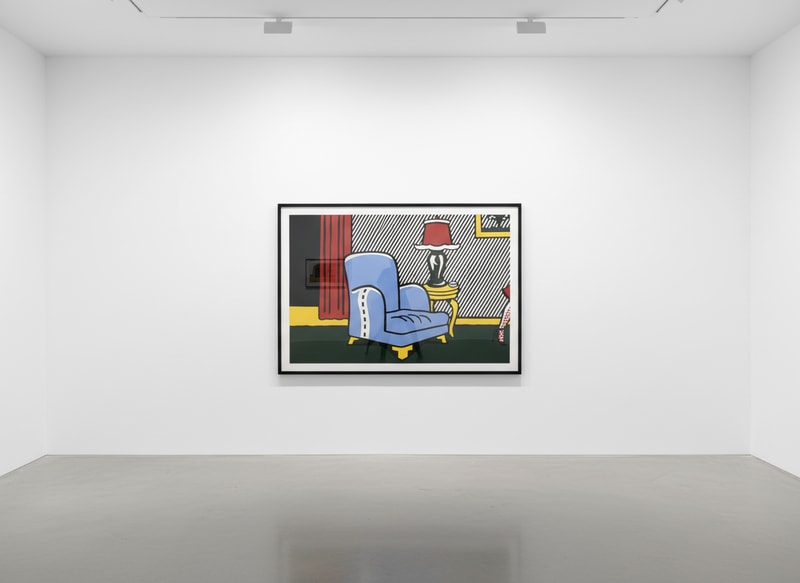
Red Lamps (Corlett 251) and its companion Red Lamp (Corlett 279) demonstrate Lichtenstein's capacity to isolate individual objects from the larger interior settings with the same formal intensity he applied to complete rooms. These works function almost as fragments or details, inviting collectors to appreciate the artist's reductive process at its most concentrated.
Modern Room (Corlett 252) and Yellow Vase (Corlett 253) round out the series with characteristic elegance. The Yellow Vase in particular demonstrates how Lichtenstein could transform a simple decorative object into a monumental graphic statement, the Ben-Day dots and bold outlines elevating ordinary domestic decoration to the status of icon.
The Lichtenstein Interiors series was produced at Gemini G.E.L. in Los Angeles, one of the world's most distinguished print workshops and a longtime collaborator with the artist. This partnership was crucial to achieving the technical precision these compositions demanded. The Lichtenstein 1990s prints from Gemini represent some of the most accomplished screenprinting and lithography of the late twentieth century, combining industrial-scale production values with handcraft attention to detail.
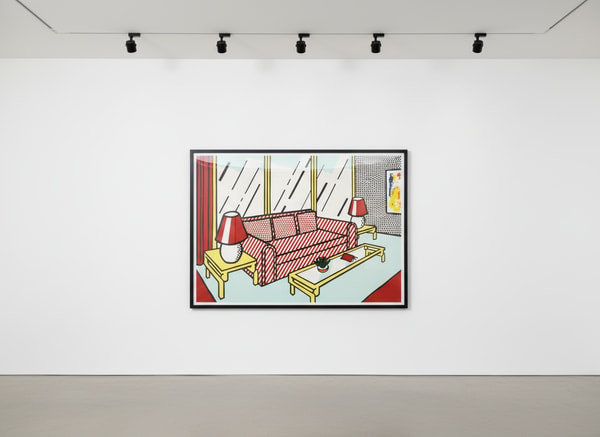
Roy Lichtenstein, Red Lamps, Screenprint. Available at Guy Hepner, New York.
The technical challenges of the Interiors series were considerable. Each composition required the precise registration of multiple color layers, with the Ben-Day dots demanding particular accuracy to achieve the mechanical appearance essential to Lichtenstein's aesthetic. The characteristic Lichtenstein woodcut technique that appears in some related works demonstrates his willingness to explore varied printmaking approaches, though the core Interiors series relies primarily on screenprint and lithographic processes that best captured the flat, commercial look of his source material.
Edition sizes for the Interiors series typically range from 40 to 60 impressions, plus artist's proofs, printer's proofs, and archive impressions. Understanding the Lichtenstein Interiors edition size is crucial for collectors assessing both authenticity and relative scarcity. The limited nature of these editions, combined with steady institutional and private acquisition over three decades, has resulted in genuine scarcity for the most desirable works.
Collectors should note that each impression was printed on high-quality paper selected specifically for the series, with dimensions that vary by composition but generally fall in the range of large-scale graphic works suitable for prominent display. The physical presence of these prints — their scale, their saturated colors, their pristine mechanical surfaces — is difficult to appreciate in reproduction but immediately apparent when encountered in person.
The Interiors series arrived at a particular moment in American cultural life. The late 1980s and early 1990s saw renewed interest in mid-century modern design, with the furniture and decorative objects that Lichtenstein depicted becoming sought-after collectibles in their own right. His Pop Art interiors thus participated in a broader cultural conversation about domestic space, taste, and the relationship between fine art and design.
Critical reception of the series was largely enthusiastic, with observers noting how the Interiors represented a synthesis of concerns that had occupied Lichtenstein throughout his career. The art historical dialogue was rich: these compositions spoke directly to Henri Matisse's interiors of the 1910s and 1920s, to the domestic scenes of Dutch Golden Age painting, and to the commercial illustration traditions of mid-century America. Yet they remained unmistakably Lichtenstein's own — the Ben-Day dots, the bold black outlines, the flat primary colors were signatures that could belong to no one else.
The relationship between Art Deco and Pop Art that the series illuminates has proven particularly generative for critical analysis. Lichtenstein's source material — those 1930s furniture advertisements and design catalogues — represented the commercial face of modernism, the moment when avant-garde design principles were translated into mass-market aspiration. By filtering this material through his Pop sensibility, Lichtenstein created a double remove: commercial imagery transformed into fine art that commented on the original transformation of fine art into commercial imagery. This complexity has ensured the series' continued relevance for scholars and curators interested in the traffic between high and low culture.
The institutional embrace of the Interiors series has been comprehensive and sustained. Major holdings exist at MoMA, the Whitney Museum of American Art, the Tate, and the Broad, among other significant collections. This museum presence serves multiple functions for collectors: it validates the art historical importance of the series, ensures continued scholarly attention, and — through loans and exhibitions — maintains public visibility that supports market values.
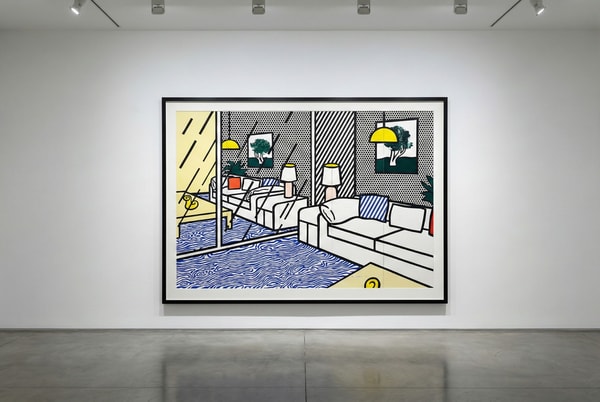
Roy Lichtenstein, The Living Room, Print. Available at Guy Hepner, New York.
Market performance for Lichtenstein Interiors has been consistently strong over the past two decades. Auction results show a clear trajectory of appreciation, with prices that have roughly doubled since the early 2000s. Current auction estimates range from $50,000 to $200,000 or more, depending on the specific composition, condition, and provenance. The Roy Lichtenstein Interiors price structure reflects both the artist's blue-chip status and the particular desirability of this series within his print oeuvre.
Several factors contribute to the market strength of these works:
For collectors seeking to acquire works from the Interiors series, several practical considerations deserve attention. Understanding how to collect Roy Lichtenstein effectively requires attention to condition, provenance, and the nuances that distinguish exceptional impressions from merely acceptable ones.
Every Interiors print should be accompanied by documentation establishing its place in the edition. Key provenance indicators include:
Condition is paramount in the print market, and the Interiors series presents particular considerations:
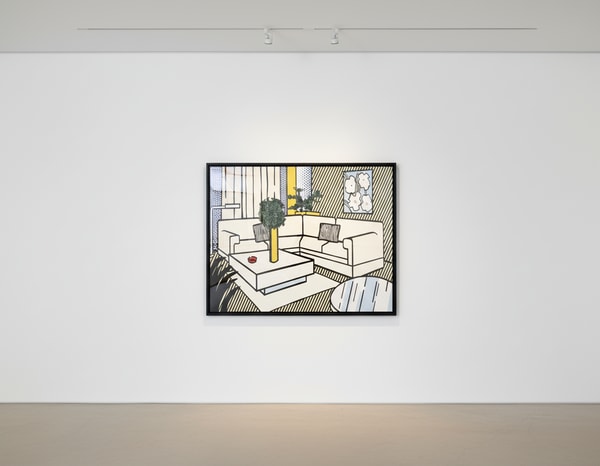
Roy Lichtenstein, Wallpaper with Blue Floor Interior , Screenprint. Available at Guy Hepner, New York.
Approaches to building a collection around the Interiors series vary depending on collector priorities and resources:
Lichtenstein's engagement with domestic space in the Interiors series participates in a longer tradition of artists finding significance in the everyday environments of home life. From Vermeer's quiet interiors to Vuillard's pattern-saturated domestic scenes to Richard Hamilton's collaged living rooms, the home has served as a persistent subject for artistic investigation. What distinguishes Lichtenstein's contribution is his characteristic ability to find the universal in the commercial, transforming mass-market aspirational imagery into statements of lasting artistic significance.
The Lichtenstein domestic space as depicted in these prints is notably unpopulated — these are rooms without inhabitants, furniture without users, decorative objects without admirers. This absence has generated considerable critical commentary. Some observers see in these empty interiors a melancholy meditation on the gap between commercial promises and lived experience. Others interpret them more formally, as exercises in pictorial structure freed from narrative obligation. Still others read them as wry comments on the aspirational emptiness of consumer culture itself.
What seems clear is that these spaces are not meant to be read as straightforward representations of actual rooms. They are, rather, representations of representations — images of images, pictures of the pictures in furniture catalogues and design magazines. This remove allows them to function simultaneously as beautiful decorative objects and as conceptual investigations into the nature of visual culture itself.
The supply of Interiors prints available for acquisition has contracted steadily over the past three decades as works have entered permanent institutional collections or settled into private collections unlikely to trade. For collectors interested in the series, acting with informed deliberation when quality examples appear is increasingly important. Waiting for "the perfect opportunity" may mean missing the opportunity altogether.
Guy Hepner Gallery currently holds works from the Interiors series, providing collectors with the opportunity to examine these prints firsthand and to benefit from professional guidance on authentication, condition, and fair market valuation. The gallery's position at 529 West 20th Street in New York places it at the center of the contemporary art market, with relationships that facilitate access to works that may not appear publicly on the secondary market.
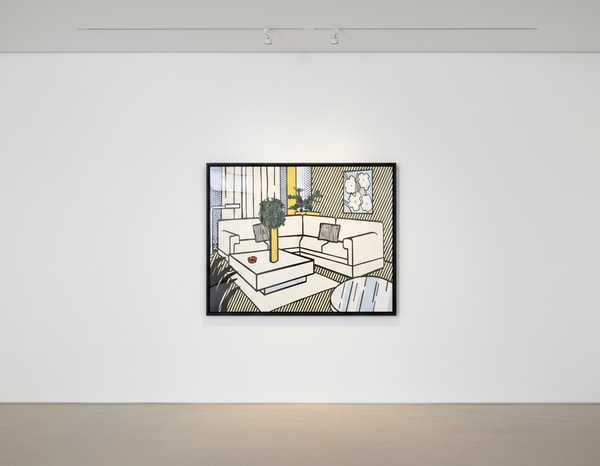
Roy Lichtenstein, Yellow Vase, Print. Available at Guy Hepner, New York.
Looking forward, several factors suggest continued strength for the Interiors series. Lichtenstein's position in the contemporary art canon is secure; major retrospectives continue to travel internationally, scholarly publication proceeds apace, and his work maintains visibility in the cultural conversation through reproduction and reference. The particular appeal of the Interiors — their decorative beauty, their conceptual sophistication, their manageable scale for domestic display — positions them well for collectors who seek work that functions both as serious art historical acquisition and as living presence in everyday life.
The Interiors series invites us to consider what we ask of the spaces we inhabit. Lichtenstein's empty rooms are full of aspiration — the aspiration of the 1930s catalogues that provided his source material, the aspiration of the modernist design movement they popularized, the aspiration of the countless consumers who paged through such catalogues imagining better lives in better rooms. Yet in Lichtenstein's hands, this aspiration is neither endorsed nor mocked. It is simply observed, with the same cool precision he brought to comic book romance and consumer products throughout his career.
For collectors, the Interiors offer something rare: work by an artist of unquestioned significance, from a series of demonstrated importance, that also functions beautifully in the domestic settings it depicts. These are prints that reward sustained attention — their compositional intricacies, their dialogue with art history, their meditation on the relationship between fine art and commercial culture become richer with familiarity. They are also prints that simply look stunning on a wall, their saturated colors and bold graphic impact holding their own against any company.
The convergence of aesthetic pleasure and intellectual substance has always been the Lichtenstein promise, and the Interiors deliver on that promise with particular elegance. For collectors seeking to acquire significant examples of late Pop Art printmaking, or simply to live with beautiful objects that happen also to be important art, the Interiors series merits serious consideration.
To discuss available works from the Roy Lichtenstein Interiors series, or to arrange a viewing at our New York gallery, contact Guy Hepner Gallery. Our specialists are prepared to provide detailed condition reports, provenance documentation, and guidance appropriate to collectors at every level of experience with the print market.
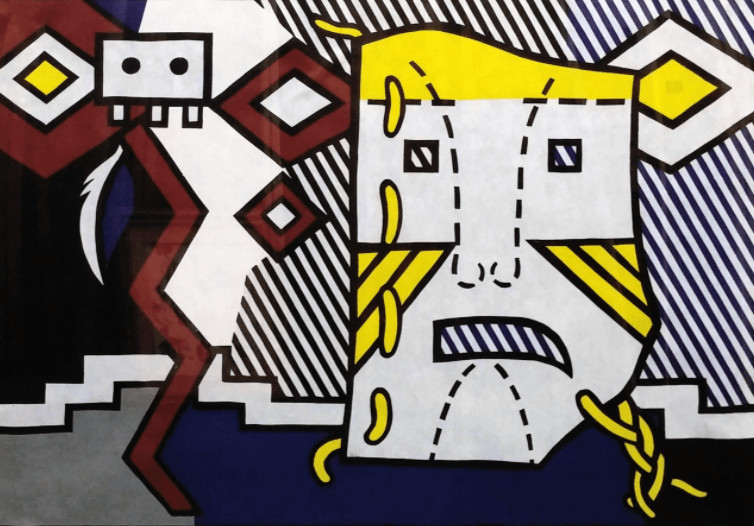
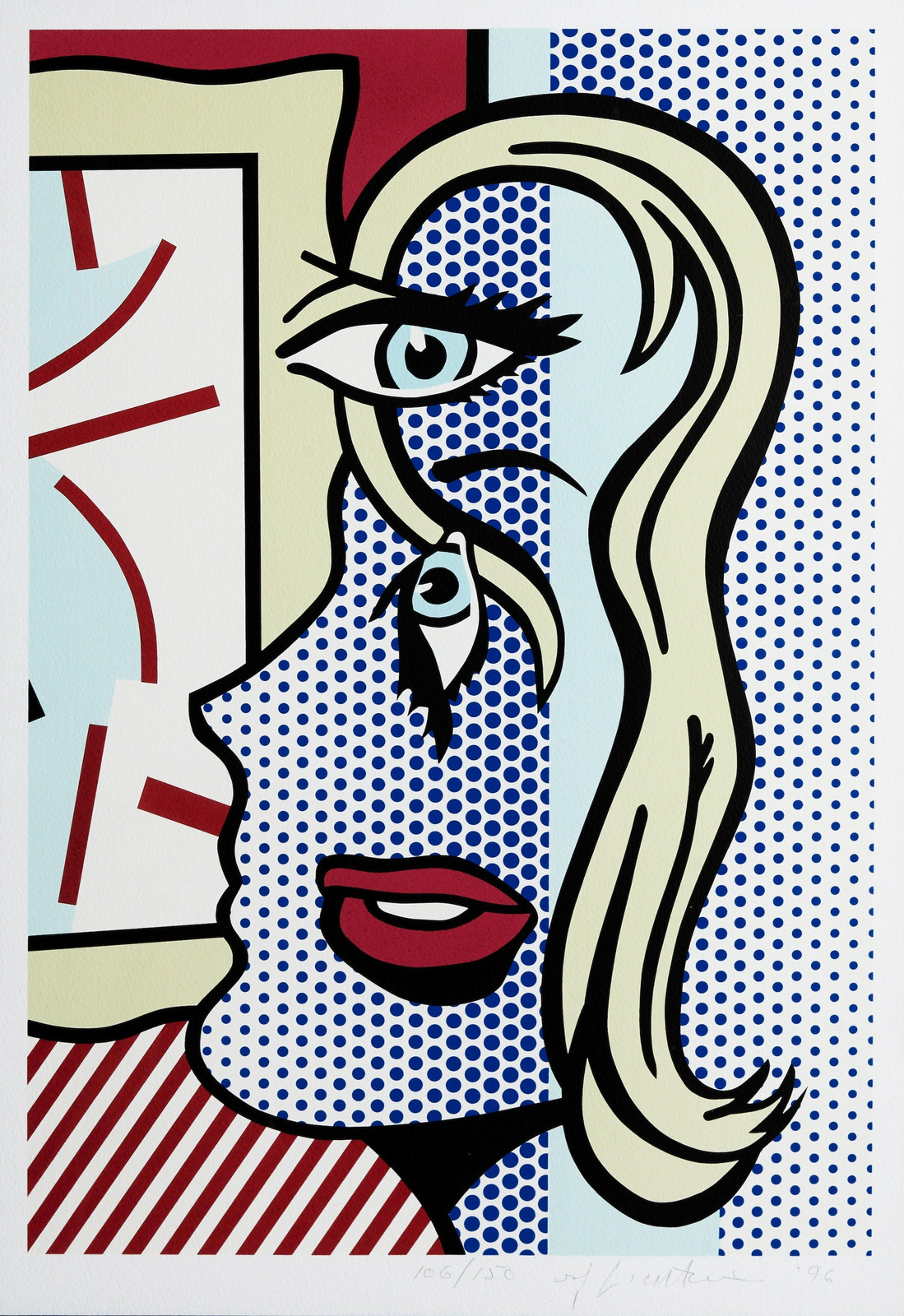
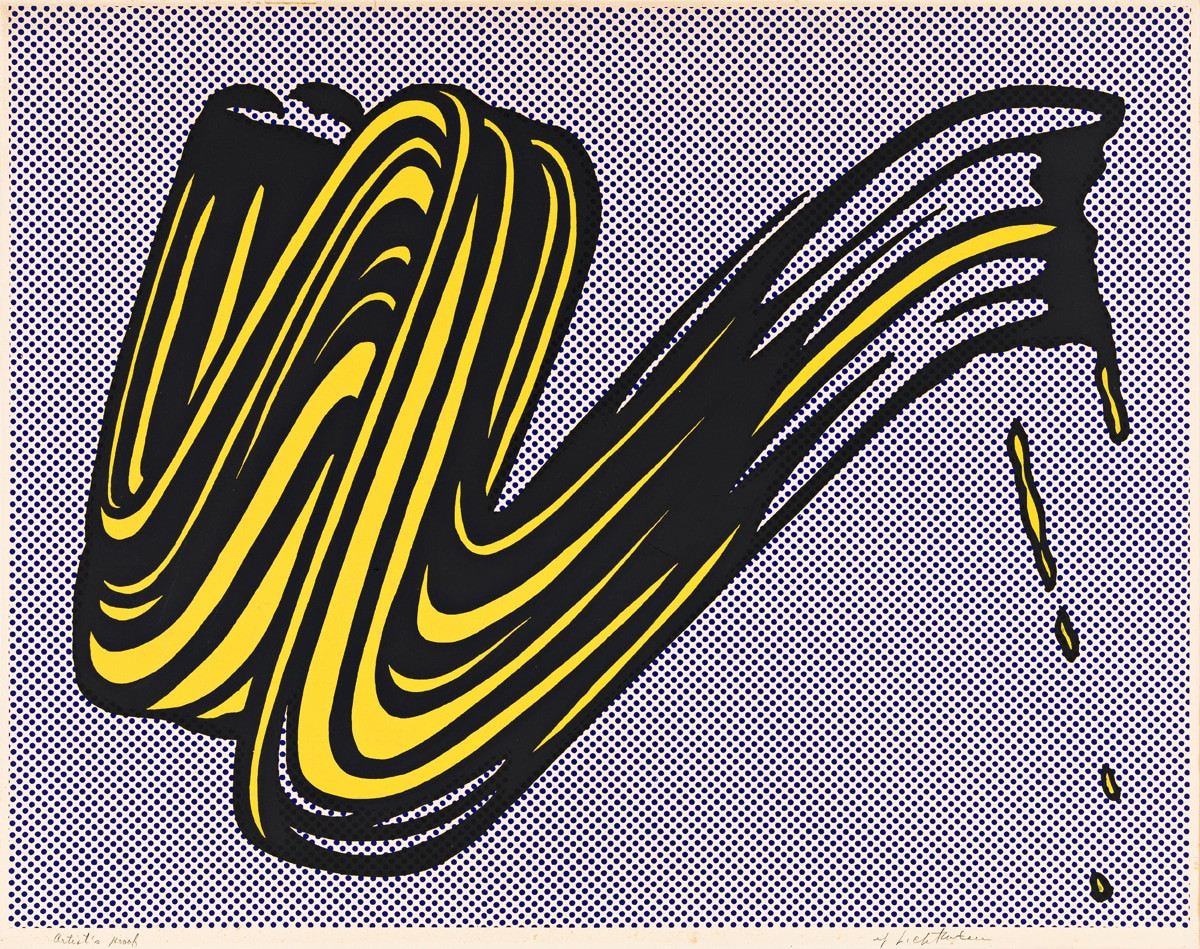
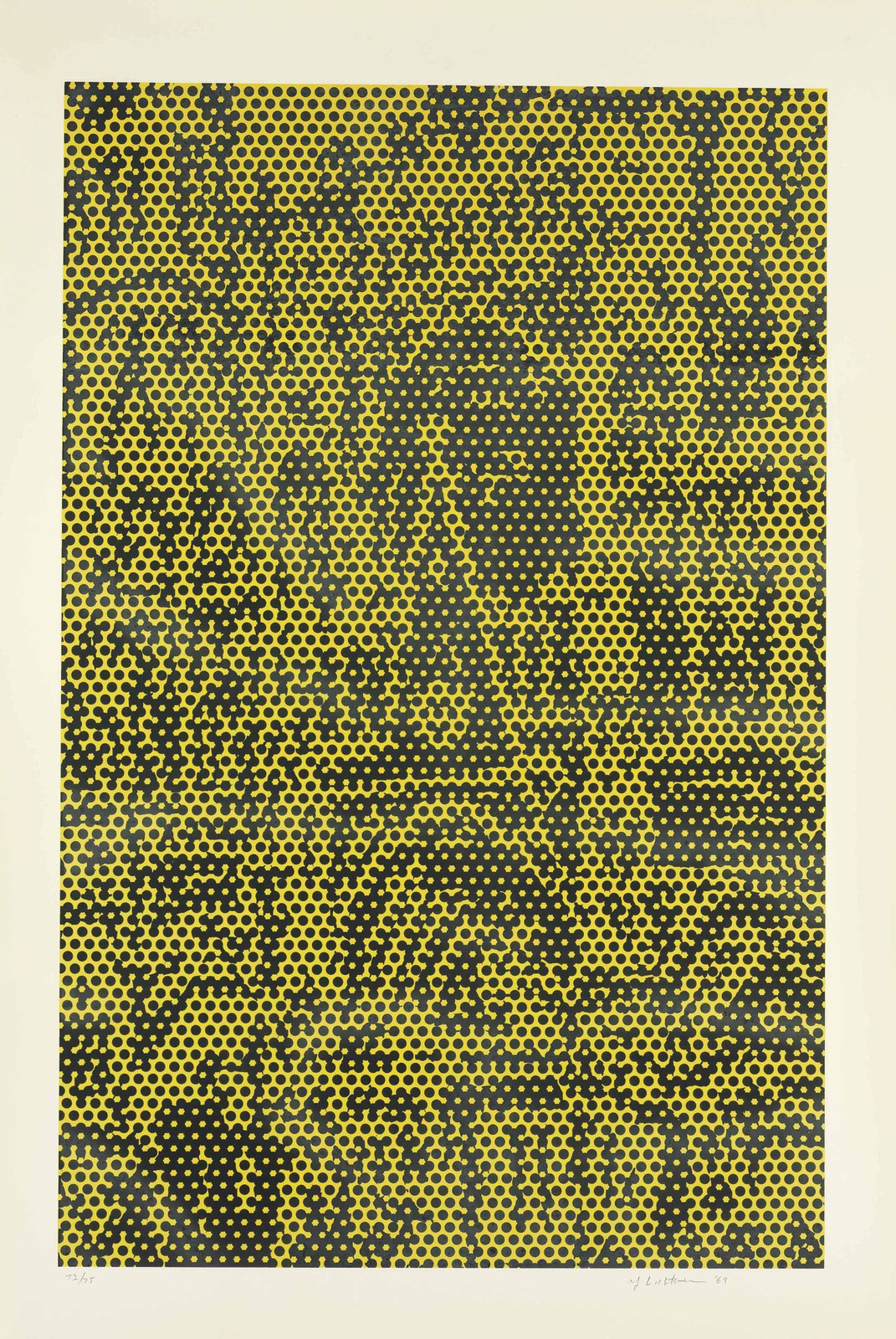
Explore Roy Lichtenstein prints for sale at Guy Hepner: Interiors, American Indian Theme, Art Critic, Brushstrokes, Cathedral.
Related Series