
Jean-Paul Donadini
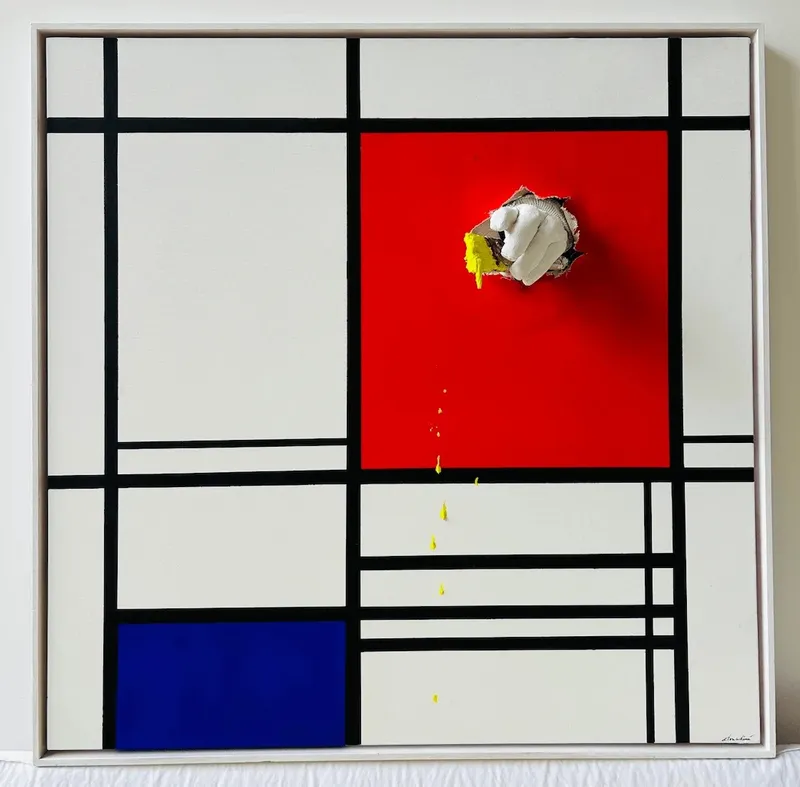
Jean-Paul Donadini
A Master of Gestural Repetition and Physical Engagement
Jean-Paul Donadini stands as one of the most distinctive voices in contemporary French art, an artist whose work dissolves the boundaries between painting, sculpture, and performance into a singular, compelling practice. Born in Troyes in 1951, Donadini emerged from a generation of European artists who sought to redefine what painting could be - not merely an image applied to a surface, but a record of physical action, a trace of the body in motion, and an exploration of materiality itself. His five-decade career has established him as a vital link between the post-war European avant-garde and contemporary gestural abstraction, earning him recognition among collectors who value both conceptual rigor and visceral aesthetic impact.
Donadini's formal training at the prestigious École Nationale Supérieure des Beaux-Arts in Paris provided him with a thorough grounding in classical techniques, yet it was his willingness to depart from convention that would come to define his artistic identity. From the earliest stages of his career, he demonstrated a profound fascination with the physicality of artmaking, deliberately eschewing traditional brushwork in favor of unconventional tools and processes. This desire to engage the canvas in a tactile, almost ritualistic manner remains the animating force behind his oeuvre, distinguishing his work from purely gestural abstraction through its systematic yet deeply personal methodology.
The Choreography of Mark-Making
Central to understanding Jean-Paul Donadini's significance is recognizing how his background in printmaking and performance art fundamentally shapes his painterly practice. Each canvas he produces can be understood as a kind of choreographed action - a documented performance where the artist's body becomes an instrument of creation. The repetition of gestural forms, often involving the pressing, dabbing, or stamping of objects onto the canvas surface, aligns his work philosophically with pioneering figures like Yves Klein and Piero Manzoni, who similarly merged bodily action with artistic surface in their groundbreaking explorations of the 1960s.
What distinguishes Donadini within this lineage is his particular synthesis of the systematic and the improvisational. Though the structure of repetition is unmistakably present in his compositions - creating rhythmic patterns that pulse across the picture plane - each individual imprint varies subtly from the next. These minute variations suggest the irreducible presence of the human hand, the impossibility of mechanical perfection when flesh meets canvas. This tension between order and organic variability gives his work its characteristic vitality, a sense of breathing movement that rewards sustained viewing.
Donadini's palette tends toward bold, saturated hues that emphasize the materiality of paint itself. Whether working in deep crimsons, electric blues, or earthy ochres, he treats color not as mere visual information but as physical substance with weight, texture, and presence. The accumulated layers of his repeated marks create surfaces of remarkable depth, where light interacts with the topography of paint to produce effects that shift as the viewer moves around the work. This sculptural quality - the way his paintings occupy space rather than merely depicting it - reflects his interdisciplinary approach and sets his work apart in the contemporary landscape.
Market Context and Collector Interest
The market for Jean-Paul Donadini's work has demonstrated consistent strength over the past two decades, reflecting growing institutional and private collector interest in artists who bridge conceptual sophistication with immediate visual appeal. According to broader market analyses from authorities including Art Basel and UBS in their annual art market reports, works that combine strong provenance, distinctive artistic vision, and connection to established art-historical movements continue to attract sustained collector attention. Donadini's positioning at the intersection of post-war European experimentalism and contemporary abstraction places him advantageously within this market context.
Collectors are drawn to Jean-Paul Donadini for multiple compelling reasons. His works offer an entry point into the legacy of European gestural and performative art while maintaining a freshness and contemporary relevance that prevents them from feeling merely historical. The physical presence of his canvases - their textured surfaces, their evidence of the artist's bodily engagement - provides an antidote to the increasingly digital nature of contemporary visual culture. In an era when so much imagery exists only as pixels, Donadini's work insists on materiality, on the irreplaceable value of the handmade object.
Furthermore, the relative accessibility of Donadini's market compared to his more widely known predecessors and contemporaries presents an opportunity for collectors building significant holdings in post-war and contemporary European art. While works by Klein or Manzoni command prices that place them beyond reach for many collectors, Donadini offers comparable conceptual depth and art-historical resonance at price points that allow for thoughtful acquisition. This value proposition has not gone unnoticed by sophisticated collectors who recognize quality and potential.
The Enduring Resonance of Process-Based Practice
Jean-Paul Donadini's continuing relevance in the contemporary art discourse speaks to the enduring power of process-based artistic practice. At a moment when questions about authenticity, the role of the artist's hand, and the relationship between concept and execution dominate critical conversation, his work offers compelling answers. Each canvas serves as documentary evidence of a creative act, a frozen moment of physical engagement that viewers can imaginatively reconstruct. This transparency of process - the way his techniques remain visible in the finished work - creates an intimacy between artist and audience that more polished or mediated approaches cannot achieve.
His influence can be traced in the work of younger artists who similarly prioritize gesture, repetition, and physical engagement with their materials. Yet Donadini's particular voice remains distinctive, shaped by his specific training, his French cultural context, and his decades of sustained investigation into the possibilities of mark-making. The body of work he has produced represents not merely a collection of individual pieces but a coherent artistic project, a lifelong meditation on what it means to translate bodily action into lasting visual form.
Guy Hepner is proud to offer works by Jean-Paul Donadini to discerning collectors worldwide. As a leading contemporary art gallery with a reputation for identifying artists of lasting significance, Guy Hepner provides collectors with access to exceptional examples of Donadini's practice, supported by comprehensive provenance documentation and expert guidance. Whether you are establishing a new collection or adding depth to existing holdings in contemporary European art, our team is prepared to assist you in acquiring works by this important artist. Contact Guy Hepner today to inquire about available works by Jean-Paul Donadini and to discuss how his distinctive vision might enhance your collection.