Keith Haring's Iconography: Decoding His Most Iconic Motifs
May 19, 2026 · Guy Hepner
Between 1980 and 1985, Keith Haring covered hundreds of blank black panels in New York City's subway system with chalk drawings. The panels — black paper placed over expired advertising spaces — offered a daily canvas across the entire transit network. Working fast, in public, under constant risk of arrest, Haring developed a visual language of extraordinary efficiency: a small set of bold, repeating symbols that could be read instantly, at speed, by anyone. The radiant baby. The barking dog. The crawling figure. The flying saucer. The angel. These are not decorations. They are a complete Keith Haring iconography — a private grammar of symbols that, over the course of a decade, expanded into one of the most recognisable visual languages in the history of contemporary art.
Inquire About Available Keith Haring Works
Browse prints and editions currently available through Guy Hepner, New York.
The Subway as Studio: How the Motifs Were Born (1980–1985)
Haring arrived in New York in 1978, enrolled at the School of Visual Arts, and immediately immersed himself in the downtown scene centred on the East Village — punk, hip-hop, graffiti, performance art, the emerging club culture of the Mudd Club and Club 57. He was twenty years old, from Kutztown, Pennsylvania, and had grown up drawing cartoons obsessively. In New York, he found a city that was itself a drawing surface.
The subway drawings began as a logical extension of what he was already doing — drawing in the SVA studios, drawing on any available surface. The black paper panels were perfect: large, flat, responsive to chalk, and visible to thousands of people daily. Haring understood something that most gallery artists missed: art that required an invitation was art that excluded. The subway was the opposite of a gallery. Everyone was there.
Working at speed — sometimes completing a drawing in under a minute, aware that transit police could appear at any moment — Haring developed the visual vocabulary that would define his entire career. Speed required reduction. Complex perspective, shading, representational detail — all stripped away. What remained was line, energy, and symbolic weight. The figures that emerged were not illustrations of ideas; they were ideas made visible in their most concentrated form.
Between 1980 and 1985, Haring made more than 5,000 subway drawings, reaching an estimated daily audience of millions. He was arrested multiple times. He was also documented, photographed, and studied by collectors, curators, and critics who recognised something unprecedented was happening. By 1982 he had his first solo gallery show at the Tony Shafrazi Gallery. The subway work and the gallery work proceeded simultaneously, each feeding the other. The motifs developed underground arrived on canvas and in print editions that now sell for hundreds of thousands of dollars at auction.
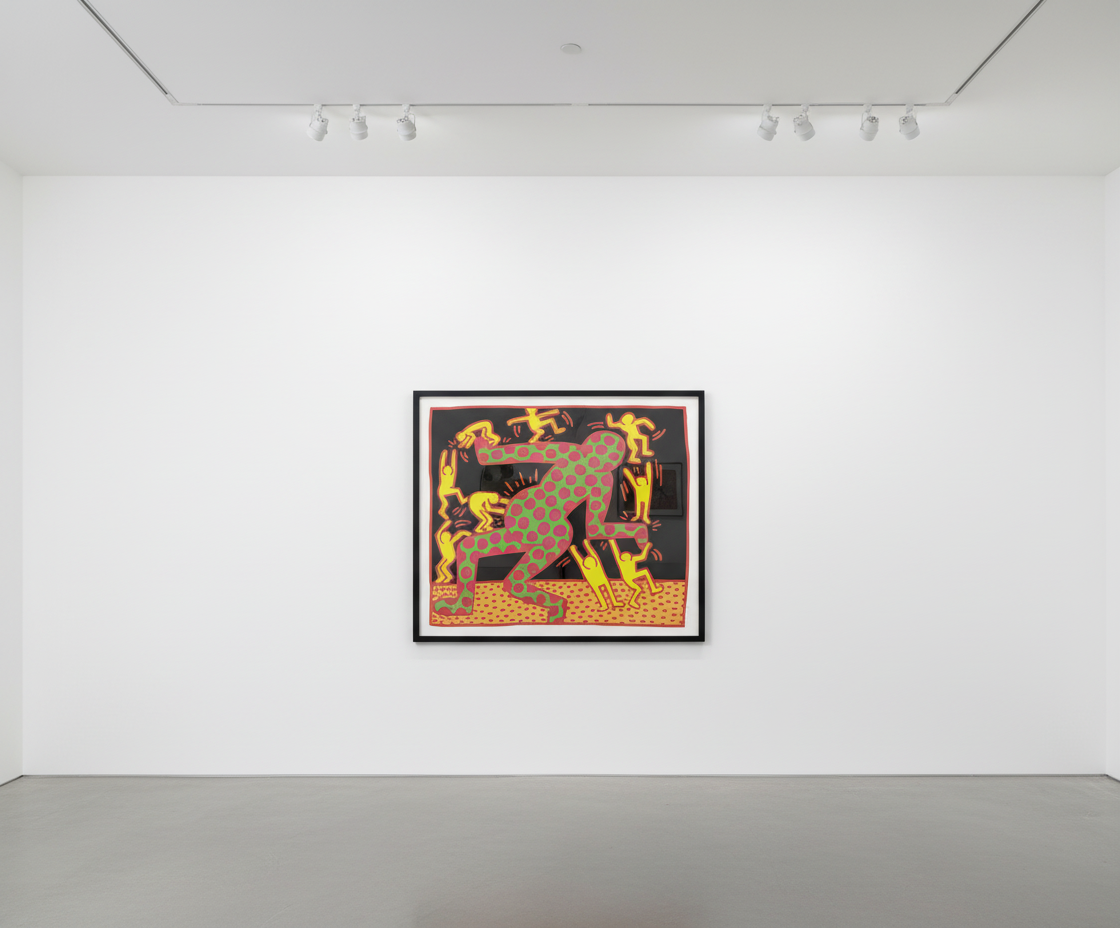
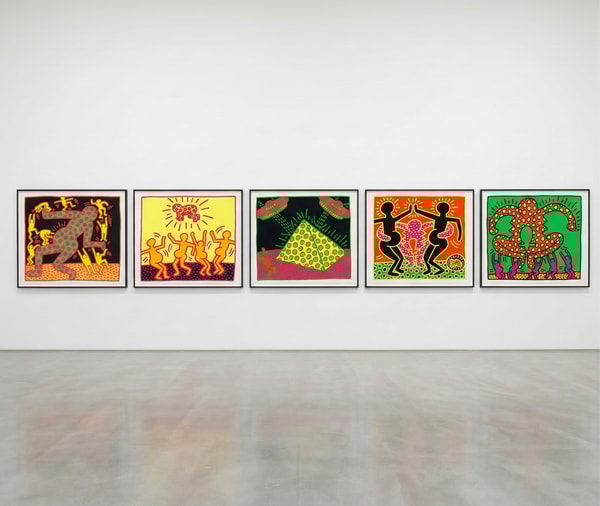
Keith Haring, Fertility 3 (Littmann PP. 32). Available at Guy Hepner, New York.
The Radiant Baby: His Most Personal Symbol
The radiant baby — a crawling infant surrounded by short radiating lines suggesting light or energy — was the first motif Haring fully developed and the one he considered most personally his own. It appeared in his earliest subway drawings and remained in his work until the end of his life.
The baby originated in a drawing Haring made in 1980, inspired by a projected image he encountered at SVA. The radiating lines surrounding the figure came from his instinct to suggest energy, life force, the aura that surrounds beings at the beginning of existence. In Haring's own account, the baby represented innocence before corruption: the fundamental human state before society, ideology, and violence shape it into something more compromised.
As his career developed and as AIDS became the defining context of his personal and political life, the radiant baby acquired additional weight. It became a symbol of vulnerability — of life under threat, of what was being lost to the epidemic. The baby in his AIDS-era work is no longer simply innocent; it is innocent in a world that has stopped protecting innocence. The juxtaposition with his more overtly political imagery — the barking dog, figures in distress — makes this tension explicit and urgent.
The radiant baby appears across the full range of Haring's print output. For collectors, works in which the baby features prominently — particularly in editions coinciding with his peak Pop Shop period (1986–1990) — carry the deepest investment of personal meaning from the artist himself.
The Barking Dog: Power, Aggression, and Authority
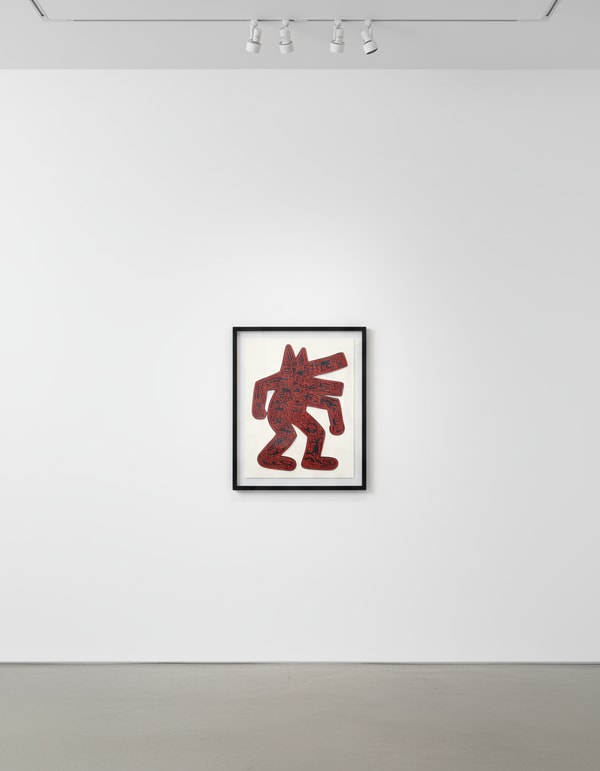
The barking dog is among the most frequently appearing and most politically loaded symbols in Haring's vocabulary. It is rendered in the same outline style as all his figures — bold, flat, filled with the short energy lines that appear throughout his work — but its posture is consistently aggressive: front legs planted, head forward, mouth open, lines radiating from its bark like a sonic assault.
In Haring's visual language, the barking dog represents institutional power wielded as threat: police violence, governmental authority, the systems of control that constrain the figures around it. It appears paired with human figures in postures of fear or flight. In works from the early 1980s — at the height of the AIDS crisis and during the Reagan administration's public silence on the epidemic — the dog's aggression is readable as the aggression of a political establishment refusing to acknowledge a public health catastrophe.
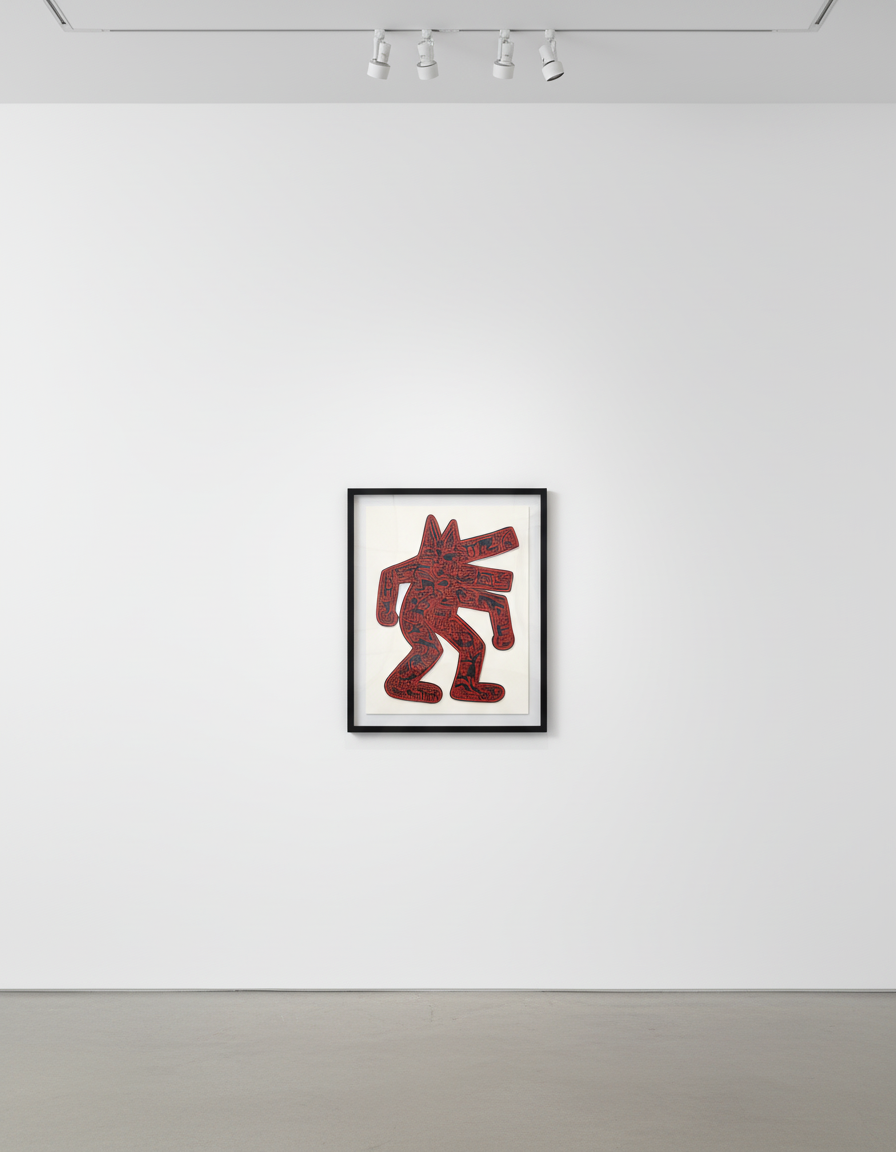
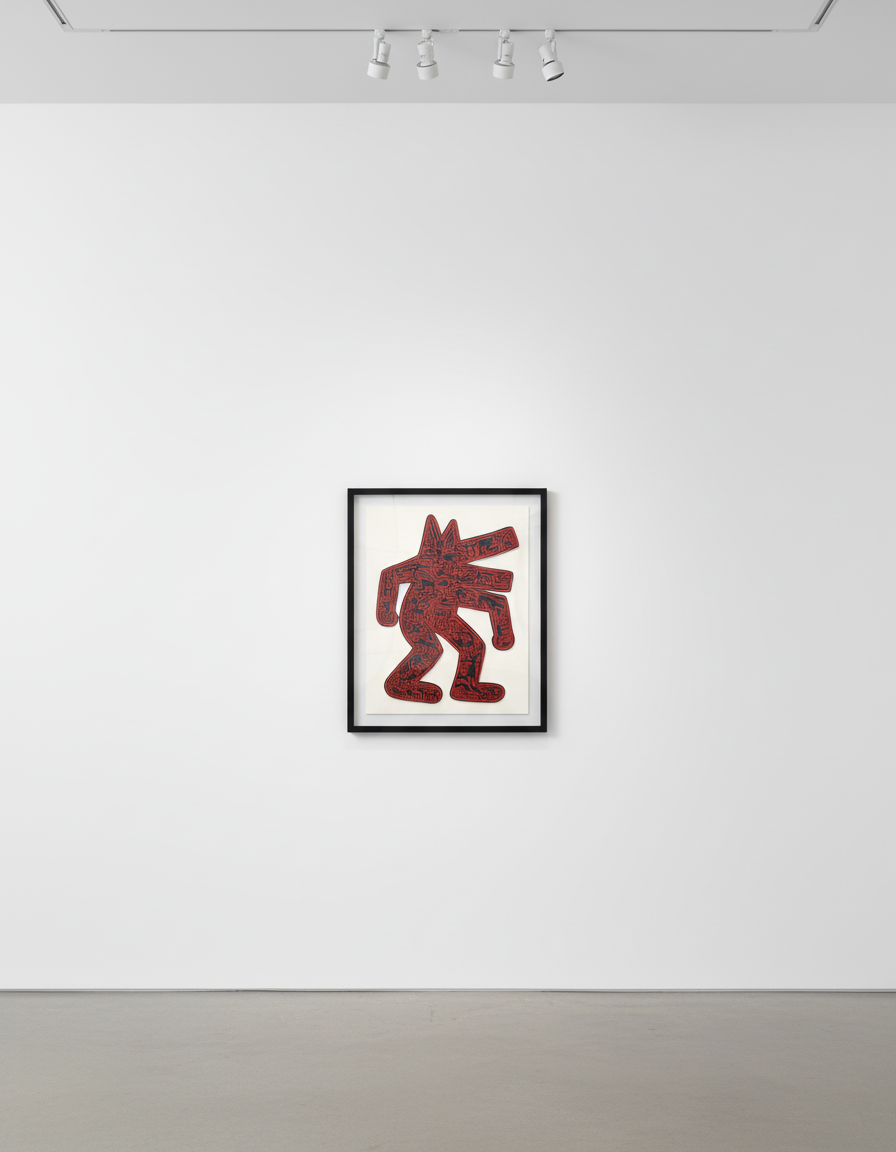
Keith Haring, Dog. Available at Guy Hepner, New York.
The dog is not invariably threatening. In some compositions it is domesticated, part of the general energy of Haring's visual world. But the confrontational version — the one that faces and menaces — is far more frequent, and far more culturally resonant. The Dog print represents the motif in its most direct form: confrontational, energetic, impossible to misread as neutral. It is one of the clearest single expressions of Haring's understanding of power in modern life.
The Crawling Figure and the Dancing Body: Movement as Language
Haring's human figures are defined by movement. They run, dance, stretch, carry objects, climb over each other, crawl across surfaces. The specific postures carry meaning. The crawling figure shares the baby's posture of vulnerability, but at human scale it suggests searching, displacement, survival under pressure. The dancing figure — arms raised, legs bent, surrounded by radiating lines — suggests joy, liberation, the body claiming its full range of motion against whatever constrains it.
The dancing body appears most intensively in works connected to the club culture, hip-hop, and the Bronx street scenes Haring observed and participated in. He was genuinely embedded in Black and Latin youth culture in a way that most downtown white artists were not. His dancing figures reflect a specific visual culture — breakdancing, the gestures of DJs and MCs — rather than the abstracted generic "figure" of European modernism. This specificity is part of what makes the work feel alive rather than programmatic.
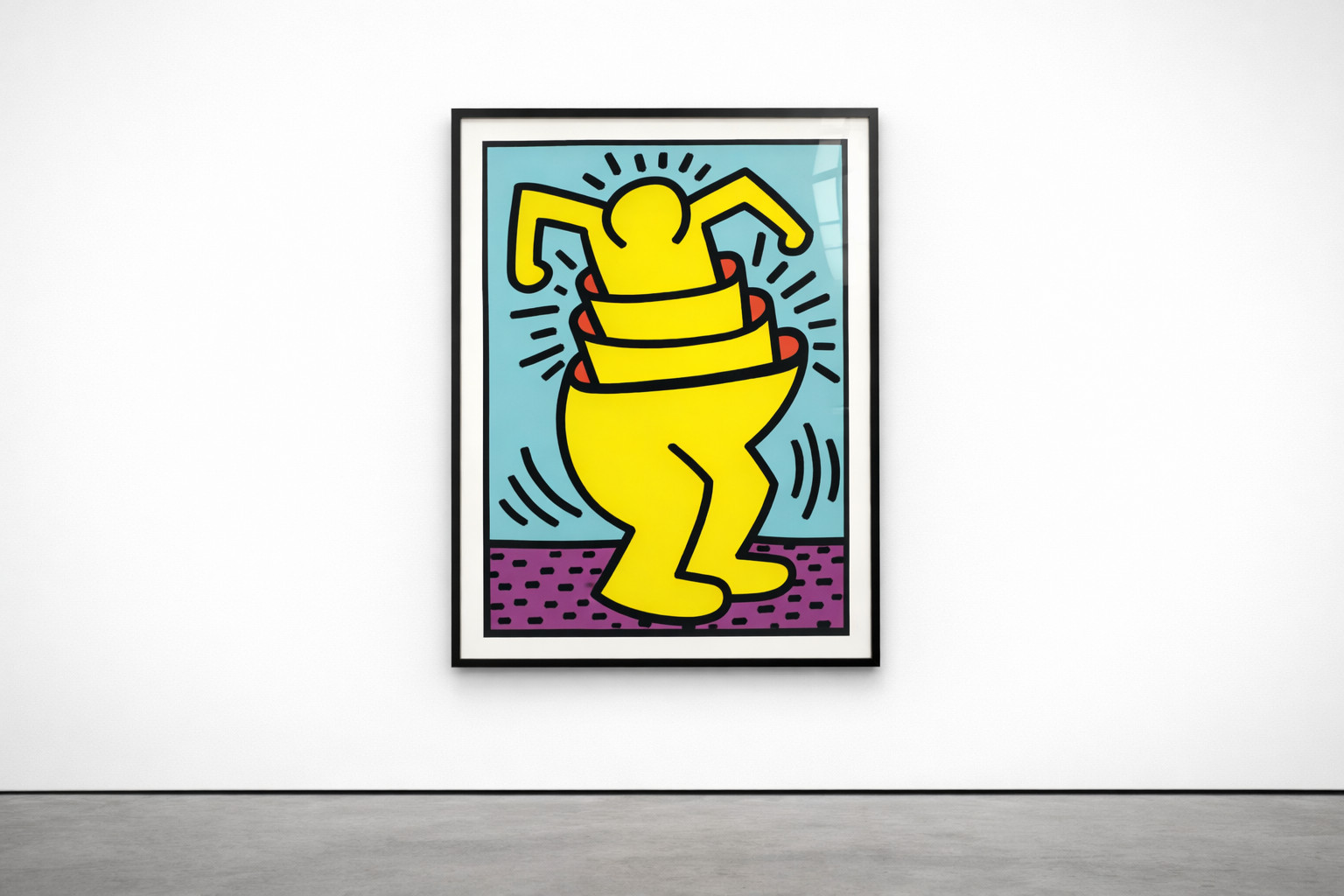
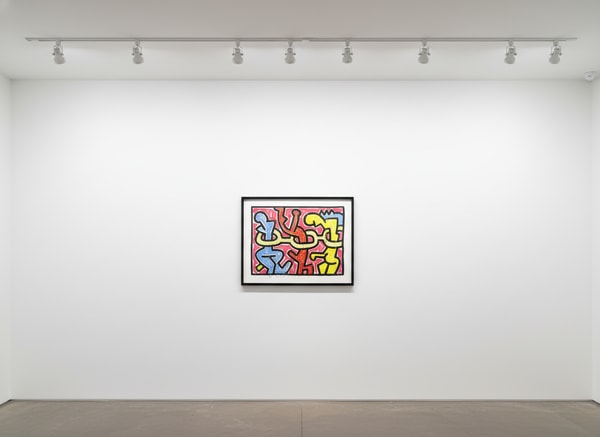
Keith Haring, Untitled (Cup Man) (Littmann PP. 116-117). Available at Guy Hepner, New York.
The figures in Haring's Fertility series — multiple human forms connected by shared energy lines, sometimes overlapping, arranged in rhythmic repetition — represent the social body: individual figures who are also part of a collective. The fertility theme is not primarily about reproduction; it is about the regenerative capacity of human connection, community, and love in the face of forces that threaten them. These works carry particular emotional weight given the AIDS context in which they were made.
Angels, Pyramids, and the Flying Saucer
Haring's cosmological symbols — the flying saucer, the pyramid with its all-seeing eye, the angel — suggest a sensibility that extends beyond the social and political into the spiritual and transcendent. These draw from the vernacular spiritual culture of the 1970s and 1980s: UFO iconography, the occult imagery that saturated post-hippie counterculture, the visual language of conspiracy and transcendence that appeared on everything from album covers to graffiti walls.
The flying saucer beams rays downward, affecting the figures below. Sometimes the effect is benign — figures reach upward in invitation or wonder. Sometimes it is threatening — the rays impinge on figures who have no control over what descends on them. The ambiguity is intentional. Technology, government, and the cosmos all arrive in human life from above, from outside human agency. Whether any of them can be trusted is a question Haring leaves open, pressing it into the viewer's hands.
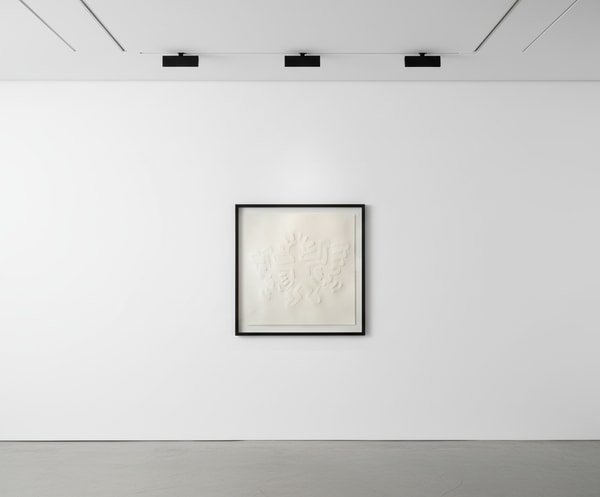
The angel is most fully developed in the White Icons series of 1990, produced in the final year of his life. By then Haring had been living with an AIDS diagnosis for two years. The White Icons series — including the Angel print — was made in the knowledge that his time was limited. These are not decorative angels. They are figures poised between worlds, messengers between the living and the dead, drawn by someone preparing for his own transition. They are among the most emotionally weighted works in his entire catalogue.
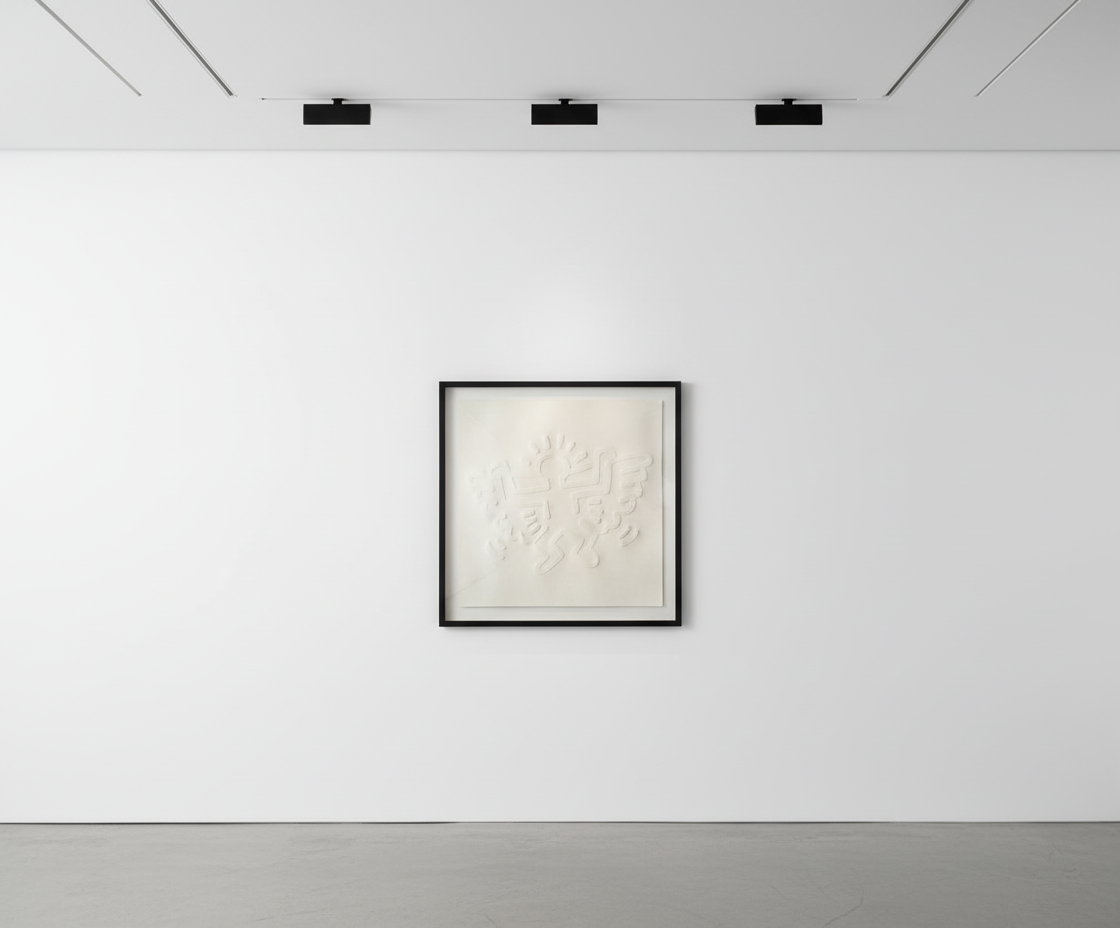
Keith Haring, Angel, from White Icons (Littmann PP. 173). Available at Guy Hepner, New York.
The Pop Shop and the Democratisation of the Icon (1986)
In 1986, Haring opened the Pop Shop at 292 Lafayette Street in SoHo, selling T-shirts, posters, magnets, and prints bearing his imagery at prices accessible to anyone. It was controversial. Critics accused him of selling out — of commodifying imagery that had begun as a gift to the public in the subway. The art world was uncomfortable with an artist who explicitly wanted his work to be affordable and ubiquitous rather than rare and expensive.
Haring's position was clear and consistent: he wanted his visual language to belong to everyone. The subway drawings had been free. The Pop Shop was the commercial extension of the same impulse. He also used the shop's revenue to fund charitable work, particularly AIDS organisations and children's programmes. It was not a commercial compromise; it was the logical conclusion of the democratic theory embedded in the subway drawings from the beginning.
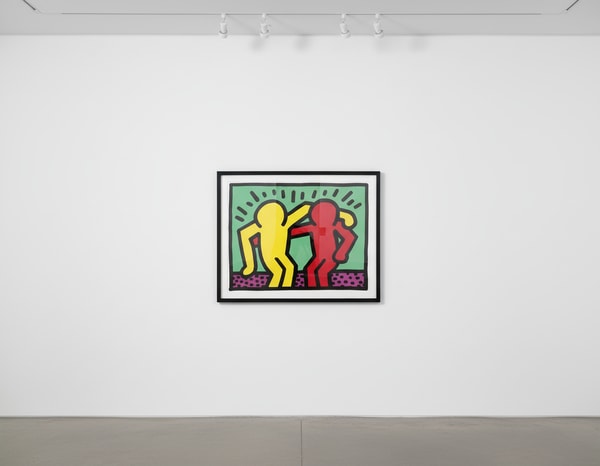
The Pop Shop series prints — documented in the Littmann catalogue at PP. 81, 96–97, and 143–147 — represent some of the most focused expressions of his full iconographic vocabulary. Each composition assembles multiple motifs into a dense, legible whole. For collectors, these prints offer the complete visual language of Haring in a single work.
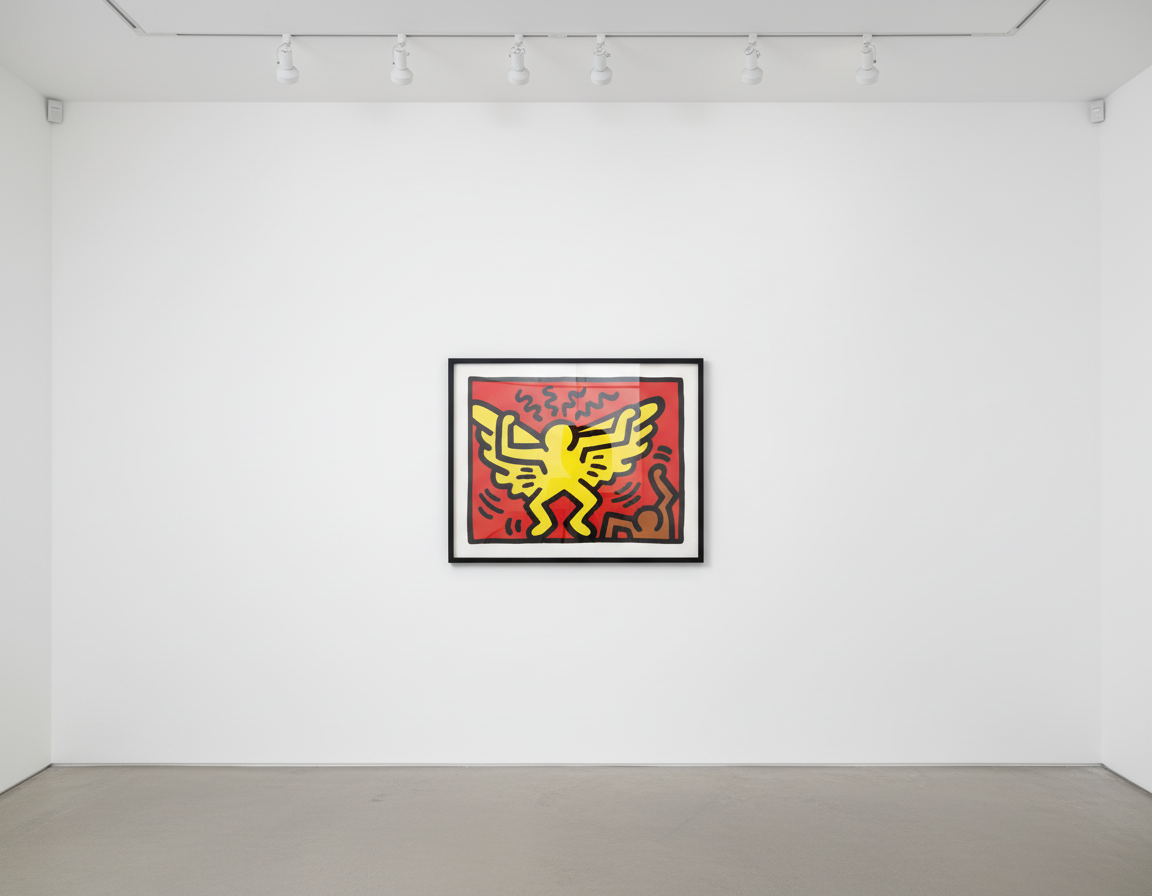
Keith Haring, Pop Shop IV (A) (Littmann PP. 146). Available at Guy Hepner, New York.
AIDS Activism and the Final Evolution
Haring was diagnosed with AIDS in 1988. He died in February 1990, aged 31. In the two years between diagnosis and death, his work became increasingly explicit in its engagement with the epidemic. The Ignorance = Fear / Silence = Death poster (1989), distributed free through ACT UP, used his visual language — figures covering eyes, ears, and mouth in a see-no-evil pose — for direct political action. It remains one of the most effective pieces of activist art of the twentieth century.
The evolution of his symbol language in AIDS-era work is visible in its density and urgency. Compositions become more packed; figures are compressed and overlaid; the energy lines that always surrounded his forms grow more insistent. Every motif acquires heavier emotional weight. The radiant baby, the angel, the dancing figure — all are inflected now by the awareness of mortality that Haring was living with daily.
The Flowers portfolio (1990), one of his final print series, introduces a motif that had been largely absent from his earlier work: the natural world. Flowers rendered in his signature outline style, vibrating with the same energy lines as his human figures. Life force made visible in its most elemental form, produced by a man who knew he was running out of time.
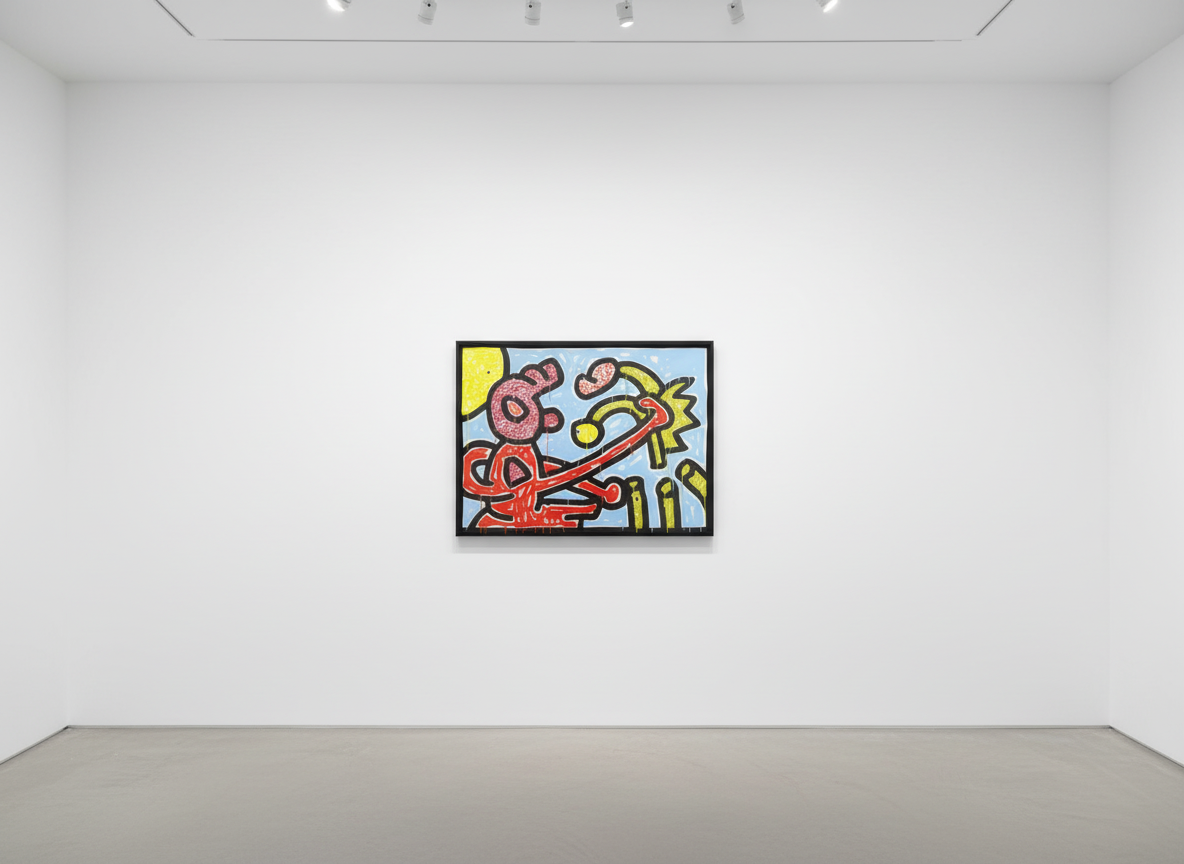
Keith Haring, Flowers 1 (Littmann PP. 165). Available at Guy Hepner, New York.
The Print Market: Auction Results
Haring's print market is one of the most consistent in post-war and contemporary editions. Christie's London set an auction record for the artist's print work in September 2023 when a complete set of four prints achieved £786,652 — a result confirming deep institutional and collector confidence in the catalogue. In May 2025, Christie's New York recorded $403,200 for Red Dog and $327,600 for an Untitled in the Post-War and Contemporary Day Sale, demonstrating the sustained strength of individual works from across his career.
Individual Haring prints operate in a market range of approximately $30,000 to $500,000 depending on the specific work, its edition, condition, and provenance. Complete portfolios — Fertility, Icons, White Icons, Flowers — command significant premiums over individual works. The Littmann catalogue reference number is the standard identifier for print editions; any serious acquisition should begin by confirming the Littmann reference against the physical work.
Works depicting the core iconographic motifs — barking dog, radiant baby, dancing figures, angel — attract the strongest collector interest and have shown the most consistent price performance. Works with direct connection to his AIDS activism carry additional cultural and historical significance that underpins long-term demand.
Authentication: The Keith Haring Foundation
Print authentication for Keith Haring works relies on the Littmann catalogue raisonné (1997, Cantz) as the primary reference document. The Keith Haring Foundation, established by Haring before his death, serves as the estate's authoritative body and maintains records of authorised works. Estate-authorised print editions were issued with certificates of authenticity signed by Haring's studio or, after his death, by the Foundation.
For collectors, authentication verification means confirming the Littmann catalogue reference number matches the physical work, checking for the presence of original estate documentation, and verifying provenance through gallery records or auction house documentation. The Foundation does not issue retroactive authentications for works lacking original documentation — clean provenance from first sale is therefore essential. Works acquired through established galleries and major auction houses with full provenance chains are the most secure acquisitions.
FAQ: Keith Haring Motifs and Icons
What are Keith Haring's most famous symbols?
Haring's most recognised symbols are the radiant baby (a crawling infant with radiating energy lines), the barking dog (institutional power and aggression), dancing and crawling human figures (liberation and vulnerability), the flying saucer (external power, the unknown), and the angel (spirituality, mortality). These motifs developed through his New York subway drawing practice between 1980 and 1985 and appear consistently across the full body of his print and canvas work.
What does the radiant baby mean in Keith Haring's work?
The radiant baby was Haring's most personal symbol, representing innocence, new life, and the fundamental human condition before social and political forces shape it. He considered it the most direct expression of his own sensibility among all his motifs. As the AIDS crisis deepened, the baby acquired additional weight — the vulnerability of life under threat, the value of what was being lost — making late works featuring it among the most emotionally charged in his catalogue.
What do the Littmann numbers mean on Keith Haring prints?
Littmann numbers (e.g. "Littmann PP. 144") refer to page numbers in the 1997 Keith Haring catalogue raisonné published by Cantz. This is the standard documentation reference for the print catalogue. A Littmann number on a certificate of authenticity or in auction documentation identifies the specific edition and confirms its inclusion in the recognised print catalogue. Always verify the reference against the physical work when acquiring.
What is the Keith Haring barking dog symbol?
The barking dog represents institutional authority, aggression, and the systems of power that threaten the human figures surrounding it. In the context of the early 1980s — police violence, the Reagan administration's silence on AIDS, governmental indifference to communities Haring was embedded in — the dog carried specific political weight. It is one of the most consistently political images in his entire output.
Are Keith Haring prints a good investment?
Haring's print market has demonstrated sustained strength, with Christie's London recording a print auction record of £786,652 in September 2023 and consistent results across major houses in 2024 and 2025. His work benefits from strong institutional recognition, a documented catalogue raisonné, a clear authentication framework through the Keith Haring Foundation, and deep collector demand. Key acquisition considerations are condition, clean provenance, Littmann catalogue reference, and whether the work expresses his core iconographic vocabulary. Complete portfolios from the Fertility, Icons, and White Icons series have historically shown the strongest returns.
Where can I buy Keith Haring prints?
Guy Hepner Gallery at 177 Tenth Avenue, New York offers a carefully selected range of Keith Haring prints including works from the Fertility, Pop Shop, White Icons, and Flowers series. Each work is offered with full provenance documentation. Contact the gallery to discuss current availability.
Works For Sale
Available through Guy Hepner
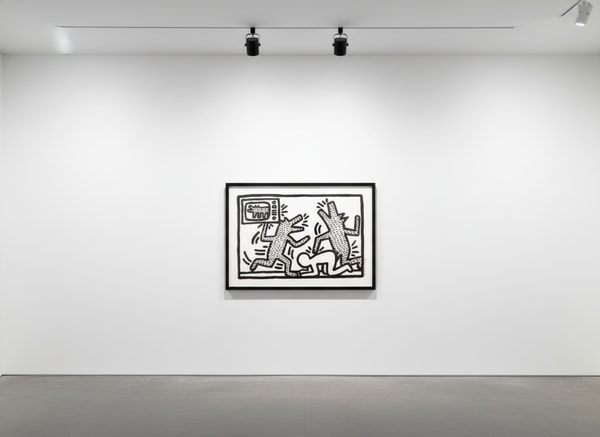
Keith Haring
Untitled III (Littmann PP. 20)
1982
Enquire →
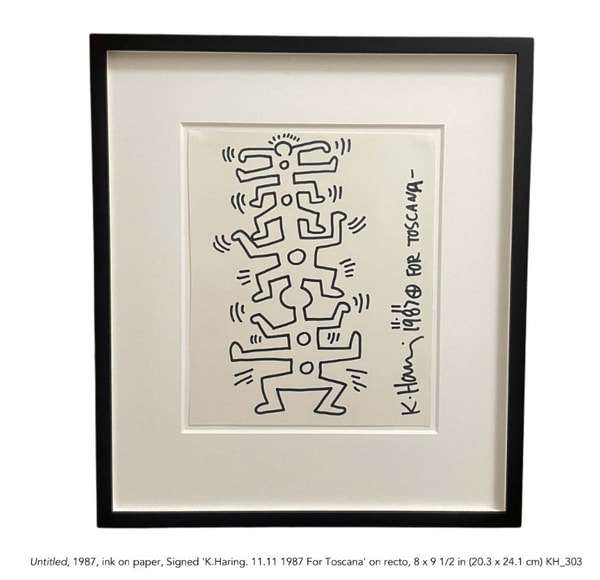
Keith Haring
Untitled (For Toscana)
1987
Enquire →
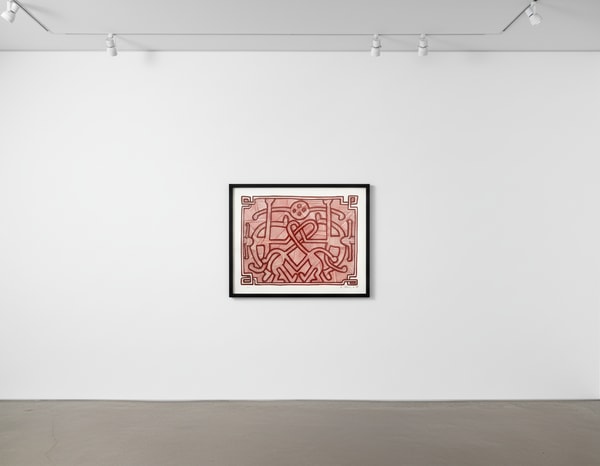
Keith Haring
Chocolate Buddha 2 (Littmann PP. 124)
1989
Enquire →
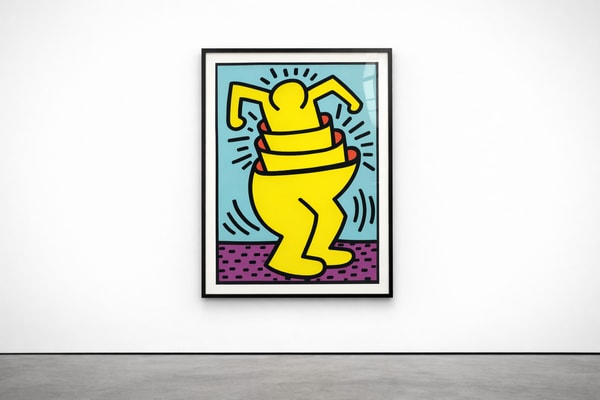
Keith Haring
Untitled (Cup Man) (Littmann PP. 116-117)
1989
Enquire →
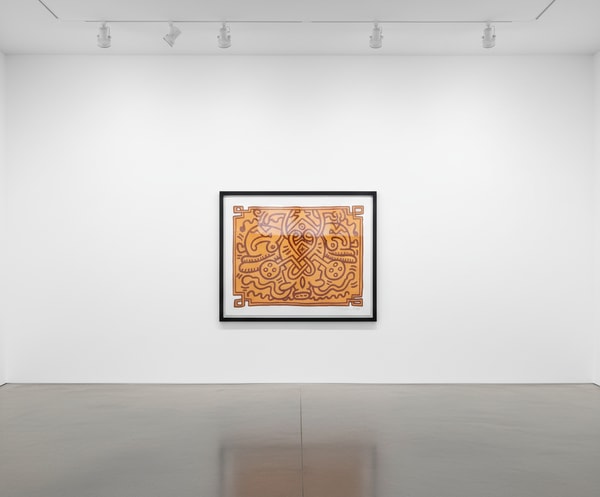
Keith Haring
Chocolate Buddha 4 (Littmann PP. 125)
1989
Enquire →
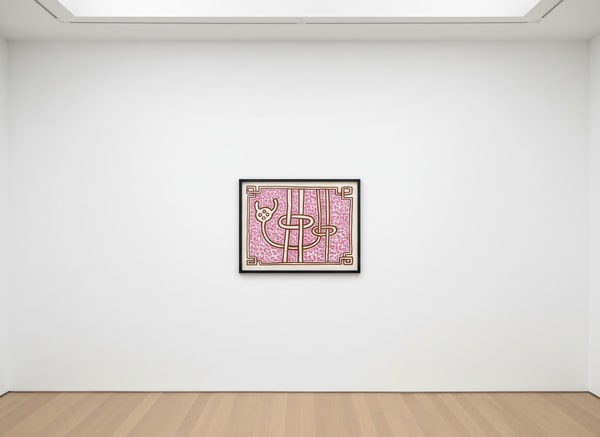
Keith Haring
Chocolate Buddha 3 (Littmann PP. 124)
1989
Enquire →
Keith Haring
Angel, from White Icons (Littmann PP. 173)
1990
Enquire →
Keith Haring
Dog
1986
Enquire →
More from Guy Hepner