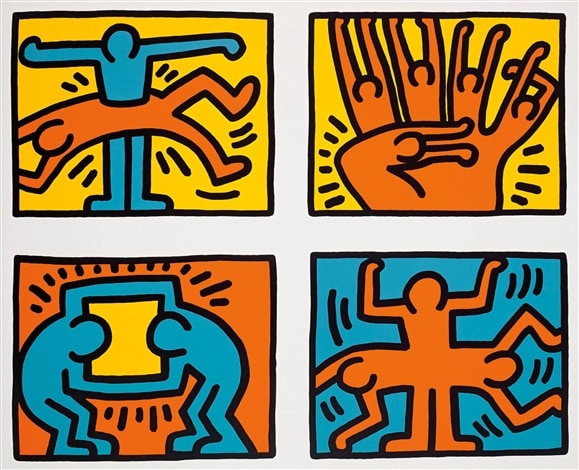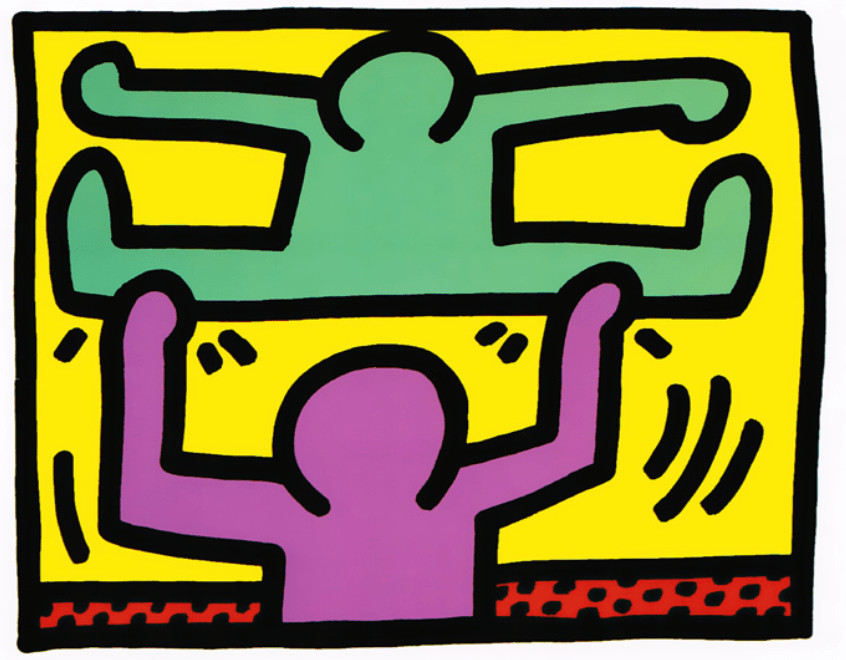
Pop Shop I

June 15, 2026
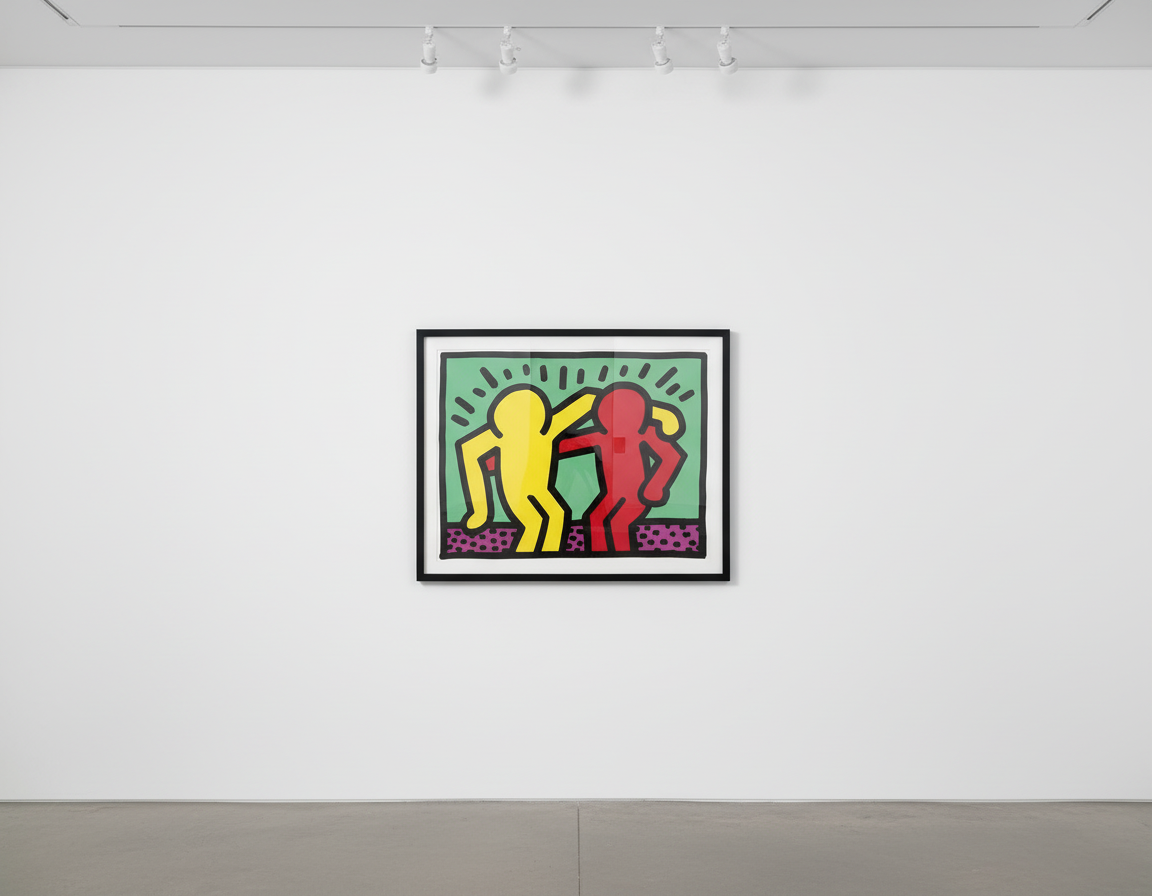
Between 1987 and 1990, Keith Haring produced six portfolios of screenprints under the Pop Shop banner — works that stand among the most important printed editions of the late twentieth century. Commercially conceived as an extension of the retail experiment he launched at 292 Lafayette Street in SoHo, the keith haring Pop Shop print series transcends its origins: these are serious fine-art multiples, catalogued in the Littmann raisonné, sought by institutional and private collectors alike, and scarce in the secondary market. This guide examines each portfolio in turn, from the founding philosophy of the Pop Shop itself to the technical specifications of every edition and the condition criteria that define value at auction today.
Inquire About Available Keith Haring Pop Shop PrintsBrowse current Pop Shop editions available through Guy Hepner, 529 West 20th Street, New York.
When Keith Haring opened the Pop Shop at 292 Lafayette Street, SoHo, in April 1986, he was making an argument about access. The art world of mid-1980s Manhattan was defined by velvet-rope exclusivity — galleries on West Broadway, collectors in limousines, prices calibrated to exclude. Haring walked in the opposite direction. The Pop Shop was a retail store open to anyone, selling T-shirts, posters, buttons, refrigerator magnets and tote bags at prices a teenager could afford. Its location in SoHo was deliberate: the same neighbourhood that housed Leo Castelli and Mary Boone, but a street-level intervention into that world rather than a participant in its hierarchies.
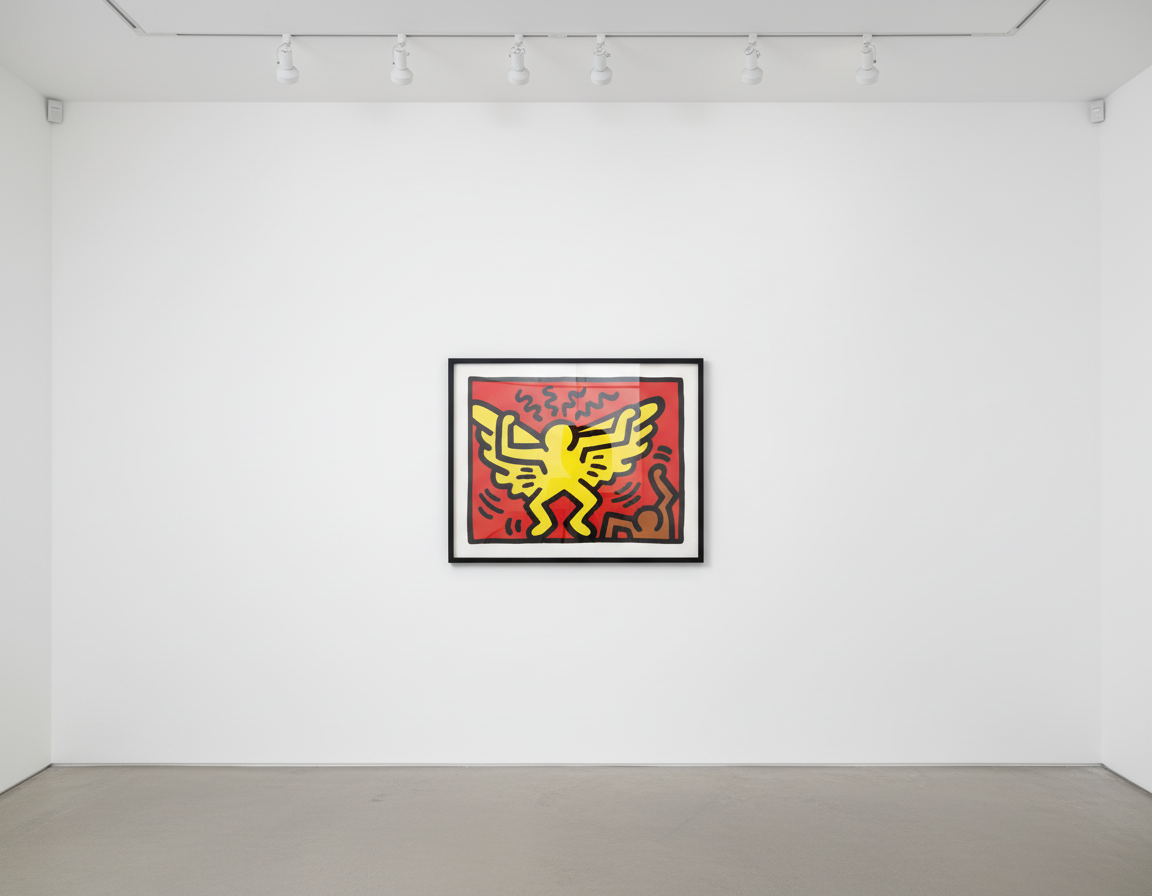
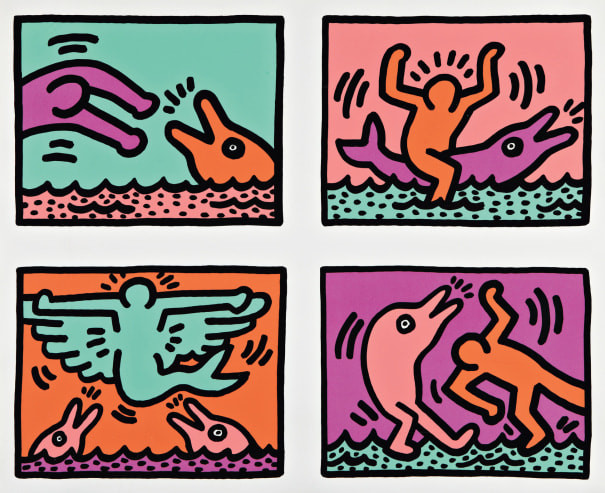
Keith Haring, Pop Shop Iv (A) (Littmann PP. 146), 1989. Screenprint. Available at Guy Hepner, 529 West 20th Street, New York. Browse Keith Haring Pop Shop IV Prints →
300 Lafayette Street, SoHo, Manhattan — steps from 292 Lafayette, where the Pop Shop operated from 1986. Photo: Deansfa, CC BY-SA 4.0, via Wikimedia Commons. Available at Guy Hepner, New York.
Haring had articulated his democratic intent from the earliest days of his Subway Drawings, when he chalked luminous figures on blank advertising panels in New York City's underground — an act of public art unmediated by dealers, critics or collectors. The Pop Shop was that impulse institutionalised. His frequently cited response to critics who accused him of crass commercialisation was characteristically blunt: he was not betraying fine art but refusing its gatekeeping function. "I could have just as easily not opened the Pop Shop and everybody would say I was a more 'serious' artist," he wrote. "But what I'm doing is making art accessible."
The critical reception was divided, predictably. Some reviewers perceived the retail venture as the moment Haring crossed from artist to brand. Others — and time has vindicated this view — understood it as consistent with a practice rooted in public space, collective participation and the rejection of scarcity as a value. The Pop Shop never claimed to replace the gallery; it claimed to operate alongside it, on different terms. The limited-edition print series that emerged from the same philosophy in 1987 made that duality explicit: these were formally produced fine-art multiples, numbered and signed, issued in editions of strictly controlled size, yet bearing the name and the spirit of a store where you could also buy a refrigerator magnet for four dollars.
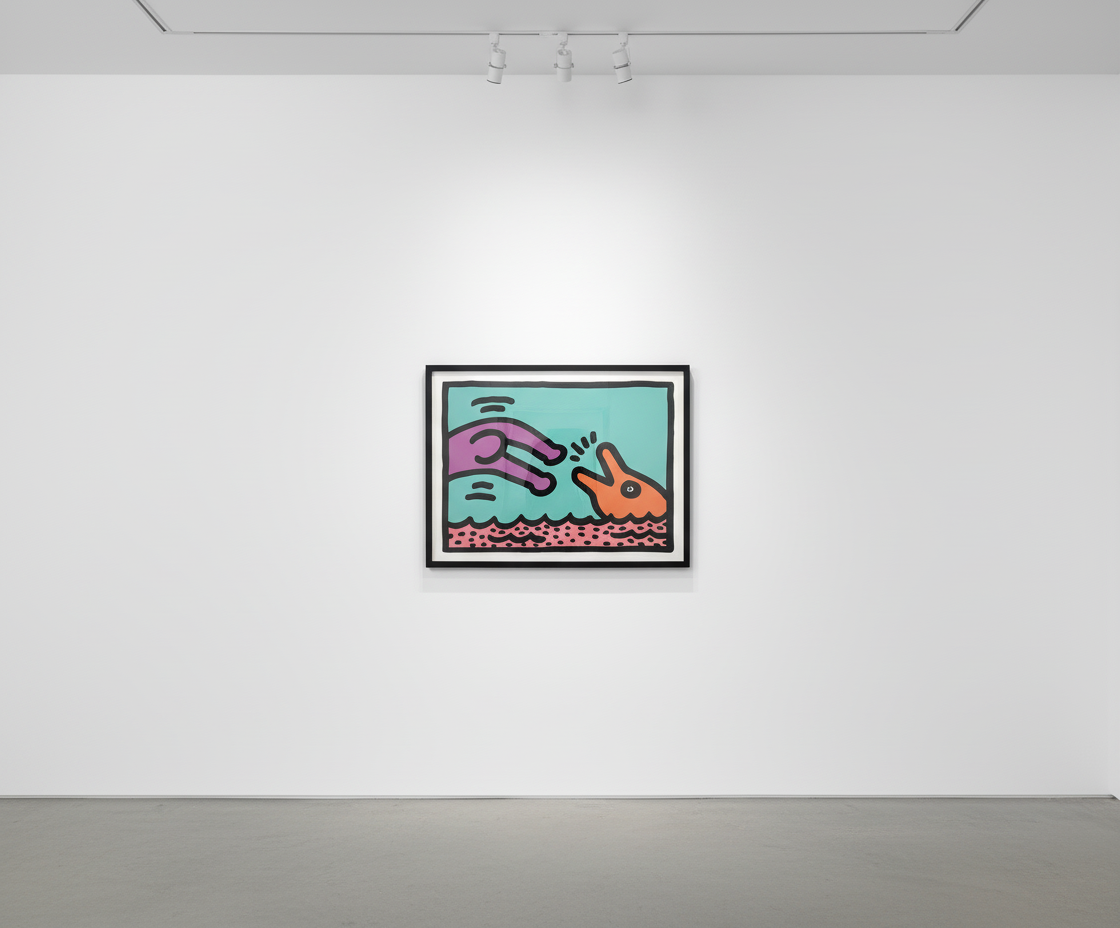
Keith Haring, Pop Shop V (A) (Littmann PP. 148), 1989. Screenprint. Available at Guy Hepner, 529 West 20th Street, New York. Browse Keith Haring Pop Shop V Prints →
Lafayette Street, Lower Manhattan, looking north — the street that runs through SoHo where Haring's Pop Shop was located. Photo: Ken Lund, CC BY-SA 2.0, via Wikimedia Commons. Available at Guy Hepner, New York.
The distinction between the Pop Shop's commercial merchandise and the Pop Shop print series is fundamental and must be clearly established for any collector. The T-shirts, posters and novelty items sold in the store were mass-produced consumer goods — unsigned, unnumbered, available in unlimited quantities. The print series, by contrast, comprises formally documented, strictly limited screenprint portfolios, each recorded and catalogued in the essential reference for Haring's printed works: the Littmann catalogue raisonné, Keith Haring: The Editions, published by Hatje Cantz.
The six portfolios — Pop Shop I through Pop Shop Vi — were produced between 1987 and 1990, overlapping with some of Haring's most concentrated creative years. Each comprises four individual screenprint compositions (with selected portfolios also including an oversized 'Quad' format), printed on archival paper in editions generally of 200, with a small number of artist's proofs. They were issued under the Pop Shop imprint but distributed through conventional fine-art channels alongside the gallery market. Today, keith haring pop shop prints appear regularly at the major international auction houses — Christie's, Sotheby's and Phillips — and in specialist print dealers including Guy Hepner, where the full series can be viewed and acquired.
The Littmann raisonné provides the authoritative record for each edition: publication dates, edition sizes, paper stock, printer information and condition precedents. Any serious collector should treat it as the primary reference alongside the Haring Foundation's authentication records. The catalogue numbers referenced throughout this guide — PP. 82, PP. 97, PP. 144 and beyond — are Littmann designations that allow unambiguous identification of individual compositions across the six portfolios.
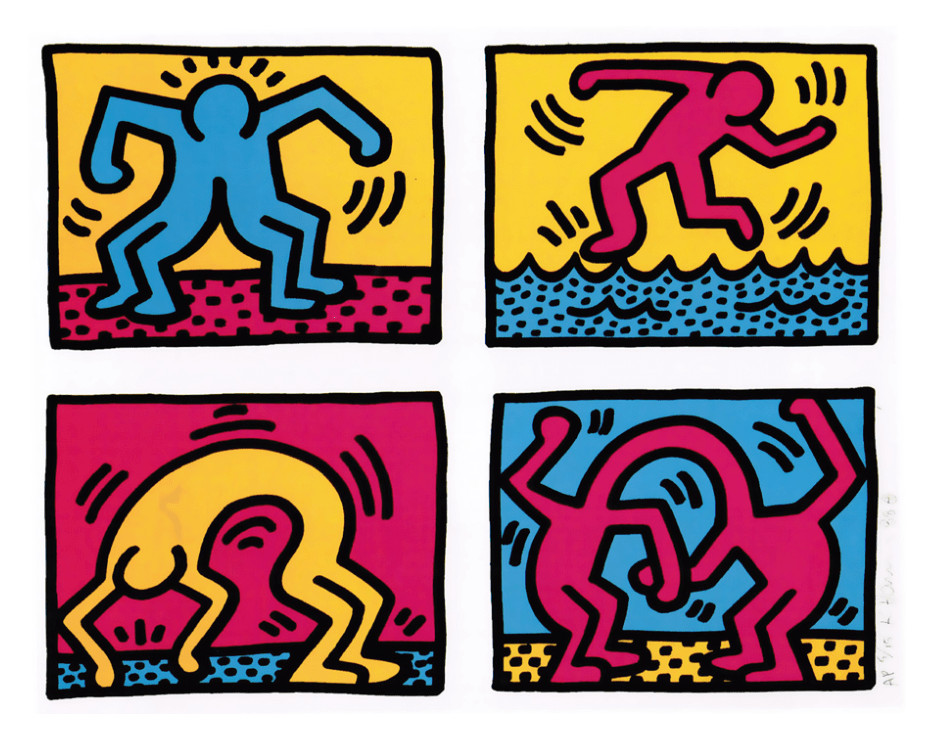
Pop Shop I, published in 1987, comprises four screenprints on wove paper, designated in the Littmann catalogue raisonné as PP. 82 through PP. 85 (with PP. 82–83 covering compositions A and B, the most frequently referenced). The four compositions — A, B, C and D — each present a distinct arrangement of Haring's instantly recognisable visual vocabulary: the Radiant Baby, the Barking Dog, crawling and leaping figures, and the interlocked forms that recur across his entire printed oeuvre. The edition size for each composition is 200, with a standard allocation of artist's proofs. Sheet dimensions are approximately 38 × 38 inches — a substantial physical presence that rewards proper framing and display.
Each print in the portfolio is executed in a limited palette that exploits screenprint's capacity for flat, saturated colour. Pop Shop I A (Littmann PP. 82) is among the most sought of the entire series, combining the Radiant Baby motif with a dense field of animated figures in a composition that collectors have consistently prioritised in the secondary market. The keith haring pop shop i works from this inaugural portfolio represent the series at its most concentrated and historically significant: first editions, printed while Haring was at the height of his creative and commercial reach, before the physical and psychological demands of his HIV diagnosis introduced new urgency into the work.
Keith Haring, Pop Shop I (A) (Littmann PP. 82), 1987. Screenprint. Available at Guy Hepner, 529 West 20th Street, New York. Browse Keith Haring Pop Shop I Prints →
The portfolio was published under the Pop Shop imprint and distributed internationally. Its immediate critical and commercial success established the series as a viable enterprise and set the template — edition size, format, presentation — that subsequent portfolios would follow and subtly vary. Pop Shop I remains the benchmark against which all later portfolios are assessed, both in terms of iconographic richness and auction performance.
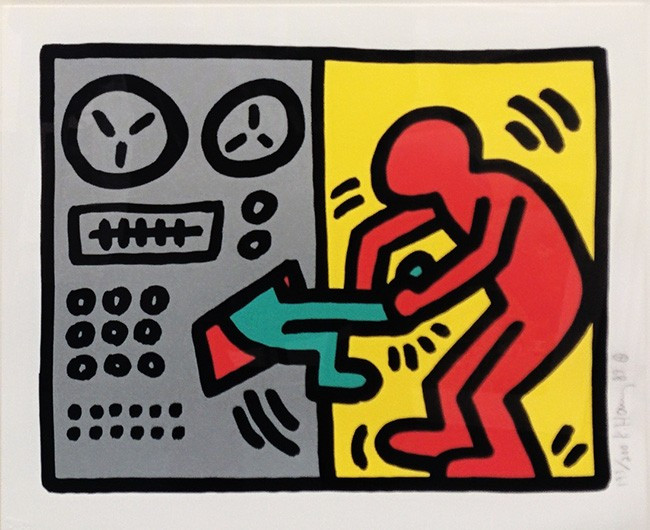
The three portfolios produced across 1988 and 1989 demonstrate both the consistency and the evolution of Haring's approach to the series. Pop Shop II, catalogued at Littmann PP. 94 through PP. 97, was published in 1988 and introduces a notably different tonal register from its predecessor: the compositions are denser, the palette more varied, and the figurative interlocking more complex. Pop Shop II D (Littmann PP. 97) — one of the most frequently auctioned of the entire series — exemplifies the portfolio's expanded visual language, deploying a large-scale interlocked figure composition in a colourway that departs markedly from the cooler tones of Pop Shop I.
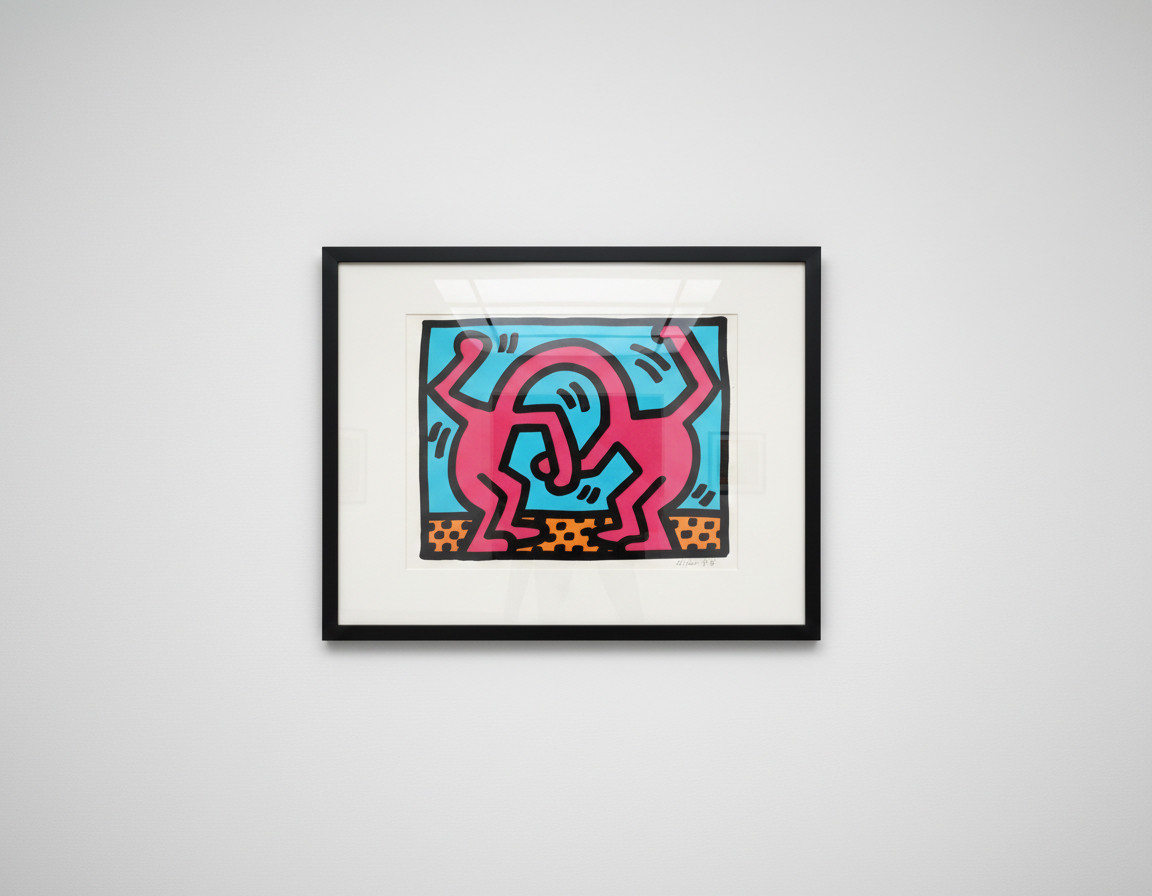
Keith Haring, Pop Shop II (D) (Littmann PP. 97), 1988. Screenprint. Available at Guy Hepner, 529 West 20th Street, New York. Browse Keith Haring Pop Shop II Prints →
Pop Shop II also introduced the Quad format: an oversized single-composition screenprint, substantially larger than the standard portfolio prints, that presents a single expansive design across a single sheet. The Quad format was repeated in Pop Shop IV and represents among the rarest and most impressive physical objects in the entire series. Collectors seeking the keith haring pop shop ii Quad should expect a premium over the standard portfolio compositions, reflecting both the scale and the relative scarcity of examples in undamaged condition.
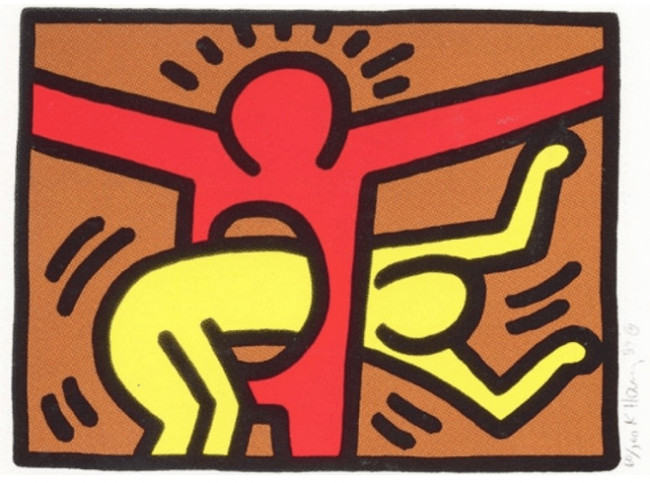
Pop Shop Iii (1989), catalogued from Littmann PP. 141, is in many respects the most discussed portfolio in the secondary market. Search volume data and auction records both confirm that the keith haring pop shop iii designation consistently outperforms its siblings in collector enquiry, a fact attributable to the portfolio's visual balance between the graphic boldness of Pop Shop I and the greater complexity of later work. The compositions from Pop Shop III combine Haring's most iconic motifs — the Radiant Baby, the Dancing Figure, the Barking Dog — in arrangements that feel simultaneously familiar and freshly resolved. Pop Shop III A (Littmann PP. 144) in particular has achieved strong auction results, with examples appearing at Christie's and Phillips in recent seasons.
Pop Shop IV, also 1989, follows the template established by its immediate predecessors while introducing further chromatic experimentation. The Quad composition from Pop Shop IV is among the series' most visually ambitious works. Edition sizes across these three portfolios remain consistent with Pop Shop I, at approximately 200 numbered impressions with artist's proofs, though prospective purchasers should verify edition details against Littmann for any specific work offered for sale.
Keith Haring disclosed his HIV-positive diagnosis publicly in 1989, having been aware of his status since 1988. The context bears directly on how the final two portfolios in the Pop Shop series should be understood. Pop Shop V (1989) and Pop Shop VI (1990) were created as Haring's health was declining and his consciousness of time as a finite resource sharpened. Both portfolios exhibit what many critics have identified as an increased density and urgency in the visual language — compositions that crowd the picture plane more aggressively, figures that seem to press against the edges of the sheet, a sense of energy that reads differently in the light of biographical knowledge.
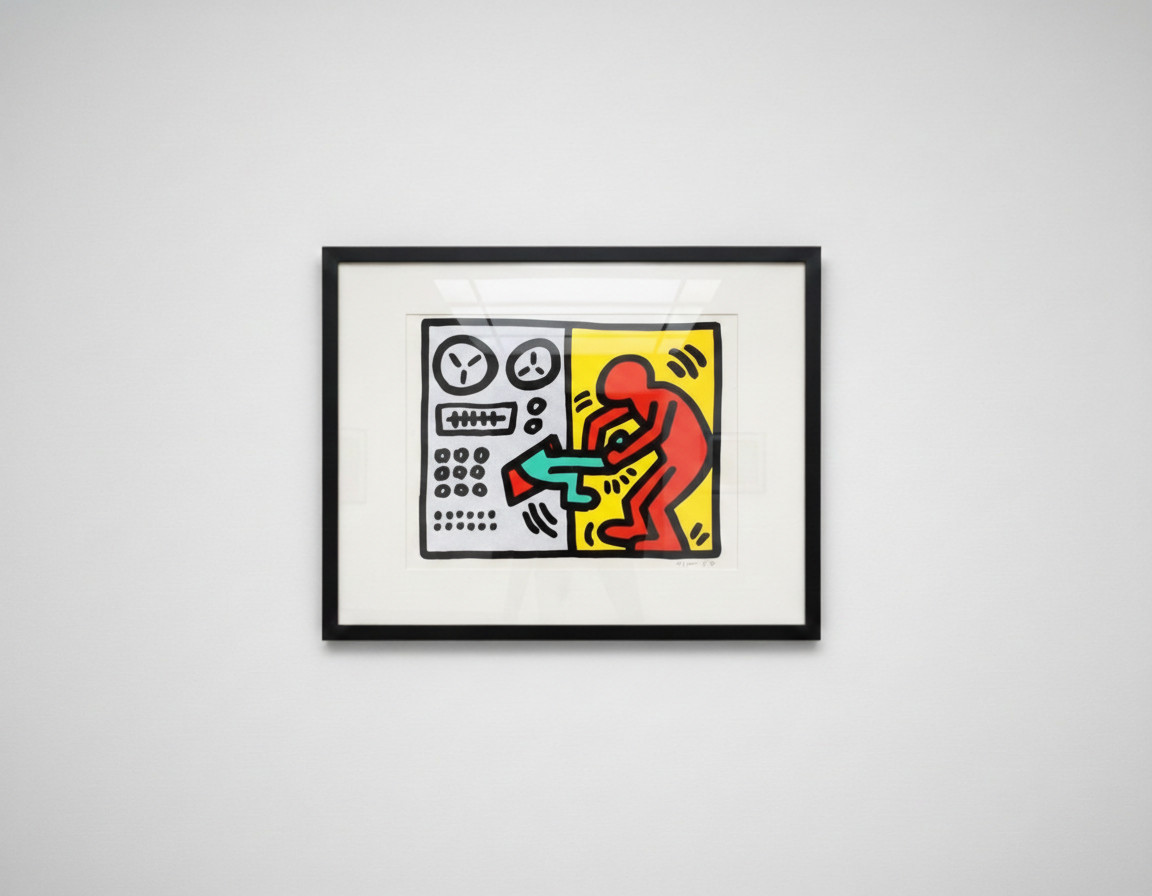
Keith Haring, Pop Shop III (A) (Littmann PP. 144), 1989. Screenprint. Available at Guy Hepner, 529 West 20th Street, New York. Browse Keith Haring Pop Shop III Prints →
Pop Shop VI (1990) has particular poignancy as the last complete portfolio published under Haring's supervision before his death in February 1990. The four compositions in the series close a chapter that had begun with Pop Shop I's confident declaration of accessible art three years earlier. In the secondary market, Pop Shop V and VI currently command lower prices than the inaugural portfolios, reflecting the relative premium collectors attach to the early, most iconic editions. However, the biographical significance of the final portfolios, combined with their genuine visual distinction, makes them compelling acquisitions for collectors who approach the series as a complete narrative rather than a set of individually ranked objects.
This late work also connects thematically with other major Haring series from the same period. The Blueprint Drawings, produced in 1990 on blueprint paper, share with Pop Shop V and VI a sense of working urgently within a defined format. The Keith Haring Retrospect exhibition examined this concentrated late productivity in detail. The Pop Shop print series and the late works together constitute the full arc of Haring's printed output: from democratic optimism at the series' opening to a more freighted but no less energetic final statement.
The following table summarises the key technical details for each portfolio in the Pop Shop series, drawn from the Littmann catalogue raisonné and auction house cataloguing. Edition sizes are standard; collectors should request certificates of authenticity and verify Littmann numbers for any individual work.
Note: Quad format prints from Pop Shop II and IV are among the largest works in the series and are catalogued separately in Littmann. Edition sizes for individual compositions should be verified against the raisonné; the figures given above represent standard editions as documented. Artist's proofs (AP) typically number between 20 and 40 per edition and trade at a premium over the standard numbered impressions.
The secondary market for keith haring pop shop prints for sale has remained robust across cycles of broader market contraction. Pop Shop I consistently commands the highest prices for individual compositions, with strong examples of Pop Shop I A and Pop Shop I B regularly achieving $15,000–$30,000 at Christie's and Sotheby's. Complete sets of all four prints from Pop Shop I in excellent condition, with original documentation, have appeared at auction above $80,000 in recent seasons. The Quad compositions from Pop Shop II and IV, owing to their scale and rarity, have achieved comparable premiums when they appear — which is infrequently, as many remain in the hands of their original purchasers.
Pop Shop III commands particular attention in search volume and enquiry data, with collector demand for keith haring pop shop iii works consistently outpacing the other portfolios. This is attributable to several factors: the portfolio's iconographic balance, the frequency with which Pop Shop III A and B are illustrated in survey publications, and the fact that it was published at the apex of Haring's critical reputation in 1989, the year that also saw his diagnosis become public. Phillips has handled several Pop Shop III examples in the past three seasons, with prices for individual prints ranging from $8,000 to $22,000 depending on condition and provenance.
Pop Shop II occupies a strong mid-market position. The keith haring pop shop ii series, particularly the D composition (Littmann PP. 97), has been increasingly sought by collectors who find Pop Shop I pricing prohibitive and appreciate the visual ambition of the second portfolio. Pop Shop V and VI remain more accessible, with individual prints typically appearing in the $5,000–$15,000 range at specialist auction, though examples with exceptional provenance or in pristine condition can exceed these benchmarks.
For collectors considering the series as an investment, the general pattern is consistent with Haring's broader printed oeuvre: early editions, first portfolios and the works most frequently illustrated in the primary literature perform best over time. The Littmann catalogue raisonné's definitive status means that catalogued works in strong condition enjoy a liquidity advantage — they can be placed at any major auction house with full scholarly documentation and a clear chain of attribution. Collectors wishing to buy keith haring pop shop works through the primary market should note that Guy Hepner maintains an active inventory across the series, with access to works not available at public auction.
Every print in the Pop Shop series should be accompanied by its original certificate of authenticity and, where available, the original invoice or purchase record from the initial point of sale. The Haring Foundation maintains authentication records and can be consulted directly for verification of works whose provenance is unclear. Edition numbers are hand-inscribed in pencil in the lower margin of each sheet, typically in the format x/200, alongside the artist's signature — also in pencil — and the Pop Shop imprint stamp. Artist's proofs are designated AP rather than numbered, and their certificates reflect this.
Condition is the primary determinant of value for screenprints on paper, and the Pop Shop series is no exception. The large sheet dimensions — approximately 38 × 38 inches — mean that paper damage at the edges, centrefold creases (if the work has ever been rolled or folded) and foxing are the most common condition issues encountered at auction. Collectors should request detailed condition reports that address the state of the paper, the intensity of the ink (fading is rare in properly stored works but has been noted in examples exposed to direct sunlight), and the integrity of the margins. Any trimming of the margins — a practice occasionally used to eliminate edge damage — significantly reduces value and should be noted in any professional condition report.
Signed examples command a premium over unsigned impressions throughout the Pop Shop series, as they do across Haring's printed work generally. The artist was consistent in signing his editions, but some works entered circulation unsigned for various documented reasons; the Littmann catalogue raisonné notes relevant cases. For the purposes of the secondary market, a clearly readable pencil signature in the lower right margin, with legible edition number lower left, constitutes the standard presentation collectors should expect.
Works mounted or framed by previous owners should be examined carefully before purchase. Acid-containing backing boards, inappropriate adhesives (dry-mounting being the most damaging intervention encountered in practice) and UV-unprotected glazing can each cause significant damage over time. A conservator's report is advisable for any work that has been commercially framed and where the framing history is unknown. Works that have been stored unframed should be examined for handling creases, which can run invisibly until the sheet is lit at an oblique angle — a standard inspection technique used by reputable auction house specialists.
The Haring Foundation (haring.com) is the definitive resource for authentication enquiries, maintaining a comprehensive database of known editions and offering a formal authentication service. Prospective purchasers of works without clear documented provenance are strongly advised to obtain Foundation confirmation before committing to a purchase. Guy Hepner works directly with established provenance sources and is equipped to support collectors through authentication and acquisition for all works in the keith haring pop shop series available through the gallery.
Explore Keith Haring prints for sale at Guy Hepner: Pop Shop I, Pop Shop Ii, Pop Shop Iii, Pop Shop Iv, Pop Shop V.
Related Series