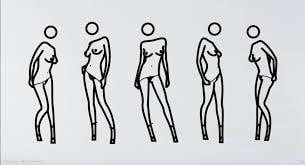
Bijou Gets Undressed

June 19, 2026
Few living artists have achieved the rare feat of becoming both a fixture of the international museum circuit and an instantly recognisable presence in the homes of private collectors worldwide. Julian Opie is one of them. His prints — bold, minimal, hypnotically simple — have been acquired by major institutions on every continent, reproduced on album covers, animated on LED screens in corporate lobbies, and hung in living rooms from London to Los Angeles. Yet the market for Opie editions remains approachable at every level, with Original Works available from a few hundred pounds up to significant five-figure sums for large-format or rare pieces. This guide is designed for anyone considering their first Julian Opie purchase, as well as established collectors looking to deepen their holdings or better understand the secondary market in 2026.
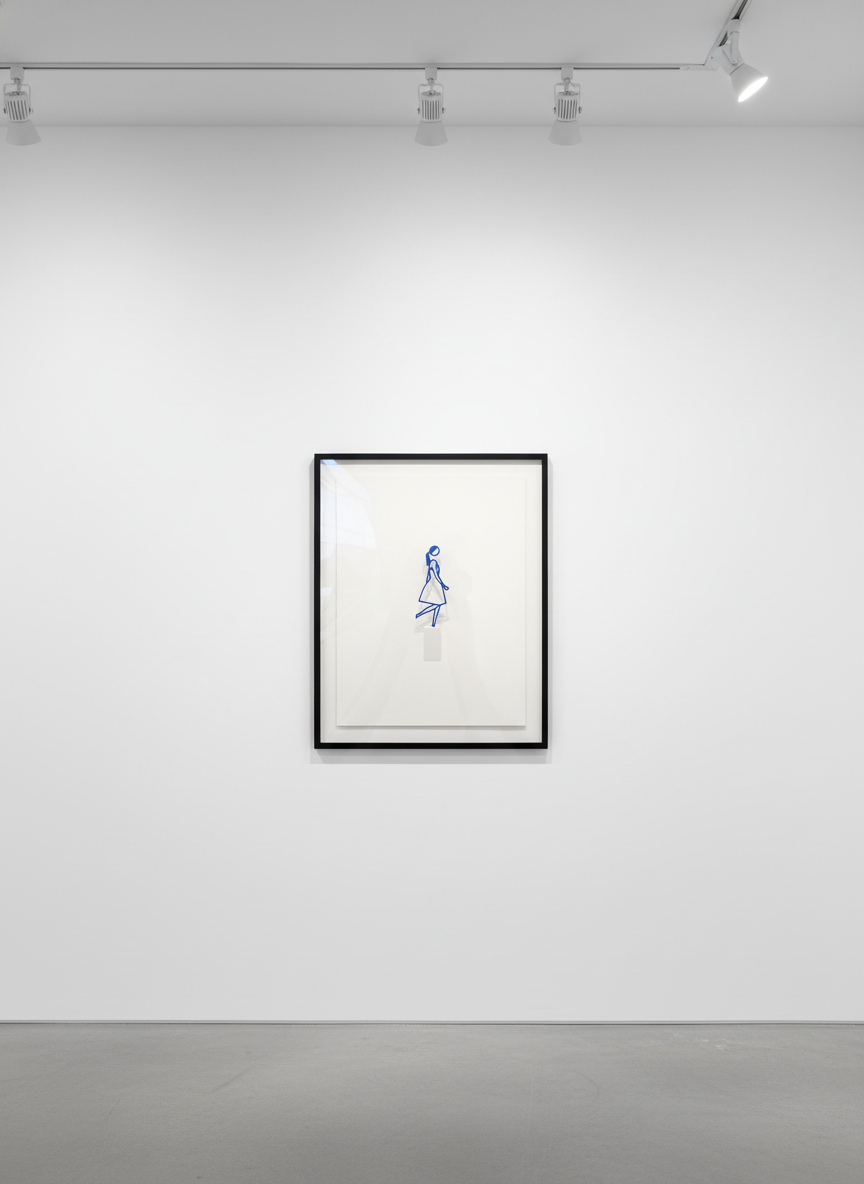
Amelia — Julian Opie. Available at Guy Hepner, New York.
Born in London in 1958, Julian Opie studied at Goldsmiths College of Art in the early 1980s, graduating into the same creative milieu that would later produce the Young British Artists. While his YBA contemporaries gravitated toward shock and provocation, Opie pursued a quieter but equally radical path: the systematic simplification of the human figure and the landscape into pure graphic form. His early sculptures — chunky, almost cartoonish three-dimensional objects rendered in industrial materials — established his interest in the tension between representation and abstraction. By the 1990s, he had shifted focus decisively toward the flat image, developing the signature vocabulary that defines his work today.
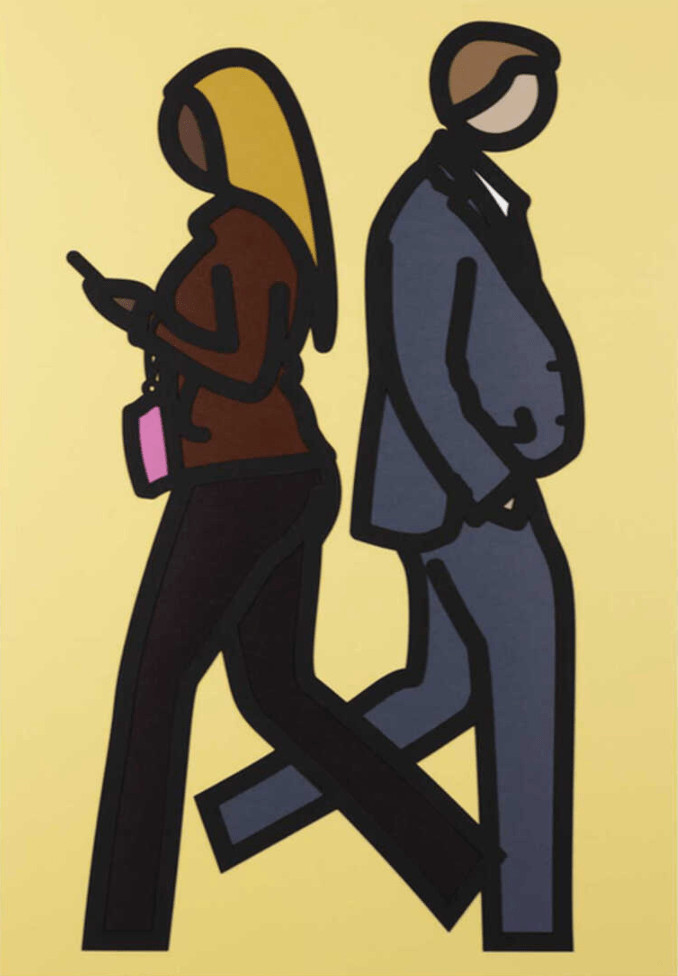
That vocabulary — thick black outlines, flat fields of colour, faces reduced to a dot and a line, bodies stripped of all but their essential gesture — draws on a remarkably broad range of influences: Egyptian hieroglyphics, Japanese woodblock prints, road-sign pictograms, video-game characters, and the long Western tradition of portraiture. The result is an aesthetic that feels simultaneously ancient and urgently contemporary. Opie's prints are not decorative in any superficial sense; they carry genuine conceptual weight, asking persistent questions about how we recognise the human form and what we lose — or gain — when we reduce it to its barest elements.
His international profile received a significant boost in 2000 when Blur used his illustrated portraits for the cover of their album Think Tank and, more famously, for the single "Coffee & TV." Overnight, Opie's style became known to millions who had never set foot in a gallery. That crossover into popular culture has sustained rather than diminished his critical standing: today, his work is held by the Tate, the Museum of Modern Art in New York, the National Portrait Gallery, the British Museum, and hundreds of other major institutions. He continues to produce new editions and large-scale public commissions at a pace that keeps the market actively supplied without ever feeling saturated.
To collect Opie well, it helps to understand precisely what makes his aesthetic so distinctive and so durable. The defining formal element is the outline: a confident, unmodulated black line that isolates each figure or object from its ground with total clarity. There is no shading, no modelling, no atmospheric haze. Colour — when it appears — is laid in flat, often luminous fields. Faces are almost always schematic: two dots for eyes, occasionally a simple curved line for a mouth. Hair is rendered as a solid silhouette rather than individual strands. The effect is not coldness but a strange, compelling warmth: these simplified figures have an emotional directness that more conventionally realistic portraiture often struggles to achieve.
This reduction is anything but accidental. Opie works from photographs, processing them through digital tools to arrive at the minimum number of lines required to convey identity and movement. The discipline is rigorous: every extraneous detail is stripped away until only the essentials remain. It is, in a sense, the opposite of photorealism — instead of accumulating detail to achieve likeness, Opie subtracts until recognition tips into abstraction and then pulls back just before it tips over entirely.
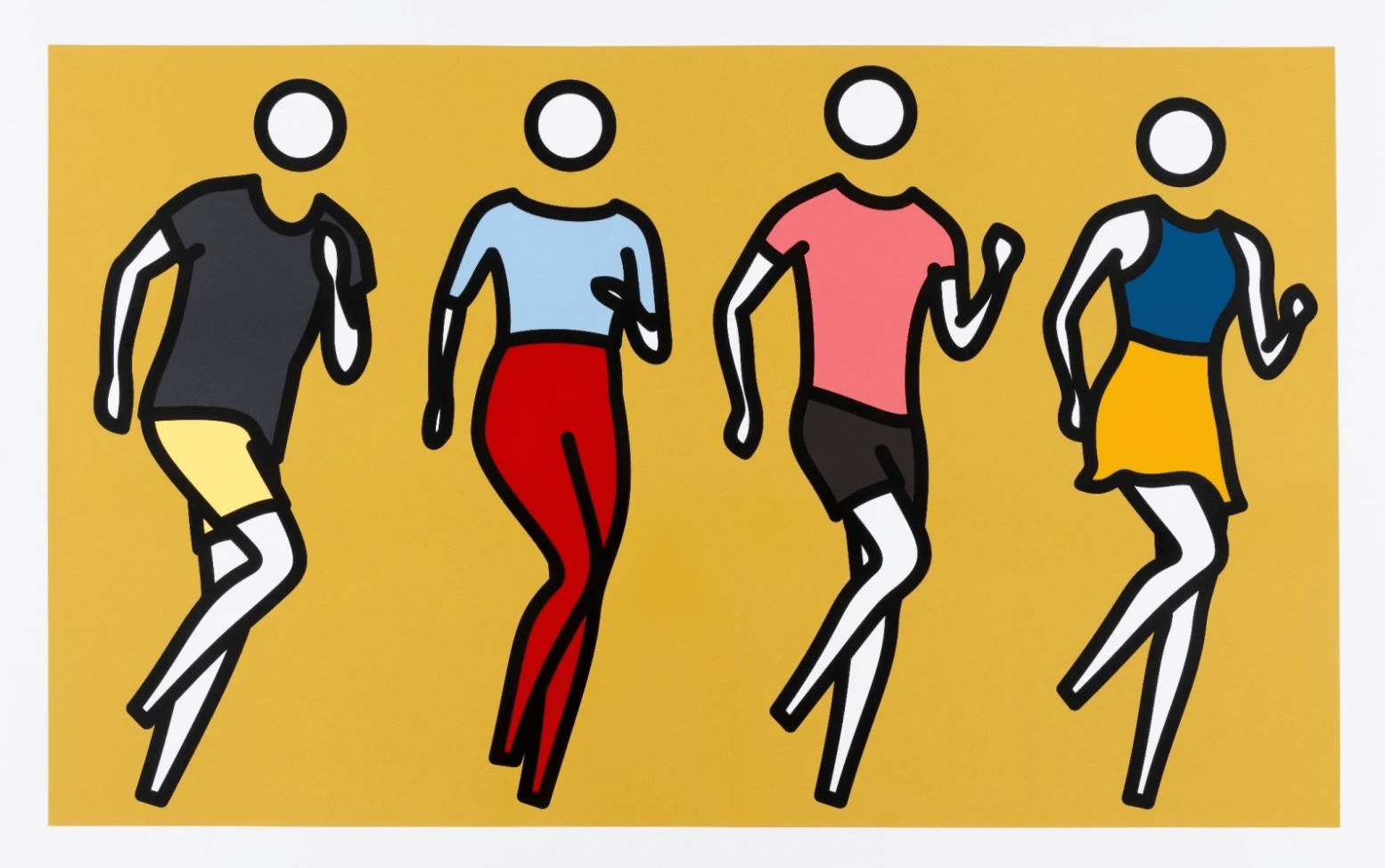
The Walking figure series illustrates this perfectly. A person walking is rendered in perhaps a dozen lines. Yet the gait is unmistakably individual: one figure walks with a slight forward lean, another with a longer stride, a third with a characteristic swing of the arms. The economy of means is staggering, and it is this economy that gives Opie's prints their peculiar staying power. Where more decorative work can feel exhausted after a few years of living with it, Opie's images reward sustained attention precisely because there is so little surface to exhaust.
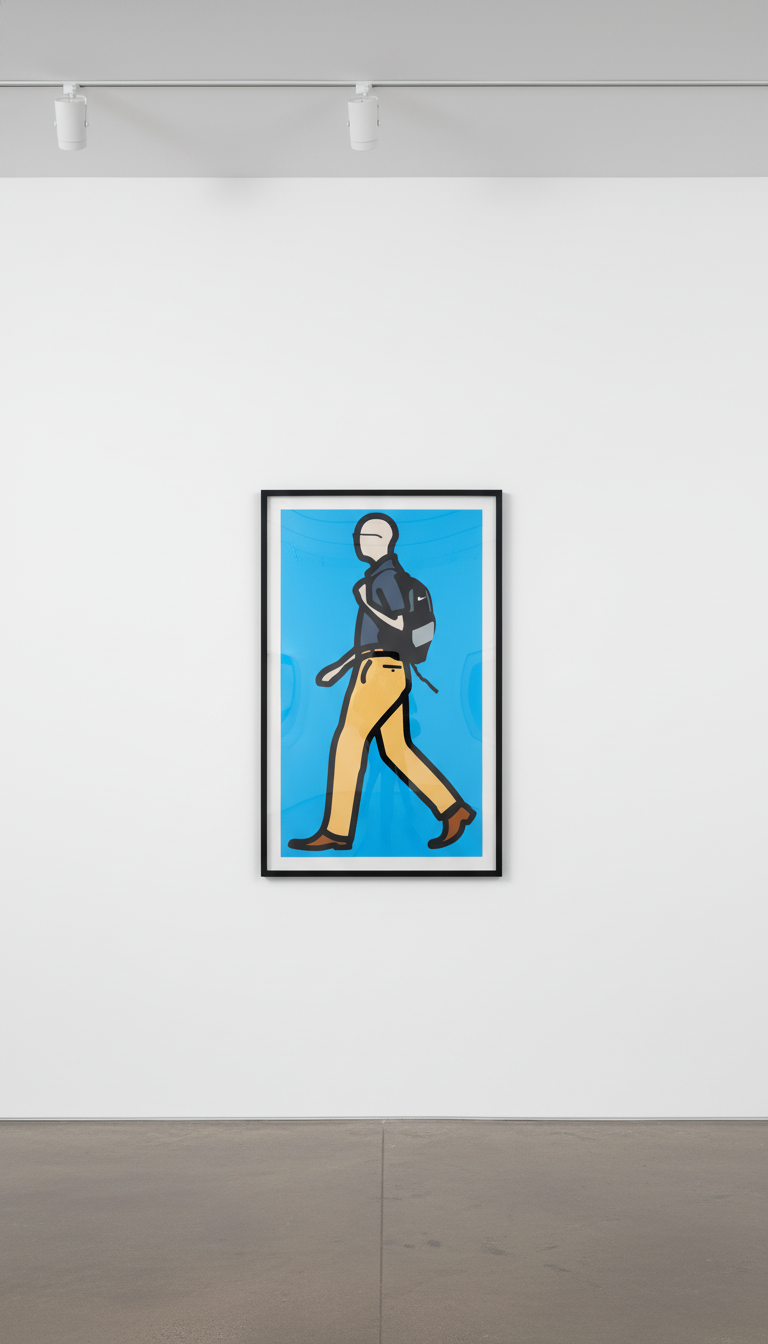
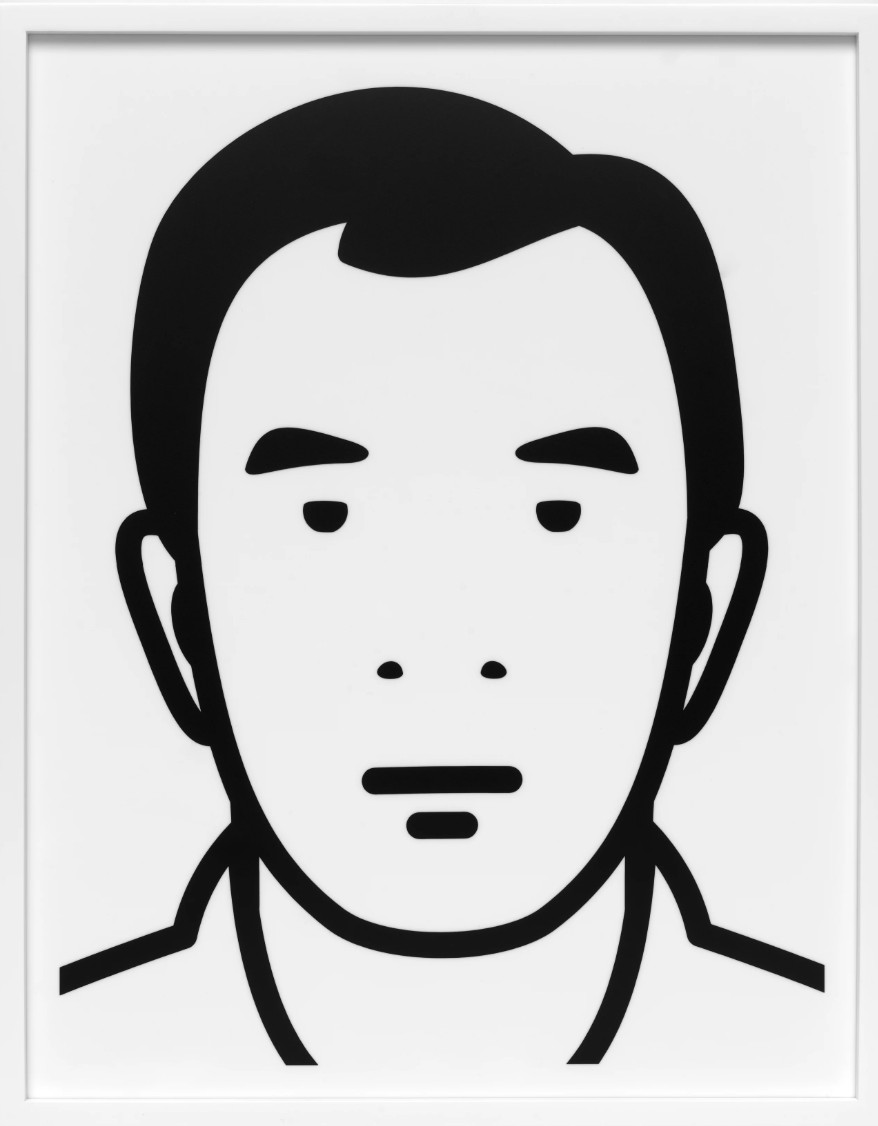
Academic 2 — Julian Opie. Available at Guy Hepner, New York.
Opie's output is prolific and varied. Understanding the principal series helps collectors identify where their interests lie and make more informed decisions about what to acquire.
The portraits are perhaps the works most immediately identified with Opie's name. They began in the mid-1990s as commissions — friends, colleagues, gallery visitors — and have grown into an enormous, ongoing archive of contemporary faces. Each portrait is typically titled with the sitter's first name: Amelia, Sara, Julian, Academic 2. The sitter's identity is specific enough to matter but reduced enough that the image feels universally legible. Collectors are drawn to portraits for their intimacy and their decorative clarity: a well-chosen Opie portrait works in almost any domestic or commercial interior. Large-format portraits on aluminium or as vinyl installations command premium prices, but screenprinted editions on paper remain accessible and are widely available on the secondary market.
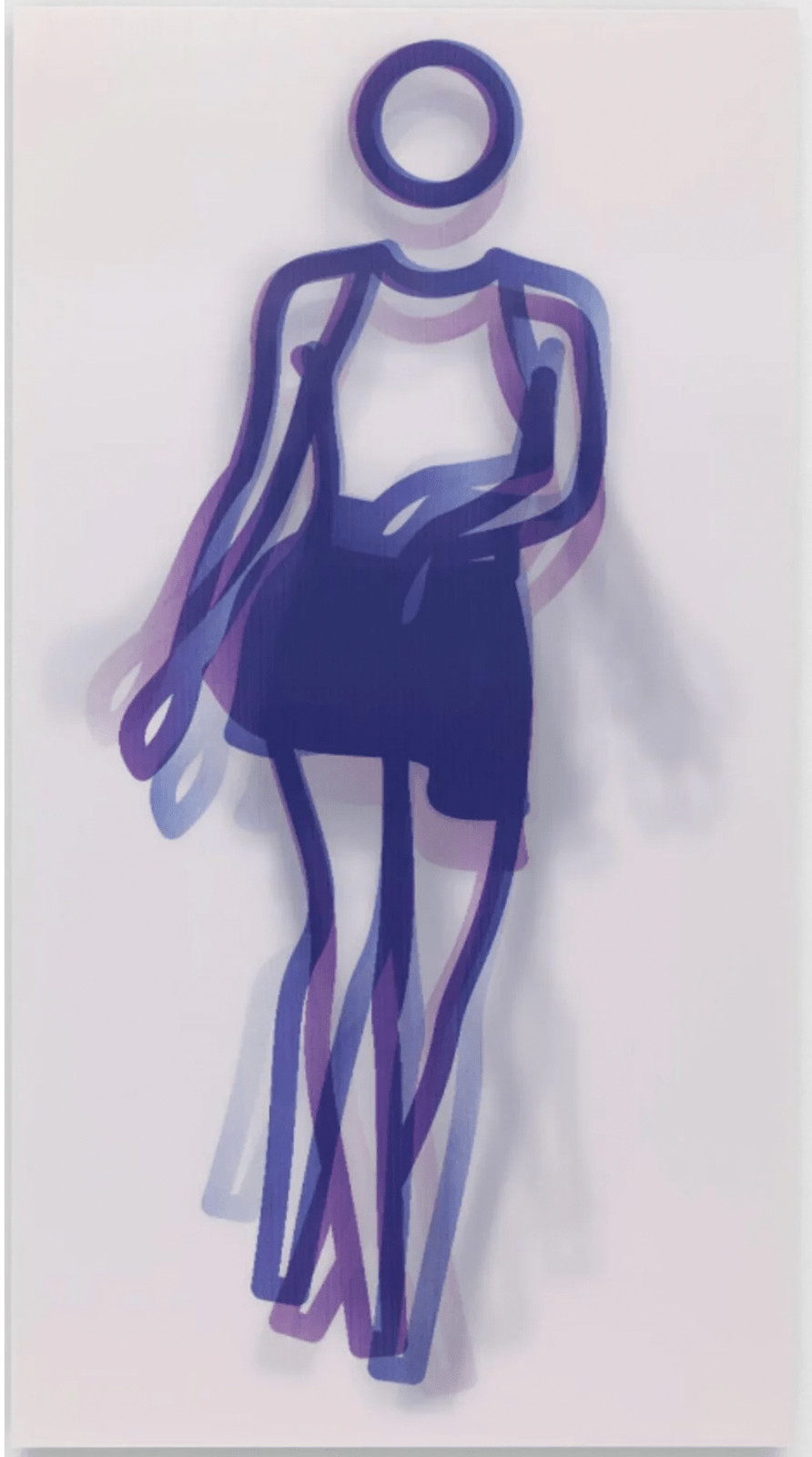
The walking figure series — which Opie began developing seriously in the early 2000s — translates the reductive logic of the portraits into movement. Single figures stride across the picture plane; groups sometimes walk together in procession. These works have been realised as screenprints, as large-scale vinyl wall pieces, as animated LED installations, and as Lenticular prints that appear to move as the viewer shifts their angle. The animation works are among the most technically ambitious of Opie's editions, and they command accordingly higher prices. However, the screenprinted walking figures on paper offer collectors an entry point into this iconic series at significantly lower cost.
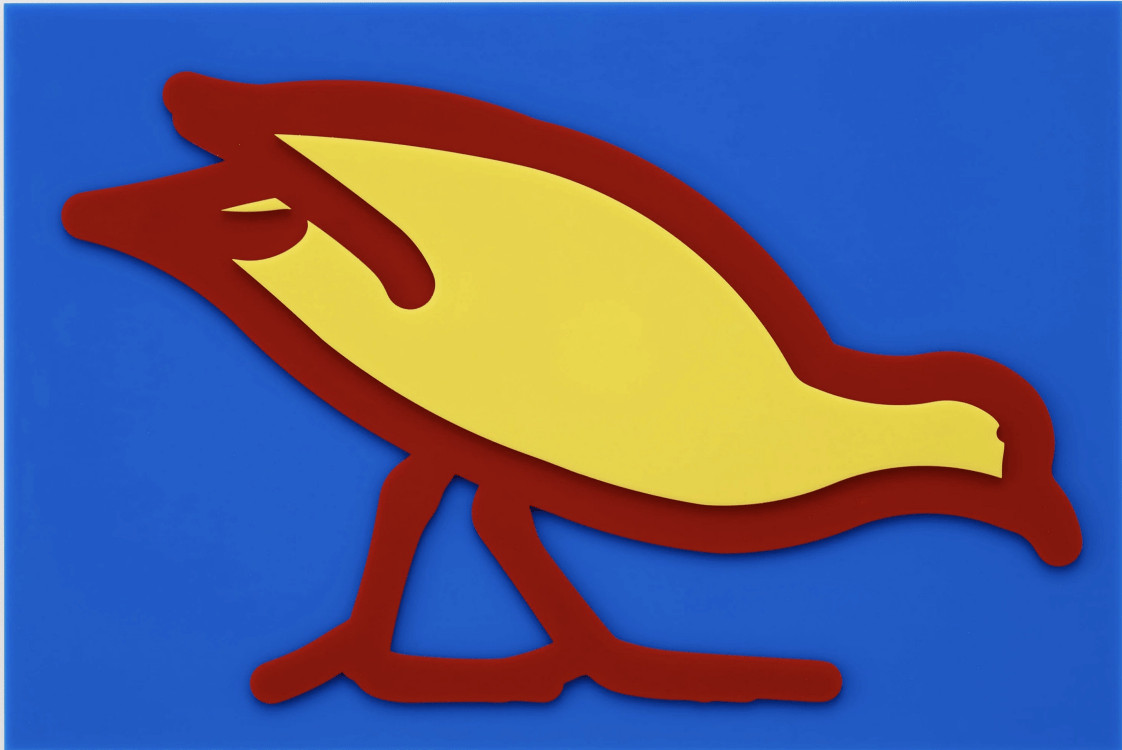
Animals have been a recurring subject throughout Opie's career. Farm animals, big cats, exotic Birds: each is subjected to the same radical simplification as the human figures, often with results that feel, if anything, even more surprising. A cow reduced to a black-and-white outline retains its cowness with uncanny precision; an elephant in three or four lines is still unmistakably an elephant. These works are popular with collectors who respond to Opie's formal wit, and they tend to be slightly less expensive than the portrait editions, making them excellent entry points into the oeuvre.
Less celebrated but equally rewarding, Opie's landscape and cityscape works apply the same vocabulary of outline and flat colour to external environments. Horizons, tree lines, urban skylines, and Japanese-influenced garden scenes are rendered with the same spare authority as his figures. Collectors with an interest in landscape or architectural subjects will find these works offer a distinctive alternative to the more figurative series.
Opie has always pushed at the boundaries of the traditional print. His LED works — backlit or animated panels that bring his walking figures to life — sit at the premium end of the market and are increasingly sought by institutional collectors and serious private buyers. Vinyl editions, designed to be applied directly to walls as large-scale installations, offer a dramatic and architecturally transformative alternative to framed prints. These special editions typically carry higher price points but represent a distinctive aspect of Opie's practice that is difficult to replicate in the work of any other artist.
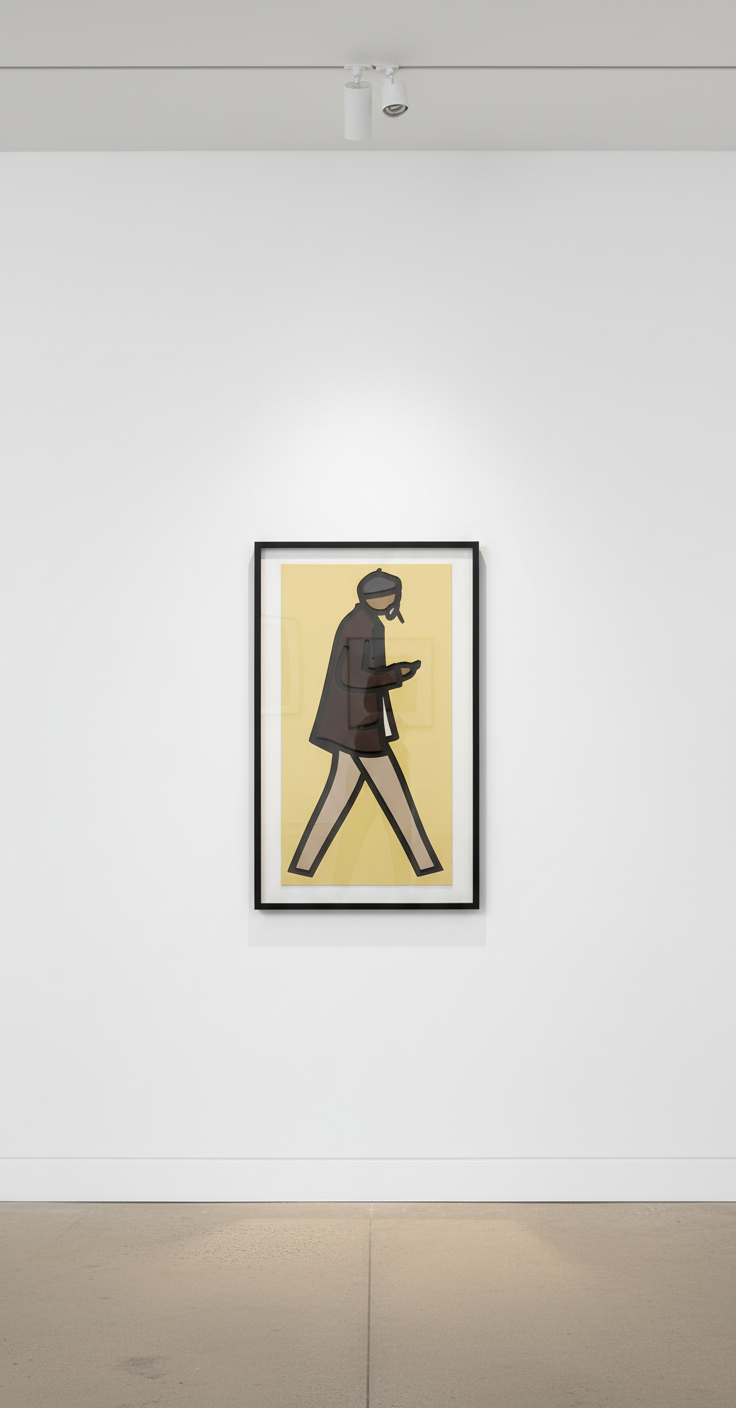
Beret — Julian Opie. Available at Guy Hepner, New York.
Julian Opie editions are produced in a variety of formats and sizes, and understanding the distinctions matters enormously when building a collection or assessing a purchase.
Traditional screenprints — ink pushed through a mesh screen onto paper — are among Opie's most enduring edition formats. The flat colour areas in his work translate particularly well to the screenprint medium, where each colour is typically applied as a separate pass. Screenprints by Opie are usually produced in editions of 25 to 50, sometimes with artist's proofs (APs) numbering around 10 per cent of the main edition. They are signed and numbered in pencil and bear the stamp or blind emboss of the publishing studio. Paper quality is consistently high — heavyweight archival sheets from specialist European mills are typical — and the prints are designed to last for centuries under appropriate storage and display conditions.
As Opie's practice moved increasingly into digital production from the 1990s onwards, digital print formats became an important part of his edition output. C-prints (chromogenic colour prints) and high-quality inkjet giclée prints offer slightly larger edition sizes — sometimes up to 50 or beyond — and can achieve the kind of luminous colour saturation that is difficult to match with traditional screenprinting. Collectors should note that "digital print" in this context does not imply any reduction in quality or desirability: these are carefully produced, fully authenticated editions.
Opie's self-adhesive vinyl editions are among his most architecturally ambitious. Typically produced in small editions of 10 to 25, these works are designed to be applied to a wall as a large-scale installation. They ship as precision-cut vinyl sheets with accompanying installation instructions. When properly installed, they transform a domestic or commercial space in a way that no framed print can match. On the secondary market, vinyl editions in excellent condition (ideally never installed, or carefully removed and stored) command strong prices.
As with all editioned works, Julian Opie prints may carry designations beyond the main numbered edition. Artist's Proofs (APs) are pulled alongside the main edition and are functionally equivalent in quality; they are typically reserved for the artist and are sometimes sold through primary dealers at a modest premium. Hors Commerce (HC) proofs, Printer's Proofs (PPs), and other variant designations occur occasionally. Collectors should not be deterred by these variant designations — they are normal features of the editioned print market — but should ensure that any such work is fully documented and accompanied by a certificate of authenticity.
The market for Julian Opie editions has remained remarkably stable over the past decade, with gradual appreciation at all price points. The following broad tiers reflect current market conditions and should be treated as indicative rather than definitive, since condition, edition size, subject matter, format, and provenance all affect individual prices.
At the entry level, collectors can acquire smaller screenprints, digital prints, and animal or landscape editions from earlier in Opie's career. This tier is also where many secondary-market portrait prints appear when condition is less than perfect or provenance documentation is incomplete. New collectors should regard this range as an excellent opportunity to begin living with Opie's work before committing to larger acquisitions.
The mid-range is where the most active collector buying takes place. Medium-format portrait screenprints in good condition with clean provenance, walking figure editions, and animal works from the most desirable series all fall comfortably in this band. This is also where some of the more recent digital editions are priced at primary market, offering collectors the reassurance of buying directly from an authorised dealer.
Large-format portrait screenprints, LED and animated works, vinyl installations, and rare early editions occupy the premium tier. At this level, condition, edition number (low numbers within an edition carry modest premiums), and documentation become critically important. Collectors in this range should always seek works that come with full provenance — ideally a direct chain of ownership from the original publisher or primary dealer — and should not hesitate to request condition reports and certificates before purchasing.
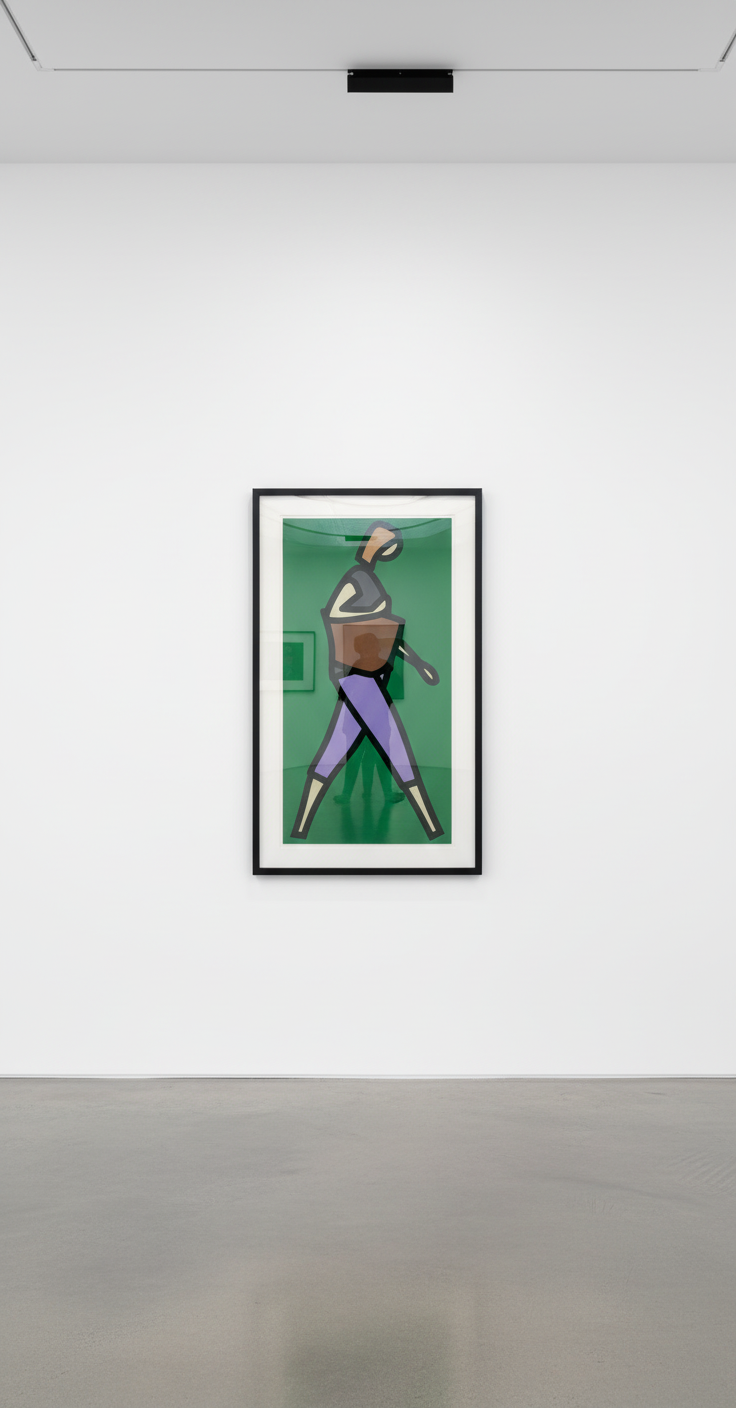
Big Bag — Julian Opie. Available at Guy Hepner, New York.
The popularity of Julian Opie's work has inevitably attracted forgeries and misrepresented works to the market. Understanding what makes a genuine Opie edition authentic is essential for any collector.
All genuine Julian Opie editions are accompanied by a certificate of authenticity (COA) issued either by the publishing studio or by an authorised primary dealer. The COA should specify the title of the work, the medium, the edition size, the specific edition number, and the year of publication. It should bear an original signature or stamp — photocopied certificates are not acceptable. If a seller cannot produce an original COA, the purchase should not proceed until the work's authenticity can be independently verified.
Many Opie screenprints bear a blind emboss or ink stamp from the printing studio that produced them. These are secondary authentication marks that complement (but do not replace) the COA and the artist's signature. Collectors who are unfamiliar with the specific stamps used by Opie's publishers should consult specialist dealers before purchasing.
Julian Opie signs his editions in pencil, typically in the lower right margin below the image. The signature is clean and consistent across the career — any work bearing a signature that seems uncertain or variable should be treated with caution until verified. Some early or unusual editions may bear a stamp signature rather than a handwritten one; this is not in itself a red flag but should be noted and investigated.
The safest Julian Opie purchases are those with a clear and documented provenance: ideally, works acquired directly from an authorised primary dealer, or from a recognised auction house with full provenance noted in the catalogue. Works offered without any provenance documentation, or with provenance that cannot be verified, carry higher risk. Collectors building a serious collection should prioritise works with clean provenance even if it means paying a modest premium.
The primary market for Julian Opie editions is handled by a small network of authorised dealers — specialist art publishers and internationally recognised galleries that work directly with the artist's studio. Buying primary ensures full authentication, current pricing, and the peace of mind that comes with knowing the work has never been in uncertain hands. The secondary market — auction houses, private sales, and reputable specialist dealers — offers a wider range of works, including editions that are no longer available through primary channels, but demands greater due diligence from the buyer.
The case for collecting Julian Opie in the current market rests on several mutually reinforcing factors.
Opie's work is held by more than 100 major public collections worldwide, including the Tate Collection, the Museum of Modern Art in New York, the Centre Pompidou in Paris, the National Museum of Modern Art in Tokyo, and the British Museum. This depth of institutional presence provides a floor of validation that is difficult to overstate. When the world's leading museums continue to acquire and display an artist's work across decades, it is a strong signal that the work will endure.
The Julian Opie style is among the most immediately recognisable in contemporary art. This is a double-edged quality — it has occasionally led critics to mistake familiarity for shallowness — but for collectors, it is an asset. A Julian Opie print on a wall is identifiable at a glance, not just to art-world insiders but to a broad general audience. This recognisability sustains demand across the widest possible collector base and underpins the work's secondary market performance.
Julian Opie editions appear regularly at the major international auction houses, and prices have shown consistent long-term growth. While the art market is never without risk, the breadth and depth of demand for Opie's work — from first-time buyers entering at £500 to institutions spending six figures on major LED installations — creates a liquid and well-supported secondary market. Collectors can enter at any level with reasonable confidence that quality works will retain their value over time.
A more personal but no less important consideration: Julian Opie's prints are extraordinarily livable. The restraint of the imagery means they do not dominate a space or exhaust the eye; they settle into domestic and commercial environments with ease while retaining their visual and intellectual presence. Collectors who have lived with Opie works for decades consistently report that the prints remain as compelling after twenty years as they were on the day of purchase. This quality — genuine staying power in the lived environment — is rarer than it might seem.
Unlike some artists whose market is driven entirely by historical works, Opie remains actively productive. New editions are released regularly, creating continued primary market access and keeping the artist's name in front of collectors, critics, and curators. This active practice also means that the secondary market for earlier works is continuously refreshed as collectors update their holdings with newer acquisitions.
Guy Hepner is an internationally recognised art gallery with deep expertise in the primary and secondary market for works by Julian Opie. Whether you are acquiring your first Opie print or adding to an established collection, our team can guide you through every aspect of the process.
Our current inventory of Julian Opie editions spans the full range of the artist's practice — from intimate portrait screenprints to large-format walking figure works. All works offered through Guy Hepner are fully authenticated and accompanied by certificates of authenticity. We are able to provide condition reports, provenance documentation, and installation advice for any work in our inventory.
We also assist collectors in locating specific works on the secondary market. If you are seeking a particular edition — a portrait of a specific subject, a large-format vinyl piece, or a rare early work — our team has the network and expertise to source it on your behalf.
To discuss your collection and explore available Julian Opie works, please contact the Guy Hepner team directly. We welcome enquiries from collectors at all levels, and we are committed to providing the same standard of service and advice whether you are spending £1,000 or £100,000.
Julian Opie's prints represent one of the most compelling collecting opportunities in the contemporary market: instantly recognisable, intellectually substantive, institutionally validated, and accessible at a wide range of price points. Whether you are drawn to the iconic portraits, the endlessly fascinating walking figures, or the quieter pleasures of the animal and landscape series, there is a Julian Opie edition that belongs in your collection. We look forward to helping you find it.
Explore Julian Opie prints for sale at Guy Hepner: Bijou Gets Undressed, Birds, Dance Synched, Everyone, Lenticular.
Related Series