Paintings

June 19, 2026
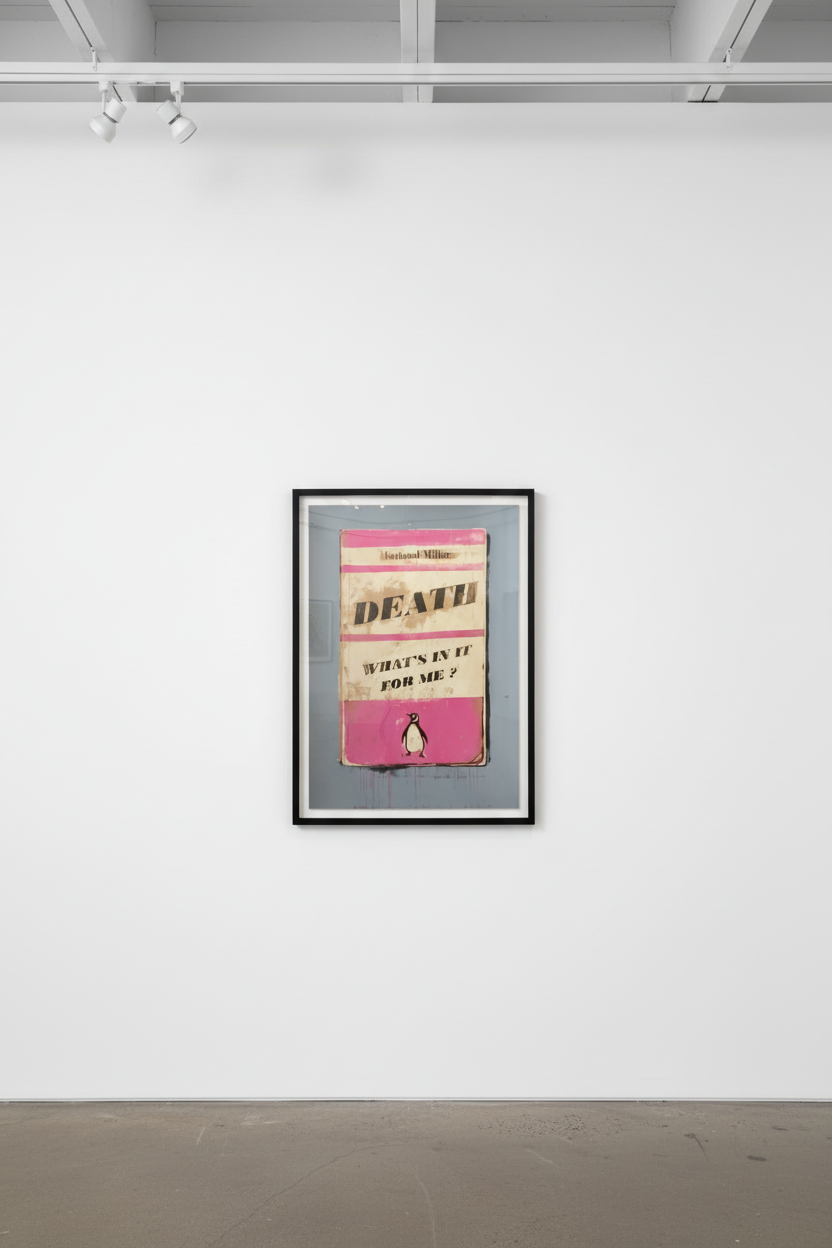
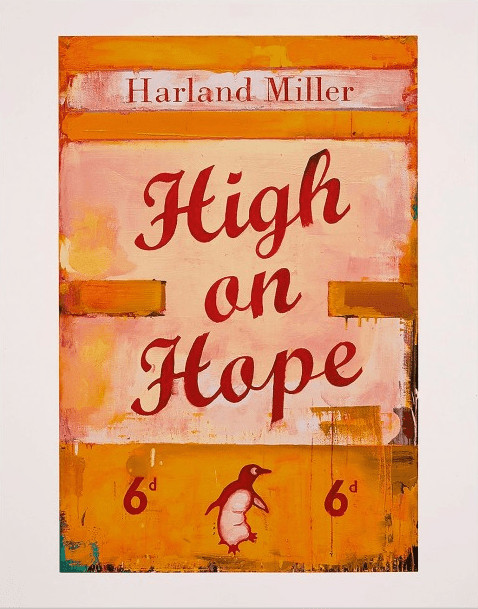
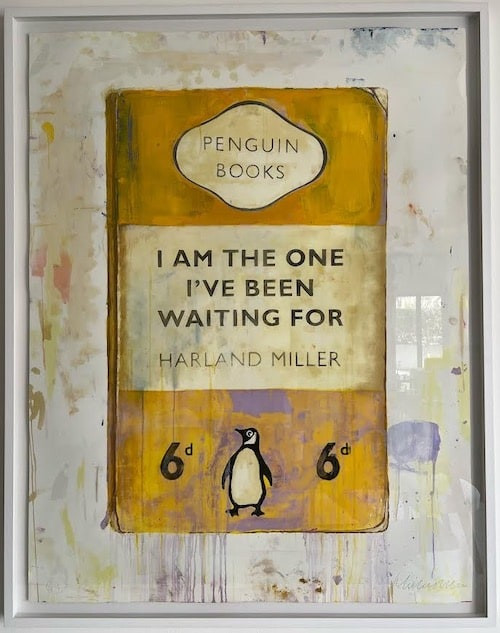
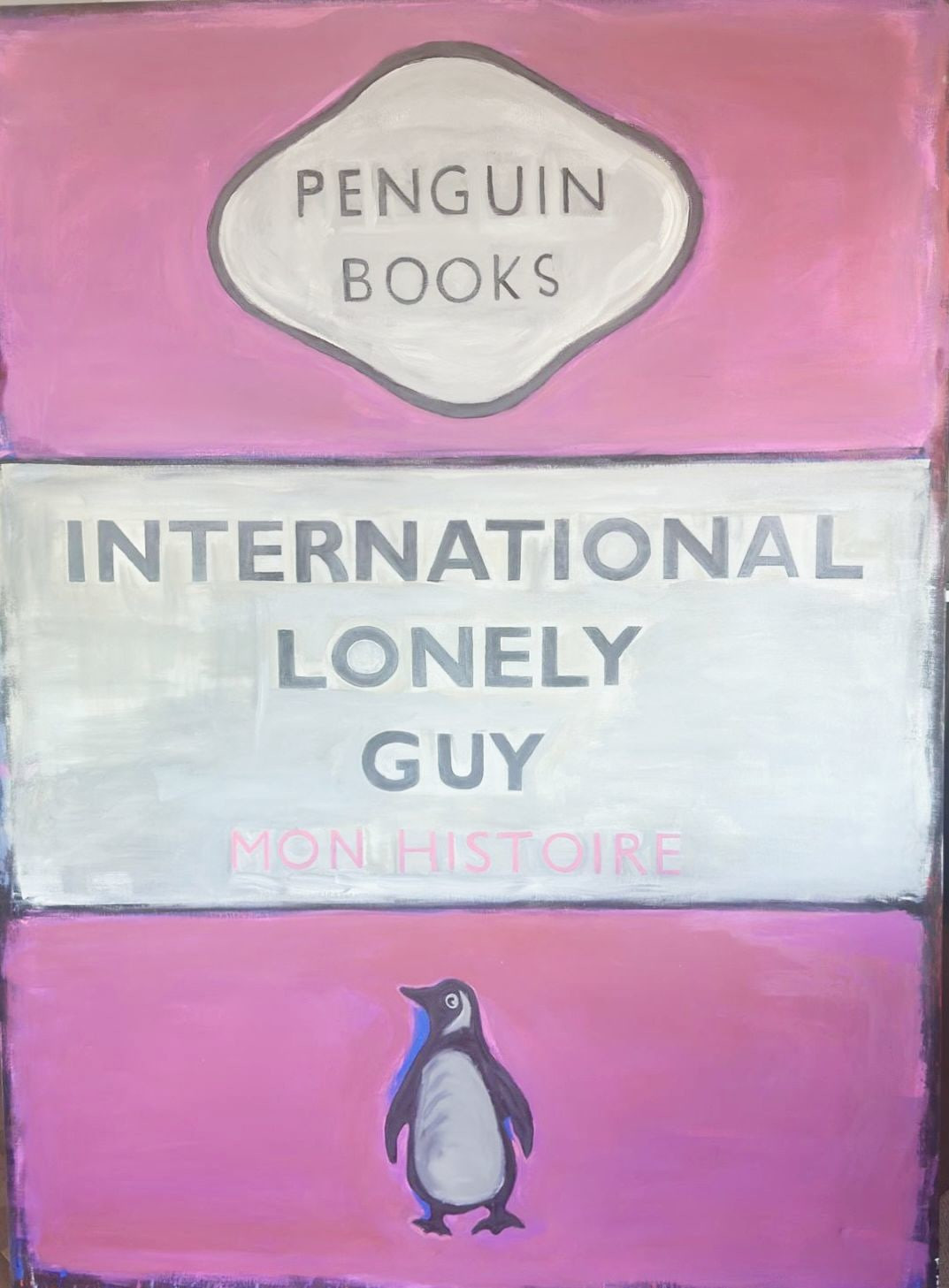
There is a particular pleasure in encountering a Harland Miller print for the first time. The format is immediately familiar — the spine, the faded cover, the Penguin colophon — and yet the title stops you dead. Death — What's In It For Me? Armageddon — Is It Too Much To Ask? Are You Unhappy Darling. The absurdity is deadpan, the melancholy is wry, and the whole thing is somehow both supremely funny and quietly devastating. Miller has built one of the most recognisable bodies of work in contemporary British art by applying existential dread to the visual vernacular of the mid-century paperback. The result is a print practice that has attracted serious collectors on both sides of the Atlantic and held its value on the secondary market with unusual consistency for over two decades.
This guide is written for the collector approaching Harland Miller's editions for the first time, and for those already holding works who want to deepen their understanding of the market. It covers the origins of the Penguin concept, the major print series, how editions are structured, what you can expect to pay in 2026, and how to buy safely from authorised sources.
Death — What's In It For Me? — Harland Miller. Available at Guy Hepner, New York.
Harland Miller was born in 1964 in Yorkshire, England, and studied at Chelsea College of Art before spending a formative period in New York and Paris. He is, in the first instance, a novelist — his debut, Slow Down Arthur, Stick to Thirty (2000), is a cult text rooted in the grubby glamour of the English North — and it is this literary sensibility that runs like a seam through his visual work. Miller is a reader, and more specifically a browser: someone who has spent serious time in second-hand bookshops, in the kind of places where a foxed Penguin paperback costs fifty pence and tells you something true about the culture that produced it.
His association with major galleries — the gallery founded by Jay Jopling that became the institutional home of the YBA generation — gave Miller a platform commensurate with his ambitions, and his paintings and prints have been exhibited at the gallery's spaces in London's Bermondsey and Mason's Yard, as well as internationally. He has been represented by major galleries since the early 2000s, and that relationship has shaped not only his exhibition history but the controlled, curated nature of his print publishing. Miller does not flood the market. Editions are released carefully, in sizes that maintain collectability without locking out newer collectors entirely.
The critical reception has been warm and sustained. Miller has been written about seriously by art historians who situate him within a tradition of text-based painting running from Ed Ruscha through Barbara Kruger to the present; he has also been embraced by a broader cultural audience who respond to the work's emotional directness without needing the theoretical scaffolding. That dual appeal — cerebral and accessible, art-historically literate and genuinely funny — is part of what makes his prints such effective objects for a diverse collecting base.
The Penguin paperback was not chosen arbitrarily. Founded in 1935 by Allen Lane, Penguin democratised reading in Britain; its distinctive cover designs — the horizontal tripartite layout, the grid of orange, cream and black, later the more illustrative styles of Germano Facetti and Alan Aldridge — became as embedded in post-war British visual culture as the BBC typeface or the roundel on the Underground. By the time Miller began working with the format in earnest in the late 1990s, these covers had acquired the peculiar status of the nostalgically familiar: everyone knew them, everyone had owned them, and the cultural memory they carried was both intimate and collective.
Miller's genius was to understand that this familiarity created a kind of Trojan horse. You think you are looking at a paperback cover. You read the title. And in that gap between recognition and meaning, something uncomfortable happens. The titles — which Miller invents, which exist for no real books — carry the weight of genuine literary thought. They are about mortality, about disappointment, about the persistence of desire in the face of entropy. They are, in the broadest sense, about being human in the twenty-first century. The format domesticates the existential; the title defamiliarises the domestic. The tension between those two operations is where the work lives.
Art historically, Miller is working in a tradition that includes Andy Warhol's appropriation of consumer packaging, Ed Ruscha's treatment of language as visual form, and the conceptual strategies of artists like Lawrence Weiner who insisted that words could be sculpture. But Miller is more sentimental than Warhol and funnier than Ruscha, and his work has a specifically British register — melancholic, self-deprecating, saturated in the particular quality of English cultural light — that makes it distinct within that lineage. The Penguin covers are not critique so much as elegy: a love letter to a certain kind of reading life, complicated by the very things that life could not resolve.
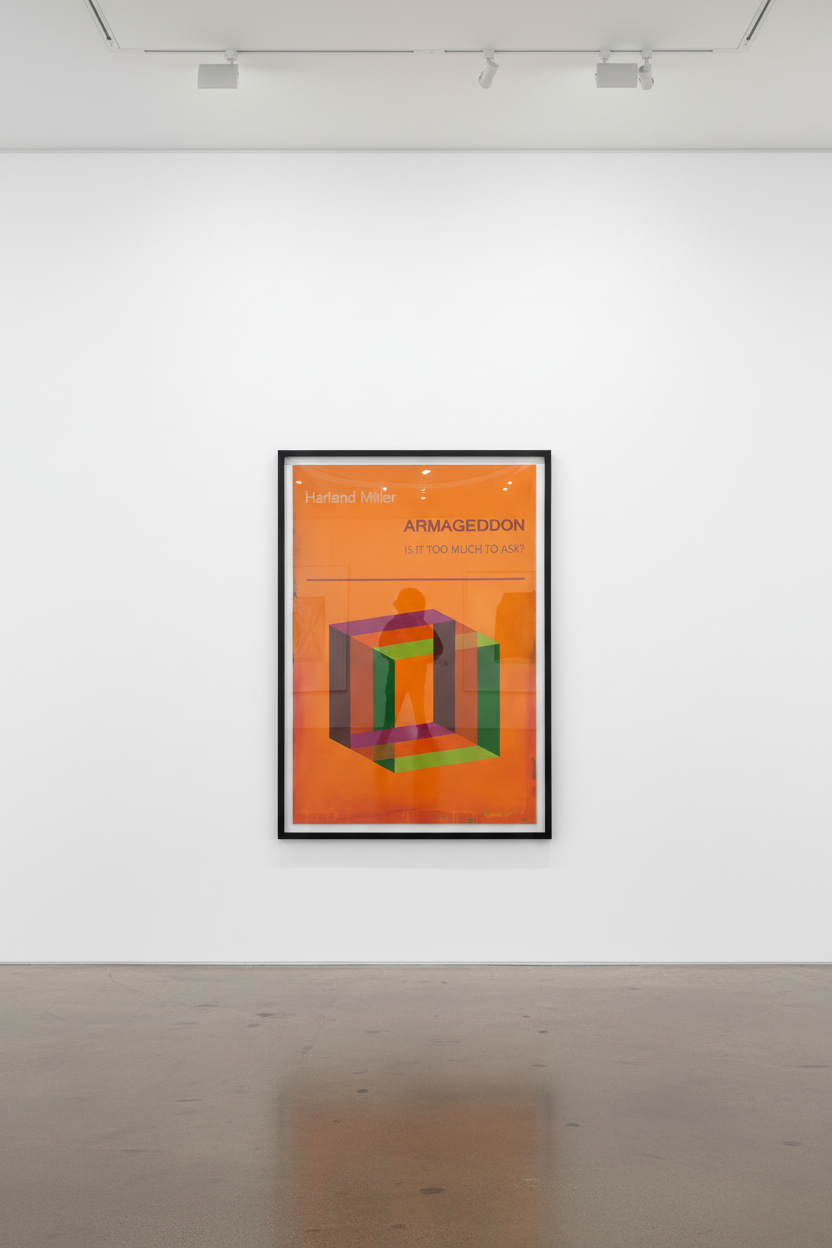
Armageddon — Is It Too Much To Ask? (Large) — Harland Miller. Available at Guy Hepner, New York.
Miller's print practice spans roughly two decades of sustained output, and the catalogue is substantial. What follows is an overview of the editions that matter most to collectors in 2026, with particular attention to works available on the primary and secondary markets.
Death — What's In It For Me? is among Miller's most recognised and most reproduced titles. The work exists in multiple iterations — as a large-scale painting exhibited at major galleries and subsequently referenced in print form — and the phrase itself has become something of a cultural touchstone, appearing on tote bags and postcards in the way that genuinely resonant art language sometimes escapes its frame. For collectors, this ubiquity is a double-edged consideration: the title's visibility has broadened Miller's audience, but the print editions themselves remain controlled in number and maintain strong market positioning. The screenprint versions in standard and large formats are among the most requested works by new collectors approaching Miller for the first time.
Released in both standard and large formats, Armageddon — Is It Too Much To Ask? is a work of considerable compositional sophistication. The faded khaki and cream tones of the cover design suggest a particular vintage — the late Penguin era of the 1970s, when the covers had acquired a kind of battered dignity — and the title's rhetorical absurdity is matched by the specificity of its typesetting. Miller is meticulous about period accuracy in these details: the typefaces, the placement of the colophon, the simulated foxing and wear. This attention to material history is part of what elevates the work beyond pastiche. Large-format editions of this title are particularly sought after and command meaningful premiums over standard sizes on the secondary market.
Are You Unhappy Darling represents a slightly different register within Miller's practice. Where some titles lean toward the cosmic — death, apocalypse, eternity — this one is intimate, almost conversational. The question is addressed to someone specific, which makes it address everyone who has ever been asked it or failed to ask it. The print's colour palette is warmer than some of Miller's other editions, the cover design softer, and there is a quality of tenderness beneath the wit that collectors find genuinely affecting. It is a work that rewards extended looking in a way that the more obviously confrontational titles sometimes do not.
Blonde But Not Forgotten occupies an interesting position in Miller's taxonomy of titles. The phrase has a film-noirish quality — a hint of the crime paperback, the pulp tradition that ran alongside the literary Penguin — and this positions the work within a slightly different cultural conversation than the more overtly philosophical titles. The print is among Miller's stronger performers at auction, and its visual composition — the particular quality of yellow and black, the typographic choices — makes it one of the most immediately striking works in the canon. Collectors who begin with this title often find themselves drawn into a broader exploration of the practice.
Fuck Art Let's Dance is arguably Miller's most anarchic title, the one that most directly invokes the punk tradition within which his sensibility was formed. The phrase appeared in various British contexts from the late 1970s onward — as a subcultural slogan, as a T-shirt, as a provocation — and Miller's reclamation of it for the Penguin format creates a pointed collision between countercultural energy and the cultural establishment. The print edition has been released as a set, making it a particular focus for collectors interested in owning multiple works as a coherent group. The set format also offers some pricing efficiency relative to acquiring individual works separately.
Ace — available in large format — is among Miller's more stripped-back titles: a single word, punchy and ambiguous, carrying connotations of excellence, of playing cards, of being perfectly positioned in the moment. The large format allows the composition to work at a scale where the typographic relationships — between the title word, the Penguin grid, the simulated wear — become fully legible, and the visual impact is considerable. Large-format Miller editions tend to anchor significant rooms; this is a work for a collector who wants the practice to make a serious spatial claim.
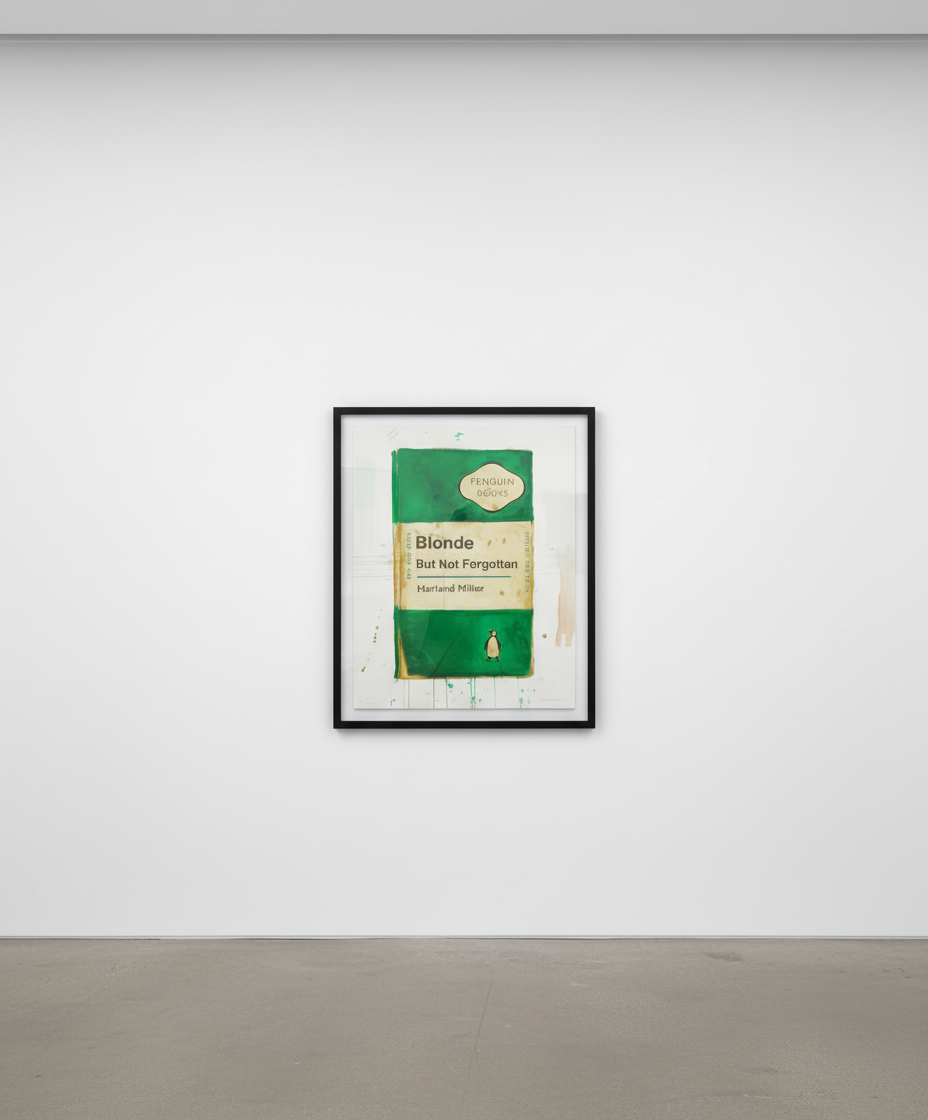
Blonde But Not Forgotten — Harland Miller. Available at Guy Hepner, New York.
Understanding the structure of a Miller edition is essential before committing to a purchase. The prints are produced as silkscreen editions — screenprinting being the technique that allows for the layered, nuanced colour separations that give the work its characteristic quality, and that aligns historically with the print traditions Miller is both working within and referencing.
Edition sizes for Miller prints vary by title and format. Standard editions have historically ranged from around 30 to 75 impressions, with large-format editions generally produced in smaller numbers — sometimes as few as 20 to 35. This is the conventional logic of the fine art print market: larger works command higher prices, and smaller edition sizes support those prices by maintaining genuine scarcity. Each impression is hand-signed and numbered by the artist, and the works are accompanied by certificates of authenticity from the publisher.
Publication has been handled by a small number of specialist fine art print publishers working in close collaboration with Miller and major galleries. The production process for a Miller screenprint involves multiple colour separations — sometimes ten or more passes through the press — and is carried out by master printers with particular expertise in the kind of controlled degradation effects that make the simulated paperback covers so convincing. The printing is done on heavyweight archival paper that will not deteriorate over time, and the inks used are rated for archival longevity consistent with professional fine art standards.
Collector's note editions — sometimes called artist's proofs or hors commerce impressions — exist outside the main numbered edition. These are typically marked AP (artist's proof) or HC and are produced in very limited numbers, often fewer than ten. They were originally retained by the artist or publisher and have since appeared on the secondary market; they command a premium over standard numbered impressions and are particularly prized by serious collectors.
Harland Miller's prints operate across a meaningful price range, reflecting the variation in format, edition size, release date and condition that characterises any substantial secondary market.
At the primary market level — meaning works acquired directly from an authorised gallery at release price — Miller editions have historically been priced between approximately £3,500 and £12,000 depending on format and edition size. Large-format works at original release have sometimes been priced higher. However, primary market access to new Miller editions is competitive; major galleries's collector waitlists are active, and authorised secondary dealers like Guy Hepner provide the most reliable route to acquiring works that are no longer available at original issue price.
On the secondary market in 2026, smaller standard-format Miller editions in excellent condition are trading in the range of £6,000 to £15,000. Works from more significant or earlier series, particularly those with strong title recognition, consistently achieve above this level. Large-format works and set editions have achieved £20,000 to £35,000 at established auction houses including Sotheby's, Christie's and Phillips, with exceptional examples — early impressions, AP proofs, works with exhibition provenance — sometimes exceeding these figures.
The long-term price trajectory for Miller prints has been consistently positive. Early works acquired at primary market prices in the early 2000s have appreciated substantially, and the continued institutional attention to Miller's practice — regular survey exhibitions, museum acquisitions, sustained critical engagement — supports the expectation that this trajectory will continue. The prints occupy a sweet spot in the market: accessible enough that a significant collecting base has formed, but scarce enough that supply constraints continue to support prices.
Condition is, as always, the critical variable. Miller prints in mint condition, retained in their original packaging, with full provenance documentation, command significant premiums over works that have been displayed without UV-protective glazing, or that show evidence of light exposure. Collectors intending to display their works should invest in appropriate framing; the investment is modest relative to the value being protected.
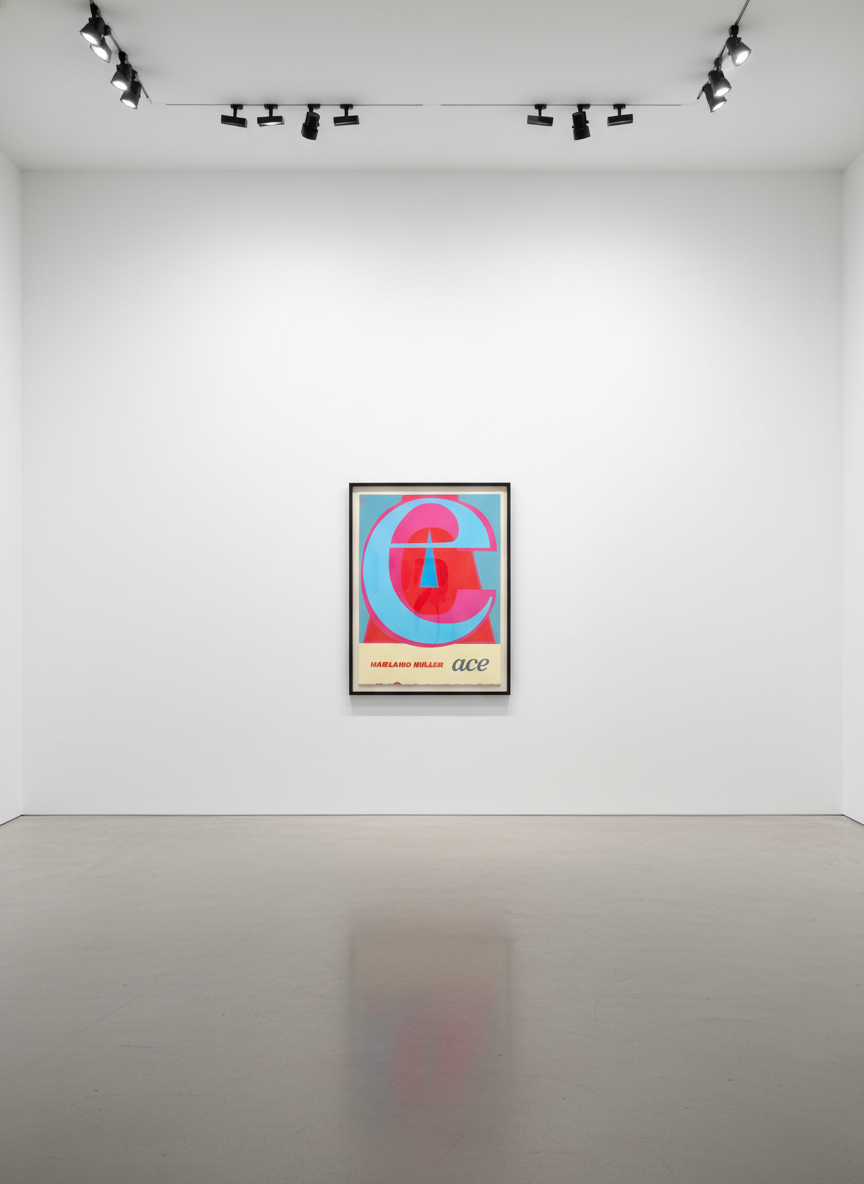
Ace (Large) — Harland Miller. Available at Guy Hepner, New York.
The Miller market, like all markets for works by artists with established secondary value, is not without its complications. Understanding the authentication landscape is important before making any significant purchase.
The primary sources for authenticated Miller prints are major galleries (London and international) and a small number of authorised secondary market dealers. All legitimate works are accompanied by a certificate of authenticity from the original publisher, hand-signed and numbered impressions verified by the artist's studio, and — for more recent releases — digital provenance documentation. When buying from any secondary source, insist on seeing the original certificate and verifying that the edition number corresponds correctly to the edition size documented for that title.
At auction, the major houses — Sotheby's, Christie's, Bonhams, Phillips — conduct their own due diligence on works offered, and buying through these channels provides a meaningful layer of authentication assurance. Estimates in auction catalogues are generally conservative relative to achievable prices for strong Miller titles, and competitive bidding on sought-after works is common. Buyers should factor in buyer's premium — typically 20 to 26 percent at the major houses — when calculating their effective acquisition cost.
The digital secondary market — platforms including Artsy, Invaluable and various print-specialist dealers — requires more careful evaluation. Works sold through these channels without gallery provenance or publisher certificates should be approached with caution. The presence of a strong digital image does not validate the physical work, and edition number claims without supporting documentation are insufficient. If in doubt, consult an authorised dealer who can advise on provenance and authentication before committing to a purchase.
Framing history matters too. Works that have been incorrectly framed — with non-archival materials, acidic mounts, or glazing that has allowed UV exposure — may show condition issues that are not immediately apparent from photographs. Always request condition reports from sellers and, for significant acquisitions, consider commissioning an independent condition assessment from a specialist paper conservator.
The case for collecting Harland Miller in the current moment rests on several converging arguments — aesthetic, institutional and commercial — that together make a compelling whole.
Aesthetically, Miller's practice is at a point of maturity and sustained development. The Penguin book cover concept, far from having exhausted itself, continues to generate new works that expand the emotional and conceptual range of what was already a rich body of output. Each new title is a fresh act of compression — an entire imaginary book, an entire strand of human feeling, reduced to a cover and a phrase. The work does not repeat itself; it elaborates, deepens, refines.
Institutionally, Miller's position is secure. His works are held in major public collections including the Victoria and Albert Museum, and his exhibition history at major galleries and internationally provides the kind of institutional validation that serious collectors and advisors look for when assessing long-term value. Museum acquisitions and retrospective survey exhibitions — both of which continue to be part of Miller's story — are among the strongest signals of enduring market relevance.
Commercially, the print market for artists of Miller's calibre has proved remarkably resilient. The combination of genuine scarcity (small, carefully controlled editions), strong brand recognition (the Penguin format is universally legible), and ongoing critical and institutional support creates conditions in which values tend to hold even through broader market corrections. The print format — more accessible than painting at entry level, but capable of achieving meaningful secondary market prices for strong examples — positions Miller as an artist whose practice can accommodate collectors at multiple stages of their development.
There is also something to be said for the work's social function. A Harland Miller print in a home or office does not merely sit on the wall; it generates conversation, prompts reflection, invites the kind of repeated looking that distinguishes truly good work from its merely decorative equivalent. The titles continue to resonate — sometimes differently as the collector's own life changes — in ways that make the relationship between owner and work genuinely dynamic over time. These are not passive acquisitions. They are ongoing companions.
Guy Hepner is an authorised secondary market source for Harland Miller prints, working with collectors across the United States, Europe and internationally. The gallery holds a curated inventory of Miller editions including standard and large-format works from major series, all accompanied by full provenance documentation and certificates of authenticity.
The process of acquiring a Miller print through Guy Hepner is designed to be straightforward and transparent. The gallery's specialist team — reached through the website at guyhepner.com/harland-miller — can advise on available inventory, provide detailed condition reports, discuss pricing relative to comparable works at auction, and assist with framing and installation where required. For collectors building a body of Miller work over time, the gallery can also advise on edition strategy: which titles are most readily available, which are becoming scarce, and which present particular opportunities in the current market.
International shipping is handled securely through specialist fine art carriers with full insurance coverage. Works are packed to gallery standards and delivered with all accompanying documentation intact. The gallery also facilitates secure payment in multiple currencies and can assist with import and customs documentation for international collectors.
For collectors approaching Miller for the first time, the recommendation is to begin with a title that resonates personally — the phrase that stops you, the colour that works in your space — and to buy the best example you can access within your budget. A single, strong, well-provenienced Miller print in excellent condition is a more considered acquisition than multiple works compromised by condition, provenance uncertainty or inflated pricing. The practice rewards patience and careful selection.
Harland Miller has spent the better part of three decades building a body of work that takes the accumulated comedy of human disappointment and turns it, through sheer wit and craft, into something approaching joy. The prints are the most accessible expression of that project — objects that carry real weight without being heavy, that make you laugh before they make you think, and that continue to give over time in ways that justify every penny of their cost. For the collector willing to look seriously, they represent one of the most rewarding relationships contemporary British art has to offer.
To enquire about available Harland Miller prints, visit Guy Hepner's Harland Miller page or contact the gallery directly. Our team is available to assist with availability, pricing and acquisition advice.
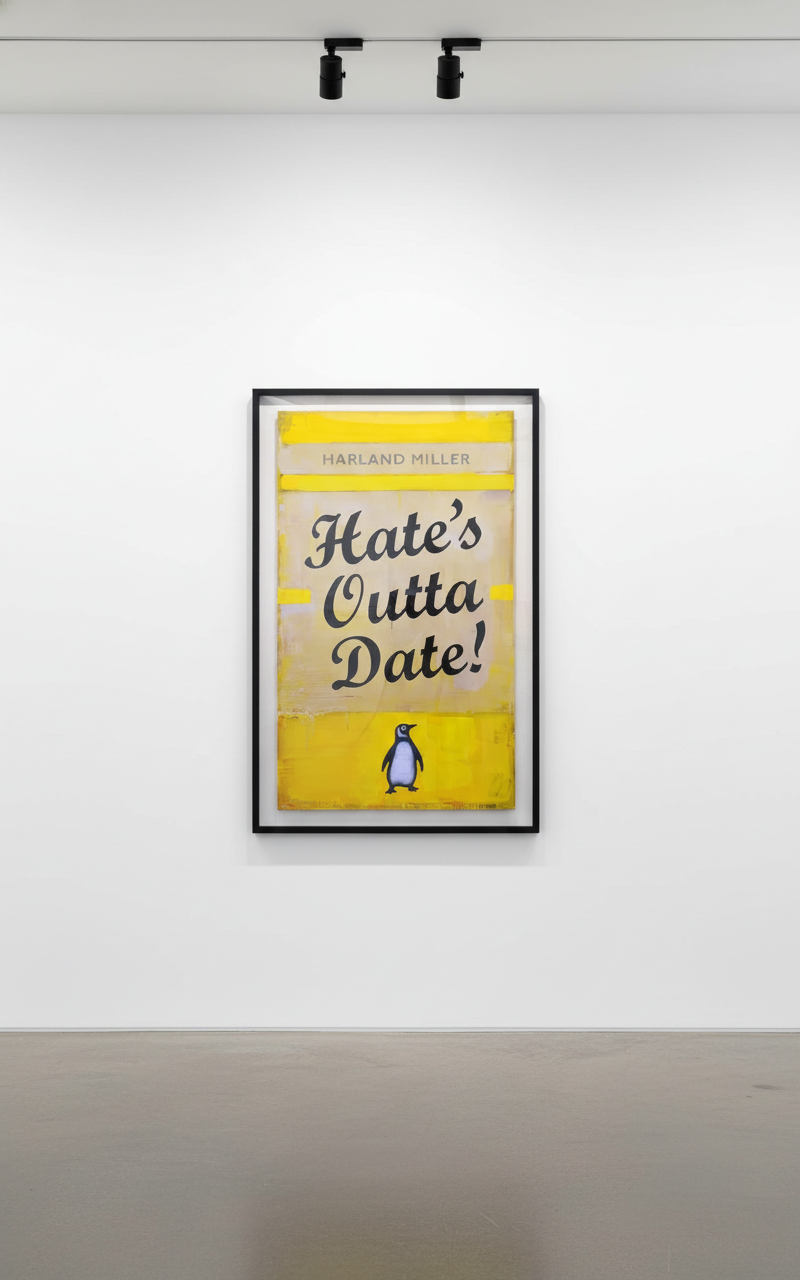
Explore Harland Miller prints for sale at Guy Hepner: Penguin Book Cover Editions, Screenprints & Editions, Works on Paper, Hate's Outta Date.
Related Series