Self Portraits

August 7, 2026
When Andy Warhol died unexpectedly in February 1987 following routine gallbladder surgery, he left behind an artistic legacy that continues to define contemporary culture. Among the most compelling threads running through his prolific output are the Andy Warhol self-portrait works—a sustained meditation on identity, celebrity, and the constructed nature of public image that spanned more than two decades. These works, ranging from playful photo-booth experiments to haunting late-career paintings, reveal an artist perpetually fascinated by the distance between the man and the mask, between Andrew Warhola of Pittsburgh and the enigmatic figure who became synonymous with Pop Art itself.
The self-portrait in art history has always served as a vehicle for self-examination, from Rembrandt's unflinching studies of his own aging to Van Gogh's fevered psychological explorations. Yet Warhol transformed this tradition into something entirely different—a cool, detached investigation of surface and celebrity that anticipated our current age of selfies and personal branding by half a century. His self-portraits do not invite us into the artist's soul so much as they demonstrate how thoroughly the modern self has become a product to be manufactured, reproduced, and sold. For collectors seeking works that sit at the intersection of art history and cultural commentary, Warhol's explorations of his own image represent some of the most intellectually rich and visually arresting achievements of twentieth-century art.
Andy Warhol was obsessed with fame and mortality in equal measure—just look at his portraits of Jackie Kennedy in mourning, Elizabeth Taylor post-tracheotomy, or Marilyn Monroe, executed after her suicide. This dual preoccupation found its most personal expression in his self-portraits, which served simultaneously as exercises in image-making and reflections on the fleeting nature of celebrity. Unlike traditional self-portraits that seek to capture some essential truth about their maker, Warhol's works consciously foreground artifice, demonstrating that in the age of mass media, the self itself had become another reproducible commodity.
Warhol's background as a commercial illustrator deeply informed his approach to self-representation. Before becoming the most famous artist of his generation, he spent the 1950s creating elegant drawings for shoe advertisements and magazine illustrations. This training instilled in him an understanding that images exist to sell—whether products, ideas, or personas. When he turned his commercial sensibility toward fine art in the early 1960s, he brought with him an awareness that the artist's own image could function as a kind of brand, recognizable and reproducible like any Campbell's Soup can or Coca-Cola bottle.
Vincent Fremont, a close associate of the artist throughout the 1970s and 1980s and now the exclusive agent for sales at the Andy Warhol Foundation for the Visual Arts, has noted that "self-portraiture is a classic art-historical exercise and it certainly was an important element of Andy's overall body of work." Yet Warhol's versions of this classic exercise consistently undermined the traditions they invoked. Where Rembrandt used self-portraiture to explore the passage of time across his own features, Warhol used wigs, makeup, and studio lighting to obscure temporal markers entirely. Where Van Gogh revealed psychological turbulence through visible brushwork, Warhol's silkscreen technique deliberately removed the artist's hand from the equation.
Andy Warhol, Polaroid Portrait, c. 1970s-1980s, Polacolor. Available at Guy Hepner, New York.
Warhol's first sustained engagement with self-portraiture emerged in 1963, when he began creating works based on photographs taken in commercial photo booths. These coin-operated machines, found in drugstores and amusement parks across America, produced strips of small black-and-white portraits in quick succession. The cheap, democratic nature of the technology appealed to Warhol's Pop sensibility, and the rapid-fire format captured the kind of spontaneous, slightly awkward poses that formal portrait photography excluded.
In these early photo-booth images, Warhol consciously constructed a public persona modeled on the movie-star idols of his youth. He dons sunglasses and affects the hauteur of James Dean and Marlon Brando, playing the role of celebrity even as he documented himself playing it. According to Joseph Ketner, curator of the exhibition "Andy Warhol: The Last Decade" at the Museum of Fine Arts Houston and the Brooklyn Museum, these works "are simply about creating his public persona and about his newfound celebrity." They represent Warhol's first systematic exploration of the gap between private self and public image—a theme that would occupy him for the rest of his career.
The late art historian Robert Rosenblum described these photo-booth images as "pure theatre," noting that "Warhol looks like the kind of celebrity he began to frequent—masking his eyes with sunglasses, affecting poses for the invisible camera man, offering a minor cinematic narrative of undoing his shirt and tie." The theatrical quality is crucial: Warhol presents himself not as he naturally was but as he wished to be perceived, constructing an artistic identity through deliberate performance. The multiple exposures captured by the photo-booth format emphasize this performative dimension, showing the artist cycling through different poses and expressions like an actor in screen tests.
These early self-portraits achieved remarkable market validation in recent years. At Christie's in May 2011, a Four-Panel Self-Portrait from 1963–64 showing Warhol in a trench coat and sunglasses—originally commissioned by collector Florence Barron—sold for $38.4 million, establishing these early works as among the most sought-after examples in his entire oeuvre. The sale demonstrated that collectors recognize these photo-booth pieces as foundational statements, establishing the visual vocabulary and conceptual framework that would inform all of Warhol's subsequent self-representation.
Following the photo-booth images, Warhol's next major self-portrait series appeared in 1964–65. In these works, his fingers cover his lips and chin in what Tobias Meyer, Sotheby's former Worldwide Head of Contemporary Art, called "a very self-conscious" gesture. The hand raised to the mouth suggests both the act of silencing oneself and the posture of contemplation, creating an image of the artist as simultaneously present and withheld. These works introduced a degree of psychological complexity absent from the more straightforwardly theatrical photo-booth portraits.
The gesture of covering the mouth carries multiple associations that enrich these images' meaning. It suggests secrecy, the withholding of speech, and by extension, the withholding of authentic selfhood. It recalls the "hear no evil, see no evil, speak no evil" iconography of Buddhist tradition, implying a deliberate withdrawal from engagement with the world. Most significantly, it anticipates Warhol's famous interview technique, in which he would respond to questions with monosyllables or deflecting non-answers, refusing to provide the authentic revelation that interviewers sought.
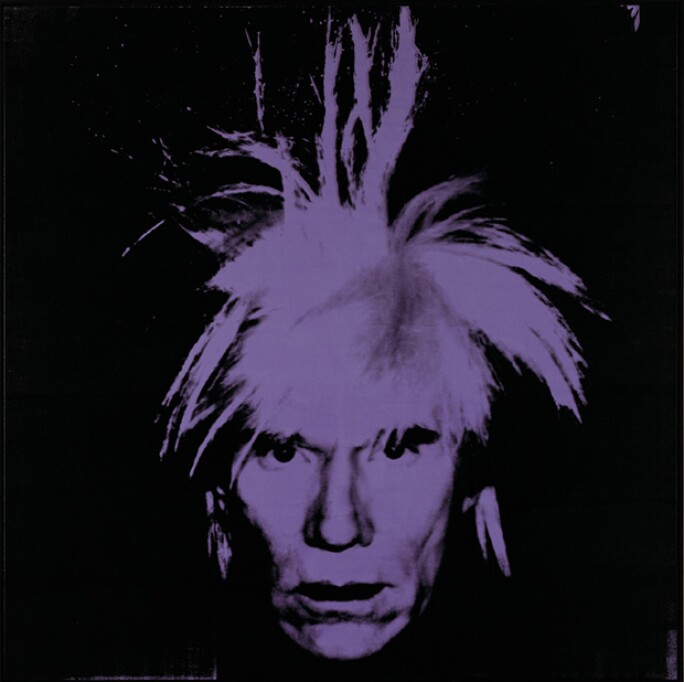
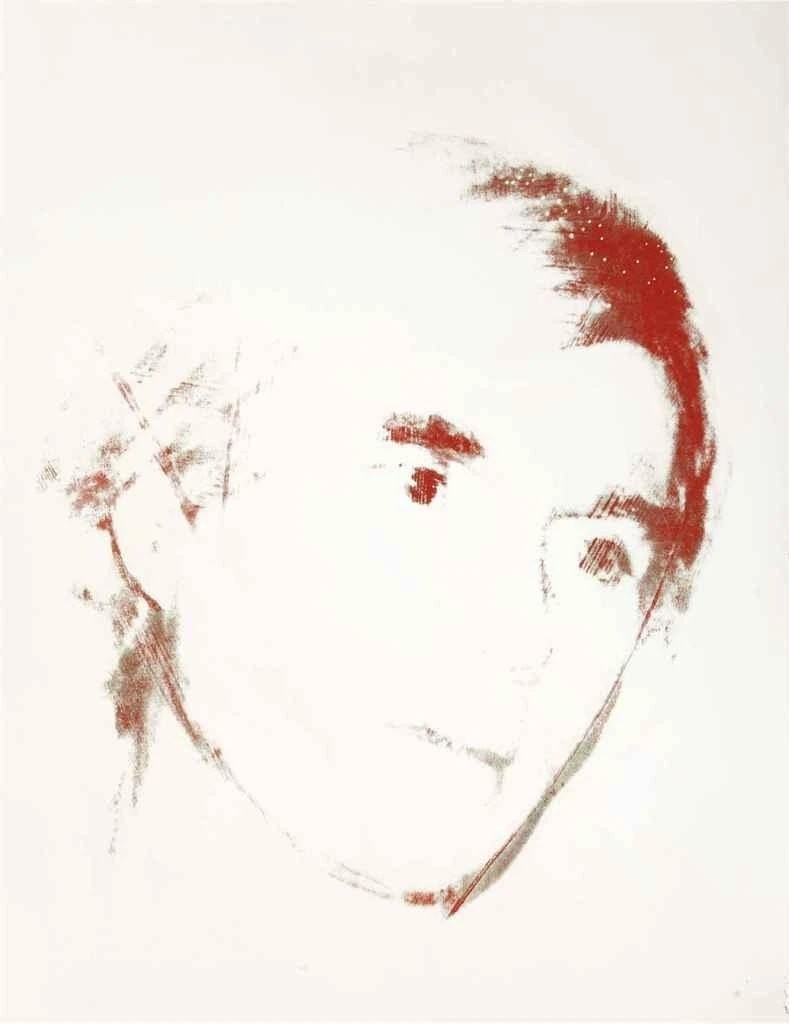
Andy Warhol, Self-Portrait, 1970s, Silkscreen on canvas. Available at Guy Hepner, New York.
These 1964–65 self-portraits also introduced the silkscreen technique that would become Warhol's signature method. By photographing himself and then transferring the image to canvas through a commercial printing process, Warhol inserted mechanical reproduction into what had traditionally been the most personal of artistic genres. The silkscreen introduces slight variations and imperfections with each pull, meaning that even when working from the same source image, each canvas becomes unique. This tension between mechanical reproduction and individual variation mirrors the tension between public persona and private self that animates all of Warhol's self-portraits.
Throughout his career, the Polaroid camera served as an essential tool in Warhol's artistic process. He used the instant camera to document everything from his social life to potential portrait subjects, generating thousands of images that would inform his paintings and serve as works of art in their own right. The Warhol Polaroid self-portraits occupy a special place within this body of work, capturing the artist in moments of self-directed performance that range from the playful to the unsettling.
The Polaroid format suited Warhol's sensibility perfectly. Its instant gratification mirrored the accelerated pace of modern celebrity culture, while its democratic availability—anyone could buy a Polaroid camera—aligned with his Pop Art embrace of commercial technologies. Unlike traditional photography, which required darkroom processing and thus introduced a delay between image capture and image viewing, the Polaroid delivered immediate results. This immediacy allowed Warhol to experiment freely, taking multiple shots in quick succession and seeing the results within minutes.
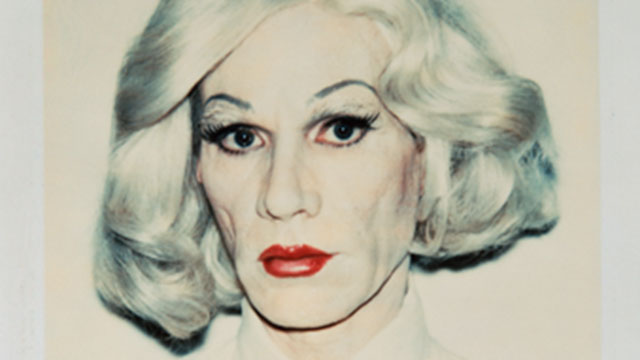
Warhol's Polaroid self-portraits from the late 1970s and early 1980s often show him in various states of transformation—wearing wigs, makeup, and costumes that blur conventional gender boundaries. Artist Cindy Sherman, who sits on the board of the Andy Warhol Foundation and explores similar issues of identity in her own work, has noted her particular fondness for Warhol "in drag and a blonde wig." These cross-dressed self-portraits anticipate contemporary discussions of gender fluidity and self-presentation, revealing Warhol as remarkably prescient in his understanding of identity as performance.
The Warhol Polaroid self-portraits have gained significant attention in recent years, with major publications and auction houses recognizing their importance. In 2015, Taschen released "Andy Warhol: Polaroids 1958–1987," a comprehensive survey that brought scholarly attention to this aspect of his practice. The Hollywood Reporter observed that Warhol was "the originator of the selfie game," while The New York Post declared that "Andy Warhol Instagrammed his life before Instagram existed." These contemporary assessments recognize what collectors have long understood: Warhol's Polaroids represent a crucial document of artistic process and self-construction.
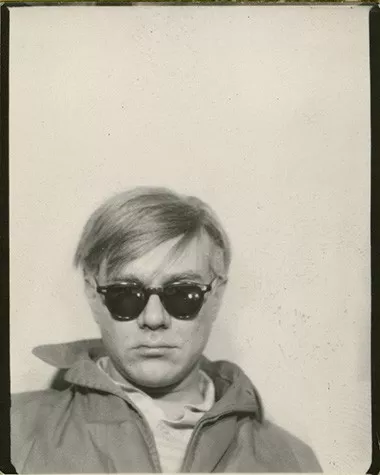
Andy Warhol, 1960s Portrait, Black and white photograph. Available at Guy Hepner, New York.
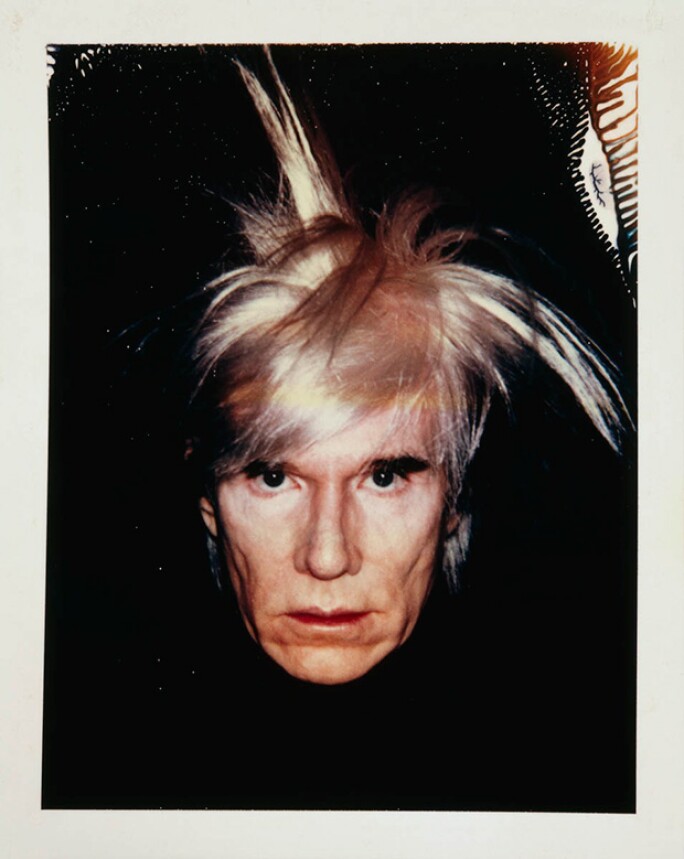
The most celebrated and haunting of all Warhol self-portraits emerged in 1986, just months before his death. Known as the "Fright Wig" series for the spiky, electrified hairpiece Warhol wears in each image, these paintings represent his most sustained and ambitious engagement with self-portraiture. The series includes works ranging from intimate prints to massive nine-foot canvases, rendered in color combinations that range from vivid to nearly monochromatic. Together, they constitute a meditation on mortality and artistic legacy that gains poignancy from the knowledge that Warhol would not survive to see them fully appreciated.
In the Fright Wig self-portraits, Warhol's face emerges from deep black backgrounds, the features rendered with stark, unflinching clarity. The wild wig, standing away from his head like an electrified halo, transforms him into something both recognizable and otherworldly—a spectral presence already partially departed from the physical world. The art historian Richard Polsky has described these works as among the most "significant paintings" of Warhol's final decade, ranking them alongside the Dollar Signs and the Last Suppers based on Leonardo da Vinci's iconic painting.
The Fright Wig paintings have achieved exceptional results at auction, demonstrating their status as cornerstones of Warhol's late achievement. At Sotheby's in May 2010, a massive purple Fright Wig self-portrait measuring nine feet square—once owned by fashion designer Tom Ford—sold for $32.6 million, setting a record for works from the series. The following year at Christie's, a red-on-black example from the same series brought $27.5 million. These results confirm that collectors and institutions recognize the 1986 self-portraits as among the most profound statements in Warhol's entire career.
Remarkably, some of the Fright Wig paintings were so disturbing that Warhol's own dealer would not exhibit them. This reluctance speaks to the unsettling power of these late works, which abandon the cool detachment that characterized earlier self-portraits in favor of something approaching raw confrontation. In these final self-portraits, Warhol seems to acknowledge what his earlier work so assiduously denied: the mortality that waits behind every constructed persona, the death that makes celebrity itself a temporary illusion.
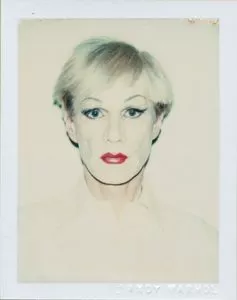
Andy Warhol, Self-Portrait, 1978, Silkscreen on canvas. Available at Guy Hepner, New York.
To understand the meaning of Andy Warhol's self-portraits requires understanding his transformation of the artist's role in contemporary culture. Before Warhol, artists achieved fame through their work; with Warhol, the artist's persona became the work, or at least became inseparable from it. The wigs, the sunglasses, the affectless voice, the silver Factory, the entourage of superstars—all of these elements combined to create a total artwork in which Warhol himself was the central figure. The self-portraits document this ongoing performance of artistic identity.
The critic Nicholas Baume has written that "clearly, Warhol was intrigued by the human face. Throughout his career, he constantly drew, painted, filmed, photographed and described it." This fascination with faces extended naturally to his own, which he treated with the same detached curiosity he applied to Marilyn or Mao or Jackie. By subjecting his own image to the same silkscreen process he used for celebrities, Warhol demonstrated that the artist had become a celebrity—and that celebrity itself was a form of artistic construction available to anyone willing to invest in the necessary image-making.
Warhol anticipated our current age of personal branding and social media self-presentation by decades. The Warhol Museum in Pittsburgh notes that his self-portraits have enjoyed renewed attention in the era of selfie culture, with publications recognizing him as "The Original King of Selfies." This contemporary relevance is no accident: Warhol understood instinctively that the technologies of image reproduction would transform the nature of selfhood, making identity something to be consciously crafted and broadcast rather than passively inhabited. His self-portraits serve as both prediction and instruction manual for our current moment.
The theatrical quality of Warhol's self-presentation extended to every aspect of his public life. The wigs, glasses, and other distinctive costumes; his inscrutable spoken script; the colorful supporting cast at the Factory; the elaborate backdrops—silver factories by day, psychedelic smoke-filled clubs by night—all served to enhance the artist's celebrity while simultaneously deflecting attention from the man in the midst of this unfolding drama. The self-portraits can be read as documents of this elaborate performance, capturing moments in a lifelong project of self-construction.
Warhol's self-portraits have occupied a central place in the critical assessment of his work since his death. Major exhibitions have devoted significant attention to this aspect of his practice, including "Andy Warhol, Self Portraits," which traveled throughout Europe in 2004, and "Andy Warhol: The Last Decade," which examined his final productive years at the Museum of Fine Arts Houston and the Brooklyn Museum in 2010. These exhibitions established the self-portraits as essential to understanding Warhol's achievement, demonstrating their evolution from youthful performance to late-career meditation on mortality.
The closure of the Andy Warhol Art Authentication Board in 2012 created new challenges for the market in Warhol's work, including his self-portraits. Richard Polsky, who operates an independent authentication service, has noted that "the Warhol market itself is filled with a fair number of fakes and forgeries" and that "there are paintings illustrated in the Andy Warhol Catalogue Raisonné that are not genuine." For collectors, this situation underscores the importance of working with established galleries that maintain rigorous standards of provenance and condition documentation.
Warhol's influence on subsequent artists dealing with issues of identity and self-presentation has been immeasurable. Cindy Sherman, whose own work explores the constructed nature of photographic identity, serves on the board of the Andy Warhol Foundation and has acknowledged his importance to her practice. Jeff Koons and Damien Hirst, both of whom function largely as art directors overseeing the production of their work, owe direct debts to Warhol's model of the artist as celebrity brand manager. In this sense, every artist who cultivates a distinctive public persona and treats their image as part of their artistic practice operates in territory that Warhol first mapped.
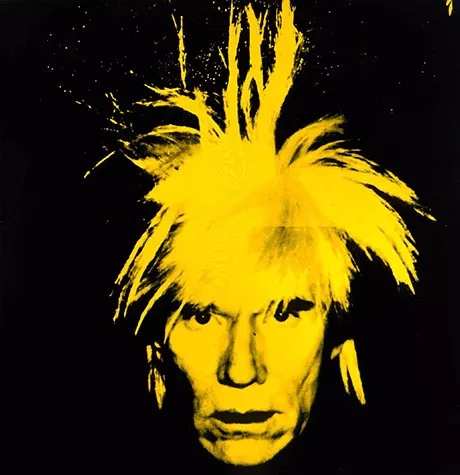
Andy Warhol, Self-Portrait, 1986, Silkscreen on canvas. Available at Guy Hepner, New York.
The market for Andy Warhol self-portraits reflects their status as essential works within his oeuvre. Major examples from the 1960s photo-booth series and the 1986 Fright Wig paintings have achieved prices in the tens of millions of dollars at auction, placing them among the most valuable works by any postwar American artist. However, Warhol's prolific output means that works at various price points remain available to collectors, from unique paintings to signed prints and Polaroids.
When evaluating Warhol self-portraits for acquisition, collectors should consider several key factors:
The portrait commissions that sustained Warhol's studio throughout the 1970s and 1980s provide context for understanding the self-portraits' place in his practice. Clients would pay $25,000 for a commissioned portrait, with Warhol taking Polaroids of the subject, selecting his favorite image, and painting four canvases in different color combinations. The subject would then be offered the additional canvases at $5,000 each. This systematic approach to portrait production demonstrates the commercial framework within which even the self-portraits emerged.
For collectors seeking entry points into Warhol's self-portrait practice, prints from official editions offer museum-quality examples at accessible prices relative to unique works. The silkscreen prints capture the essential visual impact of Warhol's self-portraits while benefiting from the artist's direct involvement in their production. These works have proven stable in value over time while remaining more available than unique paintings, making them attractive to collectors building comprehensive holdings in postwar American art.
Guy Hepner Gallery maintains an active inventory of works by Andy Warhol, including examples from his self-portrait practice. Our holdings encompass various periods and formats, from the artist's celebrated silkscreen prints to unique photographic works. Each piece in our inventory has been carefully vetted for authenticity and condition, with full provenance documentation available to serious inquiries.
The gallery's location at 177 Tenth Avenue in New York places us at the center of the contemporary art market, with ready access to the institutional and private collections that set standards for quality and significance in the field. Our specialists have deep experience with Warhol's market and can provide guidance to collectors at all levels of engagement with his work, from those making their first acquisition to those seeking museum-quality examples to anchor established collections.
Andy Warhol's self-portraits constitute one of the most sustained and intellectually ambitious projects in twentieth-century art. From the photo-booth experiments of 1963 to the spectral Fright Wig paintings of 1986, these works chart the artist's evolving understanding of celebrity, identity, and the reproducible image. They document the creation of one of the most recognizable personas in modern culture while simultaneously demonstrating that this persona was always, at some level, a performance—a mask worn by Andrew Warhola of Pittsburgh as he navigated the demands of artistic fame.
For collectors, Warhol self-portraits represent opportunities to own works that sit at the intersection of art history's most enduring genre and the specifically contemporary concerns of media, celebrity, and self-construction. These are works that reward extended looking, revealing new dimensions as viewers bring their own experiences of a culture Warhol helped to create. They speak to our current moment even as they record a specific historical period, demonstrating the prescience that has kept Warhol's reputation secure across decades of shifting critical fashion.
To explore Andy Warhol self-portraits currently available through Guy Hepner, or to discuss building a collection that includes his work, we invite you to contact our gallery directly. Our team stands ready to assist with inquiries ranging from initial acquisitions to the placement of significant works within established collections.
Explore Andy Warhol prints for sale at Guy Hepner: Self Portraits, 25 Cats Named Sam, A Gold Book, A La Recherche Du Shoe Perdu, Alexander the Great.
Related Series