Myths

September 15, 2026
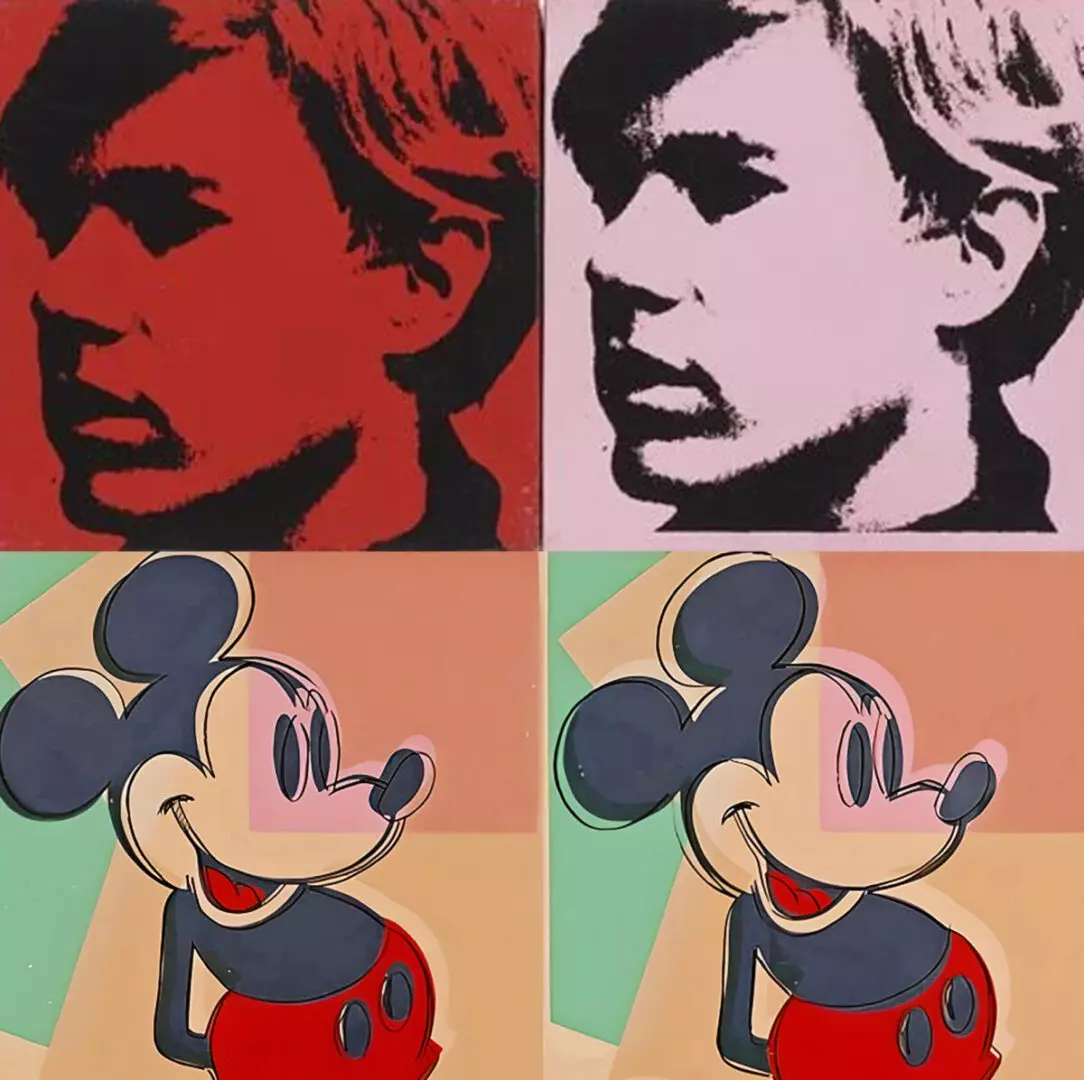
Of all the figures Andy Warhol immortalised across his five-decade career — Marilyn Monroe, Mao Zedong, Elvis Presley, Elizabeth Taylor — none had been staring back at Americans longer than Mickey Mouse. Created by Walt Disney and Ub Iwerks in 1928, the cheerful rodent predates Warhol himself by roughly six months, and by the time the artist turned his silkscreen toward Disney's mascot in 1981, Mickey had become arguably the most recognised face on the planet. The Andy Warhol Mickey Mouse print, catalogued as F.S. II 265, stands as one of the most compelling intersections of fine art, commercial iconography, and collective nostalgia in twentieth-century American art. For collectors seeking a Warhol that speaks to both art historical significance and pure visual delight, few works deliver as consistently as this diamond-dusted tribute to the world's most famous cartoon character.
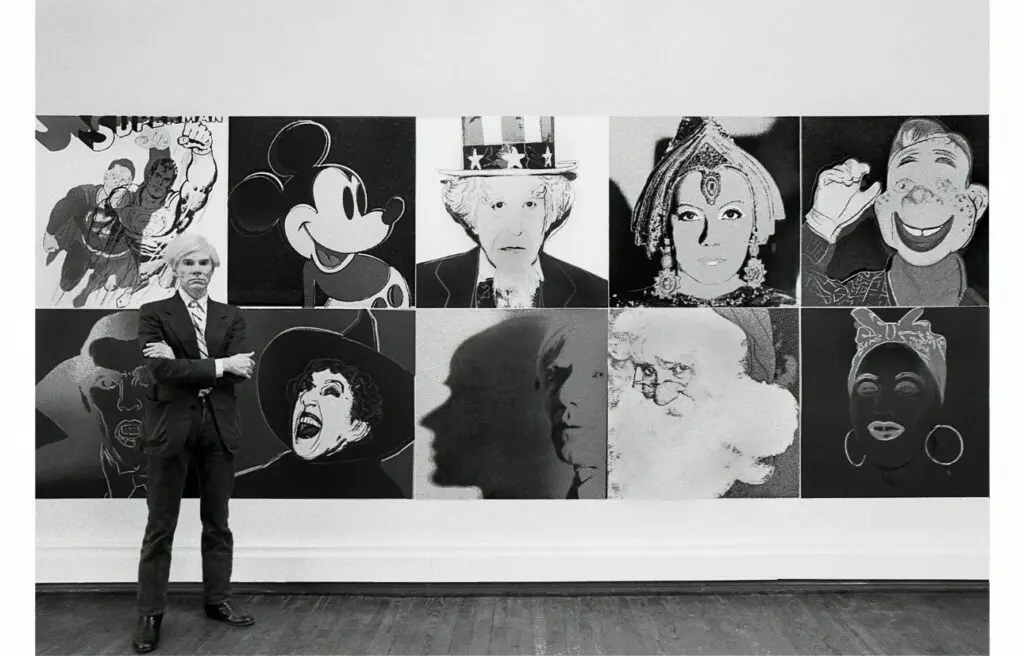
The Mickey Mouse print emerged from Warhol's Myths portfolio, a suite of ten screenprints released in 1981 that surveyed the pantheon of American popular mythology. Where Warhol had previously elevated real celebrities to the status of icons, with Myths he turned his attention to fictional characters and archetypes that had achieved a cultural penetration even deeper than that of any movie star. Mickey Mouse, alongside Superman, Dracula, Santa Claus, and others, represented a different order of fame — characters who existed purely as images, unencumbered by the complications of actual human biography. For Warhol, who had long been fascinated by the mechanics of celebrity and the power of repeated imagery, Mickey Mouse was the ultimate subject: a figure whose face was so ubiquitous that it had transcended meaning itself.
Understanding why Warhol chose Mickey Mouse requires grasping his broader artistic project. Throughout the 1960s and 1970s, Warhol had systematically documented American consumer culture and celebrity worship, transforming soup cans, Brillo boxes, and movie stars into high art. His method was deceptively simple: isolate an image already saturated with cultural meaning, reproduce it through the mechanical process of silkscreen printing, and in doing so reveal the image's power while simultaneously questioning its authenticity. When Warhol painted Marilyn Monroe immediately after her death in 1962, he was not creating a portrait so much as an examination of how we consume images of celebrities — how the face becomes divorced from the person, how repetition both amplifies and empties meaning.
Mickey Mouse represented the logical endpoint of this investigation. Unlike Marilyn, Mickey had never been a real person. He was born as a commercial product, designed to be reproduced infinitely across merchandise, films, theme parks, and every conceivable consumer surface. Where Marilyn's image was a memorial to a tragically mortal woman, Mickey's image was pure simulation — a face that referred to nothing but itself. In selecting Mickey Mouse for the Myths portfolio, Warhol acknowledged that fictional characters had achieved a cultural reality more durable and perhaps more meaningful than that of actual human beings. Children who had never seen a Marilyn Monroe film could still recognise her face, but they knew Mickey not as a distant icon but as a personal companion from their earliest memories.
The timing of the Myths portfolio also matters for collectors assessing its significance. By 1981, Warhol had fully returned to painting after a decade focused on other ventures including Interview magazine, television production, and commissioned portraits. The 1980s would prove to be an extraordinarily productive period, with Warhol creating some of his most visually exuberant work. The Myths series marked an important transition, demonstrating that Warhol could apply his iconic approach to subjects beyond the realm of literal celebrity while maintaining the conceptual rigor that distinguished his best work. The portfolio was immediately recognised as significant, and today it stands alongside the Campbell's Soup Cans, Marilyn, and Mao as essential Warhol.
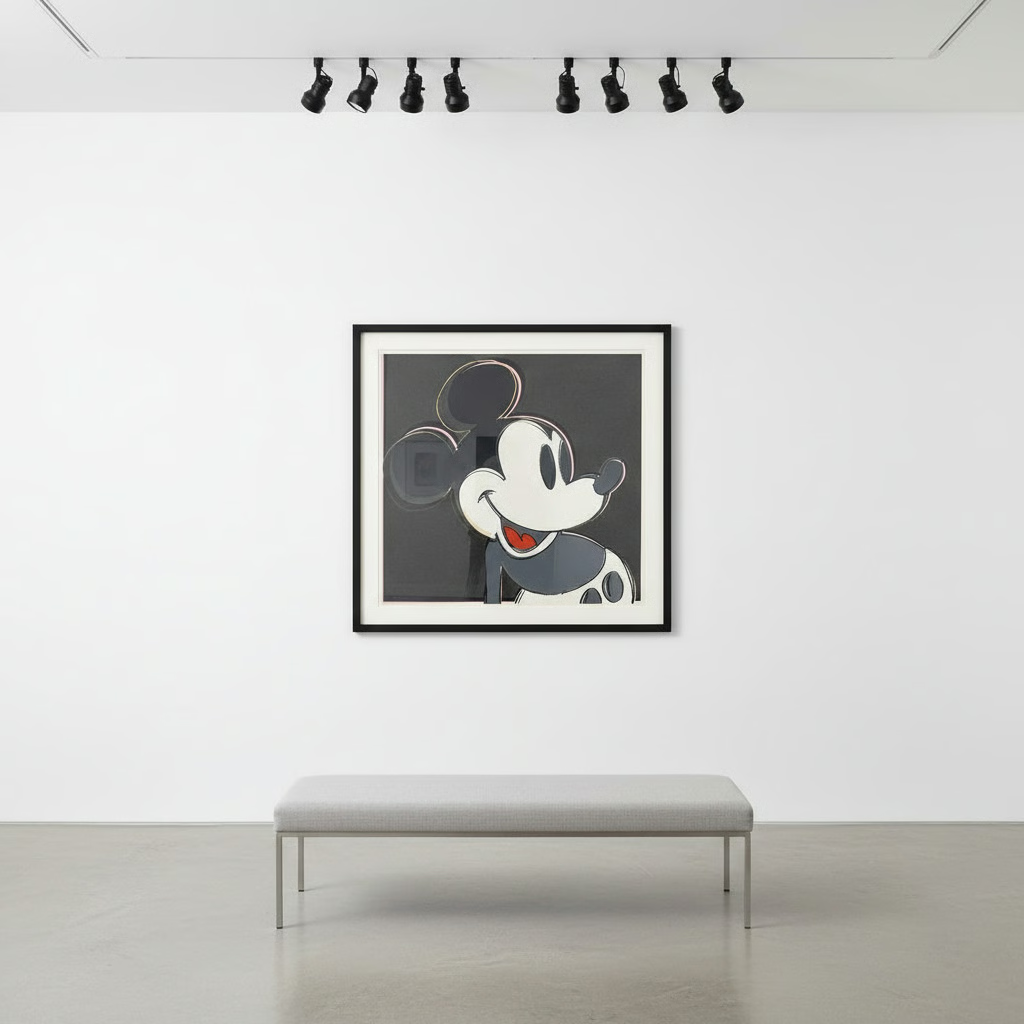
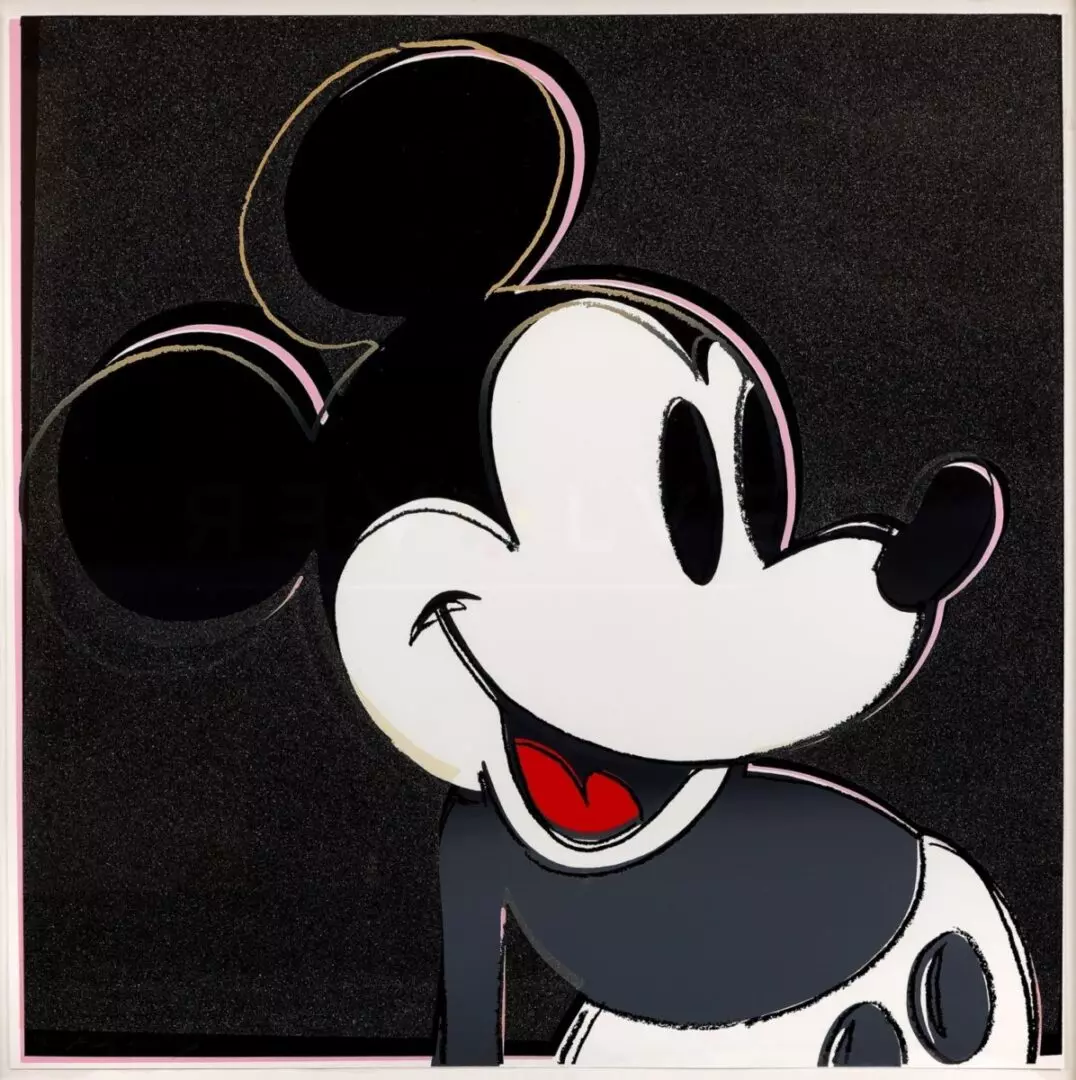
Andy Warhol, Mickey Mouse (detail), 1981, Screenprint with Diamond Dust. Available at Guy Hepner, New York.
The complete Myths portfolio comprises ten screenprints, each depicting a character or archetype from American popular culture. Alongside Mickey Mouse, the suite includes Superman, Howdy Doody, Dracula, the Star (a composite Hollywood image), the Witch, Uncle Sam, Santa Claus, Mammy (a problematic stereotype Warhol included to comment on American visual history), and the Shadow. Each print measures 38 x 38 inches, and the portfolio was published by Ronald Feldman Fine Arts, New York, with printing executed by Rupert Jasen Smith. The edition for each print consists of 200 signed and numbered impressions, plus 30 artist's proofs, making the Myths portfolio relatively accessible compared to some of Warhol's earlier, more limited editions.
What distinguishes the Myths prints from much of Warhol's earlier work is the application of diamond dust to the printed surface. This technique, which Warhol had begun using in the late 1970s, involves coating the screenprint with fine particles of crushed glass that catch and reflect light, giving the image a sparkling, almost hallucinatory quality. The effect transforms the viewing experience, making the print shift and shimmer as the viewer moves. For the Mickey Mouse print specifically, the diamond dust enhances the sense of magical unreality that Disney's character embodies. The sparkle evokes childhood wonder, fairy tale enchantment, and the literal glitter of Disneyland — all associations that deepen the work's resonance.
Collectors often approach the Myths portfolio as a unified body of work, seeking to acquire multiple prints or even the complete suite. However, individual prints from the series are equally valued, and Mickey Mouse consistently ranks among the most sought-after single images. Its appeal extends beyond the community of dedicated Warhol collectors to include Disney enthusiasts, pop culture collectors, and those for whom Mickey holds personal nostalgic significance. This broader collector base has contributed to the print's market strength and ensures consistent demand across economic cycles.
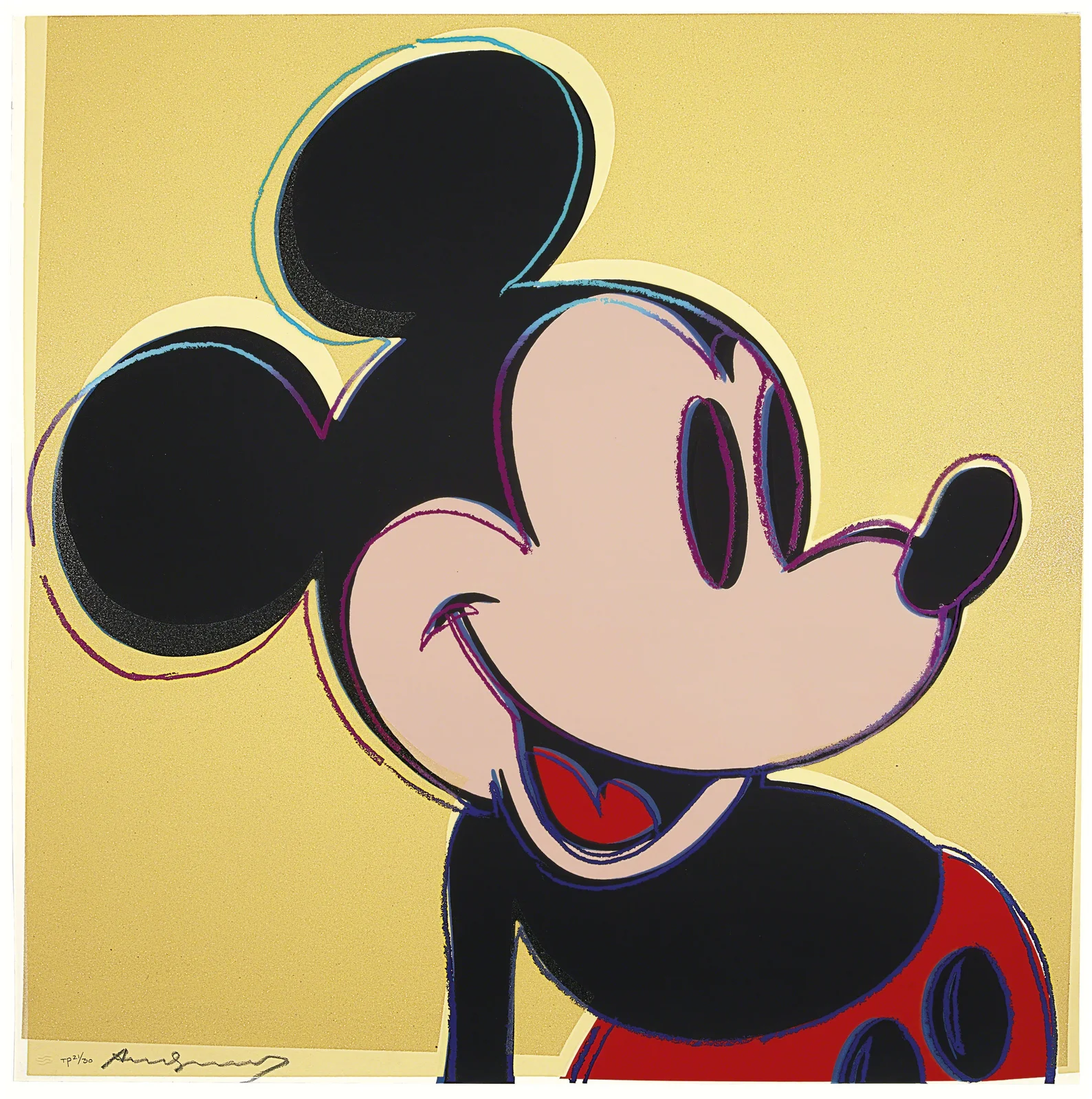
The formal qualities of the Mickey Mouse print reward close attention. Warhol based the image on a vintage Disney publicity still, depicting Mickey in his classic appearance with circular ears, white gloves, and an expression of eager friendliness. The composition is characteristically Warhol: the figure fills the square format, with minimal background and maximum focus on the iconic face. The colour palette varies across the edition, with different impressions featuring yellow, pink, red, and other vibrant backgrounds that alter the emotional register of the image without changing its essential character.
The technical execution demonstrates Warhol's mastery of the screenprint medium. Layers of colour are built up through successive passes, creating areas of flat, saturated hue punctuated by black outlines that define Mickey's features. The registration — the alignment of these multiple colour layers — is deliberately imperfect in places, introducing a handmade quality that counters the mechanical origins of the process. This tension between industrial technique and painterly gesture runs throughout Warhol's print work and gives his best prints their distinctive vitality.
The diamond dust application merits particular attention for collectors evaluating specific impressions. The dust should be evenly distributed across the printed surface, with no bare patches or excessive clumping. Over time, some diamond dust can become displaced, particularly if prints have been improperly stored or handled. The presence of original, intact diamond dust significantly affects both the visual impact and the market value of individual impressions. When examining a Mickey Mouse print, collectors should observe the surface under raking light to assess the density and evenness of the diamond dust coverage.
Understanding the edition structure of the Mickey Mouse print is essential for informed collecting. The standard edition consists of 200 signed and numbered impressions (numbered 1/200 through 200/200), plus 30 artist's proofs (marked A.P. and numbered 1/30 through 30/30). All standard edition prints and artist's proofs are signed by Warhol in pencil on the verso or lower margin. The prints are stamped on the verso with the publisher's copyright stamp and the printer's chop.
Beyond the standard edition, several variants exist that command different market positions:
The existence of these variants means that collectors have multiple entry points into Mickey Mouse ownership, from standard edition prints through increasingly rare and valuable proofs. At Guy Hepner, we maintain relationships with sources across this spectrum and can assist collectors in identifying the variant that best matches their collecting objectives and budget.
Authentication is paramount when acquiring any Warhol print, and the Mickey Mouse is no exception. The Andy Warhol Foundation for the Visual Arts maintained the artist's authentication board until 2011, when it ceased operations due to mounting legal challenges. Since then, the Foundation has directed collectors to rely on the catalogue raisonné compiled by Frayda Feldman and Jörg Schellmann, which documents all of Warhol's authorised print editions. The Mickey Mouse print is catalogued as F.S. II 265 in this definitive reference.
When evaluating a Mickey Mouse print for acquisition, collectors should verify several authentication markers:
Provenance — the documented ownership history of a specific impression — provides additional confidence in authenticity. Prints that can be traced through reputable galleries, auction houses, and collections carry lower risk than works with gaps in their ownership history. At Guy Hepner, every Mickey Mouse print we offer has been thoroughly vetted for authenticity and comes with complete provenance documentation.
Condition significantly affects both the aesthetic impact and market value of Warhol prints. The Mickey Mouse print, now over four decades old, requires careful condition assessment. Collectors should evaluate the following factors when considering an acquisition:
Prints in excellent, unframed condition with intact diamond dust command the strongest prices. However, collectors on a budget may find value in prints with minor condition issues that do not significantly affect the visual presentation. A reputable gallery can help assess whether specific condition factors are acceptable for a particular acquisition.
The Andy Warhol Mickey Mouse print occupies a strong position within the broader market for Warhol's work. As a component of the Myths portfolio, it benefits from association with one of Warhol's most conceptually coherent and visually appealing print projects. The subject matter — arguably the world's most beloved cartoon character — ensures consistent collector interest beyond the core Warhol market.
Pricing for Mickey Mouse prints varies significantly based on variant type, condition, and provenance. Standard edition prints in excellent condition have historically traded in the range of $100,000 to $250,000 at auction, though exceptional examples have exceeded this range and market conditions fluctuate. Artist's proofs typically command a 15-25% premium over standard edition prints of equivalent condition. Trial proofs and unique colour variants are sufficiently rare that pricing becomes highly individual, with exceptional examples potentially reaching significantly higher levels.
Several factors influence pricing within these ranges:
Guy Hepner works directly with collectors worldwide, providing access to Mickey Mouse prints at various price points. Our relationships with major collectors and estates often yield opportunities unavailable through public auction channels. We are happy to discuss specific pricing and availability with interested collectors.
The enduring appeal of the Warhol Mickey Mouse print reflects several factors that resonate across collector motivations. For those building comprehensive Warhol holdings, the Myths portfolio represents an essential component of any serious collection, and Mickey Mouse stands as the portfolio's most iconic single image. The print demonstrates Warhol's 1980s maturity while connecting to his foundational Pop Art concerns of the 1960s.
For collectors newer to Warhol or approaching contemporary art through a broader lens, Mickey Mouse offers an accessible entry point. The subject matter is immediately engaging, requiring no art historical knowledge to appreciate. The image connects to childhood memories and cultural touchstones that transcend the art world. Many collectors report that the Mickey Mouse print generates more positive visitor response than ostensibly more important works in their collections.
The visual impact of the diamond dust surface distinguishes this print in any collection. Where most prints are static objects, the Mickey Mouse sparkles and shifts with lighting and viewing angle, creating an almost cinematic experience. This dynamic quality makes the print a natural focal point in residential or corporate installations.
Finally, Mickey Mouse occupies an interesting position at the intersection of fine art and popular culture that aligns with contemporary collecting trends. Museums and institutions increasingly recognise the significance of Pop Art's engagement with commercial imagery, and the Mickey Mouse print embodies this engagement more directly than almost any other Warhol work. Collecting this print connects the owner to ongoing cultural conversations about the relationship between art, commerce, and mass media.
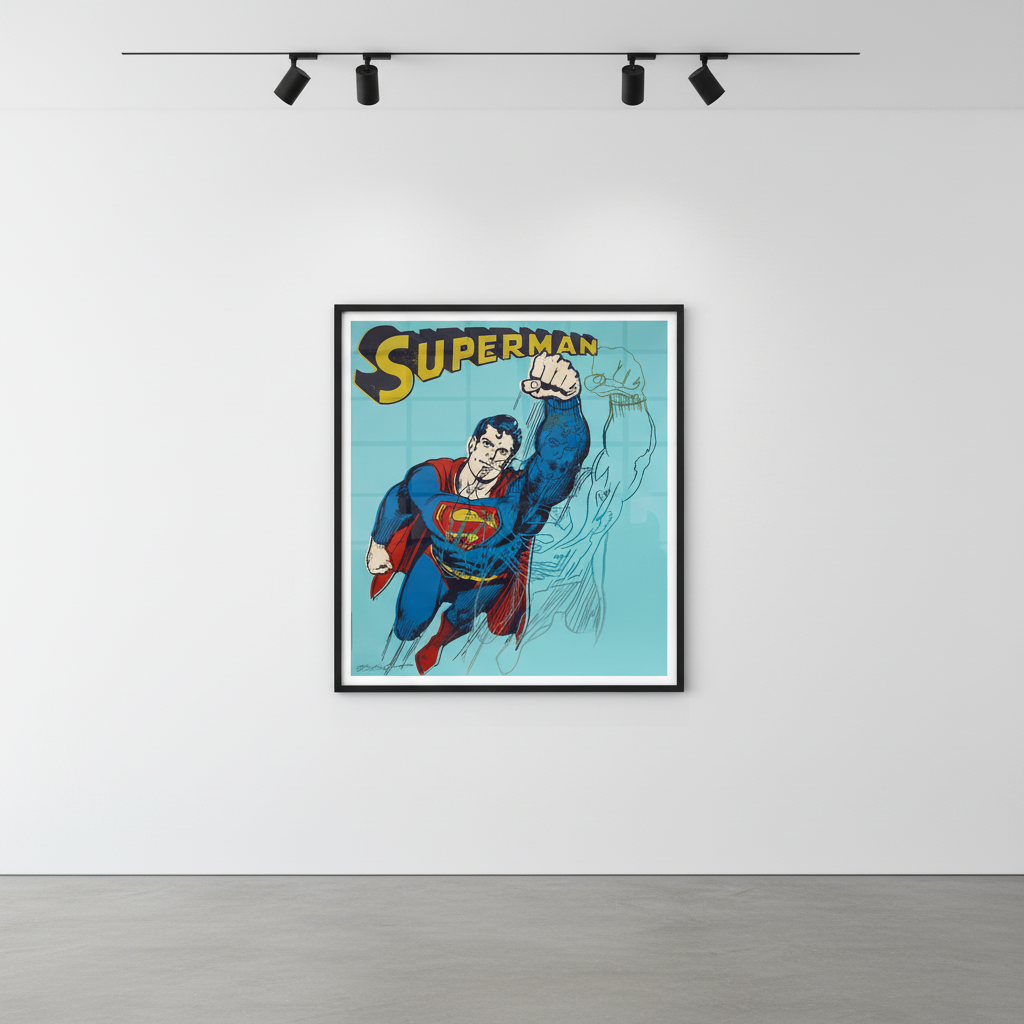
Andy Warhol, Superman, 1981, Screenprint from Myths Portfolio. Available at Guy Hepner, New York.
Collectors should be aware of an alternative Mickey Mouse image that Warhol produced: the Double Mickey Mouse, executed in various media during the same period. This composition presents two Mickey figures facing each other, creating a mirror-image effect consistent with Warhol's longstanding interest in repetition and doubling. The Double Mickey Mouse exists primarily as a unique painting rather than an editioned print, making it significantly rarer and more expensive than the Myths portfolio version.
The distinction between the single Mickey Mouse from the Myths portfolio and the Double Mickey Mouse paintings is important for collectors considering their options. The Myths print represents Warhol's most accessible Mickey Mouse format, with 200 standard edition impressions plus proofs providing genuine opportunities for acquisition. The Double Mickey Mouse paintings, by contrast, number only a handful of unique works, placing them in an entirely different market tier typically accessible only to major collectors and institutions.
Both formats have appeared at auction and through private sale, and both represent legitimate expressions of Warhol's engagement with Disney's iconic character. For most collectors, the Myths portfolio print offers the optimal combination of aesthetic impact, conceptual significance, and practical availability.
Proper care ensures that a Mickey Mouse print retains its value and visual impact across generations of ownership. The diamond dust surface requires particular attention, as the crushed glass particles can become displaced through vibration, improper handling, or contact with framing materials.
Framing should be executed by a conservator-trained professional using archival, museum-quality materials. The print should be hinged rather than adhered to the backing board, allowing the paper to respond naturally to humidity changes. Glazing should incorporate UV-filtering acrylic or glass to protect against light damage. Critically, the glazing must not touch the print surface — appropriate spacing prevents the diamond dust from transferring to the glass.
Display location affects long-term preservation. Avoid direct sunlight, which will cause fading even through UV-filtering glazing. Maintain stable temperature and humidity, avoiding placement near exterior walls, heating vents, or humidifiers. Even with ideal conditions, rotating prints in and out of display minimises cumulative light exposure.
Insurance adequate to current market value protects your investment. Standard homeowner's policies typically exclude or cap fine art coverage, requiring a separate rider or dedicated fine art policy. Update valuations every few years to ensure coverage remains adequate as markets evolve.
Guy Hepner gallery maintains an active inventory of Andy Warhol prints, including the Mickey Mouse from the Myths portfolio. Our position in the primary and secondary markets, combined with relationships developed over years of specialised dealing, provides access to works that may not appear through public auction channels. We work with collectors at all levels, from those acquiring their first Warhol to institutions building museum-quality holdings.
Our approach emphasises transparency, education, and long-term relationship building. We provide complete condition reports, authentication documentation, and provenance records for every work we offer. Our staff includes specialists knowledgeable about the Warhol print market who can advise on acquisition strategy, market timing, and collection building.
For collectors interested in the Andy Warhol Mickey Mouse print, we invite you to enquire about current availability. The market for this work remains active, and our access to private collections often yields opportunities ahead of public offering. Whether you are seeking a specific colour variant, a particular edition type, or simply the best available example within your budget, Guy Hepner can assist in identifying and securing the right work for your collection.
Visit our gallery at 177 Tenth Avenue in New York to view available works in person, or contact us directly to discuss the Mickey Mouse print and other Warhol acquisitions. The American myth that Warhol captured in diamond dust continues to enchant collectors worldwide, and we would be honoured to help you bring this iconic work into your collection.
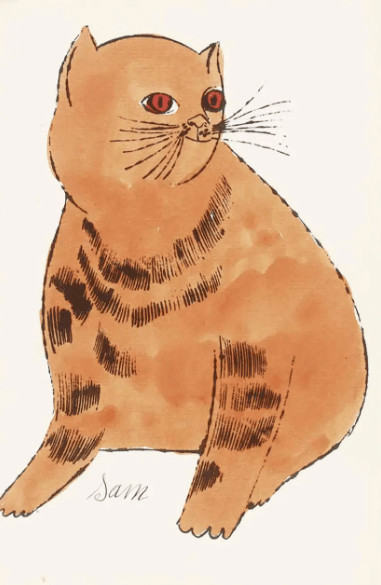
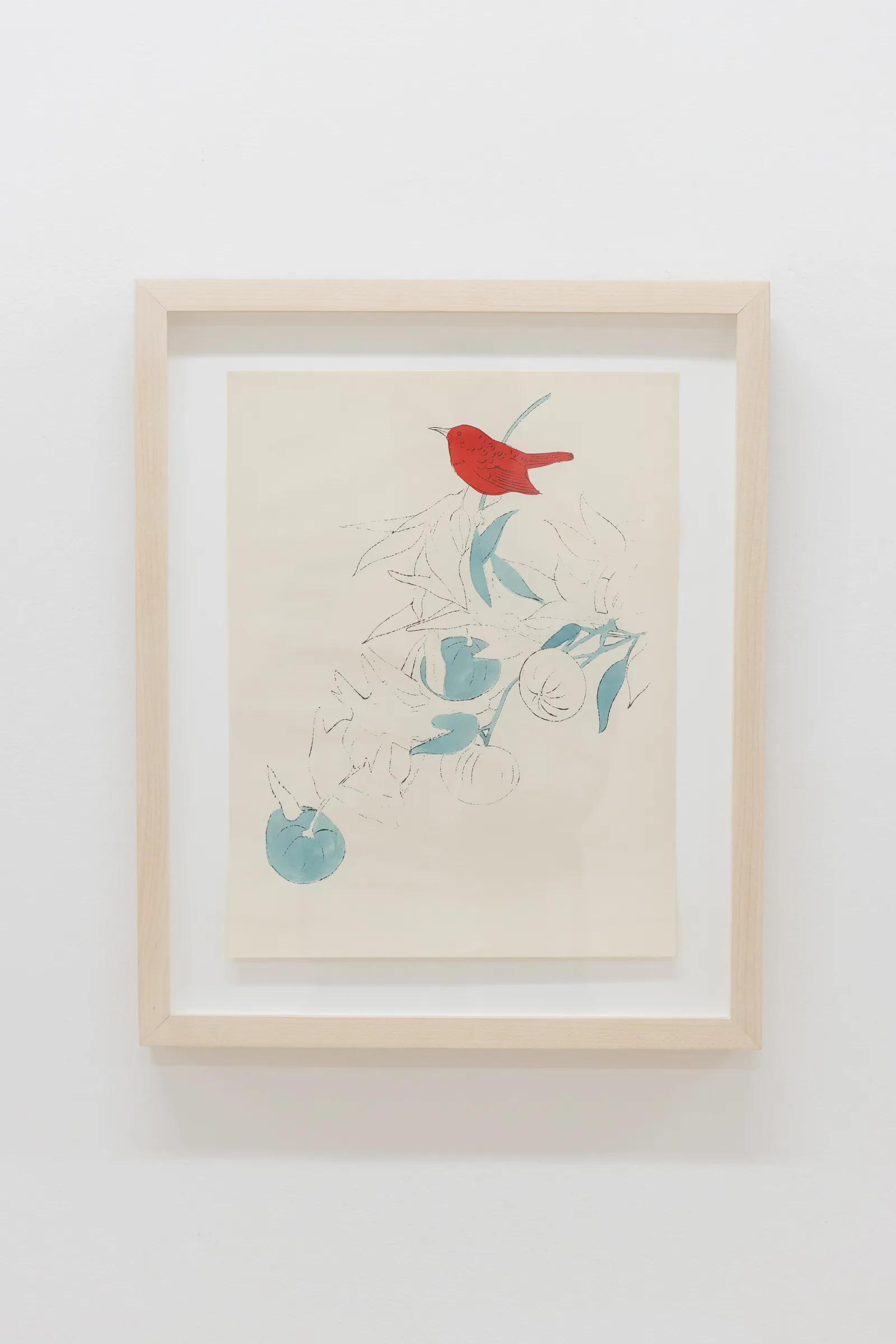
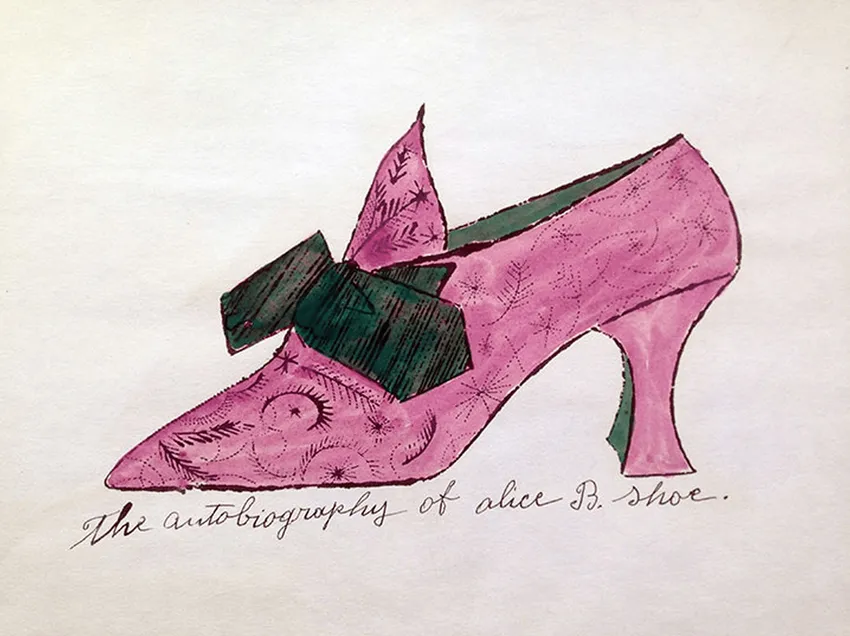
Explore Andy Warhol prints for sale at Guy Hepner: Myths, 25 Cats Named Sam, A Gold Book, A La Recherche Du Shoe Perdu, Alexander the Great.
Related Series