Marilyn

June 15, 2026
In May 2022, a single Andy Warhol Marilyn screenprint from the canonical 1967 portfolio realised $195,000 at Christie's New York. That same year, an even more extraordinary event: the 1964 painting Shot Sage Blue Marilyn crossed the block at Christie's for $195 million, becoming the most expensive work by a twentieth-century American artist ever sold at auction. These are not simply numbers — they are a barometer of cultural permanence, of how thoroughly a silk-screened image of a dead actress has embedded itself in the canon of Western art. This guide is for collectors interested in the prints: the editions published by Factory Additions, the complete FS II.22–31 portfolio, its colourways, variants, market trajectory, and precisely what to look for before making an acquisition.
Inquire About Available Andy Warhol Marilyn Prints
Browse current Marilyn editions available through Guy Hepner, 529 West 20th Street, New York.
Warhol did not work from life. He worked from photographs — specifically, from images already circulating in mass culture, already flattened by reproduction into something closer to a logo than a portrait. For the Marilyn series, the source was a promotional still taken in 1953 to publicise the 20th Century Fox thriller Niagara, in which Monroe played a scheming wife opposite Joseph Cotten. The photograph — a tight frontal crop of Monroe's face, head slightly turned, the famous beauty mark visible above her lip — had the quality Warhol required: it was simultaneously iconic and anonymous, a face that belonged to no one and everyone.
The photographers who shaped Monroe's visual legacy in the 1950s are worth understanding in their own right. Sam Shaw, the New York-born photojournalist, had an insider's access to Monroe throughout the decade. He is perhaps best known for the sequence he made on the set of The Seven Year Itch in 1955, where Monroe stands laughing over a subway grate on Lexington Avenue, her white halter dress lifting in the updraft. Shaw shot candidly, and Monroe trusted him. His photographs have a warmth and spontaneity that stand apart from the controlled glamour of studio portraiture. Bert Stern, equally significant, produced his landmark series in June and July 1962 — a commission for Vogue magazine completed over three days at the Hotel Bel-Air, just six weeks before Monroe's death on 4 August 1962. Stern's photographs, collectively known as "The Last Sitting," document a woman both radiant and exhausted, self-consciously performing her own image for the last time.
Warhol was aware of this entire photographic tradition. When he chose the 1953 Niagara still — not Shaw's spontaneous images, not Stern's intimate late work — he chose the most mediated, the most mass-produced version of Monroe's face available. By the time he silk-screened it in autumn 1962, the photograph had already appeared on posters, lobby cards, and in newspapers across the United States. Warhol found meaning not in the original but in the copy of the copy. The choice was the argument.
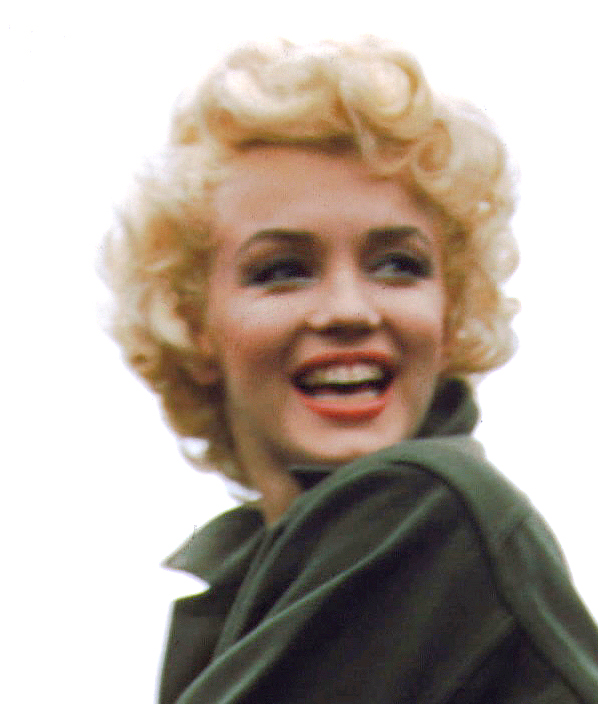
Marilyn Monroe greeting US troops during the Korea USO tour, 1954. Official USMC Photograph / USMC Archives (CC BY 2.0). The cultural ubiquity of Monroe's image — circulating across news wire, magazine, and television throughout the 1950s — provided the mass-reproduced visual material Warhol later transformed into the Marilyn series.
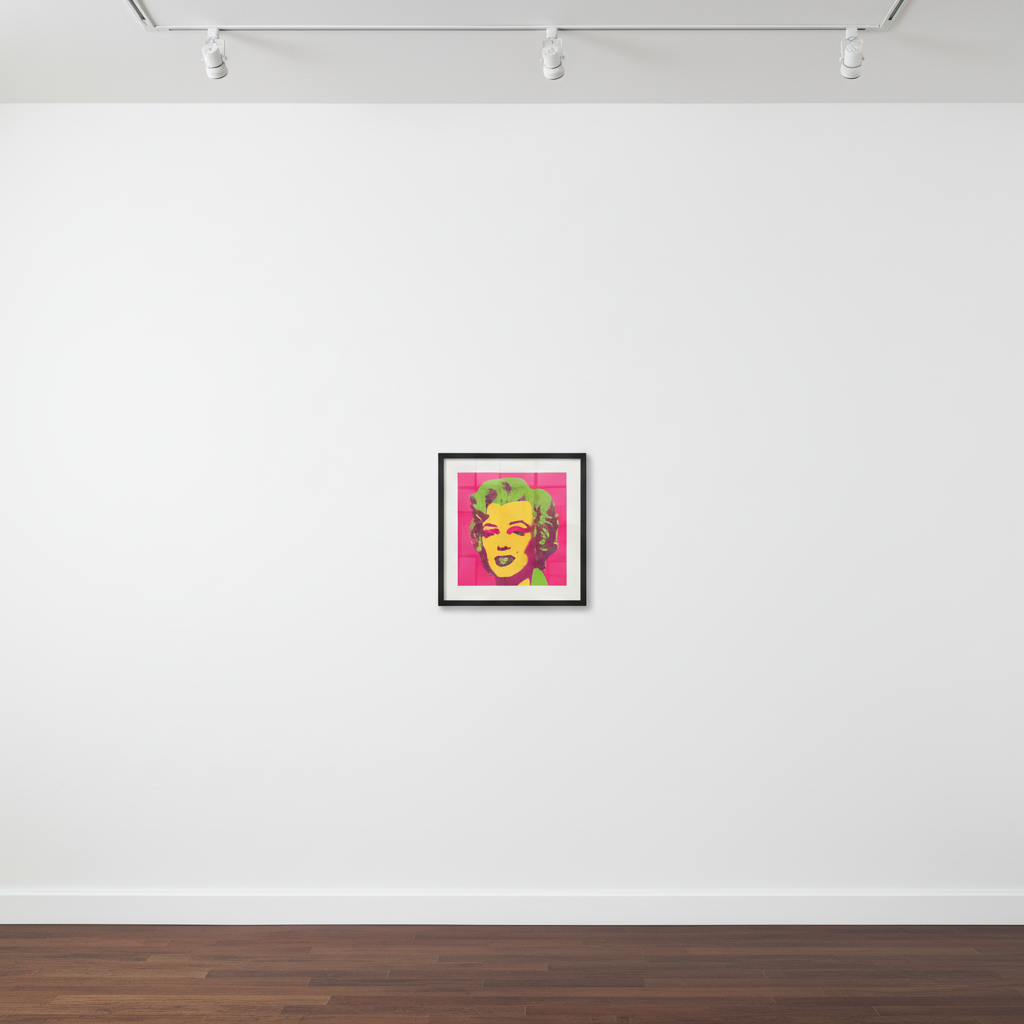
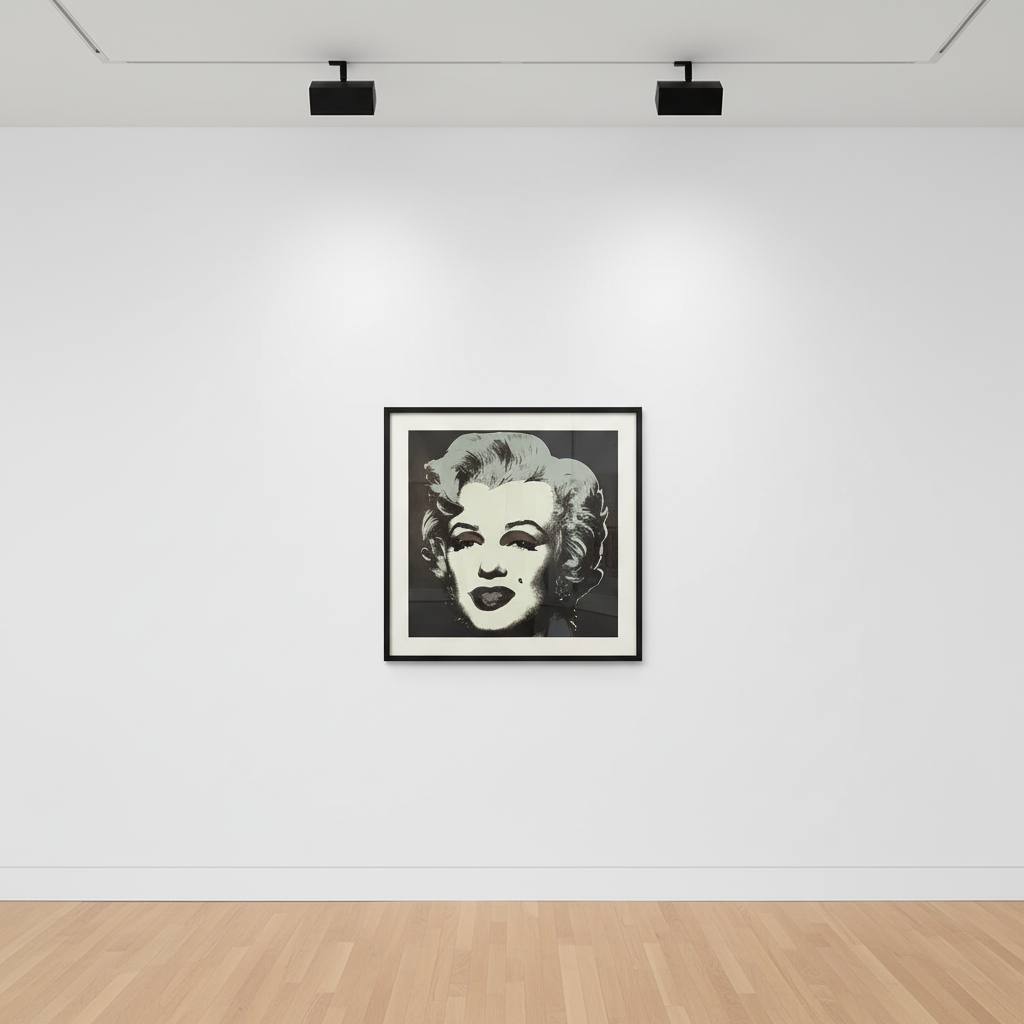
Andy Warhol, Marilyn Monroe F.S. II 21, 1967. Screenprint on Lenox Museum Board. Available at Guy Hepner, 529 West 20th Street, New York. Browse Andy Warhol Marilyn Prints →
Marilyn Monroe died in her Brentwood, Los Angeles home on the night of 4–5 August 1962. She was thirty-six. Warhol, already at work establishing himself as a serious fine art presence after years as a commercial illustrator, responded almost immediately. Within weeks of her death he completed Marilyn Diptych — fifty silk-screened repetitions of Monroe's face, twenty-five in vivid colour and twenty-five in black and white, the latter growing increasingly faint toward the right edge as though dissolving into static. The work entered the Tate collection and has not left public view since.
In the same autumn of 1962, Warhol produced a number of individual Marilyn paintings: Gold Marilyn Monroe, acquired by the Museum of Modern Art, New York, and later the four monumental "Shot" paintings of 1964, each differentiated by background colour — blue, red, orange, and sage. These large canvases, now among the most valuable American paintings ever made, established the visual lexicon that the print editions would later codify. The silk-screen process — a commercial printing technique Warhol had used in advertising and appropriated for fine art — allowed him to repeat the image without degradation, and in repetition he found his true subject: the way mass culture transforms people into symbols, and symbols into commodities.
For collectors focused on works on paper, it is essential to understand that the 1962 paintings and the 1967 print portfolio, though sharing an image and a technique, are categorically different objects. The paintings are unique; the prints are editions. But the prints carry the same conceptual freight, and they were made with comparable precision. Warhol did not consider them lesser works, and the sustained market performance of the portfolio confirms that collectors agree.
Screen printing — known commercially as silk-screen printing and in fine art as serigraphy — is a stencil-based process in which ink is forced through a mesh screen onto a substrate using a squeegee. Where a photographic stencil blocks the mesh, ink cannot pass; where the screen is open, ink flows through. By using separate screens for each colour, the printer builds up an image layer by layer, with each pass requiring precise registration.
Warhol worked closely with master printer Aetna Silkscreen Products in New York, who executed the FS II.22–31 portfolio to his specifications. The photographic source — the 1953 Niagara still — was broken down into its constituent graphic elements: the hair, the skin tones, the Shadows below the cheekbone, the eyelids, the lips, the background field. Each element was assigned a colour and a separate screen. What looks effortless in the finished prints is the result of painstaking colour separation and registration: each layer must align precisely with the others, consistently, across an edition of 250 sheets. A print with visible misregistration — even by two or three millimetres — would conventionally be pulled from the edition and destroyed.
The inks used in the Marilyn portfolio are oil-based, dense in pigment, and have aged well under normal storage and display conditions. The background colours — turquoise, orange, sage green, lemon yellow, navy, hot pink, and black — remain startlingly vivid in well-preserved examples. The paper, Lenox Museum Board, is an acid-free archival substrate manufactured specifically for fine art editions, and its long-term durability is well established. Collectors encountering Marilyn prints with significant colour fade or ground discolouration should treat this as a serious red flag; genuine fading in a properly stored example would be extremely unusual.
Andy Warhol, Marilyn Monroe F.S. II 24, 1967. Screenprint on Lenox Museum Board. Available at Guy Hepner, 529 West 20th Street, New York. Browse Andy Warhol Marilyn Prints →
The definitive Warhol Marilyn print editions are contained in the portfolio formally catalogued by Georg Feldman and Jochen Schellmann as FS II.22 through FS II.31 in Andy Warhol Prints: A Catalogue Raisonné 1962–1987, first published in 1985 and revised in subsequent editions. The Feldman & Schellmann catalogue raisonné is the primary scholarly and commercial reference for all Warhol print editions; any serious collector should own it. The specifications for the Marilyn portfolio are as follows:
Title: Marilyn Monroe (Marilyn)
Year: 1967
Medium: Screenprint on Lenox Museum Board
Size: 36 × 36 inches (91.4 × 91.4 cm)
Edition: 250, signed and numbered, plus 26 artist's proofs lettered A–Z (also signed)
Publisher: Factory Additions, New York
Printer: Aetna Silkscreen Products, New York
The portfolio consists of ten prints, each presenting the same cropped image of Monroe's face on a different background colour, with the facial elements — hair, lips, eyelid colour, skin tones — also varied across the ten variants. The prints are sold both as individual works and as complete ten-print portfolios. Complete portfolios in original clamshell box packaging command a significant premium over the aggregate value of ten individually-sold prints, owing both to their rarity as intact sets and to the additional provenance security that original Factory Additions packaging provides.
Each print in the numbered edition is hand-signed by Warhol in ballpoint pen on the verso, accompanied by the edition number (e.g., 147/250). Artist's proofs carry a letter designation (A/P through Z/P). Warhol's signing practice was not perfectly uniform across his career, and authentication therefore requires reference to documented provenance and specialist expertise. The Andy Warhol Art Authentication Board, which reviewed works from 1995 until its closure in 2012, issued stamps of authenticity that, where traceable, remain the strongest form of authentication available for works authenticated during that period.
The ten prints in the FS II.22–31 portfolio are differentiated primarily by their background colours, though the hair, lip, and eyeshadow tones also shift across each variant. Understanding the colourways matters both aesthetically and commercially, as certain combinations are consistently preferred by the market and achieve premium realisations at auction.
The ten Feldman & Schellmann catalogue numbers and their primary colour combinations are:
FS II.22 — Turquoise background, gold hair, red lips
FS II.23 — Orange background, yellow hair, red lips
FS II.24 — Sage green background, yellow hair, red lips
FS II.25 — Blue background, yellow hair, red lips
FS II.26 — Dark teal background, yellow hair, red lips
FS II.27 — Lemon yellow background, pink hair, red lips
FS II.28 — Turquoise background, pink hair, orange lips
FS II.29 — Pink background, yellow hair, red lips
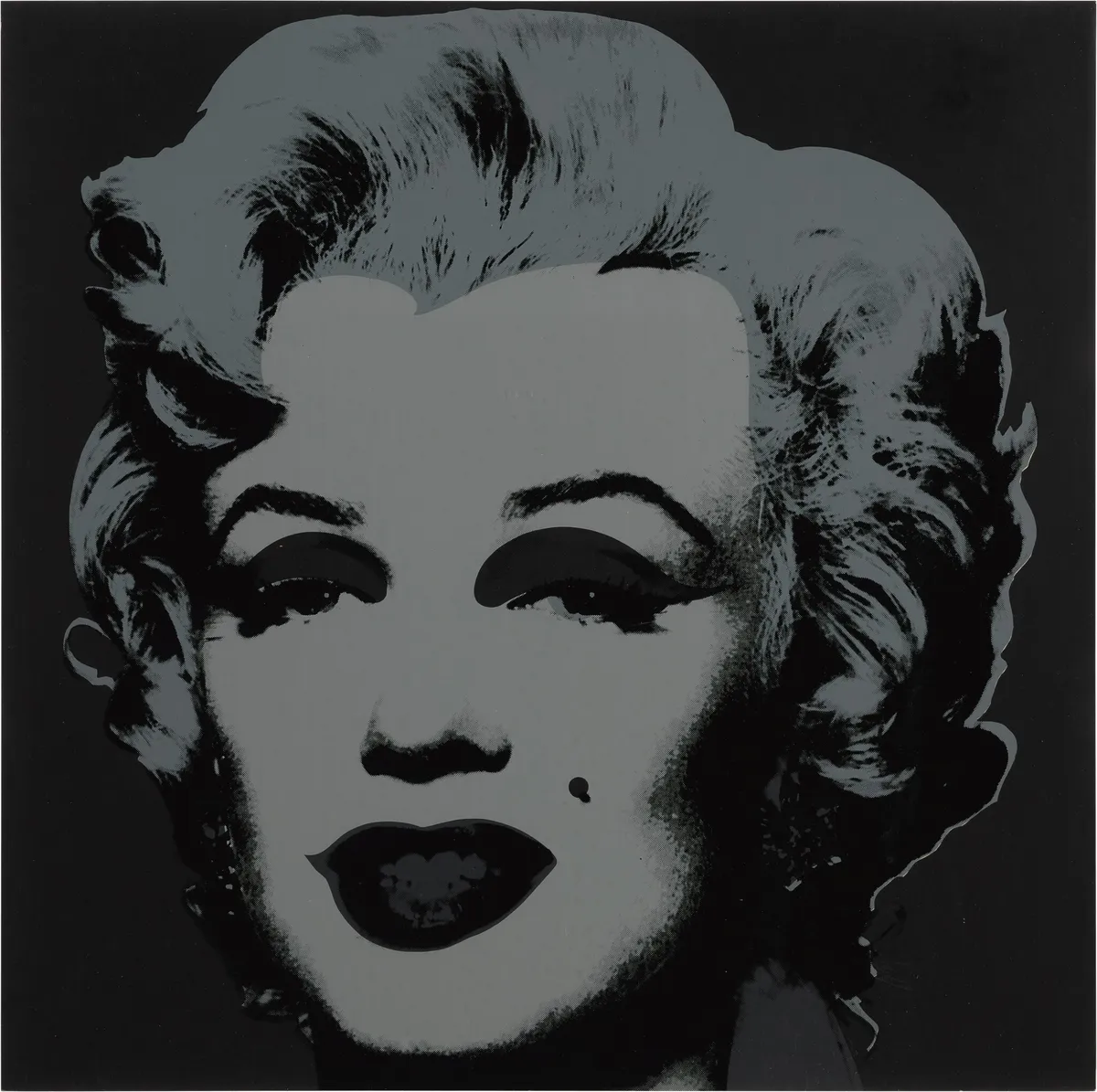
FS II.30 — Black background, silver hair, red lips
FS II.31 — Multicoloured background, the most compositionally complex variant
Among the most sought-after individual prints in the current market are FS II.22 (the turquoise/gold combination that reads as the "classic" Warhol Marilyn) and FS II.30 (the dramatically high-contrast black ground with silver hair and scarlet lips, which appears frequently in major gallery and museum presentations of the series). FS II.26 and FS II.29 tend to command slightly lower prices in recent years, though this reflects buyer preference and supply dynamics rather than any inherent quality hierarchy within the edition. All ten prints are equivalent in terms of edition size, paper, and production standards.
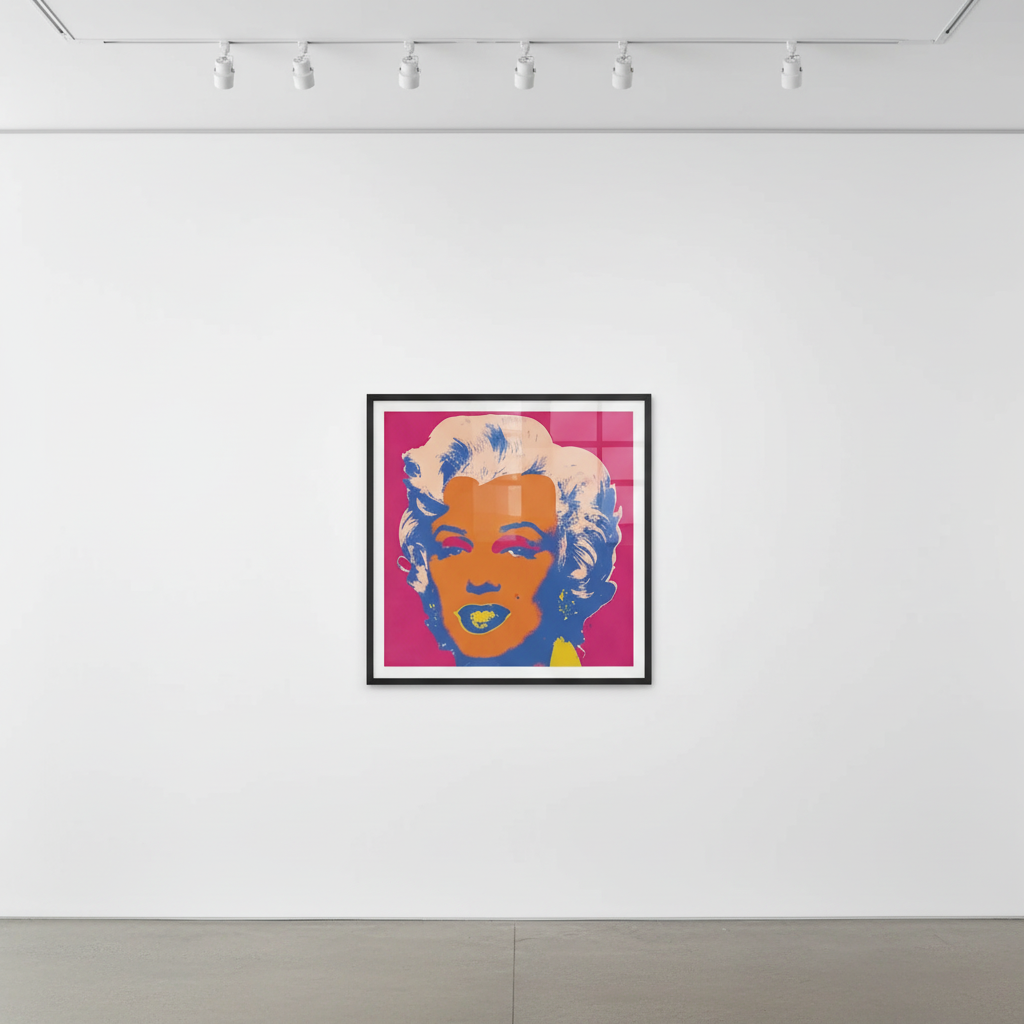
Andy Warhol, Marilyn Monroe F.S. II 22, 1967. Screenprint on Lenox Museum Board. Available at Guy Hepner, 529 West 20th Street, New York. Browse Andy Warhol Marilyn Prints →
Beyond the standard edition of 250 and the 26 artist's proofs, the Marilyn portfolio exists in a number of additional proof states that are periodically encountered in the market. Collectors should be aware of these categories and their implications:
Trial Colour Proofs (TPs): These are experimental prints made during the development of the edition, in which the printer and artist tested different colour combinations before settling on the final ten approved colourways. Trial proofs may show variant combinations not present in the finished edition. They are typically unique or in very small numbers and are not part of the numbered edition. Without a numbered designation, their authentication requires particularly thorough provenance documentation — the absence of an edition number is not inherently suspicious, but the chain of ownership must be traceable.
Printer's Proofs (PPs): A small number of proofs were set aside for the printer and for presentation to gallery collaborators. These are signed but annotated "PP" rather than numbered. They are rarer than standard edition prints and can command premiums, though this is not universal across the market.
Unauthorised and Forged Editions: It is an unfortunate reality that Warhol prints — including the Marilyn portfolio — have been extensively forged over the past four decades. The combination of high values, widely reproduced imagery, and the commercial familiarity of the works makes them targets. Key risks include: reprints from original or duplicate screens made without authorisation; digitally produced facsimiles printed on artificially aged paper; and genuine Warhol works from other projects fitted with fake signatures. Since the Authentication Board's closure in 2012, buyers should rely on major auction house specialist print departments (Christie's, Sotheby's, Phillips, Bonhams), established specialist dealers with long and verifiable track records, and exhaustive paper-trail provenance. Any work offered at a price significantly below market value warrants substantial additional scrutiny.
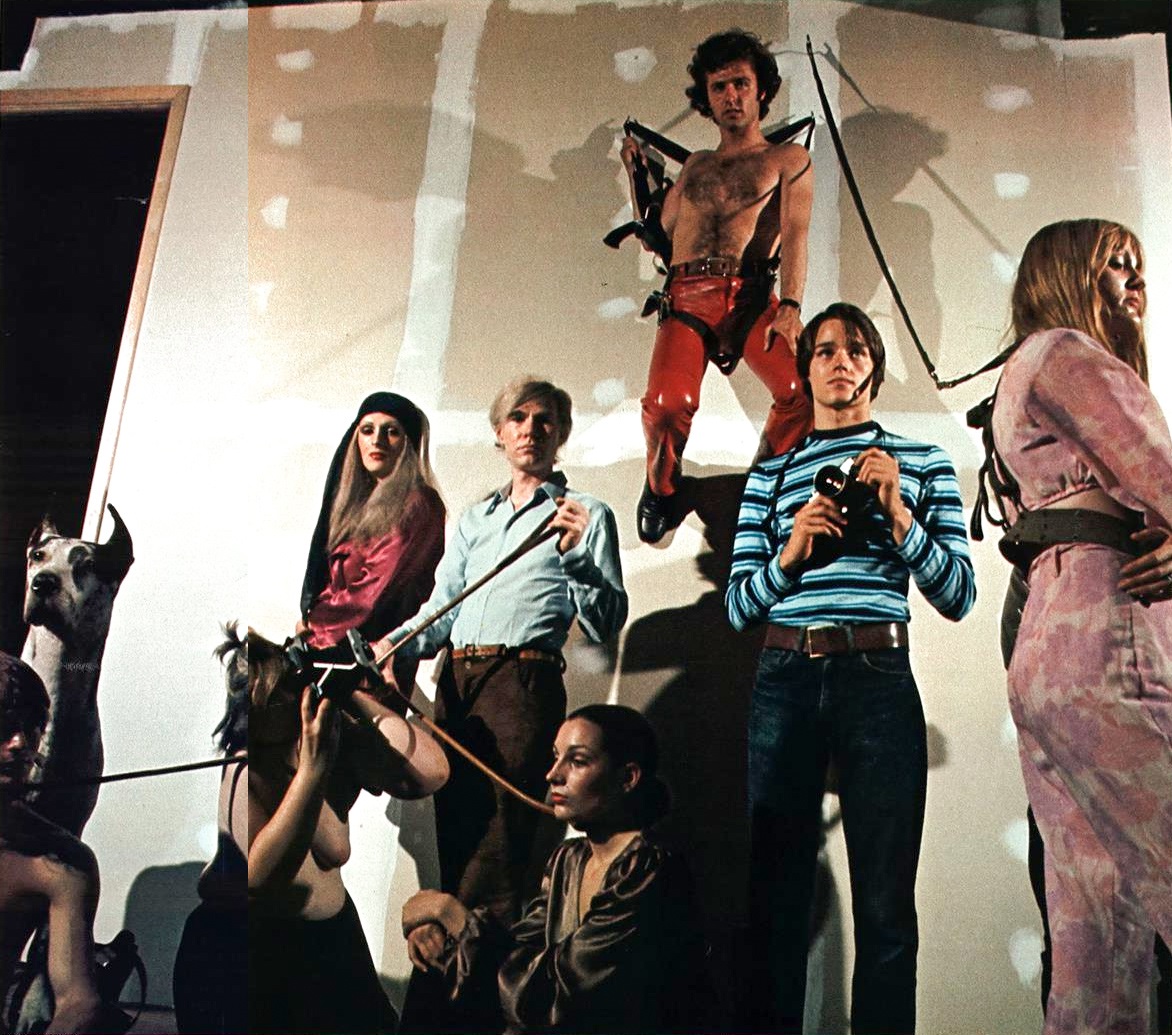
Andy Warhol and members of The Factory, photographed for Esquire magazine, December 1969. Public domain. The Factory — first on East 47th Street, then Union Square — was the production studio from which Warhol's most important print editions, including the 1967 Marilyn portfolio, were conceived and published.
The andy warhol marilyn series has been among the most consistently traded Warhol print editions in the secondary market for four decades. Individual prints from the FS II.22–31 portfolio have ranged widely in recent years, with condition, provenance, colourway, and broader market timing all functioning as variables. As a general benchmark: clean, well-provenanced individual Marilyn screenprints from the portfolio have sold at major auction houses in the range of $80,000 to $250,000 in recent years. Exceptional examples — particularly those with pristine condition, clean original collector provenance, and desirable colourways — are capable of exceeding the upper end of this range.
The ceiling for Warhol Marilyn values was dramatically reset in May 2022 when Christie's New York sold the 1964 painting Shot Sage Blue Marilyn for $195.04 million, making it the most expensive work by any twentieth-century American artist ever sold at public auction. While this is a unique painting rather than a print, its effect on the print market has been sustained: the sale brought renewed global collector attention to the Marilyn imagery across all formats and has supported elevated demand for the andy warhol marilyn screenprint editions in the years since.
Complete FS II.22–31 portfolios in original clamshell box packaging are substantially rarer on the market than individual prints. When intact portfolios do appear at auction, they have realised between $900,000 and $1.8 million at major houses in recent sales. The premium over the aggregate of ten individual prints reflects both their rarity as complete sets and the collector confidence that comes from unbroken, documented Factory provenance.
Compared to other major editions in the broader Andy Warhol catalogue — the Flowers (FS II.6–7), the Campbell's Soup Can screenprints, the 1981 Myths series (FS II.250–262), or the celebrated 1987 Moonwalk editions — the Marilyn portfolio occupies a market apex that no other Warhol print series consistently reaches. It was the first major series; it remains the most recognised; and it is the work most completely identified with Warhol's defining concerns: fame, mass culture, death, and the aesthetics of the machine-made image.
Dealer and auction specialist commentary consistently notes that demand for andy warhol marilyn prints for sale has proven remarkably resilient across economic cycles. During the 2008–2009 financial crisis, prices softened but did not collapse. Through the 2020 pandemic disruptions, private treaty transactions and online sales maintained consistent activity for the series. The combination of global recognisability, strong institutional endorsement, and proven secondary market liquidity makes the warhol marilyn original print portfolio among the most dependable stores of value in the entire contemporary print market.
The following checklist reflects the standard due diligence applied by experienced print collectors, specialist dealers, and auction house specialists when evaluating a potential acquisition of a Warhol Marilyn print:
Condition: Examine the sheet under raking light and UV illumination before purchase whenever possible. Issues to note include: foxing (brown spots caused by mould or acidic migration from improper matting), tide lines (pale rings indicating water exposure), tape repairs or residue on the verso, pin holes at corners from prior framing, and — most critically — any fading or discolouration of the ink layers or background colour. Lenox Museum Board is robust under archival conditions, but prolonged exposure to direct sunlight, high humidity, or acidic mats causes irreversible damage. Slight framing indentations in the margin are common in older works and generally acceptable; significant bleaching of a background colour is not.
Margins: Full margins are strongly preferred by the market. Trimmed margins reduce value, sometimes significantly. The standard sheet size of 36 × 36 inches should be verified; deviations suggest trimming has occurred.
Signature: Warhol signed in ballpoint pen on the verso, in a flowing, relatively consistent hand. The edition number (e.g., 124/250) appears near the signature. Both should be present on the verso. Be attentive to prints where the signature appears on the face of the image or has evidently been added at a later date — genuine period signatures absorb into the paper fibres; additions applied much later can often be identified by their surface quality under magnification.
Provenance: Ideally, ownership history should be traceable to a primary market source (Factory Additions, Leo Castelli Gallery, or documented early collectors) or to a major auction house sale with lot number and catalogue documentation. A clear, unbroken chain of ownership substantially reduces authentication risk. Works offered without any documentation warrant significantly heightened scrutiny.
Authentication Documentation: Works that passed through the Andy Warhol Art Authentication Board before its 2012 closure carry a stamp on the verso, which — combined with supporting documentation — represents the most robust form of third-party authentication currently available. For works acquired at auction, the catalogue entry and paid invoice serve as primary documents. Third-party certificates from unknown or unverifiable issuers have no substantive authentication value.
Where to Buy: The safest acquisition channels are the established major auction houses (Christie's, Sotheby's, Phillips, Bonhams Print departments), specialist print dealers with long and verifiable track records, and gallery sources with documented supply chains. Guy Hepner holds a carefully selected inventory of Andy Warhol Marilyn prints for sale and provides full provenance documentation with every work offered. Enquiries are welcome directly from our gallery at 529 West 20th Street, New York.
The andy warhol marilyn screenprint endures because it is not merely a collector's object — it is a mirror held up to the twentieth century's relationship with fame. Warhol produced these images sixty years ago and we remain unable to stop looking at them: a face reduced to coloured shapes, reproduced until the distinction between original and copy became meaningless, and in that meaninglessness, paradoxically, made permanent. For serious collectors of post-war and contemporary works on paper, the Marilyn portfolio represents not only a sound and historically proven investment but an encounter with one of the defining images in the history of art.
To buy Andy Warhol Marilyn prints or to enquire about available editions — including warhol marilyn original proofs, individual portfolio prints, and complete portfolio sets — contact Guy Hepner directly at 529 West 20th Street, New York, or browse the full Andy Warhol catalogue available through the gallery.
Explore Andy Warhol prints for sale at Guy Hepner: Marilyn, 25 Cats Named Sam, A Gold Book, A La Recherche Du Shoe Perdu, Alexander the Great.
Related Series