Moonwalk

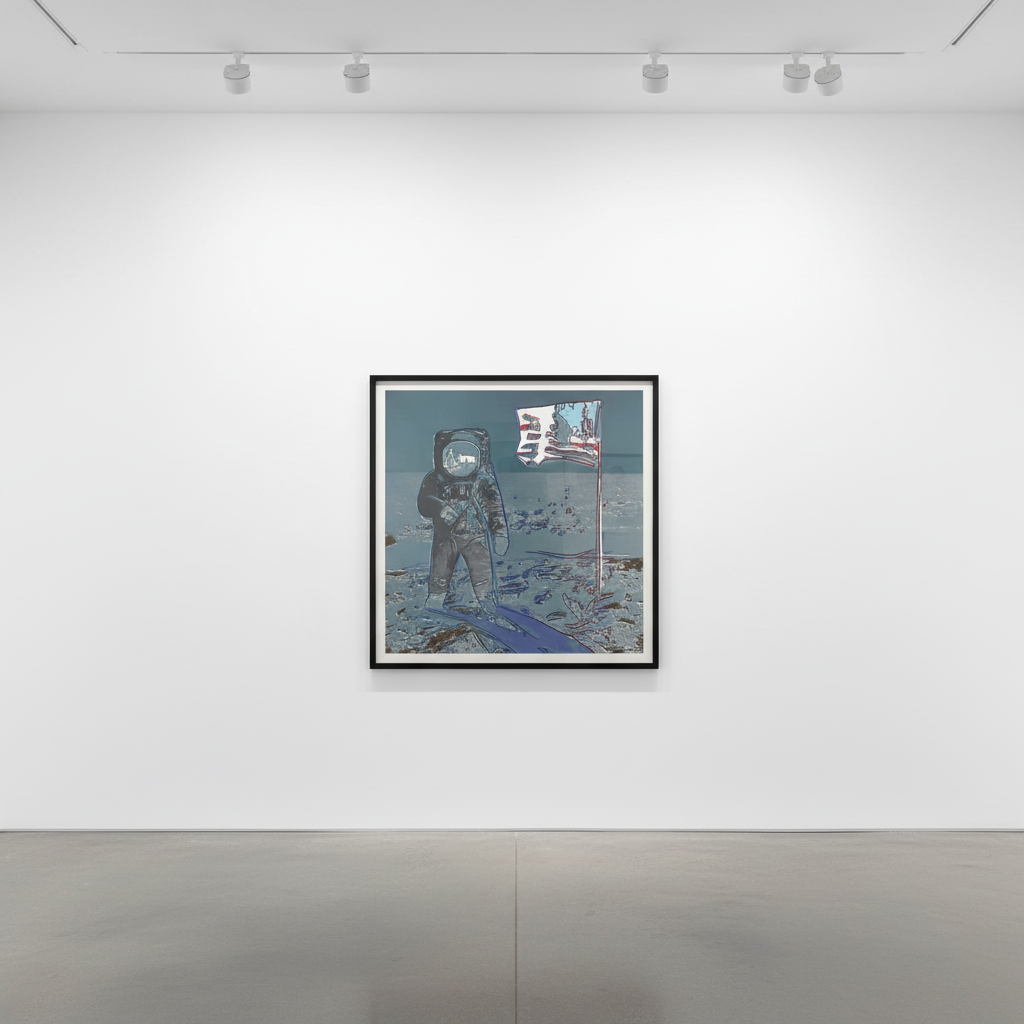
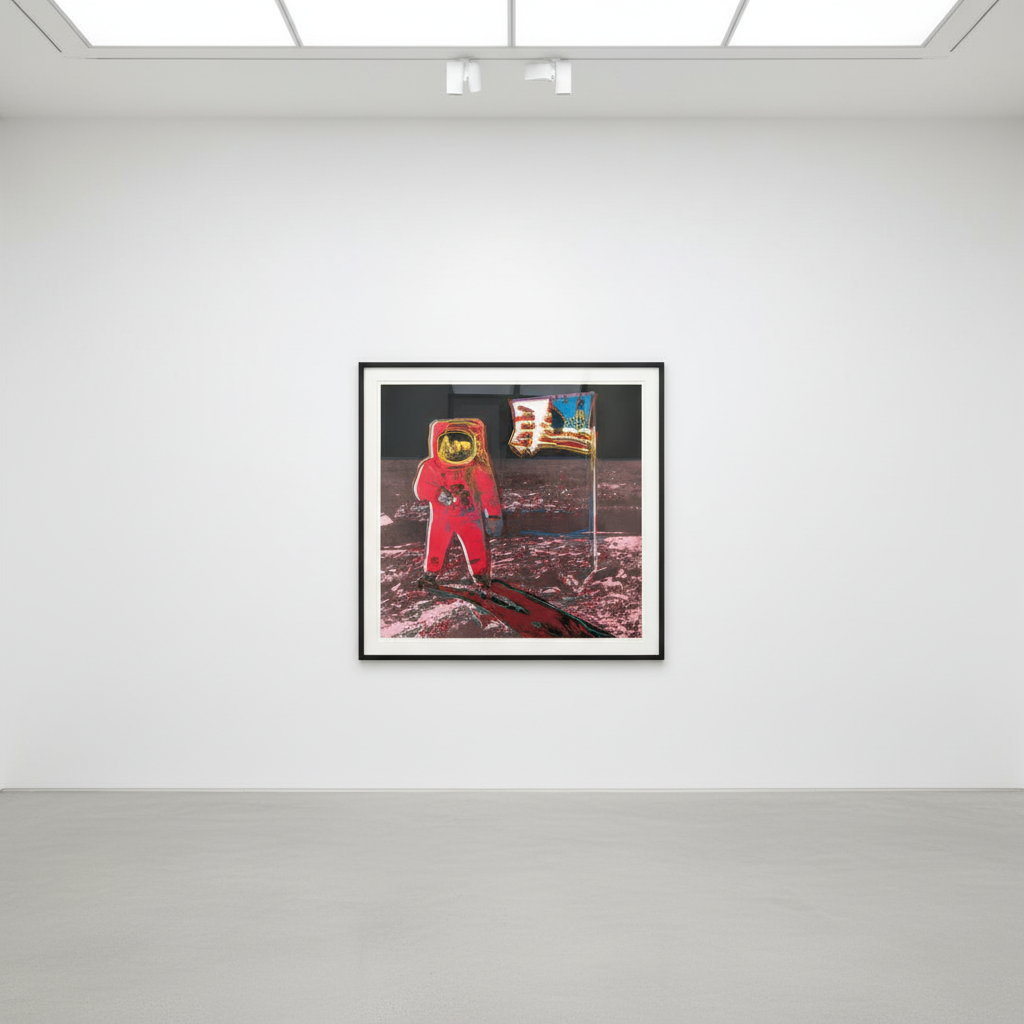
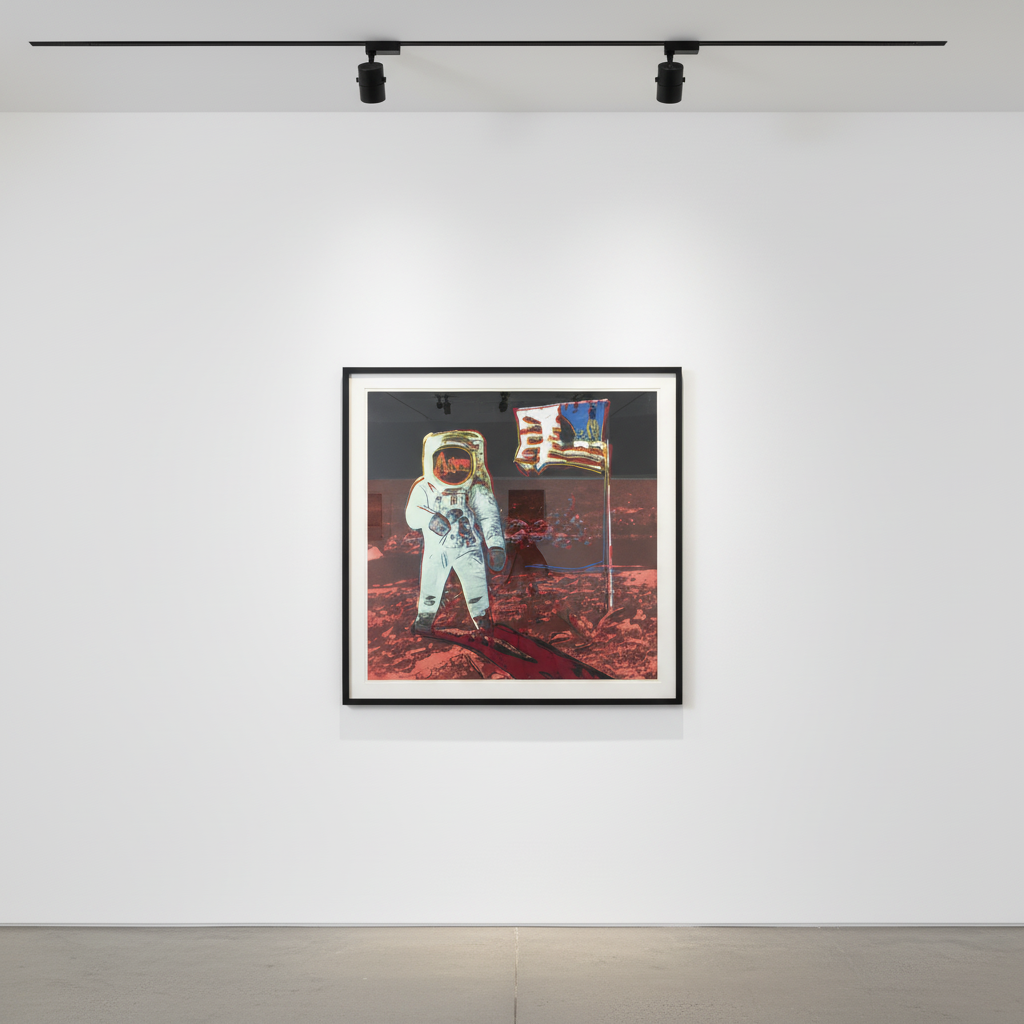
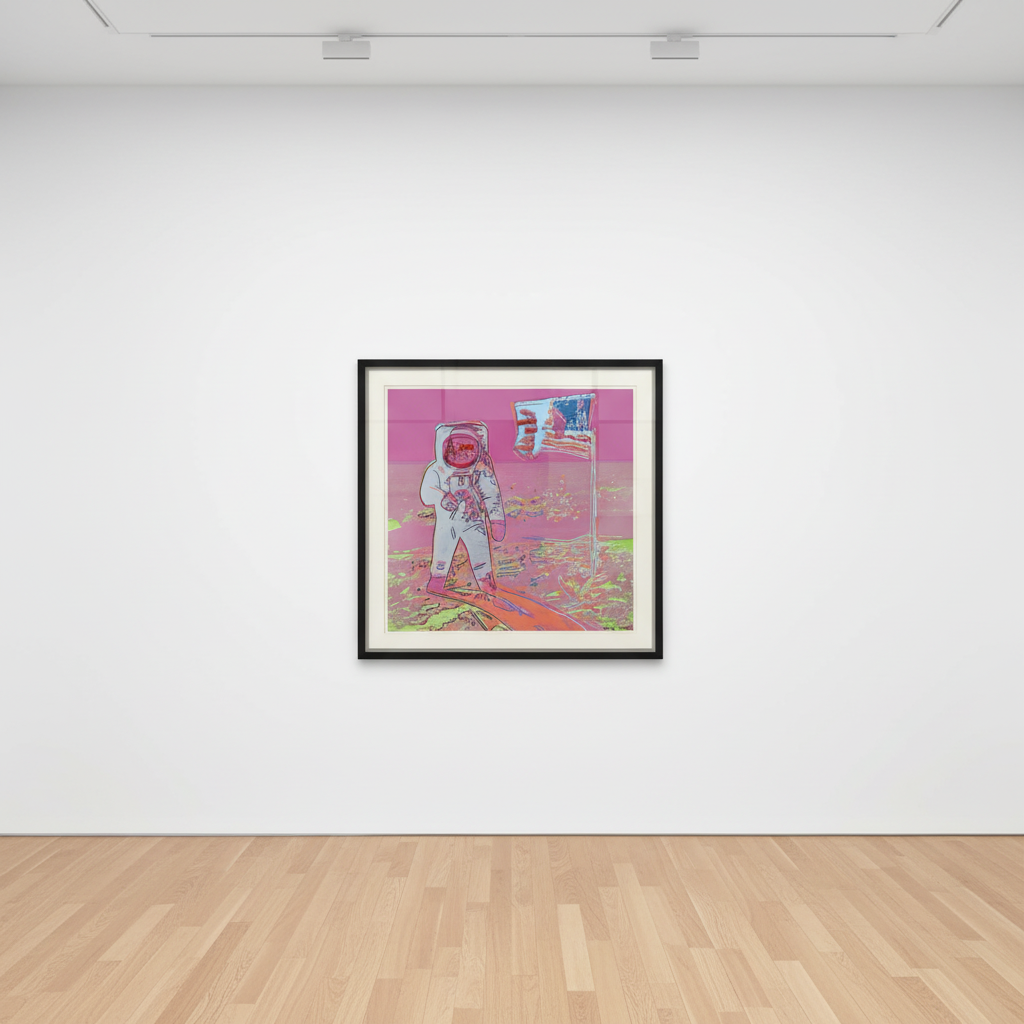
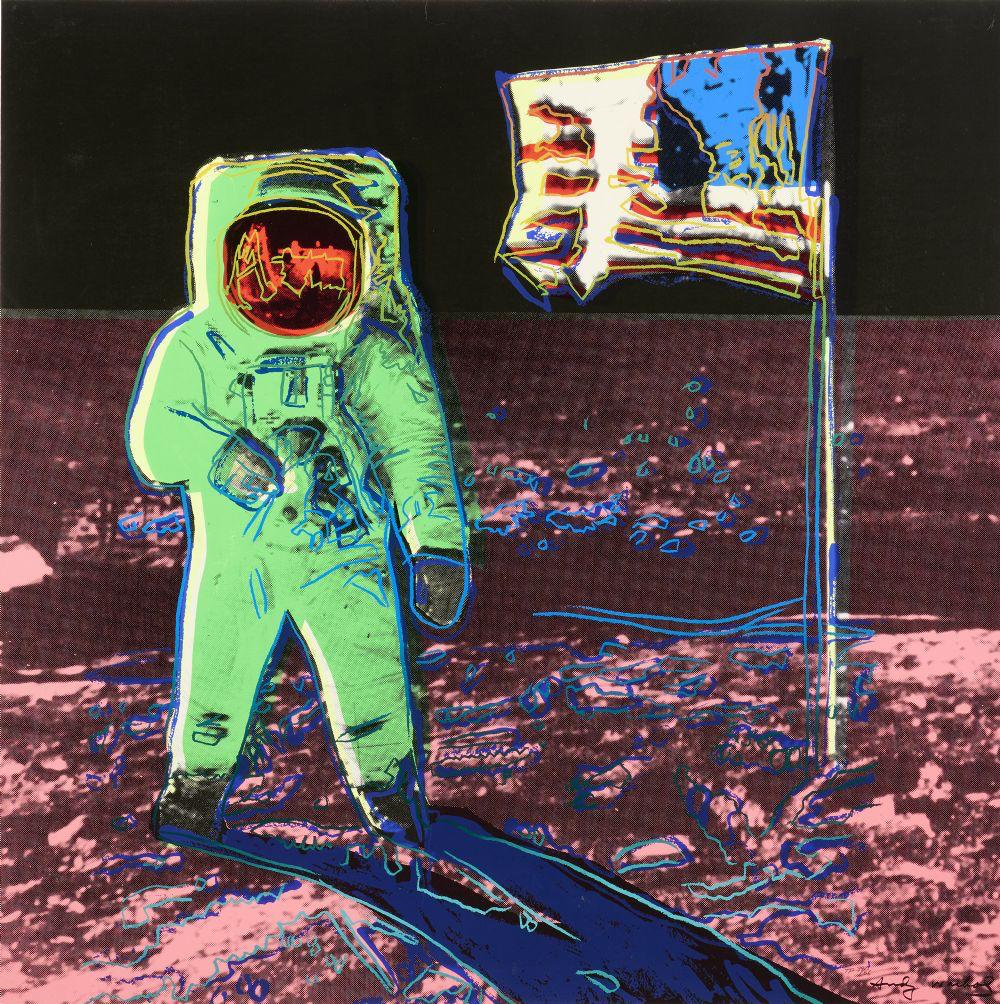
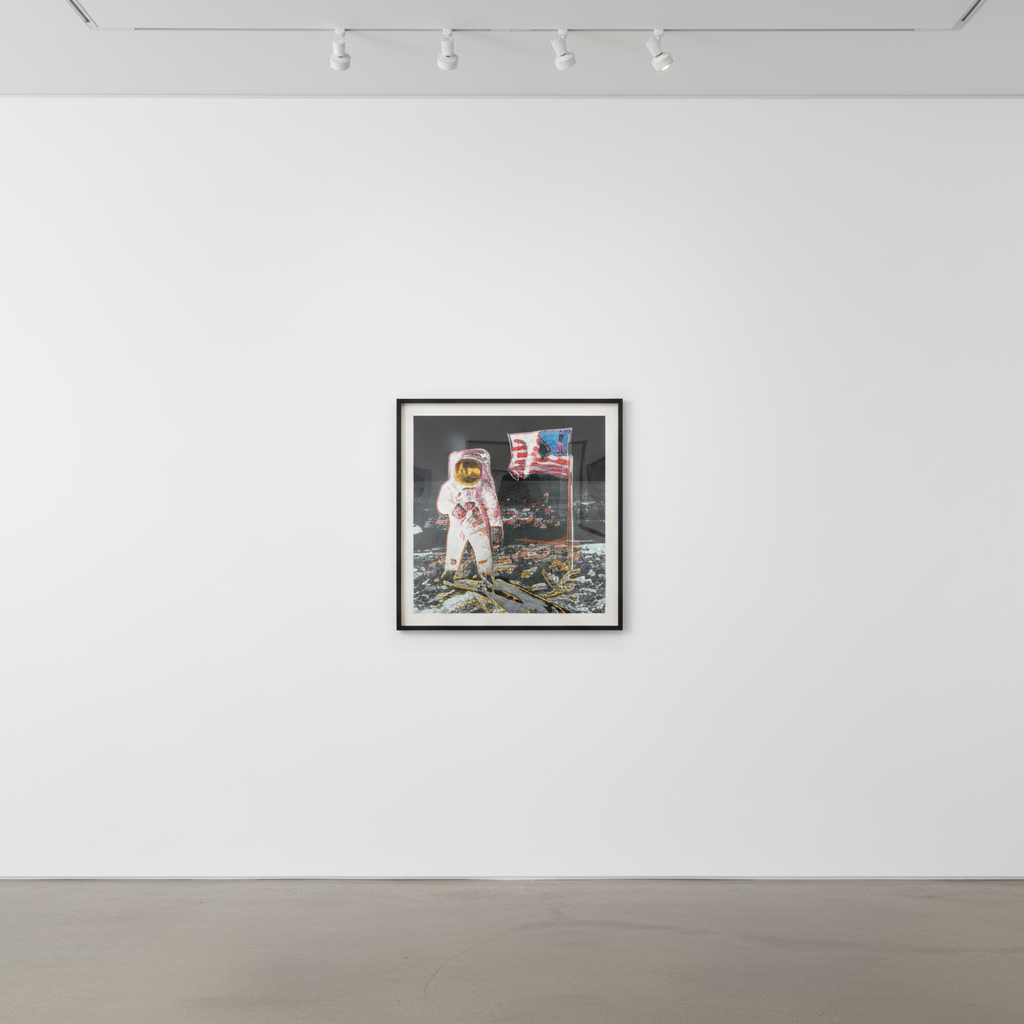
The Andy Warhol Moonwalk print occupies a position in his catalogue that no other work shares. Created in 1987 as part of a planned portfolio titled TV — intended to document defining moments from American television history — it was the only composition Warhol completed before his death on February 22, 1987. The TV portfolio never existed. What remained was a single pair of screenprints, in two colourways, depicting Buzz Aldrin's walk on the surface of the moon: the last finished work of one of the twentieth century's most productive artists.
That fact shapes everything about how this print trades. At Phillips New York in April 2024, a Moonwalk sold for $463,500 — 275% above the $120,000 low estimate, and the star lot of a sale that totalled $5.29 million across 305 works. This guide covers what the Moonwalk is, how it was made, what the editions consist of, and what collectors should understand before approaching the market.
Inquire About Available Andy Warhol Moonwalk Prints
Browse current Moonwalk editions and trial proofs available through Guy Hepner, 529 West 20th Street, New York.
On July 20, 1969, the Apollo 11 mission achieved the first crewed lunar landing. Buzz Aldrin descended from the lunar module and became the second human to walk on the surface of the moon. Neil Armstrong, who had landed first, photographed Aldrin during the extravehicular activity. One of those photographs — NASA designation AS11-40-5875 — shows Aldrin in full spacesuit, visor down, standing on the lunar surface with the American flag visible in the background.
The image Armstrong captured was not broadcast on live television. It was a still photograph, part of the documentation record of the mission. In the context of Warhol's TV portfolio — which was specifically concerned with American television history — this is an important distinction. Warhol chose an image that was culturally definitive but technically outside the scope of his stated subject. The moon landing was the event; the photograph was how most of the world eventually came to picture it.
Warhol combined two separate NASA photographs taken by Armstrong — one of Buzz Aldrin and one of the American flag — into a single composite composition. The resulting image is not a direct reproduction of a single frame but a constructed picture, consistent with Warhol's longstanding practice of working with found source material and reconstituting it into something new.
In 1969, the moon landing was the largest single shared television event in American history. An estimated 600 million people watched the broadcast. For an artist whose entire practice was oriented around the intersection of American mass culture, celebrity, and media spectacle, the moon landing was the obvious subject — the moment when a government programme became, through television, the most-watched performance in human history.
The TV portfolio was planned as a collection of screenprints depicting key moments in the history of American television. The proposed subjects included the first episode of I Love Lucy, Martin Luther King Jr.'s "I Have a Dream" speech, and the Beatles' first appearance on The Ed Sullivan Show on February 9, 1964. Each was a moment when television proved it could be the primary medium through which Americans experienced shared national events.
Warhol completed only the Moonwalk before his death on February 22, 1987, following complications from gallbladder surgery. He was 58 years old. The prints were produced at the studio of Rupert Jasen Smith in New York — Warhol's longtime print collaborator — and represent the last creative work Warhol brought to a finished state.
The incompleteness of the TV portfolio is not incidental to how the Moonwalk is valued. A completed portfolio from this period would have been an important late Warhol. An unfinished portfolio with a single surviving composition, from the final weeks of his life, is something considerably rarer: a terminated series with no parallel and no sequel.
Because Warhol died before the prints were signed by hand, all editions carry a printed (stamped) signature rather than a hand-signed one. This is a known and catalogued fact about the work — not a defect — and is reflected in the Feldman & Schellmann catalogue raisonné, which is the primary reference for Warhol print authentication.
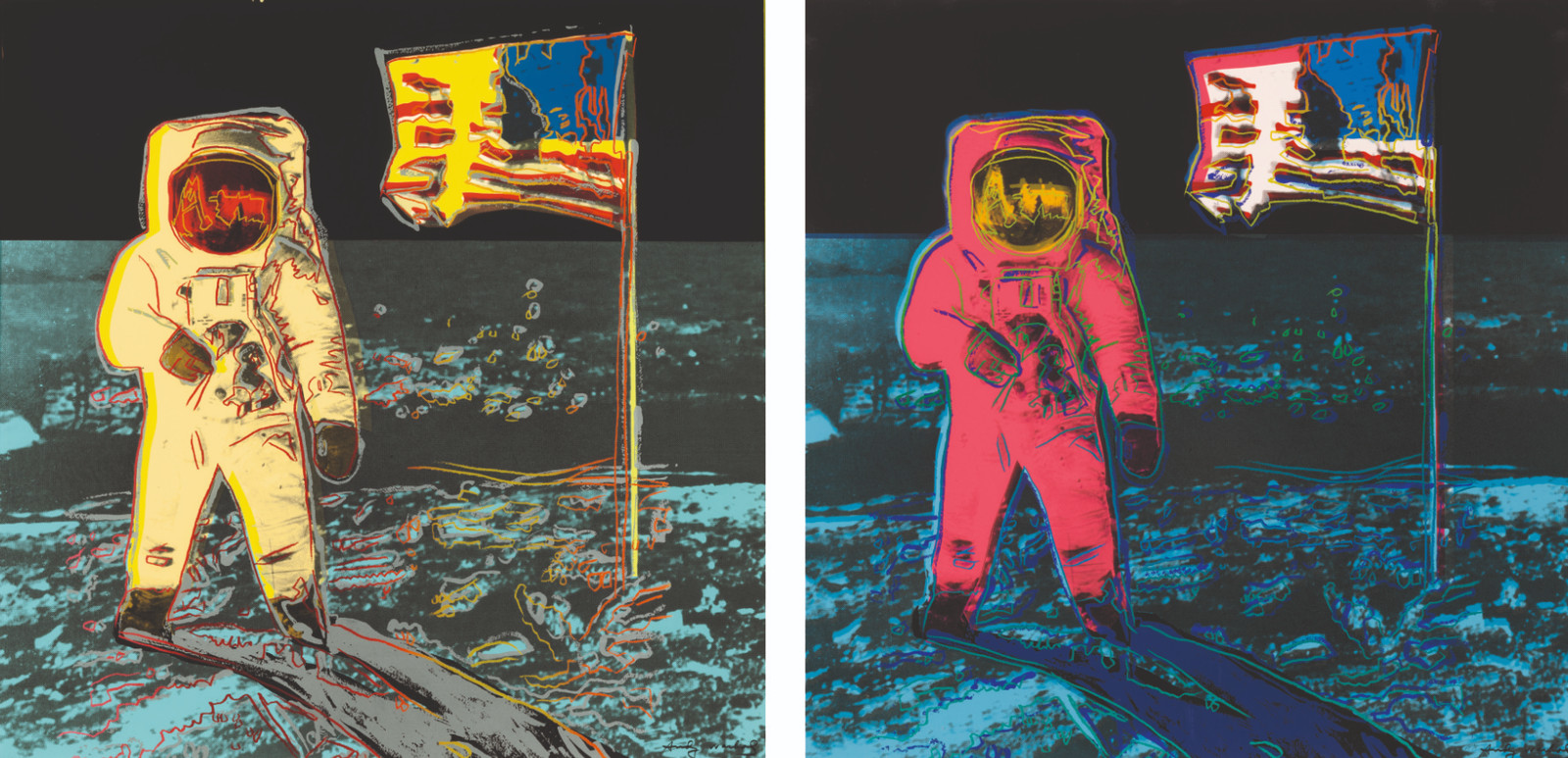
The Moonwalk was published as a portfolio of two screenprints, each produced on Lenox Museum Board. The two prints are differentiated by colourway, and each carries its own Feldman & Schellmann catalogue designation:
| FS II.404 | Radiant yellows and aquamarine colourway |
| FS II.405 | Vivid pinks and electric blues colourway |
| Sheet size (each) | 38 × 38 inches (96.5 × 96.5 cm) |
| Medium | Screenprint on Lenox Museum Board |
| Printer | Rupert Jasen Smith, New York |
| Year | 1987 |
| Edition | 160 prints |
| Artist's Proofs | 31 (designated AP) |
| Printer's Proofs | 5 (designated PP) |
| Exhibition Proofs | 5 (designated EP) |
| Trial Proofs | 66 individual proofs (each unique; designated IIB.404-405) |
| Signature | Printed (stamped) — Warhol died before hand-signing |
The complete portfolio consists of both FS II.404 and FS II.405 together. They were published as a pair and are catalogued as a single portfolio, though individual prints from the edition have been separated and sold individually at auction.
The prints were exhibited by Govinda Gallery, whose owner and director Chris Murray presented Buzz Aldrin himself with a copy of the Moonwalk screenprint — one of the more straightforwardly documented instances of an artwork being presented to its subject.
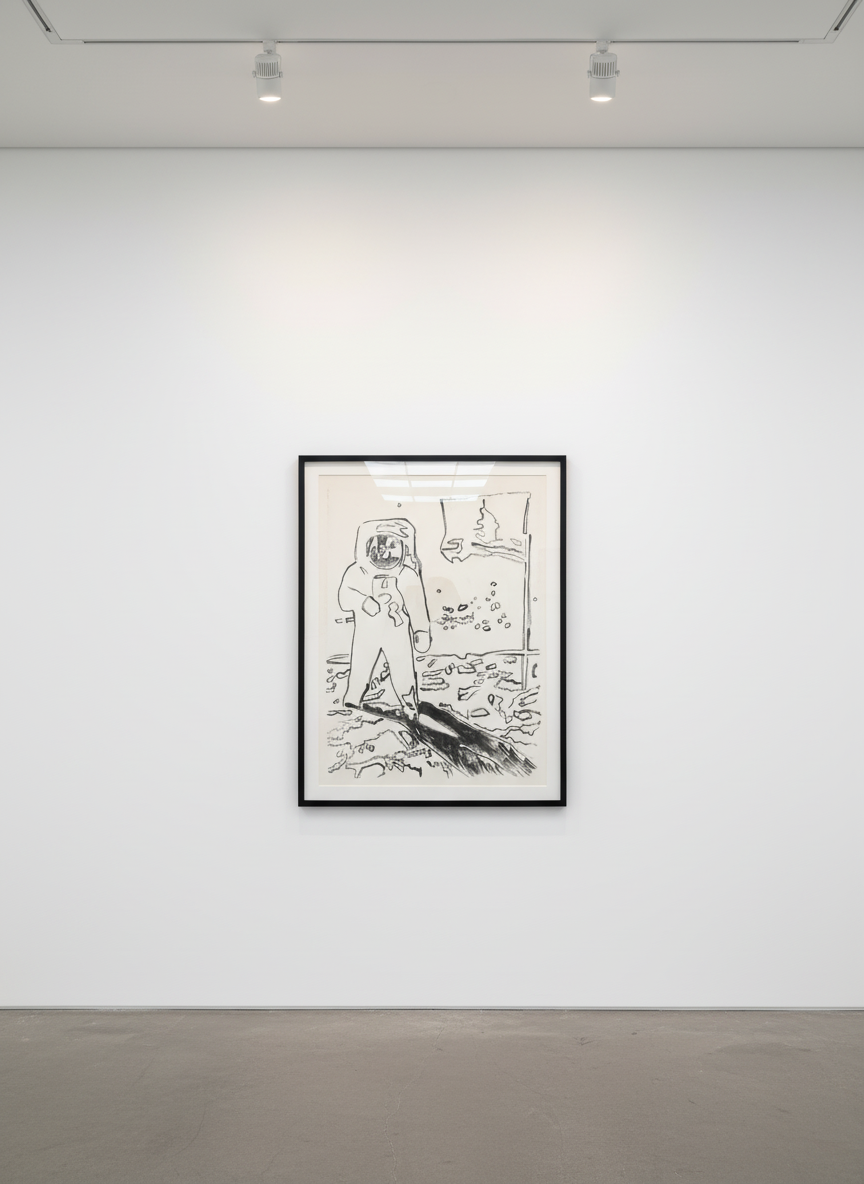
The 66 trial proofs are catalogued separately in the Feldman & Schellmann reference as IIB.404-405. Each trial proof is unique — produced during the printing process as Warhol and Rupert Jasen Smith worked through colour combinations and compositional decisions. No two trial proofs are identical. They are individual works, not variants of a standardised edition.
This uniqueness is the defining characteristic of the trial proof market. A collector acquiring a trial proof is acquiring a one-of-a-kind object: same source image, same format, but a specific colour configuration that exists in exactly one example. For collectors who want proximity to Warhol's process — the working decisions behind the final edition — trial proofs offer something the standard edition cannot.
The trade-off is liquidity. The main edition (FS II.404 / FS II.405) has a deeper auction history and a more established price range. Trial proofs trade less frequently, and their pricing is more dependent on the specific colour configuration and condition of the individual example.
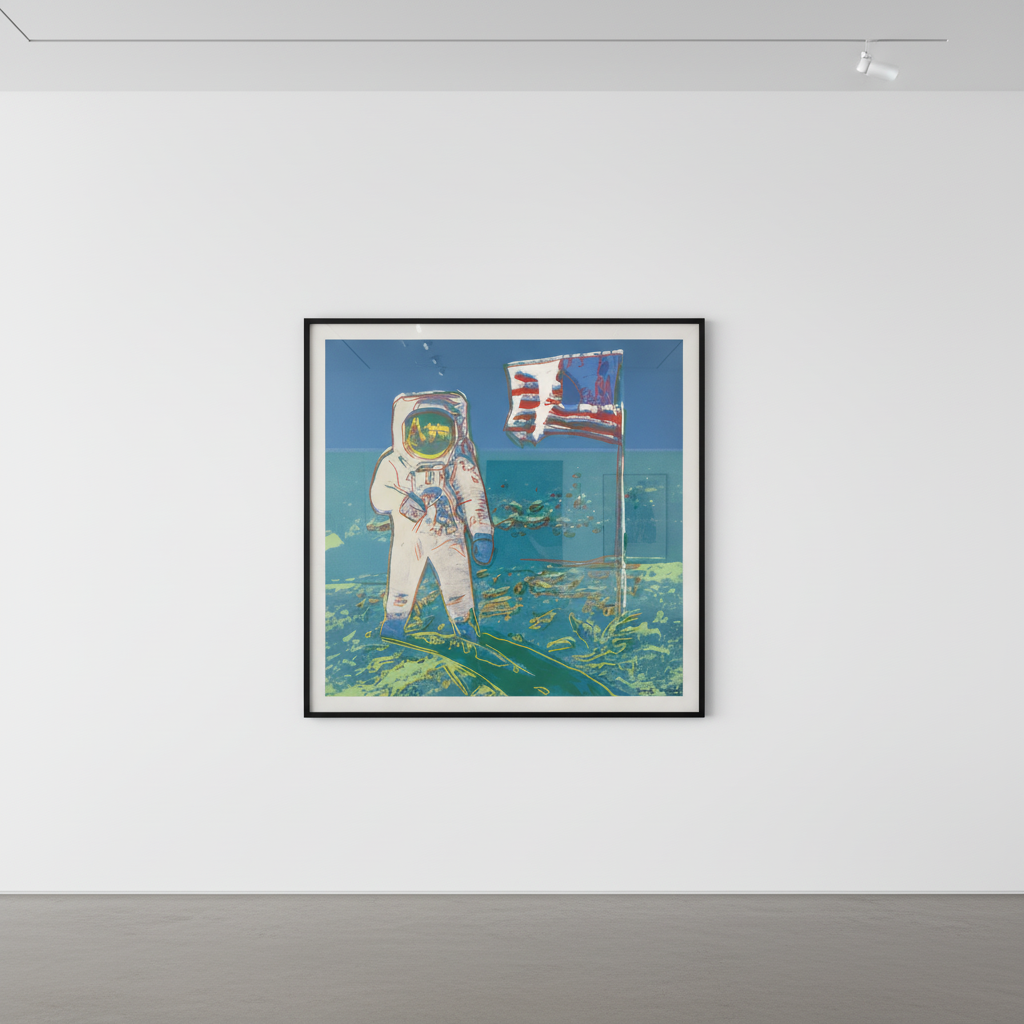
The source for the Moonwalk composition is NASA photograph AS11-40-5875, taken by Neil Armstrong during the Apollo 11 extravehicular activity on July 20, 1969. Armstrong photographed Aldrin, and in doing so produced an image of himself — reflected in Aldrin's visor. Aldrin's visor acts as a mirror, and Armstrong's figure is visible in its surface.
Warhol's version of this goes one step further. In the screenprinted composition, Warhol's own initials — "AW" — are visible in the reflections on Buzz Aldrin's visor. The initials are subtle, but they are there: a deliberate act of self-insertion into the imagery of the moon landing, analogous, as has been noted, to the placement of the American flag on the surface of the moon itself.
This is consistent with Warhol's broader practice of signature as a conceptual act. His works frequently embed authorial identity in unexpected places, and the Moonwalk's visor reflection is among the most elegant examples of this — a private mark in a public image, visible only to those who look closely enough.
Warhol combined two separate Armstrong photographs — one of Aldrin and one of the American flag — into the final composition. The resulting image is a construction, not a reproduction, which places it squarely in his long tradition of working with found material to produce something that is neither documentary nor purely invented.
The Moonwalk has a relatively concentrated auction history given the size of the edition, which tends to concentrate price discovery in a smaller number of high-profile sales.
| Sale | House / Location | Date | Result | Notes |
|---|---|---|---|---|
| Moonwalk (individual print) | Phillips, New York | April 16–17, 2024 | $463,500 | 275% above $120,000 low estimate; star lot of the sale ($5.29M total, 305 works) |
| Complete portfolio (FS II.404 + FS II.405) | Christie's | October 2022 | £388,829 | Record price for complete portfolio |
| Moonwalk (individual print) | Clars Auction Gallery | September 17, 2021 | $350,000 | Pre-sale estimate $100,000–$200,000 |
| Printer's Proof PP 3/5 | Sotheby's Prints & Multiples Evening Sale, New York | April 29, 2019 | Estimate: $150,000–$250,000 | Printer's Proof designation |
| FS II.405 (individual, signed print) | Five-year range | 2020–2024 | £119,048 – £293,510 | Low: March 2020; High: April 2024 |
| Peak hammer price (series) | — | — | £462,832 | Highest recorded hammer across all Moonwalk sales |
The Phillips April 2024 result — $463,500 at 275% above estimate — reflects both the strength of the Warhol market in that period and the particular status of the Moonwalk within his late catalogue. The Clars result in September 2021 ($350,000, again substantially above estimate) confirms that the pattern of exceeding pre-sale estimates is consistent rather than anomalous.
The Christie's October 2022 result for the complete portfolio (£388,829) is significant because it represents what the two prints together achieve when sold as published — a useful reference point for collectors considering either individual prints or the complete set.
The Andy Warhol Authentication Board (AWAB) closed in 2012 and no longer operates. There is no equivalent body that currently issues authentication stamps for Warhol works.
For the Moonwalk, authentication now relies on three factors:
Note on the printed signature: Because Warhol died on February 22, 1987, before the Moonwalk prints were hand-signed, all editions carry a stamped (printed) signature rather than an autograph. This is documented in the Feldman & Schellmann catalogue and is a known characteristic of this work — not a defect or an indication of inauthenticity. Collectors should be aware of this from the outset.
The Moonwalk is the last completed portfolio Warhol produced. This is not a secondary characteristic — it is the primary reason the work commands prices at the upper end of his print market. The TV portfolio was never finished. The Moonwalk is the only evidence of what it would have been. That circumstance is irreversible and unrepeatable.
With 160 main edition prints (in two colourways), 31 Artist's Proofs, 5 Printer's Proofs, 5 Exhibition Proofs, and 66 unique trial proofs, the total number of Moonwalk works is relatively small for a major Warhol print. The complete portfolio (both colourways together) has a more restricted supply than either individual print, which is reflected in the Christie's October 2022 record.
The moon landing is among the most culturally significant events of the twentieth century. Warhol's decision to use it as his final subject — within a portfolio about defining American television moments — gives the Moonwalk a subject that is legible and resonant across collector demographics. The work does not require specialist knowledge of Warhol's practice to communicate its weight.
The embedded initials in Aldrin's visor add a dimension that separates the Moonwalk from straightforward appropriation. This is Warhol marking the image as his own — and, by extension, marking himself as present at the most-watched event in television history. Collectors and scholars have noted this element; its presence is confirmed and documented.
Each of the 66 trial proofs is a unique object. For collectors interested in Warhol's working process, or in acquiring a genuinely one-of-a-kind work within a documented print context, the trial proofs offer a category that the main edition cannot replicate. Their relative illiquidity is real, but so is their singularity.
Works with clean, well-documented provenance chains — particularly those traceable to original sale at major auction houses or through established galleries — carry a meaningful premium over examples with gaps or uncertainty in their ownership history. Given the closure of the AWAB, strong provenance is now more important than ever for Warhol print acquisitions.
The Moonwalk is not an entry-level Warhol acquisition. Current auction results place individual prints in the range of £119,048–£293,510 for FS II.405 over five years, with the Phillips April 2024 result reaching $463,500. These are prices for serious, committed collectors — or institutions — rather than for those building their first Warhol holdings.
Main edition prints (FS II.404 / FS II.405): The two colourways offer different aesthetic registers — yellows and aquamarine versus pinks and electric blues — and have historically traded at broadly similar price levels. Collectors who prefer a specific palette should specify accordingly; there is no consistent market premium for one colourway over the other based on available data.
Complete portfolio: The Christie's October 2022 record of £388,829 for the complete portfolio (both prints together) represents the ceiling for a paired acquisition. Collectors interested in the Moonwalk as Warhol intended it — a two-print portfolio — should consider this format. The premium over individual prints is justified by rarity and the work's completeness as published.
Trial proofs: For collectors already holding main edition prints, or those who want a unique rather than an editioned work, the trial proofs are the appropriate next step. Each is different; selecting on the basis of specific colour configuration and condition is essential. Because they trade infrequently, price discovery is less established, which can work in a buyer's favour when examples come to market through non-specialist channels.
Printer's Proofs and Artist's Proofs: These carry additional designation value and have historically attracted premium estimates (the Sotheby's April 2019 PP 3/5 carried an estimate of $150,000–$250,000). Supply is more restricted than the main edition: 5 Printer's Proofs and 31 Artist's Proofs versus 160 main edition prints.
What to avoid: Works without documented provenance or catalogue raisonné references; prints offered at prices substantially below established auction ranges without clear explanation; and any seller who cannot produce verifiable ownership history. Given the closure of the AWAB, the market has no functioning authentication backstop, making due diligence on provenance and documentation non-negotiable.
The Moonwalk is a pair of screenprints created by Andy Warhol in 1987, depicting Buzz Aldrin walking on the surface of the moon during the Apollo 11 mission. It was the only composition Warhol completed from a planned portfolio titled TV, which was intended to document defining moments in American television history. Warhol died on February 22, 1987, before the other compositions in the series were produced. The two prints are catalogued in the Feldman & Schellmann catalogue raisonné as FS II.404 (yellow/aquamarine) and FS II.405 (pink/electric blue).
The highest confirmed sale is $463,500 at Phillips New York in April 2024 — 275% above the $120,000 low estimate, and the star lot of the entire sale. At Christie's in October 2022, the complete portfolio (both colourways) sold for £388,829, a record for the complete work. At Clars Auction Gallery in September 2021, an individual print sold for $350,000, far exceeding a $100,000–$200,000 pre-sale estimate. The peak hammer price recorded across the series is £462,832.
Andy Warhol died on February 22, 1987, before the Moonwalk prints were hand-signed. As a result, all editions — including the main edition, Artist's Proofs, Printer's Proofs, and Exhibition Proofs — carry a printed (stamped) signature rather than an autograph. This is fully documented in the Feldman & Schellmann catalogue raisonné and is a known characteristic of the work, not a defect. Collectors should be aware of this before purchase.
The 66 trial proofs (catalogued as IIB.404-405 in Feldman & Schellmann) are unique screenprints produced during the printing process as Warhol and printer Rupert Jasen Smith worked through colour configurations. No two trial proofs are identical. Each is a one-of-a-kind work: same source image and format as the main edition, but a specific colour combination that exists in a single example. Trial proofs are catalogued separately from the main edition and trade infrequently.
The Andy Warhol Authentication Board (AWAB) closed in 2012 and no longer operates. Authentication for the Moonwalk currently relies on: (1) inclusion in the Feldman & Schellmann catalogue raisonné (FS II.404 or FS II.405 for main edition; IIB.404-405 for trial proofs); (2) documented, unbroken provenance; and (3) original sale receipts and auction catalogue records. There is no functioning alternative authentication body. Due diligence on provenance and documentation is essential for any Moonwalk acquisition.
In Warhol's screenprinted composition, his initials "AW" are visible in the reflections on Buzz Aldrin's visor. This is a deliberate act of self-insertion into the imagery — Warhol placing himself within the most-watched event in television history. The source photograph, NASA AS11-40-5875, was taken by Neil Armstrong and shows Armstrong's own reflection in Aldrin's visor; Warhol's version adds his own initials to that reflection, a subtle but documented authorial mark.
Inquire About Available Andy Warhol Moonwalk Prints
Browse current Moonwalk editions and trial proofs available through Guy Hepner, 529 West 20th Street, New York.
Guy Hepner | 529 West 20th Street, New York
--- **Browse Andy Warhol prints** at Guy Hepner: [Andy Warhol art for sale](/andy-warhol) | [Sell your Warhol](/sell/andy-warhol)Explore Andy Warhol prints for sale at Guy Hepner: Moonwalk, 25 Cats Named Sam, A Gold Book, A La Recherche Du Shoe Perdu, Alexander the Great.
Related Series