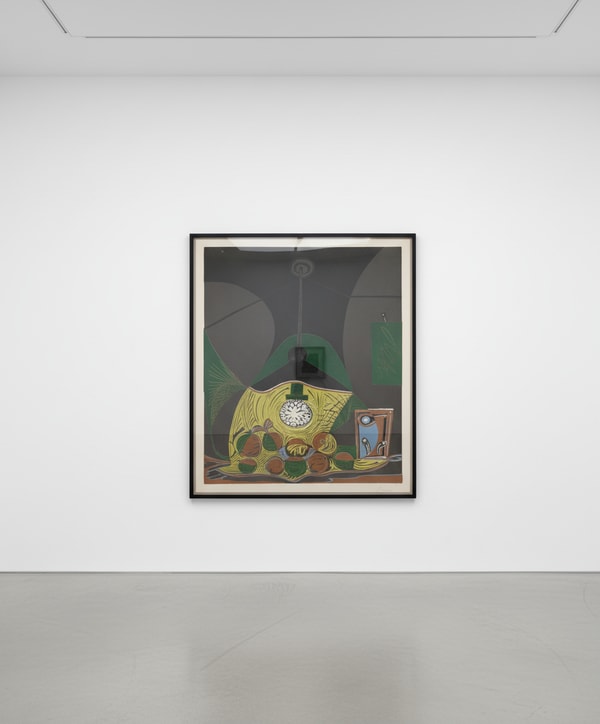

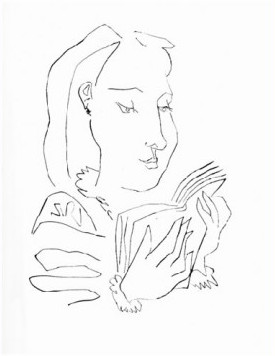
Aquatint
13 works

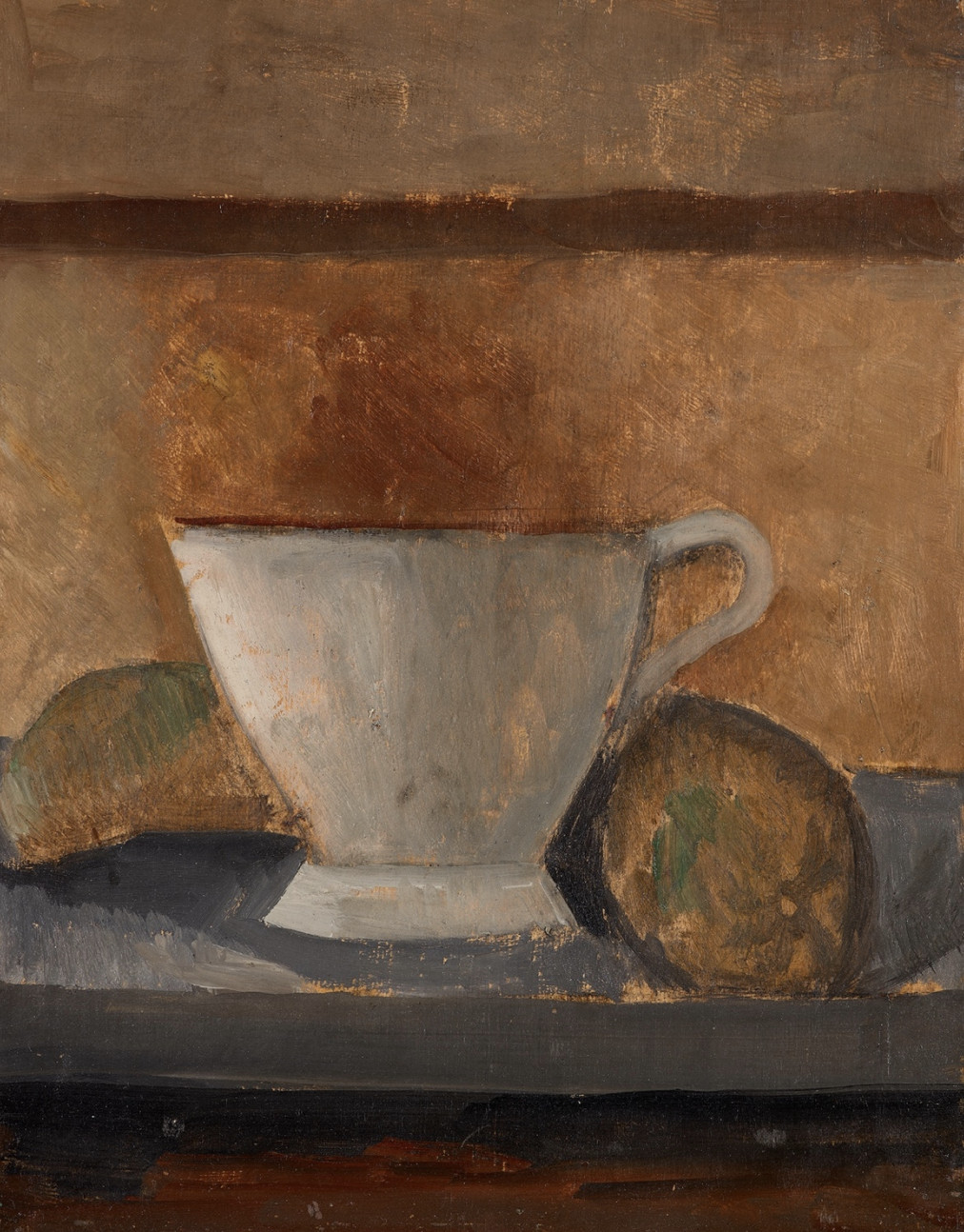
Tasse et bananes, 1908
Oil on panel Signed on the reverse, Picasso
10 5/8 x 8 3/8 in 27 x 21.3 cm
Tasse et Bananes (Cup and Bananas) is a deceptively simple still life by Pablo Picasso, created in 1908 at a key transitional moment in his artistic development. Painted in oil on panel, the work bridges his Post-Impressionist explorations and the radical innovations of early Cubism. Though modest in scale and subject—depicting a cup flanked by two pieces of fruit—the painting is rich in tonal depth, spatial ambiguity, and formal experimentation, revealing Picasso’s deep engagement with the legacy of Cézanne and his growing interest in abstraction.At first glance, Tasse et Bananes is restrained in palette and composition. A subdued range of ochres, browns, greys, and muted greens define the picture’s atmosphere. The scene is composed of a single white cup, rendered with subtle modulation of light and shadow, resting on a flat surface with two rounded, organic forms that appear to be bananas or perhaps unripe fruit. Behind the central forms, the backdrop is made up of broad, gestural strokes, abstracting the space into overlapping planes of warm brown.The brushwork is visible and deliberate. The objects are outlined with soft, earthy transitions, lacking the clean contours of earlier academic still life. The cup’s form is geometric yet softened, sitting slightly off-center, which subtly disrupts the traditional compositional symmetry of still life painting. The fruit—partially obscured—blends into the surrounding space, emphasizing volume through tonal contrast rather than linear perspective.There’s a quiet tension between solidity and dissolution. The cup and fruit do not sit comfortably on a table as in traditional still life; instead, they float within a shallow, indeterminate space. This ambiguity is key to understanding Picasso’s experimentation with pictorial depth and perspective at the time.1908 was a critical year in Picasso’s development. It marks the threshold between the structured, volumetric works inspired by Paul Cézanne and the analytical rigor of early Cubism, which Picasso would begin to fully develop in the years that followed. Tasse et Bananes reflects this intermediary stage, where objects are still recognizable, yet abstracted through form, colour, and space.The influence of Cézanne is palpable—not only in the subject matter of fruit and domestic objects, but in the way Picasso dismantles traditional perspective and flattens space into intersecting planes. The emphasis on volume and geometry, especially in the cup’s base and the play of horizontal bands in the background, anticipates the fractured logic of Cubism. While the painting does not exhibit the full deconstruction of form that would define Les Demoiselles d’Avignon (1907) or Houses on the Hill, Horta de Ebro (1909), it clearly reveals Picasso’s growing fascination with structure over illusion.Moreover, the limited palette and earthy tones foreshadow the ochres and muted greys of the early Cubist palette, which would dominate his work from 1909 to 1912.Tasse et Bananes is more than a simple still life—it is a meditative exercise in form, weight, and space. In this work, Picasso strips away decorative excess to focus on the underlying structure of things. It reflects his move away from representation toward abstraction, not through radical rupture, but through quiet, persistent experimentation. The painting stands as an important marker on the path to Cubism and a testament to Picasso’s genius in rethinking even the humblest of subjects—a cup and fruit—as the building blocks of modern visual language.For more information, contact our galleries via the inquiry form below.
Guide Price: $177,800 – $177,800
See full auction history, price trends, and comparable sales for this work.
View Market Report →Pablo Picasso's paintings stand at the summit of the modern art market and among the most influential achievements in the history of Western art. Across a career spanning more than seven decades, Picasso moved restlessly between distinct stylistic periods, each representing a decisive break from what came before rather than a gradual evolution.
His Blue Period (1901–1904) was defined by a somber, largely monochromatic blue and blue-green palette, developed while Picasso moved between Barcelona and Paris and produced work reflecting poverty, isolation, and melancholy. The Rose Period that followed (1904–1906) introduced warmer pink and orange tones alongside circus performers, harlequins, and acrobats, coinciding with the artist's relationship with his first major romantic muse, Fernande Olivier.
Picasso's most consequential contribution arrived with Cubism, developed jointly with Georges Braque in Paris between 1907 and 1914. Beginning with Les Demoiselles d'Avignon (1907), Picasso and Braque dismantled single-point perspective, fracturing form into geometric planes viewed from multiple angles simultaneously — a visual language that would go on to influence nearly every subsequent movement in modern art. Picasso later moved through a Neoclassical period in the 1920s before returning to more expressive, emotionally direct painting in his final decades, exemplified by the anti-war masterpiece Guernica (1937).
Works spanning these periods remain cornerstones of the world's great museum collections — from the Museum of Modern Art to the Museo Reina Sofía — valued equally for their art-historical importance and their enduring market strength. Each painting attributed to Picasso at Guy Hepner is presented with full provenance and authentication, reflecting the rigorous standards required for a body of work this closely studied and widely collected.
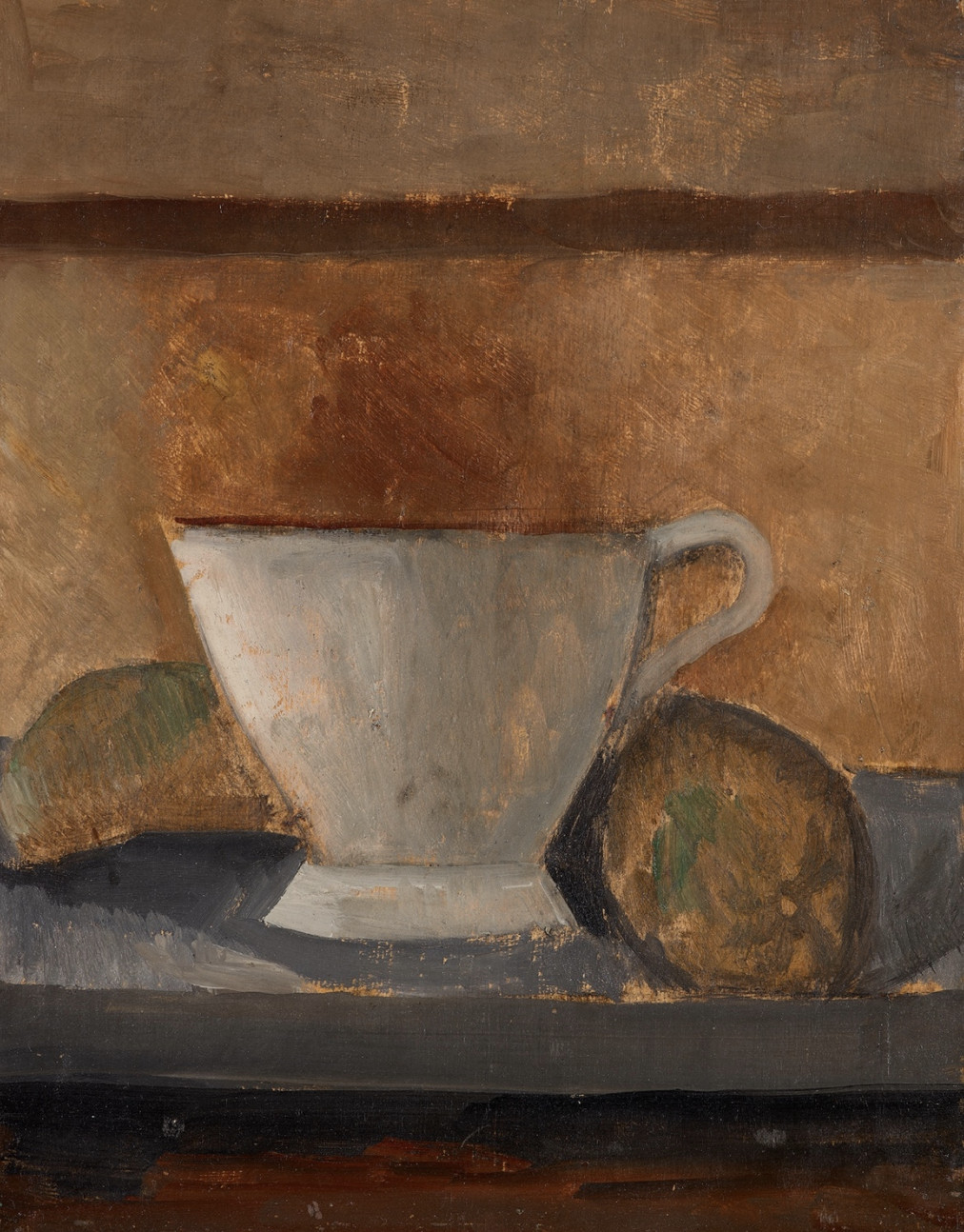
Pablo Picasso (1881–1973, born Málaga, Spain) is the most productive and formally transformative artist in the history of Western art — a figure whose influence on twentieth-century painting, sculpture, printmaking, and ceramics is so pervasive that it remains, more than fifty years after his death, genuinely difficult to assess. Born in Málaga to an art teacher father who recognised and encouraged his prodigious talent, Picasso studied in Barcelona and Madrid before arriving in Paris in the early years of the twentieth century, where the encounter with Cézanne, African art, and his own restless intelligence produced Cubism — perhaps the most radical rupture in the history of representation since the Renaissance.
Pablo Picasso prints for sale at Guy Hepner represent one of the most significant collecting opportunities in the modern art market. Our gallery offers original Picasso lithographs, linocuts, etchings, and aquatints — each accompanied by full provenance documentation and catalogue raisonné references. Whether you are seeking a signed Mourlot lithograph, a Vollard Suite etching, a Vallauris linocut, or a late aquatint, Guy Hepner has the expertise and inventory to assist collectors at every level.
Picasso's print output is among the richest and most varied in art history, spanning etchings, lithographs, linocuts, and aquatints produced across seven decades. Understanding the categories is essential to collecting intelligently.
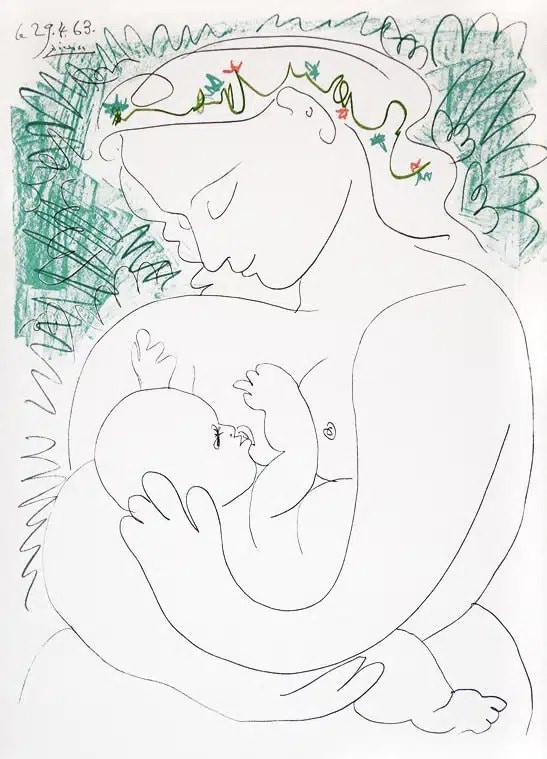
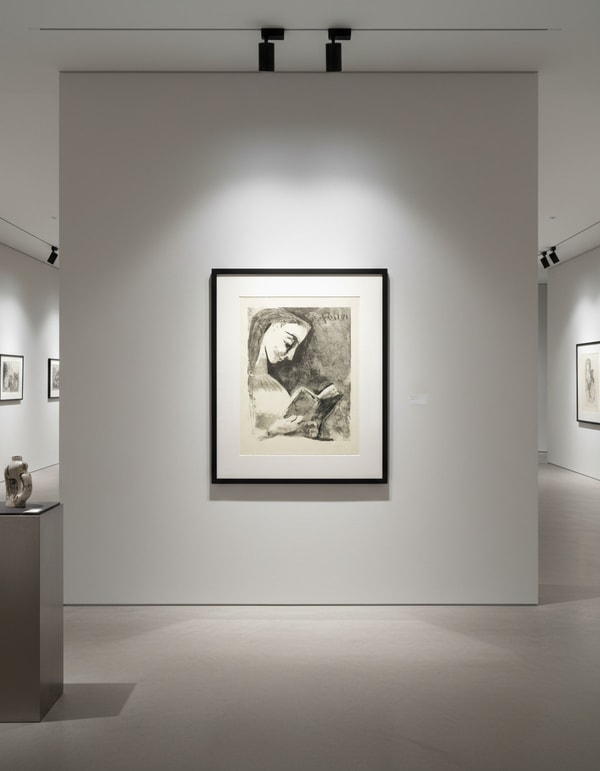
Lithographs were produced primarily through Fernand Mourlot's atelier in Paris, where Picasso worked from 1945 onwards. Mourlot documented over 400 lithographs bearing Picasso's hand, ranging from abstract heads and Cubist still lifes to the monumental Toros y Toreros bull-fighting series. Editions typically run from 50 to 275 copies. Unsigned Mourlot lithographs trade between $3,000 and $40,000; signed examples command $15,000 to $150,000 or more depending on subject and condition.
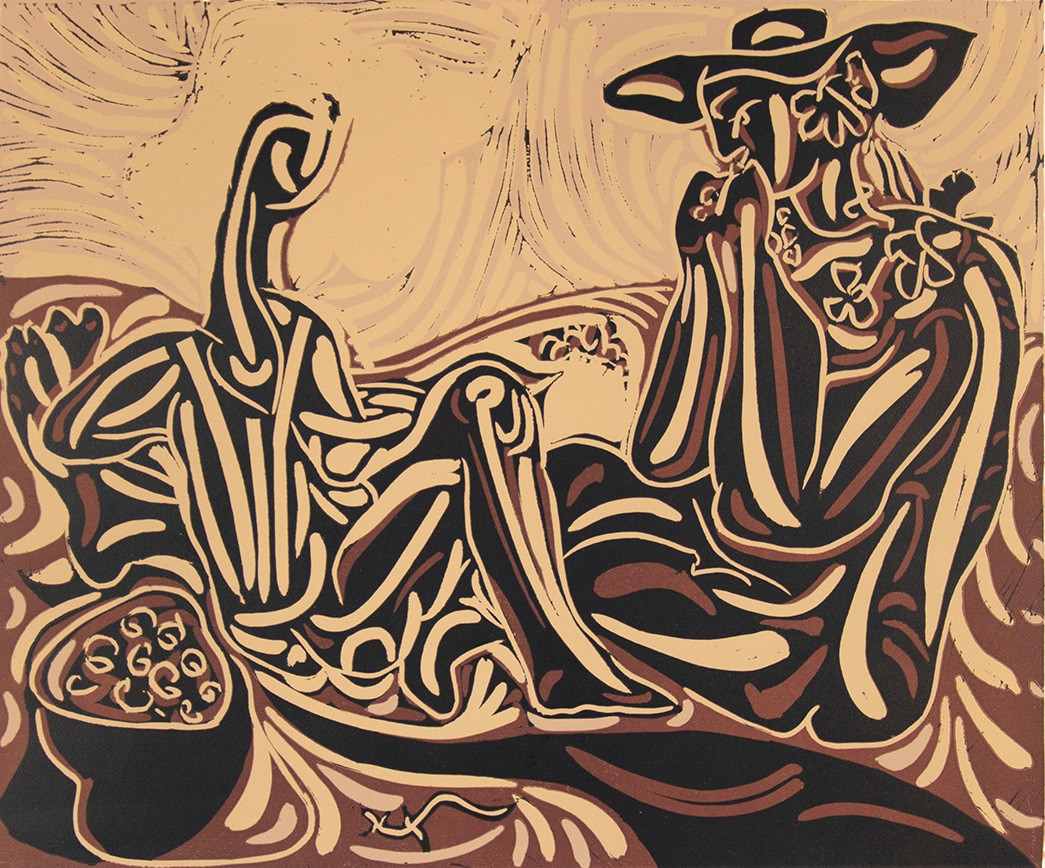
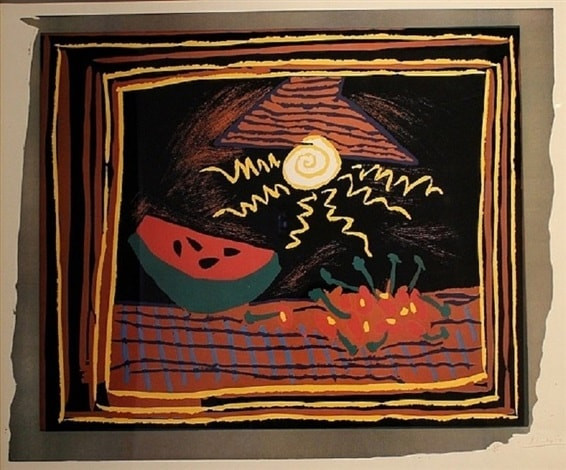
Linocuts, produced primarily at Vallauris between 1958 and 1963 using Picasso's own colour-reduction technique, are among the most technically revolutionary of all his prints. By cutting progressively deeper into a single block, Picasso achieved complex colour sequences impossible by conventional means. Edition sizes are small — typically 50 copies — and signed linocuts frequently exceed $80,000 at auction.
Etchings span Picasso's entire career, from his earliest Parisian years through to the late suites of the 1960s and early 1970s. The medium suited his restless line perfectly, and his etched output includes some of the finest prints of the twentieth century. Edition sizes vary widely, from the 50 impressions of the Vollard Suite to smaller later editions. Prices range from $5,000 for minor early works to well over $500,000 for Vollard Suite masterpieces.
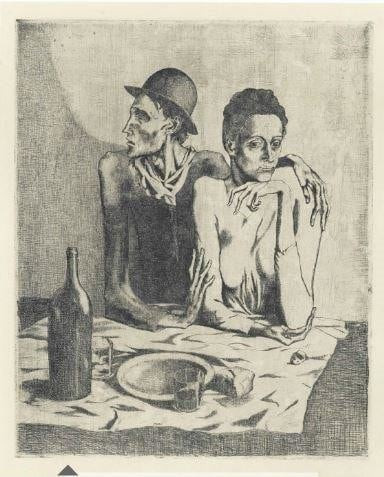
Aquatints combine etching's linear precision with tonal washes of extraordinary subtlety. Picasso's aquatint work, often produced in collaboration with master printer Roger Lacourière, includes some of his most formally sophisticated printed images. These prints are rarer than his lithographs and command significant premiums accordingly.
Authentication for all Picasso prints relies on the Bloch catalogue raisonné — the definitive scholarly record of his print output — supplemented by Mourlot's lithograph catalogue where applicable.
Picasso's paintings represent the summit of the twentieth-century market. Understanding his periods is essential for collectors.
The Blue Period (1901–1904) produced austere, emotionally charged paintings on themes of poverty, isolation, and melancholy — elongated figures rendered in blue-grey tones that echo El Greco and carry an extraordinary psychological weight. Works from this period are among the most sought-after in the history of art.
The Rose Period (1904–1906) brought warmer hues and more tender subjects — circus performers, saltimbanques, and acrobats rendered with a new formal assurance. The transitional works that followed, leading to Les Demoiselles d'Avignon (1907), represent the hinge on which the entire history of modern painting pivots.
The Cubist period (1907–1921), co-developed with Georges Braque, produced the most intellectually radical body of painting in the twentieth century. Analytic Cubism (1909–1912) fragmented forms into near-monochromatic facets; Synthetic Cubism (from 1912) introduced collage, typography, and bolder colour. Major Cubist paintings are virtually never available on the primary market; they appear at auction rarely and achieve extraordinary prices.
Picasso's auction record stands at $179,365,000 — achieved at Christie's New York in May 2015 for Les Femmes d'Alger (Version O), a 1955 work from his series responding to Delacroix. Nude, Green Leaves and Bust (1932) reached $106,482,500 at Christie's in May 2010. These are benchmark figures for a career that produced well over 16,000 works catalogued by Zervos.
The most desirable areas of the Picasso print market for serious collectors are well-defined.
The Vollard Suite (1930–1937): ninety-seven etchings (and three aquatints with Roger Lacourière) commissioned by dealer Ambroise Vollard. The suite is considered Picasso's greatest print achievement — 100 plates encompassing the Sculptor's Studio sequence, the Minotaur series, and intimate portraits of Marie-Thérèse Walter. Published posthumously by Vollard's estate, the complete suite is extraordinarily rare. Individual plates now trade from $80,000 to over $500,000.
Suite 347 (1968): three hundred and forty-seven etchings completed in seven months when Picasso was eighty-six years old — an astonishing demonstration of creative energy in extreme old age. Themes include Degas's brothel scenes, Spanish picadors, Rembrandt, and Ingres. Published by Galerie Louise Leiris. These prints represent exceptional value relative to their historical importance.
Mourlot lithographs: Fernando Mourlot's catalogue documents Picasso's lithographic output with scholarly precision. The Bloch numbers (B.1 through B.2042 for the complete print oeuvre) and Mourlot numbers together form the authentication framework used by every major auction house.
Crommelynck etchings: Piero and Aldo Crommelynck's Paris workshop produced Picasso's late etchings with extraordinary technical refinement. The 347 Suite plates were printed here, as were the 156 Series etchings (1970–1972) — Picasso's final major print campaign.
Condition criteria for print collecting: look for clean, wide margins with no trimming; avoid foxing (rust-coloured spots from paper acidity) or tide lines; fading affects lithographs most severely — examine under strong light. Impressions on Japan paper or with remarques command significant premiums.
Authentication for Picasso works operates through established institutional channels.
For prints: the Bloch catalogue raisonné (Picasso: His Graphic Work, Volumes I–IV) provides reference numbers for all known prints. Mourlot's catalogue covers lithographs specifically. The Succession Picasso estate stamp appears on many posthumously published editions. Any print without clear catalogue raisonné reference and provenance chain should be examined by a specialist before purchase.
For paintings and works on paper: the Comité Picasso (now dissolved) was the primary authentication body; the Succession Picasso now handles estate matters. The Zervos catalogue raisonné (33 volumes) is the authoritative scholarly record for paintings, drawings, and sculpture. Expert authentication by a recognised Picasso specialist is essential for any major purchase.
Guy Hepner Gallery, 177 Tenth Avenue, New York, offers full provenance verification and catalogue raisonné consultation for all Picasso works. We provide free, confidential valuations for collectors looking to sell, and access to a global network of qualified buyers. Our expertise spans ceramics, prints, linocuts, drawings, and paintings across all periods of the artist's work.