Paintings

September 15, 2026

When Novak Djokovic lifted his twenty-fourth Grand Slam trophy, millions watched a moment of athletic transcendence—but for Barcelona-based Sol Felpeto artist and painter, such moments demand more than spectatorship. They demand transformation into something you can hang on your wall and live with, argue about over dinner, and eventually pass down to someone who will understand why it mattered. Felpeto's explosive mixed-media canvases capture these cultural touchstones with the graphic punch of a comic book cover and the layered intelligence of fine art collage, creating works that function simultaneously as celebration, documentation, and visual essay on why we care so deeply about heroes—whether they swing tennis rackets or wield Captain America's shield.
The contemporary art market has witnessed a fascinating convergence in recent years: sports memorabilia has become fine art adjacent, superhero imagery has entered blue-chip auction catalogues, and collectors who once kept these enthusiasms separate now seek artists who can unite them with sophistication. Sol Felpeto paintings occupy precisely this intersection, offering collectors an opportunity to engage with their passions through work that refuses to apologise for its subjects while insisting on artistic rigour. Her pieces are not fan art elevated—they are genuinely ambitious paintings that happen to understand that Federer's backhand and Spider-Man's web-slinging occupy similar positions in our collective imagination: they are the gestures we wish we could make, frozen in moments of impossible grace.
The path to becoming an artist rarely follows a straight line, but Sol Felpeto's journey contains particularly revealing detours. Born in Venezuela in 1990, she spent her formative years moving between Buenos Aires and Madrid, absorbing the visual languages of multiple cultures before settling permanently in Spain at twenty-one. Before that decisive move, she had enrolled in veterinary medicine in Argentina—a choice that might seem disconnected from her current practice until you understand how central animals, particularly cats, would become to her artistic vocabulary. Those years studying biology and animal behaviour planted seeds that would later bloom in unexpected directions, informing the way she observes and depicts both creatures and humans with an almost clinical precision beneath the explosive colour.
Her formal artistic education came at the European Institute of Design (IED) in Madrid, where she studied Fashion and Creative Direction over four intensive years. This training explains much about her work's distinctive character: the graphic clarity, the understanding of how colour communicates emotionally, the instinct for composition that grabs attention and holds it. Fashion education, at its best, teaches artists to think about visual impact in commercial terms without sacrificing integrity—a balance that serves collectors well, since it means acquiring work that functions powerfully in domestic spaces rather than requiring institutional white walls to make sense. Felpeto graduated in June 2016 and immediately exhibited with other emerging artists, beginning the professional practice she has maintained ever since.
What distinguishes Sol Felpeto contemporary art from the broader field of pop-influenced painting is her willingness to embrace what she calls a "duality" in her practice. On one hand, she creates refined, technically polished works that engage with cubism and surrealism, telling personal stories with mystery and elegance. On the other, she produces the explosive, collage-heavy pieces that have become her signature—works characterised by loose, expressive brushstrokes combined with precise illustration, where humour and irony transform existing narratives into something entirely her own. This isn't stylistic inconsistency; it's artistic range, and it allows her to approach different subjects with the specific visual language they demand.
Sol Felpeto sports art arrives at a moment when the boundaries between athletic culture and fine art have become productively porous. Major auction houses now host dedicated sports memorabilia sales that include contemporary paintings alongside vintage equipment and signed photographs. Collectors who made their fortunes in sports-adjacent industries—media, gaming, sports medicine, athletic apparel—seek work that reflects their worlds with sophistication rather than kitsch. And a generation raised on ESPN and Sports Illustrated now possesses both the resources and the cultural confidence to collect art that celebrates what moved them before they learned to be embarrassed about enthusiasm.
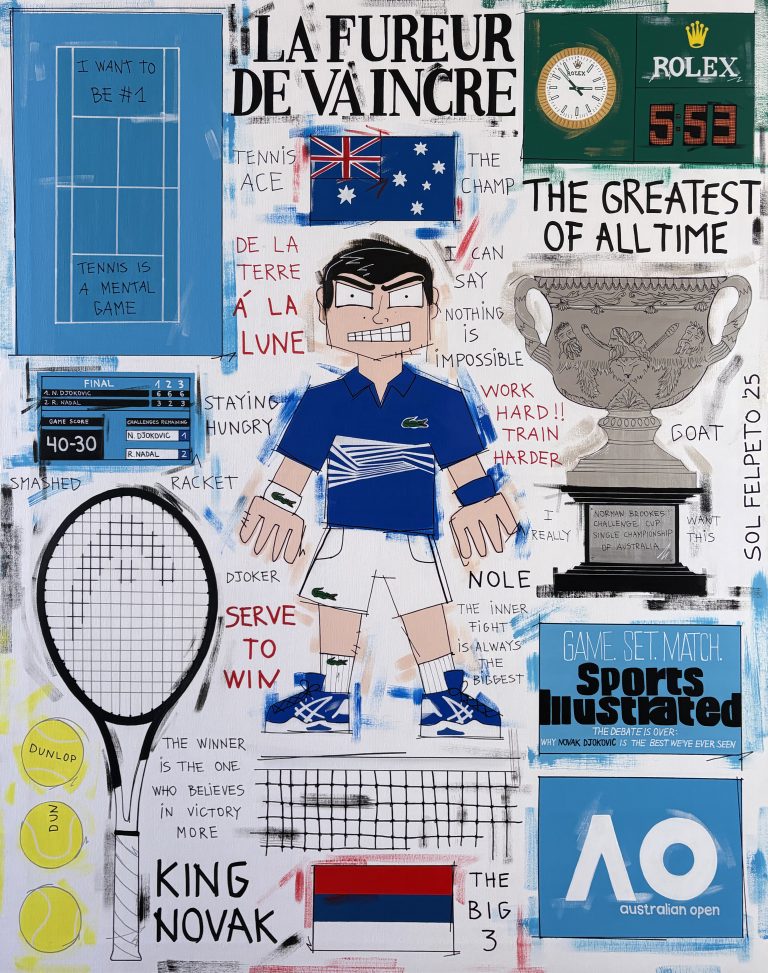
Sol Felpeto, The Big Three, Djokovic. Available at Guy Hepner, New York.
Felpeto's tennis works exemplify her approach to athletic subjects. Rather than attempting photorealistic portraits or action shots—territory thoroughly claimed by photography—she builds layered compositions that capture the cultural weight of tennis as institution and individual achievement alike. Her Djokovic pieces incorporate tournament logos, newspaper clippings, actual tennis balls and racket elements, and illustrated portraits that flatten the champion into graphic icon while maintaining his recognisability. The result sits somewhere between shrine, scrapbook, and declaration of allegiance—which is precisely how many tennis devotees experience their relationship to the sport. These works acknowledge that following tennis (or any sport at this level of engagement) involves accumulating ephemera, both physical and mental, and organising it into personal mythology.
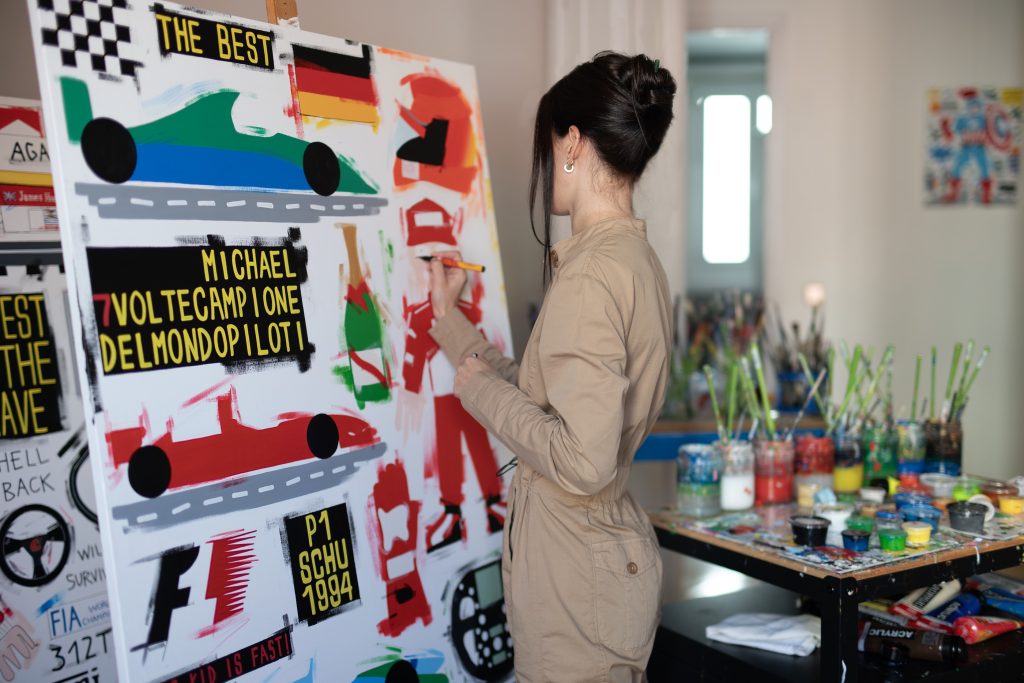
Sol Felpeto Formula 1 paintings bring similar strategies to motorsport, though the visual vocabulary shifts appropriately. Here the emphasis falls on speed, technology, and the strange glamour of an activity that combines engineering precision with mortal risk. The collage elements draw from racing ephemera, the colour palettes reference team liveries, and the overall effect captures the sensory overload of Grand Prix weekend—the noise, the heat, the blur of machines exceeding human-safe velocities while spectators watch from dangerously close proximity. For collectors with connections to automotive culture, these works offer something that a mounted photograph or even a framed poster cannot: genuine artistic engagement with why racing matters beyond its technical achievements.
Sol Felpeto comic style painting connects her work to a visual tradition that the fine art world has spent decades learning to respect. From Roy Lichtenstein's appropriations in the 1960s through contemporary artists like KAWS and Takashi Murakami, comic book aesthetics have proven remarkably durable in gallery contexts. But where Lichtenstein ironised his sources and KAWS built an empire on a single recurring character, Felpeto's engagement with comics feels more genuinely affectionate—these are characters she loves, depicted by an artist who understands both their original visual language and how to translate that language into something that functions on a gallery wall.
Her Marvel paintings demonstrate this balance particularly well. A Captain America piece doesn't simply reproduce the character; it embeds him in layers of collaged text, patriotic imagery, and graphic elements that comment on his cultural position as American symbol and commercial property simultaneously. The bold outlines and flat colour areas recall comic book printing while the mixed-media complexity insists on painterly presence. Sol Felpeto Marvel paintings offer collectors who grew up with these characters—and who perhaps initially felt that loving comics disqualified them from serious art collecting—an opportunity to honour both aspects of their aesthetic education.
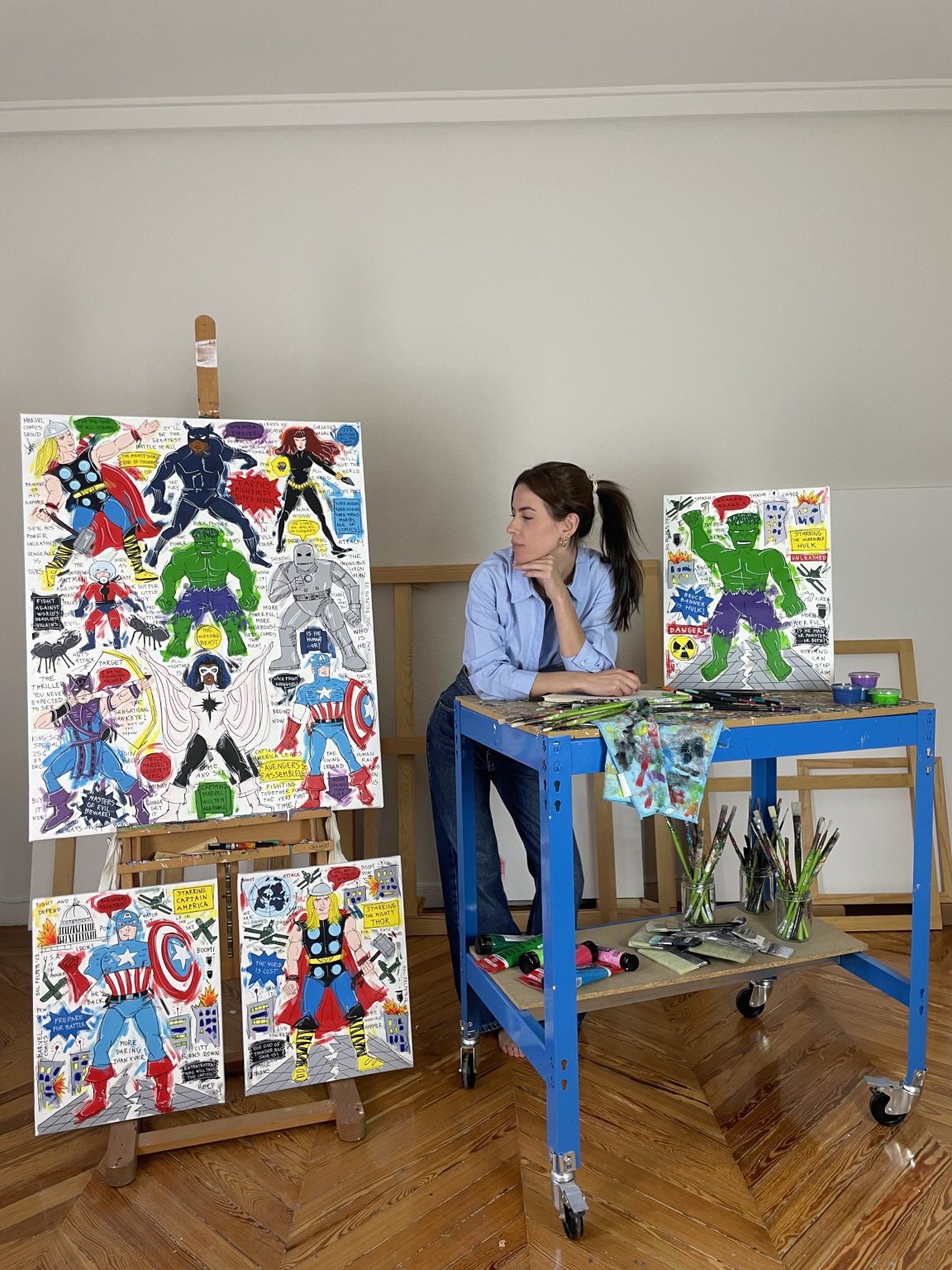
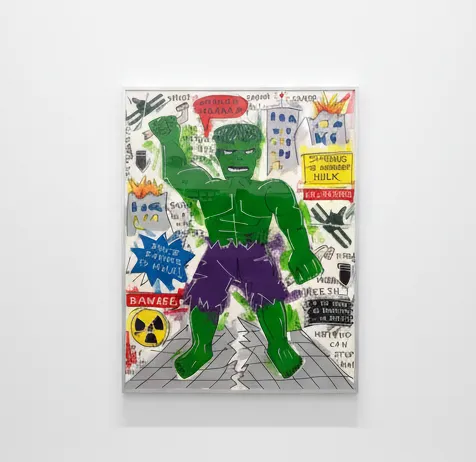
The Hulk works push into different territory, capturing the character's visual impact—the exaggerated musculature, the impossible green, the perpetual rage—while surrounding him with the textual debris of comic book language: sound effects, dialogue fragments, narrative captions. These pieces acknowledge that comic book experience involves reading as much as viewing, that the characters exist not just as images but as accumulations of story. For collectors, this means acquiring work with genuine visual density, pieces that reward extended looking rather than delivering their impact in a single glance.
Thor paintings bring Norse mythology into conversation with Marvel's reinterpretation, layering references to both sources in compositions that feel simultaneously ancient and contemporary. Felpeto's Thor carries his hammer with the weight of centuries of storytelling behind him, but he's rendered in the graphic clarity that contemporary audiences expect from superhero imagery. The mixed-media approach—acrylic, markers, collage elements—creates surfaces that reward close inspection while maintaining the bold readability that the subject demands.
Any serious discussion of Sol Felpeto figurative painting must address her feline obsession. Cats appear throughout her work, not as decorative elements but as what she describes as her "alter ego"—stand-ins for human characters, vehicles for storytelling, and emblems of the qualities she values: independence, mystery, the combination of elegance and chaos that defines domestic cats. This focus connects to her early studies in veterinary medicine, but it also links her to art historical precedent: cats have fascinated artists from ancient Egypt through the present day, their visual appeal seemingly inexhaustible.
Felpeto's engagement with art history often involves replacing human figures with cats—a strategy that might seem whimsical until you consider how effectively it defamiliarises canonical imagery. A Picasso homage with cats instead of human figures forces new attention to composition and colour, since we can no longer rely on our pre-existing relationships with the depicted subjects. The cats become both alienation device and affectionate commentary, acknowledging Picasso's own well-documented love of animals while creating genuinely novel images from thoroughly studied sources.

Sol Felpeto, Gentleman Prefer Dogs, Contemporary. Available at Guy Hepner, New York.
This duality she describes—the refined and mysterious alongside the mischievous and spontaneous—finds its perfect emblem in the cat, a creature that embodies precisely that combination. Collectors drawn to Felpeto's work often respond to this tension, recognising in her cats something about their own relationship to culture: the desire to engage seriously with art and ideas while maintaining the capacity for play, the refusal to choose between sophistication and fun.
Sol Felpeto Spanish artist identity inflects her work in ways that distinguish it from American pop art traditions. Working from Madrid and exhibiting across Europe, America, and Asia, she approaches figures like Captain America or American tennis champions from a position of engaged outsider—appreciating their cultural power without the baggage of national identification. This perspective allows for a kind of analytical affection, celebrating these figures while maintaining the distance necessary for genuine artistic transformation.
The European fine art tradition also informs her practice in less obvious ways. Her technically polished works draw explicitly on cubism and surrealism—movements that originated in France and Spain and that continue to shape European artistic education. When she describes playing with "cubism and surrealism language," she's claiming a heritage that American pop artists often ignored or rejected. This gives her work a different foundation than similarly-themed American painting, connecting contemporary pop imagery to early twentieth-century avant-garde experimentation in ways that feel neither forced nor academic.
Her multicultural biography—Venezuelan birth, Argentine adolescence, Spanish adulthood—also contributes to her perspective on cultural icons. Growing up across multiple countries means encountering different national obsessions, different relationships to American cultural exports, different conversations about what art should do and be. This doesn't make her work explicitly political, but it does give it a breadth of reference that purely national artists might lack. When she depicts tennis champions or comic book heroes, she's working with figures she encountered as imports, celebrities from elsewhere who nonetheless shaped her imagination.
Sol Felpeto pop culture art enters a market that has matured significantly over the past decade. Where galleries once hesitated to show work with overt pop cultural references, concerned about critical dismissal, the success of artists like Murakami, KAWS, and others has demonstrated that collectors will support serious engagement with popular imagery. Museums have followed, incorporating pop-influenced work into their collections and exhibitions. The stigma that once attached to loving comics or sports has largely evaporated, replaced by recognition that these enthusiasms are as legitimate as any other cultural engagement.
For collectors, this shift creates both opportunity and challenge. The opportunity: access to genuinely compelling work that reflects actual interests rather than performed sophistication. The challenge: navigating a field that now includes everything from cynical commercial product to rigorous artistic practice. Distinguishing between these extremes requires the same skills as any other collecting area: looking closely, understanding context, and trusting informed instinct. Felpeto's work rewards this attention, revealing its layered construction and thoughtful composition to viewers willing to move beyond initial impact.
The price points for buy Sol Felpeto art make her particularly accessible to collectors building serious collections without unlimited resources. Works ranging from approximately $1,900 to $14,950 allow entry at various levels of commitment, from relatively modest acquisitions that test the waters to significant pieces that anchor a collection. This accessibility doesn't indicate lesser quality—it reflects the economics of an artist still building her market, creating opportunities for collectors who recognise quality before the market fully catches up.
Sol Felpeto gallery representation includes Guy Hepner, which presents her work at 177 Tenth Avenue in New York. For collectors seeking where to buy Sol Felpeto paintings, this representation offers several advantages: access to curated selection, professional handling and shipping, and the confidence that comes from working with an established gallery. The relationship between artist and gallery also suggests a level of market validation, since galleries invest in artists they believe will sustain collector interest over time.
Guy Hepner's broader programme contextualises Felpeto's work within a conversation about contemporary figurative painting and pop-influenced art. Collectors encountering her pieces alongside other gallery artists can understand her position in the field, seeing both affinities and distinctions. This context helps inform acquisition decisions, since collecting is always partly about building coherent groups of work that speak to each other.
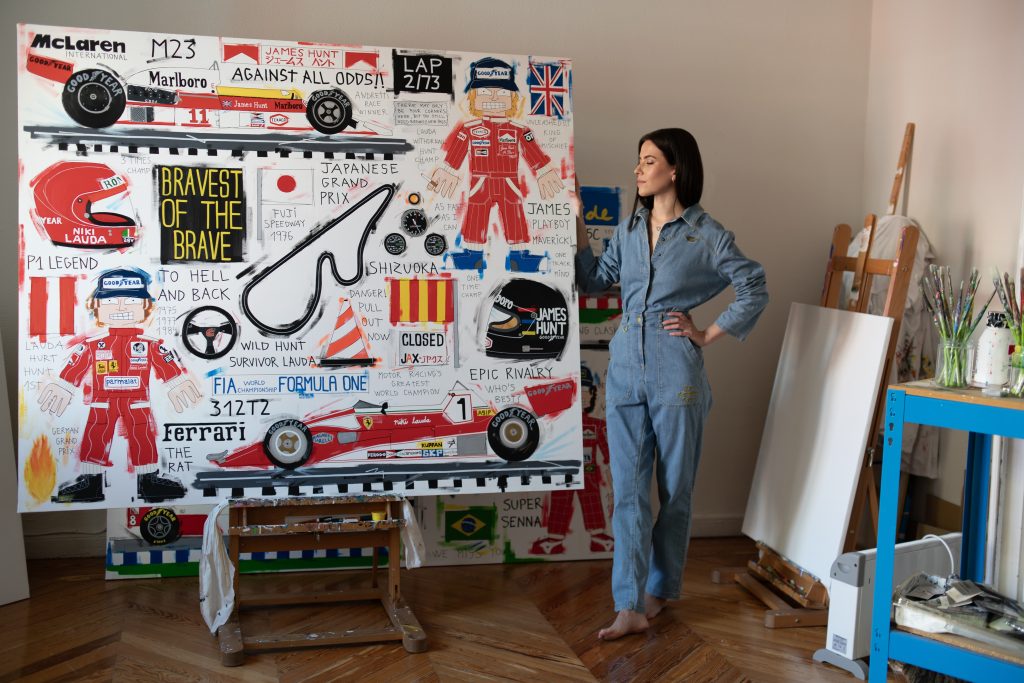
For collectors outside New York, the gallery offers remote purchasing options with detailed condition reports and professional photography. This accessibility matters particularly for work like Felpeto's, where surface complexity and mixed-media layering create subtleties that reproduction cannot fully capture. Knowing that a gallery stands behind each transaction—offering expertise, guaranteeing authenticity, and maintaining relationships beyond individual sales—transforms what might feel like an uncertain distance purchase into a confident acquisition.
Approaching Sol Felpeto art as a collecting opportunity involves several considerations that experienced collectors will recognise:
The mixed-media nature of Felpeto's work also means that condition matters more than with conventional painting. Collage elements can lift or discolour, paper components respond to humidity, and the layered surfaces require appropriate care. Collectors should confirm proper framing and display recommendations with the gallery at purchase, ensuring that these vibrant pieces maintain their intensity over time.
Sol Felpeto contemporary art occupies a position that criticism is still developing vocabulary to address. The traditional frameworks for discussing pop art—focusing on irony, appropriation, and critique of consumer culture—don't quite fit work that approaches its subjects with genuine affection. Similarly, sports art criticism has historically focused on documentary accuracy or nostalgic idealisation, categories that miss what Felpeto's layered, collaged approach actually accomplishes. Her work asks for new ways of talking about why popular imagery deserves serious artistic attention, and why treating beloved subjects with technical sophistication doesn't constitute selling out in either direction.
The European critical context may prove more receptive to this combination than American frameworks have traditionally been. Continental criticism has maintained stronger connections to comics as legitimate art form (think French enthusiasm for bande dessinée) and to sports as cultural phenomenon worth intellectual attention (think European football scholarship). Felpeto's European base and exhibition history means that her critical reception develops in this more welcoming environment, potentially shaping how American and Asian markets come to understand her work.
For collectors, critical reception matters primarily as market signal—strong reviews and institutional attention typically correlate with price appreciation. But it also matters as validation of collector judgment, confirmation that the work one loves actually possesses the qualities one perceives. Felpeto's growing exhibition history across multiple continents suggests that the art world is recognising what collectors have already discovered: this work rewards attention and sustains interest.
Why do collectors seek out Sol Felpeto tennis art or her Marvel paintings rather than acquiring photographs of the same subjects? The answer involves understanding what art can do that documentation cannot. A photograph of Djokovic captures a moment; Felpeto's painted collage captures a relationship—the accumulated weight of watching someone's career unfold, the memories attached to specific tournaments, the way devotion to a sport or character becomes part of one's own identity. Her work exteriorises what fans carry internally, giving visible form to invisible loyalty.
This emotional logic extends to comic book subjects as well. Collectors of Sol Felpeto comic book style art aren't simply acquiring superhero images available everywhere from t-shirts to phone cases. They're acquiring artistic transformation of those images, work that acknowledges how deeply these characters have shaped imagination while subjecting them to techniques that demand respect. The difference between merchandise and art lies not in subject matter but in treatment—and Felpeto's treatment clearly belongs to art.
For many collectors, these works also function as conversation pieces in the most literal sense: they start conversations, revealing shared enthusiasms with visitors, creating opportunities for connection. A Hulk painting above a fireplace announces something about its owner that a landscape painting does not, and that announcement often generates more interesting discussion than safer choices would permit.
Sol Felpeto's practice continues to evolve, with her statement indicating movement toward telling her own stories alongside reinterpretations of existing narratives. This development suggests that collectors acquiring work now are positioning themselves in a career still unfolding, with potential for both artistic growth and market development. Artists who demonstrate range while maintaining recognisable vision—as Felpeto does with her "duality" of refined and mischievous modes—often sustain collector interest across decades, since new work continues to surprise while remaining identifiably continuous with earlier purchases.
The broader market for pop-influenced figurative work shows no signs of contraction. If anything, generational shifts in collecting priorities suggest continued expansion, as buyers who grew up with these images acquire resources and confidence. Felpeto's position within this market—established enough for confidence, accessible enough for entry, distinctive enough for recognition—makes her work particularly well-suited to collectors building positions in this area.
The work itself makes the most compelling argument for attention. Standing before one of her tennis collages, with its layered imagery and explosive colour, its precise illustration and loose painterly gesture, its accumulation of ephemera and confident composition, the question isn't whether this constitutes real art—that question answers itself immediately. The question is whether you want to live with it, whether these particular obsessions align with yours, whether this specific visual language speaks to you. If the answer is yes, then the only remaining question is practical: which piece, what size, and how soon can you get it on your wall?
Guy Hepner Gallery, at 177 Tenth Avenue in New York, currently offers a selection of Sol Felpeto works spanning her sports, pop culture, and figurative practices. For collectors intrigued by this exploration of her art, the gallery welcomes inquiries about available pieces, pricing, and acquisition arrangements. In a market where timing matters and distinctive work finds homes quickly, engaging sooner rather than later often proves wise. These canvases won't wait indefinitely for collectors to make decisions—and once they're placed, they tend to stay placed, their owners disinclined to part with work that continues to generate the particular pleasure Felpeto's paintings provide.
Related Series