Reverie

July 20, 2026
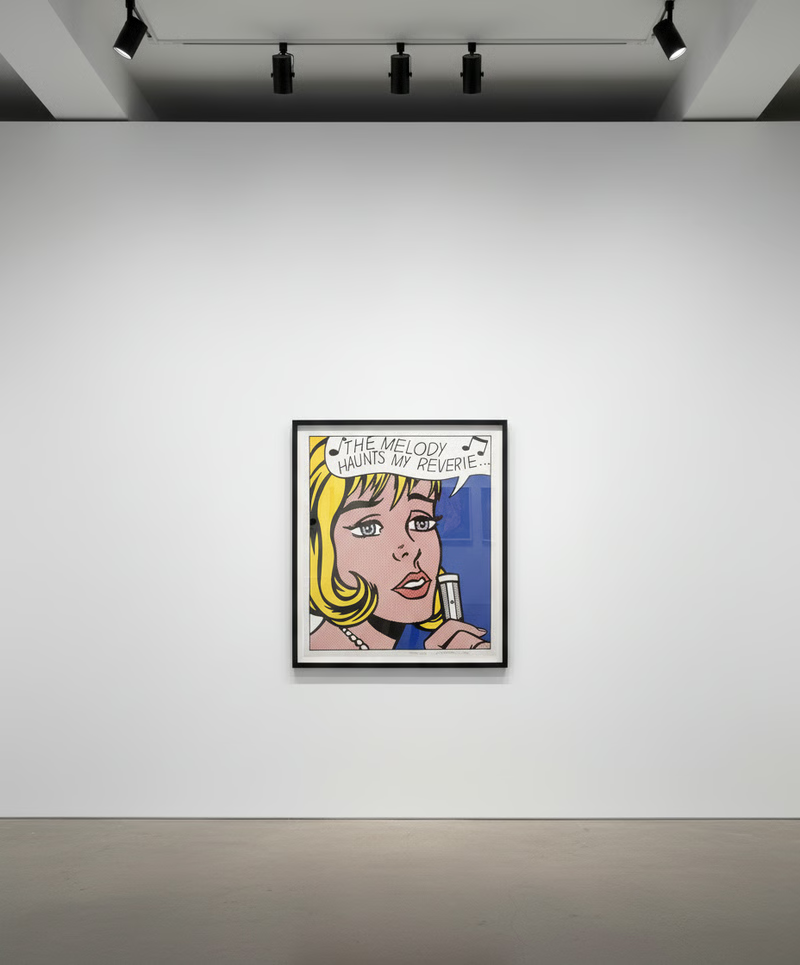
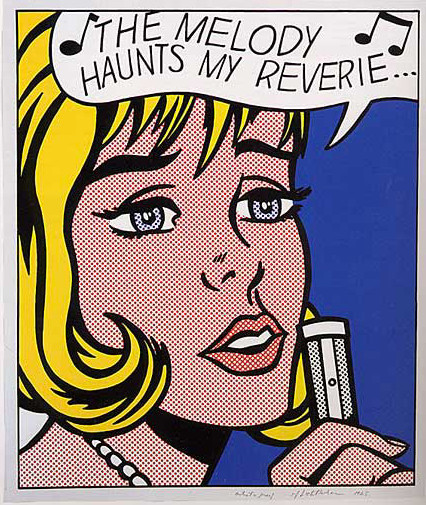
In the autumn of 1965, a blonde woman appeared on paper across two hundred impressions, her lips parted in song, her expression caught somewhere between longing and resignation. She was singing, though no sound could escape the flat surface of the screenprint. The melody, as Roy Lichtenstein titled the work, haunted her Reverie—and it has haunted collectors ever since. Roy Lichtenstein Reverie stands as one of the most emotionally resonant works in the artist's print catalogue, a piece that transforms the commercial language of romance comics into something approaching genuine pathos. Today, nearly six decades after its creation, the image continues to captivate collectors who recognize in it both the ironic detachment and the surprising sincerity that defined Lichtenstein's greatest achievements.
The print emerged during a period when Lichtenstein was at the height of his powers, translating the visual vocabulary of mass culture into high art with unprecedented success. His paintings were selling briskly, his reputation was solidifying among critics who had initially dismissed Pop Art as a clever joke, and he was beginning to explore printmaking as a medium uniquely suited to his concerns. The Lichtenstein Reverie series, if we can call it that, represents a singular moment in this trajectory—a work that distills the artist's approach to its purest form while revealing depths that many of his more celebrated images only hint at.
Roy Fox Lichtenstein was born in Manhattan in 1923, the son of a successful real estate broker. His path to becoming one of the twentieth century's most influential artists was neither direct nor preordained. After studying at the Art Students League under Reginald Marsh and earning degrees from Ohio State University (interrupted by military service during World War II), Lichtenstein spent the 1950s working in a variety of styles that ranged from Cubist-inflected abstraction to loosely painted Americana. These early works, competent but unremarkable, gave little indication of the revolution to come.
The transformation began around 1961, when Lichtenstein, then teaching at Rutgers University, created his first paintings based on comic strips. The legend holds that his son challenged him to paint something "as good as" a Mickey Mouse cartoon, though Lichtenstein later complicated this origin story. What matters is not the precise moment of inspiration but the radical nature of the departure. Within months, Lichtenstein had developed a visual language that would define his career: bold black outlines, flat areas of primary color, and—most distinctively—the Ben-Day dots that became his signature.
These dots, borrowed from the mechanical printing process used in newspapers and comic books, became Lichtenstein's most recognizable formal innovation. In commercial printing, Ben-Day dots (named after illustrator Benjamin Henry Day Jr.) create the illusion of continuous tone through patterns of small colored circles. Lichtenstein seized upon this industrial technique and monumentalized it, painting dots by hand with obsessive precision or, in his prints, employing screens to reproduce the effect at various scales. The result was images that simultaneously referenced their lowbrow sources and announced their status as sophisticated aesthetic objects.
By 1962, Lichtenstein had joined Leo Castelli Gallery in New York, the epicenter of the emerging Pop Art movement. His first solo show sold out before it opened, with collectors responding to works like Look Mickey and Drowning Girl with an enthusiasm that surprised even the artist. Alongside Andy Warhol, James Rosenquist, and Claes Oldenburg, Lichtenstein was redefining what art could be and what sources it could draw upon.
The work known as Reverie—or, by its full title, The Melody Haunts My Reverie—emerged from Lichtenstein's sustained engagement with romance comics, a genre he returned to repeatedly throughout the 1960s. These publications, aimed primarily at teenage girls and young women, featured melodramatic narratives of love, heartbreak, and emotional crisis, rendered in a graphic style that Lichtenstein found irresistible.
Roy Lichtenstein, The Melody Haunts My Reverie, 1965, Screenprint. Available at Guy Hepner, New York.
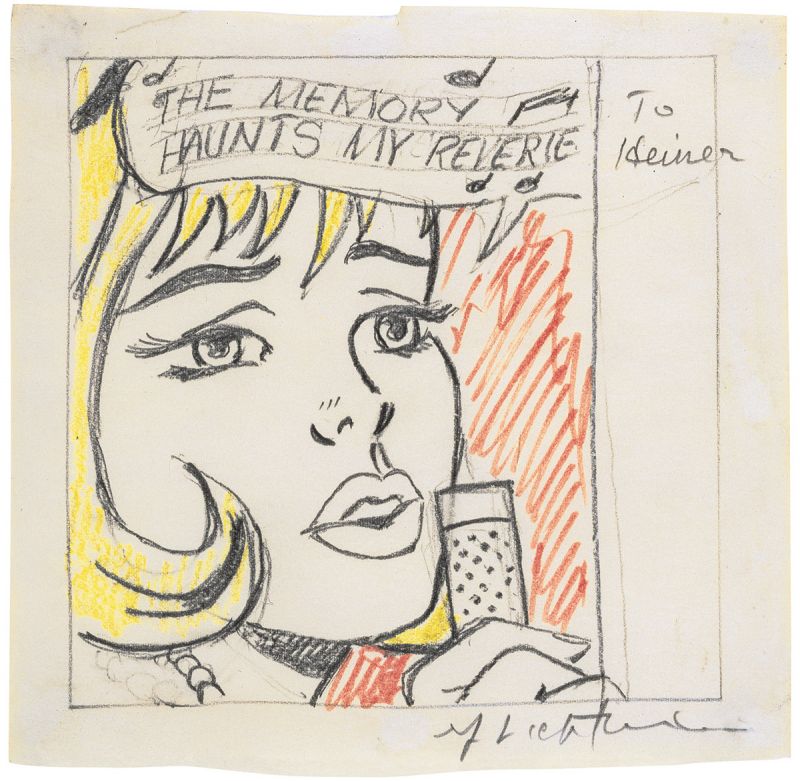
What distinguished Lichtenstein's approach from simple appropriation was his process of transformation. He did not merely reproduce comic panels; he selected, cropped, and refined them, adjusting compositions, simplifying forms, and intensifying colors until the original source became almost unrecognizable. In the case of Reverie, Lichtenstein isolated a single figure—a blonde woman with closed eyes, her head tilted slightly back—and stripped away all narrative context. The speech bubble that might have appeared in the source comic is absent; the only text that remains is contained in the title itself, suggesting a song whose melody we cannot hear.
The print was created as a color screenprint on paper, with an image size of approximately 27 by 23 inches and a sheet size of 30⅛ by 24 inches. Published by Original Editions, New York, the edition consisted of 200 impressions, each hand-signed by Lichtenstein in pencil. The work is catalogued as Corlett 38 in Mary Lee Corlett's authoritative catalogue raisonné of Lichtenstein's prints.
Executed in yellow, red, blue, and black, the Lichtenstein Reverie series exemplifies the artist's mastery of screenprinting as a medium. The Ben-Day dots that define the woman's skin and hair create a shimmering optical effect, while the solid black outlines contain the Composition with graphic precision. The blue background—flat, unmodulated, almost arbitrary in its intensity—provides a visual anchor that prevents the image from dissolving into mere pattern.
Lichtenstein himself described works like Reverie as presenting an "incomplete narrative," a phrase that captures much of their enduring appeal. We see a woman in a moment of emotional intensity, but we do not know what precedes or follows this moment. We sense that she is singing—the title tells us as much—but we cannot know what song, for whom, or why. This deliberate withholding of context transforms what might have been a disposable illustration into something approaching mystery.
The woman's closed eyes are crucial to this effect. Unlike Lichtenstein's more famous crying women, who confront the viewer with their distress, the figure in Reverie has withdrawn into an interior space that we cannot access. Her melancholy expression, as contemporary descriptions noted, suggests depths of feeling that the flat, mechanical technique seems designed to deny. This tension between emotional content and detached presentation lies at the heart of Lichtenstein's achievement.
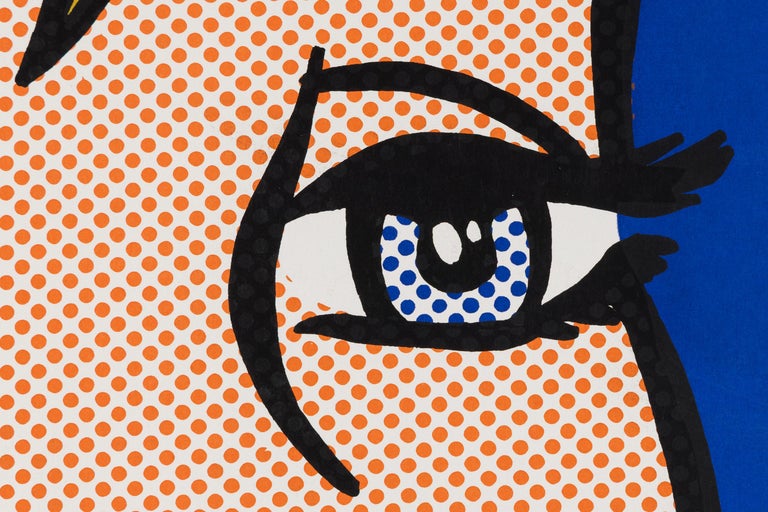
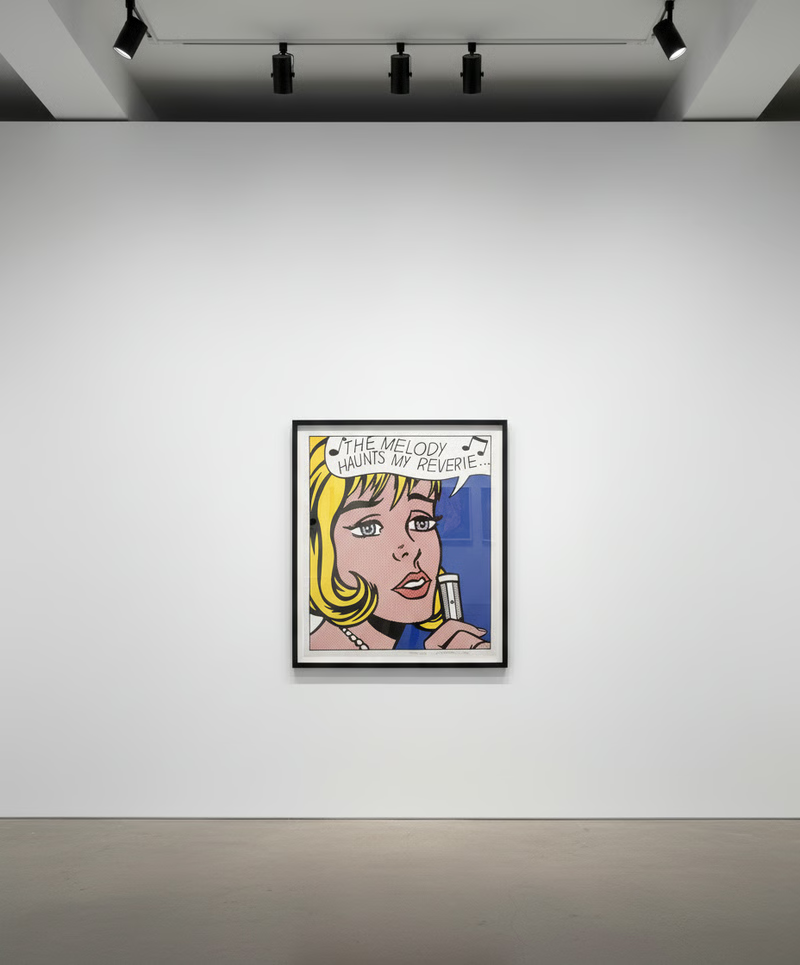
Roy Lichtenstein, The Melody Haunts My Reverie, 1965, Screenprint. Available at Guy Hepner, New York.
Critics have long debated whether Lichtenstein's romance-comic paintings and prints represent ironic commentary on mass culture, sincere engagement with emotional expression, or some combination of the two. The answer, almost certainly, is that they operate on multiple levels simultaneously. Lichtenstein was too intelligent an artist to produce simple parody, and too committed to formal investigation to settle for sentiment. In Reverie, the viewer confronts both a technical tour de force and an image of genuine, if stylized, feeling.
The title itself introduces a literary dimension that elevates the work beyond its comic-book origins. "Reverie" suggests a state of dreamy meditation, while "The Melody Haunts" introduces elements of persistence and possibly pain. The phrase "haunts my reverie" carries associations with loss, with absence, with something that will not let go—associations that complicate any purely ironic reading of the image.
To understand the significance of the Lichtenstein Reverie series within the broader context of Pop Art prints, one must appreciate the technical and conceptual implications of the Ben-Day dot technique. Lichtenstein did not invent the dot pattern—it had been in commercial use since the 1870s—but he made it mean something new.
In commercial printing, Ben-Day dots are invisible. The eye is meant to blend them into continuous tones, just as the pixels on a screen disappear when viewed at normal distance. Lichtenstein reversed this relationship, enlarging the dots until they became the dominant visual element. By foregrounding a technique that commercial printing sought to hide, he called attention to the constructed nature of all images. Every picture, he seemed to suggest, is made of discrete elements; every representation is a translation, not a transcription, of reality.
This insight had profound implications for the medium of printmaking, which had long occupied an ambiguous position between fine art and commercial production. Prints were by definition multiple, reproducible, mechanical—qualities that the traditional art market had treated as markers of lesser value. Lichtenstein's screenprints embraced these qualities, celebrating multiplicity rather than apologizing for it. The edition of 200 impressions of Reverie was not a compromise with commercial demands but an assertion that the printed image could be art.
The screenprinting process itself aligned perfectly with Lichtenstein's aesthetic. Unlike lithography, which retains traces of the artist's hand, screenprinting produces flat, uniform areas of color that match the commercial appearance Lichtenstein cultivated. Each impression is essentially identical to every other, a fact that reinforces the work's dialogue with mass production while simultaneously preserving its status as a hand-signed limited edition.
When Lichtenstein's Pop Art works first appeared in the early 1960s, critical response was sharply divided. Some observers dismissed the paintings and prints as juvenile provocations, the visual equivalent of a practical joke. Others recognized immediately that something significant was happening—that Lichtenstein, along with his contemporaries, was challenging fundamental assumptions about what art could represent and how it could represent it.
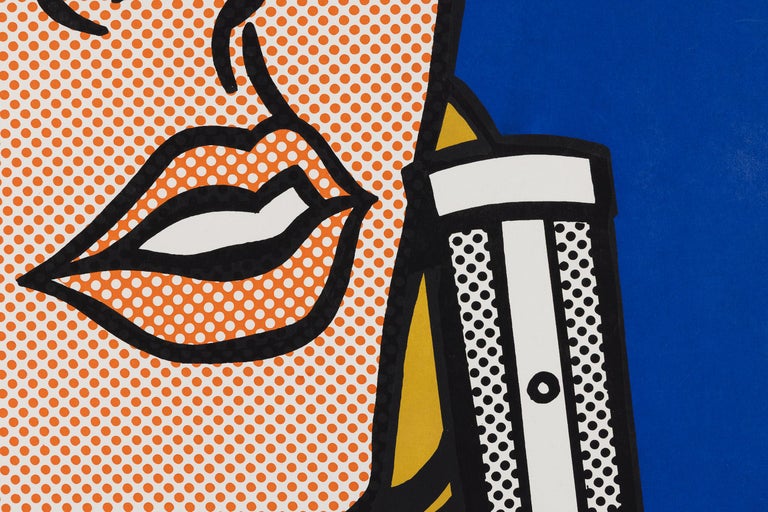
Pop Art example in Lichtenstein style, Ben-Day dots and bold outlines. Reference image.
The poet and curator Frank O'Hara, writing in 1963, praised Lichtenstein's ability to "find beauty in the most ordinary or unlikely sources." The critic Lawrence Alloway, who had helped coin the term "Pop Art," situated Lichtenstein's work within a broader renegotiation of high and low culture that defined the postwar period. By the mid-1960s, when Reverie was created, Lichtenstein had achieved a level of recognition that quieted most skeptics.
The Smithsonian American Art Museum acquired an impression of Reverie (from the portfolio 11 Pop Artists, Volume II) through a gift from Philip Morris Incorporated in 1966, just one year after the print's creation. This rapid institutional acceptance testified to the speed with which Lichtenstein had moved from avant-garde provocateur to established figure. Today, impressions of the print reside in major collections worldwide, and the image has become one of the most reproduced and recognized in the Pop Art canon.
Art historians have consistently identified Reverie as a key work in understanding Lichtenstein's treatment of female subjects and his engagement with the visual culture of romance and desire. The print has been analyzed in terms of its gender politics, its relationship to advertising and consumer culture, and its place within the artist's evolving technical practice. Each generation of scholars finds new aspects to examine, a sure sign of the work's enduring complexity.
The market for blue-chip prints by major twentieth-century artists has strengthened considerably in recent decades, and Lichtenstein's works have been among the primary beneficiaries of this trend. Collectors who might once have focused exclusively on paintings have increasingly recognized prints as viable alternatives—works that offer access to an artist's vision at more accessible price points while retaining investment potential and aesthetic integrity.
Lichtenstein prints currently range from approximately $15,000 to well over $150,000, depending on factors including the specific image, edition size, condition, and provenance. The Lichtenstein Reverie series, with its iconic imagery and relatively modest edition of 200, occupies a strong position within this market. Current estimates place impressions in the range of $30,000 to $80,000 or more, with exceptional examples—those with pristine condition, distinguished provenance, or particularly strong color—commanding premiums.
Recent gallery sales of comparable Lichtenstein prints illustrate the market's appetite for the artist's work. Bedroom sold for approximately $100,000, while Sweet Dreams Baby achieved $118,000. These results suggest sustained demand for Lichtenstein's prints, particularly those that exemplify his most characteristic concerns: the appropriation of popular imagery, the transformation of commercial technique into fine art, and the exploration of emotional content through cool, detached means.
Roy Lichtenstein, Whaam!, 1963, Acrylic and oil on canvas. Iconic Pop Art work.
For collectors considering Lichtenstein prints, several factors merit attention when evaluating potential acquisitions:
For those building collections that include Pop Art prints, Lichtenstein occupies an essential position. His works combine art-historical significance with visual impact, intellectual depth with immediate accessibility. Unlike some blue-chip artists whose reputations rest on a small number of canonical works, Lichtenstein produced a substantial body of prints that offer multiple entry points for collectors at various levels.
The romance-comic subjects, of which Reverie is a prime example, represent one of the most sought-after categories within Lichtenstein's print output. These images—featuring beautiful women in states of emotional intensity—possess an iconic quality that resonates across generations. They are immediately recognizable as Lichtenstein's work while also functioning as powerful images in their own right, capable of commanding attention in any setting.
Collectors often approach Lichtenstein prints with different priorities in mind. Some seek to assemble comprehensive representations of the artist's various themes and periods, acquiring examples of the romance subjects, the brushstroke prints, the landscape compositions, and the later works that engage with art history and abstraction. Others focus on particular series or subjects, building depth rather than breadth. Still others acquire individual works that speak to them personally, regardless of how those works fit into broader collecting strategies.
For those new to the market for Lichtenstein prints, several principles can guide decision-making. First, prioritize quality over quantity; a single exceptional impression is worth more, both aesthetically and financially, than multiple lesser examples. Second, work with established dealers who can provide expertise, documentation, and assurance of authenticity—the market, while robust, is not without risks for uninformed buyers. Third, buy what you love; the best collecting decisions are those that bring lasting pleasure, regardless of market fluctuations.
Returning to Reverie itself, one is struck by how much the work accomplishes within its modest dimensions. A woman sings; a melody haunts her; we watch without hearing. This simple scenario, rendered in the most artificial of techniques, somehow generates genuine feeling. The dots that should distance us from emotional engagement instead become a kind of veil through which emotion passes, transformed but not diminished.
The Lichtenstein Reverie series—if we expand the term to include the related paintings and works on paper that explore similar themes—represents a sustained meditation on the relationship between mass culture and individual experience. The women in these works are generic types, borrowed from publications designed for the widest possible audience. Yet in Lichtenstein's hands, they become something more: figures of unexpected dignity, worthy of attention that their original context never demanded.
This elevation of the lowly to the sublime remains one of Pop Art's most significant contributions to twentieth-century culture. Lichtenstein, more than perhaps any of his contemporaries, demonstrated that transformation was possible—that an image designed to be glanced at and discarded could become an object of sustained contemplation. The melody that haunts the reverie is, in a sense, the melody of art history itself, the ongoing song of forms and meanings that each generation inherits and transforms.
For collectors drawn to the power and sophistication of Roy Lichtenstein's print work, Guy Hepner at 177 Tenth Avenue, New York, offers carefully selected examples that represent the artist's achievement at its finest. As an established art dealer in New York specializing in blue-chip prints and contemporary works, Guy Hepner provides the expertise, documentation, and service that serious collecting requires.
The gallery's holdings include significant works from Lichtenstein's various periods and themes, with particular strength in the iconic Pop imagery that defines his legacy. Each work comes with full provenance, condition reporting, and the assurance that comes from dealing with specialists who understand both the art and the market.
Whether you are beginning a collection, adding to an existing one, or seeking a specific work to complete a group, we invite you to explore the possibilities. The melody haunts us still—and the opportunity to live with one of these remarkable prints awaits those with the discernment to recognize what Lichtenstein achieved. Contact Guy Hepner to inquire about current availability and to discuss how a Lichtenstein print might find its place in your collection.
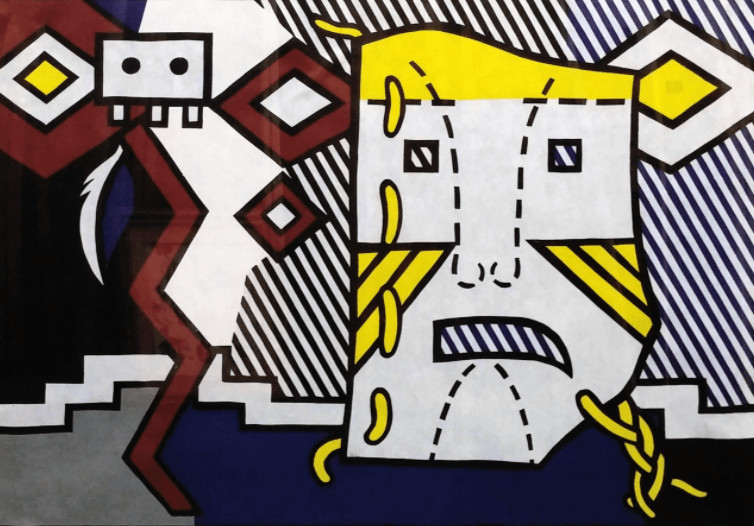
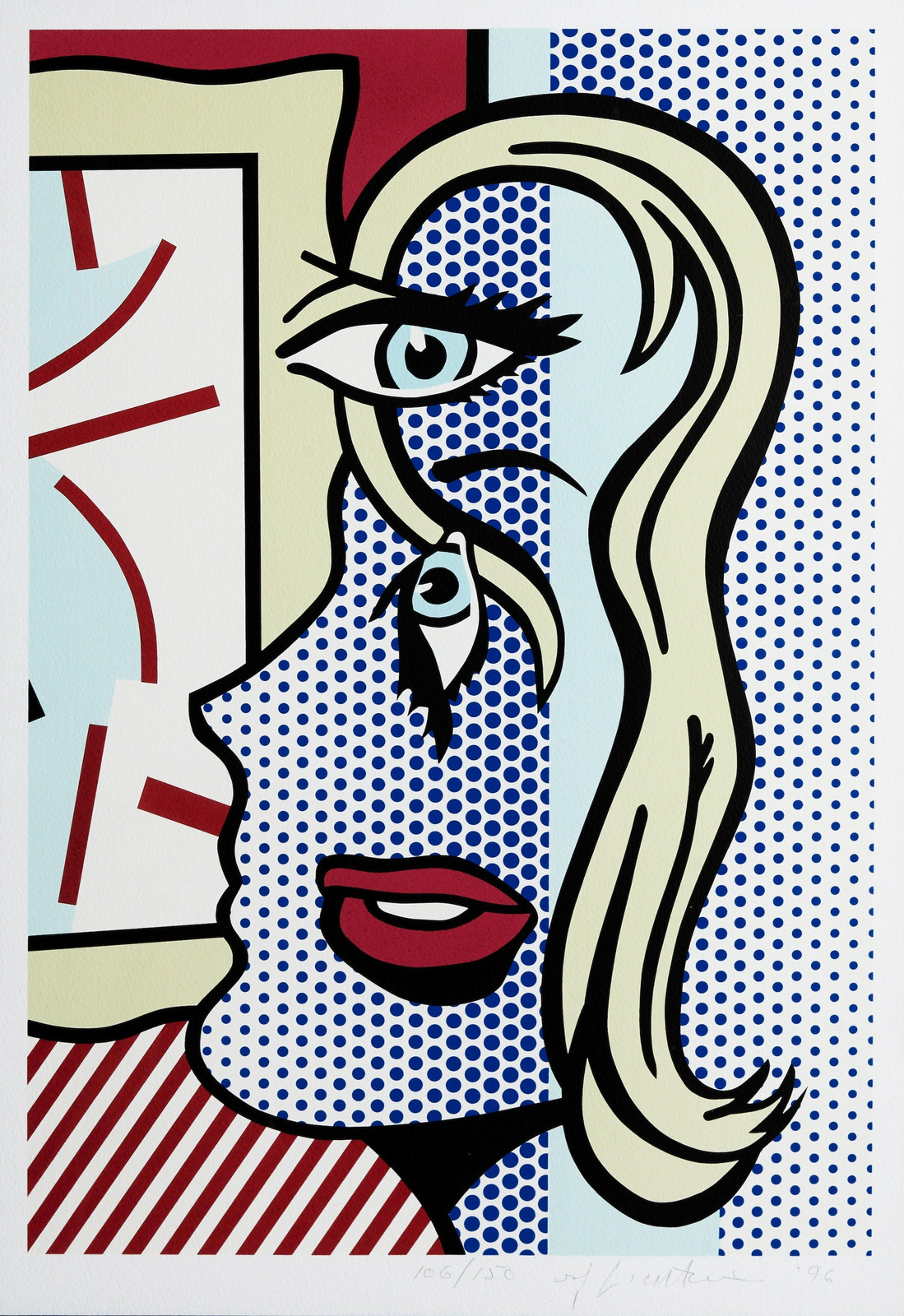
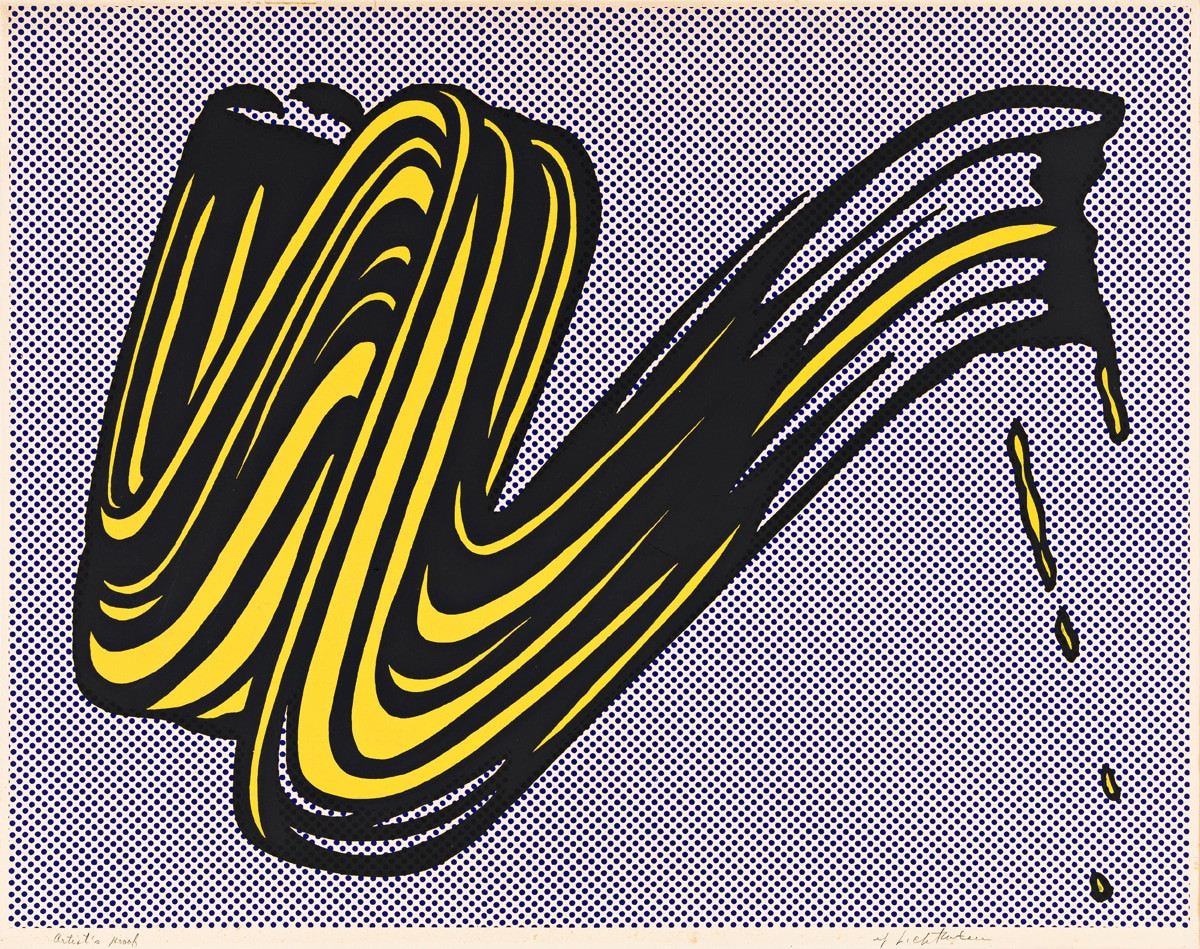
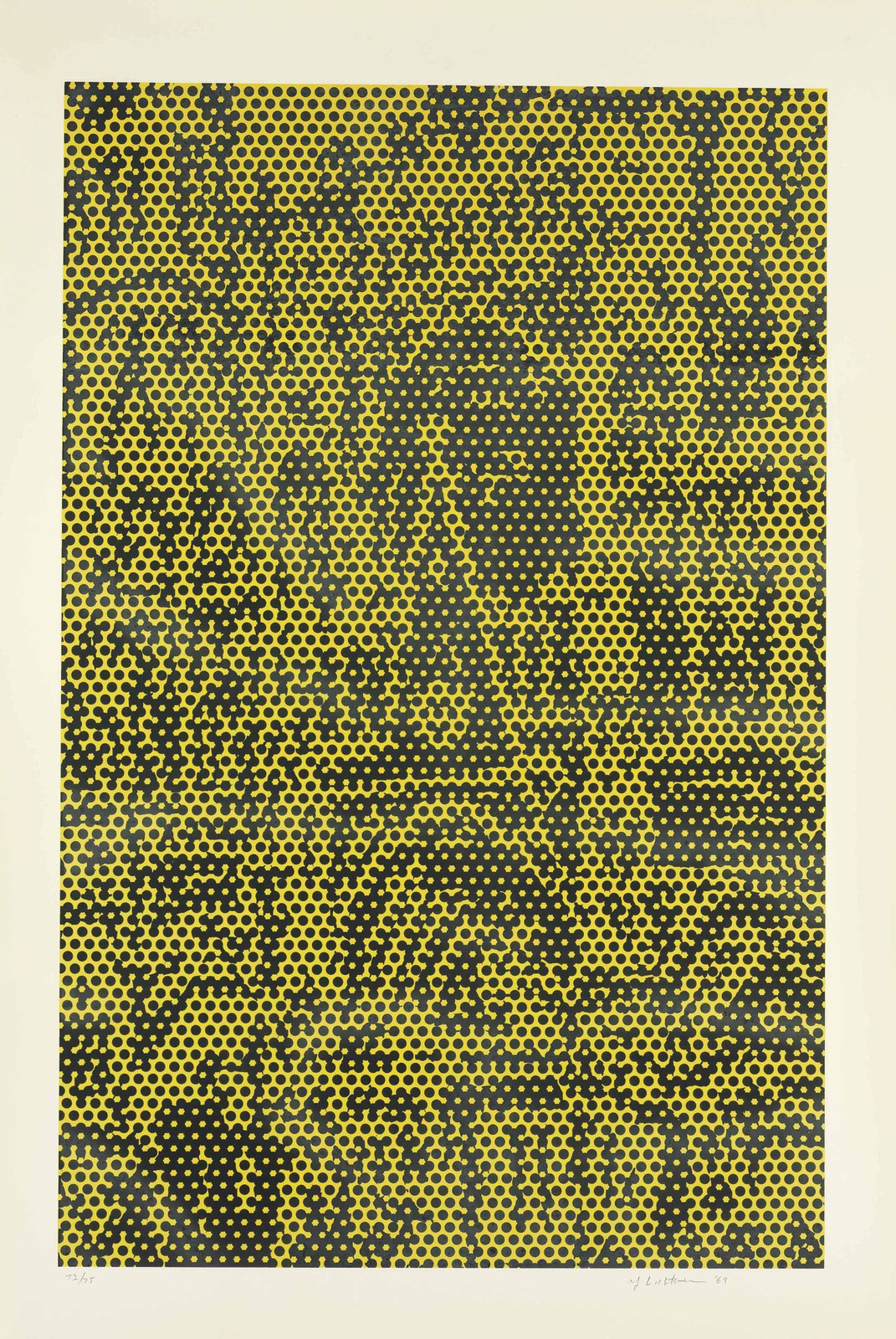
Explore Roy Lichtenstein prints for sale at Guy Hepner: Reverie, American Indian Theme, Art Critic, Brushstrokes, Cathedral.
Related Series