Nudes

June 15, 2026
Among the most sought-after late works in Roy Lichtenstein's vast print oeuvre, the Nudes series (1994) represents the final crystallisation of a career-long dialogue between popular culture and canonical Western art. Created just three years before the artist's death, these screenprints distil a lifetime of formal experimentation into a set of images that are at once technically accomplished, historically literate, and unmistakably Lichtenstein. For collectors focused on roy lichtenstein nudes, the series stands as the definitive statement of his mature idiom — and as a market proposition, it has demonstrated the consistent strength of blue-chip Print and Multiple collecting over more than three decades.
Inquire About Available Roy Lichtenstein Nudes Prints
Browse current Nudes editions available through Guy Hepner, 529 West 20th Street, New York.
Roy Lichtenstein completed the Nudes series in 1994, publishing through Gemini G.E.L. in Los Angeles, the collaborative print workshop with which he had maintained one of the most productive artist-publisher relationships in the history of American printmaking since the late 1960s. By 1994, Lichtenstein had been working with Gemini for over twenty-five years, and the Nudes prints are characterised by the extraordinary technical precision that only that degree of accumulated expertise can produce.
The series arrived at a specific moment in the artist's late career. During the 1980s and 1990s, Lichtenstein had moved away from the comic-strip source imagery that made his name in the early 1960s and turned increasingly toward art history itself as source material. The Reflections series (begun 1988) had subjected his own earlier works to self-referential scrutiny. The Modern Head series (1970, re-engaged in print form across subsequent decades) revisited Cubist and Deco formal conventions. The Nudes engaged the most freighted subject in the entire Western canon — the female nude — and submitted it to the cool, systematic transformation of the Pop aesthetic.

Roy Lichtenstein photographed at the Stedelijk Museum, Amsterdam, November 1967. Photo: Eric Koch / Anefo (CC BY-SA 3.0). The period captures Lichtenstein at the height of his international recognition, just as he began systematically revisiting canonical art history.
The result is a series of prints that function simultaneously as homage and critique: Lichtenstein loved Matisse and Picasso with genuine devotion, but his method of appropriating their imagery strips the sensuous oil paint from their surfaces and replaces it with the mechanical, flat, graphic language of mass reproduction. The Nudes are thus doubly transformed figures — first by the modernist masters who reworked classical conventions, and again by Lichtenstein who reworked modernism through the lens of print and popular culture.
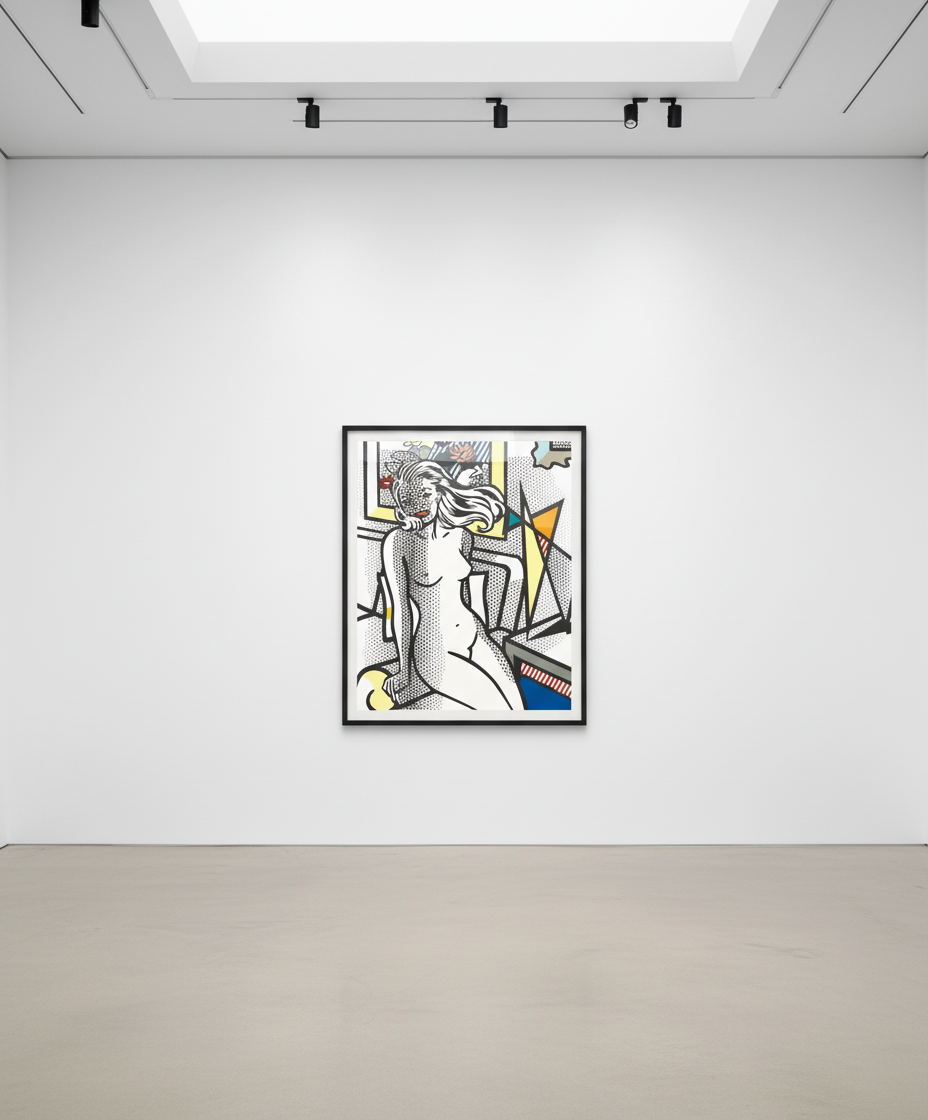
Roy Lichtenstein, Nude With Yellow Pillow (C. 283), 1994. Lithograph. Available at Guy Hepner, 529 West 20th Street, New York. Browse Roy Lichtenstein Nudes →
To understand the Nudes series, it is necessary to understand the tradition Lichtenstein was working against — and within. The female nude is perhaps the most persistently debated subject in Western art history, and Lichtenstein's immediate sources were the great early-twentieth-century masters who had themselves radically reworked that tradition.
Henri Matisse's odalisques of the 1920s are the most direct precedents. Painted in Nice, these canvases show reclining female figures in richly patterned Interiors, dissolving the classical hierarchy between figure and ground into fields of decorative pattern. The odalisque tradition — derived from Western artists' romanticised imagining of the Ottoman harem — had been present in French painting since Ingres and Delacroix, but Matisse evacuated its Orientalist fantasy content in favour of formal investigation: the nude as an occasion for exploring the relation between flat pattern and three-dimensional volume, between line and colour.
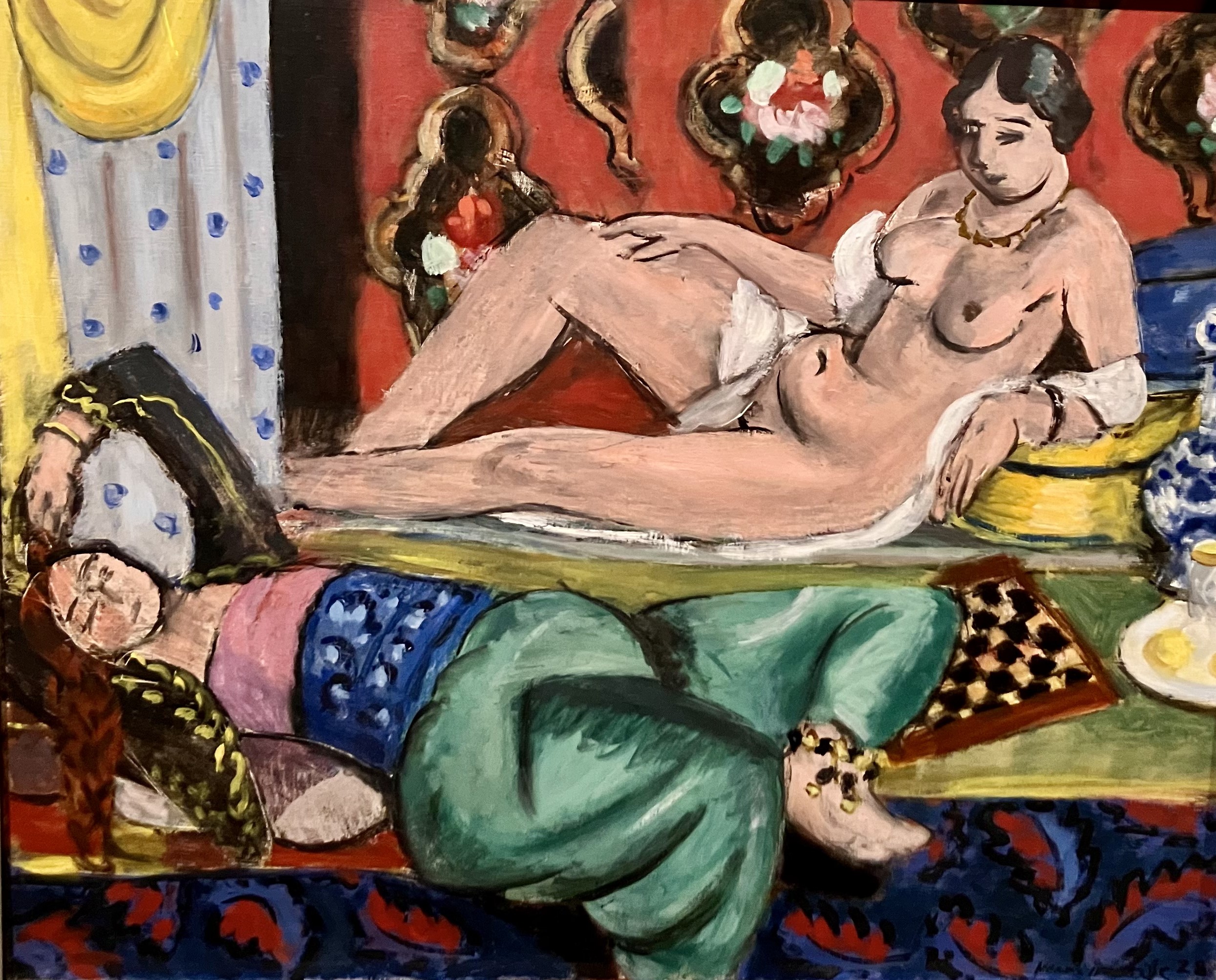
Henri Matisse, Two Odalisques, One Being Nude, Ornamental Ground and Checkerboard, 1928. Oil on canvas, 54 × 65 cm. Moderna museet, Stockholm. (CC0). This is among the odalisque paintings from Matisse's Nice period that directly influenced Lichtenstein's Nudes series — note the bold pattern, flat colour, and reclining figure that Lichtenstein would translate into his Pop idiom.
Pablo Picasso's nudes pushed further still: the fractured, multiple-viewpoint figures of Cubism, the monumental distortions of the 1920s classicist period, the flat, sexually explicit drawings of the late work. Picasso showed that the female body could be simultaneously depicted and abstracted, simultaneously honoured and violated by formal extremity.
Lichtenstein synthesised both traditions. From Matisse he took the decorative field, the bold use of pattern as equal to figure, and the reclining pose. From Picasso he took the flattened, schematised body, the graphic boldness, and the willingness to show the nude as an art-historical problem rather than a naturalistic depiction. But Lichtenstein's crucial addition — the procedure that makes the Nudes unmistakably his — was the Ben-Day dot screen, that mechanical halftone pattern borrowed from commercial printing, which transforms every passage of flesh or shadow into a field of regular coloured dots.
The effect is profound. Where Matisse's odalisques are voluptuous and tactile, Lichtenstein's nudes are cool and irreducible. Where Picasso's bodies are anguished or erotic, Lichtenstein's are systematic. This is the definitive Pop gesture: the female body refracted through the lens of mechanical reproduction, stripped of the painter's individual touch, and presented as a sign rather than as a presence.
The technical signature of the Nudes series — as of all Lichtenstein's mature work — is the Ben-Day dot. Named after printer Benjamin Henry Day Jr., who developed the process in 1879 for newspaper illustration, the Ben-Day dot was originally used to create the illusion of tone through a pattern of regularly spaced dots. Lichtenstein first employed a hand-painted simulation of the dot screen in his early 1960s paintings; by the 1990s, the dot had become the central formal device of his entire production, and in the Nudes prints it is executed with photomechanical precision.
In the Nudes series, the dot screen performs several distinct functions. On passages of flesh — the torso, limbs, face — it creates a modulated tonal range from pale skin to deep shadow, each gradation achieved by varying dot density rather than by blending colour. On areas that represent patterned fabric, wallpaper, or interior ground, the dots interact with flat planes of primary colour to create a visual vibration that mimics the decorative energy of Matisse's painted interiors. On the bold black outlines — the most immediately recognisable element of Lichtenstein's style — the dots play no role: the outlines are clean, unbroken, and absolute.
The translation of this technique into screenprint at Gemini G.E.L. required extraordinary precision. Each colour requires a separate screen, and the registration of the dot patterns across multiple screens must be exact to the fraction of a millimetre. The Gemini master printers, working in close collaboration with Lichtenstein, achieved an astonishing consistency across the edition runs for the Nudes series. Collectors examining prints from the same edition will find virtually identical dot patterns and colour values — a testament to the technical rigour of the Gemini operation.
It is worth noting how the dot screen specifically transforms the conventional representation of the female nude. The traditional painterly approach to rendering skin — the blended gradations of Titian, the warm flesh tones of Renoir — depends on the unique mark of the individual painter's brush. The Ben-Day dot eliminates that mark entirely, replacing it with a pattern that could in principle be produced by any mechanical process. This depersonalisation is central to Lichtenstein's meaning: the Lichtenstein female nude is simultaneously an image of a body and a demonstration that all images are codes, systems, conventions.
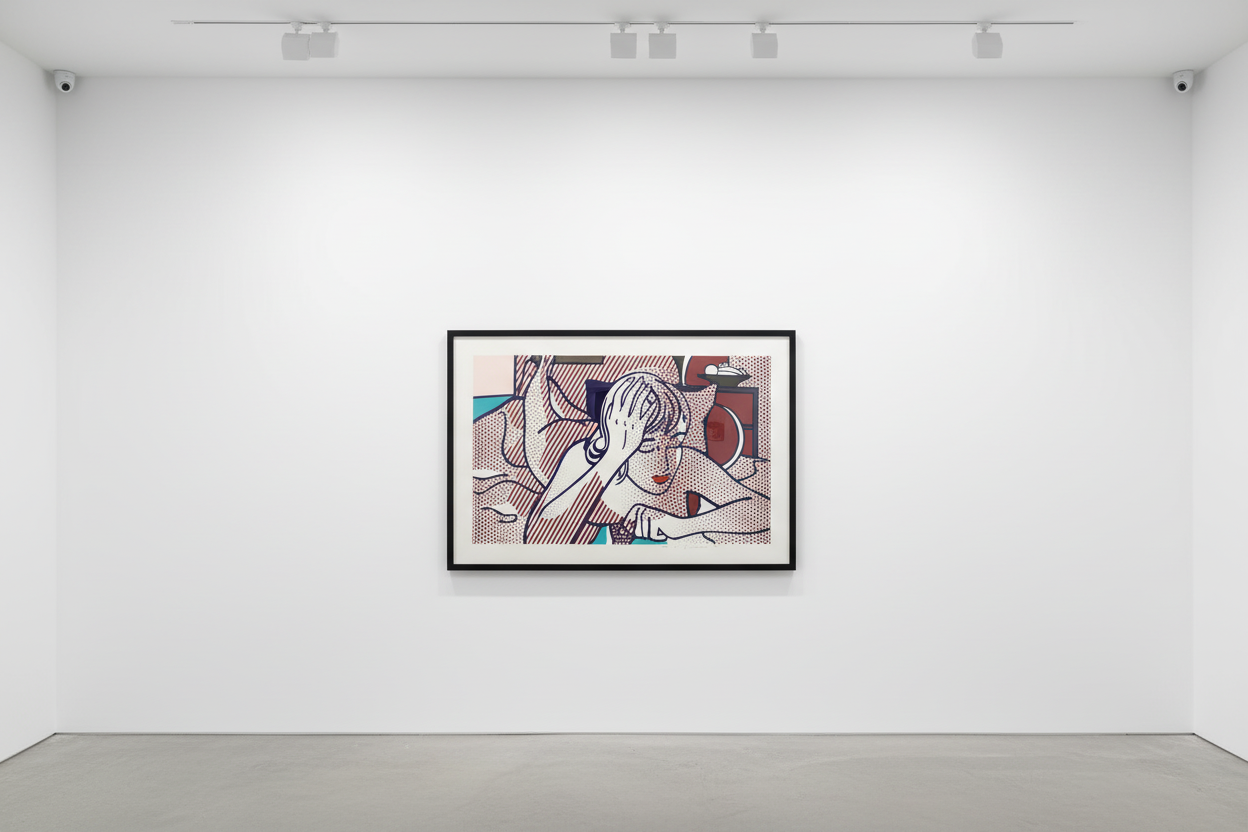
Roy Lichtenstein, Thinking Nude State I (C. 290), 1994. Lithograph. Available at Guy Hepner, 529 West 20th Street, New York. Browse Roy Lichtenstein Nudes →
The Nudes series as published by Gemini G.E.L. in 1994 comprises six screenprints, each presenting a reclining or seated female nude in a format that is broadly consistent across the series: bold black outlines, Ben-Day dot flesh passages, primary colour interiors, and a compositional vocabulary that consciously echoes the Matisse odalisque. The prints were produced on heavy rag paper, standard for Gemini's high-end production, and the edition sizes are consistent with Lichtenstein's practice in his late career.
Editions for the Nudes series prints are typically in the range of 60 to 100 impressions, plus artist's proofs (usually designated AP and numbered separately, typically 10–15% of the edition size), trial proofs (TP), printer's proofs (PP), and various documentation impressions. Each print is hand-signed by the artist in pencil in the lower right margin and numbered in the lower left. The blind stamp of Gemini G.E.L. is embossed in the lower right corner — a hallmark of authenticity that collectors should always verify.
Paper specifications for the Nudes series are consistent with Gemini's premium production standards of the period. The prints are produced on Somerset Satin wove paper or similar high-quality archival rag stock, typically 300–350 gsm, chosen for its stability, the quality of its surface for fine screenprint registration, and its long-term archival properties. The sheet size is generous, with margins of at least 2–3 inches on all sides, allowing the print image to breathe visually and providing space for authentication marks and the artist's signature.
Collectors interested in roy lichtenstein nudes series prints should be aware that the six prints in the series vary somewhat in tonal complexity and compositional ambition. The most sought-after impressions tend to be those with the richest dot-screen passages and the most complex interplay between figural and decorative elements — characteristic of Lichtenstein's engagement with Matisse's more patterned canvases. These command premiums of 20–40% over the simpler compositions at auction.
Colour in the Nudes series is deployed with the systematic rigour of a formal proposition rather than the spontaneous expressiveness of a painterly gesture. Lichtenstein's palette for the series is characteristically restricted: the primary triad of red, yellow, and blue, augmented by black and white, with the occasional deployment of green and a warm flesh tone achieved through dot-screen overlays of yellow and red on white paper. This restricted palette is simultaneously a tribute to Matisse — who himself often worked with startling chromatic economy — and an affirmation of Lichtenstein's commitment to the graphic, printed image.
The use of primary colours in relation to the female nude has a particular art-historical charge. The nude in Western painting has most often been rendered in the nuanced, complex flesh tones of oil paint — tones that require extended colour mixing and the kind of skill and time that only oil allows. Lichtenstein's primary colours deny this complexity entirely. The nude becomes blue, red, yellow, black, white. It becomes a diagram, a flag, a brand. The move is deliberately anti-erotic in its formal ambition: it removes the figure from the domain of desire and places it in the domain of analysis.
Yet the results are not cold. The interplay of the dot screen with the flat primary grounds creates a visual warmth that is partly optical — the eye does not register the dots individually but merges them into a perceived tone — and partly associative, through the long tradition of primary colour use in Matisse's decorative programme. The black outlines that frame every element are deployed with extraordinary confidence: they are thick, calligraphic despite their precision, and they function like the leading in a stained-glass window, simultaneously separating and unifying the colour fields they contain.
For collectors assessing lichtenstein female nude prints, colour quality is a primary criterion. Fading or discolouration of any of the primary areas — particularly the yellows, which are most susceptible to light damage — significantly diminishes value. Original colour saturation, visible when comparing a print to a high-quality catalogue illustration, should be the benchmark.
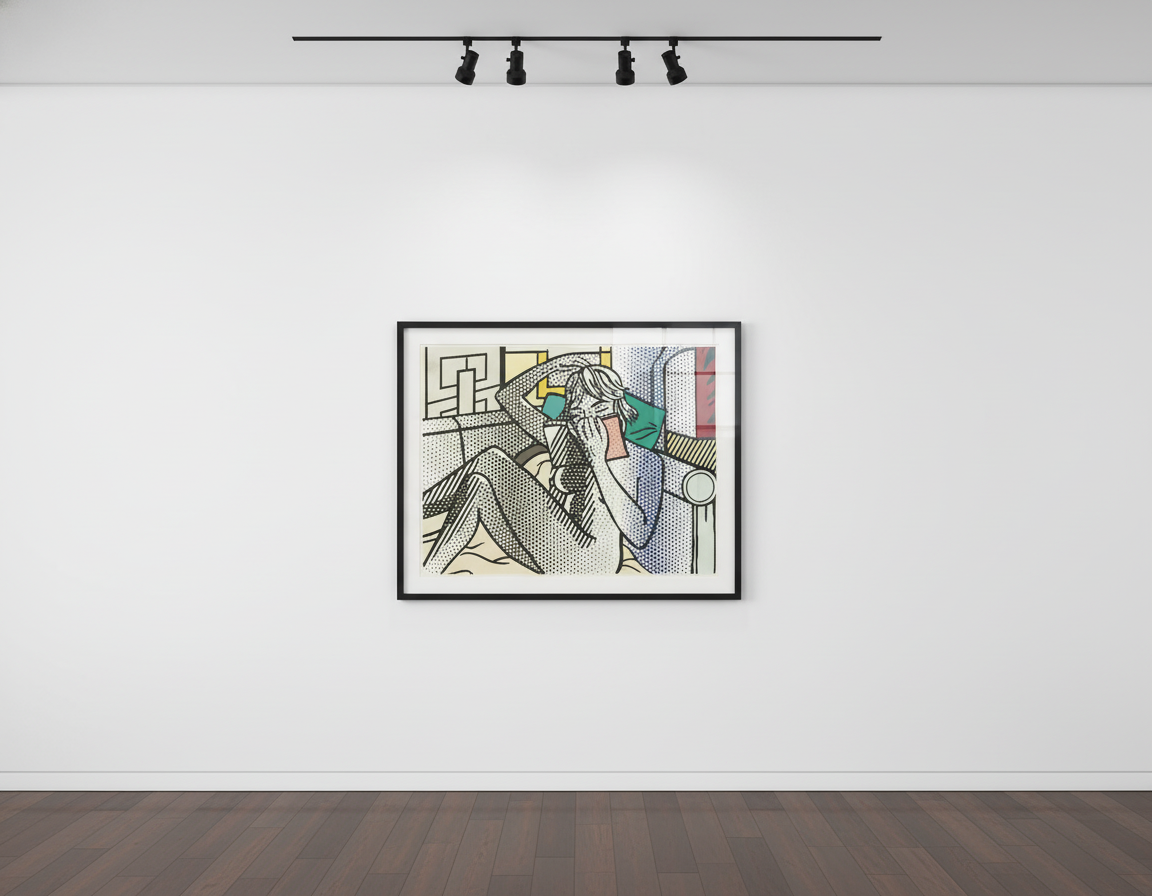
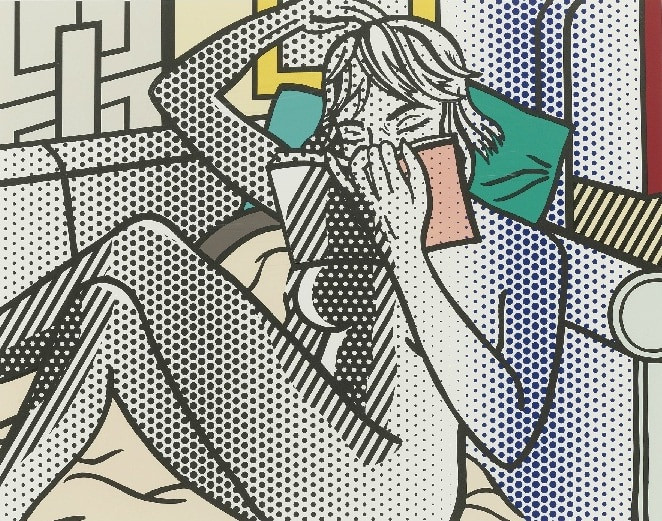
Roy Lichtenstein, Nude Reading (C. 288), 1994. Lithograph. Available at Guy Hepner, 529 West 20th Street, New York. Browse Roy Lichtenstein Nudes →
The market for Roy Lichtenstein prints has been one of the most consistently performing sectors of the print and multiple market for over four decades. The Nudes series, as a late, technically accomplished body of work with clear art-historical significance, occupies a strong position within this broader market, attracting both institutional collectors focused on the completeness of Lichtenstein's late print oeuvre and individual collectors drawn to the formal qualities of the specific images.
At auction, individual prints from the Nudes series have sold in the range of $60,000 to $250,000 depending on the specific print, condition, provenance, and the strength of the bidding market at the time of sale. Christie's, Sotheby's, and Phillips have all handled significant Lichtenstein Nudes examples in recent years, with the major New York day and evening sale sessions for prints and multiples being the primary market venues. Works with distinguished private collection provenance, accompanied by original Gemini G.E.L. documentation or certificates, consistently achieve premiums at the top of the estimate range.
The broader Lichtenstein print market provides essential context. Works from the artist's iconic early 1960s period — the Whaam! and Drowning Girl compositions — command the highest auction prices, with major examples exceeding $1,000,000 at auction. The late works, including the Nudes series, typically sell at a discount to the early icons but have shown consistent appreciation over the past fifteen years as collectors have come to appreciate the formal complexity of the late career. The Nudes series in particular has benefited from the critical reevaluation of Lichtenstein's late work as a serious engagement with art history rather than merely a recycling of earlier Pop formulas.
The primary market for buy roy lichtenstein nude prints proceeds through specialist dealers, Gemini G.E.L. archival stock, and galleries like Guy Hepner that maintain direct relationships with the Lichtenstein Foundation and Gemini archives. Primary market prices reflect the artist's estate and publisher valuations and typically set a floor below which secondary market prices rarely fall for prints in good condition.
For collectors considering roy lichtenstein nude prints for sale, the current market represents a considered entry point. The critical and market consensus on the importance of the late work has been building steadily, and the Nudes series — with its clear art-historical argument and technical excellence — is well-positioned for continued appreciation.
Purchasing any significant Lichtenstein print requires careful attention to authentication, condition, and catalogue documentation. The market is not immune to forgery and misattribution, and even honest errors of identification — confusing a reproduction for an original impression, or a later restrike for a period print — can result in significant financial loss. The following criteria are the professional standard for any serious acquisition.
Catalogue Raisonné Verification is the first and most important step. The definitive scholarly authority for Lichtenstein prints is The Prints of Roy Lichtenstein: A Catalogue Raisonné 1948–1997 by Mary Lee Corlett, published by the Hudson Hills Press in association with the National Gallery of Art (first edition 1994, revised edition 2002). Every print in the Nudes series is documented in Corlett with edition size, paper, dimensions, and a reproduction. Buyers should verify that any offered print matches its Corlett entry precisely in all technical particulars. Any discrepancy — in dimension, paper, edition size, or technical description — requires explanation before purchase.
Signature and Numbering: All genuine Nudes series prints are signed in pencil by the artist (not in marker or ballpoint pen) in the lower right margin. The pencil signature should show the natural variation of a hand-drawn mark — slight variation in pressure, the natural flow of a writing movement. Edition numbering (e.g., 45/75) appears in pencil in the lower left margin. Impressions designated AP, TP, or PP are numbered within those separate sequences and should be so indicated in the margin.
Gemini G.E.L. Blind Stamp: All Gemini G.E.L. publications carry a blind (uncoloured, debossed) stamp in the lower right corner of the sheet. This should be clearly legible under raking light. The absence of this stamp on a work claimed to be from the Nudes series is a significant warning sign.
Condition Assessment: The most common condition issues affecting Lichtenstein screenprints are fading (particularly of yellow passages under extended UV exposure), foxing or tidelines from water or humidity damage, surface abrasion, and creasing of the paper sheet. All are professionally assessable and will affect value proportionately. Prints in original, unrestored condition with no significant fading, no paper damage, and no loss to the ink layer should be considered the standard for acquisition at full market value.
Provenance Documentation: Original Gemini G.E.L. receipts, invoices, or certificates of authenticity accompanying a print provide the most direct chain of custody. Gallery receipts from recognised primary or secondary market dealers (including Guy Hepner), auction house sale records, and prior exhibition labels all contribute to a verifiable provenance history. Works with documented unbroken provenance from the original Gemini G.E.L. sale attract consistent premiums.
For collectors new to Lichtenstein prints, it is advisable to request a condition report and certificate from a specialist conservation or authentication service before any significant purchase, and to verify the Corlett catalogue raisonné reference independently. The Roy Lichtenstein Foundation maintains an authentication archive and can advise on the provenance of specific works.
The Nudes series does not stand alone in Lichtenstein's late career — it belongs to a broader programme of engagement with art history and formal systems that occupied the last two decades of his working life. Collectors building a coherent collection of late Lichtenstein prints should consider the following related series as complementary to the Nudes.
The Reflections series (1988 onward) is perhaps the most intellectually ambitious of all Lichtenstein's late print projects. These works depict reflected light on the surface of a painting or mirror, using diagonal lines and Ben-Day dots to represent the interference of reflected light with a pictorial surface. The Reflections series includes works that reflect back on the artist's own earlier imagery, creating a hall-of-mirrors effect in which the entire history of his work is subject to scrutiny. For collectors of the Nudes, the Reflections prints represent a natural companion: both series are preoccupied with the mediation of vision, the transformation of surface, and the question of what it means to see through a representational code.
The Modern Head series revisits the iconography of Art Deco and Cubist portraiture, particularly the schematised, chrome-and-enamel female head that recurs across the decorative arts of the 1920s and 1930s. Where the Nudes engage Matisse and Picasso through the full figure, the Modern Head works engage similar source material through the portrait — the face as an art-historical sign system rather than an individual physiognomy. Taken together with the Nudes, these prints establish Lichtenstein as one of the most systematic anatomists of the female figure in twentieth-century American art.
The Water Lilies series brings Monet into Lichtenstein's late-career programme of art-historical engagement. Produced in 1992, just two years before the Nudes, these prints subject the quintessential Impressionist image — Monet's beloved pond surface — to the same Ben-Day dot and primary-colour treatment as the figure works. The contrast is instructive: where the Nudes are concerned with volume, pose, and the tradition of the human figure, the Water Lilies are pure surface, pure abstraction of colour and light. Together they demonstrate the breadth of Lichtenstein's late engagement with European modernism, and they are often collected together by institutions and private collectors seeking to represent the full range of his final decade.
Collectors focused on Roy Lichtenstein's complete late print oeuvre should approach the Nudes not as isolated images but as part of this larger, coherent late-career argument. The argument is straightforward: all painting — whether Matisse's odalisques, Picasso's cubist nudes, Monet's water gardens, or his own earlier Pop canvases — is a system of signs. Lichtenstein's achievement is to have made that argument with formal beauty, technical precision, and an inexhaustible capacity for visual pleasure.
To enquire about available roy lichtenstein nudes series prints, contact Guy Hepner at 529 West 20th Street, New York, or visit our Nudes series page for current inventory. Our specialist team can advise on condition, provenance, edition positioning within the series, and market context for any specific work under consideration.
Explore Roy Lichtenstein prints for sale at Guy Hepner: Nudes, American Indian Theme, Art Critic, Brushstrokes, Cathedral.
Related Series