Paintings

July 29, 2026
Hunt Slonem artist stands as one of the most distinctive and consistently collected American painters of the past four decades, a Neo-Expressionist master whose luminous canvases of bunnies, birds, and butterflies have found permanent homes in over 250 museum collections worldwide. His work hangs in the Solomon R. Guggenheim Museum, the Metropolitan Museum of Art, the Whitney Museum of American Art, and the Smithsonian American Art Museum, placing him among the most institutionally validated living artists working today. For collectors seeking paintings that combine spiritual depth with immediate visual impact, that reward both intimate contemplation and dramatic presence in a room, Slonem offers something increasingly rare in contemporary art: a body of work rooted in genuine obsession rather than market calculation, executed with masterful technique, and available across a range of price points that accommodate both emerging and established collectors.
What distinguishes Slonem from artists who paint animals as mere subject matter is the totality of his immersion in his chosen iconography. This is a painter who lives inside his subjects. His studio houses an aviary of rescued exotic birds—at times numbering over one hundred cockatiels, macaws, parakeets, and finches—whose songs provide the ambient soundtrack to his daily practice. His rabbit paintings began not as a commercial strategy but as a personal reckoning with the Chinese zodiac, Slonem having been born in 1951, the Year of the Rabbit. His butterflies emerged from years of careful observation, their wings rendered with a luminosity that suggests both scientific precision and spiritual transcendence. This authenticity is legible in every canvas, and it is precisely what collectors respond to when they encounter his work for the first time.
Hunt Slonem emerged during the vibrant Neo-Expressionist movement of the late 1970s and early 1980s, a period that also saw the rise of Jean-Michel Basquiat, Julian Schnabel, and Francesco Clemente. While his peers often pursued figurative drama or cultural commentary, Slonem carved out a singular path focused on repetition, spirituality, and the natural world. His peripatetic childhood—born in Kittery, Maine, to a naval family, raised across Hawaii, Nicaragua, and various locations throughout the United States—cultivated an early appreciation for tropical birds, lush foliage, and the charged spiritual atmosphere of Caribbean and Central American life. These formative experiences would eventually crystallize into the three subject matters for which he is universally known.
The market for Slonem's work has demonstrated remarkable stability over five decades, a longevity that speaks to both the quality of his output and the genuine collector demand that sustains it. At auction, his paintings have appeared at Christie's, Sotheby's, Phillips, and Heritage, with prices ranging from accessible entry points around $2,000 for smaller works to over $150,000 for major canvases. This range reflects both the extraordinary volume of his production—Slonem is among the most prolific painters working today—and the clear hierarchy that collectors have established within his oeuvre. Large-scale oil paintings on canvas command premium prices, while smaller works on wood panels offer an accessible entry point without sacrificing the essential qualities that define his practice.
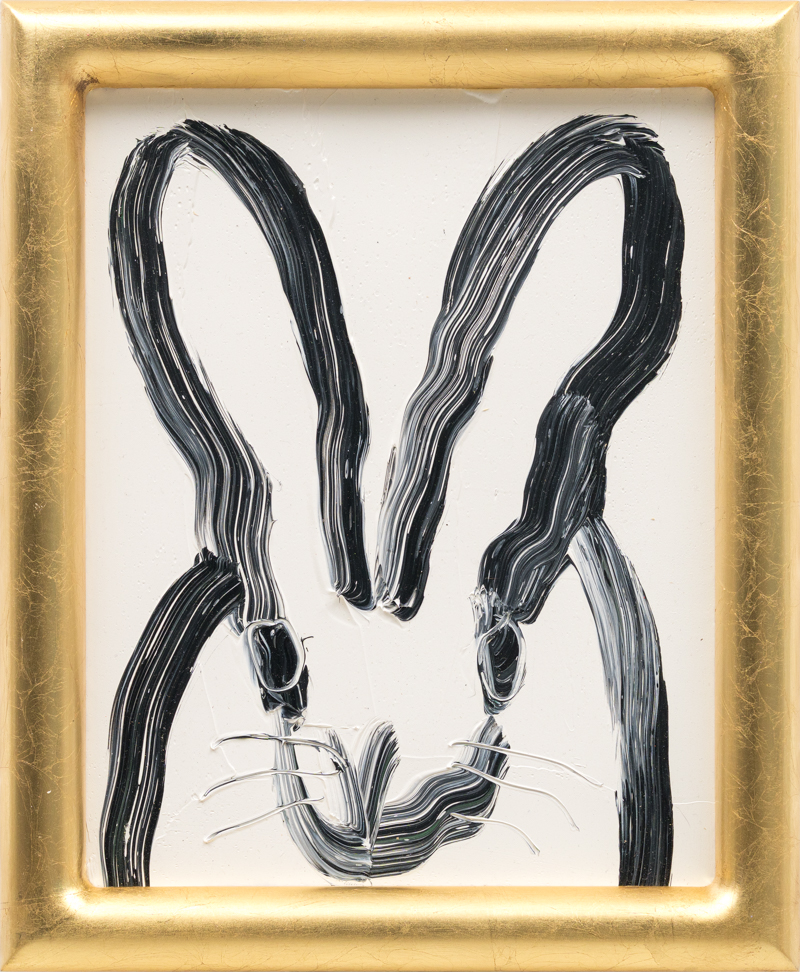
Hunt Slonem, Tatiana II, Oil on Wood. Available at Guy Hepner, New York.
Interior designers have long recognized Slonem as a favorite artist for sophisticated residential and commercial spaces. His saturated hues vibrate with life against both neutral and boldly colored walls, and his paintings possess the rare quality of commanding attention while integrating harmoniously into carefully curated environments. From the homes of U.S. presidents to the residences of cultural figures including Sharon Stone, Brooke Shields, and Jennifer Lopez, Slonem's work has proven its versatility across the most demanding contexts. For collectors, this design-world endorsement represents both validation of the work's aesthetic power and practical confirmation that these paintings will enhance virtually any interior.
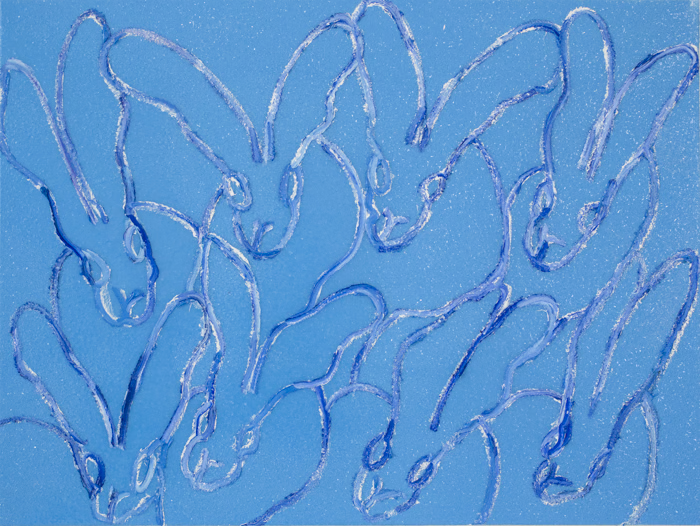
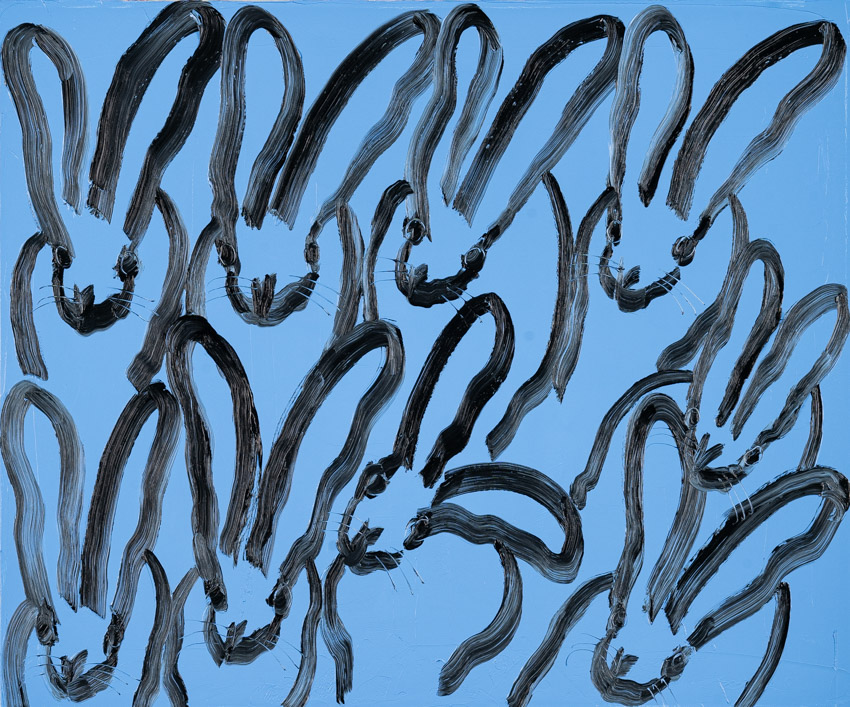
No subject in contemporary painting is more immediately associated with a living artist than the rabbit is with Hunt Slonem. He began painting Hunt Slonem bunnies in the early 1980s, and the series has never stopped. The origin is partly autobiographical—his birth year connection to the Chinese zodiac—but the paintings transcend autobiography entirely. What began as a personal symbol has evolved into something closer to a spiritual practice, each rabbit canvas functioning less as portraiture and more as mantra. The repeated imagery is an act akin to meditation, each painting asking the same question slightly differently, accumulating meaning through variation rather than invention.
Executed in gestural oil on wood panels or canvas, the Hunt Slonem rabbits are rendered in dense, repetitive strokes that build into fields of trembling form. Slonem has spoken extensively about repetition as a meditative act, a form of prayer or mantra: each bunny is both unique in gesture and part of a larger visual chant. The backgrounds shift between flat washes of saturated color—the deep oranges, electric blues, and luminous golds that have become his signature—and architectural gilded grounds that give each work an icon-like gravity. Works currently available through Guy Hepner, including Orange Bunny (2026), Hutch Monday (2025), and Michael (2026), demonstrate his current fluency within this established visual language while revealing the subtle evolution that keeps the series fresh after four decades.
Collectors prize the rabbit paintings for their accessibility as entry points into the market and their extraordinary consistency. Whether a small panel or a monumental canvas, the authority of the image never wavers. The gestural strokes that define each rabbit's form create a tactile surface that rewards close examination, while the overall composition reads with immediate clarity from across a room. This dual legibility—intimate and monumental simultaneously—explains why the bunny paintings have become the cornerstone of many Hunt Slonem collections, often serving as the first acquisition before collectors expand into his avian and lepidopteran work.
The Hunt Slonem birds arise from decades of direct observation in his working aviary, an environment that few other painters could claim to replicate. The exotic species that surround him daily—cockatiels, parakeets, macaws, finches, cardinals, and toucans—provide not merely visual reference but ambient presence. The birds sing while he paints. This immersion produces canvases that feel alive because they are made by someone surrounded by living things, and collectors consistently report a quality of animation in the bird paintings that distinguishes them from academic animal portraiture.
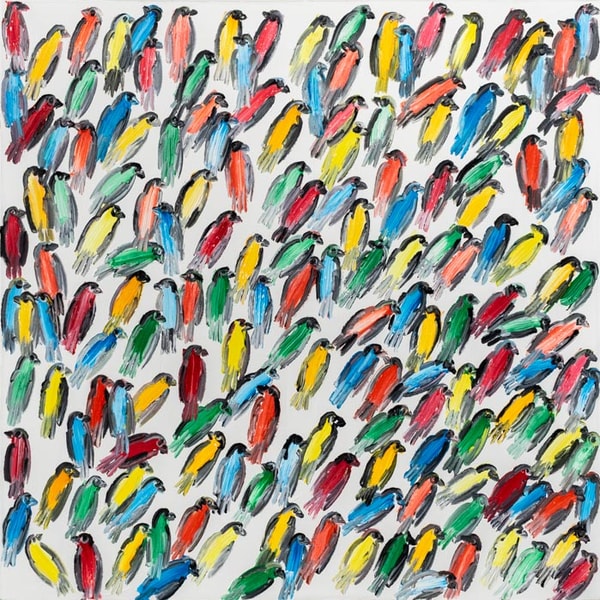
Hunt Slonem, Birds, Oil on Canvas. Available at Guy Hepner, New York.
Slonem employs a wet-on-wet technique across his bird series—pigment worked into still-wet ground—which produces the slightly blurred, trembling edges that characterize his surfaces at close range and give his compositions their distinctive pulsing quality from a distance. The Hunt Slonem toucans, with their dramatic bills and tropical coloring, offer some of the most visually striking examples of this technique, as seen in Toucans Honduras (2025). The Hunt Slonem finches and Hunt Slonem cardinals, meanwhile, tend toward more densely populated compositions, rows of birds built up through thick, expressive brushwork that blur the boundary between individual subject and overall pattern.
The spiritual dimension of these works is entirely intentional. Slonem has stated repeatedly that birds serve as his visual metaphor for consciousness, spirit, and soul. The avian form, with its capacity for flight and its associations with transcendence across virtually every human culture, carries symbolic weight that Slonem activates through painterly means rather than illustrative literalism. Cardinals Migration South (2026, Oil on Canvas) captures flocks in motion with an almost liturgical energy, while Red Ascension III (2025, Oil on Canvas) pushes further toward abstraction, crimson forms ascending through a dark field in a composition that reads simultaneously as ornithological observation and pure spiritual expression.
The Hunt Slonem butterflies offer perhaps the most immediately accessible entry point into his practice for collectors new to his work. Rendered with a luminosity reminiscent of stained glass, set against gold and jewel-toned grounds, these canvases read simultaneously as scientific specimen and pure abstraction. The wings are suggested through careful color gradation and gestural stroke rather than entomological precision, creating forms that hover between representation and pure chromatic experience. Color that holds a room. A surface that rewards close looking. The butterfly works deliver both.
Butterflys Stream (2023) exemplifies the series at its most characteristic, with specimens arranged in rhythmic patterns that create visual music across the canvas surface. The gold grounds that Slonem frequently employs recall Byzantine iconography, lending the butterflies an unexpected solemnity that elevates them beyond mere decoration. These are not naturalist illustrations but rather meditations on transformation, metamorphosis serving as both subject matter and metaphor for the spiritual themes that run through all of Slonem's work.
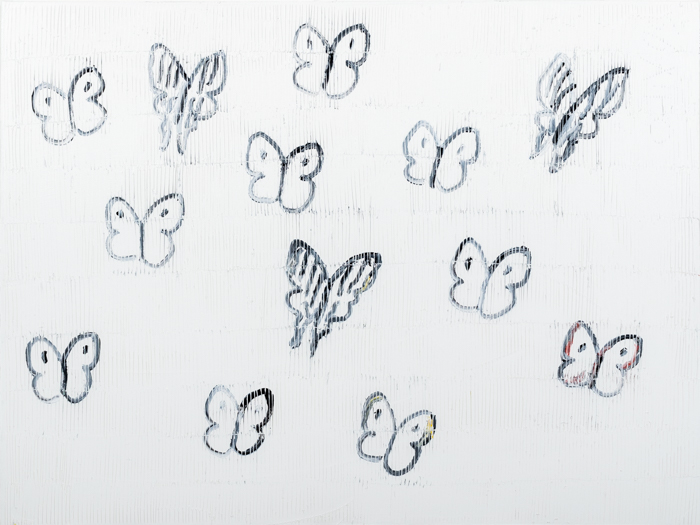
Hunt Slonem, Zebra, Oil on Canvas. Available at Guy Hepner, New York.
For collectors interested in maximalist home decor art that nonetheless carries serious artistic credentials, the butterfly paintings represent an ideal synthesis. They pair beautifully with both contemporary and traditional interiors, their saturated hues capable of anchoring a room or providing a dramatic accent within a more restrained scheme. The Hunt Slonem butterflies have proven particularly popular among interior designers seeking contemporary expressionist paintings with immediate visual impact and lasting aesthetic value.
Given Slonem's prolific output over four decades, collectors benefit from understanding the factors that distinguish exceptional examples within his oeuvre. Not all Hunt Slonem paintings are created equal, and careful evaluation ensures that your acquisition represents the strongest possible example for your investment.
Authentication of Hunt Slonem paintings benefits from several factors that make verification relatively straightforward compared to historical works. Slonem maintains active studio documentation, and the majority of works available through reputable galleries come with clear provenance chains that trace directly to the artist's studio. Guy Hepner sources Hunt Slonem paintings directly through established relationships, ensuring that every work offered comes with appropriate documentation and verification.
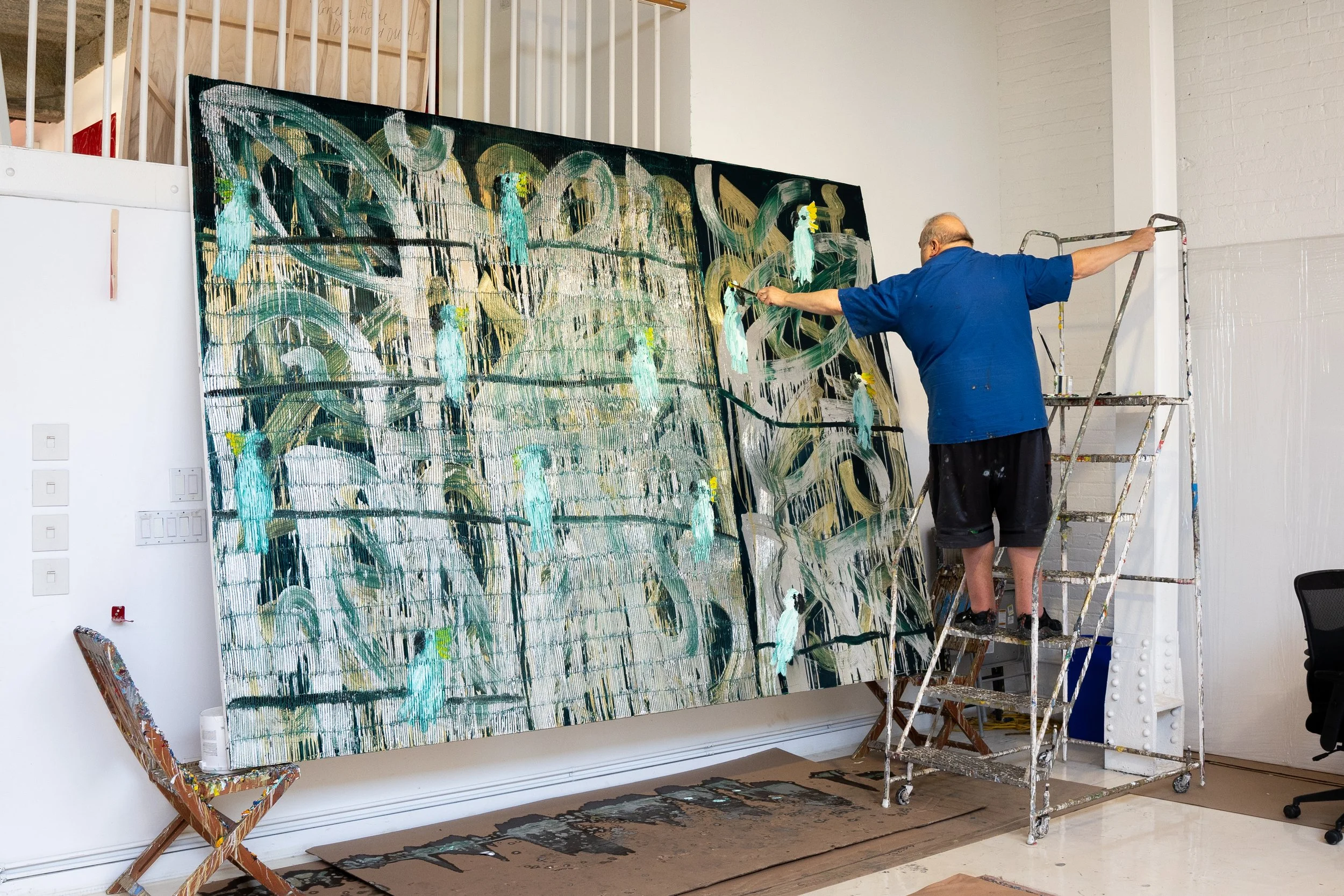
Hunt Slonem painting in New York Studio.
When evaluating works from the secondary market, collectors should request the following documentation:
Given the volume of Slonem's production, collectors should exercise appropriate caution with works offered through informal channels or without proper documentation. The consistency of his technique makes authentication by visual inspection alone challenging for non-specialists, and proper provenance documentation provides essential protection for your investment.
Hunt Slonem paintings for sale through Guy Hepner represent a curated selection from across his primary series, with current inventory including approximately fourteen published works ranging from $8,000 to $55,490. This range reflects the diversity of scale, medium, and complexity within his practice, offering collectors meaningful choice at various entry points.
The primary categories of available works include:
Availability fluctuates as works move into private collections, and desirable pieces in specific color palettes or subjects may require patience to acquire. Working with Guy Hepner allows collectors to communicate specific preferences and receive notification when matching works become available.
Understanding Hunt Slonem bunny painting price ranges and broader pricing structure helps collectors make informed acquisition decisions. The market has established clear hierarchies based on scale, medium, subject, and special finishes.
At auction, Hunt Slonem paintings have demonstrated consistent demand with results ranging from approximately $2,000 for smaller works to over $150,000 for major canvases from significant periods or featuring particularly desirable compositions. Gallery pricing through Guy Hepner reflects these market realities while offering the advantages of direct sourcing, proper documentation, and curatorial guidance.
Current pricing at Guy Hepner breaks down approximately as follows:
When considering how much is a Hunt Slonem worth, collectors should factor in both the specific characteristics of individual works and the broader trajectory of his market. His five-decade career, representation in over 250 museum collections, and consistent auction performance provide strong fundamentals for long-term value retention. Unlike artists whose markets depend on critical fashion or speculative interest, Slonem's collector base is established and genuine, built on the actual experience of living with his work rather than investment calculation alone.
For collectors considering multiple acquisitions, Slonem's work offers exceptional potential for collection building. The three primary series—bunnies, birds, and butterflies—create natural organizing principles, and many collectors find satisfaction in assembling representative examples across all three categories. The consistency of his aesthetic vision means that works from different periods and subjects hang together harmoniously, while the variety of scale and color palette allows for thoughtful curation across different rooms or installation contexts.
Strategies for building a cohesive Hunt Slonem collection include:
Guy Hepner has established long-standing relationships with Hunt Slonem's studio, enabling direct access to his most recent paintings as well as significant earlier works. The gallery's expertise in post-war and contemporary art provides collectors with knowledgeable guidance on evaluation, authentication, and collection building. Located at 529 West 20th Street in New York, the gallery offers private viewing appointments that allow collectors to experience works in person before acquisition—an essential step for fully appreciating the tactile richness and luminous color that define Slonem's canvases.
The gallery's advisory services extend beyond individual acquisitions to comprehensive collection building, helping collectors develop cohesive holdings that reflect their personal vision while maintaining strong fundamentals for long-term value. For Hunt Slonem specifically, the gallery can provide guidance on acquiring across series, building installations, and identifying exceptional examples that will anchor a collection for decades to come.
To inquire about currently available Hunt Slonem paintings, schedule a private viewing at our Chelsea gallery, or discuss how his work might complement your existing collection, contact Guy Hepner at +1 (212) 226 8680 or info@guyhepner.com. Whether you are acquiring your first Slonem or adding a significant piece to an established collection, the gallery's specialists are prepared to provide the expertise and access that serious collecting requires.
Related Series