Mao

August 4, 2026
In February 1972, Richard Nixon stepped off Air Force One in Beijing, becoming the first American president to visit the People's Republic of China. The handshake between Nixon and Premier Zhou Enlai was broadcast to millions of American television viewers—a diplomatic earthquake that cracked open two decades of Cold War isolation. Within months, Andy Warhol had begun work on what would become one of the most audacious portrait series of the twentieth century: his monumental paintings and prints of Chairman Mao Zedong. The Andy Warhol Mao series, produced between 1972 and 1973, transformed the face of the world's most powerful Communist leader into something unprecedented—a pop icon rendered in hot pink, electric blue, and lurid green, subjected to the same silkscreen treatment Warhol had applied to Marilyn Monroe and Campbell's soup cans.
The series emerged from a conversation between Warhol and his Swiss dealer Bruno Bischofberger about painting the most important figure of the twentieth century. Bischofberger initially suggested Albert Einstein, but Warhol demurred. "I was just reading in Life magazine that the most famous person in the world today is Chairman Mao," he reportedly replied. "Shouldn't it be the most famous person, Bruno?" The distinction was crucial and revealing. For Warhol, fame trumped ideas, celebrity outweighed significance, and the mechanism of image-making was more interesting than the substance behind it. Mao's portrait, reproduced hundreds of millions of times in the Little Red Book that every Chinese citizen was expected to carry, represented the ultimate ready-made icon—a face more widely distributed than any advertisement, any movie star, any product logo in history.
To understand the Warhol Mao paintings fully, one must grasp the particular cultural vertigo of that historical moment. Nixon's China visit represented a fundamental realignment of global politics, the thawing of hostilities that had defined American foreign policy since the Communist revolution of 1949. Suddenly, the bogeyman of American Cold War propaganda was being toasted with mao-tai at state banquets, his image appearing on the front pages of every American newspaper. The ideological certainties of a generation were dissolving in real time, and Warhol—ever attuned to the frequencies of mass media—recognized the moment's potential immediately.
Warhol's approach to the portrait was characteristically deadpan. He appropriated the official photograph that appeared on the frontispiece of Quotations from Chairman Mao Zedong, the so-called Little Red Book that had been printed in an estimated one billion copies since its 1964 publication. This image, rigidly controlled by the Chinese Communist Party, presented Mao in an austere frontal pose, his gaze directed slightly above the viewer—the iconography of authority, of the leader who sees beyond the individual to the historical horizon. By selecting this specific source, Warhol was working with an image already saturated with political meaning, already functioning as propaganda, already mass-produced on a scale that dwarfed even his own factory output.
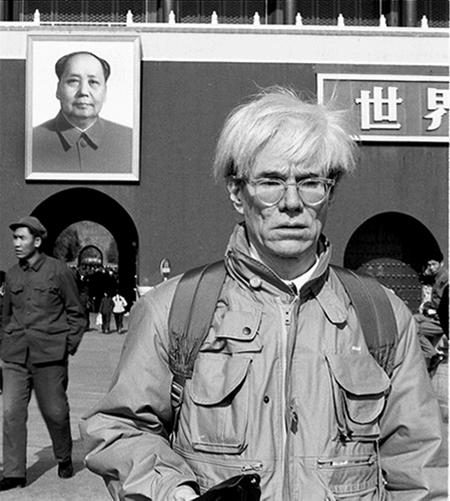
Andy Warhol in front of Tiananmen Square, Beijing, 1982. Image: © Christopher Makos, 1982
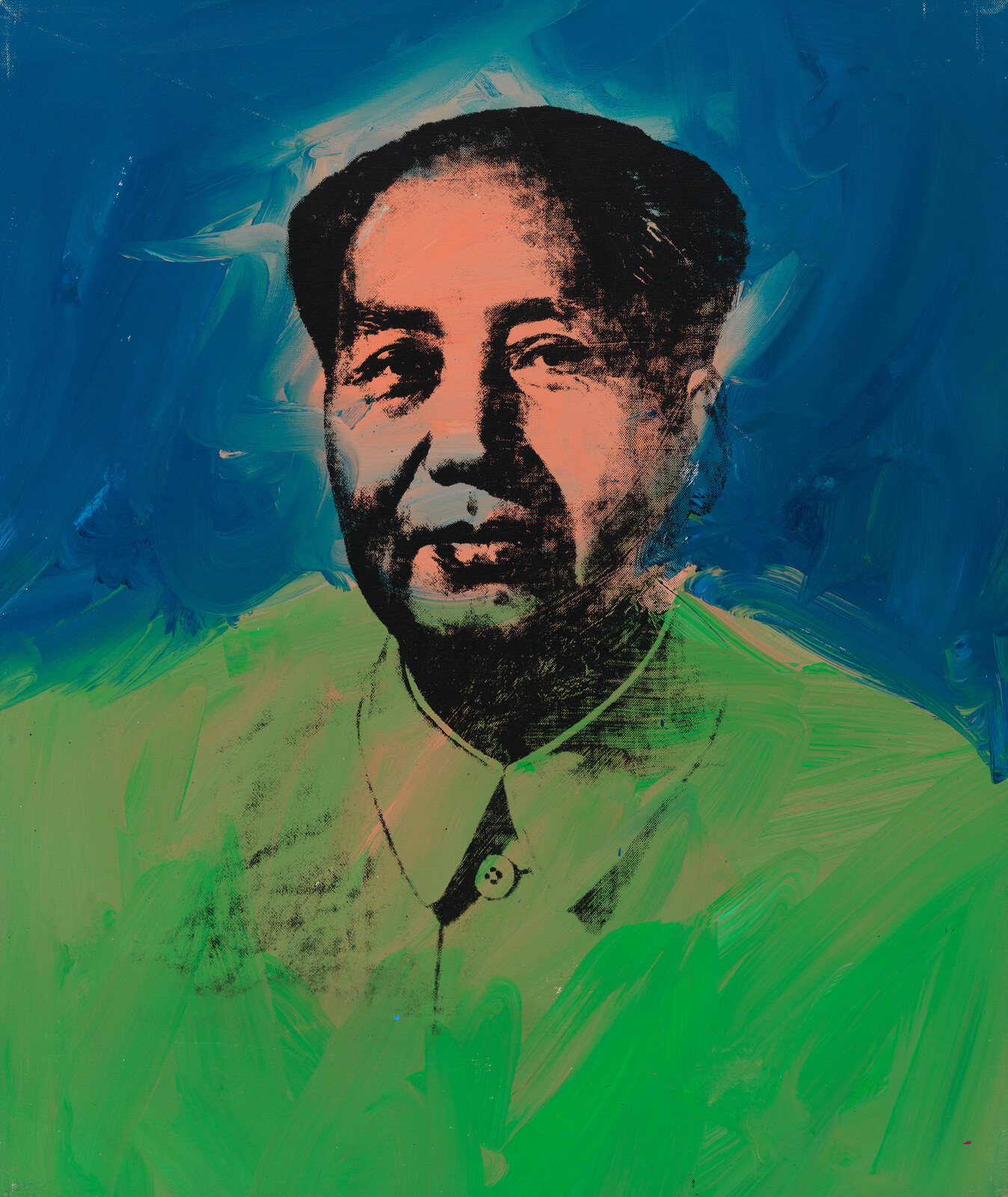
What Warhol did with this source material was simultaneously respectful and subversive. He maintained the fundamental structure of the official portrait—the frontal pose, the Mao suit, the direct gaze—while overlaying it with his signature pop art interventions. Garish colors were applied to Mao's face like cosmetics, transforming the Chairman into something resembling a drag queen or a fashion model. Loose, gestural brushstrokes slashed across the surface, introducing an element of Abstract Expressionist painterliness that the original photograph deliberately suppressed. The effect was deeply unsettling: Mao remained recognizable, authoritative, unavoidable, but he had been subjected to a kind of aesthetic violence that neither Communist propaganda nor Western political commentary had ever attempted.
Warhol's fascination with celebrity was never simply about glamour or superficiality. Throughout his career, he demonstrated a sophisticated understanding of how images function in mass society, how repetition transforms meaning, how fame operates as a system of reproduction rather than an attribute of individuals. His earlier portraits of Marilyn Monroe, created in the weeks following her death in 1962, had explored the relationship between celebrity, mortality, and the mechanical reproduction of images. The Marilyn series treated the actress as already a kind of photograph—a face so familiar, so endlessly reproduced, that it had become detached from the living person who once inhabited it.
The Mao series extended this investigation into explicitly political territory. Mao Zedong was not merely famous; he was the subject of one of history's most intensive personality cults, a figure whose image had been imposed on hundreds of millions of people as a condition of political loyalty. During the Cultural Revolution, which was still ongoing when Warhol began his series, Chinese citizens were expected to display Mao's portrait in their homes, carry his Little Red Book, and participate in ritualized veneration of his image. Warhol was reported to have been fascinated by the notion that Chinese households were permitted only one piece of artwork—a portrait of Chairman Mao—and that this single image had to serve all the functions that art might otherwise fulfill.
By treating Mao with the same silkscreen process he applied to consumer products and Hollywood celebrities, Warhol collapsed the distinction between political propaganda and commercial advertising. The Chairman became a brand, his face a logo, his political authority indistinguishable from the celebrity of Elvis or Liz Taylor. This was not necessarily a critique—Warhol was famously resistant to explicit political statements—but it was a profound observation about the nature of power in the age of mass media. Whether the image served the Communist Party or the capitalist art market, whether it appeared in the Little Red Book or on the wall of a collector's Manhattan apartment, the mechanism of reproduction and distribution remained fundamentally the same.
The Warhol Mao series represented a significant evolution in the artist's technical approach to portraiture. After being shot and nearly killed by Valerie Solanas in June 1968, Warhol had largely retreated from painting, focusing instead on film production, Interview magazine, and social activities. The Mao portraits marked his triumphant return to the canvas, demonstrating a new level of painterly sophistication that surprised critics who had dismissed him as a mere reproducer of found images.
The process began with Warhol's selection of the official Mao photograph, which was then translated into a photographic silkscreen. This screen was used to print the photographic image onto canvas in black or brown ink, establishing the basic structure of the portrait. But unlike his earlier celebrity portraits, which often presented the silkscreened image with minimal intervention, the Mao paintings featured extensive hand-painted elements that were applied both before and after the photographic printing.
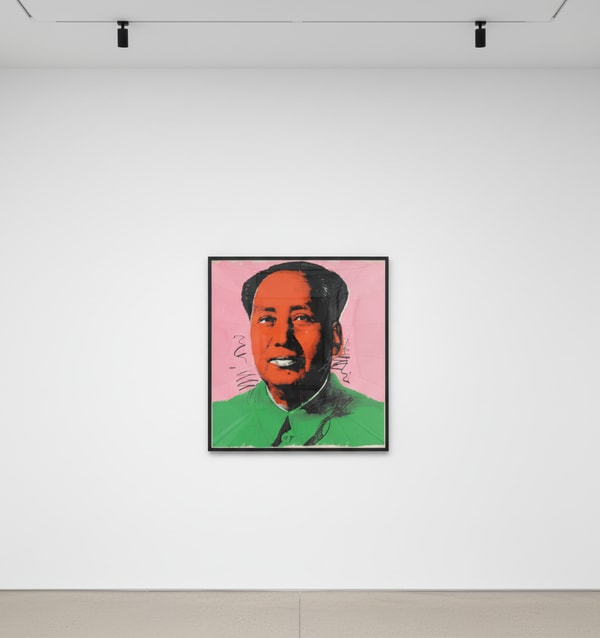
Andy Warhol, Mao F.S II 94 , Silkscreen print. Available at Guy Hepner, New York.
Warhol applied fields of bright acrylic color to the canvas before the silkscreen was printed, creating the vivid backgrounds and facial tones that give the series its distinctive pop impact. After the photographic image was laid down, he added further painted elements—lipstick-like red on Mao's mouth, blue eyeshadow above his eyes, loose calligraphic strokes that dance across the surface like graffiti. These gestural marks, executed in pencil as well as paint, introduced an element of expressionistic spontaneity that complicated the mechanical reproducibility of the silkscreen process. Each painting, while sharing the same underlying photographic source, became a unique object through the accumulation of these hand-made interventions.
The result was a body of work that occupied a strange middle ground between painting and printing, between the handmade and the mechanical, between Pop Art's embrace of commercial imagery and Abstract Expressionism's valorization of individual gesture. Critics who had accused Warhol of abdicating artistic authorship by using photographic silkscreens were confronted with works that displayed obvious painterly skill and deliberate compositional choices. The Mao series demonstrated that Warhol's apparent passivity—his famous claim that he wanted to be "a machine"—was itself a strategic pose that obscured a more complex artistic intelligence.
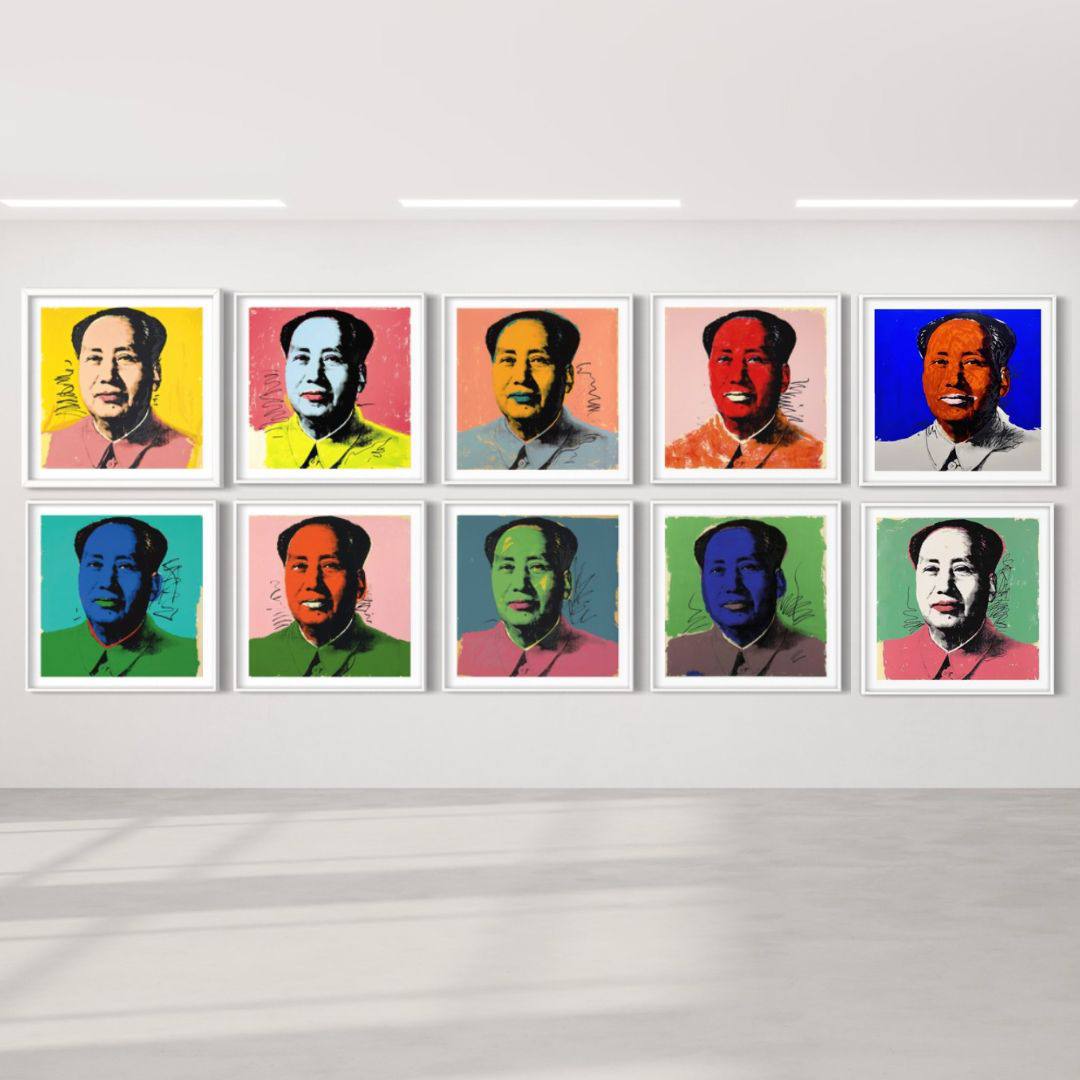
In addition to the monumental canvases, which ranged in size from 12 by 10 inches to the colossal 177 by 137 inch Giant Mao paintings, Warhol produced a portfolio of ten silkscreen prints in 1972. Catalogued as FS II.90–99 in the Feldman/Schellmann catalogue raisonné, this print portfolio was published by Styria Studio in New York in an edition of 250 plus 50 artist's proofs. Each print measures 36 by 36 inches and was printed on Beckett High White paper, presenting a square format that differs from the vertical orientation of the paintings.
The print portfolio encompasses a remarkable range of colorways, from austere compositions that preserve the severity of the original propaganda image to vibrant variants that reframe Mao within the visual language of pop culture. Some prints emphasize the photographic quality of the source image, rendering Mao in subtle tones that recall the original Little Red Book illustration. Others transform the Chairman into a riot of complementary colors—hot pink faces against chartreuse backgrounds, orange skin offset by blue Shadows—that push the imagery toward pure abstraction while maintaining the fundamental recognizability of the portrait.
This chromatic range makes the Mao portfolio one of Warhol's most versatile from a collector's perspective. Individual prints within FS II.90–99 vary considerably in mood, palette, and price point, while all sharing the same underlying conceptual architecture. The complete portfolio, when displayed together, creates a cumulative effect that emphasizes Warhol's investigation of serial imagery and the way meaning shifts through repetition with variation. Collectors may acquire individual prints that resonate with their aesthetic preferences, or pursue the more ambitious goal of assembling complete or partial portfolios that demonstrate the full range of Warhol's chromatic experimentation.
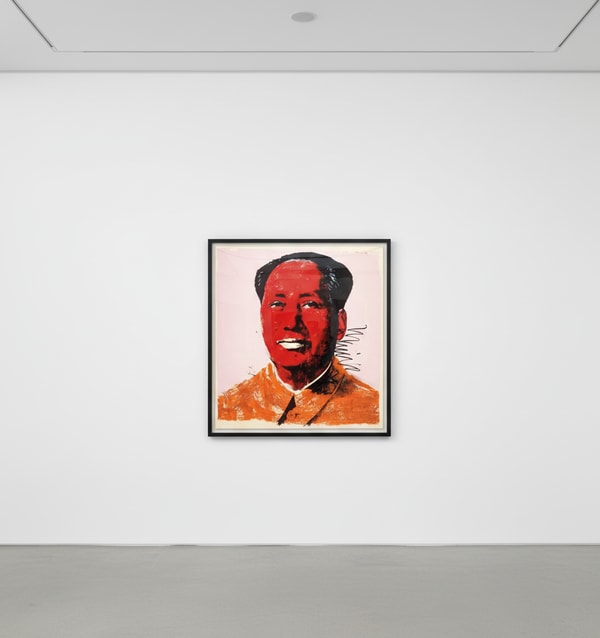
Andy Warhol, Mao F.S II 96, Silkscreen print. Available at Guy Hepner, New York.
The initial critical reception of the Mao series was mixed, reflecting broader uncertainties about Warhol's position in the art world of the early 1970s. Some critics dismissed the work as another example of Warhol's opportunistic exploitation of current events, a cynical attempt to capitalize on the Nixon visit's media saturation. Others found the treatment of a Communist dictator with the same glamorizing techniques applied to American celebrities to be politically irresponsible, a false equivalence that trivialized both Hollywood glamour and totalitarian power.
More perceptive critics recognized that the series represented something more complex than either celebration or critique. The art historian Robert Rosenblum, writing about Warhol's portraits more generally, observed that they achieved a "frozen, iconic presence" that transformed their subjects into something resembling Byzantine saints or Egyptian pharaohs. This observation applies with particular force to the Mao portraits, which take an image already designed to function as a kind of secular icon and subject it to further processes of aesthetic transfiguration. Mao becomes both more and less human through Warhol's treatment—more vivid, more present, more visually compelling, but also more distanced, more abstract, more obviously a constructed image rather than a representation of a living person.
The Mao series has aged remarkably well, gaining in significance as Warhol's broader achievement has been reassessed and as the political questions it raises have become more rather than less urgent. In an era of personality cults, authoritarian strongmen, and the relentless circulation of political imagery through social media, Warhol's investigation of power, propaganda, and celebrity feels prophetic rather than dated. The series anticipated our current moment, in which political leaders self-consciously brand themselves as celebrities and in which the distinction between political discourse and entertainment has largely collapsed.
The Mao series occupies a distinctive position in the market for Warhol's work, combining art historical significance with strong visual appeal and demonstrated investment performance. The paintings, particularly the larger canvases, have achieved exceptional results at auction when they appear, though many of the most important examples have entered permanent museum collections where they are unlikely to reappear on the market. The Andy Warhol Museum in Pittsburgh, the Corcoran Gallery of Art in Washington D.C., and the Foundation Carmignac in southern France all hold significant Mao paintings, testimony to the series' institutional recognition and art historical importance.
For collectors, the print portfolio FS II.90–99 offers the most accessible entry point into this important body of work. The edition size of 250 plus artist's proofs ensures a reasonable supply of authenticated impressions, while the range of colorways allows collectors to select works that align with their aesthetic preferences and collecting strategies. Signed and numbered impressions command the strongest prices, with condition and provenance also playing significant roles in valuation. Works that can be traced to important collections or that have appeared in significant exhibitions carry premiums reflecting their documented history.
The Mao prints demonstrate the sustained collector interest that characterizes Warhol's most important series. Unlike some bodies of work that experience cyclical fluctuations in taste, the Mao portfolio has maintained consistent demand across decades, appealing to collectors interested in political art, portraiture, and the canonical achievements of American Pop Art. The series benefits from its dual nature as both a significant art historical document—Warhol's most explicit engagement with political imagery—and a body of visually striking works that hold their own in contemporary collecting contexts.
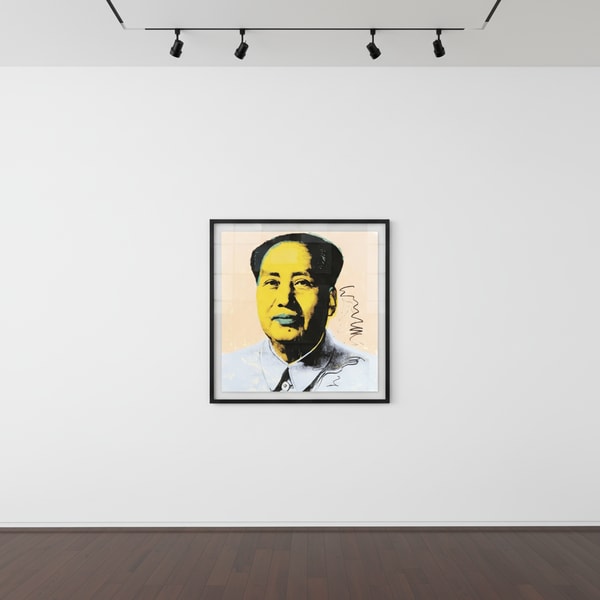
Andy Warhol, Mao F.S II 97, Silkscreen print. Available at Guy Hepner, New York.
The Mao series is often described as Warhol's first explicitly political work, though this characterization requires some qualification. Warhol had engaged with politically charged imagery throughout his career—his Electric Chair paintings, his Race Riot series, his portraits of Jackie Kennedy in the aftermath of the assassination—but these works tended to present their subjects with the same affectless equanimity applied to consumer products and celebrities. The political content was present but not foregrounded; the treatment did not obviously distinguish between a soup can and an execution chamber.
With Mao, the political dimension became unavoidable, though Warhol's characteristic ambiguity remained intact. Was he critiquing Communist propaganda by subjecting it to pop art glamorization? Was he celebrating Mao's achievement of a kind of ultimate celebrity, a fame so total that it required no media industry to maintain it? Was he making a pointed observation about the equivalence between Communist personality cults and capitalist consumer culture, both of which depend on the relentless reproduction and distribution of carefully controlled images? Warhol refused to clarify his intentions, offering only deadpan observations that could be read as ironic, sincere, or both simultaneously.
This ambiguity is not a weakness but a source of the series' enduring power. Works that deliver clear political messages tend to date quickly, their relevance tied to specific historical contexts that recede into the past. The Mao series remains compelling precisely because its meaning continues to be contested, because viewers in different eras and different political contexts can find new resonances in Warhol's treatment of power, image, and celebrity. In contemporary China, where Mao's legacy remains politically sensitive and officially controlled, the series carries meanings that could not have been anticipated when it was created. In the West, where authoritarian political styles have made unexpected returns, the series speaks to ongoing anxieties about the relationship between media spectacle and political power.
For collectors considering acquisition of works from the Mao series, several factors warrant careful attention. Authentication is paramount, as with all Warhol works, and collectors should insist on prints that can be verified through the Andy Warhol Foundation's authentication process or that carry unimpeachable provenance documentation. The Feldman/Schellmann catalogue raisonné provides the standard reference for the print portfolio, with each work assigned a specific catalogue number (FS II.90–99) that should be confirmed for any print under consideration.
Condition plays a significant role in valuation, and the particular characteristics of silkscreen prints on paper require informed assessment. Collectors should examine works for:
Provenance—the documented history of ownership—adds both scholarly and market value to works from the series. Prints that can be traced to important collections, that have been exhibited in museum shows, or that appear in significant publications carry premiums reflecting their documented history and reduced risk of authentication concerns.
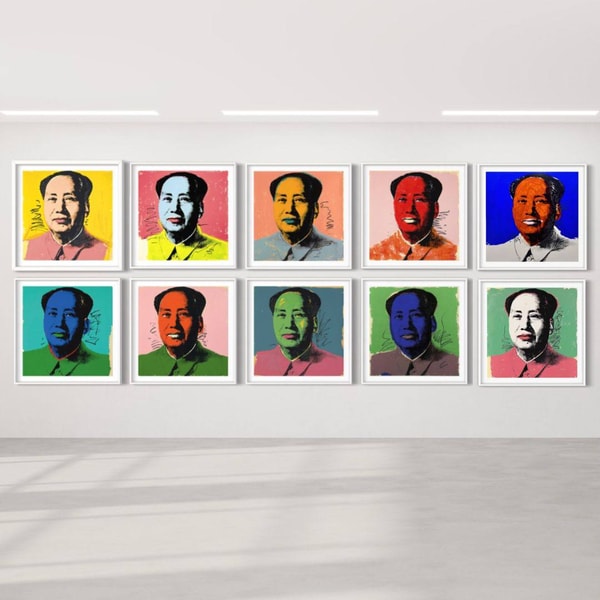
Andy Warhol, Mao Portfolio. Available at Guy Hepner, New York.
Viewed from the perspective of Warhol's complete career, the Mao series represents a crucial turning point and a significant achievement. It marked his return to painting after the trauma of the 1968 shooting, demonstrating that his creative powers remained intact and that he was capable of developing new approaches within his established practice. The series anticipated the commissioned portrait business that would dominate his 1970s output while maintaining a conceptual ambition that much of that portrait work would lack. And it established a template for Warhol's subsequent political portraits, including his images of Queen Elizabeth II, Lenin, and other figures of power and authority.
More broadly, the Mao series stands as one of the most searching investigations of political imagery that any artist has undertaken. Warhol recognized, before most cultural critics, that the line between political propaganda and commercial advertising had become indistinguishable in the age of mass media—that the mechanism of image-making and distribution was fundamentally the same whether the image served a Communist party-state or a capitalist consumer economy. This insight has only become more relevant in the decades since, as political campaigns have adopted the techniques of brand marketing and as the constant circulation of images through digital media has intensified the processes of repetition and variation that Warhol explored.
The series also demonstrates Warhol's sophisticated understanding of portraiture as a genre. By choosing an image that was already a propaganda portrait—already designed to present its subject in a particular ideological light—Warhol foregrounded the constructed nature of all portraiture. The Mao series asks, implicitly, whether any portrait can be said to represent its subject truthfully, or whether all portraits are inevitably exercises in image management, in the production of effects rather than the representation of realities. This question resonates with particular force in our current moment, when the manipulation of images has become a universal capability and the very concept of photographic truth has been destabilized.
The Mao series remains among Warhol's most intellectually provocative bodies of work—a series that asks, with deadpan precision, whether there is any meaningful difference between a Communist icon reproduced for political control and a celebrity image reproduced for commercial consumption. For collectors, these prints combine Warhol's technical mastery of the silkscreen medium with some of his most searching conceptual thinking, producing works that have aged into genuine art historical landmarks.
The market fundamentals are correspondingly strong. Works from FS II.90–99 are among the most consistently sought Warhol print series at auction, offering the combination of art historical weight, pop cultural resonance, and demonstrated investment performance that defines blue-chip print collecting. The range of colorways within the portfolio allows collectors to enter at various price points while acquiring works that share the same conceptual architecture and art historical significance. Individual prints can serve as powerful standalone works, while multiple acquisitions allow collectors to explore the serial nature of Warhol's investigation.
Guy Hepner Gallery, located at 177 Tenth Avenue in New York, specializes in museum-quality prints from Warhol's most significant series, including authenticated works from the Mao editions FS II.90–99. The gallery offers full provenance documentation and expert guidance for collectors seeking to acquire works from this historically important body of work. For those drawn to the intersection of art and politics, to Warhol's unflinching examination of power and celebrity, to prints that combine visual impact with intellectual depth, the Mao series offers opportunities that reward serious consideration.
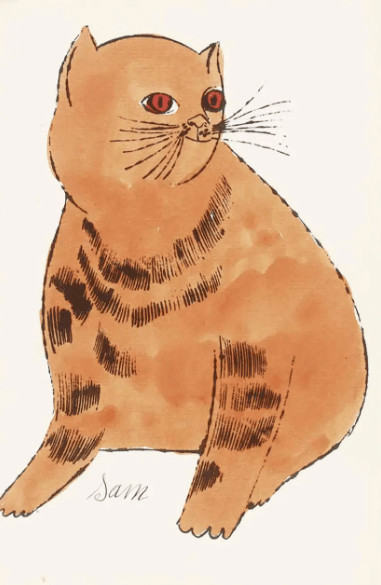
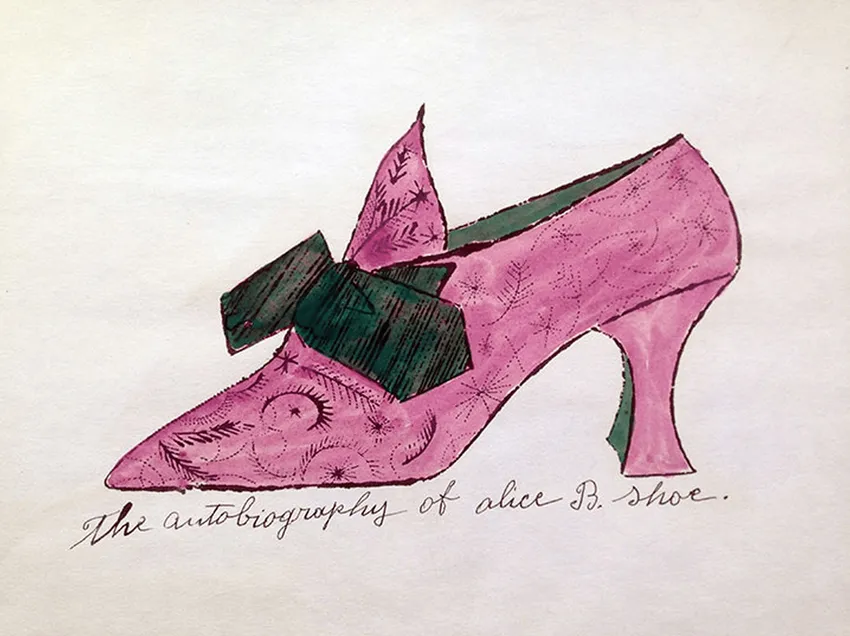
Explore Andy Warhol prints for sale at Guy Hepner: 25 Cats Named Sam, A Gold Book, A La Recherche Du Shoe Perdu, Alexander the Great, Banana.
Related Series