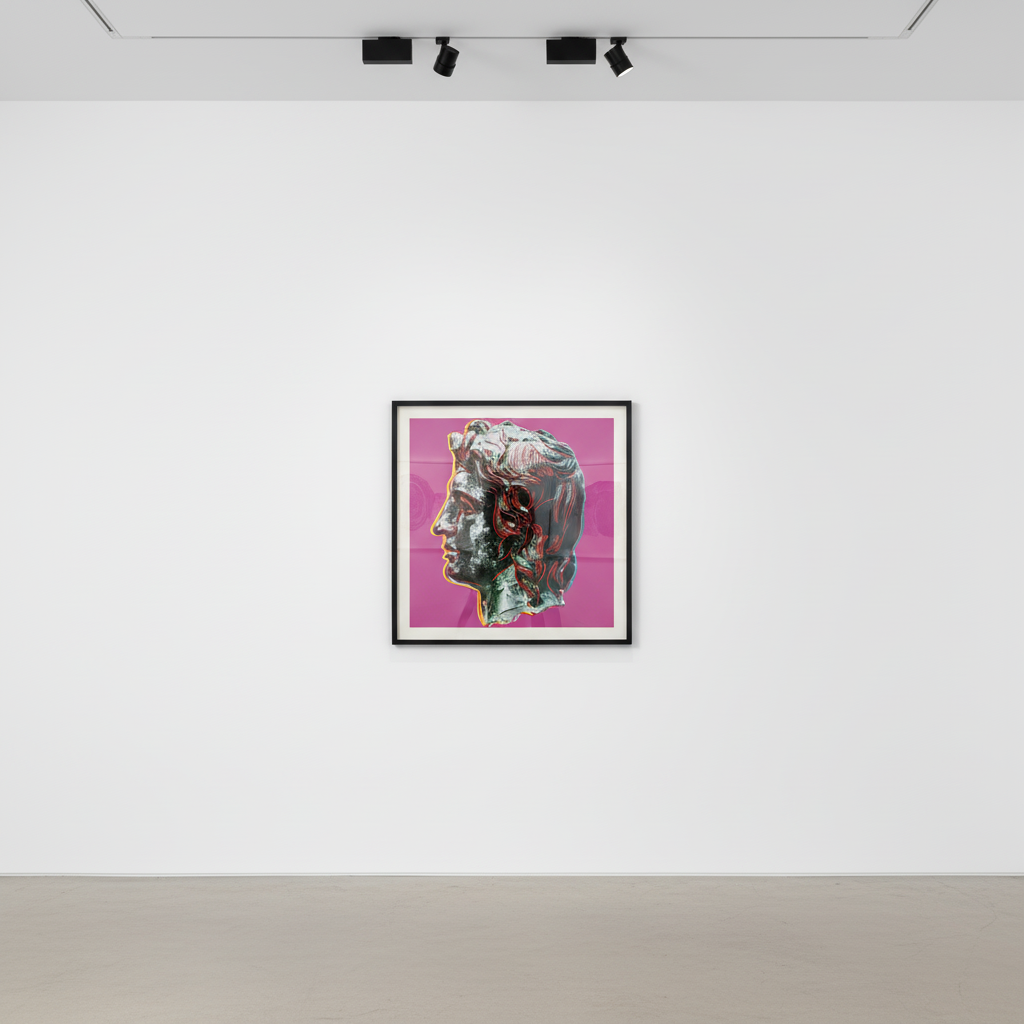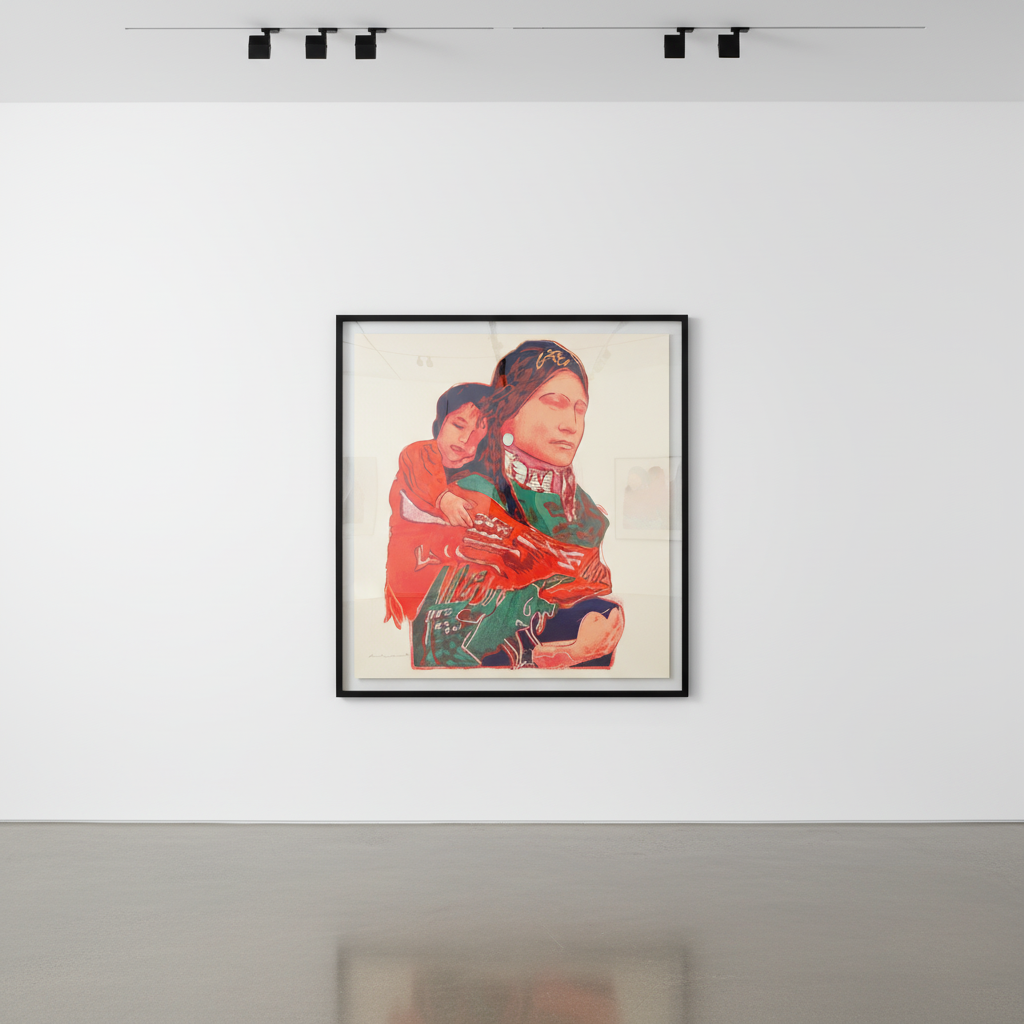
Cowboys and Indians

August 3, 2026
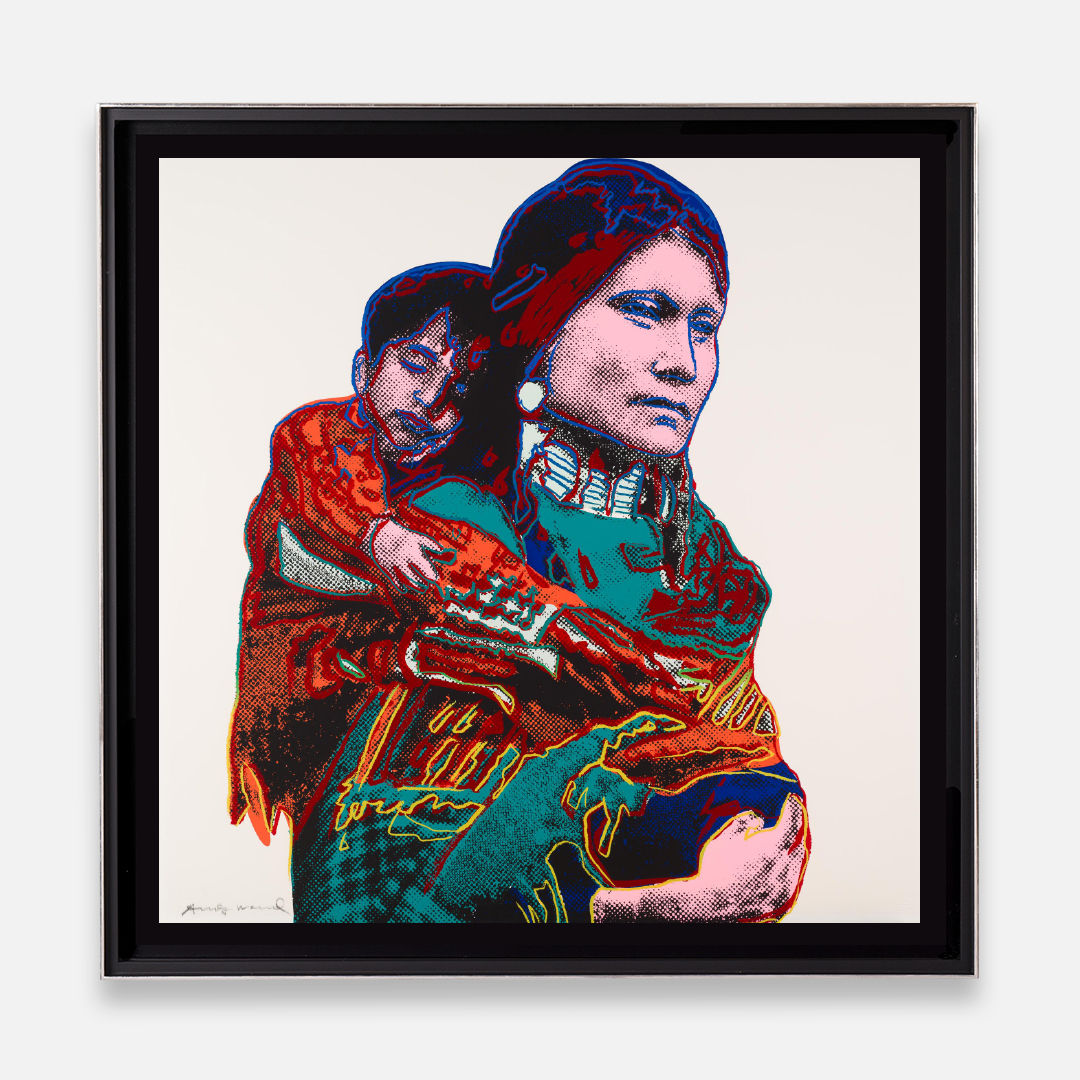
Andy Warhol's Cowboys and Indians prints represent one of the artist's most ambitious and culturally complex portfolios, created just months before his unexpected death in February 1987. This twelve-print series, catalogued as F.S. II.375-386, stands as Warhol's final sustained meditation on American mythology, combining Hollywood iconography with authentic Native American imagery to create a work that continues to resonate with collectors seeking pieces of profound historical and artistic significance. At Guy Hepner, we consider Cowboys and Indians among the most intellectually rich and visually commanding portfolios in Warhol's extensive print oeuvre, offering collectors the opportunity to acquire works that operate simultaneously as stunning pop art objects and pointed cultural commentary.
The portfolio arrived at a pivotal moment in Warhol's career, when the artist had spent decades examining how mass media shapes American identity and collective memory. By turning his attention to the American West—that foundational myth of conquest, heroism, and manifest destiny—Warhol created something far more nuanced than his celebrity portraits might suggest. These prints interrogate how we remember history, who becomes a hero, and what gets erased in the telling. For collectors, this intellectual depth adds layers of meaning that only deepen with sustained engagement, making Cowboys and Indians prints particularly rewarding acquisitions for those who value conceptual substance alongside aesthetic power.
The American West has always been more mythology than history, a distinction Andy Warhol understood with unusual clarity. From the earliest dime novels through John Ford's sweeping cinematography and onto television screens in countless living rooms, the West became America's foundational story—a tale of rugged individualism, civilizing progress, and inevitable triumph. Warhol, who had built his entire practice around the mechanics of image-making and celebrity construction, recognized the Western as perhaps the supreme example of media-manufactured reality.
By the mid-1980s, Warhol had already spent decades documenting how popular culture creates and circulates icons. His Marilyn Monroe portraits examined how death transforms a troubled actress into an eternal symbol. His Elvis paintings showed the construction of masculine cool. His Chairman Mao series explored political iconography across cultures. Cowboys and Indians extended this investigation to America's deepest origin story, asking how we manufacture heroes and villains from the raw material of historical violence. The timing proved significant: created in 1986, the portfolio arrived as revisionist histories of the American West were beginning to challenge triumphalist narratives that had dominated for generations.
Warhol's preparation for the series involved research at the National Museum of the American Indian in New York, where he photographed artifacts and objects that would inform several prints in the portfolio. This direct engagement with authentic Native American material culture distinguished Cowboys and Indians from simpler appropriations of Western imagery. Warhol was not merely reproducing Hollywood's version of the West but placing it in dialogue with genuine indigenous artifacts, creating a visual tension that sophisticated collectors immediately recognize. The portfolio thus becomes a meditation on authenticity itself—on what gets preserved, what gets commodified, and what vanishes beneath layers of media representation.
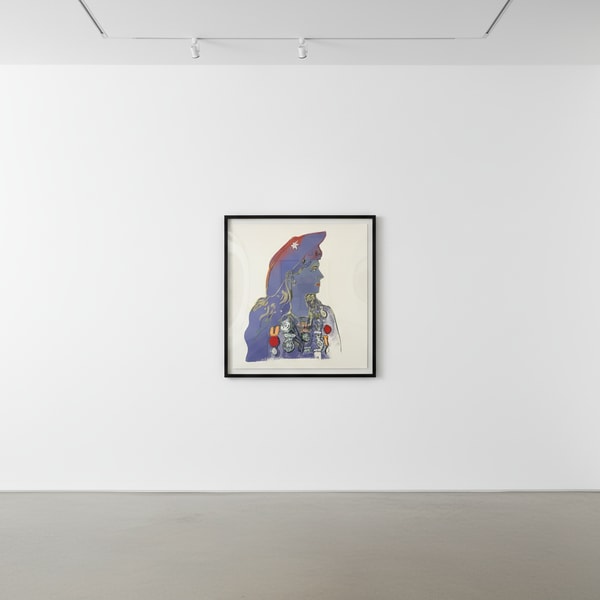
Andy Warhol, Annie Oakley, 1986, Screenprint. Available at Guy Hepner, New York.
Within Warhol's extensive print catalogue, Cowboys and Indians occupies a distinctive position that appeals to several collector categories simultaneously. The portfolio's late date—created the year before Warhol's death—gives it the aura of a final artistic statement, adding biographical weight that collectors find compelling. Works from an artist's final period often attract premium attention, and Cowboys and Indians benefits from this phenomenon while also standing entirely on its own aesthetic and conceptual merits.
The market for Warhol Cowboys and Indians prints has demonstrated consistent strength, driven by several factors that sophisticated collectors appreciate. First, the portfolio's twelve-print structure allows for multiple entry points at varying price levels, making it accessible to collectors at different stages of their acquisition journey. A collector might begin with a single portrait like Annie Oakley or John Wayne, then gradually build toward a complete set as opportunities arise. Second, the subject matter connects to enduring American cultural conversations about indigenous representation, historical memory, and national mythology—themes that continue gaining relevance in contemporary discourse.
Complete sets of the Warhol Cowboys and Indians portfolio command substantial premiums over the sum of individual prints, reflecting collectors' recognition that the series functions as a unified conceptual statement. The interplay between portraits of white Western figures and Native American subjects creates a dialogue that partial acquisitions cannot fully replicate. At auction and in private sales, complete portfolios consistently achieve results that reward patient collectors who acquire individual prints over time before ultimately uniting them into the full twelve-print series.
The prints also occupy an interesting position within Warhol's thematic categories. While his celebrity portraits remain the most immediately recognizable works, Cowboys and Indians offers something different: historical figures rather than contemporary celebrities, cultural archetypes rather than individual personalities. This distinction attracts collectors who may already own Marilyn or Mick Jagger works and seek something that expands their Warhol holdings into new conceptual territory.
The Cowboys and Indians portfolio comprises twelve screenprints, each measuring 36 x 36 inches (91.4 x 91.4 cm), published by Gaultney, Klineman Art, Inc. in New York. The edition structure follows Warhol's standard approach for major late-career portfolios: 250 signed and numbered impressions on Lenox Museum Board, plus a smaller number of trial proofs and printer's proofs. Understanding the specific prints and their individual characteristics helps collectors make informed acquisition decisions.
The portfolio includes several powerful depictions of Native American leaders, warriors, and cultural objects that form its moral center. Geronimo (F.S. II.384) presents the legendary Apache leader whose resistance to American expansion made him one of the most famous Native American figures in history. Warhol's rendering captures Geronimo's uncompromising gaze, rendered in the artist's characteristic high-contrast style that simultaneously celebrates and commodifies its subject. The tension between honoring Geronimo's historical significance and acknowledging how thoroughly his image has been appropriated by American popular culture creates the precise ambiguity that makes Warhol's work so intellectually engaging.
Sitting Bull (F.S. II.376) offers another monumental Native American portrait, depicting the Hunkpapa Lakota leader who famously defeated Custer at Little Bighorn before ultimately being killed by Indian agency police in 1890. Warhol's Sitting Bull carries enormous historical weight while also commenting on how this leader became a spectacle—literally so, during his time touring with Buffalo Bill's Wild West show. The print captures this transformation from resistance leader to entertainment commodity, a trajectory Warhol understood from his lifelong study of celebrity culture.
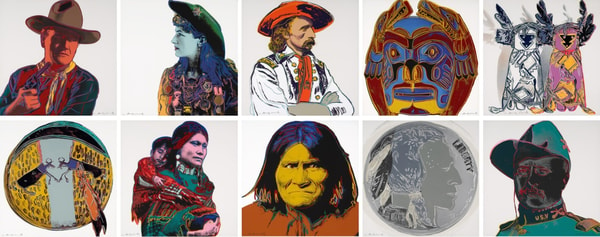
Andy Warhol, Cowboys and Indians Portfolio, 1986, Complete set of screenprints. Available at Guy Hepner, New York.
Mother and Child (F.S. II.383) presents a different perspective, offering a domestic image that counters the predominantly martial representations of Native Americans in Western media. This more intimate portrayal suggests the humanity erased by Hollywood's tendency to reduce indigenous people to obstacles or threats in narratives of white expansion. For collectors sensitive to representation issues, Mother and Child often holds particular significance within the portfolio.
The portfolio also includes objects photographed during Warhol's research: Northwest Coast Mask (F.S. II.380), Plains Indian Shield (F.S. II.382), and Kachina Dolls (F.S. II.381). These artifact-based prints connect to Warhol's longstanding interest in how objects accumulate meaning and value—themes he explored throughout his career, from his consumer product works through his time capsules. By presenting Native American objects through his signature screenprint technique, Warhol simultaneously preserves and transforms them, creating prints that comment on museum culture, ethnographic display, and the commodification of indigenous heritage.
John Wayne (F.S. II.377) stands as one of the portfolio's most iconic images, presenting the actor who embodied Hollywood's vision of Western masculinity for generations. Warhol's Wayne portrait connects to his extensive history of celebrity portraiture while also interrogating how cinema constructed the archetypal cowboy. Wayne never actually worked as a cowboy, of course—he was Marion Morrison from Iowa, transformed through Hollywood machinery into an eternal symbol of American frontier values. This gap between reality and image fascinated Warhol, and the John Wayne print remains among the portfolio's most sought-after individual works.
General Custer (F.S. II.379) presents a more explicitly controversial figure, the military officer whose defeat at Little Bighorn became one of American history's most mythologized events. Warhol's Custer carries complex valences: he appears as both tragic hero and foolish aggressor, depending on the viewer's historical perspective. The print's inclusion alongside Native American leaders like Sitting Bull and Geronimo creates an implicit dialogue about how we assign heroism and villainy in historical narrative.
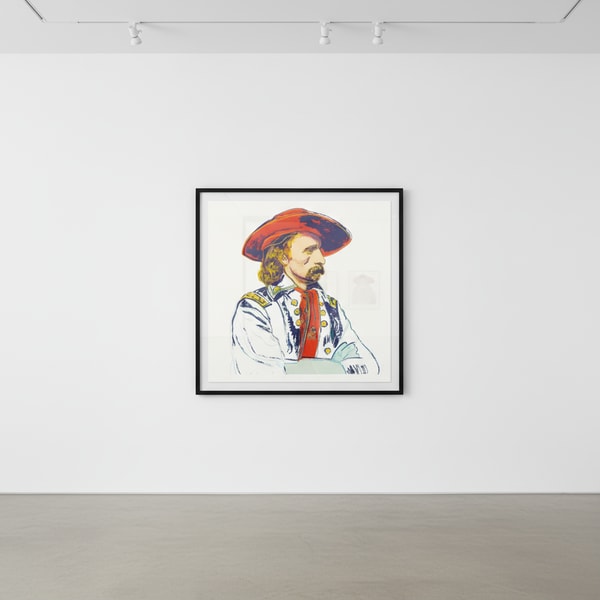
Andy Warhol, General Custer, 1986, Screenprint. Available at Guy Hepner, New York.
Annie Oakley (F.S. II.378) introduces the portfolio's lone female figure, the sharpshooter who became internationally famous through Buffalo Bill's Wild West show. Oakley's inclusion complicates simple gender narratives about the American West while also raising questions about performance and spectacle. She was a genuine expert markswoman, but she achieved fame through entertainment rather than frontier life—another instance where Warhol's interest in the construction of celebrity intersects with Western mythology.
Teddy Roosevelt (F.S. II.386) depicts the president most associated with Western expansion, conservation, and the strenuous masculine life. Roosevelt consciously fashioned himself as a Western figure, writing extensively about his time ranching in the Dakotas and projecting cowboy imagery throughout his political career. Warhol's portrait captures Roosevelt as a constructed icon rather than a simple historical figure, consistent with the portfolio's broader investigation of how media manufactures American heroes.
Buffalo Bill (F.S. II.377) rounds out the human subjects, presenting the entertainer who did more than perhaps anyone to shape popular perceptions of the American West. William Cody's traveling show employed actual Native Americans—including, famously, Sitting Bull himself—to perform dramatizations of Western conflict for audiences across America and Europe. This history makes Buffalo Bill a perfect Warhol subject: he was essentially in the image-manufacturing business, creating and circulating the very mythologies that Warhol's portfolio interrogates.
Collectors considering Andy Warhol Cowboys and Indians prints should understand the specific quality factors that affect both aesthetic impact and market value. Warhol's screenprint technique, while apparently simple, actually allows for considerable variation between impressions, and experienced collectors learn to distinguish exceptional examples from more ordinary ones.
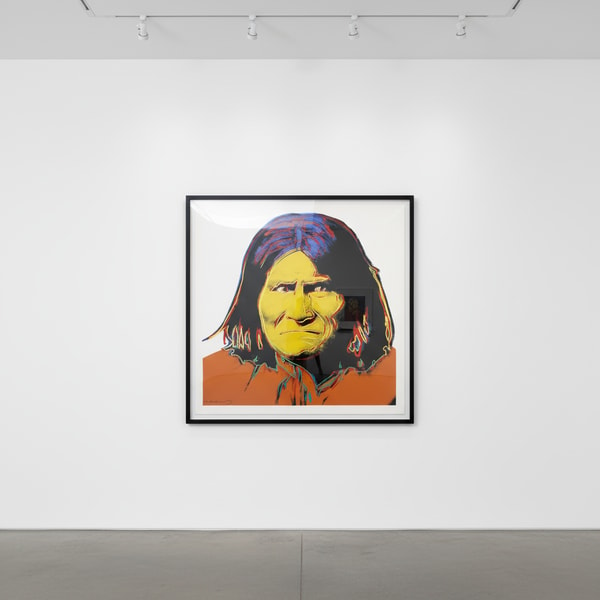
Andy Warhol, Geronimo, 1986, Screenprint. Available at Guy Hepner, New York.
Authentication represents a crucial consideration for any significant Warhol acquisition. The Andy Warhol Foundation for the Visual Arts previously operated an authentication board that examined works submitted for review, though this board ceased operations in 2011 after legal challenges. Today, authentication relies on a combination of provenance documentation, technical examination, and expert opinion.
The most secure acquisitions come with unbroken provenance chains tracing back to the original publisher, Gaultney, Klineman Art, Inc., or to documented early sales. Many impressions passed through established galleries and auction houses whose records provide documentation. The Andy Warhol Catalogue Raisonné, compiled by Frayda Feldman and Jörg Schellmann, provides the standard reference for Warhol prints, cataloguing the Cowboys and Indians series as F.S. II.375-386. Impressions that appear in this catalogue raisonné with verified documentation represent the gold standard for collectors.
When acquiring through Guy Hepner, collectors benefit from our thorough provenance research and condition assessment process. We trace ownership history, examine physical characteristics against known authentic examples, and provide comprehensive documentation supporting each acquisition. Our relationships with major Warhol scholars, estates, and institutional experts allow us to resolve questions that might otherwise create uncertainty.
Understanding the edition structure helps collectors navigate the market for Warhol Cowboys and Indians prints effectively. The portfolio exists in several distinct categories:
Availability fluctuates as the finite edition slowly concentrates in permanent collections. Some images appear at auction more frequently than others—John Wayne and Annie Oakley tend to surface regularly, while certain artifact prints appear less often. Complete portfolios are genuinely scarce, as the twelve-print sets have increasingly been absorbed into institutional and private collections unlikely to release them.
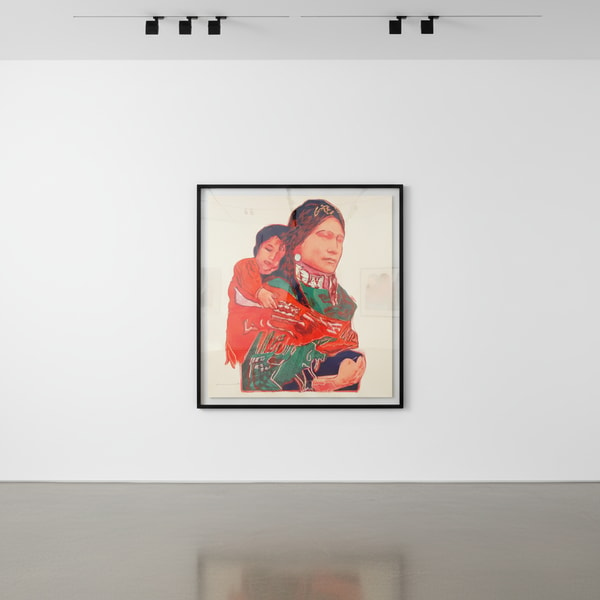
Andy Warhol, Mother and Child, 1986, Screenprint. Available at Guy Hepner, New York.
Andy Warhol Cowboys and Indians prices reflect the interaction of multiple factors: individual print popularity, condition, provenance strength, and broader market conditions for Warhol prints. While specific results vary, understanding general pricing dynamics helps collectors establish realistic expectations and recognize opportunities.
Individual prints from the portfolio typically range from approximately $30,000 to over $100,000 for exceptional examples, with portrait subjects generally commanding premiums over artifact images. John Wayne and Geronimo consistently achieve strong results, reflecting their iconic status within the portfolio. General Custer and Sitting Bull attract collectors interested in the historical narrative of Western conflict. Annie Oakley appeals to collectors seeking the portfolio's sole female figure.
Complete sets of all twelve prints achieve substantial premiums over the sum of individual print values, often 20-30% or more, reflecting collector recognition that the portfolio functions as a unified conceptual statement. The internal dialogue between Native American subjects and Western figures only fully emerges when the prints are experienced together. Collectors with long acquisition horizons often build complete sets gradually, acquiring individual prints as opportunities arise before uniting them.
Market timing affects pricing, as with any art category. Warhol prints have shown long-term appreciation, though short-term fluctuations respond to economic conditions and collecting trends. The Cowboys and Indians portfolio's subject matter—addressing indigenous representation and American historical mythology—has gained particular relevance in recent years, contributing to sustained collector interest.
Collectors approach the Cowboys and Indians portfolio with various strategies depending on their goals, resources, and available space. Each approach has merit, and the right strategy depends on individual circumstances:
Display considerations include lighting (avoid direct sunlight and UV-heavy artificial light), framing (museum-quality UV-filtering glazing is essential), and environmental control (consistent temperature and humidity protect paper-based works). The prints' substantial size makes them commanding presences in domestic and office settings, but requires thoughtful installation planning.
At Guy Hepner, we bring decades of experience with Andy Warhol's print oeuvre to every Cowboys and Indians acquisition. Our expertise encompasses provenance research, condition assessment, authentication support, and market analysis—the full range of services that informed collectors require. We maintain relationships with estates, foundations, and major Warhol scholars that allow us to resolve questions and provide documentation meeting the highest standards.
Our gallery at 177 Tenth Avenue in New York regularly handles individual prints and complete portfolios from this series, and we are pleased to discuss current availability, assist with building toward complete sets, or advise on acquisition strategy. Whether you are considering your first Warhol acquisition or seeking to expand an established collection with this significant late-career work, we welcome the opportunity to assist.
To enquire about Andy Warhol Cowboys and Indians prints currently available through Guy Hepner, or to discuss acquisition strategy for this remarkable portfolio, please contact our gallery. We look forward to helping you acquire works that represent both powerful aesthetic experiences and meaningful cultural statements.
Explore Andy Warhol prints for sale at Guy Hepner: Cowboys and Indians, 25 Cats Named Sam, A Gold Book, A La Recherche Du Shoe Perdu, Alexander the Great.
Related Series