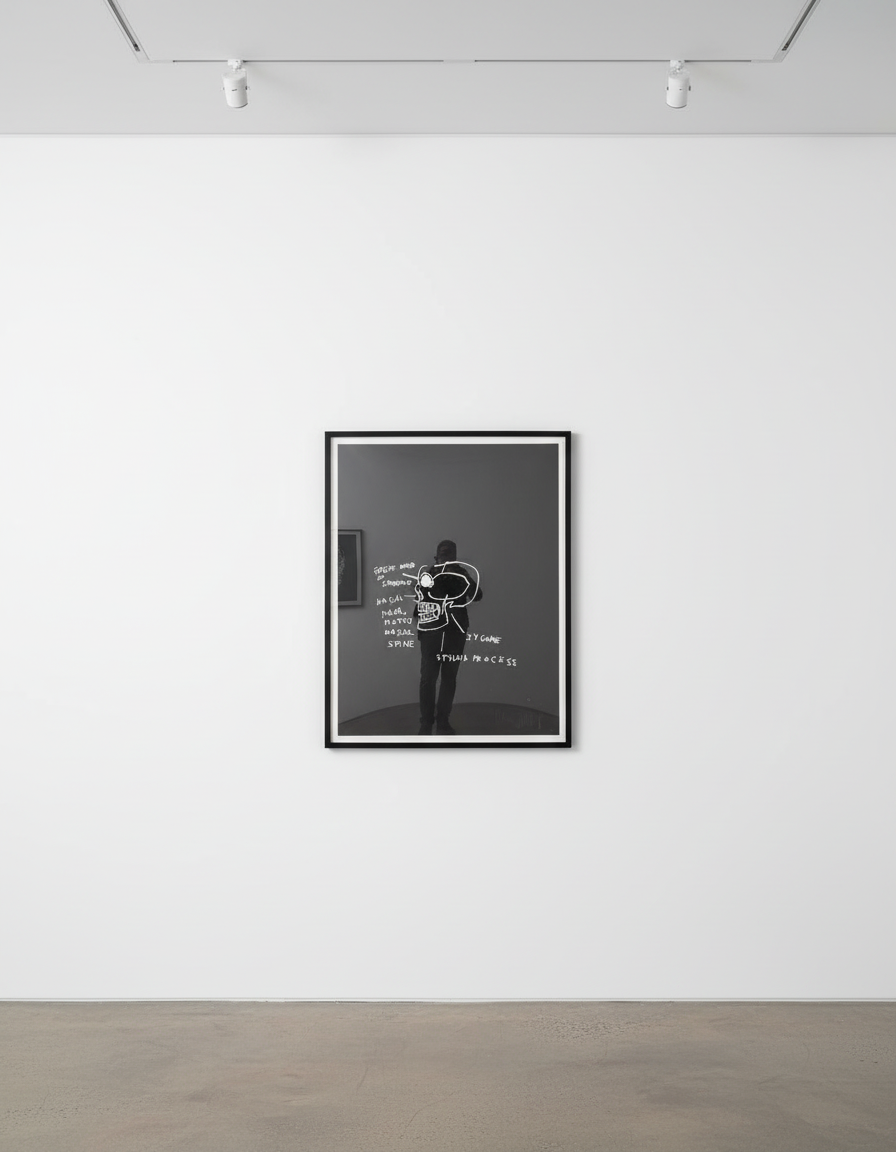
Anatomy

May 18, 2026
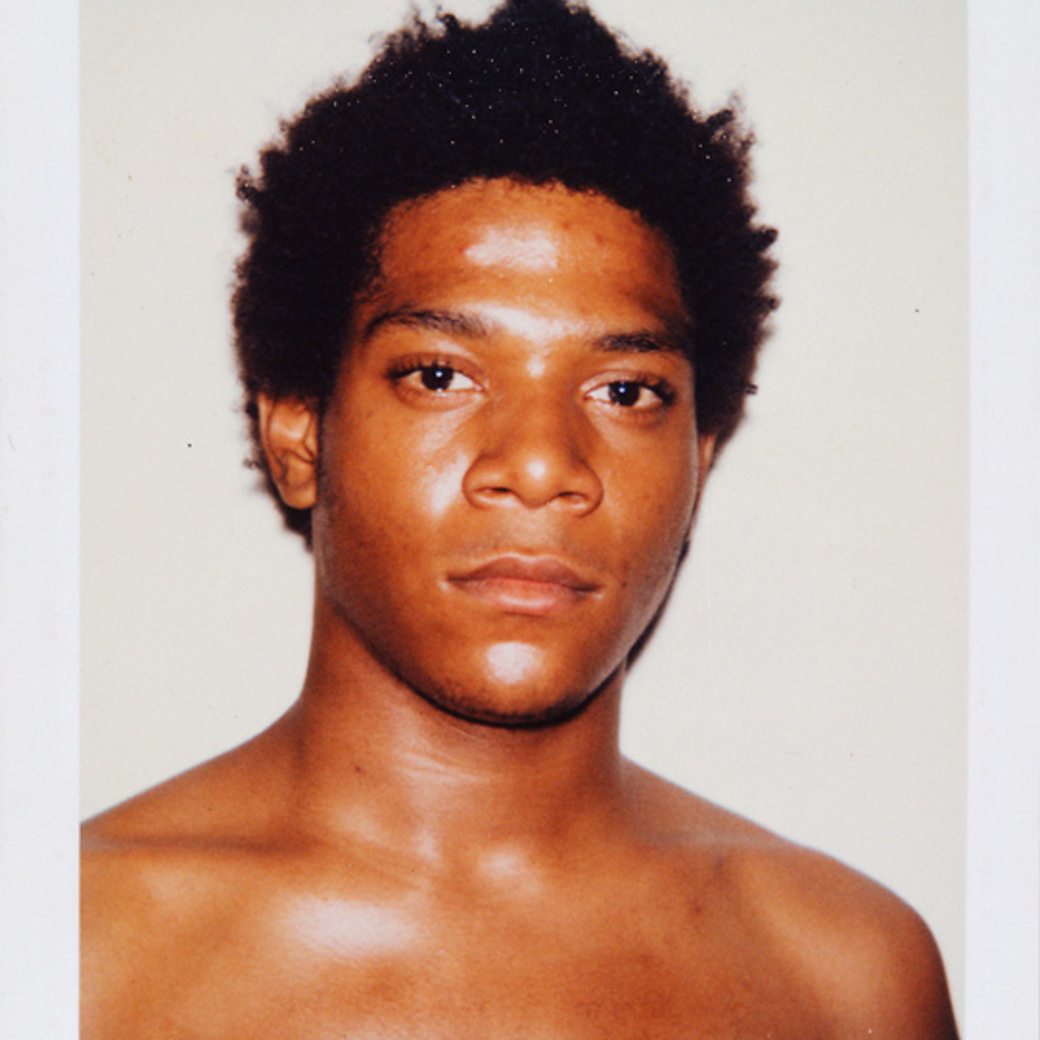
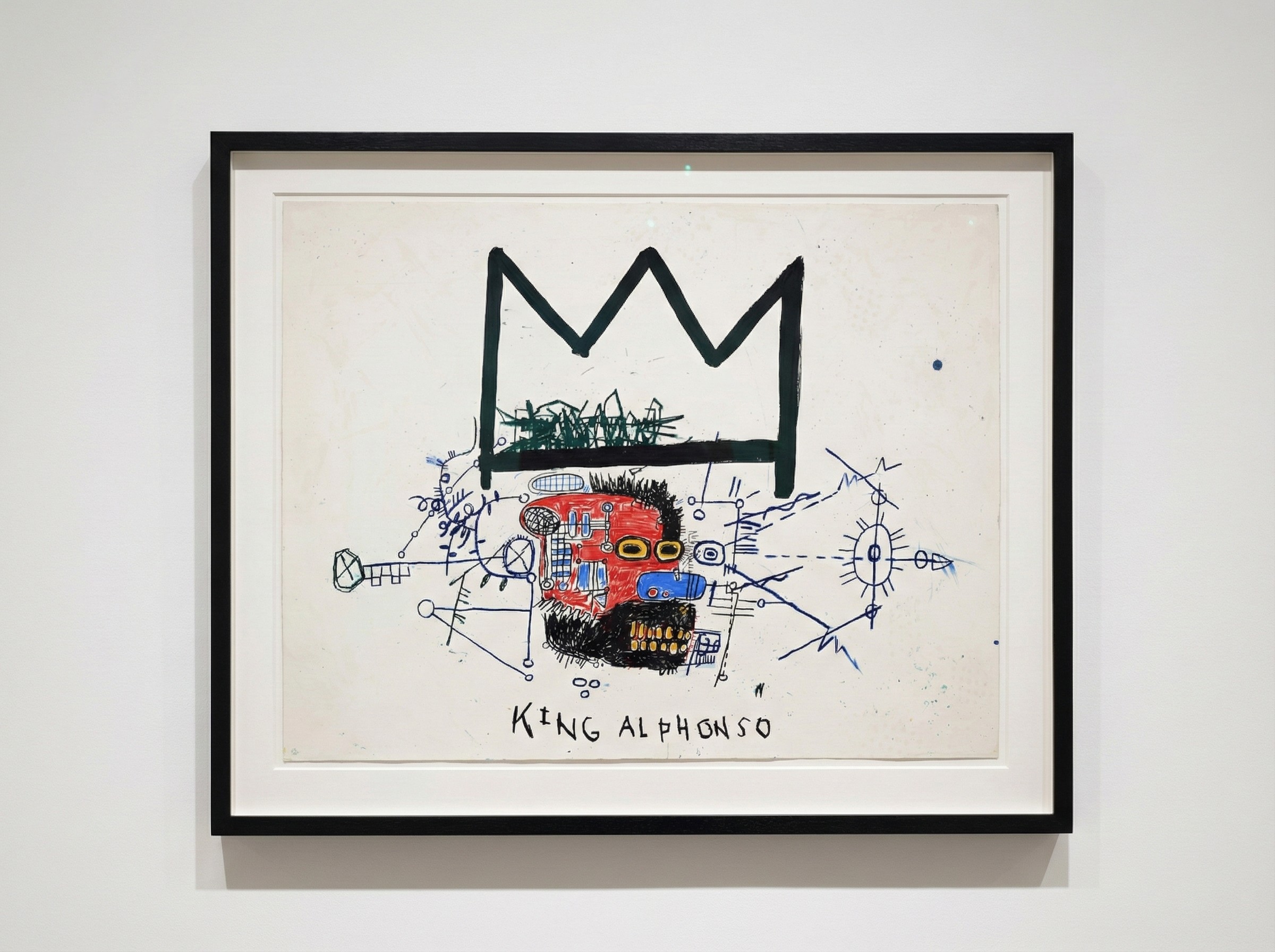
Jean-Michel Basquiat's crown is one of the most recognisable symbols in contemporary art. A simple three-pointed form — sometimes sharp and angular, other times loose and childlike — it appears throughout his work from the earliest SAMO graffiti through to the large-scale canvases of his final years. Crowns hover above skulls, athletes, jazz musicians, anatomical studies, and historical Black figures. The symbol looks deceptively simple. Its meaning is anything but.
The Basquiat crown motif is not a single idea — it is a compressed argument about power, recognition, race, and history, rendered in a form so direct it could be sprayed onto a wall in seconds. Understanding what Basquiat meant by the crown is to understand the engine driving much of his work: the insistence that those who had been erased, undervalued, or excluded from official culture deserved to be seen, named, and elevated.
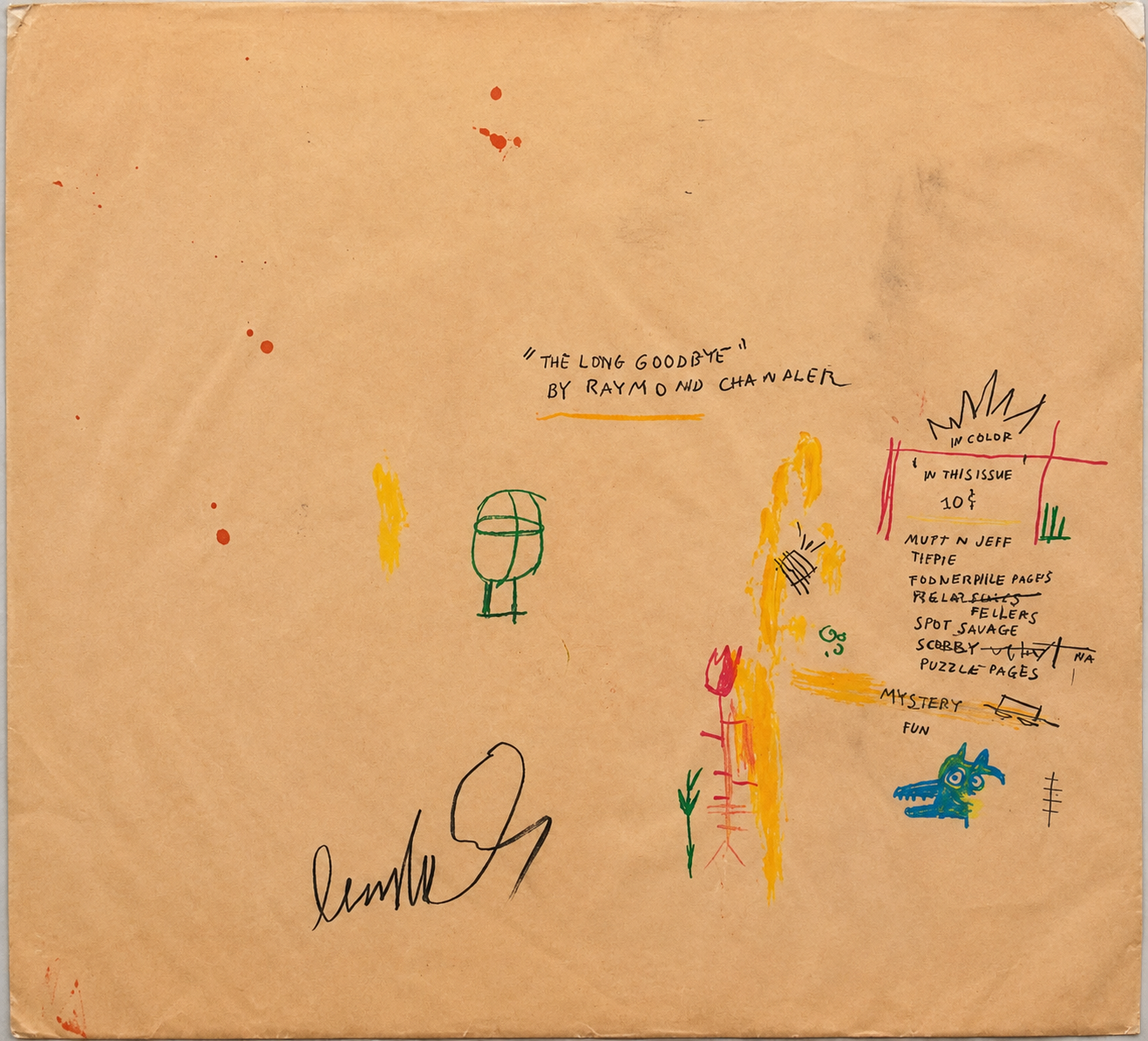
Basquiat began his artistic life as a graffiti writer under the tag SAMO — Same Old Shit — scrawling cryptic phrases across Lower Manhattan in the late 1970s alongside Al Diaz. Even at this stage, his visual language was built on symbols: quick, loaded forms that could communicate across class and context. The three-pointed crown was already present in these early street works, drawn with the same casual authority as his text.
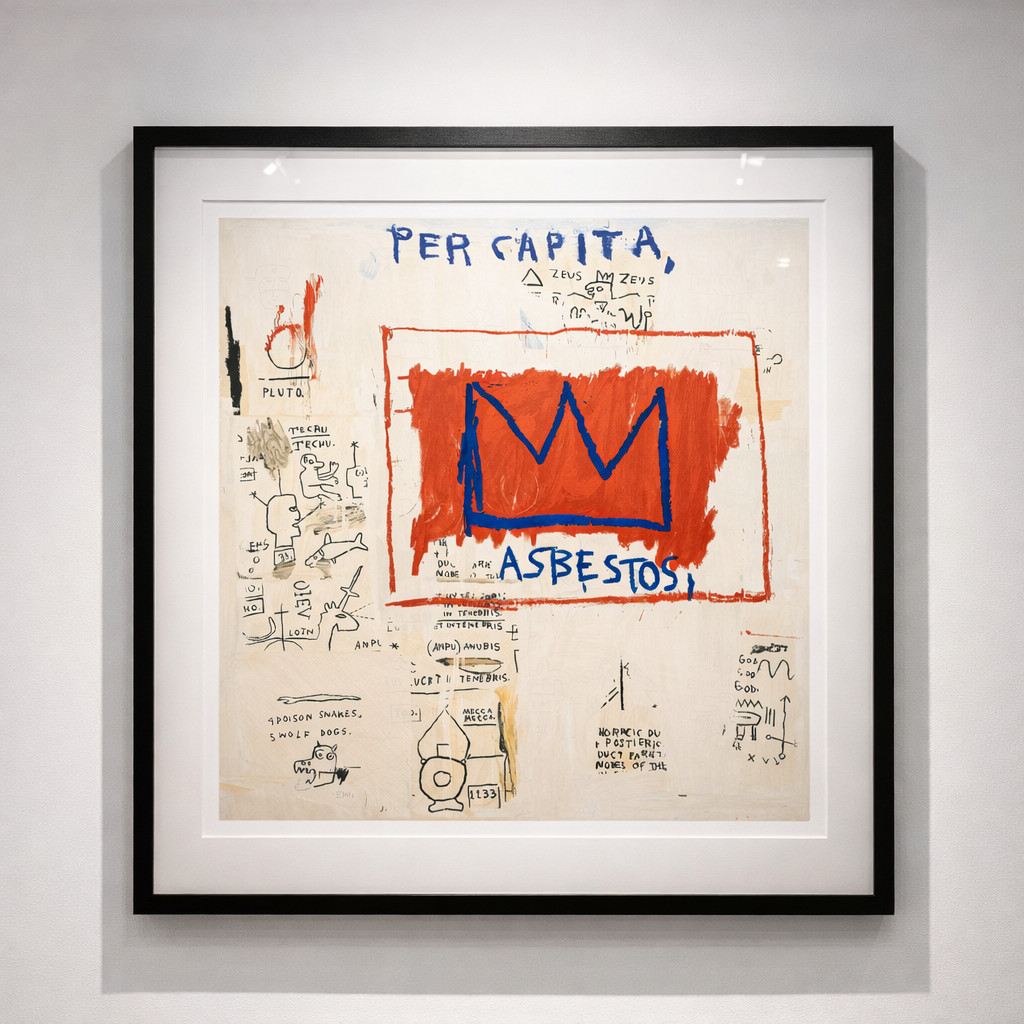
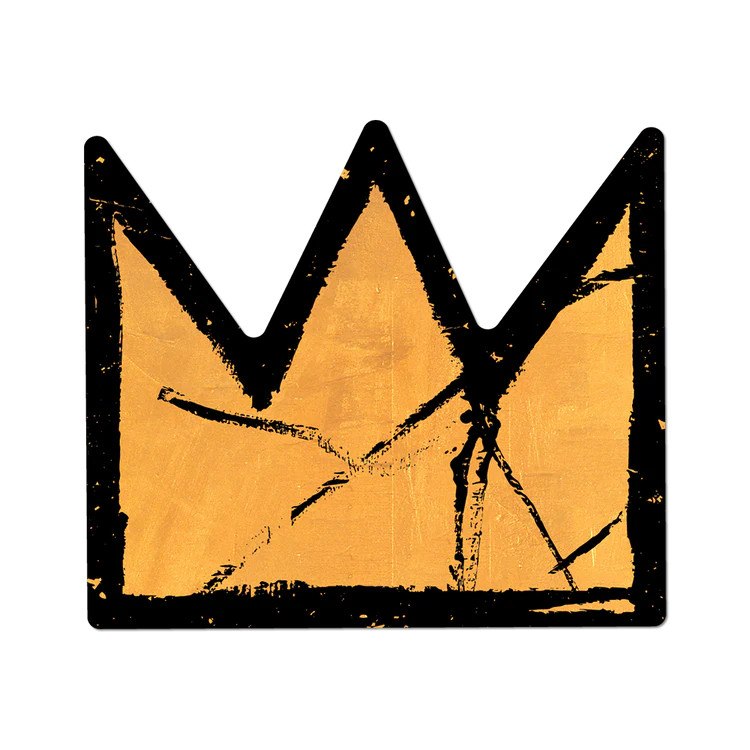
When Basquiat moved from walls to canvas in the early 1980s, the crown came with him. It became a portable symbol — applied to virtually any subject he wanted to mark as significant. The form itself was deliberately imperfect: hand-drawn, irregular, sometimes barely legible. This was intentional. Basquiat's crown was not the polished heraldic emblem of European monarchy. It was something rawer and more democratic — a mark anyone could make, conferred by the artist rather than by institutions.
Art historians have traced the crown's visual sources to several places simultaneously: the Statue of Liberty's seven-rayed diadem, the crowns in children's drawings, the halos of Byzantine religious painting, and the logos of commercial brands. Basquiat absorbed all of these and collapsed them into a single form that carried the weight of all of them — sacred, commercial, royal, and street-level at once.
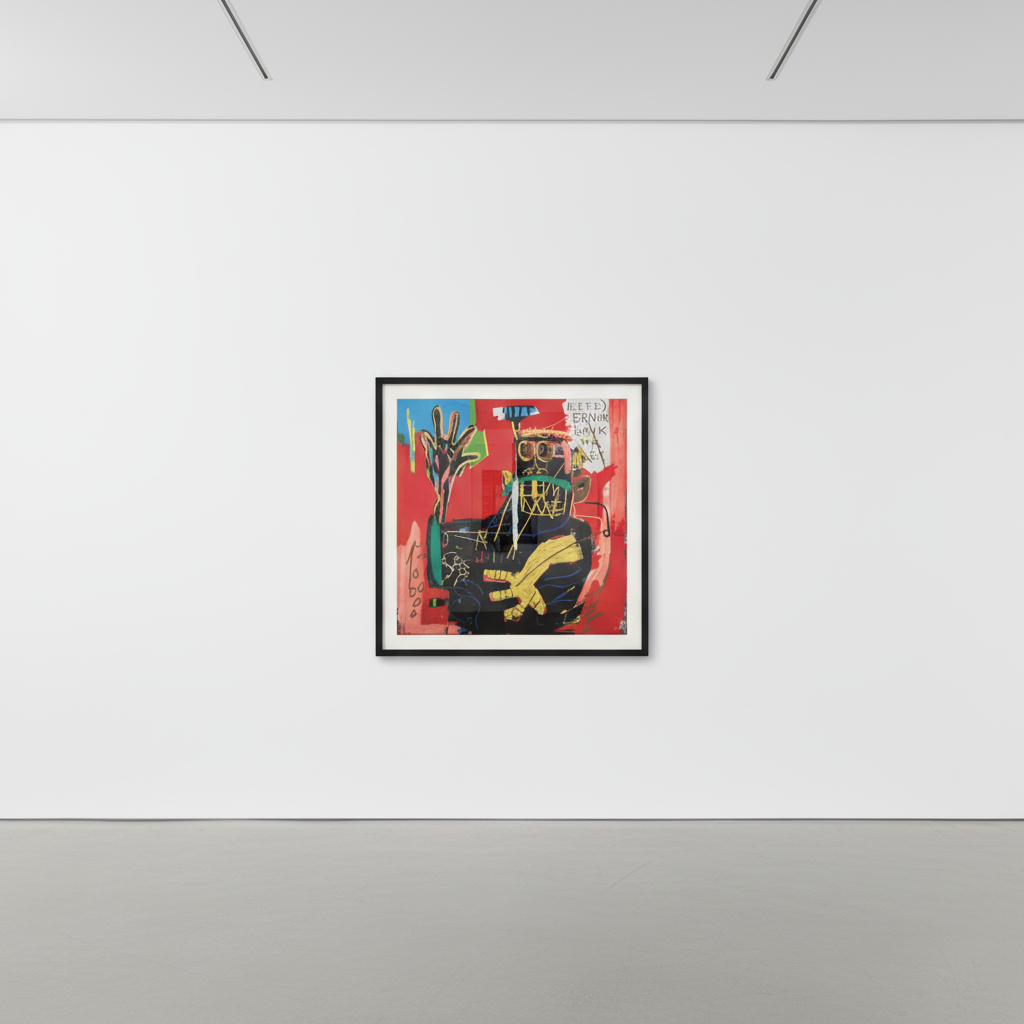
The crown's central function in Basquiat's work is elevation — the act of crowning subjects who had been systematically excluded from Western art history's canon of greatness. He placed crowns above boxers like Jack Johnson, jazz musicians like Charlie Parker and Dizzy Gillespie, ancient African kings, anonymous Black figures, and anatomical diagrams of the human body. In each case, the gesture was the same: this person matters. This person is royalty. Look at them.
This was a pointed act of resistance. The Western art tradition Basquiat was entering had largely treated Black subjects as marginal, exotic, or absent. His crown was a counter-argument painted directly onto canvas: a claim that heroism, genius, and divinity existed far beyond the narrow confines of European culture, and that the failure to recognise this was a form of violence that art could redress. The Basquiat crown meaning is inseparable from this politics of recognition.
The crown also functioned as self-coronation. Basquiat placed it above his own image repeatedly — asserting his place among the artists and thinkers he admired, refusing to wait for the art world to bestow legitimacy on him. As a young Black man navigating a market that was simultaneously fascinated by him and uncertain how to categorise him, this self-crowning was defiant and pragmatic in equal measure. He knew the value of what he was making. The crown said so.
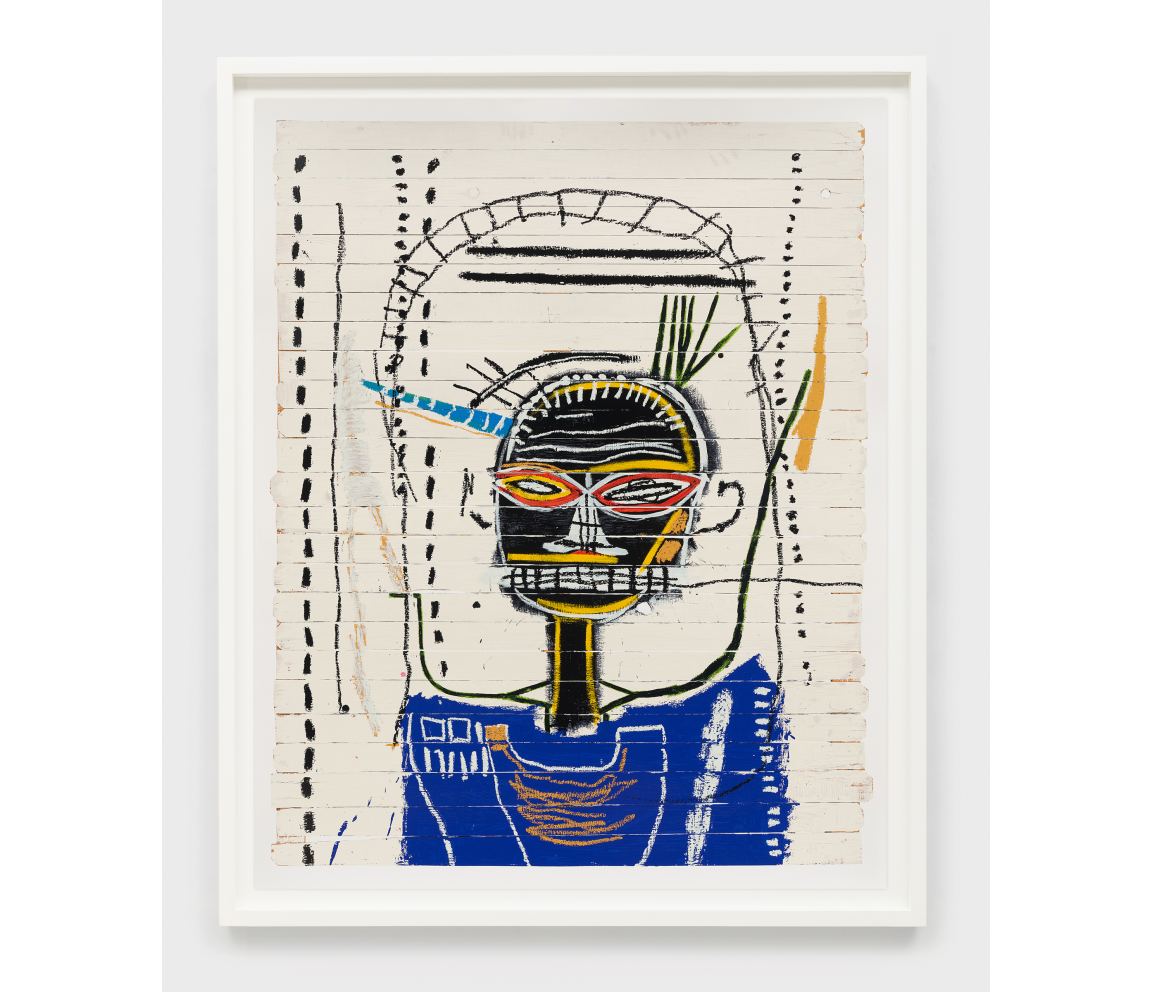
One of the most recurring pairings in Basquiat's work is the crown placed above or upon a skull. These crowned skulls appear across dozens of works and have become the image most associated with the Basquiat crown in popular culture. The combination is a compressed meditation on mortality and legacy: the skull reminds us that even the greatest lives end, while the crown insists that greatness persists beyond death.
This pairing had specific resonance in the context of Basquiat's wider project. Many of the Black figures he elevated — jazz musicians, athletes, historical kings — had died unrecognised, underpaid, or actively exploited. The crowned skull was his way of giving them back what the world had taken: their due. The image also had a personal dimension. Basquiat was acutely aware of his own mortality and the precariousness of his position. The crowned skull appears in his work with increasing frequency as his career progressed and the pressures on him intensified.
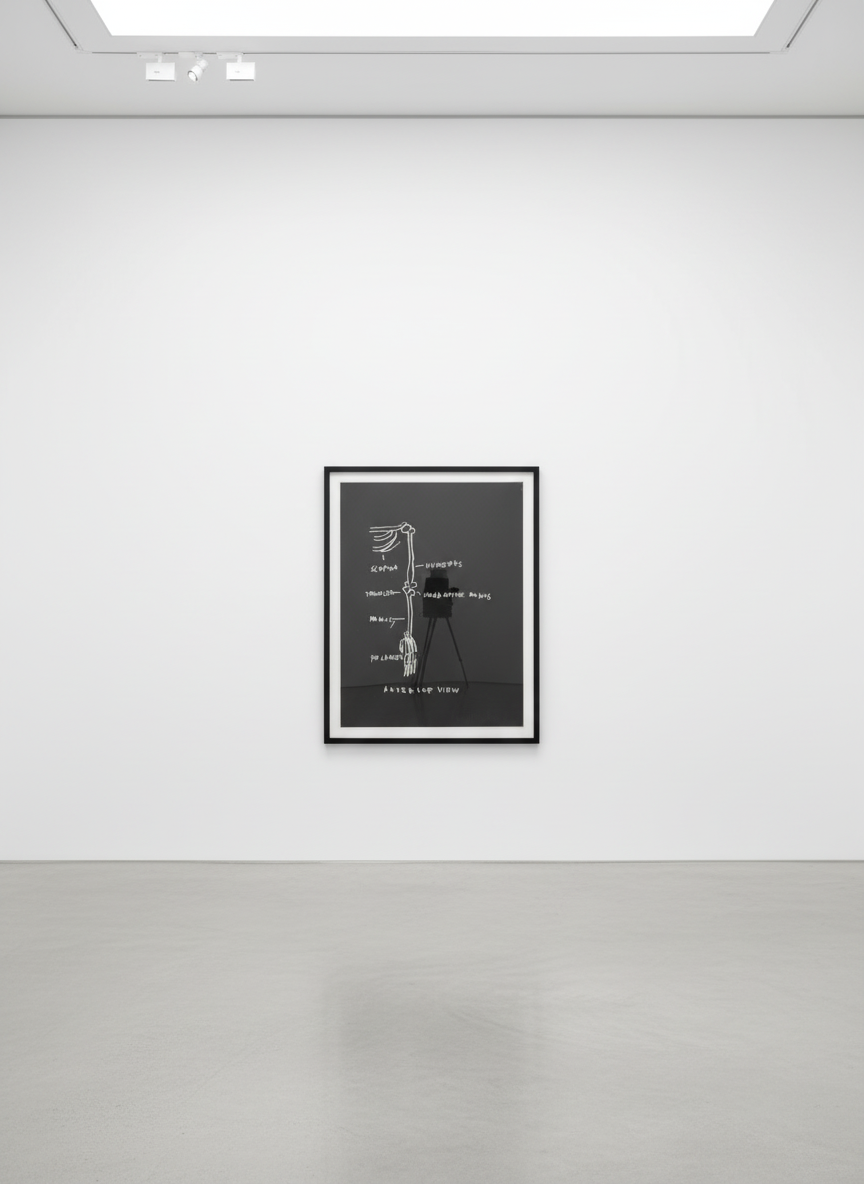
Basquiat's deep engagement with anatomy — he kept a copy of Gray's Anatomy in his studio and drew from medical illustrations throughout his career — gave the skull imagery additional layers of meaning. The skull was not only a symbol of death but a record of how the body works: its architecture, its systems, its remarkable complexity. To crown it was to crown the physical fact of human existence, as well as its inevitable end.
It would be a mistake to reduce the crown to a single meaning. Part of what makes Basquiat's visual language so powerful is its deliberate multiplicity — the way a single symbol can carry several meanings simultaneously without resolving into any one of them. The crown is royal and streetwise, sacred and ironic, political and personal. It operates differently depending on who it crowns, what surrounds it in the composition, and what the viewer brings to it.
In some works, the crown is celebratory: a straightforward act of honouring figures Basquiat loved. In others, it is mournful — placed above subjects whose crowns were denied them in life. In self-portraits, it is assertive, even combative. In the anatomical works, it is philosophical, connecting physical existence to questions of knowledge and power. This range is not inconsistency; it is sophistication. Basquiat understood that the best symbols are the ones that mean more than they say.
The crown also functions as what scholars have called a counter-narrative device — a visual intervention that rewrites history as Basquiat believed it should have been written. By crowning Charlie Parker or a West African king, he was not simply celebrating them; he was correcting the record. He was making visible the greatness that dominant culture had chosen not to see. The Basquiat crown motif is, at its deepest level, an argument about whose stories get told and who gets to decide.
View available Jean-Michel Basquiat works at Guy Hepner
Works featuring Basquiat's crown motif are among the most sought-after in the contemporary art market. In 2017, his Untitled (1982) — depicting a crowned skull rendered with raw, confrontational energy — sold at Sotheby's New York for $110.5 million, setting a record for an American artist at auction. The work has since become the defining image of Basquiat's market position: a symbol recognised globally, whose commercial value mirrors its cultural weight.
For collectors, crown-bearing works represent Basquiat at his most characteristic and his most legible. The symbol's recognisability makes these pieces immediately identifiable as Basquiat, while the depth of meaning behind them ensures they reward extended engagement. Prints and works on paper featuring crown imagery are available across a range of price points, making this aspect of Basquiat's output accessible to collectors at various stages of their practice.
The crown is Basquiat's primary symbol of elevation and recognition. He used it to honour figures he believed deserved greater acknowledgment — particularly Black athletes, musicians, and historical figures — and to assert his own place among the greats. The crown also carries meanings of royalty, mortality (when paired with skulls), intellectual sovereignty, and resistance to institutional exclusion. Its meaning shifts depending on context, which is part of its power.
The three-pointed form was drawn from multiple visual sources: the Statue of Liberty's crown, children's drawings, religious halos, and commercial logos. Basquiat collapsed these references into a single, deliberately imperfect symbol — one that could be made quickly with a brush or spray can, and that carried associations of both street culture and high art simultaneously. Its simplicity was strategic; its meaning was layered.
The crown first appeared in Basquiat's SAMO graffiti works in the late 1970s, making it one of his earliest and most enduring symbols. It remained a constant presence across his entire career from 1980 until his death in 1988, appearing in works from his earliest gallery paintings through to his final canvases.
The most celebrated is Untitled (1982), depicting a crowned skull against a vivid background, which sold for $110.5 million at Sotheby's in 2017. Other widely recognised crown works include Warrior (1982), Charles the First (1982) — a tribute to jazz musician Charlie Parker — and numerous works from the Anatomy series in which crown imagery accompanies skeletal diagrams.
Yes. Guy Hepner holds an inventory of authenticated Basquiat prints and works featuring his characteristic crown imagery and figurative vocabulary. Browse available Jean-Michel Basquiat works at Guy Hepner, or contact the gallery directly to discuss specific works or editions.
The crown does not appear in the abstract � it is always attached to a subject Basquiat has decided to elevate. Tracing it through his most celebrated works reveals the precision behind what can look like spontaneous mark-making.
Charles the First (1982) is among the most direct expressions of Basquiat's crowning impulse. The painting is an elegy for Charlie Parker � "Bird" � the bebop alto saxophonist who died at 34, exploited by club owners, misunderstood by critics, and undercompensated throughout his brief life. Basquiat fills the canvas with fragmented text, musical references, and a prominent crown hovering above the figure. The title itself performs the crowning: Charlie Parker is not just a musician but a king, ranked alongside historical royalty. The Basquiat crown here is not decorative � it is an act of posthumous restitution.
The Superhero Portfolio (1983) extends this logic into a more explicitly heroic register. The series of screenprints depicts figures drawn from the iconography of superheroes but inflected with the visual grammar of Basquiat's street origins � crowns, crosshatching, anatomical fragments, and text. The crown appears throughout, conferred on figures who possess power that dominant culture has refused to name as such. The portfolio was among Basquiat's earliest major print editions and remains one of the most collected groupings of his works on paper. For collectors, the Basquiat crown prints from this series represent an opportunity to own a defining symbol of his practice in an accessible format.
Other key works bearing the crown include Warrior (1982), Undiscovered Genius of the Mississippi Delta (1983), and the Anatomy series prints, where the crown appears alongside detailed skeletal diagrams � connecting Basquiat's interest in the body's architecture to his broader project of recognition and elevation.
What does the Basquiat crown mean? At its most direct: the crown is Basquiat's way of saying that someone � or something � deserves to be seen as great. He conferred it on Black musicians, athletes, historical figures, and himself at a time when the institutions that decide greatness had systematically excluded people who looked like him. The crown was a refusal of that exclusion.
Why does Basquiat use a crown so often? Because the argument required repetition. A single crown could be dismissed; hundreds of them, spread across a decade of work, formed a sustained counter-narrative. Each crown is a data point in Basquiat's larger argument about who gets recognised and why.
Is the Basquiat crown always positive? Not always. Placed above skulls, the crown becomes an elegy � honouring figures who died without receiving their due. In self-portraits made during periods of personal difficulty, it reads as defiant rather than triumphant. The same symbol does different work in different contexts, which is what makes it one of the most sophisticated recurring devices in post-war art.
What makes the Basquiat crown so recognisable? Its formal simplicity. Three points, drawn by hand, irregular and immediate. It looks like something a child could make � and that accessibility is precisely the point. The crown belongs to anyone Basquiat chooses to give it to, not to hereditary succession or institutional validation. In this sense, the Basquiat crown meaning is inseparable from its form: democratic, direct, and impossible to mistake.
Guy Hepner holds one of the most comprehensive collections of authenticated Jean-Michel Basquiat prints available on the primary and secondary markets. Crown imagery features prominently across the gallery's Basquiat holdings � from the Superhero Portfolio screenprints to works from the Anatomy series and individual editions produced during the peak years of 1982�1987.
Basquiat prints featuring his characteristic crown are among the most sought-after works on paper in the contemporary collecting market. They represent a point of access into a body of work whose major paintings are now held in institutional and high-net-worth private collections, available at prices that reflect their significance without requiring the capital required for unique works.
All works available through Guy Hepner are accompanied by full provenance documentation and, where applicable, certificate of authenticity from the Jean-Michel Basquiat Authentication Committee. The gallery's specialist team is available to assist collectors in identifying specific crown works, editions, and condition reports.
Browse Basquiat prints at Guy Hepner ?
Sell your Basquiat ? free confidential valuation ?
## Further Reading For a broader look at the symbols Basquiat used throughout his career, read: [Basquiat's Symbols: The Meaning Behind His Art](/news/345-the-meaning-behind-basquiats-symbols)Explore Jean Michel Basquiat prints for sale at Guy Hepner: Anatomy, Daros Suite, Estate Prints, King Alphonso, Original Works.
Related Series