Anatomy

May 12, 2026
Jean-Michel Basquiat was many things — prodigy, provocateur, graffiti poet, art-world comet. But running beneath the crowns, the SAMO© tags, and the fractured text-fields of his paintings is a persistent obsession with the human body. Not the body as ideal or decorative form, but the body as mechanism, as vulnerability, as political site. Bone, sinew, organ, skull: these anatomical elements are not incidental to Basquiat's work. They are its skeleton — its structural logic.
From his teenage years on the streets of Lower Manhattan through to his final canvases before his death at twenty-seven, Basquiat returned again and again to the interior of the human body. He depicted it clinically and emotionally, medically and mythologically. He labeled its parts, crossed them out, exploded them across vast canvases, and rendered them in delicate silkscreen prints that read like lost pages from a medical atlas. In doing so, he produced one of the most sustained engagements with Anatomy in twentieth-century art — one inseparable from questions of race, mortality, power, and the gaze.
When Basquiat was seven years old, he was struck by a car on the streets of Brooklyn. The accident was serious; he spent a month in hospital recovering from internal injuries. His mother, Matilde, brought him a copy of Gray's Anatomy to pass the time.
It is impossible to overstate the impact this book had on him. Gray's Anatomy — first published in 1858 and still in print today — is not a book for the faint-hearted. Its cross-sectioned illustrations of human tissue, its labeled diagrams of bone structure, its clinical exposure of the body's innermost workings: these images entered Basquiat's visual imagination at a formative, traumatic moment. He was already curious, already voracious. Now he had a visual vocabulary for what was inside.
That vocabulary would surface throughout his career. The characteristic Basquiat move — labeling body parts directly onto figures, exposing musculature beneath skin, depicting skulls and ribcages with the schematic precision of a medical illustration — originates here, in a hospital bed in Brooklyn, in a boy reading a book about what bodies are made of. The accident gave him not just convalescence but an anatomy lesson that never ended.
What distinguished Basquiat's use of this material, however, was never clinical detachment. Where Gray's offered systematic order, Basquiat introduced rupture. He took the logic of the medical diagram — the confidence of its labels, the authority of its exposing gaze — and shot it through with emotion, protest, humor, and grief.
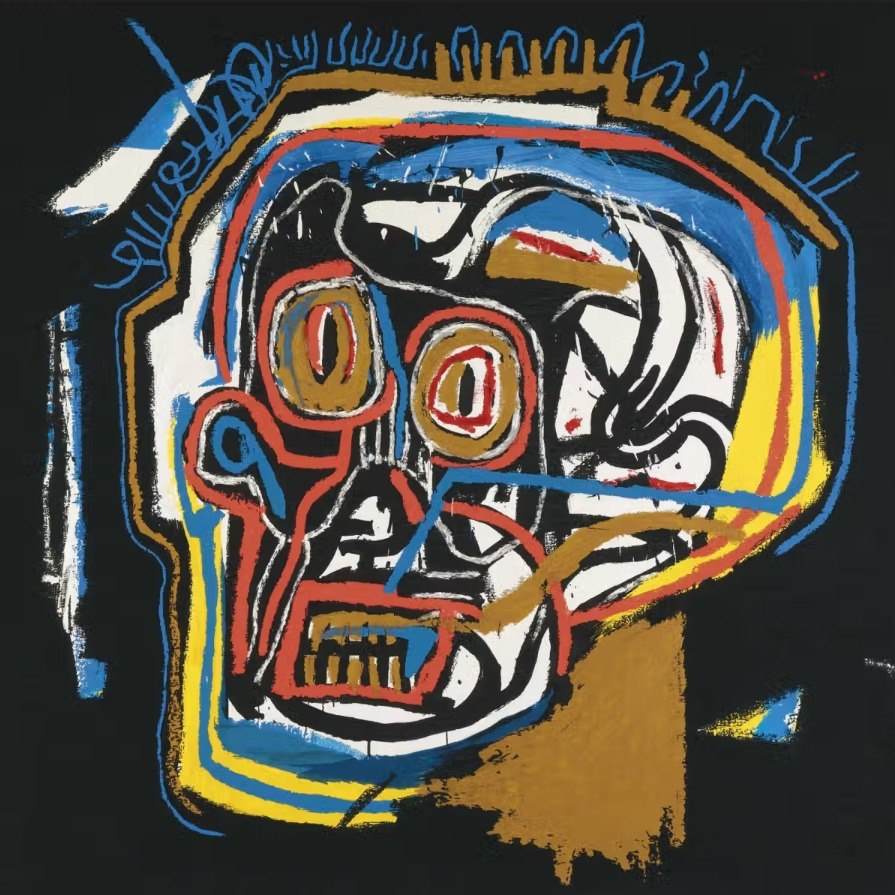
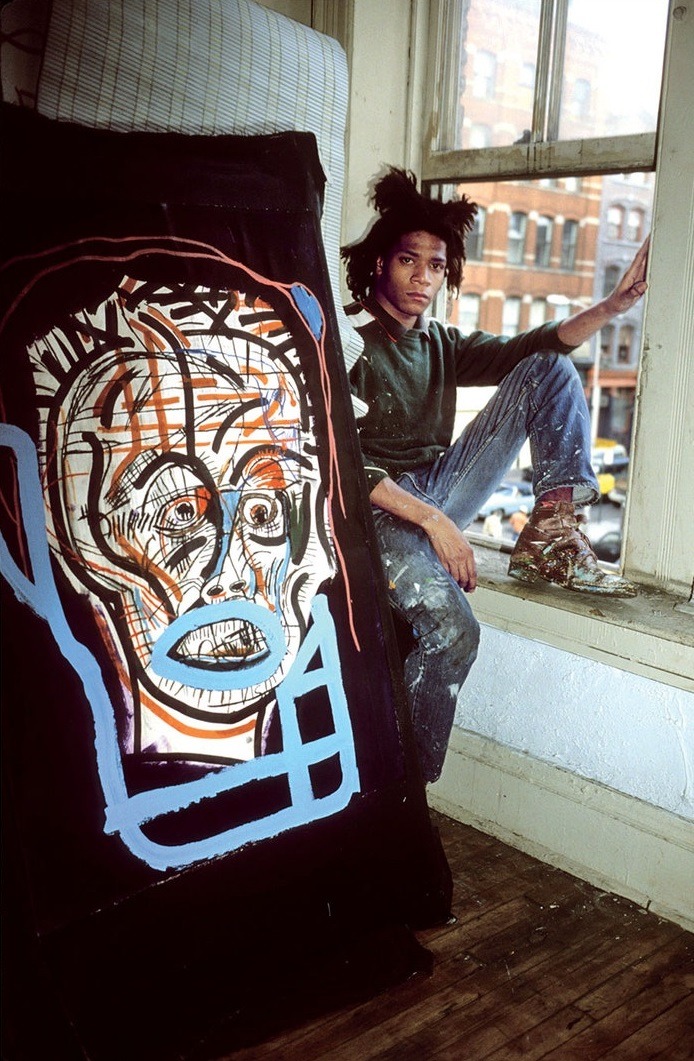
No motif in Basquiat's work is more recurring — or more misread — than the skull. It appears in dozens of paintings across his career, and it is among his most powerful symbols. His Untitled (Skull) from 1981, now in the collection of the Museum of Modern Art, is one of the defining images of the decade: a massive head rendered in loose, urgent strokes, the skull's structure visible beneath a face that is simultaneously mask and self-portrait.
The skull, in Western art history, has a well-established function as memento mori — a reminder of death, a meditation on impermanence. Basquiat inherits this tradition and transforms it. His skulls are not peaceful reminders of mortality. They are confrontational. They stare. They assert. The skull in his work is not a passive symbol of death but an active presence — a face that refuses to be looked away from.
This has particular resonance in the context of race. Basquiat was acutely aware that the Black body in America occupied a specific, often lethal, relationship to mortality. Police violence, poverty, structural neglect: these were not abstract concerns but daily realities of the world he moved through. The skull levels all bodies — beneath the skin, we are the same structure of bone — but Basquiat was too historically literate to take that leveling at face value. The skeleton might be universal, but what happens to the living body above it is not.
His skulls are also, in some readings, self-portraits. In the year he painted Untitled (Skull), Basquiat was twenty years old, newly famous, and navigating a world that was simultaneously making him a star and reducing him to a stereotype. The skull, stripped of the surface markers of race, identity, and cultural expectation, becomes a space of both erasure and essence.
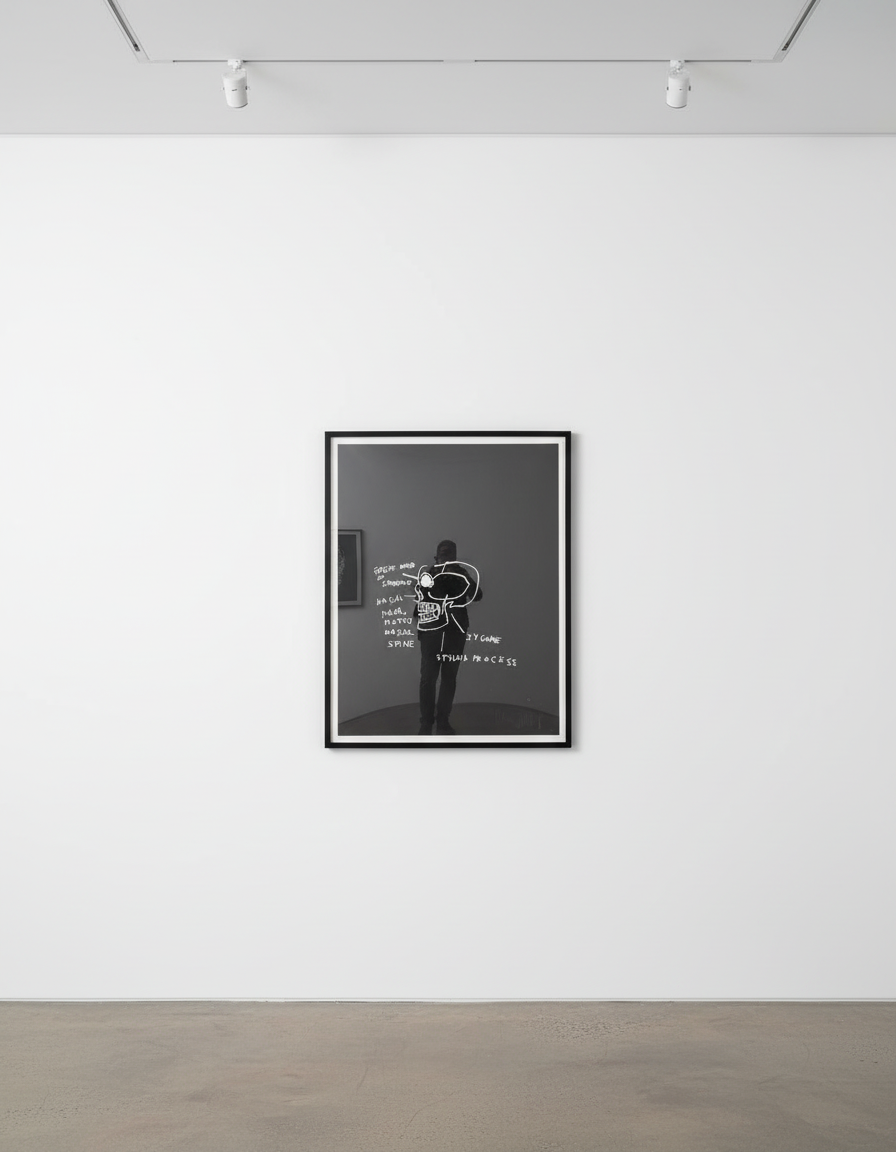
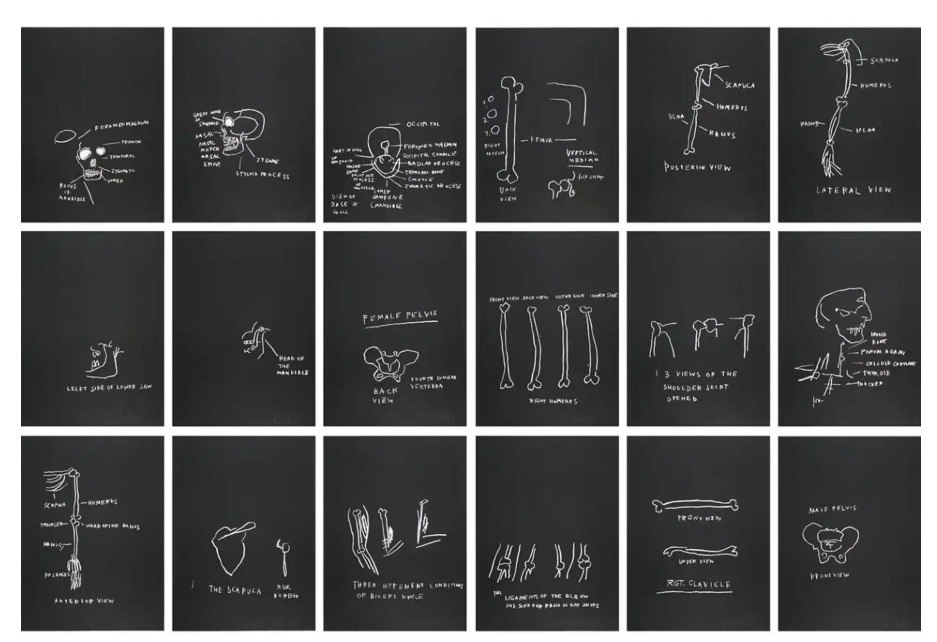
In 1982 and 1983, Basquiat produced a group of silkscreen prints that represent his most direct engagement with medical illustration as an art form. The series — simply titled Anatomy — takes its titles directly from the language of anatomical textbooks. Works include Great Wind of Sphenoid, from Anatomy; The Scapula, from Anatomy; Three Views of The Shoulder Joint Opened, from Anatomy; Female Pelvis, Back View, from Anatomy; Right Humerus, from Anatomy; and Anterior View, from Anatomy.
The titles read like entries in a medical index — sphenoid, scapula, humerus, pelvis. These are the bones of the body, each with its precise anatomical name, each isolated for examination. The clinical naming is part of the conceptual move. Basquiat is positioning these works within a tradition of anatomical knowledge-production: the tradition of the atlas, the diagram, the dissection table.
But the images themselves are something else entirely. Basquiat translates the schematic precision of medical illustration into the language of expressionist drawing — gesture, raw mark, the sense of a hand moving urgently across a surface. The result is a profound collision: the authority of medical taxonomy meets the subjectivity of the artist's body making the work. Knowledge and feeling refuse to separate.
The sphenoid is a bone at the base of the skull, shaped like a butterfly, connected to nearly every other bone in the cranium. "Great Wind of Sphenoid" — the title already introduces something that a textbook would not. Wind. Movement. There is atmosphere here, a sense of invisible force. The clinical name is granted a poetry that the medical tradition actively suppresses. Across the series, Basquiat performs this operation repeatedly: borrowing the language of diagnosis and returning it transformed, charged with something the diagnostician did not intend.
To understand what Basquiat was doing with the skeleton, it is necessary to understand what the body has meant, historically, for Black Americans — and specifically what has been done to Black bodies in the name of medical knowledge.
The history of anatomy in the United States is inseparable from the history of slavery. For centuries, the bodies of enslaved people and later of Black prisoners and paupers were disproportionately used for anatomical dissection and medical education — often without consent, often obtained through grave robbery or outright theft. Medical schools in the antebellum South relied on the bodies of enslaved people to train their students. The presumed availability of Black bodies for medical study was not incidental to American racism; it was one of its expressions.
This history was not abstract to Basquiat. He was a widely read, historically aware artist working in New York in the early 1980s, a time of active conversation about racial justice, police violence, and the AIDS epidemic (which was devastatingly affecting communities of color). When he depicted skeletal figures, when he exposed the interior of the body, when he labeled its parts with the vocabulary of the medical gaze, he was engaging — consciously or unconsciously, and probably both — with this history.
The skeleton, in this light, is not simply a universal symbol of human mortality. It is a specifically charged image: the body stripped to its most basic structure, the body as it has been examined, dissected, used. Basquiat's figures are both subject and object of the anatomical gaze. They stare back. They assert their humanity precisely at the moment when that humanity is being reduced to anatomy.
Police brutality is another thread. Basquiat depicted beat cops, courts, and the machinery of state violence throughout his career. The exposed body — vulnerable, unprotected, skin stripped away — carries this charge too. In painting after painting, figures are anatomized: not as an act of knowledge-production but as an act of exposure, of vulnerability, of violence.
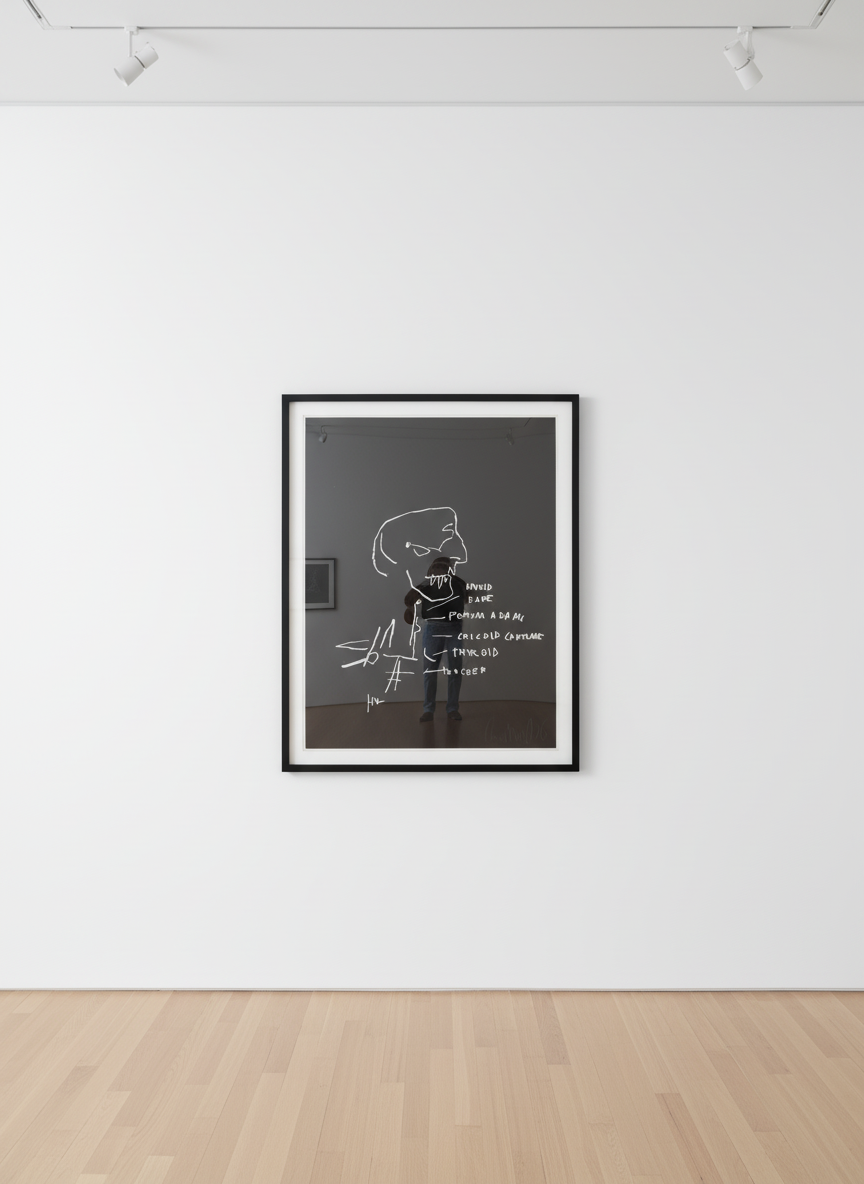One of the most distinctive features of Basquiat's anatomical imagery is his habit of labeling. He writes directly onto the body — names of muscles, bones, organs — with the same urgent, graffiti-derived hand that he uses for everything else. The body becomes a surface for text. The text becomes body.
This is not simply illustrative. When a painter labels the parts of a figure — writes "TEETH" next to teeth, "RIBS" next to ribs — they are performing an act with a specific cultural history: the anatomical diagram. They are claiming the authority to name, to organize, to categorize. Basquiat claims that authority and immediately destabilizes it: the labels are crossed out, misspelled, contradicted, layered over with paint.
The crossing-out is crucial. Basquiat's cross-outs are not erasures — the words remain legible beneath the marks. They are a kind of correction, a refusal, a way of asserting that what has been named is still present even as it is being contested. In the context of anatomical labeling, the crossed-out body part is both identified and disputed. The medical gaze has named it; the artist refuses the finality of that naming.
Words and bodies fuse in his work. The figure in a Basquiat painting is always already a text — marked, annotated, read. And the text always already has a body — visceral, urgent, located in specific flesh. This fusion is one of his great formal achievements, and it derives directly from his engagement with anatomy.
Basquiat's engagement with anatomical imagery was not confined to his immediate sources. He was deeply interested in the history of Western art, including its long tradition of anatomical drawing — a tradition that begins, in art history, with Leonardo da Vinci.
Leonardo's anatomical notebooks, produced in the late fifteenth and early sixteenth centuries, are among the most celebrated objects in Western culture: exquisitely detailed drawings of dissected bodies, muscles, organs, and bones, accompanied by mirror-script observations. They represent the Renaissance aspiration to understand the human body through systematic visual study — to see through the surface to the mechanism beneath.
Basquiat engaged with this tradition directly. His works Untitled 1 (from Leonardo) and Untitled 4 (from Leonardo) signal their debt explicitly in their titles. He was positioning himself in relation to a specific tradition of the artist-anatomist — the figure who opens the body to knowledge through drawing — while simultaneously bringing to that tradition a perspective it had systematically excluded.
The Old Masters' anatomical tradition was built on a specific erasure: the bodies being dissected and drawn were often those of the poor, the criminal, the socially marginal — and, in the colonial period, the enslaved. The beautiful drawings in Leonardo's notebooks do not acknowledge whose bodies they were. Basquiat's engagement with this tradition restores that question. By situating himself as an heir to Leonardo while foregrounding the racialized politics of the anatomized body, he inserts what the tradition left out.
There is something else here too: a claim to artistic genealogy. Basquiat was insistent — against the art world's tendency to patronize him as a primitive or naif — on his place within the Western artistic tradition. He was not an outsider who had wandered in from the street. He was an heir to Leonardo, to Cy Twombly, to Dubuffet. The Leonardo series is, among other things, a statement of belonging — and of transformation.
See also Untitled 1, from The Figure Portfolio, which shows Basquiat's approach to the human figure in a related register: the body as subject, as text, as site of inquiry.
Among Basquiat's major paintings of the mid-1980s, Flexible (1984) stands out for the density and complexity of its anatomical references. A large-scale canvas, it deploys the full range of his anatomical vocabulary: exposed musculature, skeletal structure, labeling, the interplay of text and image that characterizes his most ambitious work.
Flexible was produced at a moment when Basquiat was at the height of his powers — technically assured, conceptually sophisticated, working at a scale and ambition that matched the largest gestures in contemporary painting. The title itself is anatomically suggestive: flexibility is a property of joints, of connective tissue, of the body in motion. It is also a property of identity, of survival — you flex, you adapt, you find the positions the situation requires.
The figure in Flexible is simultaneously athletic and vulnerable: a body capable of movement, exposed to damage. The anatomical detail is not decorative but structural — it tells us something about the figure's relationship to its own physicality, to the demands being made on it, to the forces acting upon it. This is Basquiat at his most integrated: the anatomy is not a quotation from Gray's but a language native to the painting itself.
Basquiat died in August 1988, of a heroin overdose, at twenty-seven. He left behind a body of work that has grown only more significant in the decades since — not because the art world eventually caught up with his market value, but because the questions he was asking have become central to contemporary art and culture.
The politics of the body — who gets to represent it, who gets to examine it, whose bodies are vulnerable and whose are protected — have become defining concerns of the past three decades. Artists across generations have engaged with questions of racial identity, medical racism, police violence, and the history of the anatomized Black body. Kara Walker, Theaster Gates, Hank Willis Thomas, Jordan Casteel, Toyin Ojih Odutola: these and many others work in a field that Basquiat helped to define.
His anatomical work is central to this legacy. The Anatomy print series, the skull paintings, the Leonardo works, the anatomically charged figures of his major canvases: together they constitute a sustained argument about what the body means — what it has meant, historically, for people who look like Basquiat, and what it might mean if we look at it differently.
The medical gaze claims authority through its refusal of emotion — through its insistence that the body is a mechanism to be understood, not a person to be regarded. Basquiat refused this separation. For him, anatomy was never just science. It was always already politics, history, feeling. The body he opened in his paintings was not a cadaver on a dissection table. It was alive, responsive, asking to be seen.
In this, he did something that Leonardo's notebooks — brilliant as they are — did not: he gave the body back its gaze. The skulls look out. The figures labeled and annotated still breathe. The anatomy refuses the clinical distance that would reduce it to information. In Basquiat's work, the body insists on itself — on its interiority, its mortality, its political situation, its right to be more than a diagram.
That insistence is his enduring contribution, and it speaks — with undiminished urgency — to the present.
The Anatomy series is a group of silkscreen prints produced by Basquiat in 1982–83, taking their titles directly from anatomical textbook terminology. Works include Great Wind of Sphenoid, The Scapula, Three Views of the Shoulder Joint Opened, Female Pelvis, Back View, Right Humerus, and Anterior View. Each print translates the clinical language of medical illustration into Basquiat's expressionist visual vocabulary.
Basquiat Anatomy prints are highly sought after by collectors worldwide. Depending on the specific work, condition, provenance, and edition, prices typically range from around $20,000 to well over $150,000. The market for Basquiat prints has strengthened considerably in recent years. Contact Guy Hepner for current availability and pricing.
Yes. Guy Hepner carries authenticated works from Basquiat's Anatomy series and related anatomical prints. Browse our current Basquiat collection or contact us directly to enquire about specific works.
Basquiat's engagement with anatomy began when he was seven years old, following a serious car accident in Brooklyn. During his hospitalisation, his mother gave him a copy of Gray's Anatomy. The book's precise medical illustrations entered his visual imagination at a formative moment and remained a persistent influence throughout his career.
The skull in Basquiat's work is simultaneously memento mori, self-portrait, and political statement. His skulls are confrontational presences that assert humanity rather than passive symbols of mortality. They carry particular weight in the context of race — Basquiat was acutely aware of the historical relationship between the Black body and medical violence, and his skeletal figures function as acts of reclamation.
Yes. The Anatomy silkscreen series was produced in limited editions and represents a historically significant body of work within Basquiat's output. Opportunities to acquire individual prints from the series arise infrequently. Guy Hepner maintains relationships with collectors and can assist with sourcing specific works on enquiry.
Explore Jean Michel Basquiat prints for sale at Guy Hepner: Anatomy, Daros Suite, Estate Prints, King Alphonso, Portfolio I.
Related Series