GUYHEPNER

Andy Warhol Camouflage For Sale

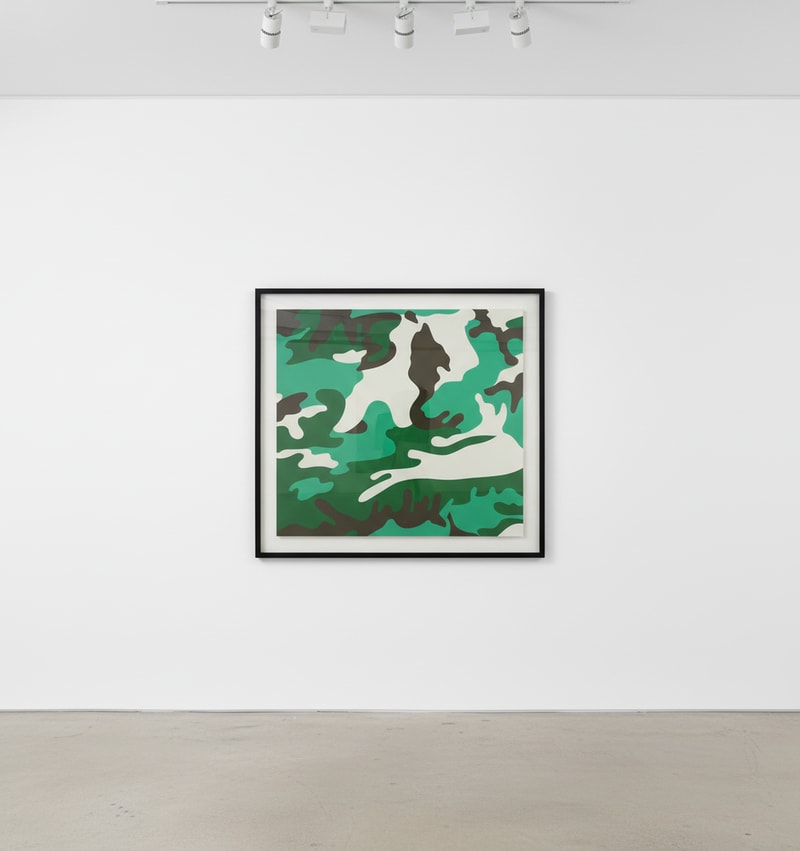
Andy Warhol: Camouflage

Series Performance & Market Position

The Camouflage portfolio represents one of Warhol's final major print series, completed the year of his death in 1987, and carries the distinctive weight of late-period works within his market. Guy Hepner has facilitated 478 Warhol transactions totalling over $51 million across 292 collectors, providing direct insight into how this series performs against the broader Warhol print market.

Auction results from Guy Hepner records demonstrate consistent pricing within the series: Camouflage F.S. II 406 achieved $378,000 in April 2021, while Camouflage F.S. II 409 matched that figure in the same sale. The Trial Proof TP 4/84 also reached $378,000 in April 2021, though a subsequent appearance in June 2022 realized £83,160—a price differential that reflects condition variables and market timing rather than diminished demand. More recently, Camouflage F.S. II 406 sold for $254,000 in October 2023, indicating continued secondary market activity.

These figures sit comfortably within the broader Warhol print ecosystem. For context, Warhol's market reached its apex when Shot Sage Blue Marilyn (1964) sold for $195,040,000 at Christie's in May 2022—the highest price ever achieved for a 20th-century work at auction. While Camouflage operates at a different price tier than unique paintings, recent Christie's results from May 2025 show the enduring strength of Warhol prints: two Mao works (F.S. II.96 and II.97) each achieved $4,648,000. The Camouflage series appeals to collectors seeking entry into late Warhol at accessible price points with demonstrated resale liquidity.

Technical & Historical Context

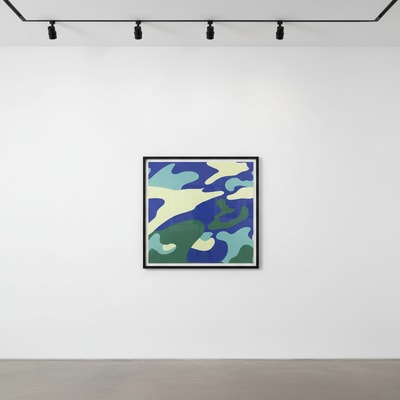
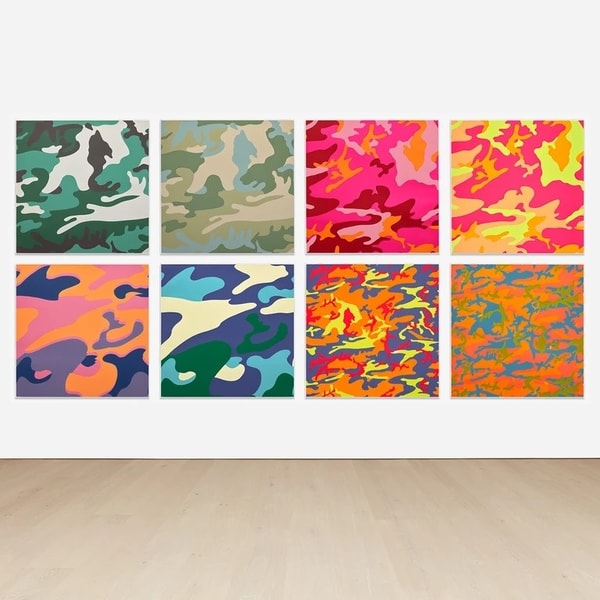
Warhol produced the Camouflage portfolio in 1987 with publisher Ronald Feldman Fine Arts and printer Rupert Jasen Smith, releasing it as part of his final sustained engagement with printmaking. The series comprises eight standard edition prints alongside trial proofs, all executed as screen prints on Lenox Museum Board at 38 x 38 inches.

The source material draws from military camouflage patterns—a subject Warhol had explored in paintings since 1986. By translating the motif into prints, he democratized imagery originally designed for concealment, transforming functional military design into collectible multiples. The work arrived during a period when Warhol was revisiting appropriation with renewed interest, applying his signature color manipulations to found patterns rather than commercial or celebrity source material.

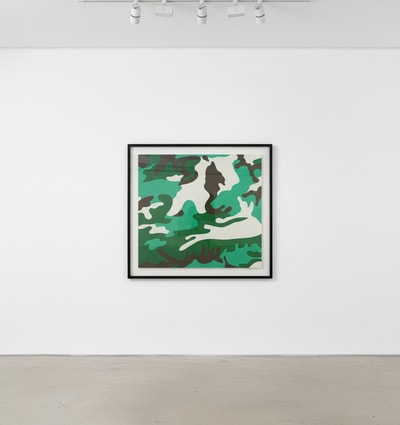
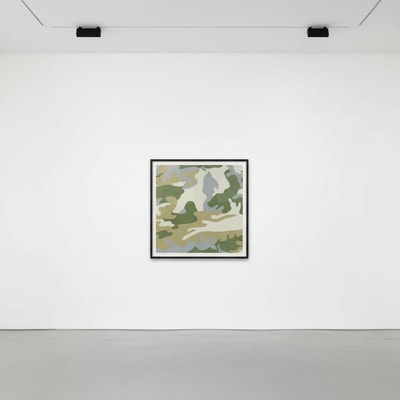
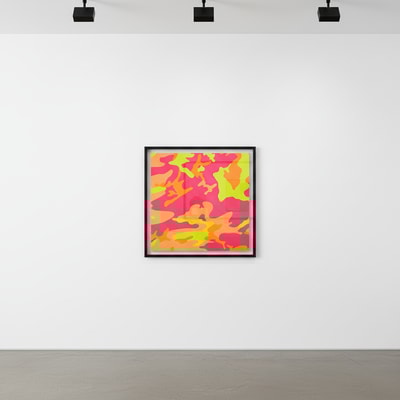
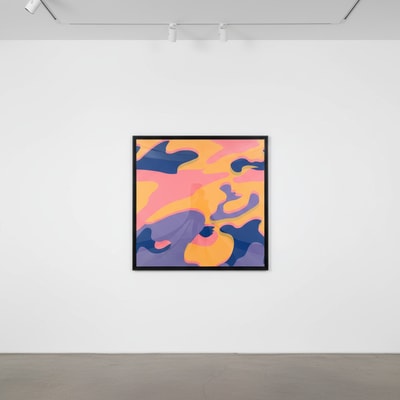
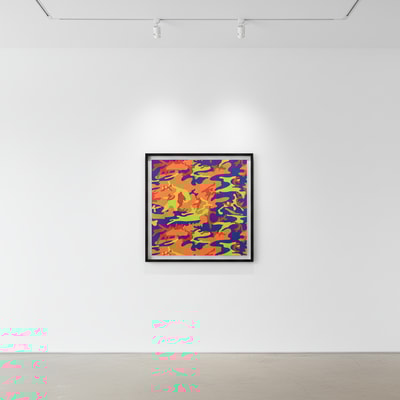
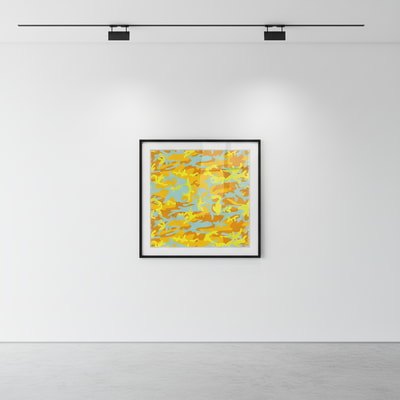
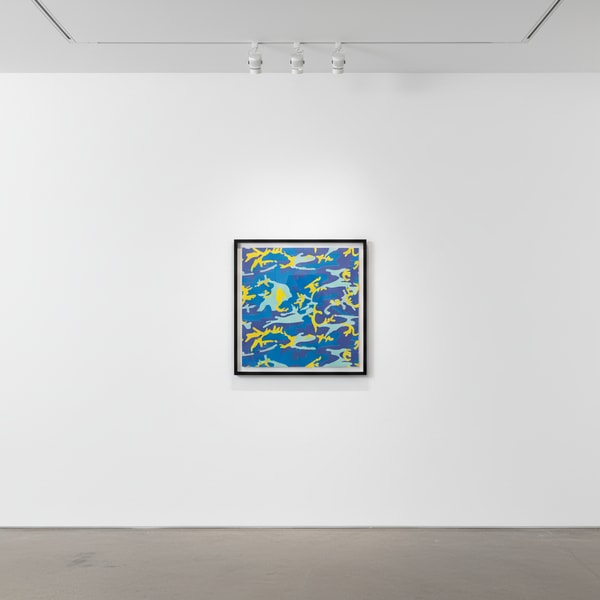
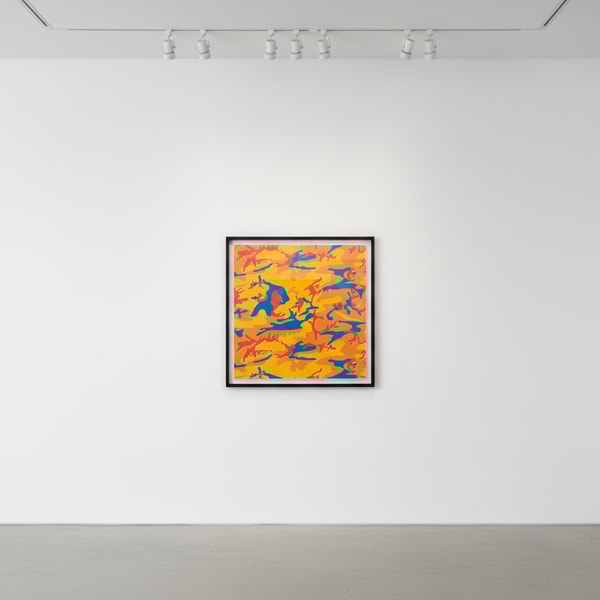
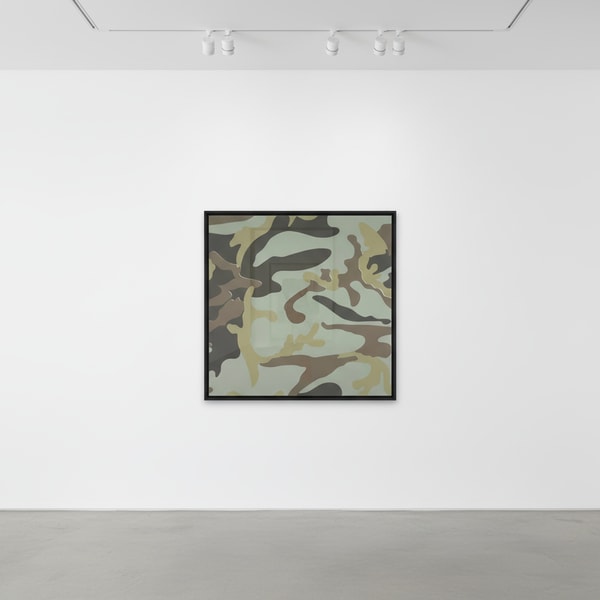
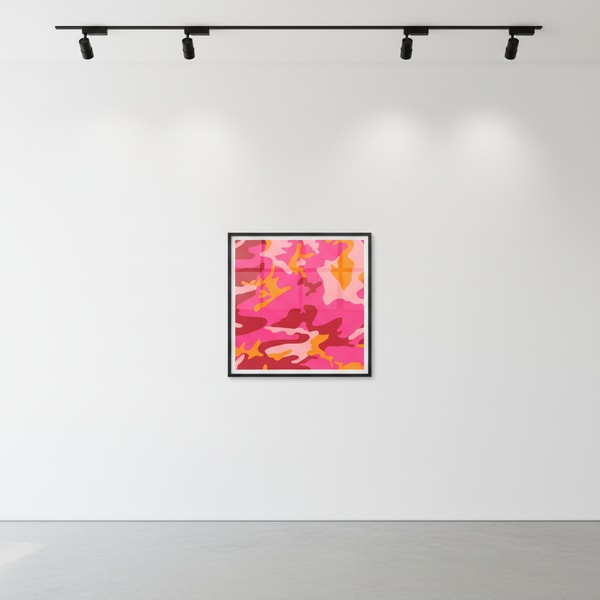
Each colorway in the portfolio offers a distinct chromatic interpretation: forest greens, desert tans, electric pinks, and synthetic blues. This range allowed Warhol to demonstrate that camouflage—ostensibly about blending in—could be rendered in palettes that demand attention rather than deflect it.

Individual Works & Collector Preferences

The Camouflage portfolio presents eight distinct colorways, each attracting different collector profiles based on aesthetic preference and display context.

Camouflage F.S. II 406 employs a traditional green palette that references actual military usage, appealing to collectors who appreciate the conceptual tension between the pattern's original purpose and its transformation into fine art. This edition has the strongest auction track record in the series, with multiple sales documented.

Camouflage F.S. II 409 features warmer earth tones and shares the market performance of 406, having achieved the same $378,000 result in April 2021. Collectors often pair these two editions when building Warhol print holdings.

Camouflage F.S. II 411, 412, and 413 offer more experimental color combinations, with 413 presenting particularly vivid synthetic hues. These editions attract buyers seeking Warhol works that function as contemporary design elements while retaining historical significance.

The Trial Proofs carry additional appeal for advanced collectors. TP 4/84 and TP 53/84 document the printing process and exist in smaller quantities than standard editions. From a dealer perspective, trial proofs consistently command collector interest when they surface, as they represent both the finished aesthetic and the working methodology of Warhol's print studio.

Authentication & Condition Considerations

Every work in the Camouflage portfolio carries authentication markers specific to Warhol's late print production. Standard editions are signed in pencil by Warhol on the front, numbered from the edition of 80, and bear the printer's chop mark from Rupert Jasen Smith. Trial proofs feature separate numbering systems (e.g., TP 4/84) and may include additional notations from the production process.

The Andy Warhol Art Authentication Board, which operated until 2011, examined works from this period, and many examples carry their stamp. For works authenticated after 2011, provenance documentation and catalogue raisonné inclusion (Feldman/Schellmann) serve as primary verification methods. Guy Hepner maintains relationships with Warhol estate experts and authentication specialists to verify works before offering them to collectors.

Condition factors specific to this series include paper toning along edges—Lenox Museum Board can exhibit yellowing if improperly stored—and registration alignment across the multiple color passes required for the camouflage pattern. Works with original documentation from Ronald Feldman Fine Arts command premium positioning.

Investment Analysis & Acquisition Strategy

The Camouflage series occupies a strategic position within Warhol's print market. Unlike Flowers or Marilyn, which carry extensive auction histories and corresponding price volatility, Camouflage appears less frequently at auction, creating relative price stability and acquisition opportunities when examples surface.

Comparing series performance: Flowers achieved $4,076,000 and $3,832,000 at Sotheby's in May 2025, while Self-Portrait reached $18,144,000 at Sotheby's in November 2023. Camouflage operates at a more accessible tier—documented results between $254,000 and $378,000—positioning the series as an entry point for collectors building comprehensive Warhol holdings without the capital requirements of blue-chip iconography.

For 2026 acquisition strategy, collectors should prioritize examples with complete provenance documentation and stable condition. Trial proofs merit particular attention given their scarcity relative to standard editions. The series also benefits from the broader narrative of late Warhol, which continues to receive institutional and scholarly attention as the market reevaluates his final decade of production.

Guy Hepner recommends building positions across multiple colorways where budgets permit, as the full portfolio demonstrates Warhol's chromatic range more effectively than individual acquisitions.


Acquire Camouflage Works

Guy Hepner maintains current inventory and private sale access for the Camouflage portfolio. Contact our New York team directly to discuss available works, pricing, and acquisition timing. For collectors seeking specific colorways or trial proofs, we provide sourcing services through our established network of Warhol collectors and estates.

Andy Warhol Camouflage

From the Journal