Flowers

May 16, 2026
Few motifs in contemporary art are as instantly recognizable as Yayoi Kusama's Pumpkins. Their bulbous forms covered in hypnotic polka dots have become visual shorthand not only for the artist herself but for the very idea of contemporary art as spectacle. Yet behind the popularity of her pumpkins—exhibited in sculpture, painting, installations, and prints—lies a complex story of biography, cultural history, and artistic experimentation.
This article traces the evolution of Kusama's pumpkins from their early appearance in her childhood imagination to their current status as global icons. It explores their art-historical significance, symbolic resonance, cultural impact, and their crucial role in the global art market.
Kusama was born in 1929 in Matsumoto, Japan, into a conservative family of seed merchants. The natural environment of her childhood, particularly the fields surrounding her family home, had a lasting impact on her artistic vision. It was here that she first encountered pumpkins, not as monumental sculptures or gallery centerpieces, but as humble crops growing in the soil.
She recalls being fascinated by their forms, their tactile surface, and their scale relative to her own small body. The pumpkin became, for Kusama, a friend and companion—something she described in interviews as both humorous and endearing. It was less threatening than other hallucinatory visions that plagued her, such as the recurring nets and fields of dots that seemed to engulf her surroundings.
In postwar Japan, the pumpkin also carried cultural associations with nourishment and survival. Food scarcity after World War II meant that pumpkins were valued for their reliability as a crop. For Kusama, this connection reinforced the idea of the pumpkin as both sustaining and humble—a motif that could embody resilience in the face of adversity.
By the time she began formal art training in Kyoto in the late 1940s, Kusama was already sketching and painting pumpkins. These early works, while less stylized than her later creations, reveal her interest in their rhythmically segmented forms. They foreshadow her mature style, in which repetition and surface pattern dominate.
Kusama moved to New York in 1958, immersing herself in the avant-garde scene that included Donald Judd, Claes Oldenburg, Andy Warhol, and other rising stars. While her Infinity Net paintings defined her reputation in this period, the pumpkin motif remained quietly present in her practice.
By the late 1960s, Kusama was staging provocative happenings and installations that often included organic forms resembling gourds. Although overshadowed by her performance art and political activism, these works show that the pumpkin was never far from her imagination. It represented an anchor, linking her avant-garde experimentation in America to her childhood memories in Japan.
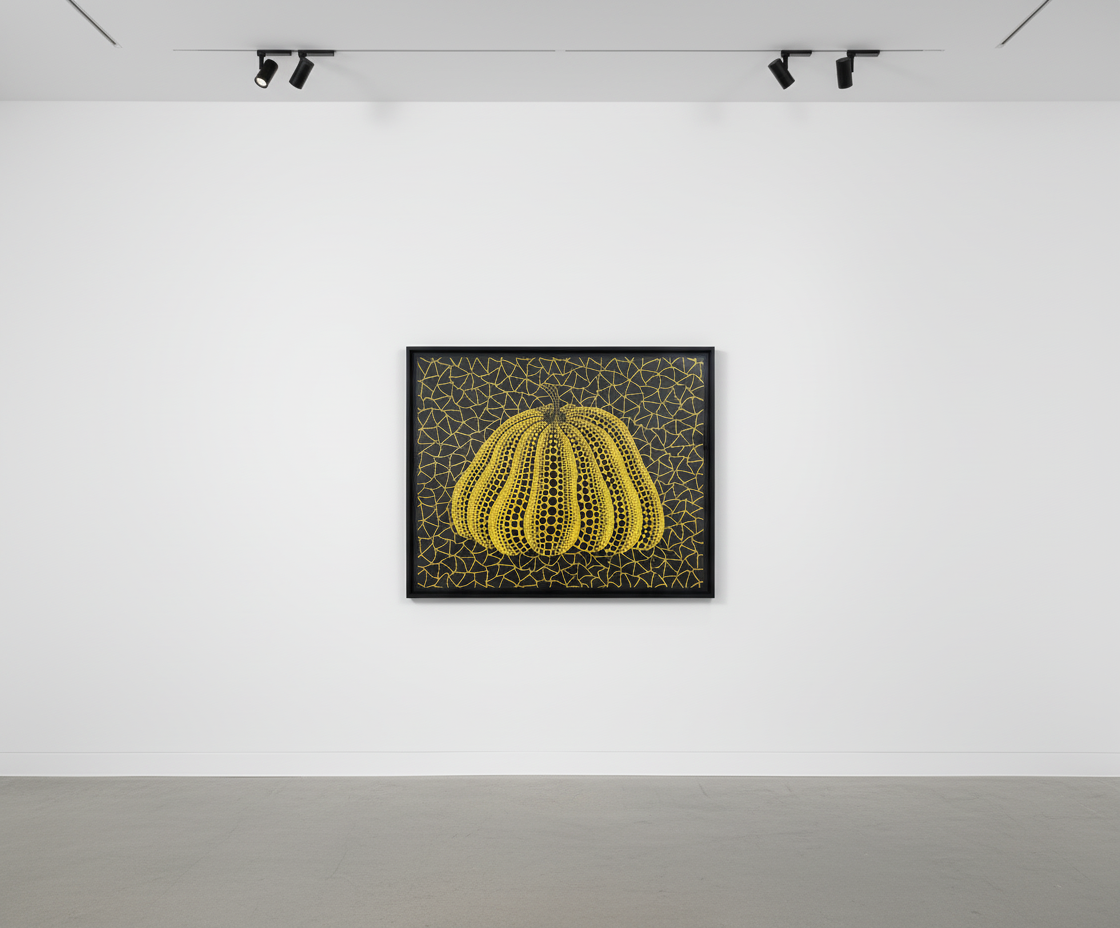
After struggling with health issues and returning to Japan in 1973, Kusama entered a period of relative isolation. Residing voluntarily in a psychiatric hospital in Tokyo, she continued to make art daily. The pumpkin reemerged during this time as a central motif, finding fuller expression in drawings, prints, and small sculptures.
In the 1980s and 1990s, as international interest in her work grew, Kusama began producing monumental pumpkin sculptures and large-scale paintings. These works transformed the pumpkin from a private childhood symbol into a public emblem of her artistic identity.
Kusama's pumpkins are never simply naturalistic depictions. They are covered in her signature polka dots, which extend across their surfaces in rhythmic patterns. The dots are not decoration but a conceptual language, representing her lifelong vision of self-obliteration in endless repetition.
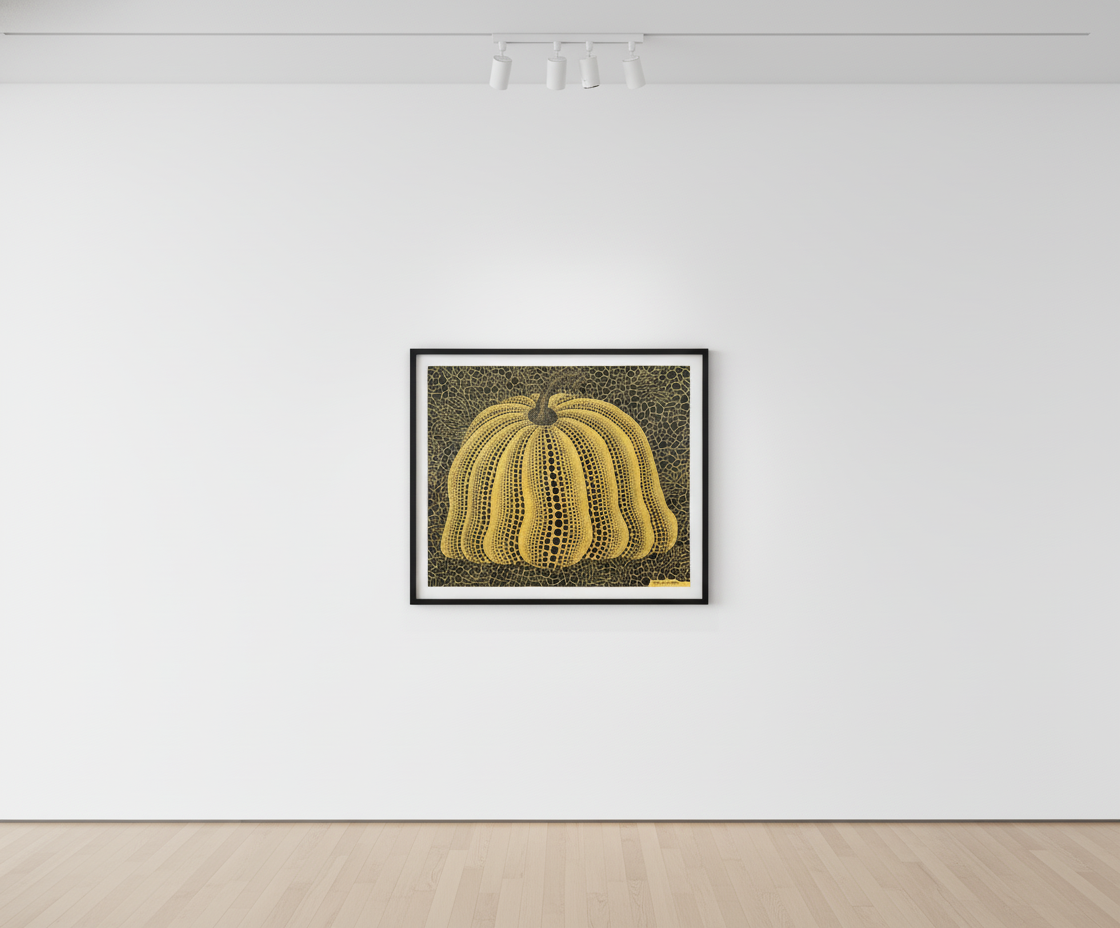
The pumpkin, with its ridged surface and organic curves, provides an ideal form for this system of dots. The segments allow her to structure the polka dot patterns, creating both order and variation. Some pumpkins are painted in vivid yellows with black dots, others in red and black, while some sculptures glow with internal light.
This transformation of a natural object into a patterned icon demonstrates Kusama's ability to merge the organic and the abstract. The pumpkin is both a thing in itself and a vehicle for infinity.
Browse available Kusama works at Guy Hepner
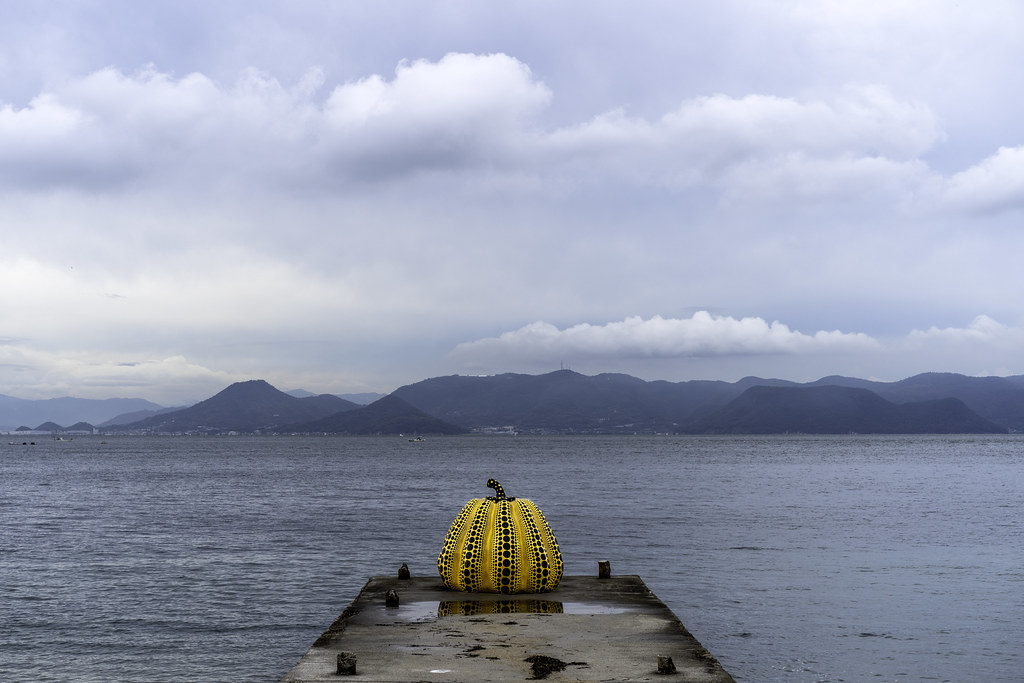
The giant yellow pumpkin on Naoshima Island, perched at the end of a pier, has become one of the most photographed works of contemporary art in Japan. Installed in 1994, it symbolizes Kusama's integration of art and landscape. Although damaged by a typhoon in 2021, it was restored and reinstalled in 2022, underscoring its resilience.
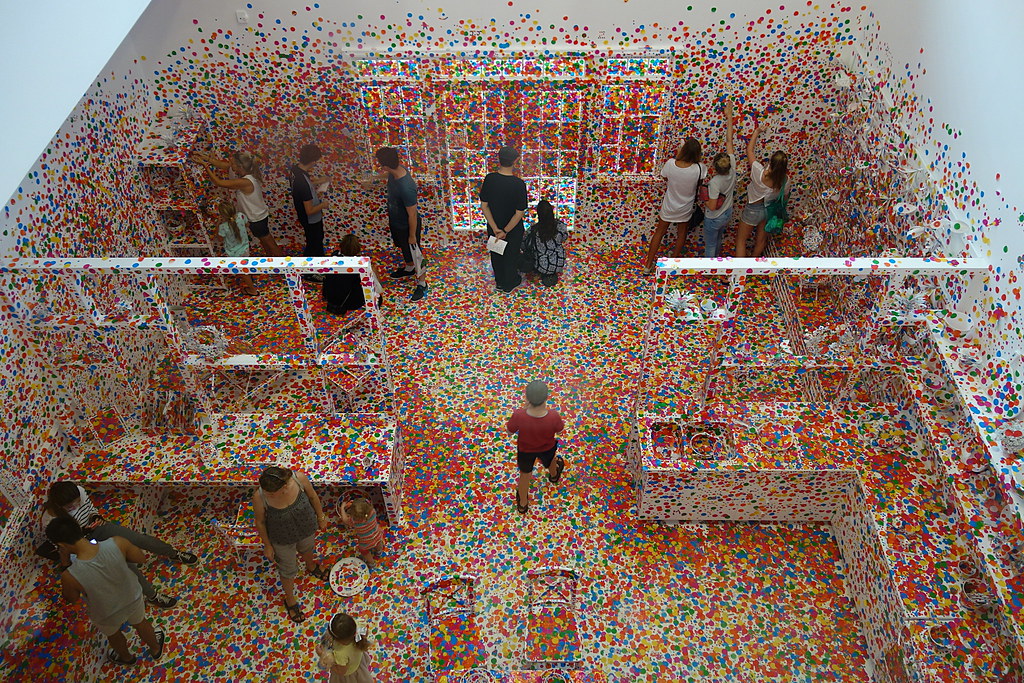
This installation combines Kusama's mirrored environments with her pumpkins, filling the room with glowing gourds reflected into infinity. It has toured internationally, captivating audiences with its immersive blend of spectacle and intimacy.
Paintings such as Pumpkin (1981) and Red Pumpkin (1982) established Kusama's bold visual language of dotted gourds. These works combine vibrant colors and dense repetition, transforming pumpkins into pulsating presences.
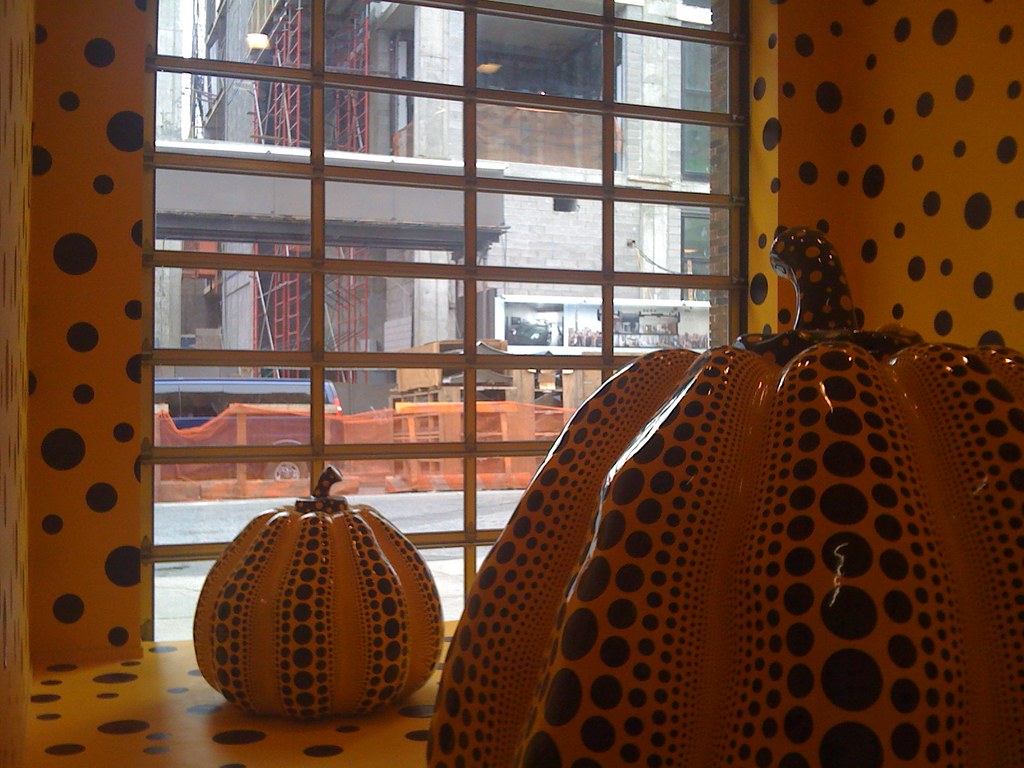
Kusama has created monumental bronze and fiberglass pumpkin sculptures for public exhibitions in London, New York, Paris, and beyond. These works translate the organic softness of pumpkins into monumental durability, reinforcing their iconic status.
The giant yellow pumpkin on Naoshima Island — perched at the end of a pier overlooking the Seto Inland Sea — has become one of the most photographed works of contemporary art in Japan. Installed in 1994 at the Benesse Art Site, it was severely damaged in a typhoon in August 2021 and restored in October 2022.
Kusama's pumpkins have featured prominently in major international exhibitions.
Venice Biennale (1993): Kusama represented Japan with a mirrored pumpkin installation, cementing the motif's global importance.
Naoshima Benesse Art Site (1994–present): The outdoor sculpture has become a pilgrimage site for contemporary art lovers.
Victoria Miro Gallery, London: Kusama's pumpkins have been repeatedly exhibited here, drawing record-breaking attendance.
"Give Me Love" (2015, David Zwirner, New York): Presented pumpkin paintings alongside polka-dot installations.
"Infinity Mirrors" (2017–2019, Hirshhorn and touring): A blockbuster exhibition that introduced Kusama's pumpkin installations to millions worldwide.
These exhibitions not only reinforced Kusama's global reputation but also established pumpkins as her most recognizable and commercially valuable motif.
For collectors, Kusama's pumpkins offer a combination of accessibility and prestige. Their instantly recognizable form ensures broad appeal, while their deep roots in Kusama's biography and artistic philosophy guarantee historical importance. Collectors are drawn to them because they embody the full range of Kusama's themes—repetition, infinity, self-obliteration—yet remain approachable and even playful.
Pumpkins also act as "signature works" in Kusama's market. Much as Andy Warhol's soup cans or Damien Hirst's spot paintings symbolize their creators, pumpkins serve as Kusama's brand-defining motif. For this reason, owning a pumpkin work is often considered essential for any serious Kusama collection.
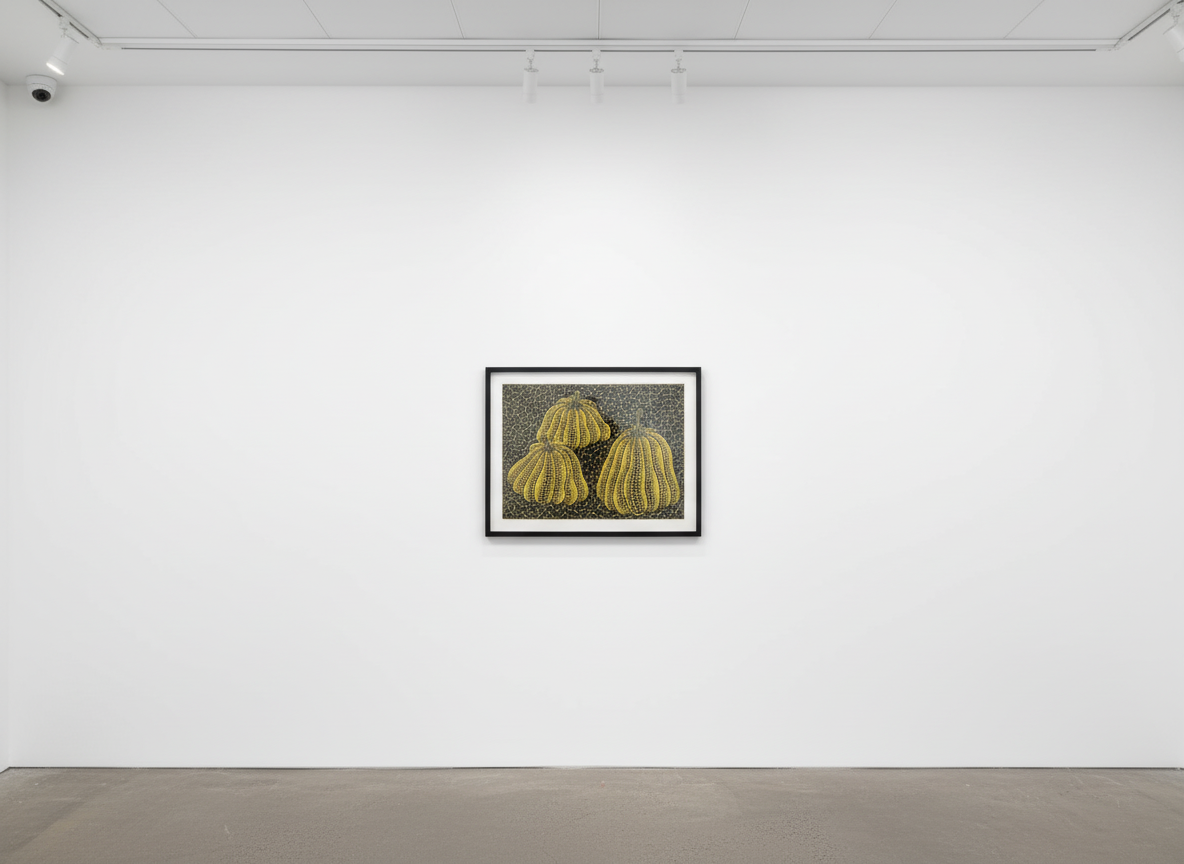
Inquire about Kusama pumpkin works at Guy Hepner
The market for Kusama's pumpkins has soared over the past two decades.
In 2019, a large yellow pumpkin sculpture sold at Sotheby's Hong Kong for over $8 million USD, a record for her pumpkin works at the time.
Pumpkin paintings from the 1990s and early 2000s regularly achieve between $2 million and $6 million USD at Christie's and Sotheby's.
Limited-edition pumpkin prints, while more accessible, often sell for $100,000 to $300,000 USD depending on rarity and scale.
Pumpkins consistently outperform other motifs in Kusama's oeuvre at auction, making them reliable investments as well as culturally iconic acquisitions.
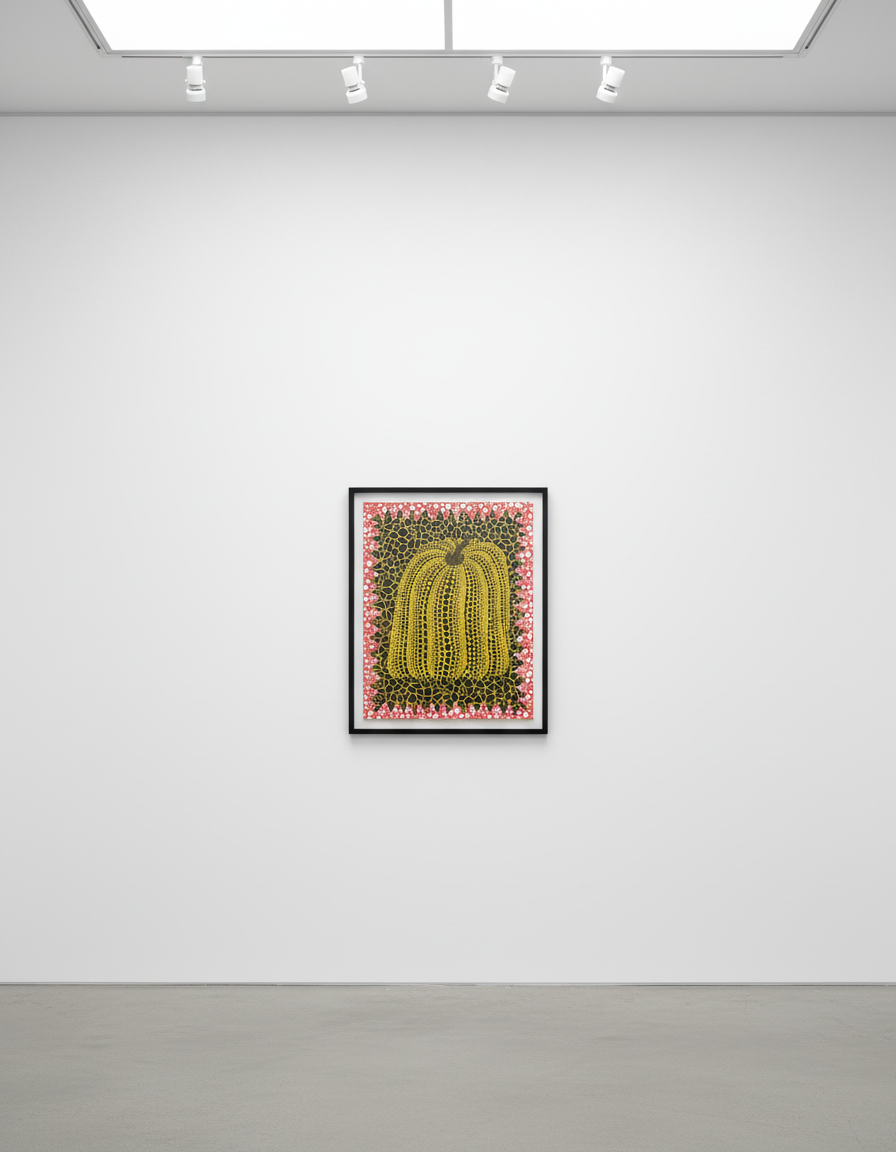
Still life traditions in Western art—from Caravaggio's fruit to Cézanne's apples—used humble objects to explore formal and symbolic concerns. Kusama reinvents this tradition for the contemporary age. Her pumpkins are not naturalistic but hallucinatory, hovering between object and pattern, sculpture and environment.
In this sense, her pumpkins bridge Surrealism's fascination with organic forms and Minimalism's interest in repetition. They also extend the Japanese tradition of celebrating humble, everyday objects as carriers of beauty and meaning.
Kusama herself has acknowledged that pumpkins function as self-portraits. Their whimsical yet sturdy forms mirror her balance of vulnerability and resilience. The endless dots reflect her hallucinations and her desire to dissolve into infinity. She has described the pumpkin as "a spiritual home," a form in which she sees herself reflected.
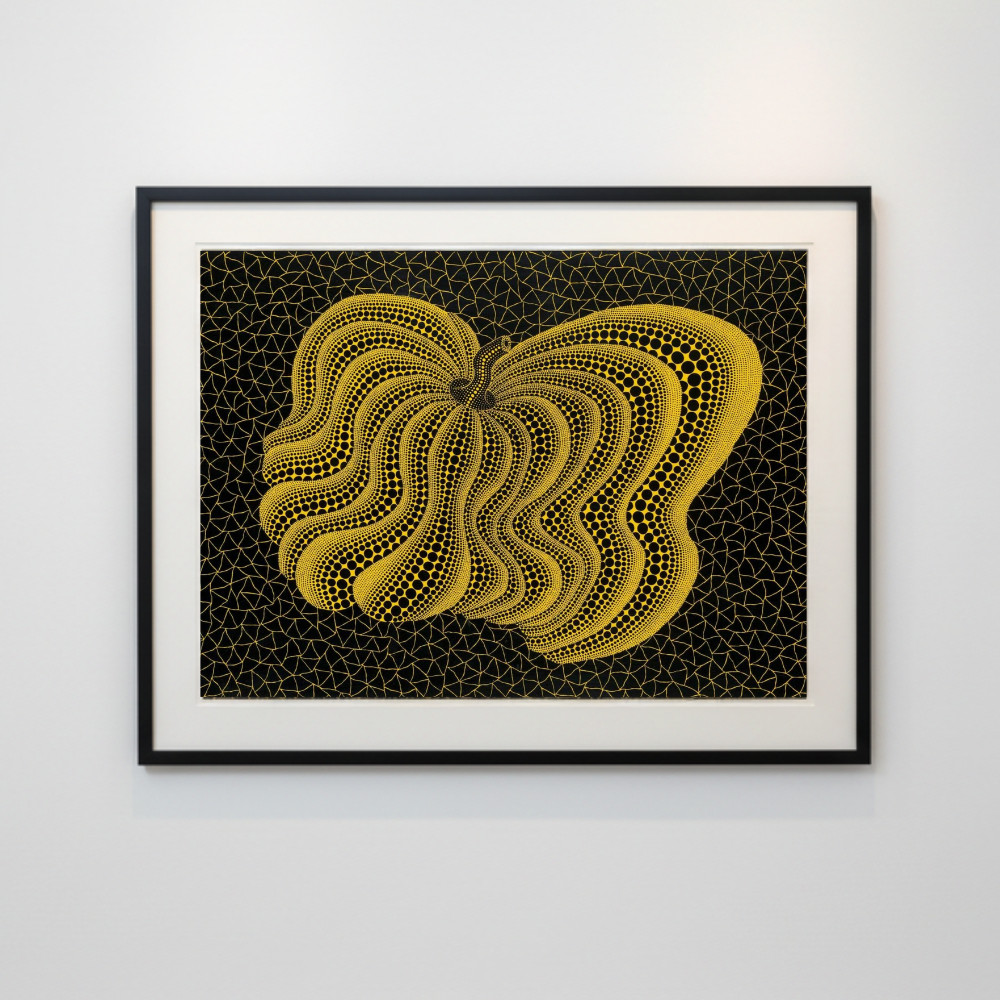
Kusama's pumpkins have expanded beyond galleries into fashion, design, and mass culture. Collaborations with Louis Vuitton and museum shops worldwide have disseminated pumpkin imagery to millions. This popular presence does not diminish their seriousness but instead reinforces Kusama's position as an artist who blurs the boundaries between high art and everyday life.
Yayoi Kusama's pumpkins are one of her most iconic and enduring motifs — bulbous gourd forms covered in polka dots, produced across sculpture, painting, prints, and installation. Rooted in childhood memories from her family's seed merchant business in Matsumoto, Japan, they have evolved into global symbols of contemporary art.
Kusama has described the pumpkin as a 'spiritual home' — a form she finds humorous, endearing, and resilient. She first encountered pumpkins as a child in the vegetable fields near her home, and the motif has remained central to her work ever since, serving simultaneously as self-portrait, philosophical statement, and a vehicle for her dot-based language of infinity and self-obliteration.
Kusama's most famous pumpkin is the yellow polka-dot sculpture installed in 1994 at the Benesse Art Site on Naoshima Island, Japan. Perched at the end of a pier overlooking the Seto Inland Sea, it became one of the most visited public artworks in contemporary art. It was damaged in a typhoon in August 2021 and restored in October 2022.
Kusama began making pumpkin works in the late 1940s as a student in Kyoto. The motif gained wider recognition through prints and paintings in the 1980s and 1990s, and achieved global iconic status with the 1994 Naoshima installation. She continues to create new pumpkin works to this day.
Guy Hepner Gallery carries an extensive selection of Yayoi Kusama pumpkin prints and editions. Browse available Kusama works or contact the gallery directly to discuss acquisition.
Explore Yayoi Kusama prints for sale at Guy Hepner: Flowers, Fruits, Pumpkins, Watermelon, Fauna.
Related Series