Neons

September 26, 2026
Tracey Emin neon works represent one of the most distinctive and emotionally charged bodies of work in contemporary art. Since the mid-1990s, the British artist has transformed the industrial medium of bent glass tubing and noble gases into vessels for raw human confession, creating luminous sculptures that pulse with vulnerability, longing, and unflinching honesty. For collectors seeking works that bridge conceptual rigor with profound emotional resonance, Emin's Neons offer a rare combination of art historical significance, market strength, and enduring visual power.
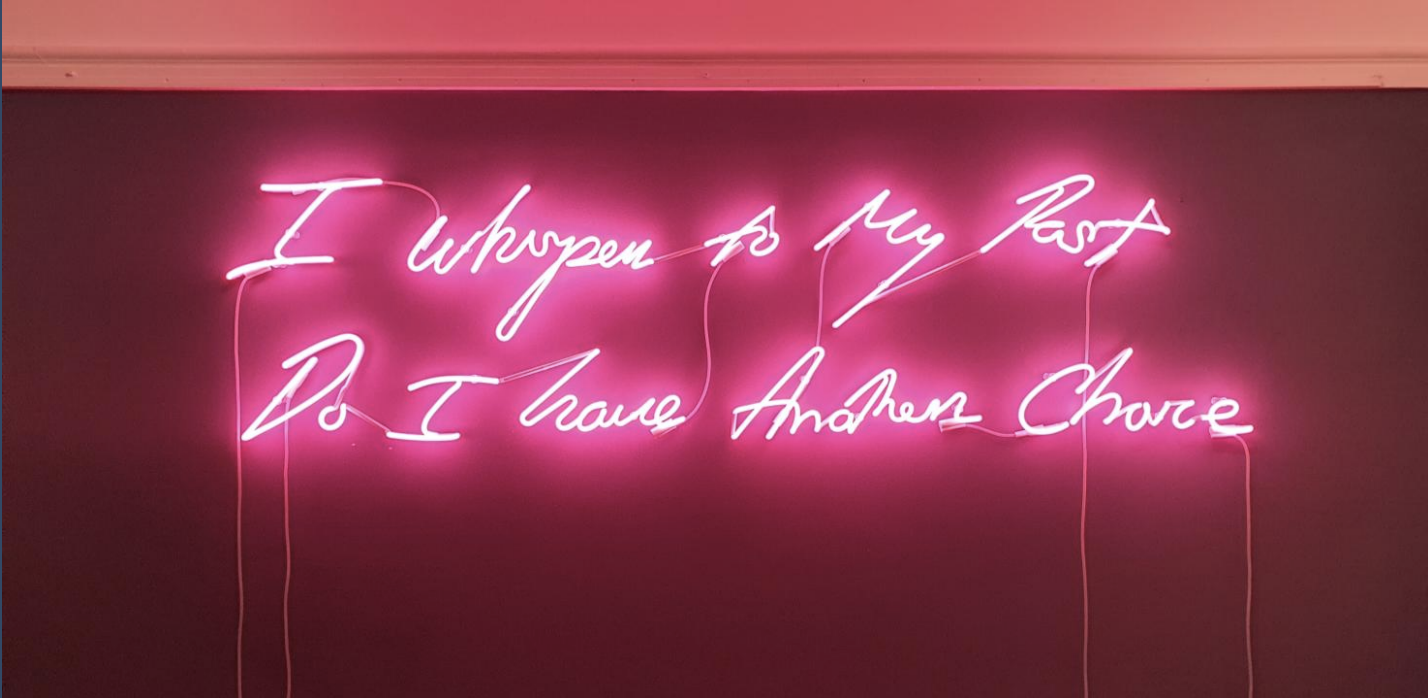
The neon sculptures have become synonymous with Emin's artistic identity, functioning as three-dimensional poems that hover between commercial signage and private diary entries. Written in the artist's own distinctive cursive handwriting, these works transform intimate declarations—statements about love, loss, desire, and mortality—into public monuments of feeling. They occupy a unique position in the contemporary art market, appealing equally to institutions seeking iconic works and private collectors drawn to their emotional directness and environmental presence.
Tracey Emin emerged as a central figure in the Young British Artists movement during the early 1990s, achieving international recognition alongside contemporaries including Damien Hirst, Sarah Lucas, and the Chapman Brothers. Born in London in 1963 and raised in the seaside town of Margate, Emin developed an artistic practice rooted in autobiography and confession. Her 1999 Turner Prize nomination for "My Bed"—an unmade bed surrounded by personal detritus including vodka bottles and pregnancy tests—cemented her reputation for transforming intimate experience into powerful art objects.
Emin created her first neon work in 1995, drawing inspiration from the glowing shop signs and fairground attractions of her Margate childhood. The medium offered her something no canvas or textile could provide: the ability to make words physically glow, to give language a literal radiance that could fill and transform a room. Growing up surrounded by neon's commercial applications, Emin understood its psychological effects—the way the pulsating gases create what she has described as a "feel-good factor" associated with casinos, funfairs, and red-light districts. By redirecting this commercial technology toward personal confession, she created a new paradigm for text-based art.
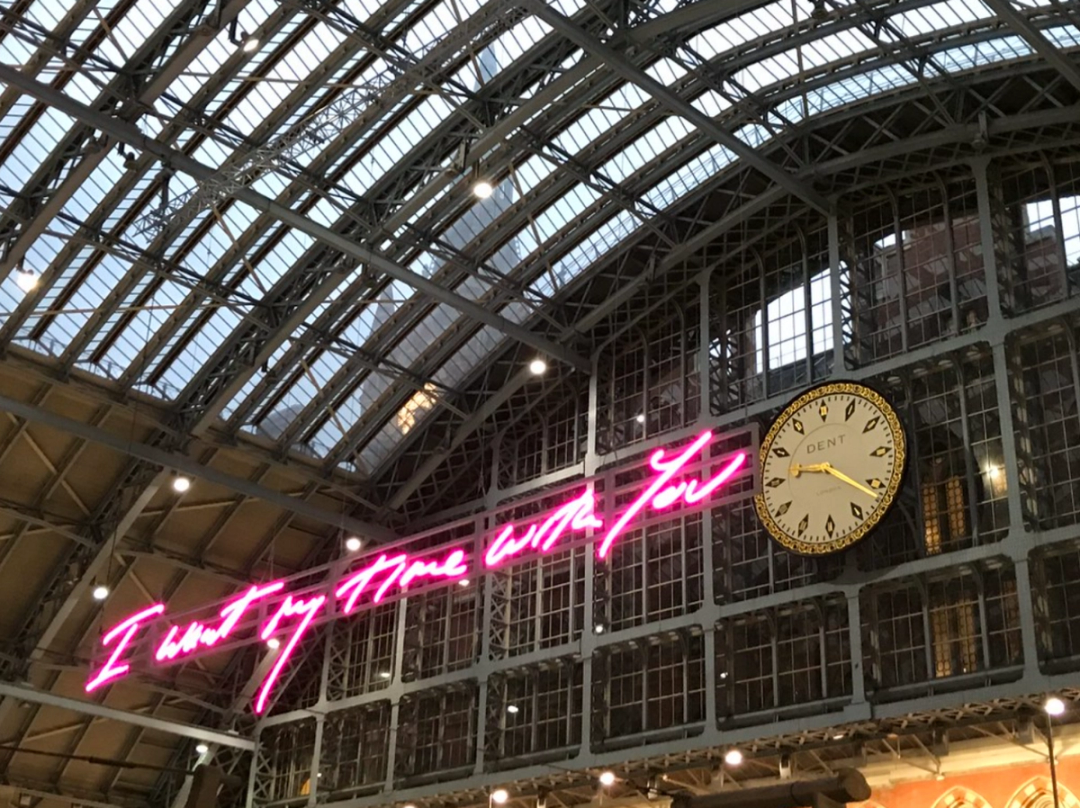
The market for Emin's neons has strengthened considerably over the past two decades. While her prints and textile works remain accessible entry points for new collectors, the neon sculptures command premium prices that reflect their status as signature works. Auction results have demonstrated consistent appreciation, with major pieces achieving six-figure sums. The institutional validation has been equally significant: Emin's neons have entered permanent collections at major museums worldwide and have been installed in prominent public commissions, including the 2018 installation of "I Want My Time With You" at London's St Pancras International station.
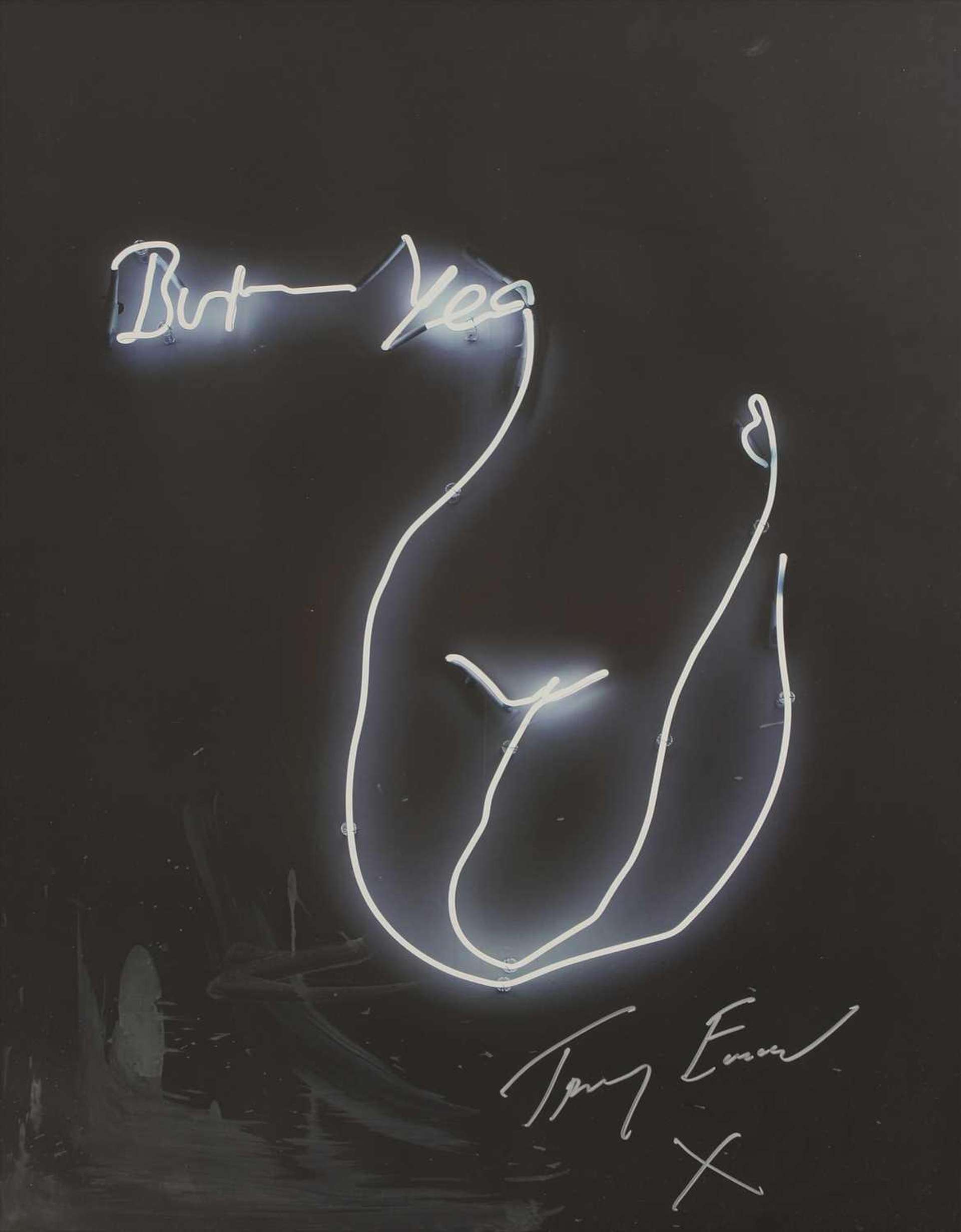
Tracey Emin, Neon Work. Available at Guy Hepner, New York.
The 2026 retrospective "A Second Life" at Tate Modern, the artist's largest exhibition to date, has further solidified the neons' art historical importance. In preparation for the exhibition, Emin's neon texts were installed across 22 locations in 11 London boroughs, transforming the city into an open-air gallery and introducing her work to audiences who might never enter a museum. This public activation demonstrated the unique capacity of the neons to function simultaneously as intimate confessions and large-scale public artworks.
Emin's neon practice has evolved over three decades while maintaining remarkable thematic consistency. The works address the fundamental experiences of human existence—love, desire, abandonment, hope, and mortality—through deceptively simple statements rendered in the artist's handwriting. The phrases often read as fragments of conversation, private thoughts made public, or declarations that hover between vulnerability and defiance.
Early works from the mid-1990s established the template that Emin would refine over subsequent decades. Pieces like "Just Love Me" (2001) and "Life without you Never" (2001) demonstrated her ability to compress complex emotional states into brief, resonant phrases. The grammatical ambiguity of many titles—"Life without you Never" can be read as both a statement of devotion and a lament—creates interpretive openness that allows viewers to project their own experiences onto the work.
The mid-2000s saw Emin expand both the scale and public profile of her neon practice. "Meet me in Heaven I will wait For You" (2004/2011) introduced explicitly spiritual themes, while works like "Love is What You Want" (2011) achieved iconic status through their use as exhibition titles and institutional commissions. The phrase "Love is What You Want" served as the title for Emin's major 2011 retrospective at the Hayward Gallery, demonstrating how the neons could function as both artworks and curatorial statements.
Recent works have continued to explore the emotional terrain that has defined the series. "I Want My Time With You" (2017), now installed at St Pancras station, addresses the finite nature of time and the courage required to ask for closeness. The 2025 works "A Second Life," "I Loved You Until the Morning," and "Sex and Solitude" suggest continued engagement with mortality and intimacy, themes that have gained additional poignancy as the artist has aged and faced health challenges, including her 2020 diagnosis with bladder cancer.
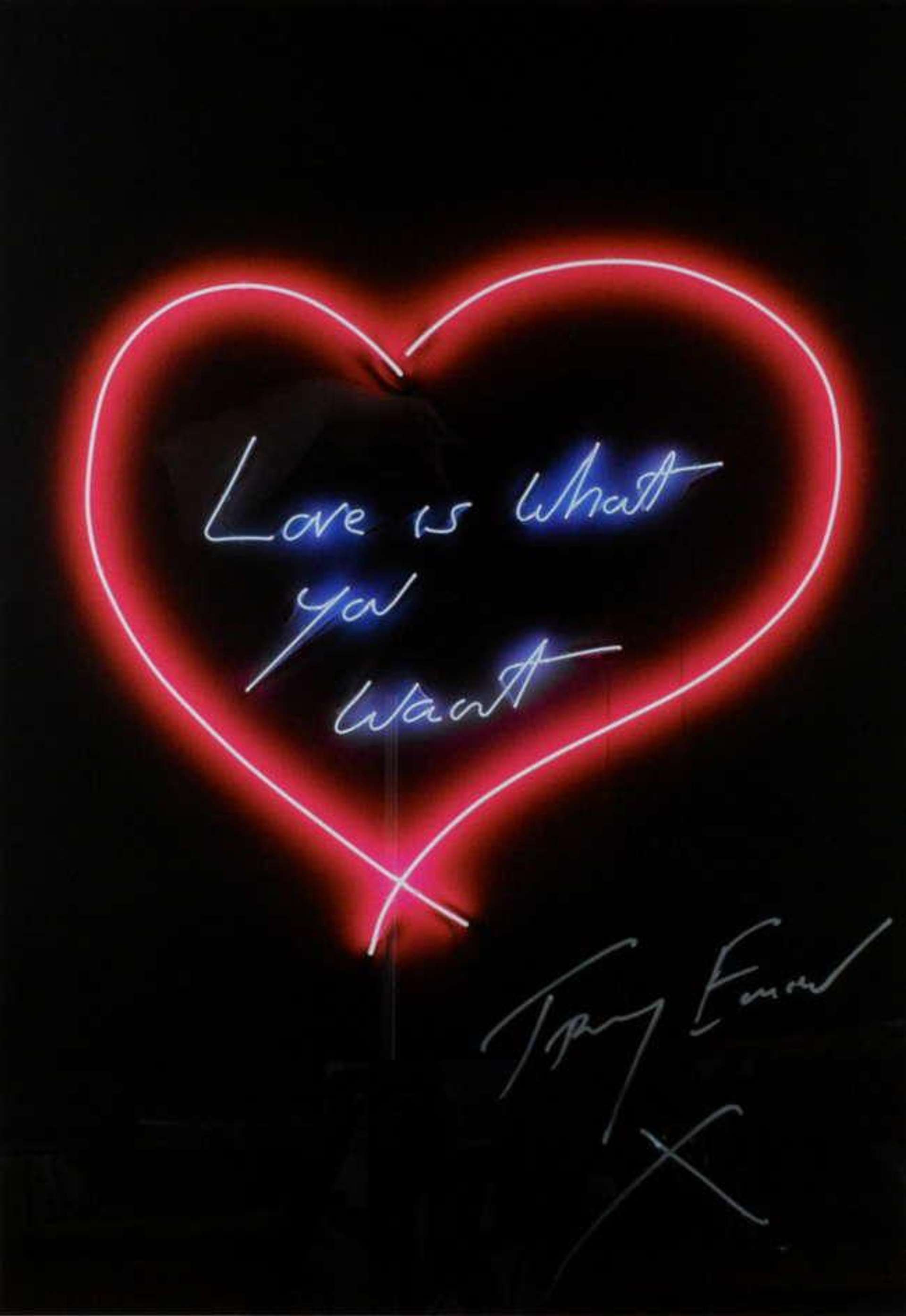
Tracey Emin, Love is What You Want, 2011, Neon. Available at Guy Hepner, New York.
Collectors approaching Emin's neons should understand the criteria that distinguish exceptional examples from standard pieces. The quality of a neon work depends on factors ranging from fabrication precision to condition preservation, and informed evaluation requires attention to multiple dimensions.
The defining characteristic of Emin's neons is their reproduction of her distinctive cursive script. Authentic works capture the specific rhythms and irregularities of her handwriting—the slight unevenness of baseline, the characteristic loops and flourishes, the pressure variations that suggest the original pen stroke. Works where the glass tubing faithfully reproduces these idiosyncrasies possess greater authenticity and visual interest than those where the fabrication has overly regularized the letterforms. Examine how the neon tubes handle the transitions between letters and the overall flow of the script.
Emin has employed a range of neon colors throughout the series, with certain hues becoming associated with specific emotional registers. Soft pinks predominate in works about love and desire, while reds, blues, and whites appear in pieces addressing different emotional territories. The condition of the gas fill is critical: neon tubes can dim over time or develop inconsistencies in their glow. Well-maintained examples should display even illumination across the entire script without dead spots or flickering. Original transformers and mounting hardware add to the work's integrity.
The physical scale of a neon work significantly affects its presence and market value. Larger pieces—some spanning nearly three meters in width—command premium prices and create immersive environmental experiences. The work "I Want My Time With You," for example, measures approximately 110 inches wide, allowing the script to unfold across a wall like a line of poetry. Consider how a potential acquisition will function in your collection space: neons require adequate wall area and benefit from subdued ambient lighting that allows their glow to dominate.
Authentication of Tracey Emin neons requires careful attention to documentation and provenance chain. Unlike prints, which carry edition numbers and signatures directly on the work, neon sculptures rely on accompanying certificates of authenticity and exhibition histories to establish their legitimacy.
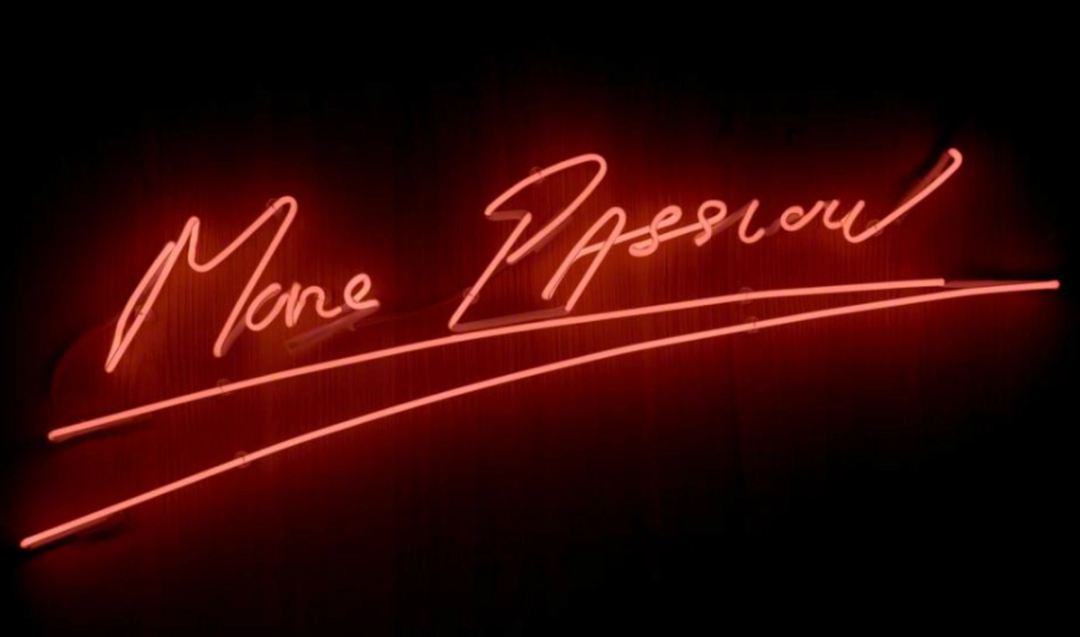
Tracey Emin, More Passion, Neon. Available at Guy Hepner, New York.
Emin's neons are typically issued with certificates signed by the artist that document the title, date, edition number, and dimensions. These certificates are essential to establishing authenticity and should be preserved with the work. The certificate should match the physical characteristics of the piece, including the specific wording, color, and scale. Any discrepancy between certificate and object warrants further investigation.
Provenance documentation should trace the work's ownership history from the original gallery or publisher to the present. Neons that have appeared in major exhibitions or are documented in catalogue raisonnés carry enhanced market confidence. Works that have passed through recognized dealers specializing in Emin's work, or that were acquired directly from the artist's representing galleries, offer stronger provenance than pieces with unclear ownership chains.
Collectors should exercise caution with works lacking documentation or offered through unfamiliar channels. The fabrication process for neon is relatively accessible, making the category potentially vulnerable to unauthorized copies. Purchasing through established dealers with direct relationships to the artist's estate or representing galleries provides important protection.
Tracey Emin's neons are typically issued in small editions, reflecting both the complexity of fabrication and the artist's desire to maintain scarcity. Edition sizes commonly range from three to five examples plus artist's proofs, though specific configurations vary by work. The intimate edition sizes distinguish the neons from Emin's more widely available print editions and contribute to their premium market positioning.
Understanding edition terminology is essential for collectors:
The small edition sizes mean that primary market availability is extremely limited. Most Emin neons enter collections shortly after creation and only return to market through secondary channels. When examples do become available, they typically command significant premiums over original issue prices. The combination of institutional demand, limited supply, and consistent collector interest creates favorable conditions for long-term value retention.
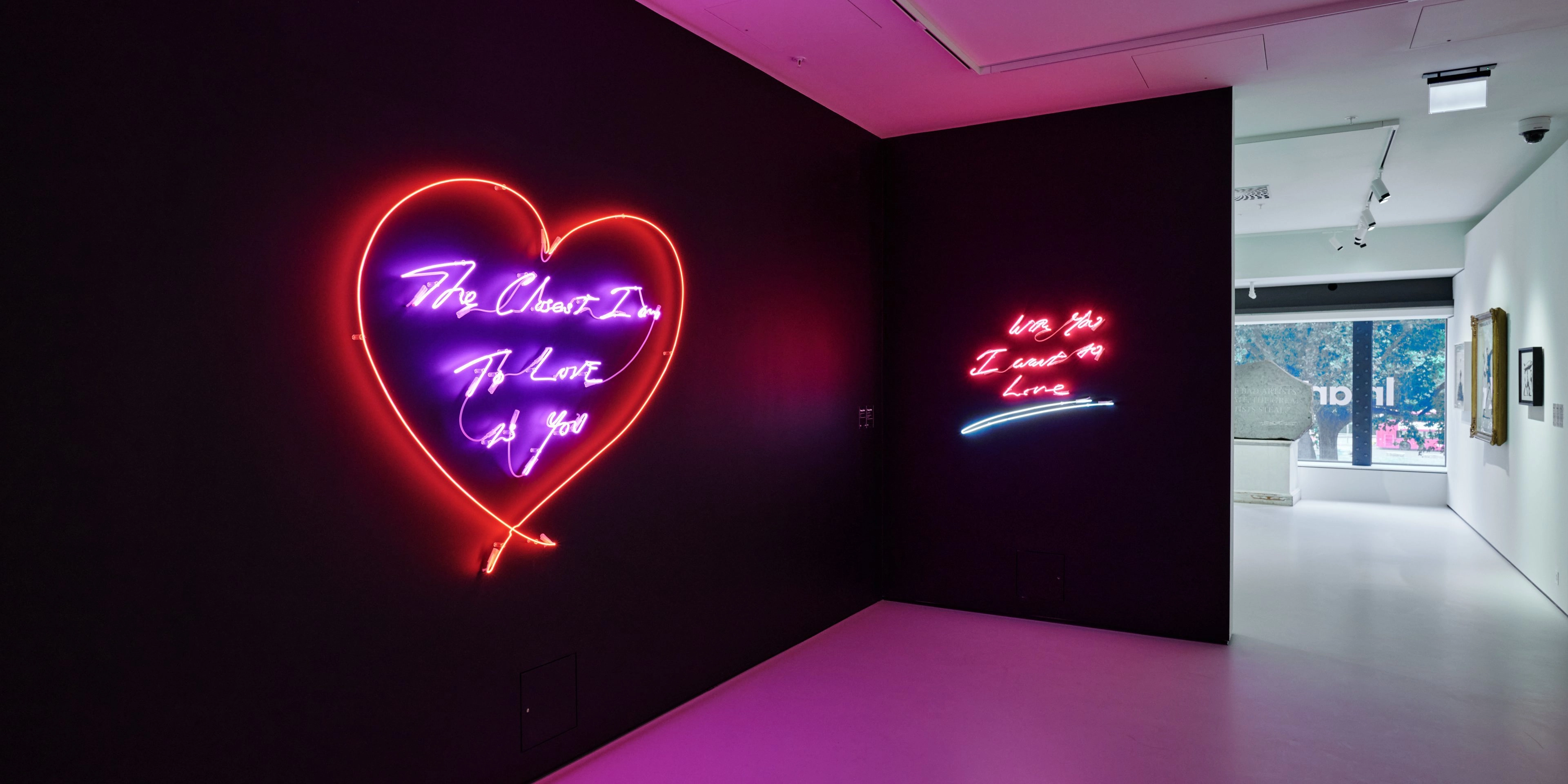
Tracey Emin, Neon Heart Installation. Available at Guy Hepner, New York.
Current availability at Guy Hepner includes fourteen neon works spanning the artist's production from 2001 to 2025. This inventory represents one of the most comprehensive selections available through a single gallery source, offering collectors the opportunity to acquire works from different periods and explore the thematic development of the series.
The market for Tracey Emin neons has matured significantly since the artist's emergence in the 1990s, with pricing now reflecting both her established art historical position and the works' genuine scarcity. While specific prices depend on the individual work, its edition position, condition, and provenance, collectors can anticipate the following general framework.
Entry-level examples—smaller works or those from less prominent moments in the series—may be available in the mid-five-figure range. These pieces offer authentic access to the artist's neon practice while requiring more modest capital outlay. Works from this tier typically feature shorter phrases and more compact dimensions, making them suitable for residential installation in spaces that cannot accommodate the monumental scale of major pieces.
Mid-range works, including significant phrases from the artist's productive middle period, generally trade in the six-figure range. These pieces often represent the sweet spot for serious collectors, offering substantial presence and recognized significance without the premium attached to the most iconic examples. Works like "Love is What You Want" or "I Think I Love You" fall into this category, commanding prices that reflect both their emotional resonance and their frequency of institutional exhibition and scholarly discussion.
At the upper end of the market, the most celebrated works—those with major exhibition histories, prominent public installations, or exceptional rarity—can approach or exceed the quarter-million-dollar threshold. The most significant auction results have confirmed this upper boundary, with institutional buyers and established collectors competing for examples that represent career-defining statements.
Approaching Emin's neons requires clarity about collecting objectives. The series offers multiple entry points suited to different collector profiles, from those building comprehensive YBA holdings to individuals seeking a single transformative acquisition.
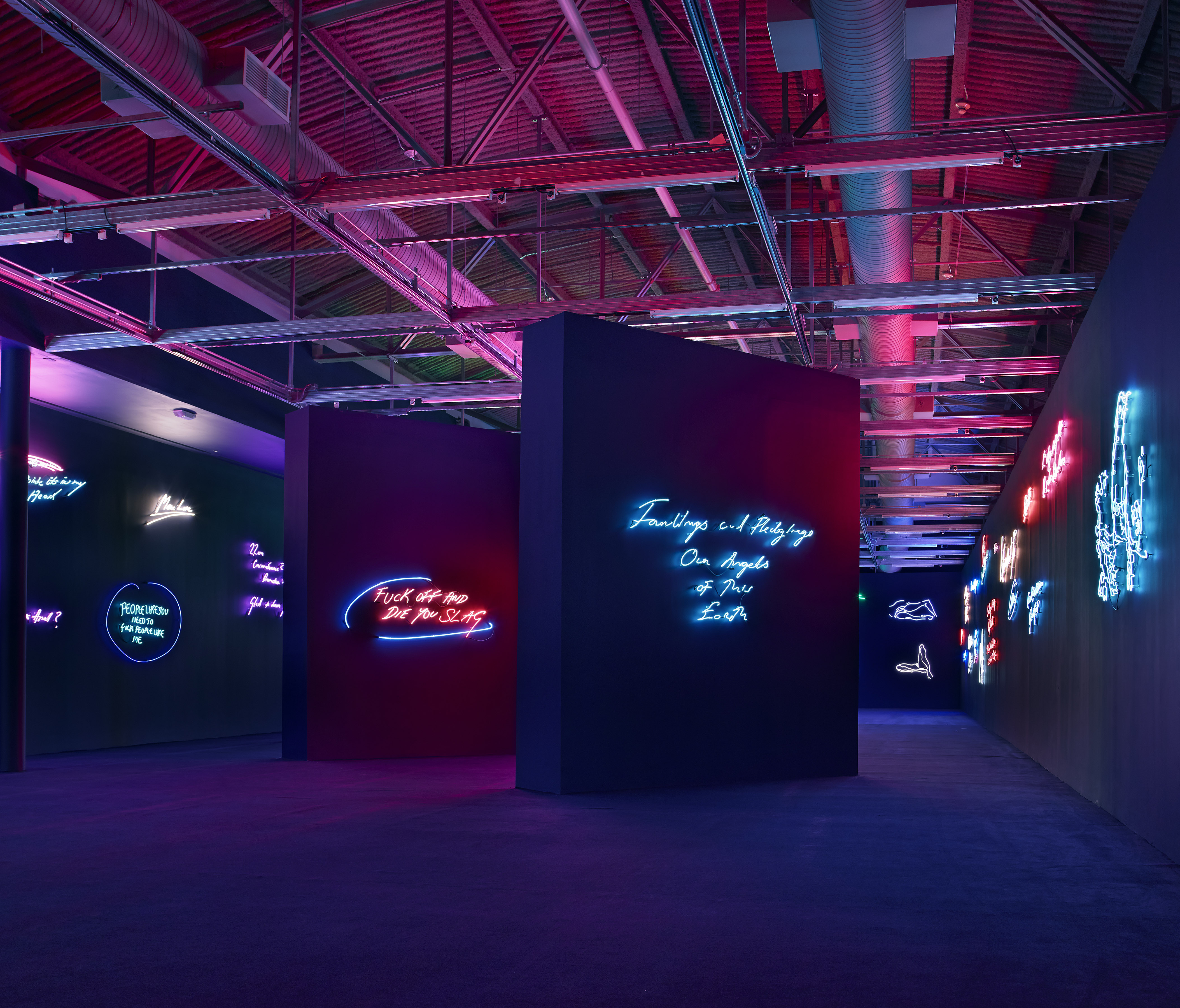
Tracey Emin, Neon Installation. Available at Guy Hepner, New York.
Collectors focused on art historical significance should prioritize works from periods of peak institutional recognition. The neons created around major museum exhibitions—the Hayward Gallery retrospective in 2011, or the current Tate Modern survey—carry enhanced scholarly attention and documentation. Works that have appeared in museum collections or significant traveling exhibitions bring institutional validation that supports long-term value and resale potential.
Those collecting for personal resonance might approach the selection differently, seeking phrases that speak to their own emotional experience. Emin's genius lies in her ability to articulate feelings that seem simultaneously intensely personal and universally recognizable. A collector may find that a particular phrase—"I Want My Time With You," "You Saved Me," "The Closest I am to Love is You"—resonates with their own life circumstances in ways that transcend market considerations. These works become more than investments; they become companions.
Practical considerations include installation requirements and space constraints. Neons demand appropriate electrical infrastructure, including accessible outlets and potentially dedicated transformers. The works generate modest heat and emit a gentle humming sound that some find meditative while others find intrusive. Lighting design matters significantly: neons reveal their full power in spaces where ambient light can be controlled, allowing the work's own luminosity to dominate the environment.
Guy Hepner Gallery maintains one of the most comprehensive inventories of Tracey Emin neons currently available on the secondary market. With fourteen works spanning the artist's production from early pieces through recent creations, the gallery offers collectors genuine choice and the opportunity to compare options across the series. Each work is fully authenticated with complete provenance documentation, condition reports, and appropriate certificates.
The gallery's position at 529 West 20th Street, New York places it at the center of Chelsea's gallery district, facilitating in-person viewing appointments where collectors can experience the environmental presence of these works firsthand. The team brings deep expertise in British contemporary art and the Young British Artists specifically, with established relationships that enable sourcing of works beyond current inventory.
For collectors considering a Tracey Emin neon acquisition, Guy Hepner provides comprehensive services including condition assessment, authentication verification, installation consultation, and ongoing collection management support. The gallery welcomes inquiries from both new collectors exploring the category and established clients seeking to expand existing holdings. Contact the gallery to discuss current availability and acquisition opportunities.
Explore Tracey Emin prints for sale at Guy Hepner: Neons.
Related Series