Book Wall Pieces

July 21, 2026
There's a particular kind of relief that comes from having your most unspeakable thoughts spoken aloud. The therapist's office has long been the designated space for this unburdening—that leather chair, those neutral walls, the measured silence before the confession. But what happens when the confession arrives not from a patient's mouth but from a painted book cover hanging in a gallery? What happens when Johan Deckmann art takes the innermost anxieties you've been nursing at 3 a.m. and presents them in bold serif type, framed and ready for purchase?
The answer, as it turns out, is that you laugh. Then you wince. Then you consider buying the piece because it understands you better than most humans you've dated.
Johan Deckmann operates from a studio in central Copenhagen, situated with appropriate irony near Tivoli Gardens—a place dedicated to manufactured joy—and the Carlsberg brewery, purveyor of manufactured numbness. He is a practicing psychotherapist, an author, and an artist, though the boundaries between these vocations have become so permeable that distinguishing where one ends and another begins feels like a therapeutic exercise in itself. His work consists primarily of fabricated self-help book covers and text-based canvases, each bearing titles that read like the chapter headings from a memoir you're too cowardly to write.
The titles themselves are the work. "How to Mistake Chemistry for Compatibility." "The Ultimate Guide to Existential Crisis." "I Love You Too and Other Lies." These aren't throwaway one-liners designed for Instagram engagement (though they perform beautifully there); they're diagnostic statements dressed in the visual language of paperback wisdom literature. Deckmann takes the form of the self-help book—that most earnest and often ridiculed genre—and subverts it into something closer to confession, critique, and catharsis all at once.
What distinguishes Deckmann from other practitioners of psychological text art is his professional legitimacy in the field he satirizes. This isn't an outsider looking in and making educated guesses about human neurosis; this is someone who has spent countless hours listening to people explain why they keep returning to partners who make them miserable, why they self-sabotage at the moment of potential success, why they feel lonely in crowded rooms. His studio practice and his clinical practice feed each other in ways that would make most ethics boards nervous but produce art of uncommon emotional precision.
Johan Deckmann
To understand where Deckmann sits within contemporary art history, one must trace the evolution of text-based contemporary art from its conceptual origins to its current ubiquity. Jenny Holzer's LED truisms, scrolling their unsettling aphorisms across Times Square in the 1980s, established the possibility that language itself—without accompanying imagery—could constitute visual art of the highest order. Barbara Kruger's confrontational declarations, set in Futura Bold against red and white, demonstrated that graphic design and political critique could merge into something museum-worthy. Ed Ruscha painted single words against sunset gradients, making the ordinary extraordinary through sheer formal elegance.
Deckmann inherits this tradition but redirects its energy. Where Holzer's statements feel oracular and universal ("Abuse of power comes as no surprise"), Deckmann's feel personal and specific ("How to Lower Your Standards Without Knowing It"). Where Kruger addresses systems of power and consumption, Deckmann addresses the power we hold over ourselves and the ways we consume our own potential. The political here becomes psychological; the systemic becomes intimate. You don't leave a Deckmann exhibition thinking about capitalism—you leave thinking about that relationship you stayed in two years too long because you confused anxiety for attraction.
This intimacy represents both the strength and the potential limitation of therapy art as a genre. Critics might argue that work so focused on individual psychology risks becoming apolitical, navel-gazing, complicit in the very self-help culture it appears to critique. But this reading misses something essential: Deckmann's work recognizes that political and social conditions manifest in psychological symptoms. The anxiety about productivity, the fear of failure, the chronic loneliness despite hyperconnectivity—these aren't purely individual pathologies but responses to structural conditions. The fictional self-help book becomes a document of how we've internalized certain economic and social imperatives, how we've learned to blame ourselves for systemic failures.
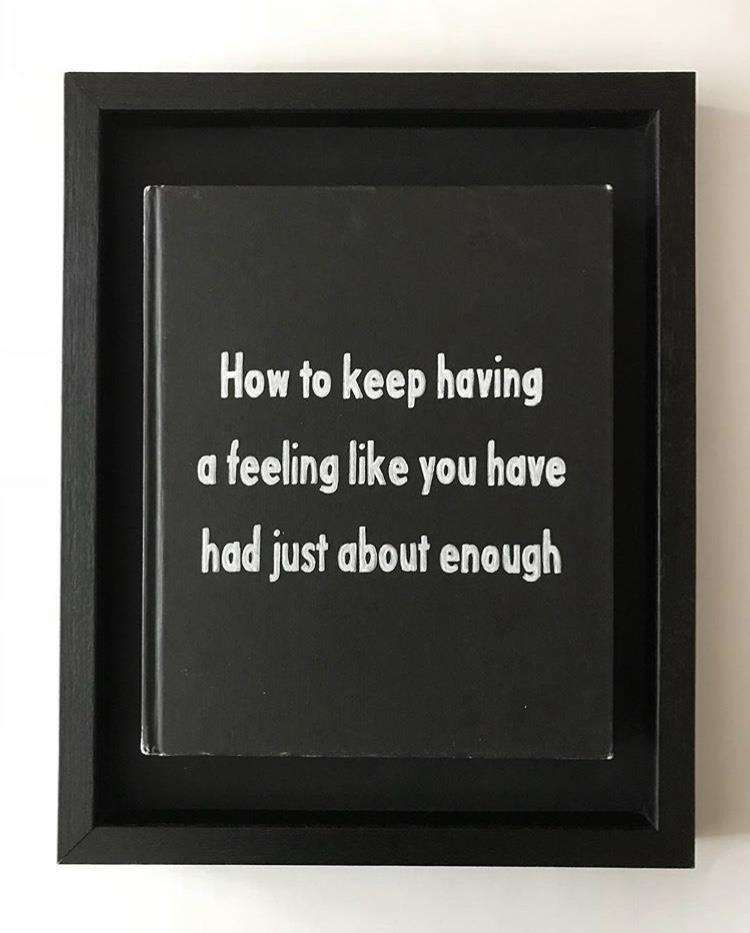
Johan Deckmann book paintings deserve particular attention for their formal properties, not just their textual content. He works primarily in two formats: acrylic painted directly onto vintage book covers and larger canvas works that mimic the aesthetic of book jackets. The choice of actual books as substrate carries conceptual significance—these are objects that once contained someone else's ideas, now repurposed to hold Deckmann's interventions. There's something slightly violent about this transformation, something that acknowledges how our minds become palimpsests of received wisdom we must eventually overwrite.
The vintage book covers provide an aesthetic warmth that pure canvas cannot achieve. The slightly yellowed pages, the weathered spines, the cloth bindings—these markers of age and use create a visual vocabulary that suggests accumulated wisdom, the kind of authority we grant to old books simply because they've survived. Deckmann exploits this authority, lending his satirical titles the false gravitas of genuine scholarly work. A statement like "The Complete Guide to Never Admitting You Were Wrong" carries different weight when painted on what appears to be a 1950s hardcover than it would as a Tweet.
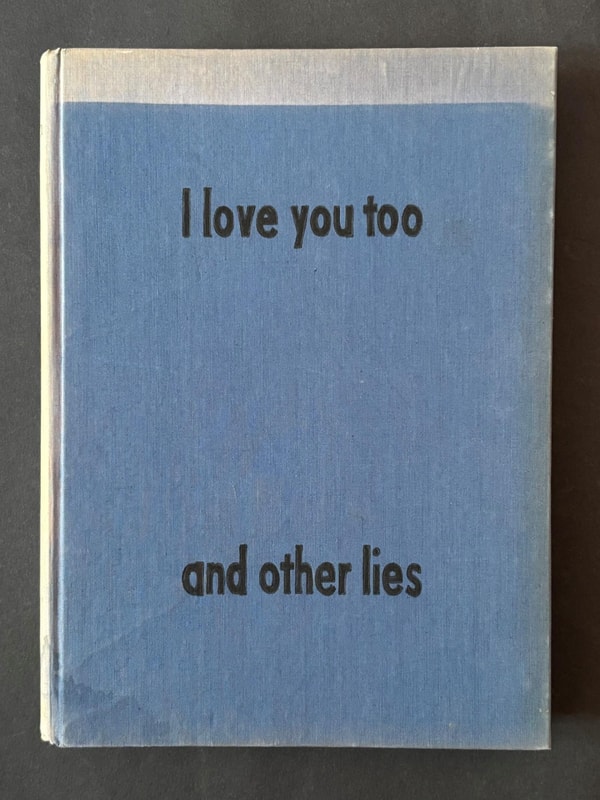
Johan Deckmann, I Love You Too and Other Lies, Acrylic on Book Cover. Available at Guy Hepner, New York.
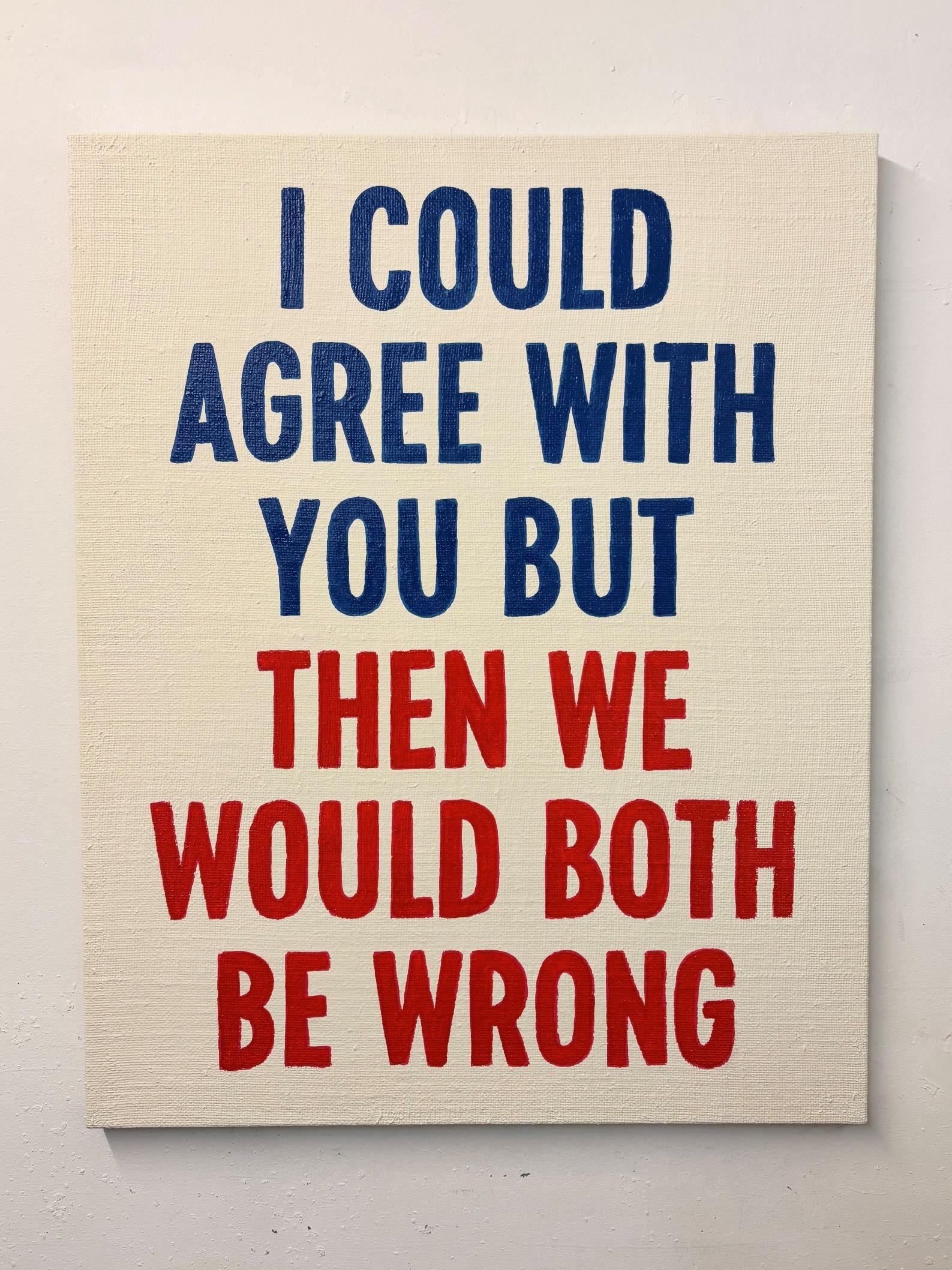
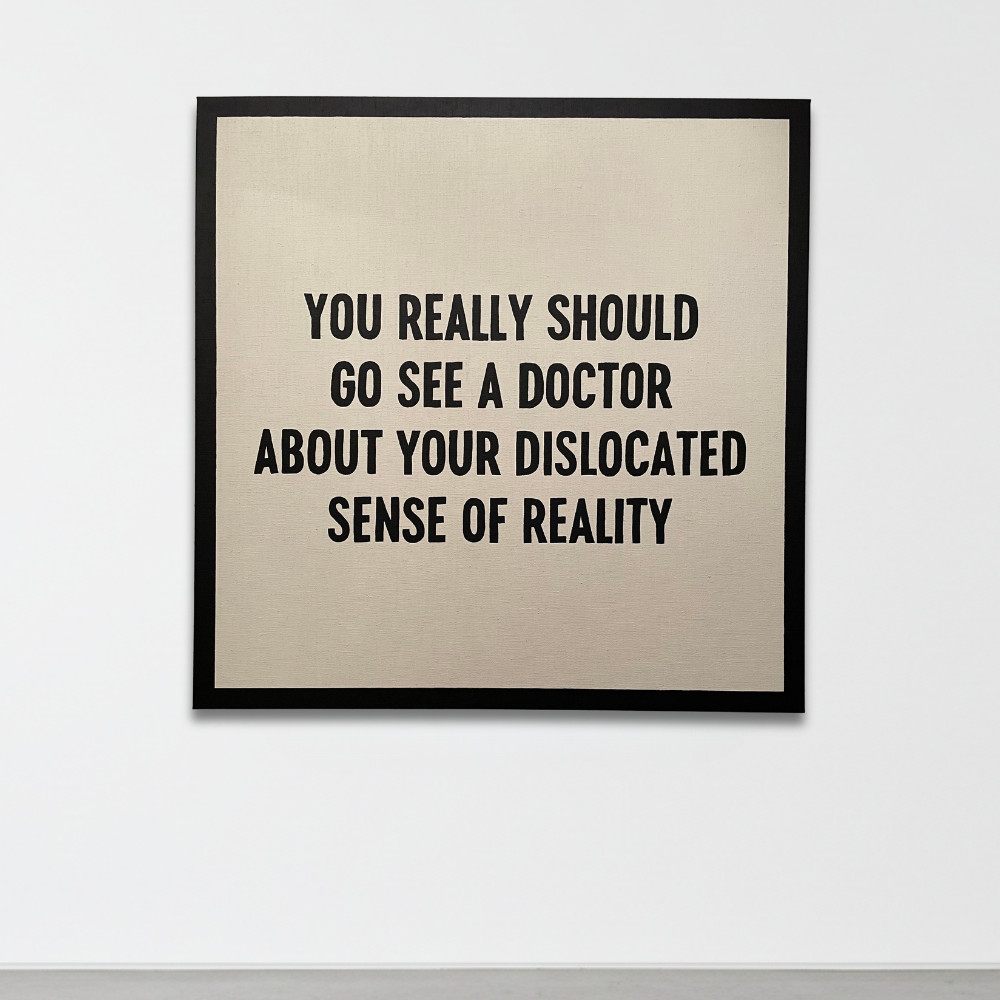
The canvas works, meanwhile, allow for larger scale and different chromatic possibilities. These pieces often feature bold primary colors—yellow, blue, red—that recall both vintage paperback design and the color-coding of emotional states in certain therapeutic frameworks. The typography is precise, usually serif, always legible, never decorative for decoration's sake. The visual clarity serves the conceptual clarity; there's no hiding from these statements behind formal ambiguity.
Deckmann has spoken explicitly about humor's centrality to both his artistic and therapeutic practice. "Humor is somehow the instrument of the light-hearted," he has noted, a statement that sounds simple until you consider its implications. The light-hearted are not those unburdened by darkness but those who have learned to carry their burdens with a certain grace. Humor in this sense isn't escapism or denial; it's a coping mechanism of the most sophisticated kind, a way of acknowledging pain while refusing to be defeated by it.
The laughter his work provokes operates on multiple levels. There's the initial recognition response—the sudden seeing of yourself in a title you would never have admitted described you. There's the relief of shared experience—the understanding that others must feel this way too, or the work wouldn't exist. And there's the more complex laughter of acknowledgment, the rueful chuckle that admits you've been caught. This is the laughter of the patient who has just heard their therapist name exactly the pattern they've been avoiding discussing.
Darkly humorous mental health art occupies a peculiar position in contemporary culture. We live in an era of unprecedented mental health awareness, where therapy speak has entered common parlance and "doing the work" is an acceptable topic of dinner party conversation. Yet this mainstreaming has also produced a certain performative quality, an anxiety that arises from turning self-improvement into content. Deckmann's work threads this needle carefully—participating in the discourse of mental health while simultaneously questioning whether discourse alone produces change.
Among Deckmann's works, his series of imagined apology letters from famous figures deserves special mention. These pieces take the form of handwritten correspondence, supposedly penned by historical figures addressing their personal failings. A letter "from" Picasso acknowledging his treatment of women. A note "from" van Gogh expressing regret about certain creative decisions. These works extend Deckmann's psychological concerns beyond the universal and into the specific, imagining what remorse might look like from those who never expressed it.
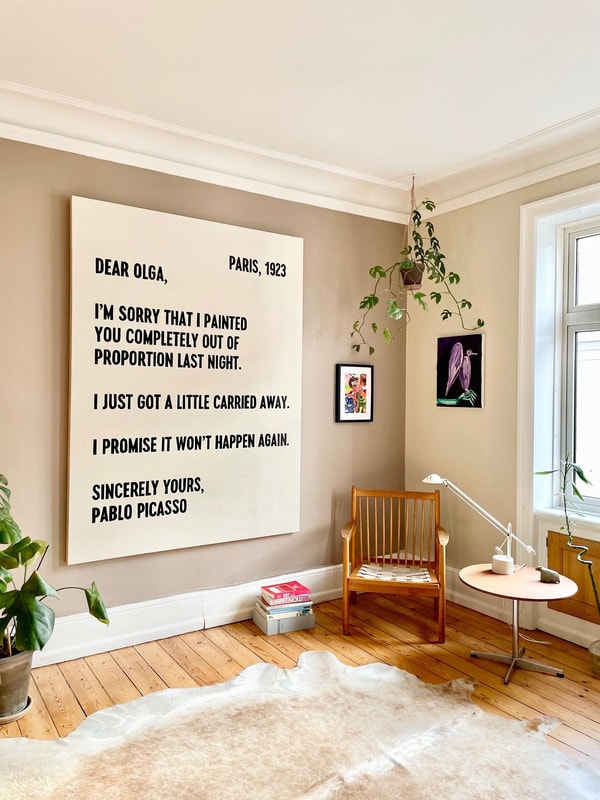
Johan Deckmann, Dear Olga (Picasso Letter), Mixed Media. Available at Guy Hepner, New York.
The ethical implications are interesting to consider. Is it appropriate to put words in the mouths of the dead? To manufacture apologies they never gave? Deckmann seems to suggest that these imagined confessions serve a purpose beyond historical speculation—they model what accountability might look like, provide a script for the unspoken, and perhaps offer closure to those who will never receive actual apologies from those who harmed them. It's therapeutic fan fiction, if you will, and its very impossibility makes its emotional truth more apparent.
The Danish contemporary artist has built a collector base notable for its loyalty and engagement. Records from gallery sales indicate that repeat purchases are common—collectors who acquire one Deckmann work frequently return for additional pieces, building personal collections of interrelated statements. This pattern suggests the work operates not as standalone objects but as an ongoing conversation, a developing relationship between viewer and artist that deepens over time.
Current pricing places Johan Deckmann for sale works in an accessible range for emerging collectors while reflecting their established market presence. Book works typically command around $6,300, while larger canvas pieces range from $10,000 to $13,000. With over thirty works currently available through major galleries and a consistent sales record spanning more than five years, the market for Deckmann's work has achieved a stability that eludes many contemporary artists. This isn't a speculative proposition but an opportunity to acquire work from an artist with demonstrated staying power and continued production.
The accessibility of the work—both conceptually and financially—positions it well for collectors new to the contemporary art market. Unlike much text-based conceptual art, which can feel hermetic or requiring specialized knowledge to appreciate, Deckmann's pieces communicate immediately. You don't need an MFA to understand "How to Mistake Chemistry for Compatibility"; you just need to have lived. This democratic quality hasn't diminished critical appreciation but has rather expanded the audience beyond traditional art world boundaries.
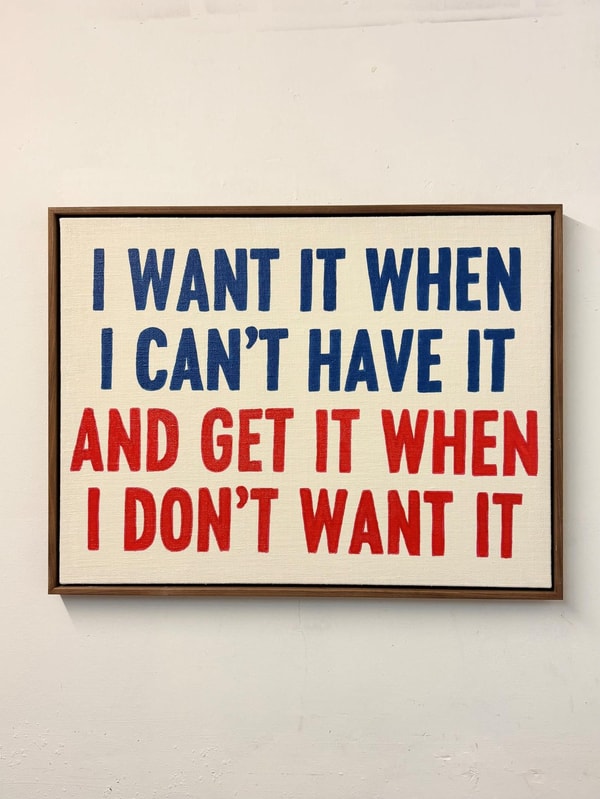
Johan Deckmann, Either Way, Mixed Media. Available at Guy Hepner, New York.
Critical engagement with Deckmann's work has been notably warm, particularly from writers interested in the intersection of visual art and psychology. Reviewers have praised the work's ability to balance humor with genuine emotional insight, to critique self-help culture while participating in its therapeutic potential. The comparison to Holzer and Kruger appears regularly in critical writing, though always with acknowledgment that Deckmann's register is fundamentally different—more intimate, less overtly political, more concerned with individual transformation than collective action.
What critics have sometimes overlooked is the formal sophistication beneath the accessible surface. The choice of typefaces, the color relationships, the material qualities of the book objects—these aren't accidents but deliberate decisions that reinforce conceptual content. A self-help book title painted in an aggressive sans-serif would communicate differently than one rendered in a warm, humanist serif. The visual rhetoric supports and complicates the verbal rhetoric in ways that reward sustained attention.
The work's performance on social media deserves mention without reducing its significance to virality. Deckmann's pieces circulate widely on Instagram and other platforms, shared by users who see themselves reflected in the titles. This digital dissemination could be read as diluting the work's power—turning art into memes—but it might equally be understood as extending the therapeutic reach beyond gallery walls. When someone shares "I Like the Concept of Existence But I'm Not Like Blown Away," they're performing a small act of vulnerable self-disclosure, using Deckmann's language to articulate what they couldn't say directly.
What does it mean to live with a piece of psychological text art? To encounter daily a statement that names some aspect of your inner life you might prefer to keep unconscious? The question matters because Deckmann's work functions differently in the domestic environment than in the gallery context. A museum visit offers temporary confrontation; ownership means permanent cohabitation with whatever truth the piece speaks.
Collectors report various relationships with their Deckmann pieces. Some choose titles that feel aspirational—statements about patterns they're actively working to change, serving as gentle reminders of ongoing personal development. Others prefer titles with more resolved humor, pieces that acknowledge universal foibles without hitting too close to specific current wounds. The choice of which statement to live with becomes itself a form of self-reflection, a commitment to a particular kind of honest self-regard.
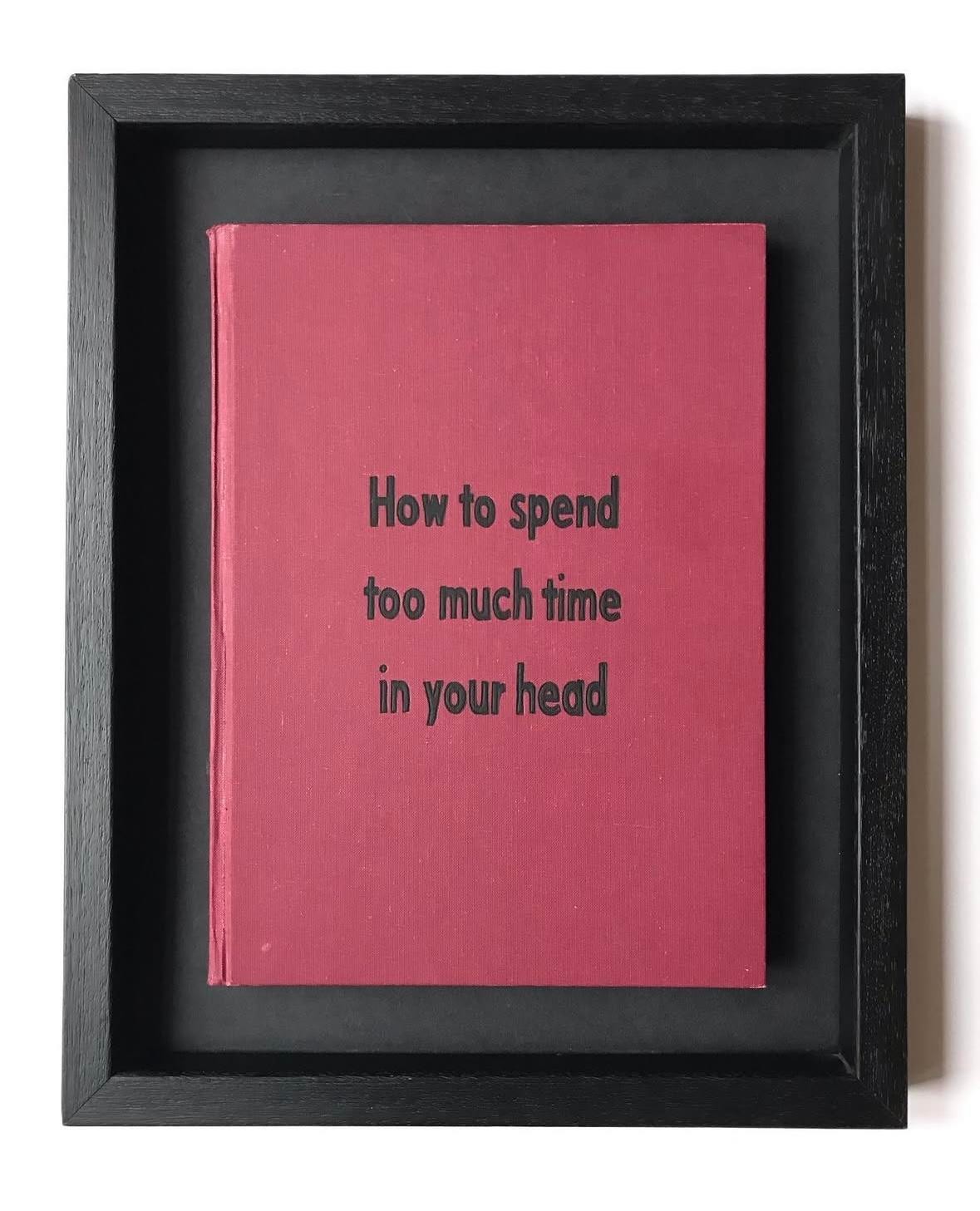
Johan Deckmann, Overthinking, Acrylic on Book. Available at Guy Hepner, New York.
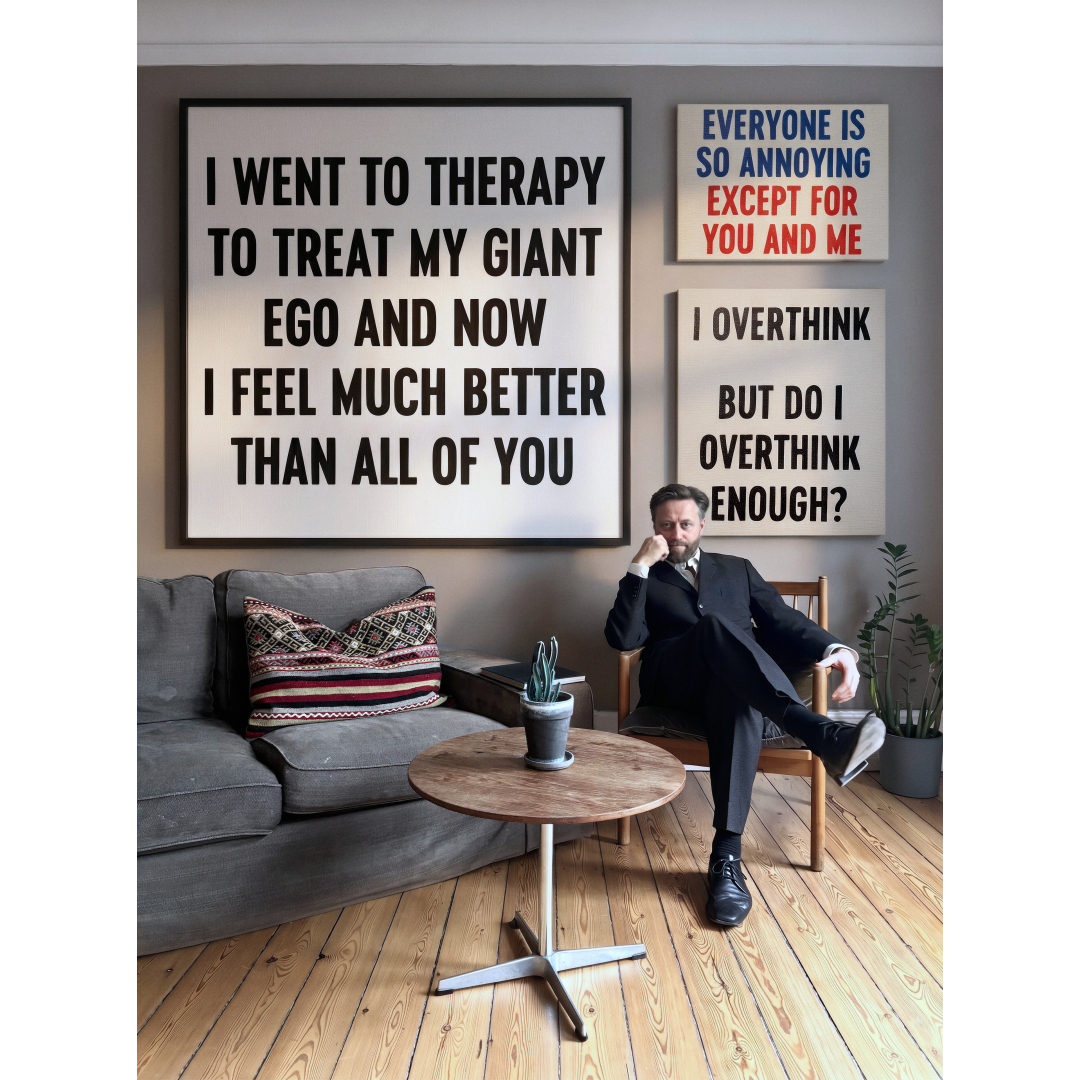
Placement within the home carries significance beyond mere aesthetics. A Deckmann in the bedroom communicates something different than one in the living room, the former suggesting private self-examination, the latter indicating willingness to share one's vulnerabilities with guests. Some collectors install pieces in home offices, using the text as motivation or caution during work hours. Others position them near mirrors, creating conversations between reflected self-image and painted self-assessment. The work invites this kind of intentional relationship, this ongoing negotiation between art object and living subject.
"I want my works to be like mirrors," Deckmann has stated. "When you look at them you might not like what you see, but like in a mirror, you now get the awareness and the chance to change something." This metaphor of the mirror recurs throughout his discussions of the work, and it's worth taking seriously as a framework for understanding what the pieces actually do.
A mirror shows you what you already know but perhaps haven't fully seen. It doesn't create new information but makes existing information unavoidable. This is precisely what good therapy does—not revealing secrets the patient doesn't already possess but making those secrets speakable, visible, available for examination. Deckmann's titles operate similarly. "How to Lower Your Standards Without Knowing It" describes a pattern you've probably been enacting for years; the title simply makes the pattern legible.
But the mirror metaphor has its limits. A mirror reflects without judgment; Deckmann's work carries implicit judgment, even when cushioned by humor. To title a book "A Complete Guide to Never Admitting You Were Wrong" is to suggest that never admitting wrongness is, in fact, wrong. The stance isn't neutral but normative, advocating for certain kinds of self-awareness and honesty. This is therapeutic in the most traditional sense—the work believes in the possibility of improvement and wants to help you get there.
"I think that the art world is a perfect place to create awareness," Deckmann has observed, "and this awareness just might lead to a better wellbeing." The conditional phrasing matters: might lead, not will lead. The artist is too experienced as a therapist to promise transformation, knowing that awareness alone rarely produces change. People can understand their patterns completely and continue enacting them anyway. Insight isn't action; recognition isn't reform.
This modesty about outcomes distinguishes Deckmann's work from the actual self-help industry it satirizes. Self-help books promise results: follow these steps and achieve happiness, implement this program and find love. Deckmann promises only recognition, only the small but significant gift of having your situation articulated. What you do with that articulation remains your responsibility—"like little personal reminders disguised as art," as he puts it, not prescriptions but prompts.
The distinction matters for collectors considering the work's place in their lives. These are not motivational posters offering guaranteed uplift. They are more like diagnostic tools offering accurate description. Whether description leads to change depends on the viewer, on their readiness for change, on countless factors the artwork cannot control. The work does its job simply by naming; the rest is up to you.
Johan Deckmann occupies an unusual position in contemporary art: simultaneously popular and critical, accessible and sophisticated, therapeutic and subversive. His work satisfies the Instagram algorithm while bearing serious critical weight, gets shared as memes while hanging in serious collections. This dual citizenship—in commercial culture and art world critique—reflects the complex position of psychology itself in contemporary life, at once a clinical discipline and a popular entertainment, a serious practice and a source of endless content.
What remains constant across contexts is the work's commitment to honesty. Not brutal honesty, not honesty as weapon, but honesty as invitation—the recognition that seeing ourselves clearly, while uncomfortable, offers the only real starting point for whatever comes next. The fictional self-help book becomes, paradoxically, a form of genuine help: not by promising solutions but by accurately describing problems. In a culture saturated with false promises of easy transformation, this insistence on difficult truth feels almost radical.
The therapeutic transaction Deckmann offers is modest but real: you look at the work, you see yourself, you have a choice about what to do with that seeing. The art doesn't judge, doesn't lecture, doesn't moralize beyond the gentle implication that self-knowledge beats self-deception. It laughs with you, not at you, even when the laughter stings.
For collectors seeking to engage with Johan Deckmann's work, Guy Hepner Gallery at 529 West 20th Street in New York maintains an extensive selection of both book paintings and canvas works. The gallery's staff can assist in navigating the available pieces to find statements that resonate with individual collectors' situations and sensibilities. In matters of psychological art as in matters of actual psychology, the right fit makes all the difference.
Explore Johan Deckmann prints for sale at Guy Hepner: Book Wall Pieces, Paintings on Canvas.
Related Series