Paintings

August 17, 2026
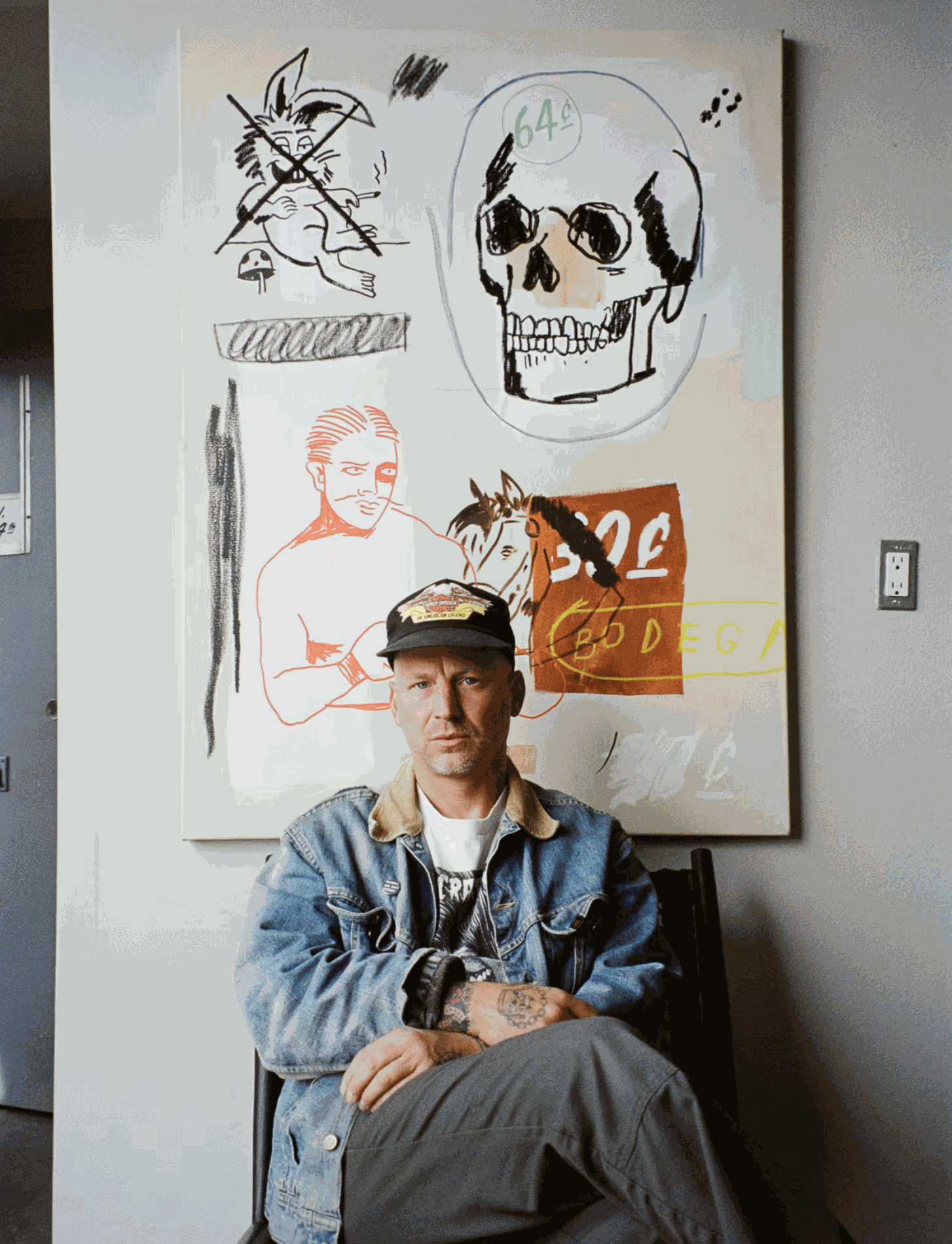
Somewhere around 2015, Terry Urban artist and former nightclub DJ made a decision that would alter the trajectory of his creative life. After more than a decade spinning records for crowds in New York City, producing mixtapes that earned praise from Jay-Z, Coldplay, and Drake, he walked away from the decks. The music industry had taken everything he had to give — his nights, his health, his financial stability — and he needed something new. So he picked up a brush, returned to the canvases he had abandoned years earlier, and began painting as if his life depended on it. In many ways, it did.
The story of Terry Urban's transformation from celebrated DJ to emerging contemporary painter reads like a uniquely American narrative of reinvention. Born in 1977 in Cleveland, Ohio, raised in a working-class Irish-American household under the guidance of his Cherokee stepfather, Urban absorbed the values of perseverance and humility that would later define both his character and his artistic practice. His journey took him from the skateparks of San Diego to the radio stations of Cleveland to the nightclubs of New York City before finally depositing him in a Los Angeles studio where he now begins each morning with a surf session before settling into hours of intensive painting. Every canvas he produces carries the accumulated weight of these experiences — the underground music scenes, the creative burnout, the search for meaning beyond the temporary highs of nightlife success.
What emerges from Urban's studio today is figurative painting charged with the raw energy of someone who has lived more than one life. Skulls loom from fields of vibrant color. Figures dissolve into layers of charcoal, aerosol, and acrylic. Text fragments surface through painted passages like half-remembered conversations. His work confronts mortality with unflinching directness while simultaneously celebrating the chaotic beauty of existence. For collectors seeking authenticity in an art world increasingly dominated by market calculation, Terry Urban paintings offer something rare: the genuine article, created by an artist who came to his practice not through institutional channels but through the urgent necessity of creative survival.
Understanding Terry Urban's art requires understanding where he came from. Cleveland, Ohio, in the late twentieth century was not a city of easy opportunity. It was a place defined by industrial decline, economic hardship, and the stubborn resilience of its working-class population. Growing up in this environment instilled in Urban a profound identification with the underdog — a theme that permeates his work to this day. His paintings often depict figures in states of struggle or transformation, their humanity emphasized rather than idealized, their imperfections rendered with empathy rather than judgment.
The influence of his Cherokee stepfather added another dimension to Urban's developing worldview. Indigenous perspectives on mortality, spirituality, and the interconnection between human beings and larger forces appear throughout his mature work, though never in a didactic or appropriative manner. Instead, these influences manifest as an underlying philosophy — a sense that death is not an ending to be feared but a transition to be acknowledged, that the material world contains depths invisible to casual observation. This philosophical foundation distinguishes Urban's skull imagery from more superficial uses of memento mori symbolism. When he paints a skull, it carries genuine weight.
Urban's formal art education was minimal, which he now considers an advantage rather than a limitation. Without the burden of academic conventions or the pressure to conform to institutional expectations, he developed his visual language organically, drawing from the sources that genuinely moved him. Album covers, skateboard graphics, graffiti, comic books, cinema — these were his art schools. The result is a style that feels both contemporary and timeless, connected to traditions of figurative expressionism while remaining distinctly individual. His paintings could only have been made by someone who spent years immersed in underground culture before turning to the canvas.
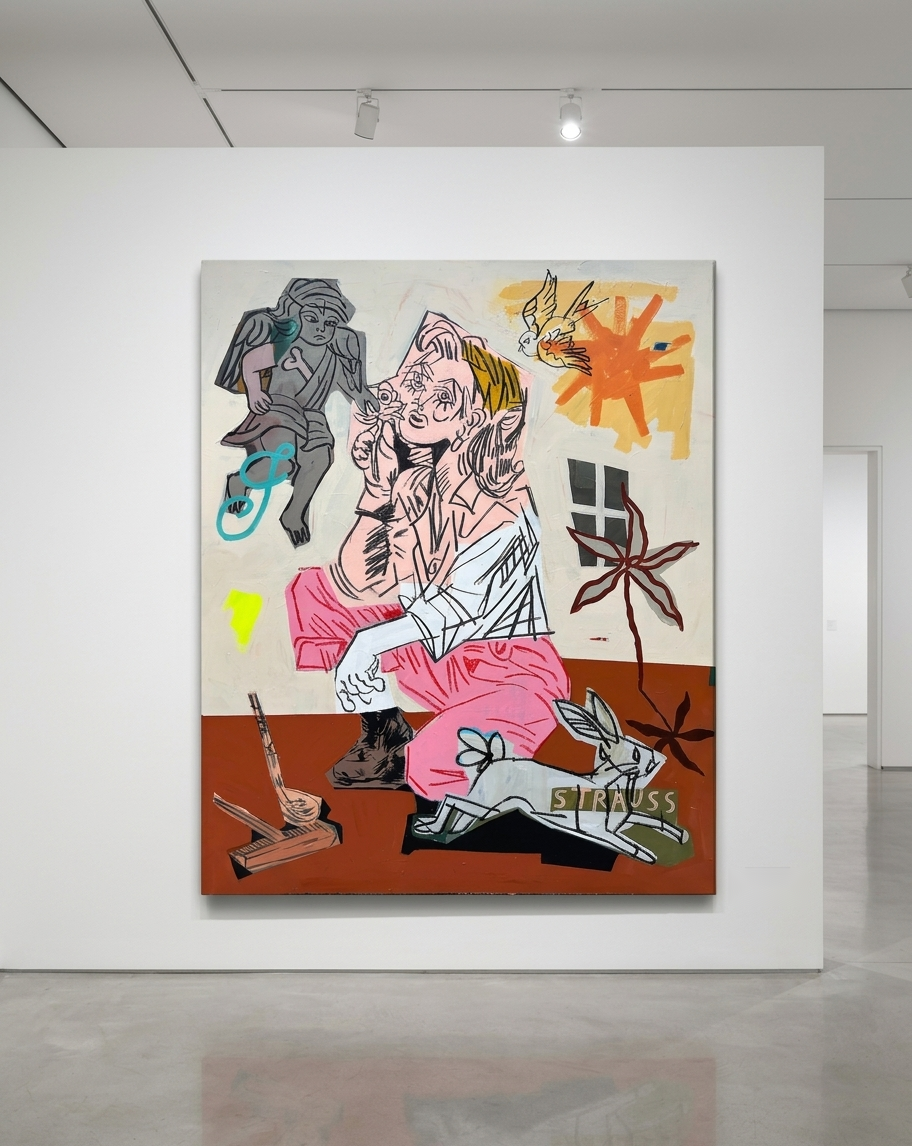
Terry Urban, Lucille's Garden, Mixed Media on Canvas. Available at Guy Hepner, New York.
Before Terry Urban art hung in galleries, Terry Urban was a presence behind the decks at clubs across America. His path into DJing began almost accidentally. After relocating to San Diego to pursue professional skateboarding — a dream that ultimately proved elusive — he discovered turntablism and recognized an outlet for the same creative energy he had channeled into skating. The technical precision required to master turntables, the improvisational flow of reading a crowd, the layering of samples into coherent compositions — these skills would later translate directly into his painting practice.
Returning to Cleveland to work at WENZ radio gave Urban the platform to refine his craft and develop the musical identity that would bring him to New York City in 2006. There, his career accelerated dramatically. The mixtapes he produced during this period — most notably Viva la Hova, Southerngold, and Biggie Stardust — achieved cult status in hip-hop circles. His mash-up work demonstrated a sophisticated understanding of cultural juxtaposition, combining disparate musical sources into unified statements that felt both surprising and inevitable. Jay-Z acknowledged his work. Coldplay praised his creativity. Drake recognized his contributions to the culture.
Yet the accolades masked a more complicated reality. Success in nightlife demanded constant presence, late nights that extended into early mornings, environments saturated with substances and exhaustion. The financial rewards rarely matched the cultural capital accumulated. Urban found himself celebrated and broke, recognized and depleted. By his late thirties, he had reached a crossroads familiar to many who burn bright in youth-oriented industries: continue down a path of diminishing returns, or risk everything on transformation.
The years behind the decks contributed more to Urban's visual sensibility than might be immediately apparent. DJing is fundamentally about layering — building tracks atop one another, allowing elements to emerge and recede, creating texture through accumulation. This approach translates directly onto his canvases, where painted passages overlap with collaged elements, where imagery is partially obscured and then revealed, where the finished surface records the history of its own creation. His compositions move like his best mixes: rhythmically complex, emotionally resonant, never static.
The transition from DJ to painter was not a sudden rupture but a gradual reclamation. Urban had always drawn and painted, even during his most intensive years in music. But around 2015, these activities shifted from peripheral pastimes to central practices. He began devoting serious hours to studio work, developing techniques, building a body of paintings that moved beyond hobbyist experimentation toward professional ambition. The discipline that had served him in mastering turntables now applied to mastering brushwork.
What distinguishes Urban's approach to painting is its integration of multiple influences into a coherent visual language. His work draws from Neo-Expressionism, Street Art, Pop Art, and traditional figurative painting without belonging exclusively to any category. Basquiat is an obvious reference point — the raw mark-making, the incorporation of text, the skull imagery — but Urban's sensibility differs in important ways. Where Basquiat channeled the aggressive energy of early 1980s downtown Manhattan, Urban filters his imagery through decades of subsequent cultural development. His work acknowledges influences while remaining unmistakably contemporary.
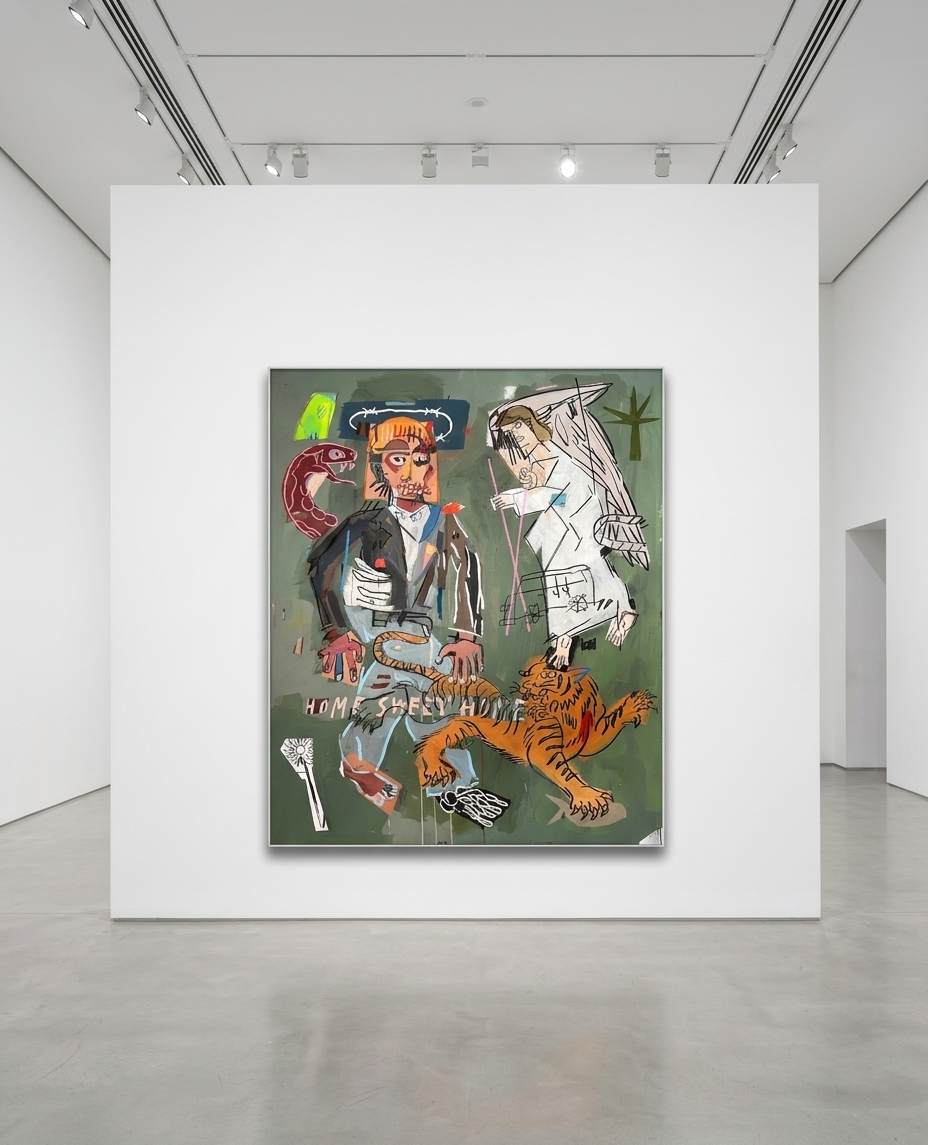
Terry Urban, Home Sweet Home, Acrylic and Mixed Media on Canvas. Available at Guy Hepner, New York.
The move to Los Angeles provided Urban with the environment necessary for sustained creative development. The city's distance from New York nightlife offered freedom from old patterns and associations. The climate encouraged the surfing rituals that now structure his daily practice — morning sessions in the Pacific clearing his mind before extended hours in the studio. This combination of physical activity and meditative focus creates the mental state from which his best work emerges. Unlike the reactive energy of DJing, painting demands sustained attention, the patience to build surfaces over days or weeks rather than hours.
Urban's studio practice reflects his Midwestern work ethic combined with California openness. He maintains regular hours, approaching painting as labor rather than inspiration. The romantic notion of the artist waiting for creative lightning holds no appeal for him. Instead, he shows up daily, puts in the time, trusts the process. This discipline has allowed him to develop rapidly as a painter, producing a substantial body of work in relatively few years. The results speak for themselves: canvases that reward sustained viewing, surfaces rich with accumulated decision-making, imagery that reveals new dimensions with each encounter.
The most immediately recognizable element of Terry Urban artwork is the recurring presence of skulls. These are not decorative motifs or shock tactics but genuine engagements with mortality — attempts to understand, or at least acknowledge, the inevitability that shadows every human life. Urban himself has admitted uncertainty about the origins of this fascination. Perhaps it stems from anxiety about death, perhaps from curiosity about what lies beyond, perhaps from the losses accumulated over years in industries not known for their longevity. Whatever the source, skulls have become central to his iconography.
The skulls in Urban's paintings differ from those in traditional vanitas imagery or contemporary pop culture. They are not symbols of rebellion or warnings against worldly attachment but presences to be reckoned with — reminders that every moment of existence occurs against the backdrop of eventual dissolution. Yet this awareness does not produce morbid or depressive work. On the contrary, Urban's paintings vibrate with life. The skulls share canvas space with bursts of color, gestural marks that convey energy and motion, figures engaged in the activities of living. The effect is paradoxically affirming: by acknowledging death, the work celebrates the preciousness of what remains.
Terry Urban skulls often emerge from layers of paint and collage, their forms partially obscured or fragmented. This treatment suggests that mortality is always present but not always foregrounded — a constant companion rather than an obsessive focus. The technical approach reinforces the thematic content. Just as life accumulates experiences that partially obscure what came before, Urban's surfaces accumulate marks that partially cover underlying imagery. The skull that appears in a finished painting has been painted over and revealed multiple times during the creative process, each iteration adding depth and complexity.
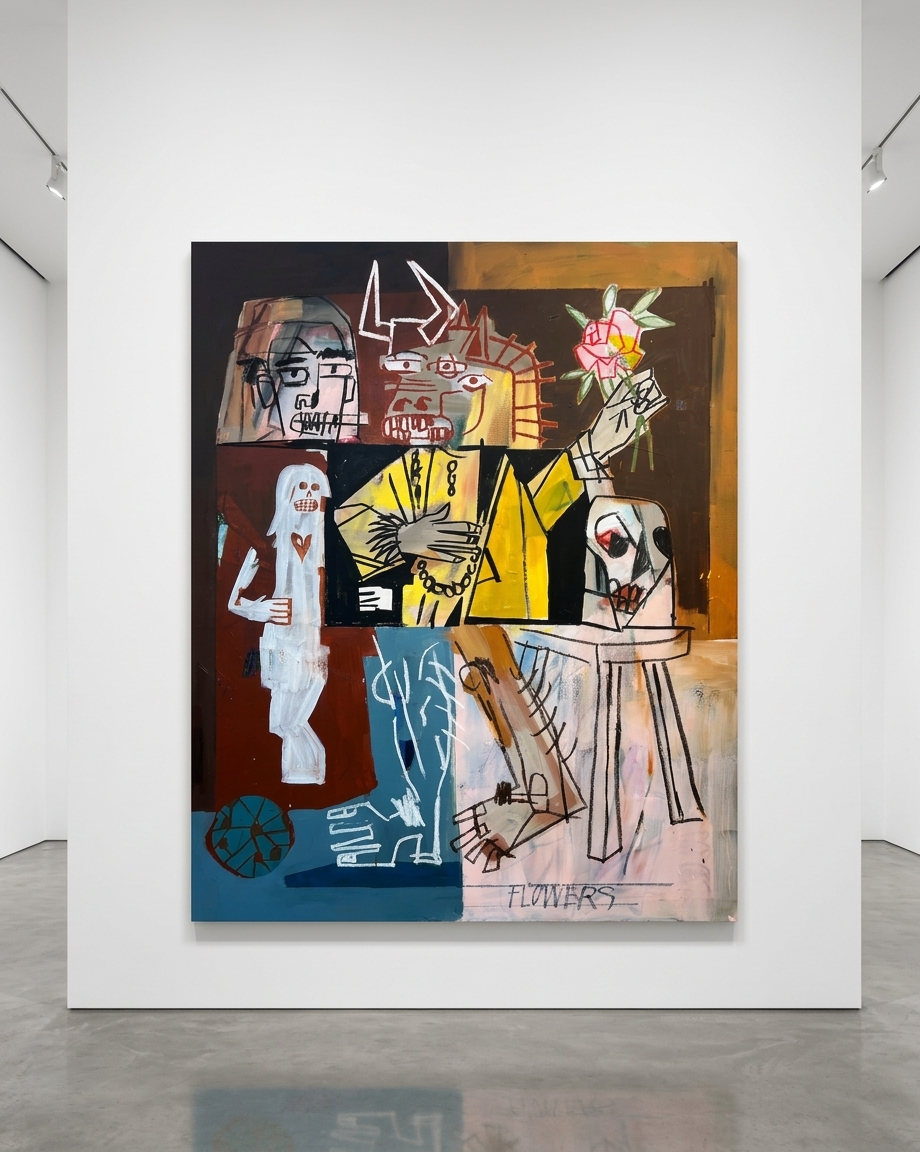
Terry Urban, I'd Rather Smell the Flowers, Mixed Media on Canvas. Available at Guy Hepner, New York.
For collectors, the skull paintings represent Urban at his most characteristic and powerful. These works anchor collections focused on contemporary figurative painting while connecting to broader art historical traditions. They function equally well as statement pieces in corporate collections or contemplative presences in private spaces. The pricing of these works — currently ranging from approximately $4,000 to $30,000 — positions them as accessible entry points for emerging collectors while offering significant value to established collectors building comprehensive holdings.
Urban's technical approach deserves attention for collectors interested in understanding what makes his paintings distinctive. He works across canvas and wood panels, building surfaces through accumulation rather than direct application. The process begins with underpainting and often incorporates collaged elements — fragments of paper, found materials, earlier drawings. Subsequent layers of acrylic and mixed media partially cover these foundations while allowing glimpses of underlying imagery to emerge. The result is a palimpsest effect, surfaces that record their own history.
The mark-making in Urban's paintings ranges from controlled linework to gestural sweeps to aerosol applications. This variety reflects his diverse creative background. The precision required for DJing appears in carefully rendered details; the improvisational flow of live performance appears in spontaneous passages. Text often enters the compositions, sometimes legible and sometimes obscured, adding verbal dimensions to visual content. These words function less as messages to be decoded than as elements contributing to overall effect — the visual presence of language rather than its semantic content.
Color plays a crucial role in Urban's work, distinguishing his paintings from more monochromatic Neo-Expressionist precedents. While skulls and dark imagery might suggest somber palettes, Urban employs vibrant yellows, electric blues, hot pinks, and acidic greens. These colors create tension with darker content, preventing the work from settling into predictable emotional registers. A painting might begin with ominous imagery but resolve into something closer to celebration or acceptance. This tonal complexity rewards repeated viewing and prevents quick aesthetic consumption.
The physical scale of Urban's paintings varies from intimate works suitable for residential spaces to large-format canvases commanding gallery walls. This range allows collectors to engage with his work at various levels of commitment and spatial requirement. The consistency of his approach across scales ensures that smaller works are not lesser versions of larger ambitions but complete statements appropriate to their dimensions. A thirty-inch canvas by Urban contains the same intensity and accumulated decision-making as a six-foot piece.
Positioning Terry Urban contemporary artist within the broader landscape of twenty-first-century painting requires acknowledging multiple contexts. His work participates in the ongoing revival of figurative painting that has characterized the past two decades, a return to representation after the conceptual and abstract dominances of earlier periods. Within this revival, Urban occupies a specific position: not academic or illustrative figuration, but expressionistic engagement with human forms and conditions.
The influence of Street Art and graffiti culture distinguishes Urban from painters emerging through more traditional channels. While he does not identify primarily as a street artist, the visual vocabularies of urban surfaces — tags, throw-ups, wheat-pastes, and the layered archaeology of walls that have been marked and remarked over years — inform his approach to canvas. This connection gives his work immediate accessibility for viewers familiar with contemporary urban aesthetics while grounding it in practices that predate gallery validation.
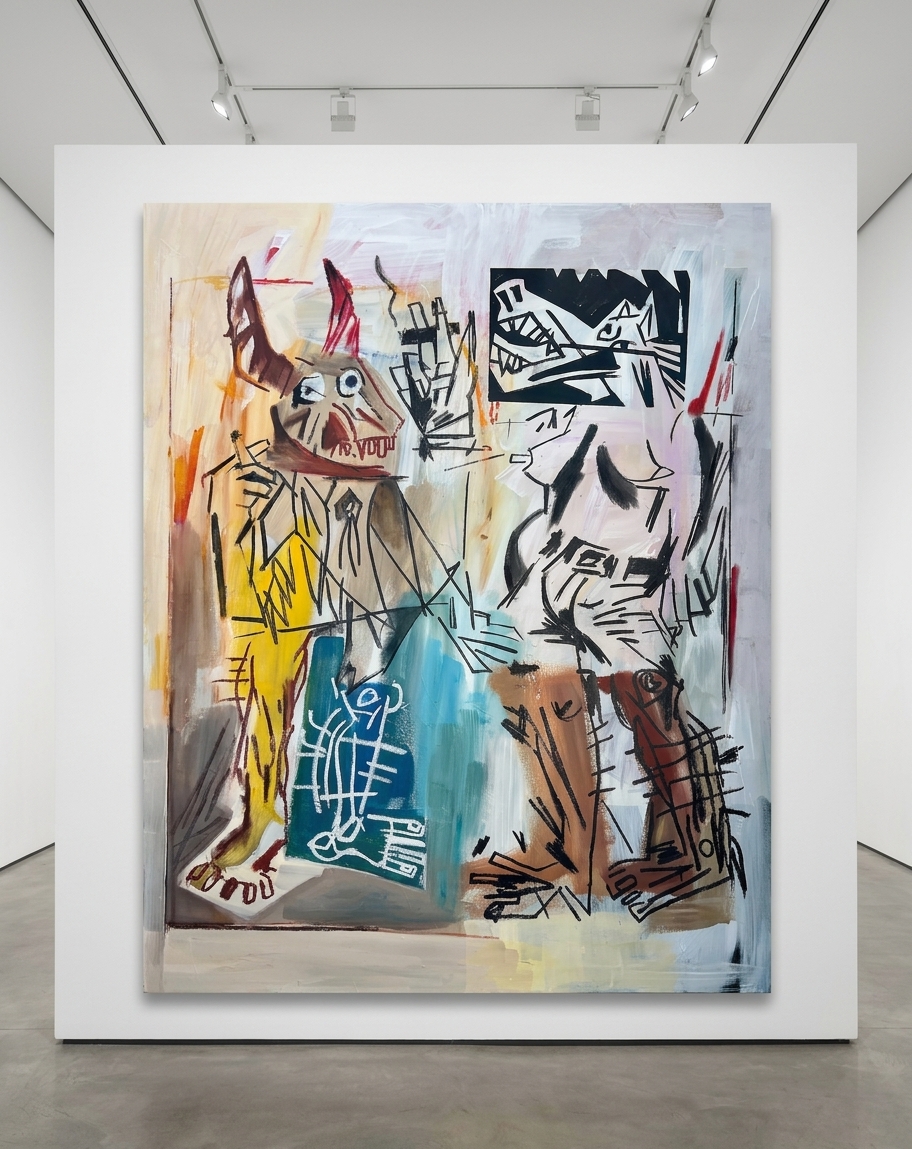
Terry Urban, The Smoke Break, Acrylic and Mixed Media on Canvas. Available at Guy Hepner, New York.
The music industry connections that Urban brings to his art practice also position him interestingly within cultural conversations about authenticity and crossover. Unlike celebrities who turn to art as secondary pursuits or branding exercises, Urban pivoted to painting at a moment of crisis rather than opportunity. His art is not an extension of fame but a replacement for it — a new creative identity built from the remnants of an old one. This narrative resonates with collectors who value genuine transformation over calculated career management.
Within the market, Urban currently occupies the emerging artist category — a designation that carries both opportunity and responsibility. Emerging status means prices remain accessible relative to established figures working in similar modes. It also means collectors acquiring work now participate in the early phases of what may become a significant career trajectory. The risk inherent in collecting emerging art is balanced by the potential for meaningful appreciation as critical attention and market recognition develop.
For collectors considering Terry Urban paintings for sale, several factors merit attention. Primary market works are currently available through galleries including Guy Hepner, with pricing that reflects Urban's emerging status while accounting for the quality and scale of individual pieces. Works on paper and smaller canvases begin around $4,000, positioning them as accessible acquisitions for collectors building diverse holdings. Major paintings range toward $30,000, offering statement pieces for collectors seeking significant works.
Authenticity verification for Urban's work remains straightforward at this stage of his career. Works acquired through established galleries come with documentation establishing provenance from the artist's studio. As the secondary market develops, maintaining records of acquisition will become increasingly important for establishing clean ownership histories. Collectors should retain all paperwork associated with purchases and photograph works upon acquisition for insurance and documentation purposes.
Condition considerations for Urban's paintings center on the mixed-media surfaces that characterize his practice. Works incorporating collage elements or multiple media require appropriate framing and environmental controls. While the paintings are not fragile, the textured surfaces benefit from protection against physical contact and extreme environmental fluctuations. Standard museum-quality hanging and care protocols apply.
The question of investment potential deserves honest treatment. While no responsible gallery promises returns on art acquisitions, certain factors suggest positive trajectory for Urban's market. His work connects to established traditions while remaining individual and recognizable. His practice demonstrates discipline and development rather than stagnation. His biography provides compelling narrative for critical contextualization. And his pricing remains accessible relative to artists of comparable quality working in similar modes.
Urban's exhibition history includes solo presentations at galleries in Los Angeles and participation in major art fairs through gallery representation. His work has appeared in contexts ranging from traditional gallery spaces to alternative venues, reflecting the crossover appeal that distinguishes his practice. Critical attention continues to build as more observers encounter the work directly, recognizing its distinctive combination of street credibility and painterly sophistication.
The reception of Urban's work has emphasized its emotional authenticity and technical accomplishment. Critics note the successful integration of diverse influences into coherent personal style, the avoidance of derivative imitation despite obvious art historical references, and the genuine engagement with difficult themes including mortality and transformation. The work rewards both immediate aesthetic response and sustained analytical attention, functioning for viewers at multiple levels of engagement.
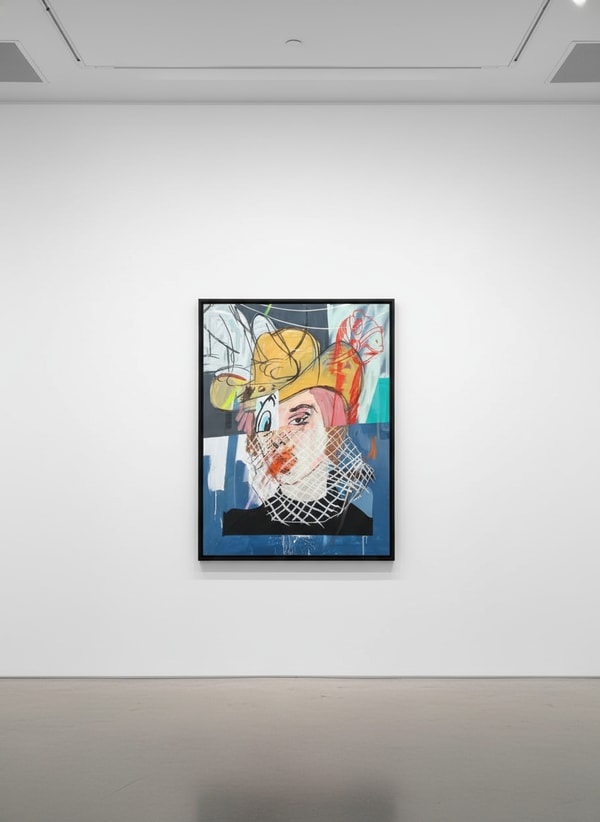
Terry Urban, Portrait with Mixed Media. Available at Guy Hepner, New York.
Gallery representation at this stage of Urban's career provides important infrastructure for market development and critical positioning. Working with established galleries ensures professional presentation, appropriate pricing, and access to collector networks that individual artists cannot cultivate independently. For collectors, gallery acquisition offers assurances regarding authenticity, condition, and provenance that direct purchases may not provide.
While this article includes images of Urban's work, and while these reproductions convey significant information about composition and color, they cannot substitute for direct encounter. The textured surfaces of his paintings — the accumulated layers, the physical presence of collaged elements, the variations in paint thickness from thin washes to impasto passages — exist fully only in person. The scale of his larger works produces physical effects impossible to reproduce digitally. The presence of a painting in a room differs fundamentally from its representation on a screen.
This observation applies to most painting but holds particular weight for artists like Urban whose practices emphasize surface and accumulation. The palimpsest effect that characterizes his canvases reveals itself fully only through close viewing, where the eye can trace earlier layers beneath more recent applications, where small fragments of underlying imagery emerge upon sustained attention. Reproductions flatten these spatial relationships, converting three-dimensional surfaces into two-dimensional images.
For collectors seriously considering acquisition, viewing appointments at Guy Hepner's New York location at 529 West 20th Street provide opportunity to encounter the work directly. The gallery maintains rotating selections of Urban's paintings alongside other contemporary artists, allowing comparative viewing and contextual appreciation. Staff members can provide detailed information about specific works, discuss available inventory, and facilitate discussions about collecting strategies.
At this writing, Terry Urban remains an artist in active development — not yet canonized, not yet priced beyond reach, not yet reduced to signature imagery repeated for market demand. This developmental status represents opportunity for collectors willing to engage with emerging practices rather than established names. The work available now reflects mature technical command and distinctive vision; the work to come may extend in directions not yet visible. Acquiring now means participating in that evolution.
The trajectory from Cleveland to Los Angeles, from skateboarding to DJing to painting, demonstrates Urban's capacity for transformation and his willingness to pursue creative authenticity regardless of practical calculation. The man who walked away from music industry success to pursue painting was not making a career move but following necessity. This commitment to authentic creative practice over external validation produces work that carries corresponding conviction.
For collectors seeking contemporary figurative painting that engages mortality without morbidity, that incorporates street culture without posturing, that acknowledges art historical precedent without derivative imitation, Terry Urban represents compelling consideration. His paintings offer immediate visual impact alongside sustained viewing rewards. They connect to recognizable traditions while remaining unmistakably individual. And they remain, for now, accessible to collectors at various levels of resources and experience.
Guy Hepner maintains selection of Terry Urban artwork for sale at the gallery's New York location, with additional works available through consultation. The current inventory includes paintings across scales and price points, allowing collectors to identify works appropriate to their spaces and collecting goals. New works from Urban's studio enter the gallery regularly as his productive practice continues.
Collectors interested in Terry Urban paintings are encouraged to schedule viewing appointments to experience the work directly. The gallery team can discuss available inventory, provide detailed condition reports and provenance information, and offer guidance on building collections that incorporate Urban's work alongside other contemporary artists. For those unable to visit in person, detailed images and information can be provided remotely, though the gallery recommends direct viewing when possible given the material nature of Urban's practice.
Terry Urban's journey from Cleveland underdog to New York DJ to Los Angeles painter embodies something essential about creative life in contemporary America — the necessity of reinvention, the value of accumulated experience, the possibility of authentic transformation. His paintings carry this history in their layered surfaces and unflinching imagery. For collectors who respond to this combination of lived experience and painterly ambition, the opportunity to acquire his work while it remains emerging represents a chance to participate in what may prove a significant career. The paintings are at Guy Hepner, at 529 West 20th Street in New York. The rest is up to you.
Related Series