Flower Ball

June 19, 2026
Of all the images Takashi Murakami has produced across a career spanning more than thirty years, the Flowers are the ones that have become inseparable from his name. Instantly recognisable — circular cartoon faces, dozens of graduated petals in rainbow colour fields, rendered in the flat graphic language of his Superflat aesthetic — the flowers are simultaneously his most accessible and most debated motif: cheerful enough to disarm, art historically complex enough to reward serious looking, and commercially significant enough to represent the largest single body of work in the Murakami print market. This guide provides the deepest available account of the Murakami flower print canon: its history, its major editions, how to identify what you are looking at, how prices have moved, and what condition means for value.
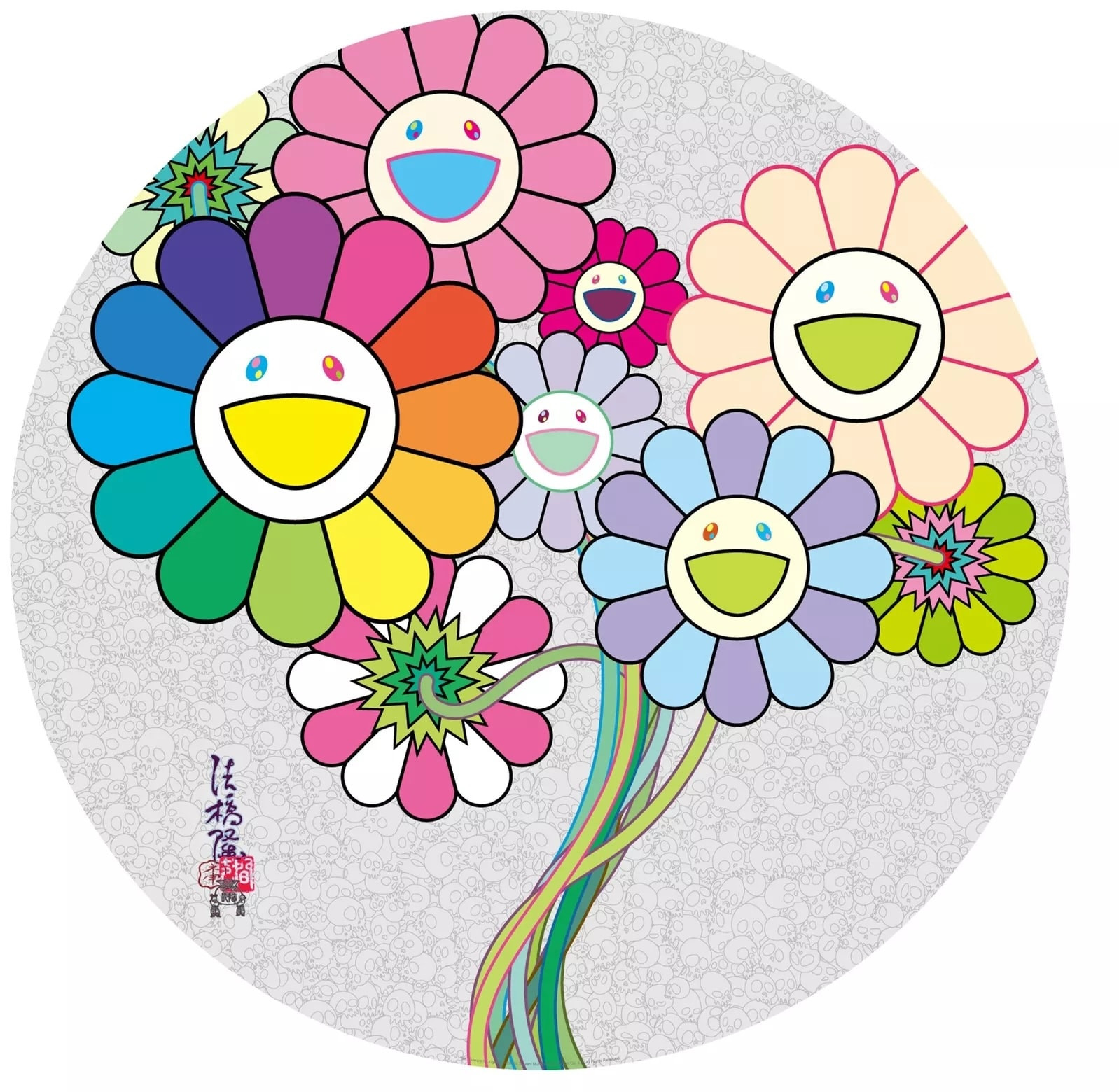
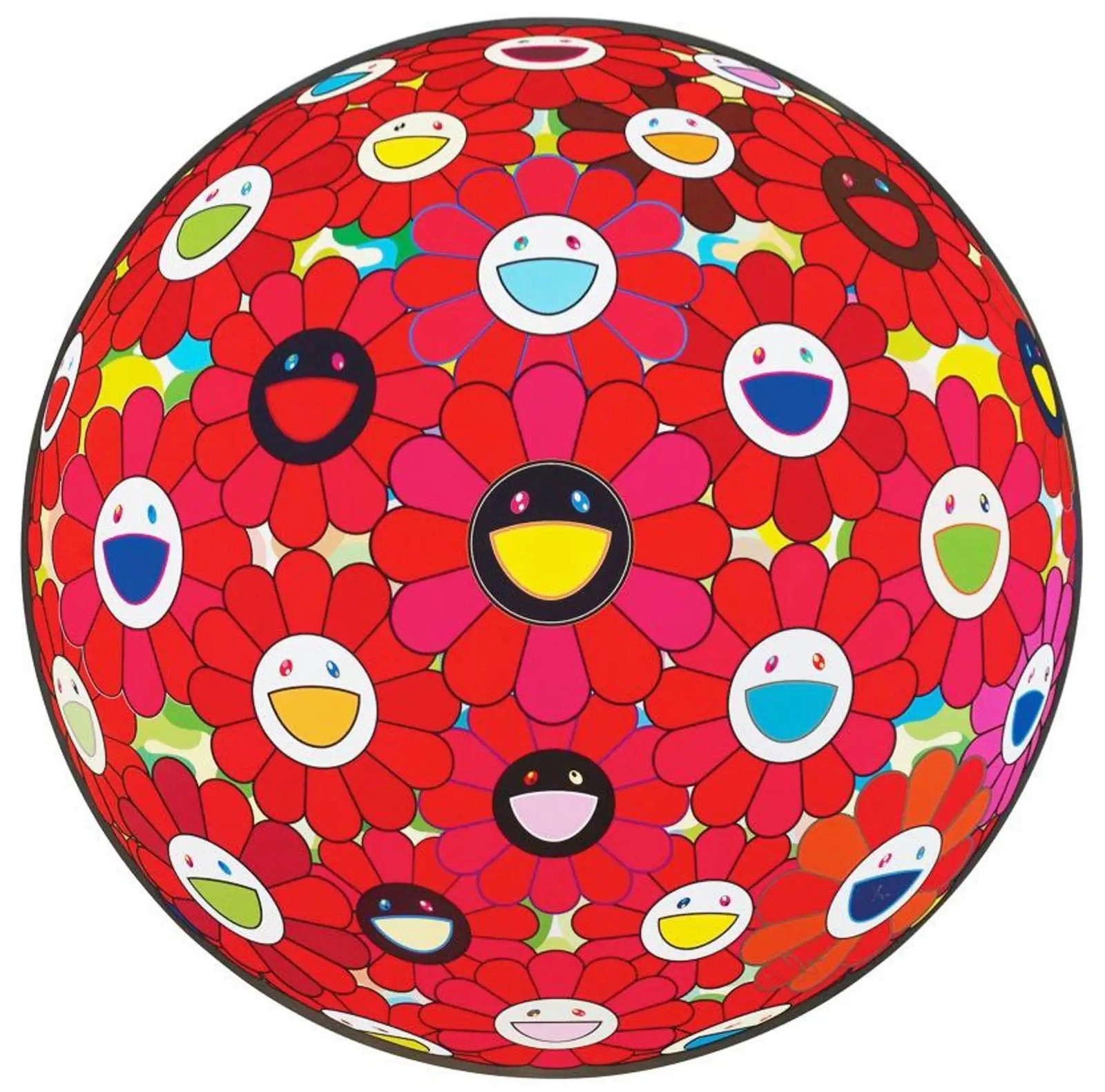
Flower Ball (Multicolour) — Takashi Murakami. Available at Guy Hepner, New York.
Murakami's flower motif did not appear fully formed. Its development across the late 1990s and into the 2000s reflects a sustained process of visual research that draws on multiple sources, several of which he has discussed in interviews and catalogue essays.
The most direct antecedent is the decorative floral tradition of Rimpa-school painting, the Edo-period movement associated with masters including Hon'ami Koetsu, Tawaraya Sotatsu, and — most directly relevant to Murakami — Ogata Korin (1658–1716). Korin's celebrated folding screens, including the Irises screens in the MOA Museum in Atami and the related pair in the Metropolitan Museum of Art, New York, are organised around flat, pattern-driven arrangements of flowers — irises, plum blossoms, chrysanthemums — set against gold grounds, with no perspectival depth and no attempt at botanical accuracy. The flowers exist as decorative elements within a formal visual field, not as representations of nature. This is the visual logic Murakami inherits and radically transforms: the flat, patterned flower field becomes his cartoon flower field, the gold ground becomes his metallic screenprint ground, and the classical Rimpa authority becomes a source of hidden art historical legitimacy within an apparently populist image.
The other key source is obvious: Japanese anime and manga character design of the 1980s and 1990s, with its emphasis on round, expressive faces, reduced feature sets (large eyes, small mouth, no nose), and the kawaii aesthetic of deliberate cuteness. Murakami's flower faces embed this visual vocabulary directly — the multiple eyes arranged in the circular face are a direct inheritance from anime character design conventions. The flowers are cartoon faces that happen to be flowers, or flowers that happen to have cartoon faces; the ambiguity is the point.
The first flower works appeared in Murakami's practice around 2000–2001, coinciding with the articulation of his Superflat manifesto. They were not immediately the commercially dominant motif they would become — that status developed gradually through the early 2000s, accelerated by the 2003 Louis Vuitton collaboration, and consolidated through his retrospective exhibition at MOCA Los Angeles in 2007–2008.
The Murakami flower print catalogue spans hundreds of individual editions published over two decades, and no collector can be expected to have command of all of them. What follows is a guide to the most significant and most actively traded editions, organised by series and type.
The core flower print editions — typically titled simply "Flowers" or with a colour variant descriptor — are the works most frequently seen at auction and in gallery inventory. They share a common compositional approach: a single large flower head centred on the sheet, with multiple smiling faces in the petals arranged around a central face, all rendered in graduated rainbow colour fields against a flat ground. The ground treatment varies across editions: some use white or pale grounds, others use metallic gold or silver grounds that dramatically affect the visual character of the work.
Key identifying features of genuine core flower screenprints: the ink density on a genuine screenprint is visible as a slight relief when the work is examined in raking light; colour fields are even and fully opaque; petal edges are precisely defined; the central and peripheral faces have a slightly raised quality distinct from the smoother surface of offset lithograph versions of similar images.
Edition sizes for core flower screenprints typically range from 30 to 150, with publisher documentation from Kaikai Kiki Co., Ltd. or major gallery partners. Secondary market prices for this category range from $15,000 for smaller-edition, smaller-format works in good condition, to $80,000–$150,000 for large-format signed editions from prestigious gallery publications with exceptional provenance.
The "Flowers in Heaven" series represents a significant variation on the core flower motif, introducing a more celestial register through the use of white and pale ground treatments, gold and silver metallic elements, and compositional arrangements that suggest the flowers floating in an undefined space rather than anchored to a field. These works are among the most visually serene in the Murakami canon and appeal to collectors who find the saturated rainbow palette of the core flowers too intense for their display contexts.
"Flowers in Heaven" editions have performed well at auction, particularly among collectors in East Asian markets where the celestial and Buddhist resonances of the imagery carry additional meaning. They are among the more frequently requested Murakami works at Guy Hepner, and significant examples in fine condition represent some of the most compelling acquisitions in the mid-range of the flower print market.
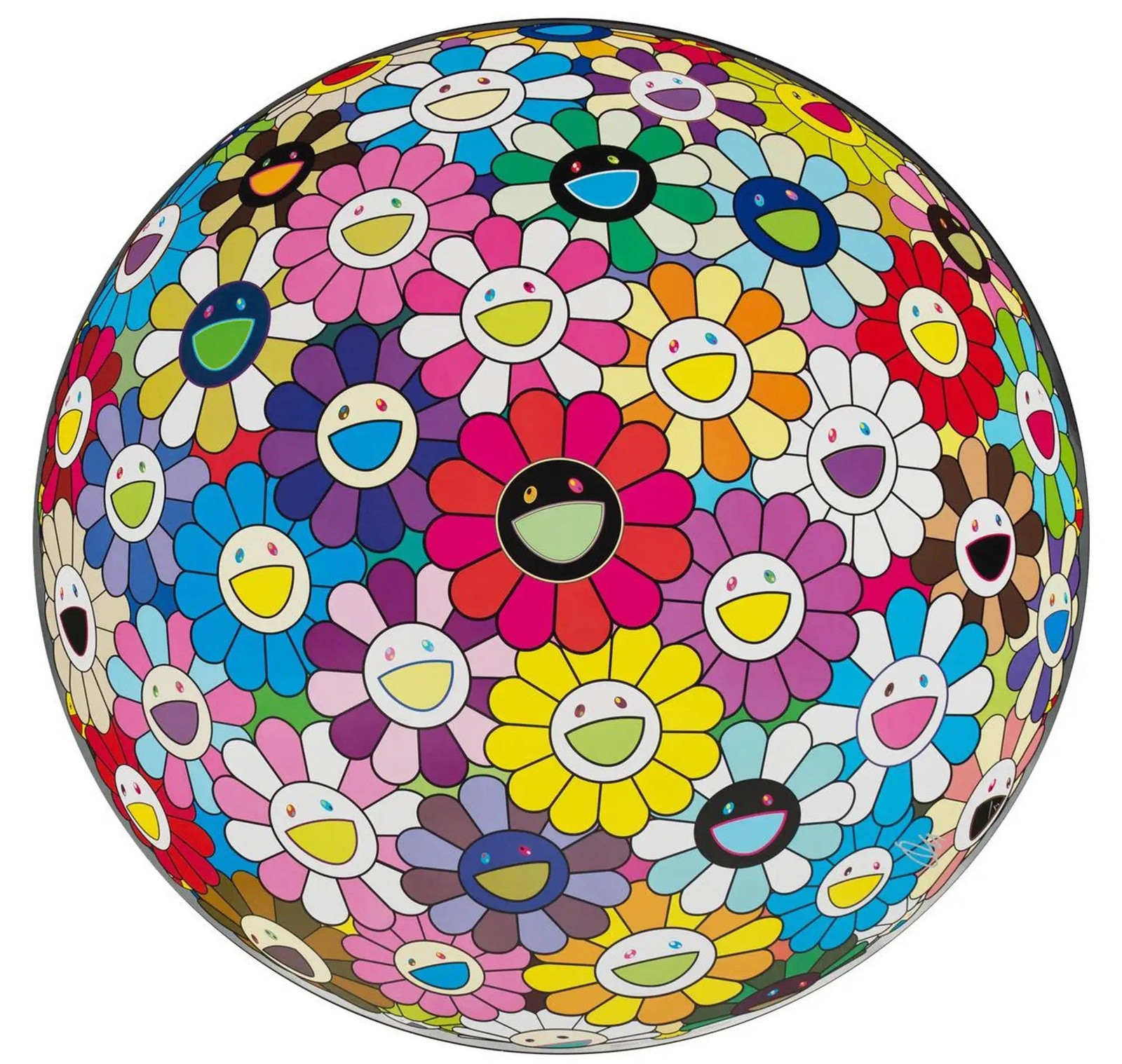
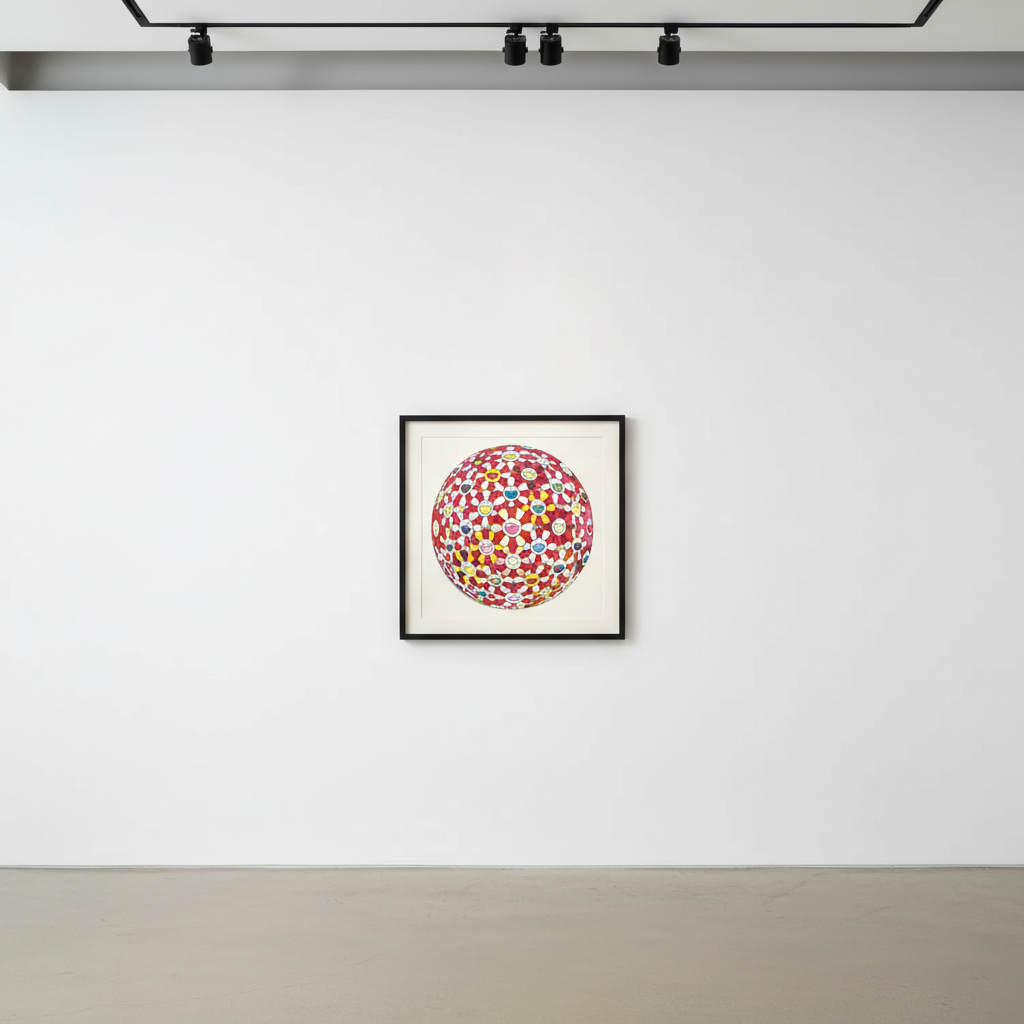
The Flower Ball works — three-dimensional compositions in which the flowers are arranged to suggest a spherical volume, creating the illusion of a ball of blooms — represent one of Murakami's most formally inventive variations on the flower theme. The Flower Ball prints are two-dimensional works that create genuine spatial illusion through the arrangement and scale variation of individual flower heads across the sheet: flowers at the front of the implied sphere are larger and more saturated; those at the edges and back are smaller and cooler in tone. The result is a convincing impression of rotational mass rendered in a flat graphic language.
Flower Ball editions have been among the most consistently strong performers at auction within the flower category. Their compositional complexity — the sense of dimensional mass — distinguishes them from flatter, more pattern-based flower compositions and appeals to collectors who want a work with more formal ambition. Large-format Flower Ball screenprints from small editions have exceeded $300,000 at major auction houses.
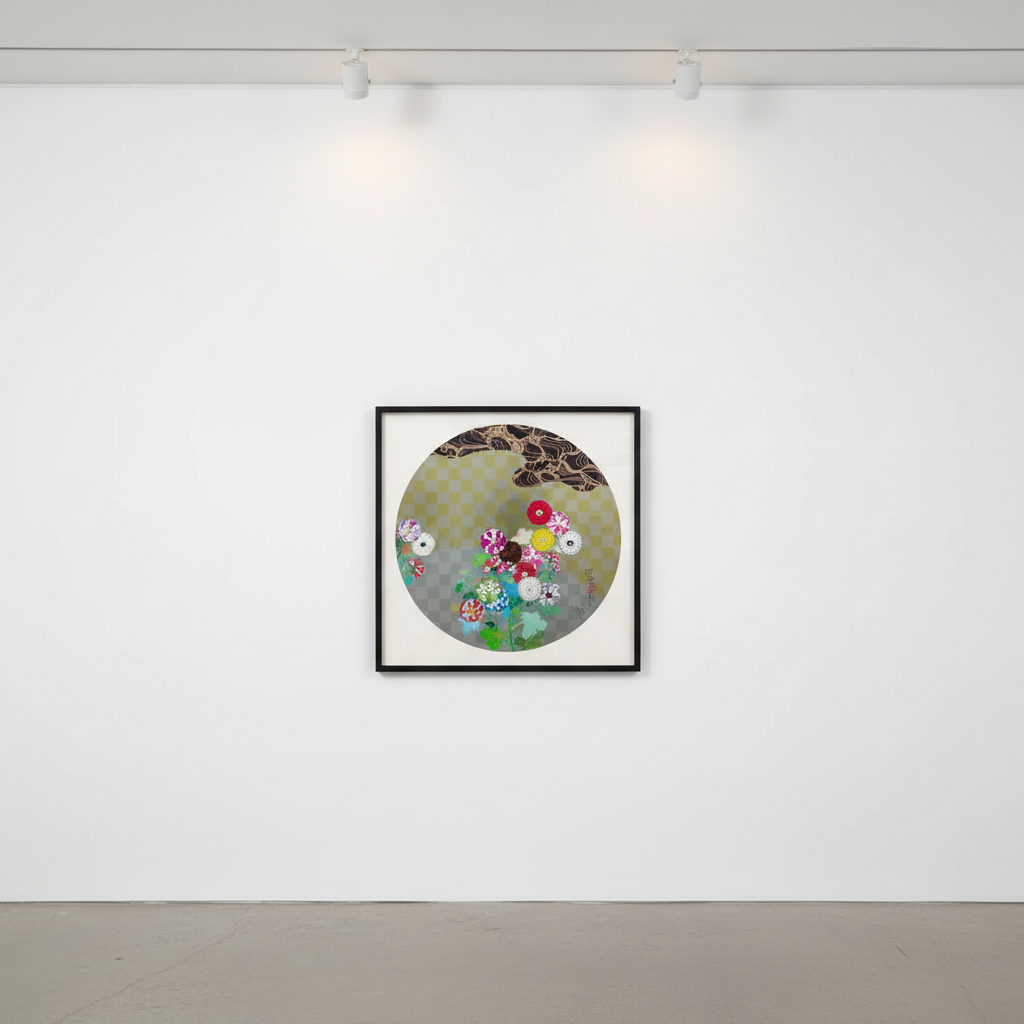
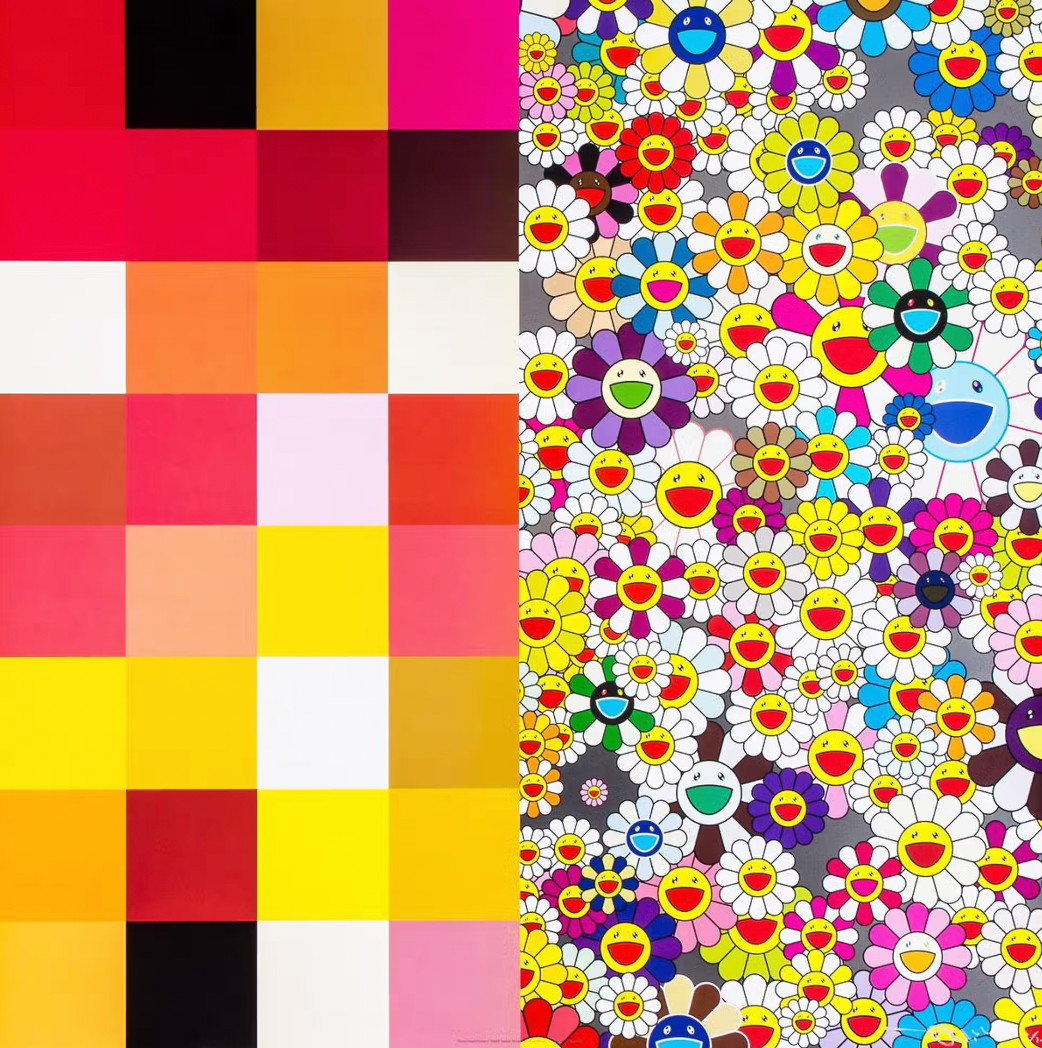
Korin Flowers and Water — Takashi Murakami. Available at Guy Hepner, New York.
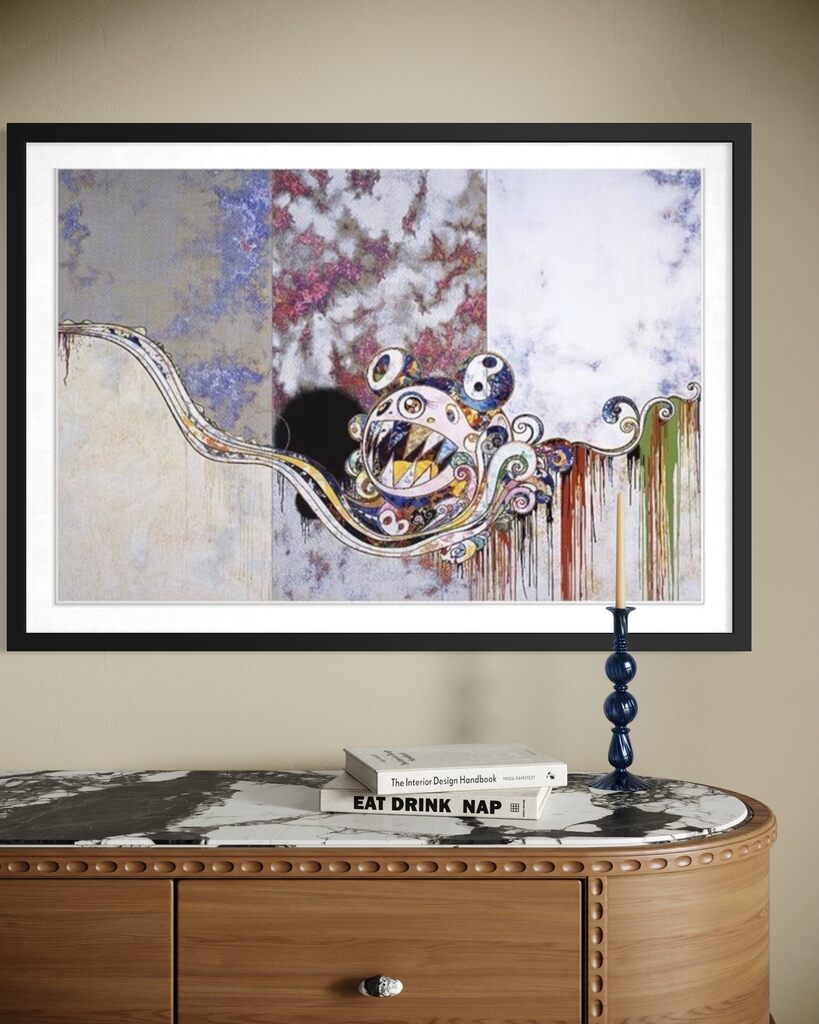
The 727 series — named after the landmark 1996 painting and its exhibition history — includes works in which flower imagery appears in dialogue with Murakami's more complex compositional vocabulary: dragon-clouds, wave patterns derived from classical Japanese screen painting, and the biomorphic character Mr. Dob. Flower elements within 727-related print editions carry a different art historical register from standalone flower compositions: here the flowers are part of an explicitly art historical argument about the relationship between Edo-period decorative painting and contemporary graphic culture.
These works appeal to collectors interested in Murakami's more ambitious compositional projects and who want works that position the flower motif within its full theoretical context. They typically trade at premium prices relative to equivalent standalone flower prints, reflecting their greater compositional complexity and art historical weight.
Murakami's direct homages to Ogata Korin — including works titled "Korin Flowers and Water" and related compositions — place the flower motif most explicitly within its classical Japanese art historical lineage. These works directly invoke Korin's compositional conventions — the flat, gold-ground arrangement, the repetitive patterning of floral forms — and translate them into Murakami's graphic register. They represent the most intellectually serious category of flower print for collectors who want work that declares its art historical positioning clearly.
Korin-related editions have attracted consistent institutional attention and perform well with collectors who approach the Murakami market from a traditional fine art rather than a pop culture direction. They are among the most contextually rich flower editions in the catalogue.
Murakami's flower imagery has appeared across multiple skateboard deck editions, both through his own Kaikai Kiki label and through collaborations — most notably with Supreme. These works occupy the lower price tier of the flower print market but are genuine collectibles with their own secondary market dynamics. Condition and original packaging are critical value drivers in the deck market: mint-in-box examples with original wrapping and documentation trade at significant premiums over opened or shelf-displayed decks.
Flower skateboard deck sets from significant collaborations — particularly Supreme releases — have achieved $2,000–$10,000 in excellent condition with complete packaging, and represent an accessible entry point to the flower collecting category for new collectors.
The flower motif's visual simplicity — a cartoon face surrounded by petals in graduated colours — makes it the most frequently counterfeited image in the Murakami catalogue. The following identification criteria apply to genuine fine art flower prints:
Genuine Murakami screenprints have an ink density and surface relief that is perceptible in raking light and under magnification. The transition between colours within a petal — the gradient from lighter to darker values in each individual petal — is achieved through multiple colour separations, each precisely registered. Under magnification, a genuine screenprint shows a continuous, dense ink deposit. An offset lithograph of the same image shows the characteristic halftone dot pattern of photomechanical printing — visible at 5–10x magnification as a grid of tiny dots rather than a continuous ink field. A digital giclée print shows the inkjet dot pattern of inkjet printing, different again from both screenprint and offset. These distinctions are unambiguous to anyone who examines prints regularly; if you are new to print collecting, comparing a suspected work against documented examples under magnification is the single most reliable physical test.
The colour palette in Murakami flower prints is precisely calibrated across editions and documented in the colophon. Counterfeit prints frequently exhibit colour profiles that are slightly off — too bright, too desaturated, or with individual hues that differ from genuine examples. The metallic inks used in many authentic flower editions — gold and silver grounds, metallic elements within the flowers themselves — are particularly difficult to replicate convincingly in giclée printing, and an apparent metallic element that appears flat in person (rather than exhibiting the genuine reflective quality of metallic ink) is a significant warning sign.
Fine art Murakami flower prints are produced on archival-quality papers and boards — typically heavyweight, acid-free, with consistent cream or white tone throughout the margin. The paper should be substantial and have a quality of the hand consistent with fine art print production. Thin, flimsy paper or paper that yellows at the edges is inconsistent with genuine fine art editions. Margins should be proportionate to the image — fine art editions typically have generous margins — and should show no hand-trimming or irregular edges.
Genuine Murakami flower print editions include a colophon — typically printed on the reverse of the sheet or in accompanying documentation — that states: the title; the edition number and total size (e.g., 12/50); the printing technique; the publisher; the date; and, for screenprints, often the number of colour separations used. The colophon should be consistent with the details on the Certificate of Authenticity. Discrepancies between colophon and COA information are a significant red flag.
Murakami signs fine art editions in the lower margin, typically in pencil. Genuine signatures — made in the specific, slightly irregular but confident hand of an artist who has signed tens of thousands of works — exhibit a characteristic fluid quality. Examine signatures under magnification: hesitant strokes, inconsistent pressure, letterforms that differ from documented examples, or signatures that appear to have been traced or duplicated are all warning signals. Note that some editions include stamps rather than hand signatures; this is documented in the colophon and COA and is not in itself problematic, but a hand signature where documentation states a stamp should be treated with caution.
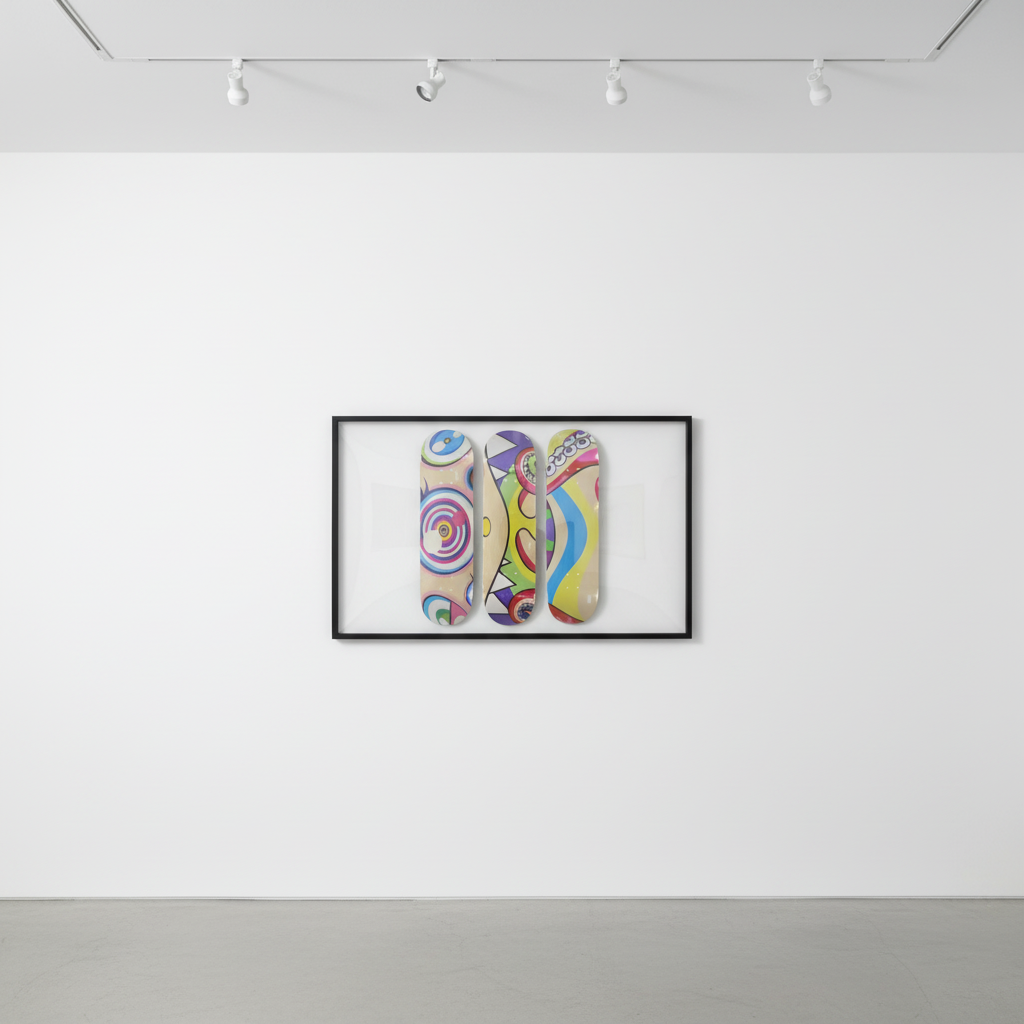
Flowers Set of 3 Skateboard Decks — Takashi Murakami. Available at Guy Hepner, New York.
The flower print market in Murakami's early print career operated at a fraction of current prices. Works that now trade at $40,000–$80,000 at auction were available at primary market for $3,000–$8,000 in the early 2000s. The Louis Vuitton collaboration in 2003 was a significant inflection point: it dramatically broadened awareness of Murakami's imagery outside the art world and accelerated the formation of a serious secondary market. By 2007–2008, driven by the MOCA Los Angeles retrospective and the general strength of the contemporary art market in that period, flower print prices had roughly tripled from their early 2000s primary market levels.
The 2008 global financial crisis temporarily softened the broader contemporary art market, and Murakami prints were not immune. However, the correction in flower print values was less severe than in many other segments of the contemporary market, reflecting the genuine depth and geographic diversity of the collector base. By 2010–2011, prices had recovered, and the market entered a period of steady consolidation in which secondary market values for core flower screenprint editions settled into the $15,000–$60,000 range that would remain broadly representative through the mid-2010s.
The period from 2015 to 2020 saw sustained growth across the flower print category, driven by increasing Asian collector participation (particularly from Chinese collectors entering the contemporary art market in significant numbers for the first time), the continued strength of the broader contemporary art market, and the cultural profile maintained by Murakami's ongoing collaborations. Major Flower Ball editions from prestigious publications began regularly exceeding $150,000 at auction, and exceptional examples achieved $300,000+. The mid-range core flower screenprint category saw prices in the $30,000–$80,000 range become standard for documented signed editions.
The COVID-19 pandemic had a complex effect on the Murakami flower print market. The initial lockdown period saw some softness in auction volumes, but digital sales channels maintained activity. The broader cultural resonance of Murakami's cheerful, life-affirming flower imagery during a period of global anxiety may have contributed to sustained collector interest at a moment when more challenging aesthetic content faced stronger headwinds. By 2021–2022, auction results for major flower editions were broadly in line with 2019 pre-pandemic levels or above.
In 2026, the flower print market is operating with clear price stratification. Entry-level open editions and small-format prints remain available in the $3,000–$10,000 range. The core collecting tier — signed screenprints in editions of 50–100 — trades broadly in the $20,000–$80,000 range at auction, with premium examples above $100,000. Flower Ball and exceptional large-format editions regularly exceed $150,000, with the top results for exceptional works with pristine provenance and institutional exhibition history above $300,000–$500,000.
Condition is, alongside edition documentation and provenance, the most significant determinant of individual flower print value within any given edition tier. The following grading framework reflects established auction house practice:
No visible defects. Colours fully saturated with no fading, shifting, or loss. Paper bright and stable with no foxing, discolouration, or surface irregularity. Metallic inks (where present) fully intact with no oxidation or tarnishing. Signature (where present) sharp and undisturbed. No handling marks, creases, or surface abrasion. Works in this condition represent the top of the value range for any given edition and are the most actively sought by serious collectors. Proper conservation storage and framing from the point of first acquisition is the only reliable way to maintain this condition over time.
Minor handling marks or very slight fading, not immediately apparent at normal viewing distance. No foxing or significant surface issues. Paper bright. Metallic inks mostly intact. Signature clear. A very good condition Murakami flower print will typically achieve 70–85% of the value of a mint example in the same edition. This condition is the realistic outcome for works that have been on display in appropriate but not museum-standard conditions for a decade or more.
Visible fading or colour shift, particularly in blue and yellow fields which are most vulnerable to UV degradation. Possible minor foxing. Metallic inks may show some oxidation. Handling marks or minor surface abrasion may be present. A good condition flower print may achieve 40–65% of a mint comparable. Works in this condition category are typically unsuitable for institutional display contexts and may face buyer resistance from the most demanding collectors.
Significant fading, foxing, or surface damage. Restoration may have been attempted. Works in this condition range have significantly reduced market value and limited resale prospects. Unless the edition is of extraordinary rarity, fair or poor condition Murakami flower prints are not recommended acquisitions at any price level above nominal.
The most common condition issue in the Murakami flower print market is fading — specifically, the differential fading of individual colour fields under UV light exposure. The yellow and blue inks used in many flower editions are particularly vulnerable to UV-induced fading; greens shift towards yellow; the balanced rainbow effect of a mint print can become noticeably imbalanced with sustained exposure. A flower print displayed without UV protection for ten years in a room with natural light can lose 15–30% of its colour saturation in the most vulnerable areas. This is not theoretical: it is the most common single reason that Murakami flower prints sell below their potential at auction. UV-filtering museum glass is an essential, not optional, component of proper Murakami flower print ownership.
Red Crane — Takashi Murakami. Available at Guy Hepner, New York.
At this price point, the genuine fine art flower print market is largely inaccessible for signed screenprints. However, two genuine options exist: smaller open-edition or large-edition offset lithographs published by Kaikai Kiki or in conjunction with institutional exhibitions (these can provide authentic Murakami imagery with proper documentation at accessible prices); and skateboard deck editions from significant collaborations, which offer genuine Murakami collectibles with their own market dynamics. Either can serve as a meaningful entry point while building familiarity with the market before committing larger sums.
This price tier gives access to genuine signed screenprint editions from documented publications. Look for editions of 50–100 with clear Kaikai Kiki or major gallery publisher documentation, in excellent or better condition. Core flower screenprints in this range represent the heart of the Murakami flower print market and offer the best combination of authenticity confidence, visual impact, and secondary market liquidity for a first or second significant Murakami acquisition.
At this level, the focus should be on editions of 30–50 from major gallery publications with pristine condition and strong provenance — ideally with documented primary gallery purchase history. Flower Ball editions, major signed examples from exhibitions at Gagosian or Perrotin, and works with Versailles or MOCA exhibition history represent the most compelling acquisitions. These works combine strong visual impact with the institutional context that sustains long-term value.
Large-format, early-career, or museum-quality Flower Ball and major series works with exceptional provenance. Acquisitions at this level should ideally be supported by specialist authentication confirmation from Kaikai Kiki and, where possible, pre-purchase due diligence with a specialist print advisor or major auction house specialist.
The investment in properly caring for a Murakami flower print begins the day it arrives and pays dividends over decades. The three non-negotiable requirements:
UV protection: Museum-grade conservation glazing, blocking 97–99% of UV radiation. Standard glass or Perspex is not adequate. This is the single most important conservation decision you make for any Murakami flower print.
Acid-free framing: Acid-free mat boards and backing boards, with the mat creating a physical separation between the print surface and the glazing. Never allow the print surface to contact the glazing directly.
Climate control: 45–55% relative humidity and 65–70°F (18–21°C) for display and storage. Avoid proximity to exterior walls, heating vents, and areas with rapid temperature variation. Never store in attics or basements.
Major Flower Ball editions in large formats from small gallery editions with pristine provenance represent the upper end of the flower print market, with exceptional examples exceeding $300,000–$500,000 at major auction houses. The most valuable flower prints combine small editions, large formats, exceptional condition, and institutional exhibition history.
Physical examination under 5–10x magnification is the most reliable method. A screenprint shows continuous ink deposits without dot patterns; a giclée shows the characteristic inkjet dot matrix of digital printing. Additionally, screenprint inks have a tactile quality — slight surface relief visible in raking light — that giclée printing does not replicate. The colophon should state the printing method; if it doesn't, or if the stated method and the physical evidence don't match, treat that as a significant red flag.
The flower print market in 2026 has matured significantly from its early growth phases, and the dramatic appreciation rates of the 2000s and 2010s are not the expectation for established editions. However, the market has demonstrated consistent resilience across multiple economic cycles, and significant editions in excellent condition with strong provenance continue to hold and grow value reliably. The most dependable approach is to focus on quality, condition, and provenance rather than attempting to time market movements.
Primary market access to major Kaikai Kiki editions typically requires existing relationships with representing galleries (Gagosian, Galerie Perrotin, Blum and Poe) rather than direct studio purchase. Guy Hepner maintains active relationships with the Murakami gallery ecosystem and can assist collectors in accessing primary market opportunities when they arise.
Browse Takashi Murakami Flower Prints for Sale at Guy Hepner
Sell your Takashi Murakami flower print — free valuation
Explore Takashi Murakami prints for sale at Guy Hepner: Flower Ball, Flowers, Acupuncture, And Then and Then and Then and Then and Then, Characters.
Related Series