Kaikai and Kiki

July 29, 2026
In 2010, Takashi Murakami art invaded Versailles. Not quietly, not politely, but with a golden Buddha towering over the Hall of Mirrors and psychedelic Flowers blooming in the gardens of Louis XIV. Prince Sixte-Henri de Bourbon-Parme, a descendant of the Sun King himself, condemned the exhibition as a "murder" of French heritage and artistic identity. The Coordination de la Défense de Versailles—the same group that had tried to block Jeff Koons two years earlier—mounted protests. French cultural conservatives called Murakami's figures "frankly grotesque." And yet the show went on. The palace that once hosted the most extravagant displays of monarchical power became a stage for smiling flowers, cartoon skulls, and a 19-foot bronze Buddha covered in gold leaf. The collision was deliberate. The outrage was, in a sense, the point.
This is how Takashi Murakami operates. He doesn't simply make art; he stages confrontations between worlds that are supposed to remain separate. High culture and low culture. East and West. The sacred and the commercial. The cute and the apocalyptic. His Takashi Murakami Superflat philosophy isn't just an aesthetic choice—it's a sustained argument about the nature of contemporary existence, about how we consume images, about what happens when the boundaries between fine art and mass culture dissolve entirely. To dismiss him as a commercial artist is to miss the critique embedded in the commerce. To celebrate him as a postmodern genius is to ignore the very real questions about whether art can maintain meaning in an age of infinite reproduction.
The Takashi Murakami meaning—if we can speak of a single meaning—lies precisely in this refusal to resolve contradictions. The flower smiles. The skull grins. Both are true simultaneously. This is not irony in the tired postmodern sense, where everything is a knowing wink. It's something stranger: a sincere embrace of surfaces that becomes, paradoxically, a profound statement about depth. Understanding contemporary Japanese art in the twenty-first century requires grappling with this paradox, and grappling with Murakami himself.
Takashi Murakami was born in Tokyo in 1962, into a Japan still processing its post-war identity crisis. His father worked for a taxi company; his mother was a homemaker who encouraged his artistic interests. The cultural landscape of his childhood was defined by this peculiar tension: American occupation had reshaped Japanese consumer culture, filling the visual environment with Western imagery and products, while traditional Japanese aesthetics persisted as a kind of ghostly presence—respected but increasingly disconnected from daily life. Anime and manga were everywhere, dismissed by serious people as entertainment for children or escapism for adults who couldn't face reality. The gap between "real" art and popular culture seemed absolute.
Murakami initially pursued the most traditional path available to a Japanese artist with serious ambitions. He enrolled at Tokyo University of the Arts to study Nihonga, a style of painting that emerged in the late nineteenth century as a consciously "Japanese" response to Western influence. Nihonga artists worked with traditional materials—mineral pigments, animal glue, washi paper, silk—and drew on classical Japanese visual conventions. It was the establishment track, the way to become a legitimate artist in the Japanese context. Murakami earned his PhD in Nihonga in 1993, making him one of the most formally credentialed artists working today.
But even as he mastered traditional techniques, Murakami was becoming increasingly interested in what those techniques excluded. Nihonga defined itself against Western art but also against Japanese popular culture. It maintained a fantasy of purity, of authentic Japaneseness, that seemed increasingly untenable in a world where Japanese teenagers were as likely to be watching American television as reading classical poetry. The hierarchy that placed Nihonga at the top and manga at the bottom struck Murakami as both historically arbitrary and intellectually dishonest. Japanese visual culture had always been more fluid than the categories suggested. Ukiyo-e woodblock prints—now housed in major museums worldwide—were originally mass-produced entertainment, the manga of the Edo period. The distinction between high and low was a relatively recent invention, imported from Western art historical frameworks that didn't quite fit Japanese reality.
© 2025 Takashi Murakami / Kaikai Kiki Co., Ltd. All Rights Reserved.
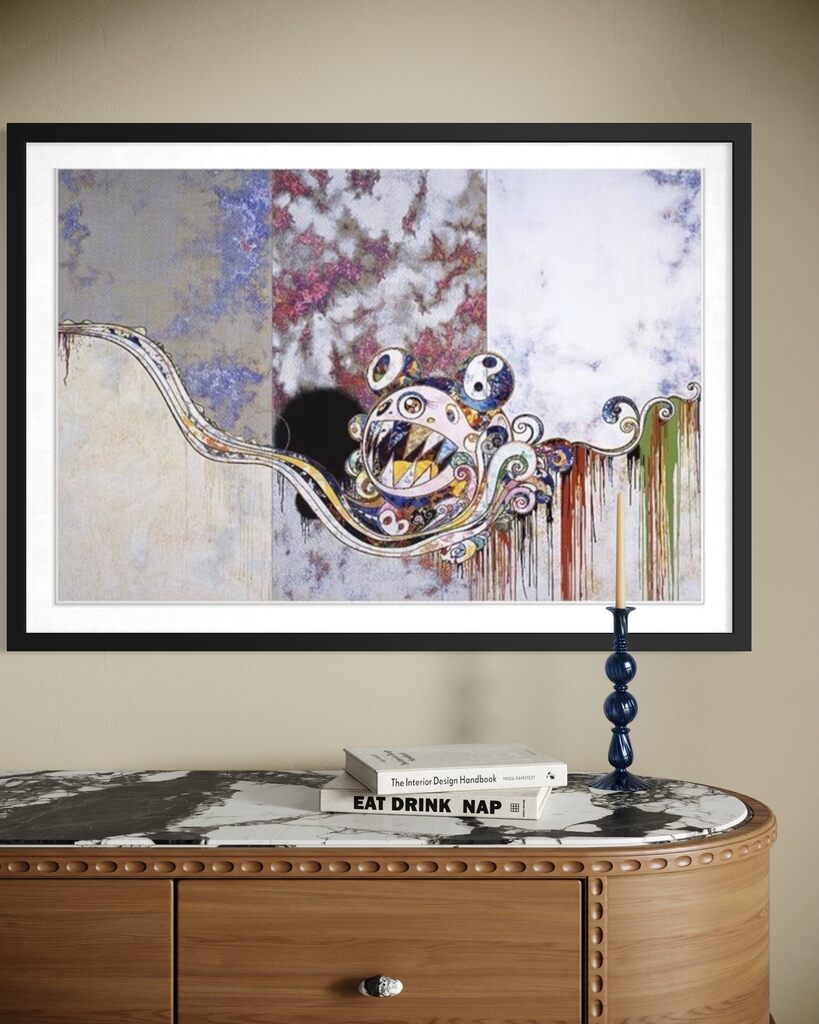
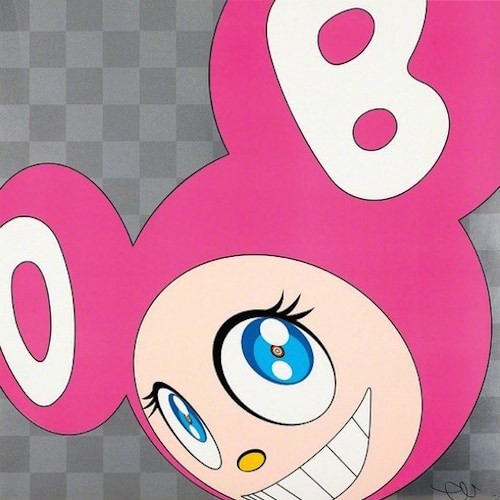
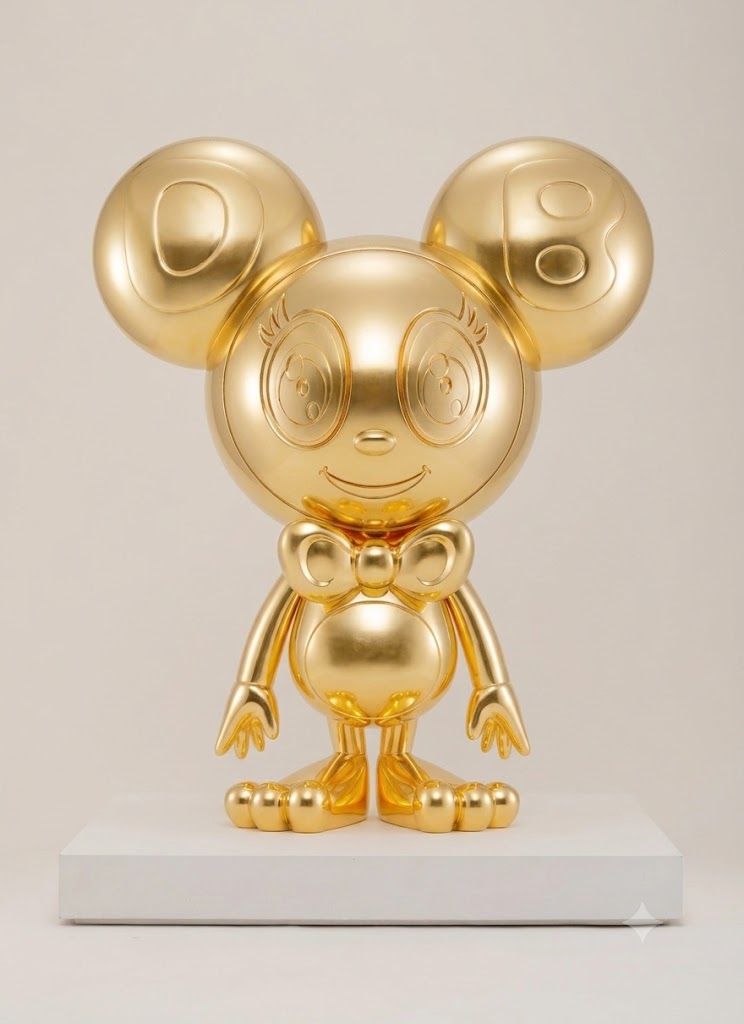
This realization became the foundation of the Takashi Murakami philosophy that would define his career. In the early 1990s, he began developing work that deliberately collapsed the boundaries his training had taught him to respect. The DOB character emerged in 1993—a mouse-like figure with a round head and sharp teeth, whose name derived from a Japanese slang expression meaning "why?" DOB was simultaneously cute and menacing, childlike and unsettling. It looked like something from a cartoon but carried echoes of traditional Japanese demons and the mushroom clouds of atomic destruction. Most importantly, it was designed to be reproducible across media: paintings, sculptures, prints, merchandise, anything. DOB wasn't a character that happened to appear in art; it was a character designed to question what art was in the first place.
The term "Superflat" first appeared in 2000, when Murakami curated an exhibition by that name at the Museum of Contemporary Art in Los Angeles. The accompanying catalog included his "Superflat Manifesto," a dense, provocative text that attempted to articulate the theoretical framework underlying his practice. The manifesto argued that Japan's social hierarchies, visual culture, and even psychological structures had become "super flat"—compressed into a single plane where traditional distinctions no longer held. High art and commercial art, the self and society, the cute and the grotesque, reality and fiction: all existed on the same flattened surface.
This wasn't presented as a crisis to be mourned but as a condition to be understood and potentially leveraged. Murakami drew connections between the flattening of space in traditional Japanese painting—which never adopted the perspectival depth of Western art—and the flattening of consumer culture in contemporary Japan. Both operated on the principle that surface was primary. Ukiyo-e prints didn't try to create the illusion of three-dimensional space; they reveled in the two-dimensionality of the picture plane. Similarly, contemporary Japanese consumer culture didn't try to create the illusion of depth; it proliferated surfaces endlessly—images on screens, Characters on products, advertisements on every available surface.
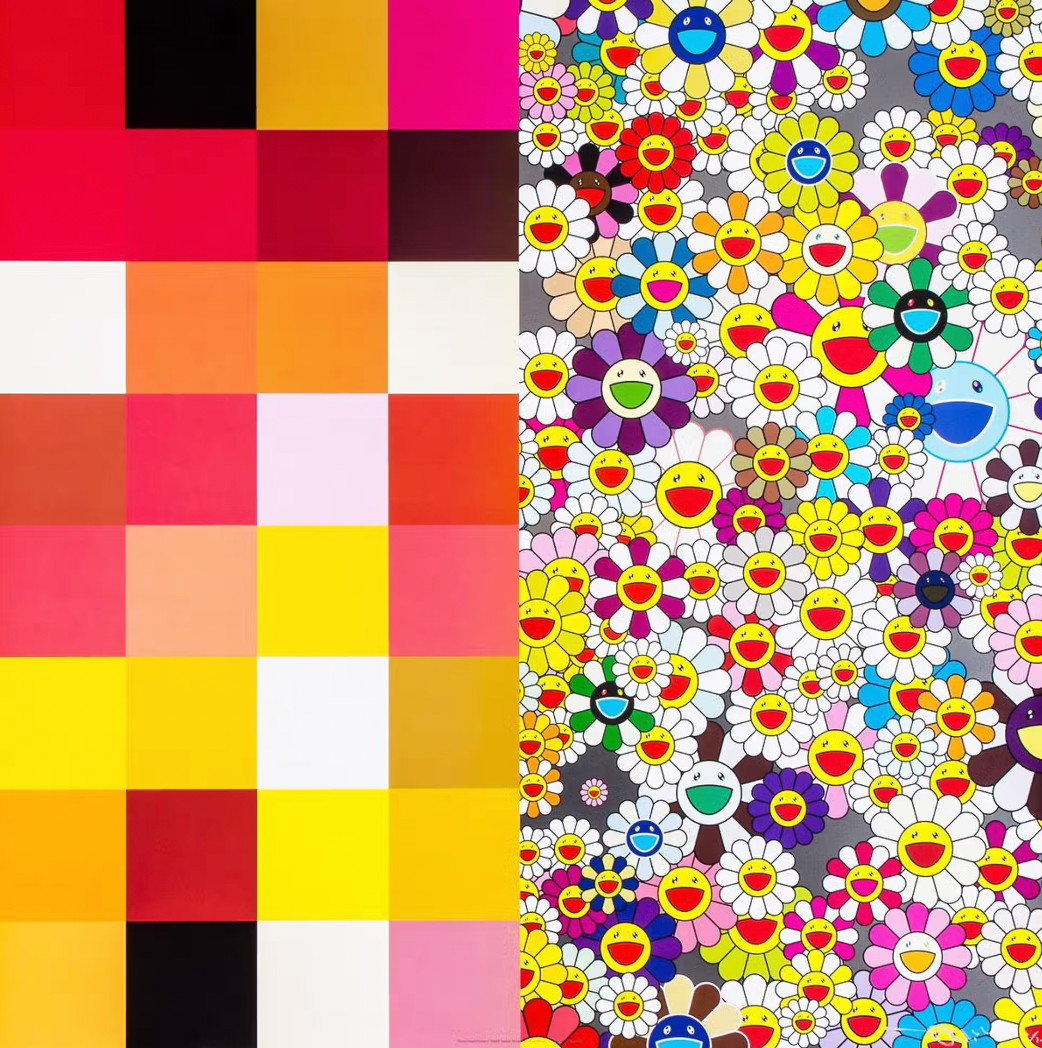
The Takashi Murakami Superflat aesthetic emerged from this analysis. His paintings reject perspectival depth, presenting figures and backgrounds on the same plane. His signature flowers—those endlessly grinning circular faces surrounded by petals—exist in a space that is purely decorative, purely surface. There is no behind, no underneath, no hidden reality to be uncovered through interpretation. The surface is all there is, which is precisely what makes it so unsettling to viewers trained to look for meaning beneath appearances. We keep expecting depth, and Murakami keeps denying it to us.
But here's where the Takashi Murakami meaning becomes complicated: the denial of depth is itself a profound statement. By insisting on surface, Murakami forces us to confront our assumptions about what makes art valuable. We tend to believe that great art reveals hidden truths, that it opens windows onto deeper realities. Superflat challenges this belief not by arguing against it directly but by presenting an alternative: art that is entirely surface, yet somehow still meaningful. The meaning isn't hidden behind the smiling flower; it's in the smile itself, in the way that smile relates to other smiles in consumer culture, in the way we project emotions onto cartoon faces, in the entire apparatus of cuteness that structures so much of contemporary visual experience.
Understanding contemporary Japanese art through Murakami requires understanding the specific cultural context he's addressing. The Superflat theory isn't just a formal observation about flatness in painting; it's a diagnosis of Japanese society in the decades following World War II. Murakami has been explicit about this connection: the proliferation of kawaii (cute) culture, the obsession with anime and manga, the retreat into fantasy worlds populated by big-eyed characters and supernatural creatures—all of this, he argues, is a response to historical trauma that cannot be directly addressed.
Japan's defeat in World War II, the atomic bombings of Hiroshima and Nagasaki, the subsequent American occupation and cultural restructuring: these events created a rupture in Japanese national identity that was never fully processed. Instead, according to Murakami, Japan developed a culture of displacement, channeling anxieties and traumas into fantasy forms that seemed innocent on the surface but carried darker undercurrents. The cute becomes a screen for the catastrophic. The childlike becomes a refuge from a adulthood defined by defeat and dependence. The flat becomes a way of avoiding depth that might reveal wounds too painful to examine directly.
Takashi Murakami
This reading gives Murakami's work a gravity that the smiling flowers might not immediately suggest. When Murakami paints mushroom clouds rendered in the style of traditional Japanese painting, or creates sculptures that combine cute anime aesthetics with imagery of destruction, he's making explicit what he sees as implicit in the entire visual culture he draws from. The cuteness isn't just cute; it's a defense mechanism, a cultural strategy for managing unbearable history. The flatness isn't just an aesthetic choice; it's a symptom of a society that has suppressed its capacity for psychological depth.
Whether you accept this analysis or not—and it has been criticized as oversimplified, self-serving, and potentially orientalist in its own way—it provides a framework for understanding why Murakami's work matters beyond its visual appeal. He's not just making pretty pictures or clever commodities; he's proposing a theory of culture that uses art as both evidence and intervention. The work enacts the conditions it describes, which is either a profound critical strategy or a convenient excuse for making marketable products, depending on your perspective.
No discussion of Takashi Murakami can avoid the Louis Vuitton collaboration, and no discussion of that collaboration can avoid the question it raises: Is Murakami a sellout? He would say that's the wrong question. The collaboration began in 2003, when Marc Jacobs, then the creative director of Louis Vuitton, invited Murakami to redesign the brand's iconic monogram bags. The result was an explosion of color: the classic LV pattern rendered in 33 different hues against white or black backgrounds, later joined by cherry blossom motifs, cartoon eyes, and other Murakami imagery. The bags sold enormously well—some estimates suggest the collaboration generated over $300 million in revenue for the brand.
For critics, this was proof that Murakami had abandoned any pretense of artistic integrity in favor of commercial success. He wasn't critiquing consumer culture; he was actively participating in it at its most luxury-obsessed level. The handbags weren't challenging anything; they were simply expensive accessories for wealthy consumers. Whatever theoretical framework Murakami wrapped around his practice, the collaboration revealed the truth: he was a designer playing artist, a merchandiser with a PhD.
But this critique assumes a separation between art and commerce that Murakami's entire career has been devoted to questioning. From the beginning, he's argued that the distinction between high art and commercial production is historically contingent and philosophically unstable. Warhol collapsed this boundary in the American context; Murakami seeks to do the same in the Japanese context, where the boundary was always different anyway. The Louis Vuitton collaboration wasn't a deviation from his artistic practice; it was an extension of it. By placing his imagery on the most prestigious luxury goods in the world, Murakami was testing the limits of what art could be and where it could appear.
Moreover, the collaboration addressed a specific aspect of the Superflat thesis: the relationship between Japanese and Western consumer culture. Louis Vuitton is a French brand that has achieved enormous success in Japan—a symbol of Western luxury that Japanese consumers have enthusiastically embraced. By redesigning the brand's signature pattern, Murakami was inserting Japanese visual sensibilities into this Western luxury object, creating a hybrid that belonged to neither tradition entirely. The bags became artifacts of globalized consumer culture, neither purely French nor purely Japanese, neither fine art nor mere commodity.
Whether this justification is convincing depends largely on what you think art should do. If art's purpose is to stand apart from commerce, to offer a space of contemplation untainted by market forces, then Murakami's collaborations are indeed a betrayal. But if art's purpose is to engage with the conditions of contemporary life—and contemporary life is saturated with commerce—then the collaborations become a form of honesty, a refusal to pretend that art exists in some pure realm outside the market.
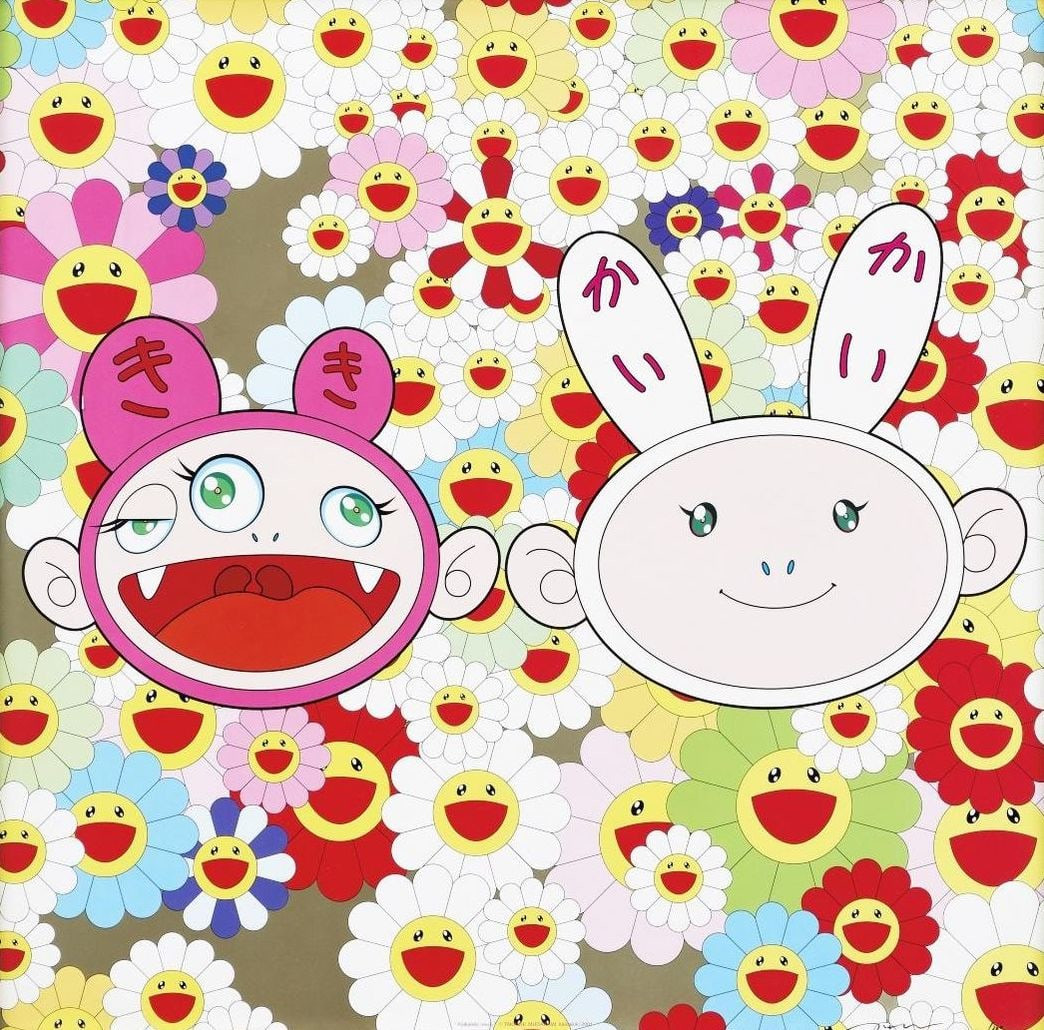
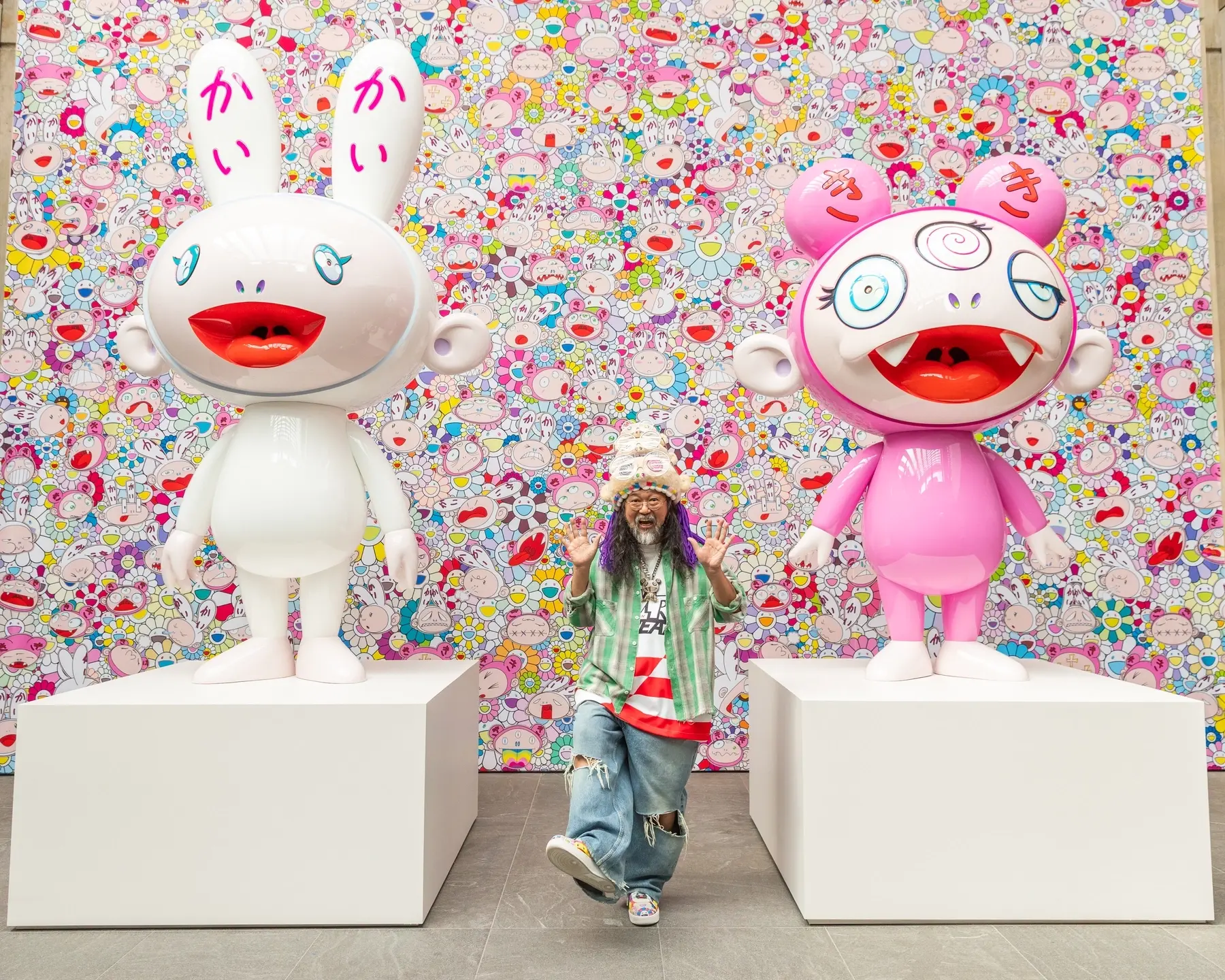
Among Murakami's most recognizable creations are Kaikai and Kiki, twin characters who serve as mascots for his Kaikai Kiki Co., Ltd., the production company through which all his work is created and managed. Kaikai is a white rabbit-like creature with bulging eyes; Kiki is pink with three eyes and fangs. They appear adorable at first glance—the kind of characters you might find on children's merchandise—but something is slightly off. The eyes are too wide, too alert. Kiki's third eye suggests mutation or supernatural perception. The cuteness contains a hint of menace.
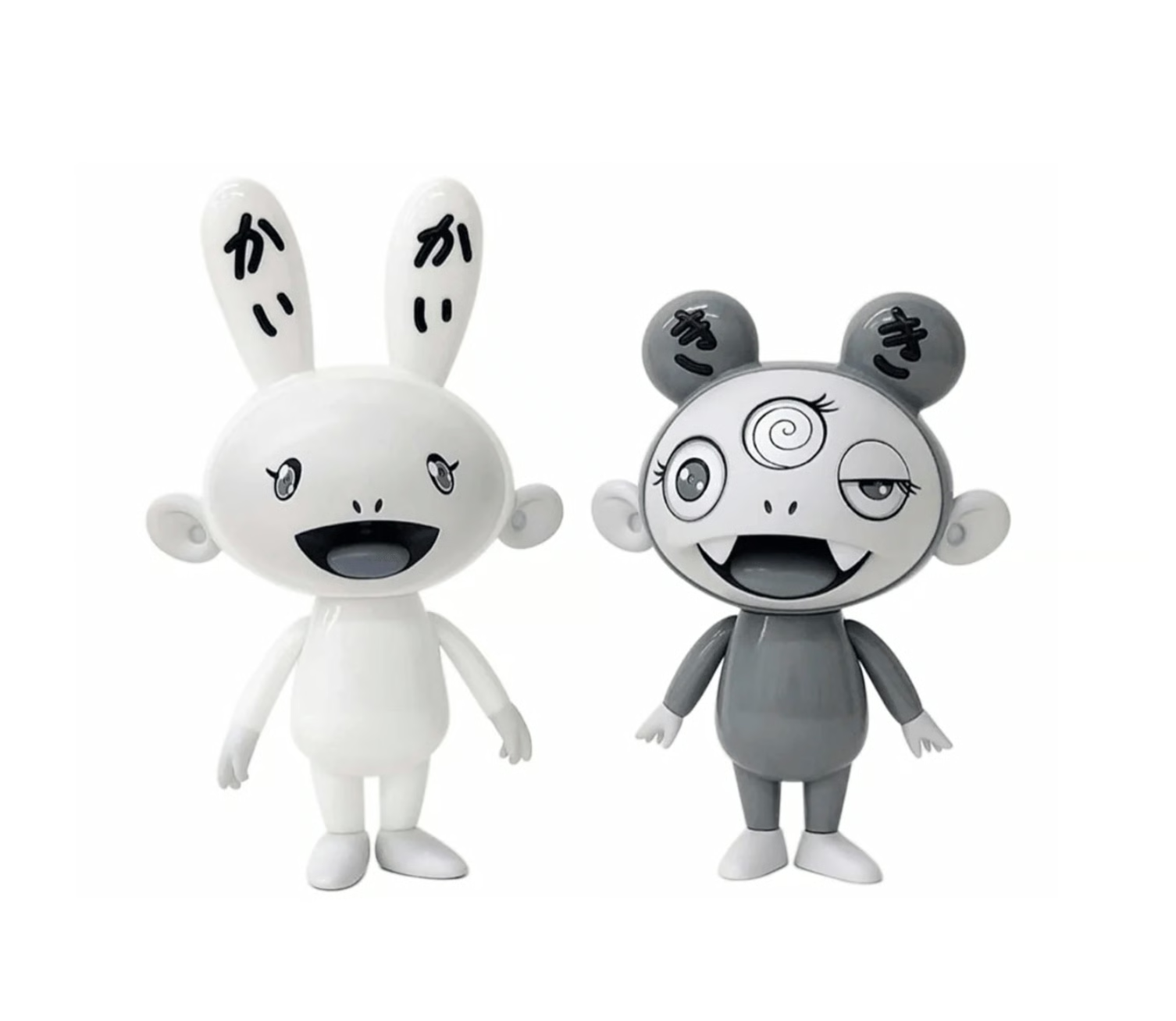
Takashi Murakami, KaiKai and Kiki, 2020, Vinyl sculpture. Available at Guy Hepner, New York.
These characters embody the central tension in Murakami's work: the coexistence of innocence and darkness, attraction and unease. They're designed to be lovable, yet they resist complete comfort. You can buy Kaikai and Kiki plush toys and figures, but owning them doesn't resolve the ambiguity they represent. They remain slightly strange, slightly other, even as they invite embrace. This is the Takashi Murakami philosophy in miniature: surfaces that seem transparent but turn out to be mirrors, reflecting our own desires and anxieties back at us.
The characters also represent Murakami's approach to artistic production. Kaikai Kiki Co., Ltd. employs hundreds of assistants who help produce Murakami's paintings, sculptures, and merchandise. The studio operates more like a Japanese animation company than a traditional Western artist's atelier. Individual works emerge from collaborative processes that blur the line between the artist's hand and industrial production. Murakami has been open about this, comparing his practice to that of Renaissance masters who employed workshops of assistants, but also to contemporary anime studios where hundreds of animators collaborate on a single film. The myth of the solitary genius, creating masterpieces in isolation, has no place in his practice.
This production model has been criticized as well—if Murakami doesn't physically paint his paintings, are they really his work?—but here again, the critique assumes a romantic notion of authorship that Murakami is explicitly rejecting. In the Superflat world, the distinction between original and reproduction, between the artist's hand and the assistant's labor, becomes as questionable as the distinction between high art and low culture. What matters is the concept, the vision, the system—not the physical act of applying paint to canvas. Kaikai and Kiki, as mascots of this system, remind us that we're not looking at expressions of individual genius but at products of a cultural machine.
Takashi Murakami has achieved something remarkable: near-universal name recognition combined with deeply divided critical opinion. He is simultaneously celebrated as one of the most important artists of his generation and dismissed as a clever marketer with nothing substantive to say. The art world cannot seem to decide whether he's a profound critic of contemporary culture or its most successful symptom.
The positive case is substantial. Murakami has exhibited at major museums worldwide, including retrospectives at the Museum of Contemporary Art in Los Angeles, the Brooklyn Museum, and the Palace of Versailles. His work is held in the collections of the Museum of Modern Art, the Art Institute of Chicago, the San Francisco Museum of Modern Art, and numerous other institutions. He has been the subject of serious scholarly attention, with critics and art historians analyzing his work in relation to Japanese art history, postmodernism, globalization, and consumer culture. The Superflat theory has influenced a generation of artists, both in Japan and internationally, who have built on his critique of hierarchy and his embrace of pop cultural forms.
The negative case is equally substantial. Critics argue that Murakami's theoretical sophistication is a cover for work that is fundamentally decorative and commercially calculated. His paintings are visually overwhelming but intellectually empty—all surface in the worst sense, offering nothing beyond immediate visual pleasure. The collaborations with luxury brands and fashion designers reveal his true priorities: money and fame rather than artistic integrity. His claims to be critiquing consumer culture are undermined by his enthusiastic participation in that culture at its most excessive levels. The Superflat theory is too convenient, providing a ready-made justification for any commercial activity the artist might pursue.
Both assessments have merit, which is perhaps the point. Murakami has positioned his practice precisely at the fault line between art and commerce, criticism and complicity. He refuses to choose a side, which frustrates critics who want clarity. Is he a critic or a participant? A philosopher or a salesman? The answer is yes—to all of it, simultaneously. This refusal of resolution is consistent with the Superflat philosophy, which insists on surfaces rather than depths, on coexistence rather than hierarchy. But it also makes definitive critical assessment impossible. Murakami has built a career on unresolvable ambiguity.
While Murakami is primarily known for his paintings, his sculptural work represents a crucial dimension of his practice. The sculptures translate the Superflat aesthetic into three-dimensional space, which creates an interesting paradox: how can you be flat in three dimensions? The answer lies in the way Murakami's sculptures treat their surfaces. Even when rendered in full three-dimensional form, figures like DOB, Kaikai, and Kiki maintain the quality of animated characters—surfaces that feel flat even when they exist in space.
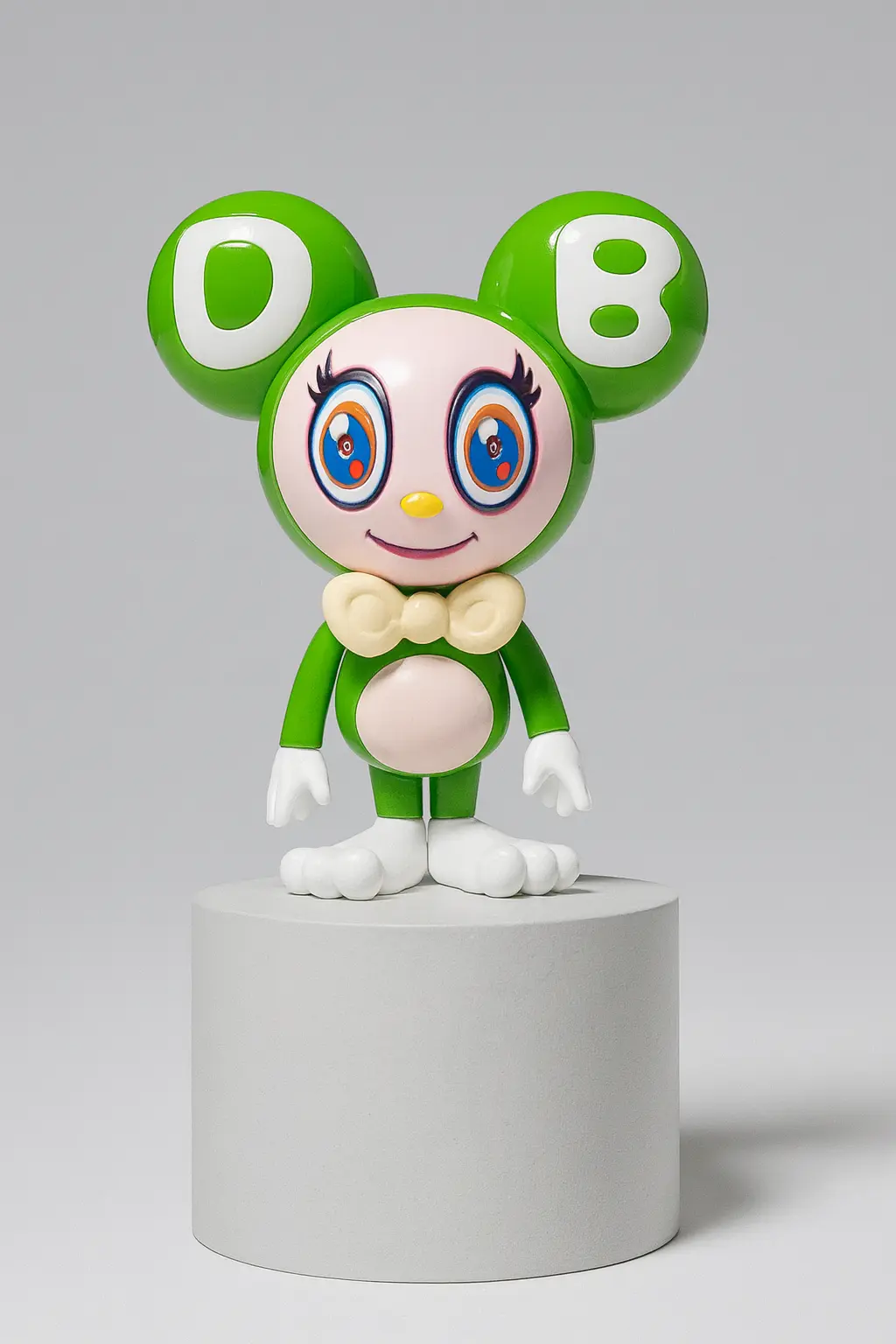
Takashi Murakami, Untitled (Green) , 2020, Vinyl sculpture. Available at Guy Hepner, New York.
The 2010 exhibition at Versailles featured several major sculptural works, including the monumental "Oval Buddha," a bronze and gold leaf figure standing over 18 feet tall. The Buddha sits in traditional meditation posture, but its features are rendered in Murakami's signature style: smooth, cartoon-like, simultaneously ancient and contemporary. Placed in the Hall of Mirrors at Versailles, the sculpture staged a collision between Buddhist iconography, French royal excess, and Japanese pop culture. The gold leaf echoed the gilded surfaces of the palace while pointing to different traditions of sacred decoration. The cartoon features disrupted any easy reverence, insisting that we see the Buddha not as a transcendent religious symbol but as a cultural image subject to the same operations of reproduction and circulation as any other.
The sculptural editions available to collectors typically operate at a more intimate scale—vinyl figures and limited edition pieces that can be displayed domestically. These works function differently than the monumental installations, entering private spaces and everyday life rather than occupying museum or palace contexts. But they carry the same philosophical freight. A Murakami figure on your shelf poses the same questions as a Murakami Buddha at Versailles: What is the relationship between art and commodity? Between the unique object and the multiple? Between high culture and popular entertainment? The questions follow the work wherever it goes.
From a market perspective, Takashi Murakami occupies a distinctive position. His auction record was set in 2008 when "My Lonesome Cowboy"—a life-size fiberglass sculpture of an anime-style figure—sold at Sotheby's New York for $15.2 million. This was during the height of the contemporary art bubble, and subsequent market corrections have tempered prices somewhat. But Murakami remains one of the most consistently traded contemporary artists, with works appearing regularly at auction and through gallery sales.
The market for Murakami breaks down into several tiers. Major paintings and unique sculptures command prices in the seven and eight figures, accessible primarily to major collectors and institutions. Limited edition prints offer entry points at lower price levels, though desirable editions can still trade for substantial sums. The sculptural editions—vinyl figures and limited production pieces—represent perhaps the most accessible way to acquire original Murakami work, with pieces available from several thousand to several tens of thousands of dollars depending on edition size, rarity, and condition.
What distinguishes Murakami collecting from other contemporary artists is the range of formats and price points available. Because his practice encompasses fine art, limited editions, and merchandise, there are genuine Murakami objects available at nearly every price level. This democratization of access is itself consistent with his artistic philosophy—the breakdown of hierarchies between unique art objects and mass-produced commodities. Of course, the market still imposes its own hierarchies: a unique painting remains more valuable than a print, which remains more valuable than a mass-produced t-shirt. But the spectrum is broader than for most artists.
For collectors interested in contemporary Japanese art more broadly, Murakami serves as a gateway figure. His international visibility has helped draw attention to other Japanese artists working in related territories, from Yoshitomo Nara's melancholic cartoon children to Yayoi Kusama's infinity rooms. The Superflat movement he helped define continues to influence younger artists, both in Japan and internationally. Understanding Murakami is in some sense a prerequisite for understanding the broader field.
Guy Hepner Gallery, at 529 West 20th Street in New York, maintains a selection of Takashi Murakami works including sculptural editions from his most recognized series. The DOB figures—those mouse-eared characters with sharp teeth and numbered ears—represent some of his most collected sculptural works, available in various colorways that each carry their own market history. The Kaikai and Kiki series offers access to the twin mascots that represent Murakami's artistic vision in concentrated form.
These sculptural editions occupy an interesting position in Murakami's output. They're multiples rather than unique works, which places them within the expanded field of his practice rather than at its most exclusive tier. But they're also finite editions, manufactured to specific standards and authenticated by the artist's studio. They carry the full weight of Murakami's philosophical project while being accessible to collectors who may not be in a position to acquire major paintings.
The decision to collect Murakami is, in a sense, a philosophical decision. It's an affirmation of the Superflat worldview, a willingness to accept that the boundaries between art and commerce, between high culture and popular culture, are less stable than we might wish. Some collectors resist this, preferring artists who maintain clearer separations between their fine art practice and commercial activities. Others embrace it, seeing in Murakami a more honest engagement with the conditions of contemporary life. There is no correct position—only the choice that reflects your own understanding of what art should be and do.
Takashi Murakami turns 63 this year. He has been making art for over three decades, has achieved global recognition, has influenced countless other artists, and has become wealthy beyond what most artists can imagine. And yet the fundamental questions his work poses remain unresolved. Is he a profound critic of consumer culture or its most successful collaborator? Is Superflat a genuine theoretical breakthrough or an elaborate justification for commercial art? Are the smiling flowers sincere expressions of joy or ironic masks concealing darker truths?
Perhaps the most honest answer is that Murakami has succeeded in making these questions unanswerable—and that this is precisely his achievement. In a world that demands clarity, that wants to know whether something is good or bad, authentic or fake, art or commodity, Murakami insists on ambiguity. He holds contradictions without flinching, presents surfaces without depth, smiles without revealing what's behind the smile. Whether you find this frustrating or liberating probably says as much about you as it does about him.
What's certain is that engaging with Murakami's work means engaging with some of the most pressing questions facing contemporary art. Questions about globalization and cultural identity. Questions about the relationship between art and money. Questions about originality in an age of reproduction. Questions about whether critique can survive commercialization. These are not comfortable questions, and Murakami offers no comfortable answers. He offers only the work itself: those flowers, those skulls, those grinning characters that seem to know something they're not telling.
For collectors and viewers interested in exploring Takashi Murakami art firsthand, Guy Hepner Gallery at 529 West 20th Street in New York offers the opportunity to encounter these questions in material form. The gallery's specialists can provide context on specific works, edition histories, and the broader landscape of Murakami collecting. Whether you're beginning your engagement with Superflat or deepening an existing collection, the invitation is the same: to confront the surface and see what it reflects back.
Explore Takashi Murakami prints for sale at Guy Hepner: Kaikai and Kiki, Acupuncture, And Then and Then and Then and Then and Then, Characters, Doraemon.
Related Series