
The New Neo-Expressionist: Niall Campbell Strachan
July 20, 2026
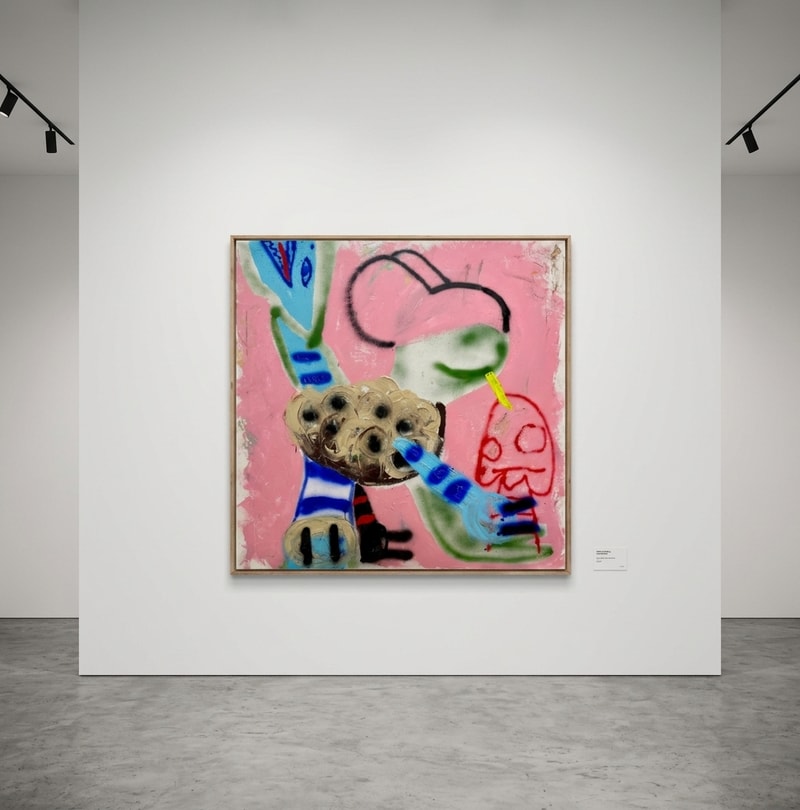
The Subconscious Made Visible
In a contemporary art market increasingly dominated by digital works, algorithmic aesthetics, and conceptual gestures that privilege idea over execution, there remains a hunger among serious collectors for painting that operates on primal terms — work that arrives from somewhere deeper than strategy, that carries the unmistakable charge of an artist working at the edge of what they understand about themselves. This is the territory Niall Campbell Strachan inhabits. The Scottish painter, born in 1986, has emerged as one of the most compelling voices in the next generation of Neo-Expressionist artists, creating work that channels the same raw gestural energy that defined Jean-Michel Basquiat's revolutionary output while forging a visual language entirely his own.
For collectors who have built holdings around Basquiat, Keith Haring, and the post-graffiti movement that transformed street art into fine art during the 1980s, Strachan represents something increasingly rare: an accessible entry point into an artist with genuine blue-chip trajectory. His paintings — executed in oil stick on canvas, spray paint, and acrylics across surfaces ranging from raw linen to reclaimed cardboard — demonstrate the same intuitive confidence and chromatic boldness that marked Basquiat's early canvases. But where Basquiat channeled the frenetic energy of downtown Manhattan, Strachan draws from a different well: the mythological imagination of his Scottish heritage, filtered through a contemporary sensibility that speaks to viewers across continents and cultures.
An Artist Between Worlds
Niall Campbell Strachan occupies an intriguing position in the contemporary landscape. He is young enough to be genuinely emerging — his market is still developing, his prices remain accessible relative to established figures in the Neo-Expressionist tradition — yet experienced enough to have built a coherent practice with international recognition. His work has appeared in major galleries across London, Miami, Shanghai, Madrid, Paris, and New York, and his paintings reside in notable private collections, including that of Jay-Z. This combination of critical validation and collector accessibility creates a particular kind of opportunity, the sort that experienced collectors recognize as the moment before the market catches on.
Born in Scotland, Strachan came of age artistically through the country's vibrant contemporary scene, with early formative exhibitions at the Royal Scottish Academy in Edinburgh and the Transmission Gallery in Glasgow. These institutions provided a foundation in rigorous practice, but Strachan's work has always operated somewhat outside the conceptual frameworks that dominate much British contemporary art. His commitment to painting as a medium — to the physical act of applying pigment to surface, to the encounter between brush and canvas — aligns him more closely with the figurative expressionism that has its roots in the American 1980s than with the more cerebral tendencies of the YBA generation.
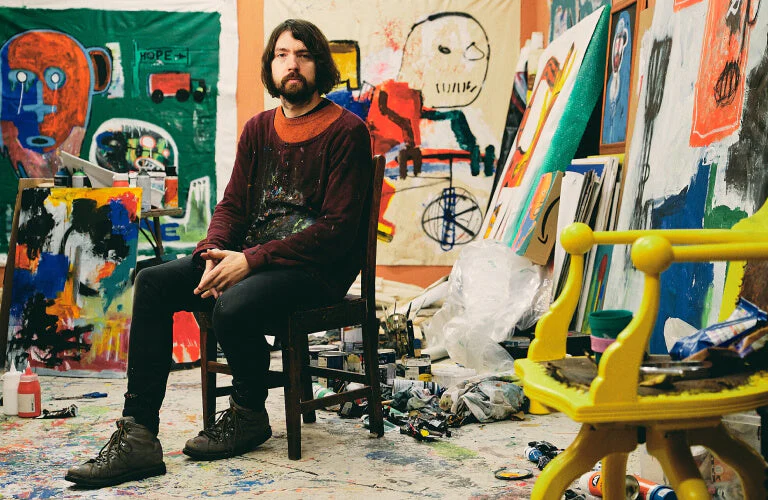
Niall Campbell Strachan
A significant moment in Strachan's early career came in 2018, when he featured in "Artists who make music/Musicians who make art" alongside Martin Creed and David Shrigley — two figures who have shaped contemporary British art while maintaining connections to performance and sound. This intersection of rhythm, visual form, and spontaneous creation continues to inform Strachan's practice. His paintings possess a musicality in their construction, a sense of improvisation within structure that recalls jazz composition as much as it does the action painting tradition.
The Creatures That Arrive Unbidden
At the center of Strachan's practice are his creatures — imagined beings that resist easy classification. They are animals, but not quite. They carry expressions of curiosity, melancholy, and what might be described as a low-grade bewilderment that feels distinctly human. These figures arrive, Strachan has suggested, fully formed from the subconscious, and they land on his canvases with a quiet authority that belies their fantastical origins. The artist paints what he sees rather than what he plans, allowing the work to dictate its own terms.
This method of working — intuitive, improvisational, trusting the hand to know what the conscious mind cannot articulate — places Strachan squarely within the tradition that runs from the Abstract Expressionists through Neo-Expressionism and into the present. Basquiat famously worked in bursts of intense activity, layering text, symbol, and figure in a process that seemed to bypass deliberation entirely. Strachan operates in a similar register, though his vocabulary is distinct. Where Basquiat assembled fragments of language, anatomy, and cultural reference into explosive compositions, Strachan builds worlds populated by beings that seem to have their own interior lives, their own mythologies.
The facial expressions of these unnamable animals, while rendered with apparent simplicity, reveal themselves on extended viewing as remarkably complex. They portray emotional beings stumbling through existence much like their human counterparts, dressed in tribally ornate abstraction that suggests ritual significance without ever explaining itself. This quality of mystery — of meaning that remains partially obscured even as it communicates powerfully on an emotional level — is one of the markers of significant painting. The work invites return visits; it rewards sustained attention.
Materials and Method
Strachan's technical approach demonstrates a sophisticated understanding of how materials communicate. Working with cardboard, spray paint, acrylics, oil stick, and wood, he builds surfaces that carry texture and history. The choice of oil stick is particularly significant — this was Basquiat's signature medium, allowing for drawing and painting simultaneously, creating marks that are at once linear and painterly. In Strachan's hands, the oil stick produces the same quality of urgent inscription, lines that seem to emerge from necessity rather than planning.
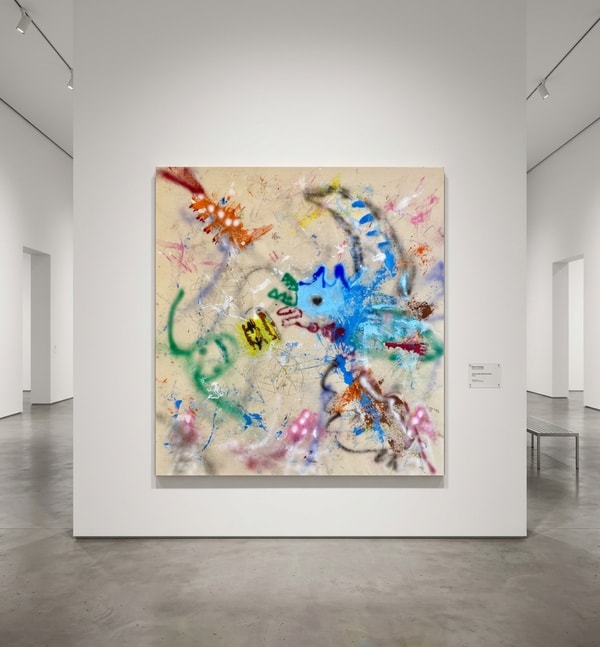
Niall Campbell Strachan, Garden Battle, 2026. Available at Guy Hepner, New York.
The spray paint brings an urban contemporary edge that connects his work to the street art tradition without reducing it to that category. Unlike artists who apply street aesthetics superficially, Strachan integrates spray paint into his layered surfaces organically, using it for atmospheric effects and chromatic intensity rather than as a signifier of subcultural authenticity. The result is work that acknowledges its debts to the post-graffiti movement while maintaining its independence from that lineage.
His use of raw canvas and unprimed surfaces creates another layer of meaning. These materials carry their own presence — the weave of the fabric, the tooth of the cardboard — and Strachan allows them to participate in the final image rather than covering them entirely. This dialogue between ground and mark is central to modernist painting, from the stained canvases of Helen Frankenthaler to the exposed supports of contemporary abstraction. Strachan's integration of this formal concern with his figurative subjects creates a productive tension, images that are simultaneously about something and about painting itself.
Color as Emotional Architecture
Strachan's approach to color deserves particular attention. His palette operates with what critics have described as emotive intensity — luminous contrasts meeting deep shadows to create an almost cinematic atmosphere. There is nothing tentative about his chromatic choices; reds blaze against electric blues, yellows push forward from grounds of deep green and earth tones. This boldness recalls the Fauvist tradition as much as it does Neo-Expressionism, suggesting an artist who understands color as a form of communication independent of descriptive function.
Through sophisticated layering, Strachan allows underlying tones to bleed through his surfaces, imbuing the paintings with a sense of memory and transience. The viewer encounters not just the final image but traces of the painting's own history — earlier decisions, buried marks, chromatic underpainting that surfaces unexpectedly. This temporal dimension gives the work a sense of depth that goes beyond spatial illusion; these are paintings that contain their own pasts.
Each hue functions as what might be called a metaphorical tool, chosen to direct the viewer's psychological experience of the work. Strachan has spoken of wanting to create emotional landscapes rather than static subjects, and his color functions as the primary vehicle for this ambition. Standing before one of his larger canvases, the viewer finds themselves surrounded by color that operates on them before conscious interpretation begins.
The Basquiat Parallel
To speak of Strachan in relation to Basquiat is not to diminish his originality but to locate him within a tradition that has proven its lasting significance. When Basquiat emerged in the early 1980s, he represented something unprecedented — an artist who brought the raw energy of downtown New York, the visual vocabulary of graffiti, and a self-taught intensity to the rarified spaces of the gallery world. The street art meets fine art crossover he embodied fundamentally altered what was possible in contemporary painting.
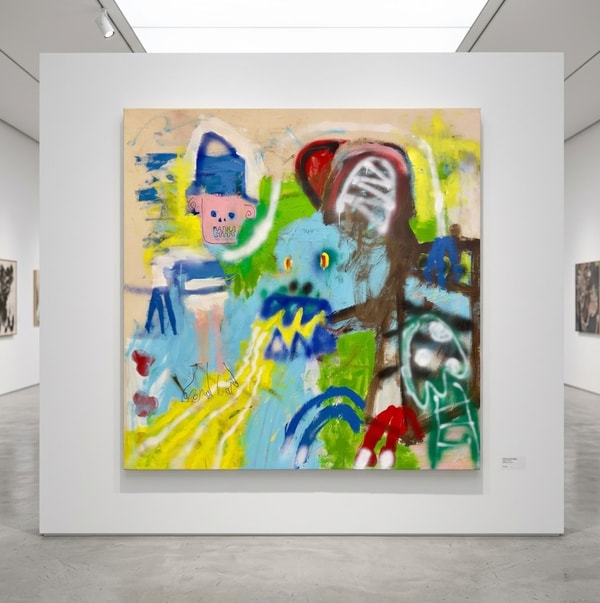
Niall Campbell Strachan, Good Boy, 2026. Available at Guy Hepner, New York.
Strachan operates in the space Basquiat opened while bringing his own concerns and imagery. Both artists share a commitment to raw gestural marks as carriers of meaning, to surfaces that register the speed and urgency of their making. Both employ what might be called primal energy — a quality that communicates through the body before it reaches the intellect. And both demonstrate how figurative expressionism can convey emotional truth through deliberate distortion, using the conventions of representation not to describe the visible world but to make interior states visible.
The parallel extends to their market trajectories as well. Basquiat's work was available at modest prices during his lifetime — collectors who recognized his significance early acquired major paintings for figures that seem impossible today. The artists who follow in his tradition offer similar possibilities for collectors with the knowledge to identify quality before broader recognition drives prices upward. Strachan's current accessibility represents this kind of opportunity, a chance to acquire significant work at an accessible price point that may not remain available as his market develops.
Critical Reception and Institutional Presence
Strachan's work has attracted serious attention from curators and critics who recognize its position within the broader Neo-Expressionist tradition while acknowledging its distinctive qualities. His exhibitions have moved from regional Scottish venues to major international platforms — solo shows at galleries in Shanghai, Madrid, Paris, and across the United States have established him as an artist of genuinely global reach.
The Shanghai exhibition "Symbiosis" and the Madrid show "I know you are but what am I?" demonstrated Strachan's ability to communicate across cultural contexts. His imagery, rooted in the subconscious and expressed through universal visual languages of color, gesture, and figure, translates without requiring explanation. This quality of accessibility combined with depth — work that welcomes viewers immediately while rewarding sustained engagement — distinguishes commercial success from lasting significance in contemporary painting.
The presence of Strachan's work in notable collections, including those of major cultural figures, suggests that discerning eyes have already identified his potential. These early collectors, whether guided by advisors or their own connoisseurship, have positioned themselves to benefit from his continued rise. For collectors entering his market now, the opportunity remains to join this group before broader recognition makes acquisition more competitive and expensive.
The Current Market Landscape
Strachan's market sits at an interesting inflection point. He has achieved sufficient recognition to establish authenticity and quality — his work appears in serious galleries, notable collections, and international exhibitions. At the same time, his prices remain accessible relative to established figures in the Neo-Expressionist tradition. This combination creates what might be called a collector sweet spot: verified quality at emerging-market prices.
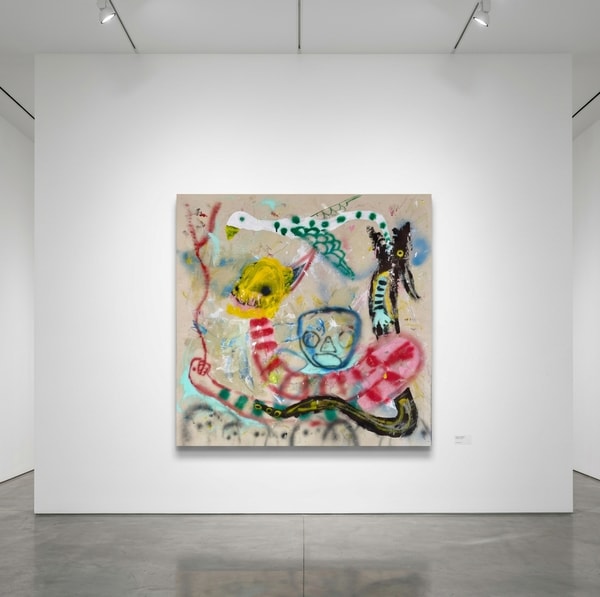
Niall Campbell Strachan, Head Carrier, 2026. Available at Guy Hepner, New York.
For collectors who have built holdings around Basquiat, Haring, and the 1980s generation, Strachan offers a way to extend that sensibility into contemporary practice. His work hangs comfortably alongside these predecessors while asserting its own identity. This quality of dialogue with tradition while maintaining independence marks artists who contribute to movements rather than merely imitating them.
The trajectory of Neo-Expressionist pricing over recent decades demonstrates the category's enduring collector appeal. Basquiat's market has grown exponentially, with major works regularly achieving eight-figure results at auction. Even secondary figures from the movement command prices that would have seemed impossible during their lifetimes. This pattern suggests that serious engagement with the Neo-Expressionist tradition retains cultural and commercial significance, and that emerging artists working within this lineage benefit from the established collector base the movement has developed.
Why Now
Several factors converge to make this a particularly opportune moment for Strachan collecting. His practice has matured sufficiently to demonstrate consistent quality and clear artistic vision — the work being produced now represents the current pinnacle of his technical and conceptual evolution. At the same time, his market has not yet experienced the sharp appreciation that typically follows institutional recognition and blue-chip gallery representation.
The broader art market context also favors his work. After years of conceptual and digital dominance, there is renewed appetite among collectors for painting that demonstrates genuine commitment to the medium. Strachan's work satisfies this desire while engaging contemporary concerns and sensibilities. He is neither nostalgically returning to historical modes nor abandoning painting's particular strengths in pursuit of fashion.
For collectors who love Basquiat but want to get in early on the next wave of Neo-Expressionist talent, Strachan represents exactly this opportunity. His visual language operates within the tradition that Basquiat helped establish while developing its possibilities in new directions. His prices allow for acquisition without the substantial capital required for historical work. And his age and productivity suggest decades of continued development and market appreciation ahead.
Available Works at Guy Hepner
Guy Hepner represents Niall Campbell Strachan and presents his work to collectors seeking contemporary painting with genuine quality. The gallery's New York space at 529 West 20th Street offers opportunities to experience Strachan's work firsthand, allowing collectors to assess the physical presence and material qualities that distinguish his paintings.
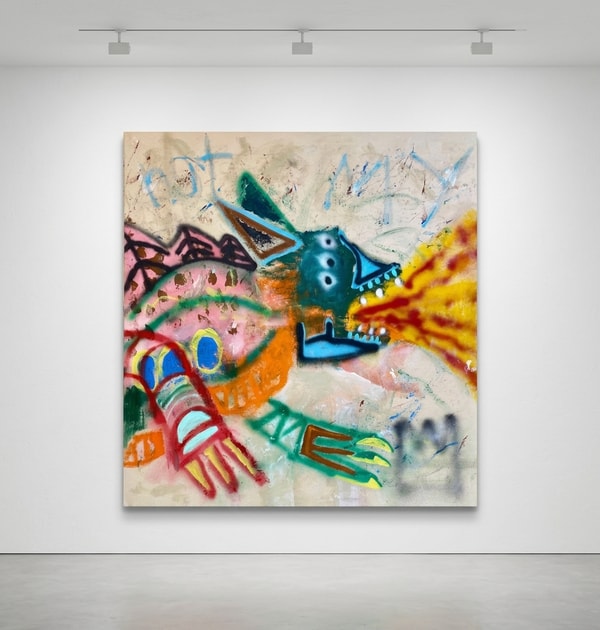
Niall Campbell Strachan, History Painting, 2026. Available at Guy Hepner, New York.
Current holdings include major paintings that demonstrate Strachan's signature approach — the imagined creatures, the bold chromatic relationships, the surfaces built from oil stick, spray paint, and acrylic. These works range in scale from intimate pieces suited to residential contexts to larger canvases that command gallery and institutional settings. Each represents a genuine opportunity to acquire significant contemporary painting at a price point that reflects the artist's emerging status while anticipating his continued rise.
The gallery's expertise in post-war and contemporary art positions it to advise collectors on building holdings that include both historical figures and contemporary artists with genuine potential. For those already collecting Basquiat, Haring, Warhol, and established contemporary figures like Eric Stefanski and Johan Deckmann, Strachan offers a natural extension — an artist working within a shared tradition while developing it in new directions.
A Closing Thought
Collecting contemporary art involves a particular kind of faith: faith that the artists one identifies early will prove significant, that their work will endure as cultural values shift and markets evolve. This faith is informed by knowledge — of art history, of what distinguishes genuine achievement from momentary fashion, of how artists develop over careers. But it also requires a willingness to act on conviction, to acquire work before broader recognition makes the case obvious.
Niall Campbell Strachan represents an opportunity for this kind of informed conviction. His work demonstrates the raw gestural energy, chromatic boldness, and figurative invention that have defined significant Neo-Expressionist painting since the movement's emergence. His practice has achieved international recognition while his prices remain at an accessible level. And his age suggests decades of continued development and market appreciation ahead.
For collectors ready to expand their engagement with contemporary painting in the Neo-Expressionist tradition, Guy Hepner invites inquiry about available works by Niall Campbell Strachan. Contact the New York gallery at 529 West 20th Street to discuss current holdings and arrange a private viewing.