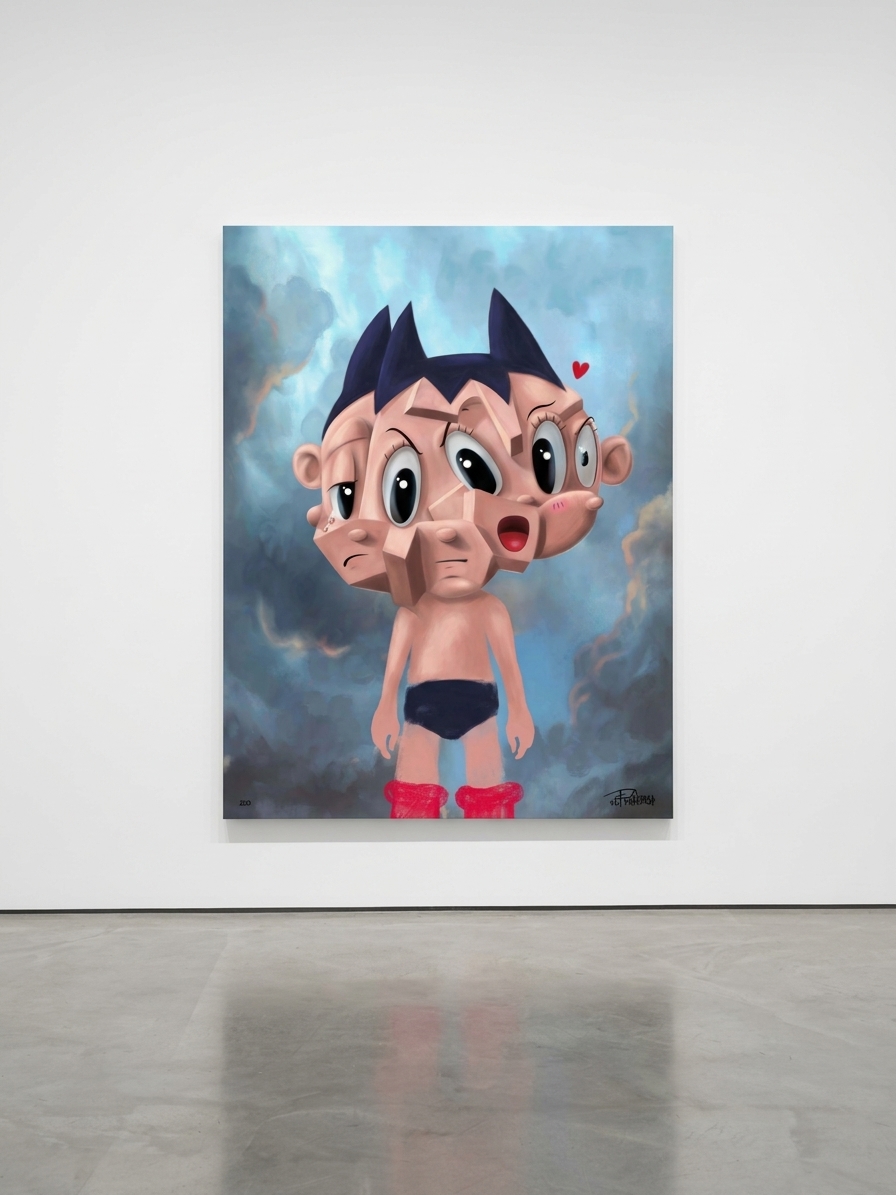
Fragmented Cubism

September 18, 2026
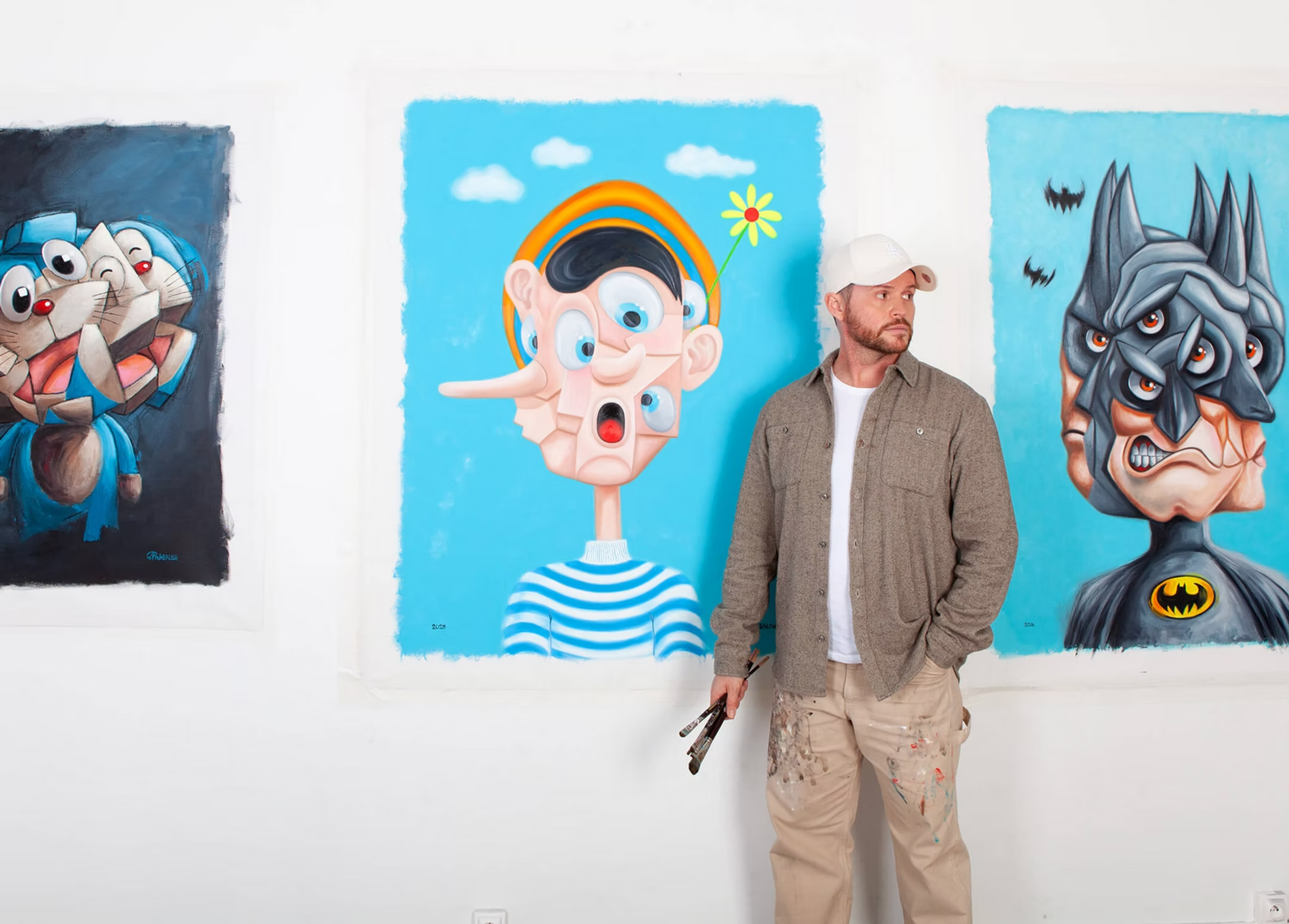
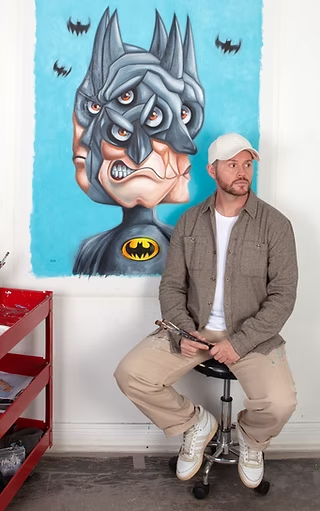
In an era when digital avatars have become extensions of identity and childhood cartoons are mined for billion-dollar franchises, one artist has found a way to interrogate what these familiar figures actually mean to us. Mr Pinkbrush artist Fabian Frohly has developed an entirely new visual vocabulary—what he calls Fragmented Cubism—to explore how iconic characters function as psychological mirrors, reflecting not corporate branding but the fractured, layered nature of contemporary selfhood. Working from his studio on the Côte d'Azur, a region forever marked by Picasso's own cubist experiments in Antibes and Vallauris, Frohly has built an international reputation that bridges the worlds of street art spontaneity and fine art refinement, earning him collaborations with Warner Bros. Entertainment and DC Comics while placing his work in collections alongside modern masters.
The art world has long struggled with how to position artists who engage with cartoon imagery. Too often, such work is dismissed as kitsch or relegated to the margins of illustration. Yet the past two decades have witnessed a fundamental shift in how we understand the relationship between high culture and popular iconography. Artists from KAWS to Takashi Murakami have demonstrated that childhood visual language carries profound psychological weight. Mr Pinkbrush extends this conversation in a distinctly European direction, grounding his practice not in the flat surfaces of Pop Art but in the spatial complexity and philosophical depth of cubist tradition. His paintings ask us to consider what happens when we fragment not just form and perspective, but identity itself.
Fabian Frohly's journey to becoming Mr Pinkbrush began in Switzerland, where his early artistic development was shaped by drawing, painting, and an immersion in comics and graffiti culture. These seemingly disparate influences—the disciplined tradition of Swiss design, the anarchic energy of street art, the narrative possibilities of sequential illustration—would eventually synthesize into his mature practice. His formal training culminated in a Master of Fine Arts from Basel, one of Europe's most important art centers and home to Art Basel, the fair that has done more than any other to shape the contemporary art market.
A formative moment in Frohly's artistic consciousness came in 2001, when he met Ernst Beyeler in Riehen. Beyeler, the legendary Swiss art dealer who co-founded Art Basel and established the Fondation Beyeler, represented a direct link to the giants of modern art. As a young man working in Beyeler's garden, Frohly encountered someone who had known and worked with Picasso, Giacometti, and virtually every major figure of twentieth-century art. This personal connection to the lineage of modernism would prove crucial to Frohly's later development, as he sought to position his own work not as a break from art history but as a continuation of its central concerns.
The choice of pseudonym itself carries significance. "Mr Pinkbrush" suggests both the tools of the painter's trade and a kind of playful persona, a character who mediates between the artist and his audience. This performative dimension aligns with a broader tendency in contemporary art toward the construction of artistic identities—think of Banksy's anonymity or KAWS's character-driven brand. Yet unlike artists who hide entirely behind their alter egos, Frohly maintains a visible presence, allowing collectors and critics to understand both the man and the myth.
The term "Fragmented Cubism" describes more than a style; it constitutes a theoretical framework for understanding how identity functions in the contemporary world. Classical Cubism, as developed by Picasso and Braque in the early twentieth century, fragmented perspective and space, showing multiple viewpoints simultaneously to reveal the underlying structure of reality. Frohly's innovation is to apply this logic not to external objects but to psychological states. His figures contain multiple faces, shifting expressions, and overlapping emotional registers, all existing within the same pictorial space.
"Unlike classical Cubism, which fragmented perspective and space, Fragmented Cubism focuses on the fragmentation of identity," Frohly has explained in his artist statement. "It reflects a condition that has become increasingly present in contemporary life—where the self is shaped across different roles, contexts, and projections, both physical and digital." This observation resonates deeply in an age of social media personas, professional networking profiles, and the constant performance of selfhood across multiple platforms. We are all, in some sense, fragmented beings, presenting different faces to different audiences while struggling to maintain some coherent sense of who we actually are.
The choice to work with recognizable cartoon characters serves a specific conceptual purpose. These figures—Mickey Mouse, Batman, Pikachu, and others—function as what Frohly calls "vessels" or "containers of collective memory." They are not subjects in the traditional sense but screens onto which psychological content can be projected. Because viewers already have an emotional relationship with these characters, the paintings achieve an immediate connection that more abstract work might struggle to establish. The fragmentation then operates on this familiar material, revealing hidden depths within figures we thought we knew completely.
The painting process itself embodies the tension between control and dissolution. Frohly works in oil on canvas, building controlled, layered surfaces that interact with areas left deliberately open and unresolved. This technical approach mirrors the conceptual content: precision and construction coexist with instability, just as our sense of self involves both carefully constructed narratives and uncontrollable psychological currents. The result is work that rewards extended viewing, as the eye moves between areas of refined detail and passages of raw, almost gestural energy.
Mr Pinkbrush paintings occupy a unique position within the broader category of pop art, distinguished by their depth of psychological inquiry. Where Warhol's Marilyns addressed fame, reproduction, and the mechanisms of celebrity, Frohly's cartoon figures investigate something more intimate: the role these images play in our inner lives. The characters he paints are not simply cultural commodities but genuinely formative presences in the psyches of multiple generations. To grow up in the late twentieth or early twenty-first century was to have one's imagination populated by these figures, to learn emotional responses and social behaviors partly through their mediation.
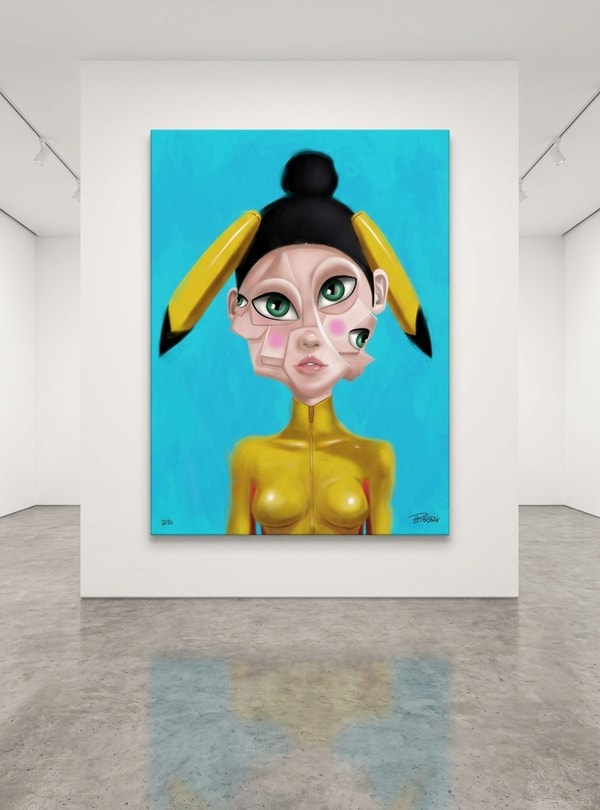
Mr Pinkbrush, Pika Girl, Oil on Canvas. Available at Guy Hepner, New York.
This gives Frohly's work a quality of excavation, as if he were conducting archaeology on the contemporary unconscious. A painting of Batman, for instance, is not simply a representation of a popular superhero but an investigation into what Batman means—the fantasies of justice and power he embodies, the darkness and vulnerability he conceals, the way his iconic status has accumulated layers of meaning across decades of reinvention. By fragmenting such a figure, Frohly makes visible the multiplicity that was always present but typically goes unexamined.
The artist's engagement with DC Comics iconography reached a significant milestone with his official collaboration with Warner Bros. Entertainment. This licensing arrangement, which resulted in a curated series of limited-edition artworks, represents an unusual bridge between corporate intellectual property and fine art practice. While many artists work with appropriated imagery, operating in legal gray zones or claiming fair use, Frohly's collaboration places his work within an officially sanctioned framework. This positions his DC Comics art not as critique or commentary from outside but as a legitimate extension of these characters' visual histories.
The Mr Pinkbrush DC Comics series demonstrates how familiar figures can be transformed without being diminished. Batman, Superman, and other heroes appear not as they do in comics or films but as psychological studies, their iconic features fragmented and recombined to suggest inner complexity. These are not action heroes frozen in heroic poses but beings wrestling with the same questions of identity that afflict us all. The collaboration affirms that even the most commercialized imagery can serve as material for genuine artistic exploration.
The trajectory of Mr Pinkbrush art within the contemporary market reflects broader trends in how collectors approach work that engages with popular culture. Once dismissed as peripheral to serious collecting, such work has moved decisively toward the center of contemporary art discourse. The inclusion of Frohly's work in significant private collections signals this shift. Carlos Slim, the Mexican entrepreneur and founder of Museo Soumaya, has acquired work by Mr Pinkbrush, placing it alongside his renowned collection of European masters. Similarly, the Doetsch Grether family collection in Basel—one of the most important private art holdings in the world—includes Frohly's paintings.
These placements matter not simply as markers of prestige but as indicators of how the work is understood. When a collector of Slim's sophistication acquires a Mr Pinkbrush painting, it suggests that the work is being evaluated on the same criteria applied to any serious contemporary art: conceptual rigor, technical achievement, and historical significance. The cartoon subject matter is not a disqualification but rather the specific territory through which the artist pursues enduring questions about representation and identity.
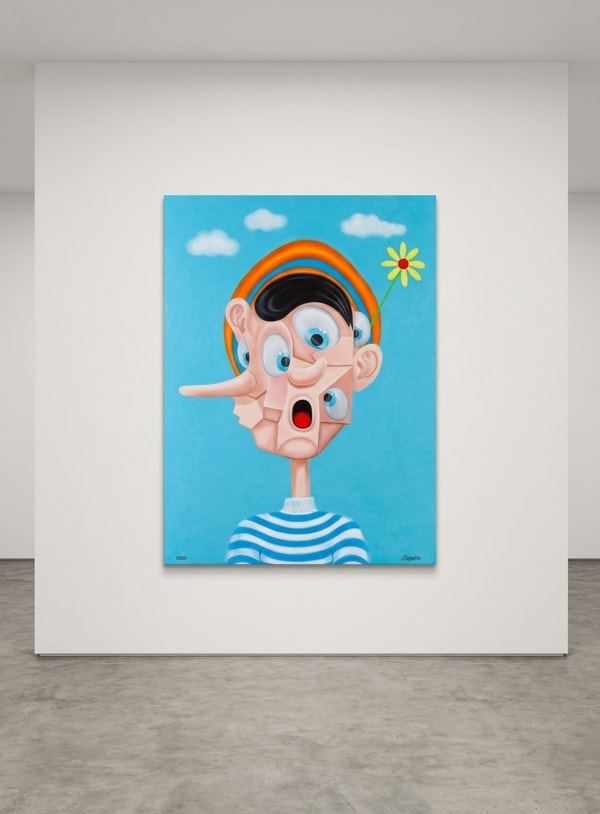
Mr Pinkbrush, Pinocchio, Oil on Canvas. Available at Guy Hepner, New York.
The gallery representation further confirms this market position. Guy Hepner in New York and London, Krause Gallery in New York, Les Galeries Bartoux across Paris, Monaco, and Cannes, Markowicz Fine Art in Miami, and Corridor Contemporary in Tel Aviv constitute a network of respected venues that specialize in blue-chip contemporary art. This distribution ensures that collectors encounter Mr Pinkbrush's work in contexts that frame it appropriately—not as novelty or decoration but as substantial artistic achievement.
Fair presentations have included Art Basel Miami Beach and Palm Beach Modern + Contemporary, placing Frohly's work before the international collecting community that shapes market trends. Museum Ground in South Korea currently includes his painting "The Crew" in its contemporary program, marking an institutional validation that often precedes broader market recognition. For collectors considering where to buy Mr Pinkbrush paintings, these exhibition histories and collection placements provide important context for understanding the work's standing within the field.
Beyond conceptual ambition, Mr Pinkbrush paintings demonstrate genuine technical command. Frohly's training in the rigorous Swiss academic tradition manifests in his ability to control complex compositions while maintaining visual clarity. The paintings balance multiple competing demands: they must be immediately engaging through their recognizable imagery, yet they must also reward sustained attention through formal sophistication. They must feel spontaneous and energetic, in keeping with their graffiti and animation influences, yet they must also exhibit the craftsmanship expected of serious oil painting.
This balance is achieved through careful attention to surface and structure. Frohly's canvases typically feature areas of refined, almost classical rendering alongside passages of raw, sketch-like energy. The fragmented faces emerge from backgrounds that suggest both physical depth and psychological space. Color is deployed with precision, creating harmonies and tensions that guide the viewer's eye through the composition while establishing emotional tones. The influence of his engagement with both street art and academic painting produces surfaces that are neither slick nor crude but possess a distinctive quality of controlled intensity.
The scale of the work varies, allowing collectors to engage with Frohly's vision at different levels of commitment and display. Large-format paintings command significant wall space and make strong statements in contemporary interiors, functioning as focal points that organize entire rooms. Smaller works and the collectible trading cards released through his Warner Bros. collaboration offer entry points for emerging collectors while maintaining the essential qualities of his larger pieces. Fine art prints extend access further, making selected works available in carefully produced editions that preserve the visual presence of the originals.
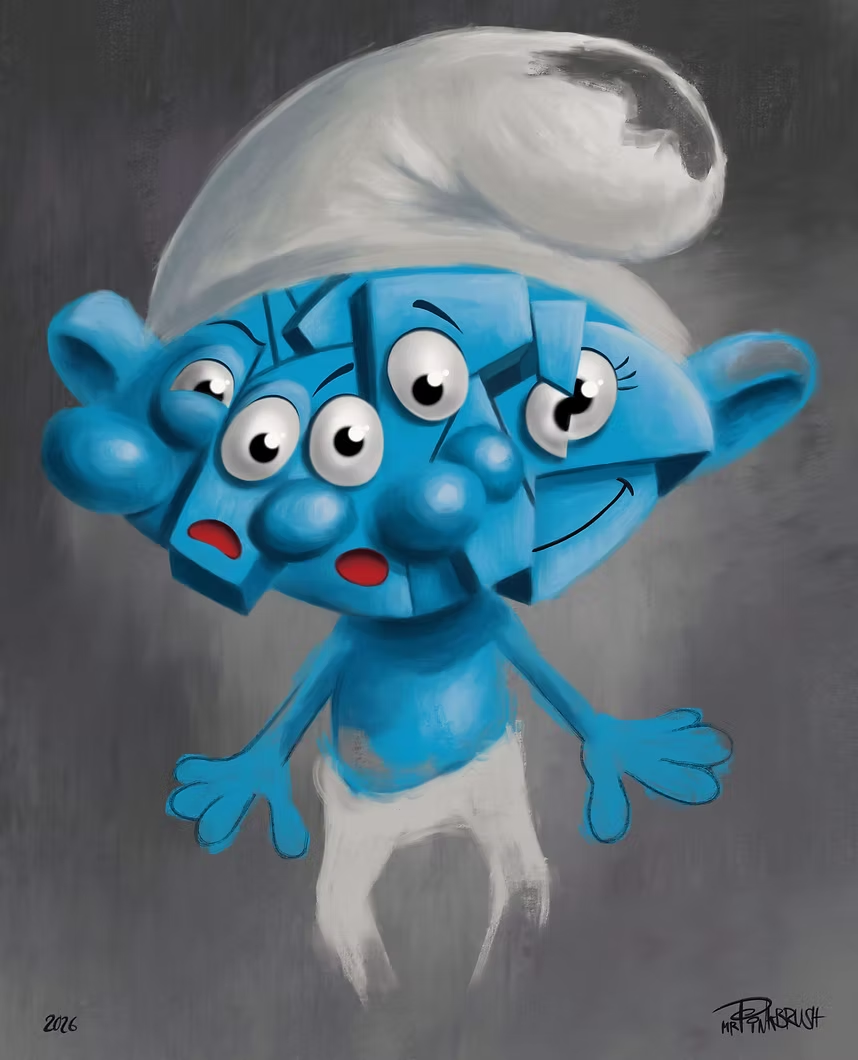
Mr Pinkbrush, Blue Dwarf, Oil on Canvas. Available at Guy Hepner, New York.
Fragmented Cubism emerges at a moment when questions of identity have become central to cultural discourse. The proliferation of digital platforms has made the construction and maintenance of multiple personas a daily experience for billions of people. We curate our images, perform our personalities, and navigate between professional and personal registers with a fluency that would have been unimaginable to previous generations. Frohly's work visualizes this condition, giving form to the experience of being multiple while remaining somehow singular.
The choice to develop this practice on the Côte d'Azur connects Frohly's work to a specific art historical lineage. This region witnessed some of Picasso's most important experiments, as he worked through the implications of Cubism in Antibes, Vallauris, and Mougins. By situating himself in this geography, Frohly positions his practice as a continuation of modernist inquiry rather than a postmodern break. He is not ironically quoting Cubism but genuinely extending its logic into new territory, applying its insights to the particular conditions of twenty-first-century experience.
Critical reception has emphasized the work's ability to bridge seemingly opposed categories. Mr Pinkbrush cartoon paintings are simultaneously accessible and intellectually serious, commercially viable and conceptually rigorous. This bridging function is itself culturally significant, as it refuses the distinction between high and low culture that organized much twentieth-century aesthetics. In treating Pikachu and Batman with the same formal attention that earlier generations of artists devoted to saints and goddesses, Frohly asserts the legitimacy of contemporary visual culture as subject matter for serious art.
The comparison to other artists working with cartoon imagery illuminates Frohly's distinctive contribution. Where KAWS tends toward a kind of melancholic beauty, emphasizing the pathos of abandoned childhood objects, Mr Pinkbrush is more psychologically complex, presenting characters as sites of ongoing internal conflict rather than nostalgic loss. Where Murakami's superflat aesthetic embraces surface and spectacle, Frohly insists on depth, both literally in his layered painting technique and conceptually in his focus on psychological interiority. These distinctions matter for collectors seeking to understand where the work fits within the broader landscape of contemporary figurative painting.
For those looking to acquire work by Mr Pinkbrush, several factors merit consideration. The artist's output spans multiple formats and price points, each offering different advantages:
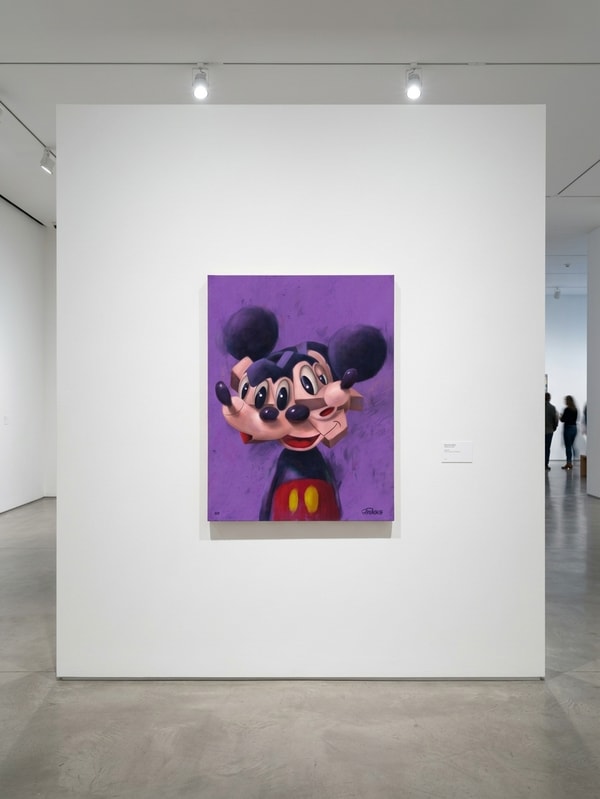
Mr Pinkbrush, The Icon, Oil on Canvas. Available at Guy Hepner, New York.
Authentication is supported by certificates provided through the artist's studio, an important consideration given the visual complexity of the work and the potential for confusion in secondary markets. Collectors should ensure that any acquisition includes proper documentation and provenance information.
The market for Mr Pinkbrush continues to develop as the artist's profile rises through major collaborations and institutional presentations. For collectors who appreciate work at the intersection of pop culture and fine art tradition, who respond to imagery that is both immediately engaging and conceptually substantive, Frohly's paintings offer a distinctive proposition. The placement of his work in major collections suggests that sophisticated collectors recognize its quality, while the ongoing gallery and fair presentations ensure continued visibility and market activity.
Understanding an artist's working process often illuminates the meaning of finished works. Frohly's studio on the Côte d'Azur serves as the laboratory where Fragmented Cubism is developed and refined. The choice of location, as noted, connects him to modernist history, but it also provides a working environment removed from the art world centers where market pressures can distort creative decision-making. This geographic distance allows for focused development of his visual language without the constant noise of trends and fashions.
The paintings emerge through a process of construction and revision, building up surfaces through multiple layers while maintaining openness to spontaneous interventions. Frohly has described the tension between controlled, layered oil surfaces and areas that remain open and unresolved as reflecting the internal structure of the figures themselves—composed yet unstable, carefully constructed yet perpetually in flux. This technical approach ensures that each painting contains genuine formal complexity rather than simply illustrating a concept.
Drawings play an important role in the studio practice, functioning as both preparatory studies and independent works. These works on paper reveal the underlying structure of Frohly's thinking, showing how he develops compositions and works through the fragmentation of forms. For collectors, drawings offer insight into the creative process while representing more accessible price points and different display possibilities than the major paintings.
The development of any artist's career involves uncertainty, but several factors suggest continued growth for Mr Pinkbrush's market and critical standing. The Warner Bros. and DC Comics collaboration demonstrates institutional validation from major corporate entities with sophisticated approaches to brand management and artistic quality. The placement of work in significant collections confirms recognition from experienced collectors with access to the full range of contemporary art. The gallery network ensures ongoing market activity and visibility across multiple international centers.
More fundamentally, the conceptual framework of Fragmented Cubism addresses conditions that show no sign of diminishing. The fragmentation of identity, the psychological weight of childhood imagery, the navigation of multiple personas across digital and physical spaces—these are not passing concerns but enduring features of contemporary experience. Art that engages meaningfully with such conditions tends to maintain relevance as the culture continues to grapple with their implications.
For collectors seeking work that bridges popular accessibility and intellectual substance, that combines formal achievement with conceptual depth, that positions itself within art historical tradition while addressing specifically contemporary conditions, Mr Pinkbrush offers a compelling proposition. The Swiss artist Fabian Frohly has created not just a body of work but a visual language capable of expressing truths about how we experience identity in an age of fragmentation.
Guy Hepner Gallery maintains one of the most significant selections of Mr Pinkbrush paintings available to collectors today. Located at 177 Tenth Avenue in New York's Chelsea gallery district, Guy Hepner has established itself as a leading venue for contemporary art that engages with popular culture while maintaining the highest standards of artistic quality. The gallery's expertise in this area ensures that collectors receive informed guidance on the work's position within Frohly's development, its relationship to other holdings, and its potential within a broader collection.
Whether you are building a collection focused on contemporary figurative painting, seeking work that bridges pop culture and fine art tradition, or simply responding to the immediate visual appeal of Frohly's imagery, the gallery's team can provide the context and assistance necessary for confident acquisition. The current inventory includes original paintings across a range of scales and subjects, offering collectors genuine choice in how they engage with this distinctive artistic vision.
To learn more about available works by Mr Pinkbrush or to schedule a private viewing at the gallery, contact Guy Hepner directly. In a market where the most significant works rarely remain available for long, early engagement ensures access to the strongest examples of this Swiss artist's increasingly sought-after practice.
Explore Mr Pinkbrush prints for sale at Guy Hepner: Fragmented Cubism.
Related Series