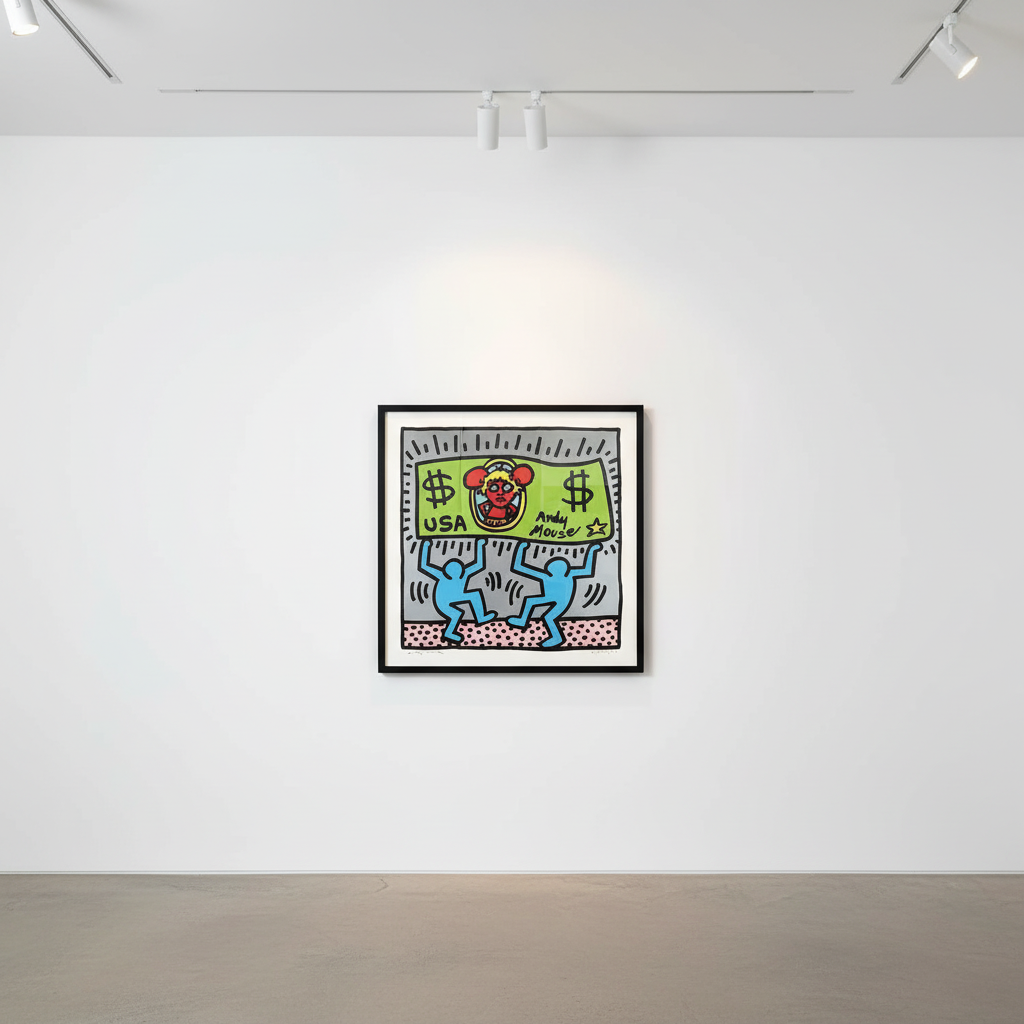
Andy Mouse

August 25, 2026
In 1986, Keith Haring did something audacious, reverent, and utterly brilliant: he fused Mickey Mouse, Andy Warhol, and the American dollar sign into a single hybrid creature called Andy Mouse. The result was not parody but homage—a love letter from a young street artist to his mentor, wrapped in the iconography of consumer culture that both men had spent their careers interrogating. What makes the Keith Haring Andy Mouse series even more extraordinary is what happened next: Warhol himself signed every single print alongside Haring, creating one of the only dual-signed portfolios in Pop Art history. With an edition size of just thirty, these works represent a vanishingly rare intersection of two generational talents at the height of their powers.
The Andy Mouse portfolio stands as perhaps the most personal and playful collaboration in twentieth-century printmaking. Here was Haring, the subway graffiti artist who had conquered SoHo and beyond, paying tribute to the silver-wigged godfather who had shown him that commerce and art need not be enemies. And here was Warhol, the perpetual observer, lending his signature to an image of himself rendered as a cartoon mouse—an act of self-aware humor that perfectly captured his understanding of celebrity as performance. For collectors today, these prints offer something impossible to replicate: the visual evidence of a friendship that shaped the trajectory of contemporary art.
The story of Keith Haring and Andy Warhol begins in the charged atmosphere of early 1980s New York, a moment when the boundaries between high art, street culture, and club life had dissolved entirely. Haring had emerged from the subway stations where he drew his iconic figures on blank advertising panels, his radiant babies and barking dogs becoming familiar to commuters long before they appeared in galleries. By the time he met Warhol at the Tony Shafrazi Gallery in 1984, Haring was already a phenomenon—but he remained, in his own words, in awe of the older artist who had redefined what art could be.
Warhol, for his part, recognized in Haring a kindred spirit. Both artists understood the power of repetition, the democratic potential of printed images, and the productive tension between artistic integrity and commercial success. Their friendship blossomed in the clubs and studios of Manhattan, with Haring becoming a regular at the Factory and Warhol appearing at the openings of Haring's Pop Shop, the retail space where the younger artist sold affordable merchandise bearing his designs. This was no ordinary mentorship but a genuine exchange between two artists who shared fundamental convictions about art's place in everyday life.
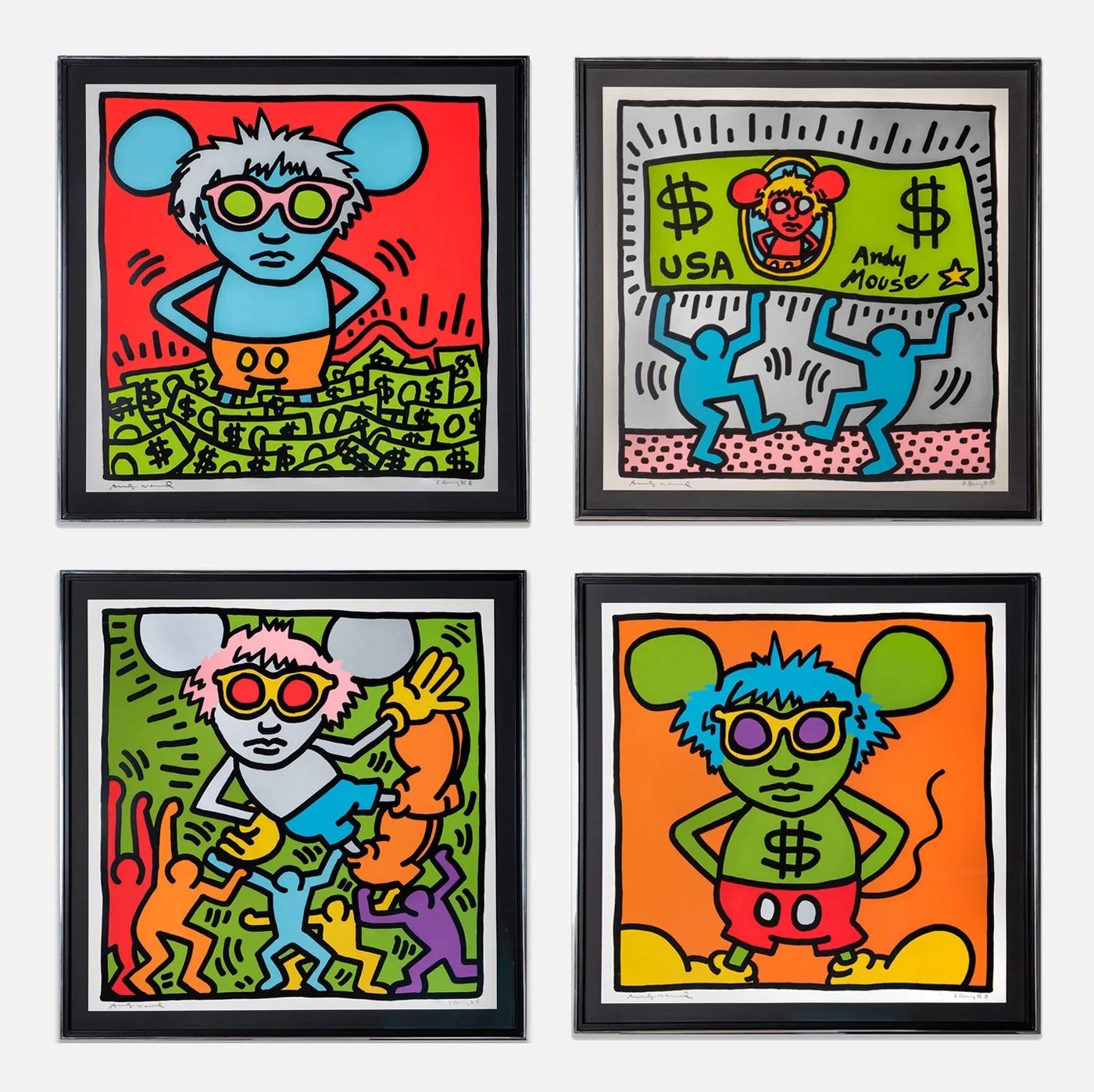
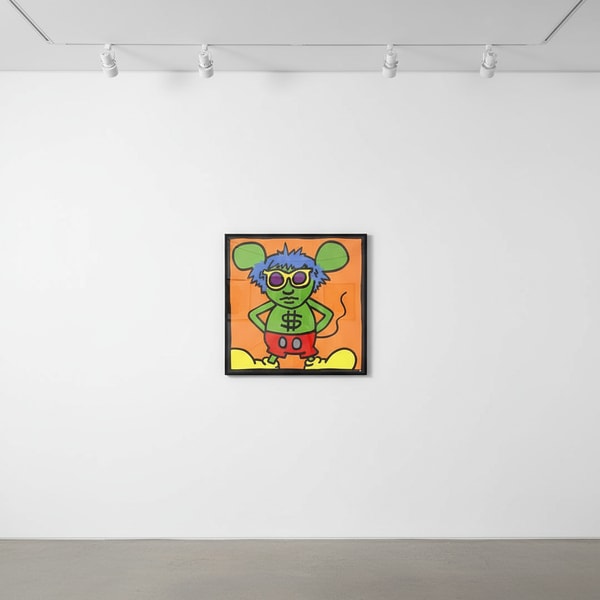
Keith Haring, complete portfolio of Andy Mouse, 1986, Four Silkscreen. Available at Guy Hepner, New York.
The idea for Andy Mouse emerged from this context of mutual admiration and shared sensibility. Haring wanted to create something that honored Warhol's legacy while also engaging with the visual language both artists had explored throughout their careers. Mickey Mouse was an obvious choice—Disney's creation had long fascinated Warhol, who saw in the cartoon character the ultimate symbol of American innocence commodified. By combining Mickey's silhouette with Warhol's distinctive features—the shock of white hair, the owlish glasses—Haring created a figure that was simultaneously critique and celebration, satire and sincere tribute.
Understanding the Keith Haring Andy Mouse portfolio requires grasping the symbolic weight of each element Haring chose to include. Mickey Mouse, by the 1980s, had transcended his origins as a cartoon character to become perhaps the most recognizable corporate logo on earth. His image represented not just Disney but American cultural imperialism itself, exported to every corner of the globe alongside Coca-Cola and blue jeans. For Haring, who had grown up consuming American pop culture in suburban Pennsylvania, Mickey was both beloved childhood memory and potent symbol of the commercial forces that shaped consciousness.
Andy Warhol had spent two decades exploring precisely these themes. His portraits of Marilyn Monroe, Elvis Presley, and Campbell's soup cans had interrogated the relationship between celebrity, consumption, and identity with a cool detachment that masked genuine insight. By the mid-1980s, Warhol himself had become a kind of cultural icon—his face as recognizable as those he had immortalized, his persona a carefully constructed performance that blurred the line between artist and artwork. Haring's genius was to recognize that Warhol had become exactly the kind of figure Warhol himself would have painted.
The addition of the dollar sign completed the trinity of American icons. Throughout Haring's work, the dollar sign appears as both celebration and critique of capitalism's omnipresence. In the Andy Mouse images, the currency symbol adorns the character's torso like a superhero emblem, transforming the figure into a kind of mascot for consumer culture. Yet there is no simple condemnation here. Both Haring and Warhol understood that art existed within the marketplace, not outside it, and that pretending otherwise was either naive or dishonest. The dollar sign acknowledges this reality while also gently mocking the idea that anything—art, celebrities, cartoon mice—could remain untouched by commercial forces.
The Andy Mouse portfolio consists of four silkscreen prints, each measuring approximately 38 by 38 inches, produced in an edition of thirty plus artist's proofs. The series was published in 1986, the same year Warhol was photographed wearing a Haring-designed T-shirt, the same year their friendship reached its most publicly visible peak. Each print features the Andy Mouse character in different color combinations, Haring's bold black outlines containing fields of vivid, pulsating color that seem to radiate energy from the picture plane.
Haring's visual language had always been defined by its accessibility and immediacy. His lines possess a confidence that comes from years of rapid execution—in the subway, a single drawing might take only minutes before transit police arrived to intervene. This urgency translated into a graphic style that sacrificed nothing in terms of visual impact. The Andy Mouse figures display the same qualities: bold, unbroken contours that contain forms rendered in pure, unmodulated color. There is nothing tentative about these images; they announce themselves with the directness of advertising while carrying far greater conceptual depth.
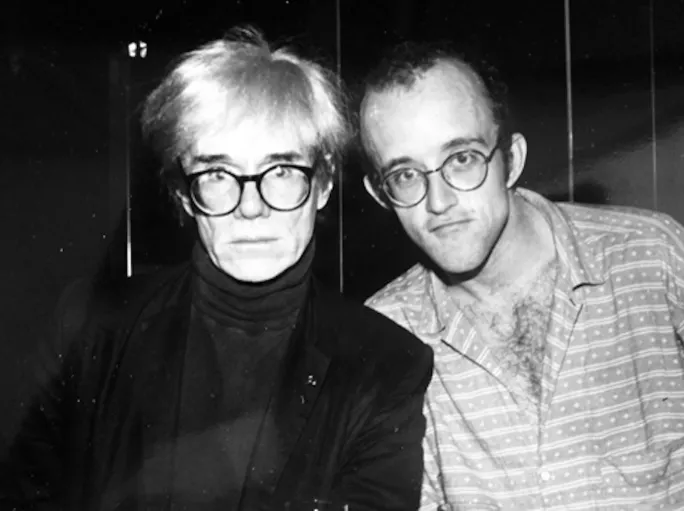
Andy Warhol and Keith Haring circa 1985. © 2021 The Keith Haring Foundation
The production of the portfolio involved the expertise of premier print workshops in New York, ensuring technical quality that matched the conceptual ambition. Silkscreen printing—the medium Warhol had made his own—allowed for the rich, saturated colors that give the Andy Mouse prints their visual punch. Each layer of ink was applied with precision, building up the final image through a process that mirrored the mechanical reproduction both artists had long embraced. The choice of silkscreen was itself a tribute: Haring was working in Warhol's preferred medium, using the language the older artist had developed to create an homage to the master himself.
What transforms the Andy Mouse portfolio from remarkable to genuinely historic is the presence of both artists' signatures on each print. This was not a formality or an afterthought but a deliberate statement about the collaborative nature of the work. Keith Haring Andy Warhol collaboration prints are exceedingly rare—the two artists worked together on few projects, and even fewer resulted in dual-signed editions. The Andy Mouse series represents one of the only instances where both signatures appear together, making these works unique documents of their friendship.
Warhol's willingness to sign the prints speaks volumes about his regard for Haring and his appreciation for the project's wit. Warhol was notoriously protective of his image and brand, yet here he allowed himself to be depicted as a cartoon character—ears and all—and endorsed the representation with his signature. This was an act of genuine affection and trust, an acknowledgment that Haring had captured something essential about Warhol's persona while remaining unmistakably within his own artistic vocabulary. The dual signatures transform each print into a kind of contract, a visual record of mutual respect between two artists who understood each other completely.
For collectors seeking Haring Warhol dual signed prints, the Andy Mouse portfolio represents the definitive opportunity. While the two artists appeared together in photographs, attended the same events, and influenced each other's work throughout the 1980s, the documentation of their friendship rarely took such permanent and collectible form. These prints are not simply artworks but artifacts of a cultural moment—evidence that two of the twentieth century's most influential artists found in each other kindred spirits and genuine friends.
The Andy Mouse series arrived at a moment when questions about art's relationship to commerce had reached a kind of fever pitch. The 1980s art boom had transformed the market, sending prices to unprecedented levels and turning artists into celebrities in their own right. Haring and Warhol stood at the center of these developments, their work eagerly collected by the same Wall Street traders who had fueled the decade's excess. Andy Mouse engages with this context directly, creating an image that is simultaneously about celebrity, commerce, and the American obsession with both.
Yet the series is never cynical. Haring genuinely admired Warhol, and that admiration infuses every element of the Andy Mouse character. The figure is playful rather than mocking, affectionate rather than critical. When Haring places the dollar sign on Andy Mouse's chest, he is not condemning Warhol's commercial success but acknowledging it as an integral part of his achievement. Warhol had proven that an artist could engage with the marketplace without sacrificing integrity, that popularity and profundity need not be mutually exclusive. Andy Mouse celebrates this lesson rather than questioning it.
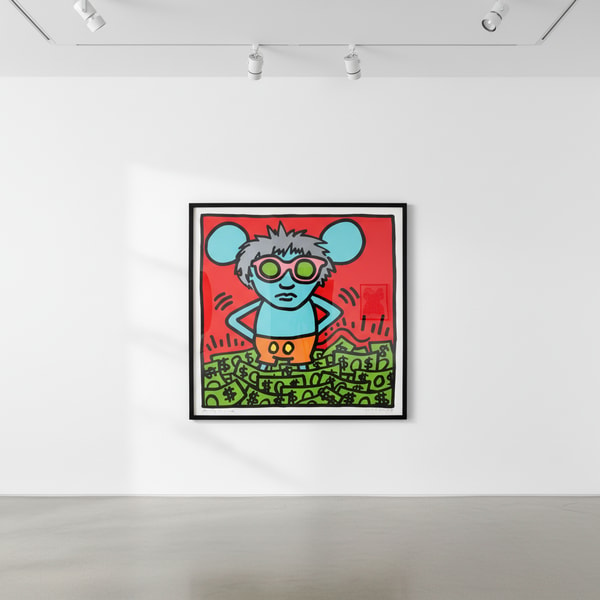
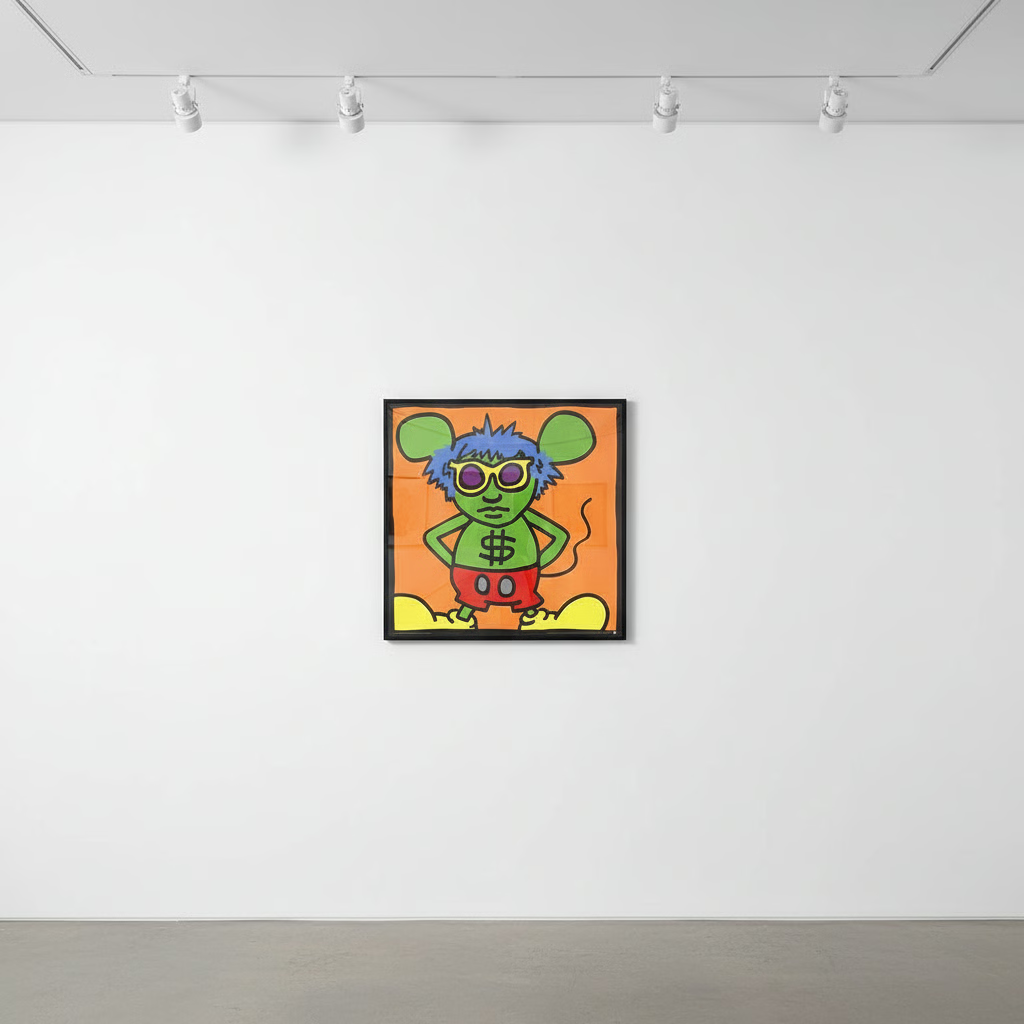
Keith Haring, Andy Mouse, 1986, Silkscreen. Available at Guy Hepner, New York.
The Keith Haring Mickey Mouse imagery in these prints also connects to a longer tradition of artists appropriating corporate symbols. From Claes Oldenburg's giant hamburgers to Jeff Koons's vacuum cleaners, Pop and post-Pop artists had long recognized that consumer products carried cultural meaning worth exploring. Haring's use of Mickey Mouse placed him within this lineage while adding his characteristic warmth and accessibility. Unlike some appropriation art, which maintains an ironic distance from its sources, Haring's work embraces popular culture with genuine enthusiasm. He loved Mickey Mouse just as he loved breakdancing and hip-hop and the energy of New York's streets.
Haring's artistic vocabulary developed in the subway stations of New York, where he would cover blank advertising panels with white chalk drawings executed in a matter of minutes. These works—seen by thousands of commuters daily—established the visual language that would define his entire career: bold outlines, active figures, radiant energy lines suggesting movement or aura. The Andy Mouse prints translate this vocabulary into the more permanent medium of silkscreen, preserving Haring's characteristic line quality while exploiting the full possibilities of color printing.
The colors in the Andy Mouse portfolio are deliberately synthetic, the kind of hues found in plastic toys and neon signs rather than in nature. Bright greens, electric blues, and vivid pinks dominate, creating a visual experience that recalls both the Pop Art palette and the fluorescent atmosphere of downtown clubs where Haring and his peers spent their nights. These are not colors designed to soothe but to energize, to capture attention with the same immediacy that advertising imagery demands. Haring understood that competing for visual attention in the modern environment required meeting commercial imagery on its own terms.
The compositional structure of each print places the Andy Mouse figure centrally, surrounded by the additional elements—dancing figures, radiating lines, barking dogs—that populate Haring's visual universe. This horror vacui, or fear of empty space, gives the images their characteristic energy, every inch of the picture plane activated with some form of visual incident. The effect is joyous rather than overwhelming, a celebration of abundance that mirrors the excess of 1980s consumer culture while transforming it into something genuinely life-affirming.
The Keith Haring Andy Mouse price reflects both the artistic significance of the series and its extreme rarity. With an edition size of just thirty impressions plus artist's proofs, these prints appear at auction infrequently, and when they do, they command substantial premiums over other Haring works from the same period. The dual signature adds considerable value, transforming each print from a single-artist edition into a collaborative document whose scarcity is unmatched in either artist's printed output.
Collectors seeking Keith Haring Andy Mouse for sale face a challenging market. The prints trade largely through private sales and established galleries rather than appearing regularly at public auction, meaning that patience and relationships with knowledgeable dealers become essential. When examples do surface, they tend to sell quickly, often to collectors who have been waiting years for the opportunity. The combination of two iconic artists, an impossibly small edition, and a subject that perfectly encapsulates the spirit of 1980s Pop Art creates demand that far outstrips supply.
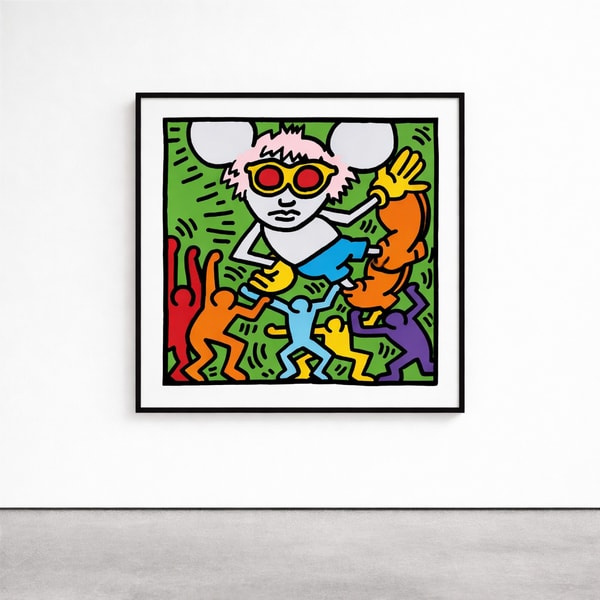
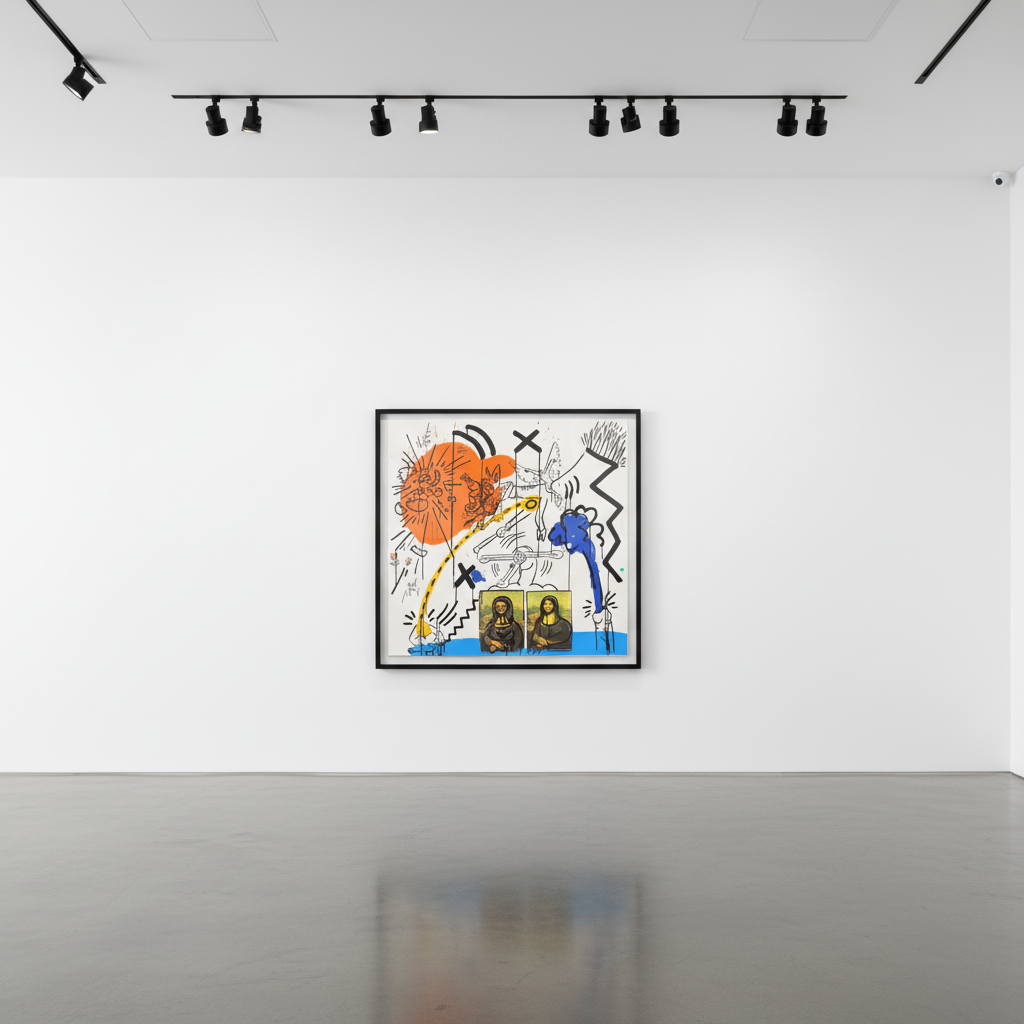
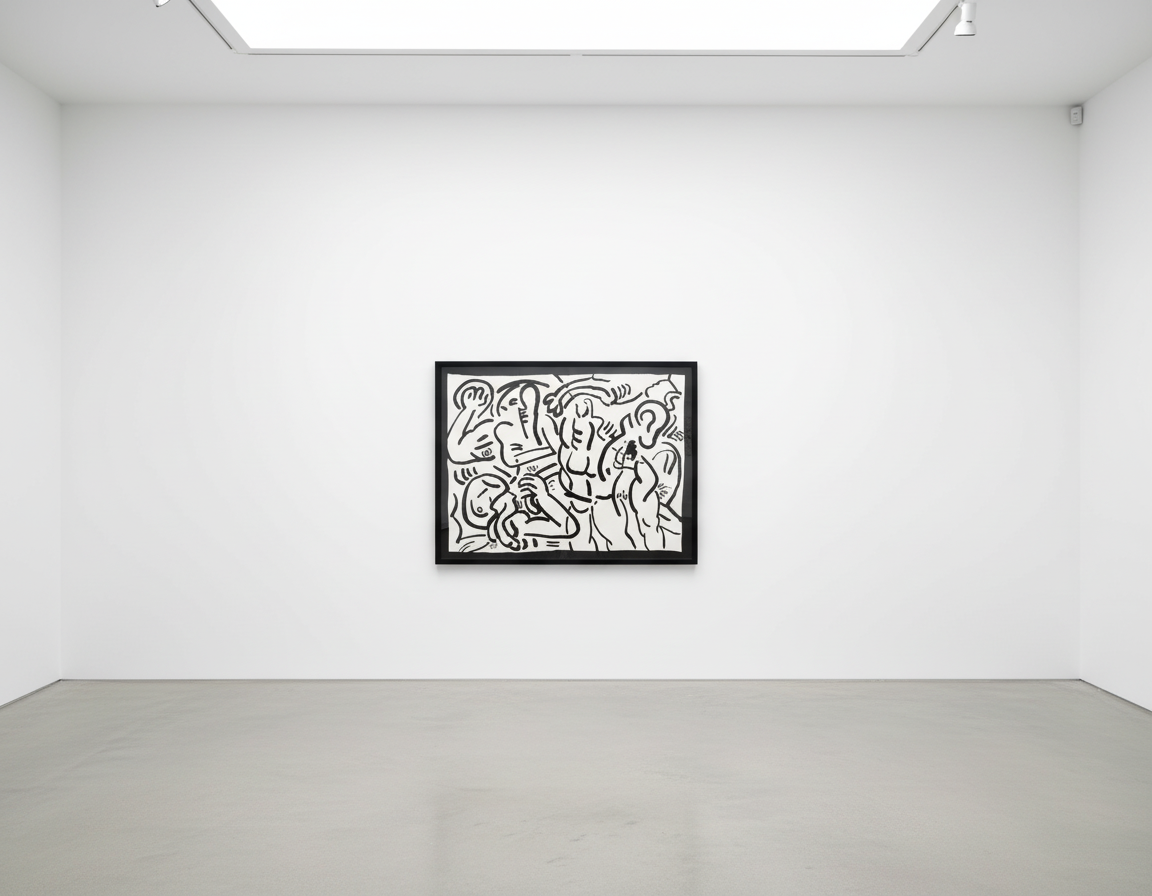
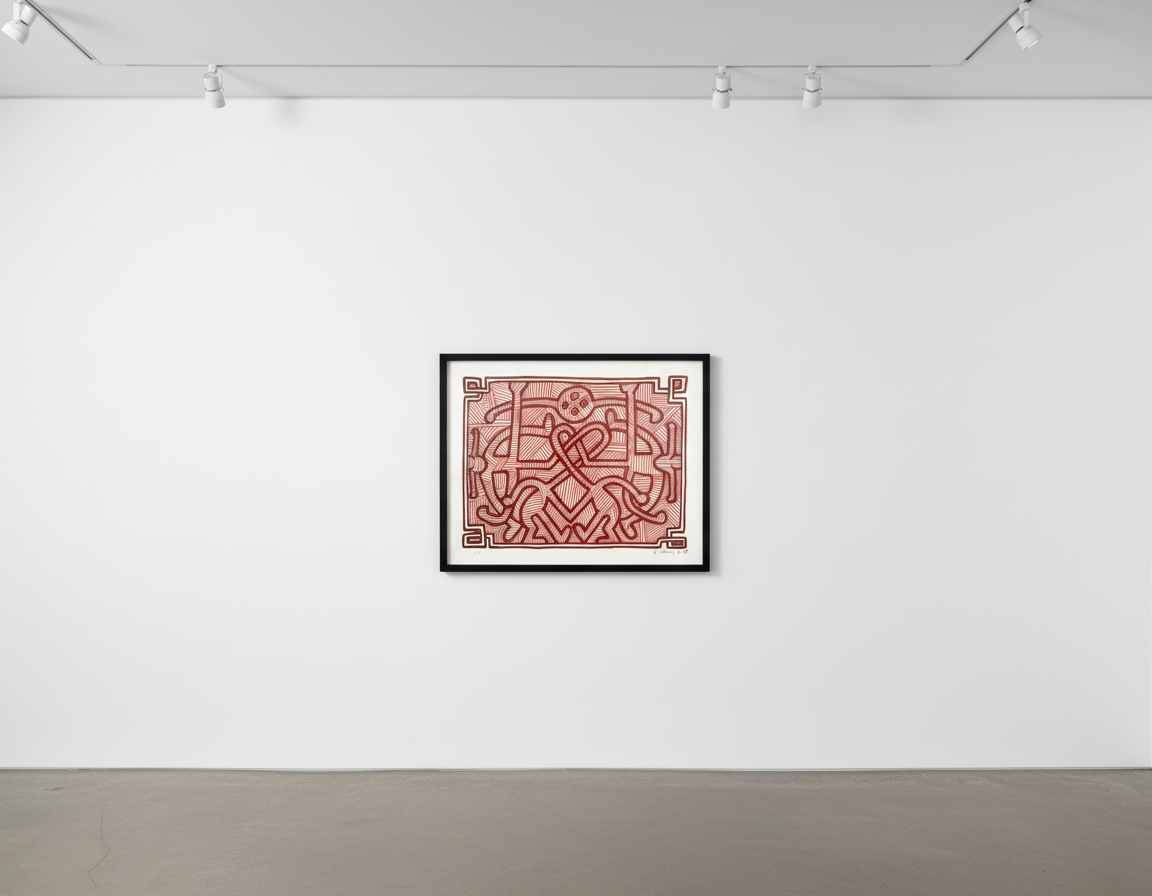
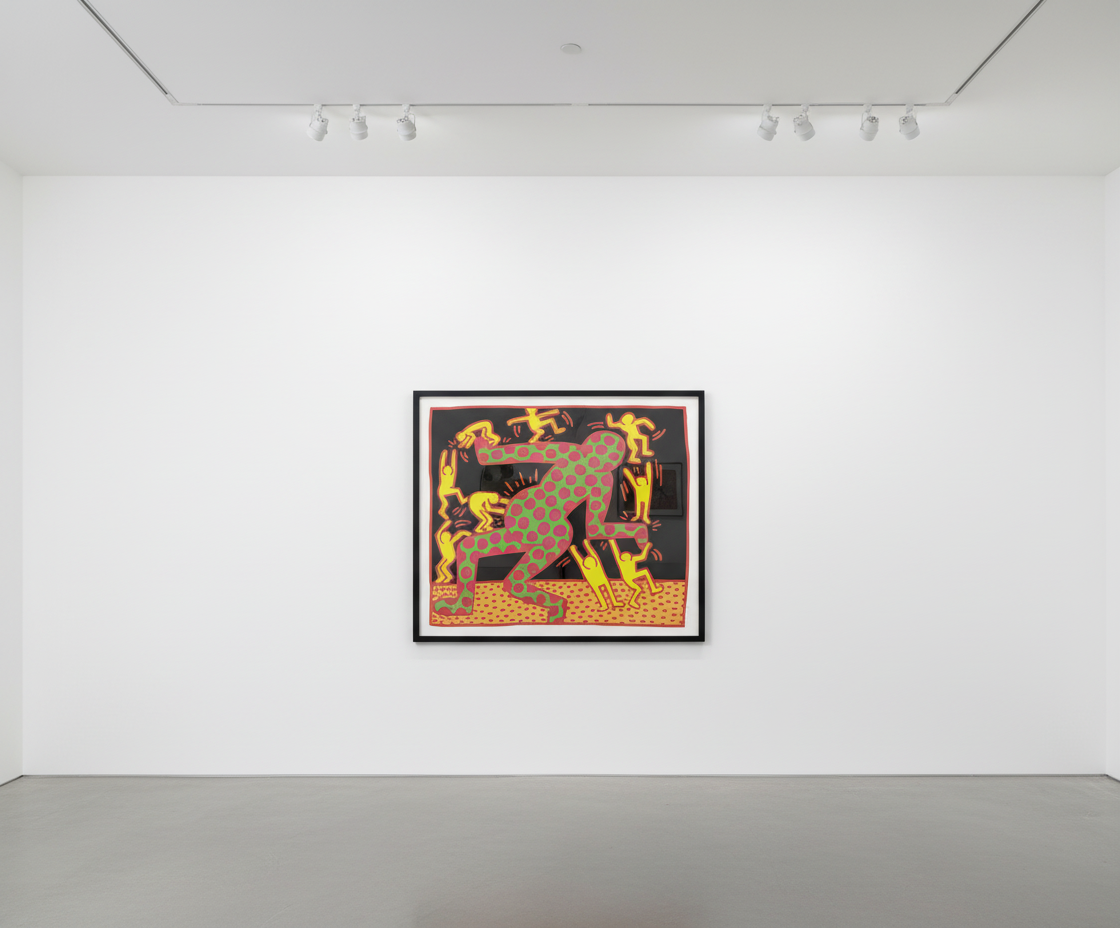
Keith Haring, Untitled, 1987, Acrylic and screenprint on canvas. Available at Guy Hepner, New York.
The investment case for the Andy Mouse portfolio rests on several factors. Both Haring and Warhol continue to appreciate in the secondary market, with major museum exhibitions and scholarly attention reinforcing their positions in the art historical canon. The dual-signed nature of these prints means they appeal to collectors of both artists, effectively doubling the potential buyer pool. And the cultural moment they capture—the friendship between two icons, the playful engagement with celebrity and commerce—resonates as strongly today as it did in 1986, ensuring continued interest from new generations of collectors.
When evaluating Keith Haring Andy Mouse prints for purchase, several factors determine value and desirability:
Authentication for Haring works is handled by the Keith Haring Foundation, which maintains records of the artist's output and provides certificates of authenticity for legitimate works. Given the value of the Andy Mouse prints, obtaining such documentation is essential before any significant purchase. The Foundation's archives include production records for the portfolio, allowing definitive confirmation of individual impressions.
Andy Warhol died in February 1987, less than a year after the Andy Mouse portfolio was completed. The series thus stands as one of the final artistic statements involving both men—a last collaboration before the friendship was cut short. Haring would continue working feverishly until his own death from AIDS-related complications in 1990, but the Andy Mouse character remained one of his most personal creations, a permanent record of the bond between mentor and protégé.
The series has influenced subsequent generations of artists who explore the intersection of high art and popular culture. Haring's willingness to engage with commercial imagery while maintaining artistic integrity offered a model that artists from KAWS to Takashi Murakami have followed in different ways. Andy Mouse demonstrated that reverence and irreverence could coexist, that an artist could simultaneously celebrate and critique the forces shaping contemporary life. This both/and approach—rather than either/or—has become central to how many artists navigate the marketplace today.
Keith Haring, Untitled, 1982, Acrylic and oil on canvas. Available at Guy Hepner, New York.
For collectors, the Andy Mouse portfolio represents an irreplaceable piece of art history. These are not merely prints but documents of a friendship, a collaboration, and a cultural moment that defined the last great flowering of Pop Art. The edition of thirty ensures that they will always remain rare, while the dual signatures guarantee continued fascination from scholars and collectors alike. In an art market increasingly dominated by spectacle and novelty, these works offer something rarer still: genuine artistic significance combined with emotional resonance and historical importance.
Guy Hepner maintains a selection of Keith Haring prints including works from the Andy Mouse series when available. Our specialists understand the particular demands of collecting dual-signed works and can advise on authentication, condition assessment, and market positioning. Whether you are building a collection focused on Pop Art, seeking significant examples of 1980s printmaking, or pursuing the rare intersection of Haring and Warhol, our gallery offers the expertise and inventory to support your goals.
The Andy Mouse series represents one of the most compelling opportunities in contemporary printmaking. For collectors who recognize that some works transcend their market value to become cultural touchstones, these prints offer something genuinely rare: the chance to own a piece of art history that continues to speak to fundamental questions about celebrity, commerce, and creativity. We invite you to visit our gallery at 177 Tenth Avenue in New York or contact our team to discuss available works and begin your collecting journey.
Explore Keith Haring prints for sale at Guy Hepner: Andy Mouse, Apocalypse, Bad Boys, Chocolate Buddha, Fertility.
Related Series