Basketball

June 19, 2026
Jonas Wood has become one of the defining painters of his generation — an artist whose deceptively cheerful domestic Interiors, lushly patterned plant Pots, and flattened sporting arenas have earned him a place in the permanent collections of the Whitney Museum of American Art, the Museum of Contemporary Art Los Angeles, and the Hammer Museum, among dozens of other institutions worldwide. Yet for collectors new to his work, it is the print editions that offer the most accessible and, in many respects, the most revealing entry point into his practice. A Jonas Wood screenprint distils everything that makes the paintings compelling — the layered flat colour, the tension between pattern and depth, the quiet wit — into a format that has been produced in close collaboration with master printers and issued through the world's most respected galleries. This guide covers what you need to know before buying: the major series, how editions are structured, what they cost in 2026, how to verify authenticity, and why the secondary market continues to strengthen year on year.
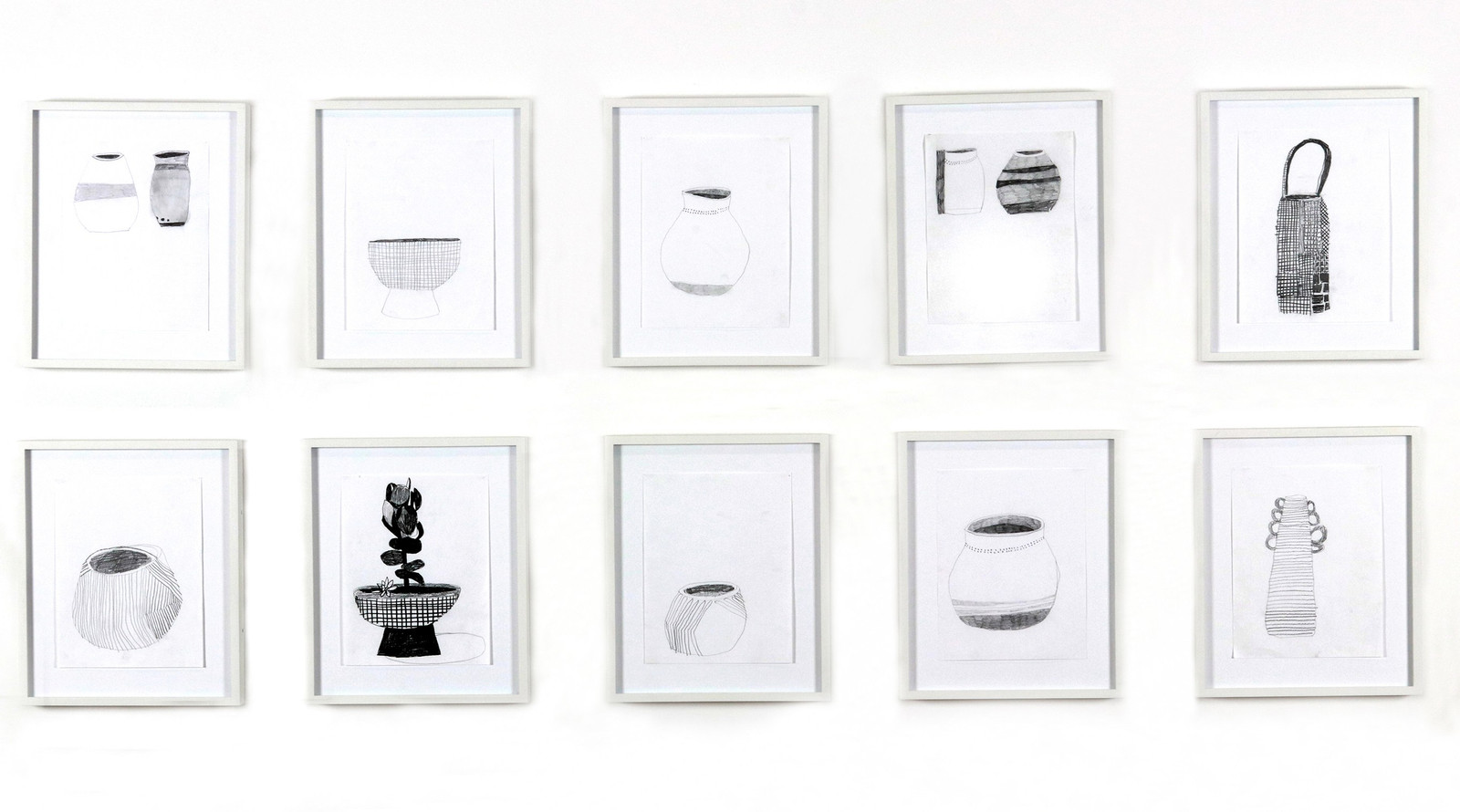
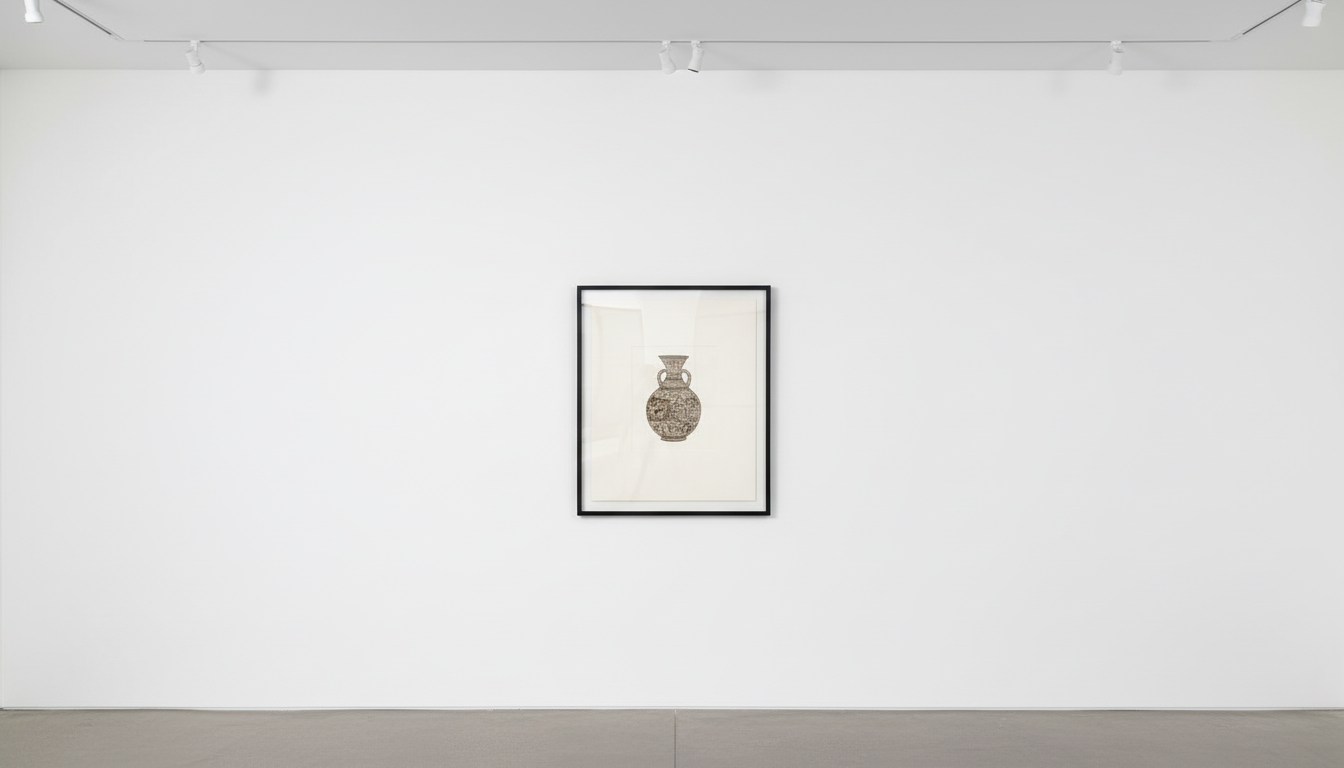
8 Pots — Jonas Wood. Available at Guy Hepner, New York.
Born in Boston in 1977 and based in Los Angeles since the early 2000s, Jonas Wood studied at Hobart and William Smith Colleges before completing his MFA at the University of Washington, Seattle. He came to wider critical attention in the mid-2000s through a series of large-scale interior paintings that seemed to sit entirely outside the prevailing concerns of contemporary art — no irony, no institutional critique, no digital mediation — and that was precisely what made them remarkable. Wood painted the things immediately around him: the plants in ceramic pots that crowd the windowsills of his Los Angeles home, the Basketball court visible from his studio, the walls of his living room hung with other artworks, the bowls of fruit on the kitchen table. The paintings were, on the surface, ordinary. Their formal intelligence was anything but.
Wood's signature technique involves flattening three-dimensional space into interlocking planes of colour, suppressing perspective so that a tiled floor and a patterned sofa and the shadow on a wall all read as equally weighted elements in a visual field. The influence of Henri Matisse is often cited, and it is accurate as far as it goes, but Wood also draws on Japanese woodblock prints, the bold graphic colour of 1960s illustration, and the snapshot aesthetic of family photography. The result is work that feels simultaneously historical and completely contemporary — paintings and prints that reward prolonged looking in a way that much more declaratively serious art does not.
His commercial trajectory has been equally considered. Represented since the early 2010s by leading galleries in Los Angeles — one of the most strategically astute galleries of its generation — and latterly by leading international galleries internationally, Wood has maintained a disciplined approach to the market. Editions are produced in limited quantities, priced to reflect genuine demand, and authenticated through rigorous documentation. The result is a secondary market characterised by steady appreciation rather than speculative boom-and-bust cycles.
To collect Jonas Wood prints intelligently, it helps to understand the formal vocabulary that makes them distinctive. Three elements recur across almost every edition and deserve particular attention.
The first is the treatment of colour. Wood works with flat, unmodulated planes that sit adjacent to one another without blending or gradation. Where a conventional painter might model a ceramic pot with highlights and shadows to suggest volume, Wood renders each facet as a single solid tone. The effect is paradoxically both more abstract and more immediately legible than naturalistic representation: the eye grasps the subject instantly, then lingers on the surfaces themselves. In screenprint, this approach translates with particular fidelity, since screenprinting is itself a medium built on layered flat colour.
The second element is pattern. Wood is obsessed with the decorative surfaces of domestic life — the glazed motifs on a Japanese ceramic, the geometric repeat on a kilim rug, the graphic typography on a vintage sporting poster. These patterns are rendered with documentary precision, each tile individually drawn, each leaf of a houseplant individually placed. Yet they are simultaneously flattened into the same plane as everything else, so that a patterned pot sitting in front of a patterned wallpaper creates a visual competition between two equally insistent systems of mark-making. The tension this generates — between figure and ground, between the legible object and the decorative field — is central to what makes the work compelling.
The third element is spatial compression. Wood consistently refuses the conventional devices by which painters create an illusion of depth: foreshortening, atmospheric perspective, consistent light sources. Rooms are represented as if seen from a slightly elevated angle, with the floor tipped up toward the picture plane. Objects at the back of a room appear the same size as objects at the front. The result is a sense of everything pressing toward the viewer, of domestic space rendered as intensely present rather than receding into illusionistic distance.
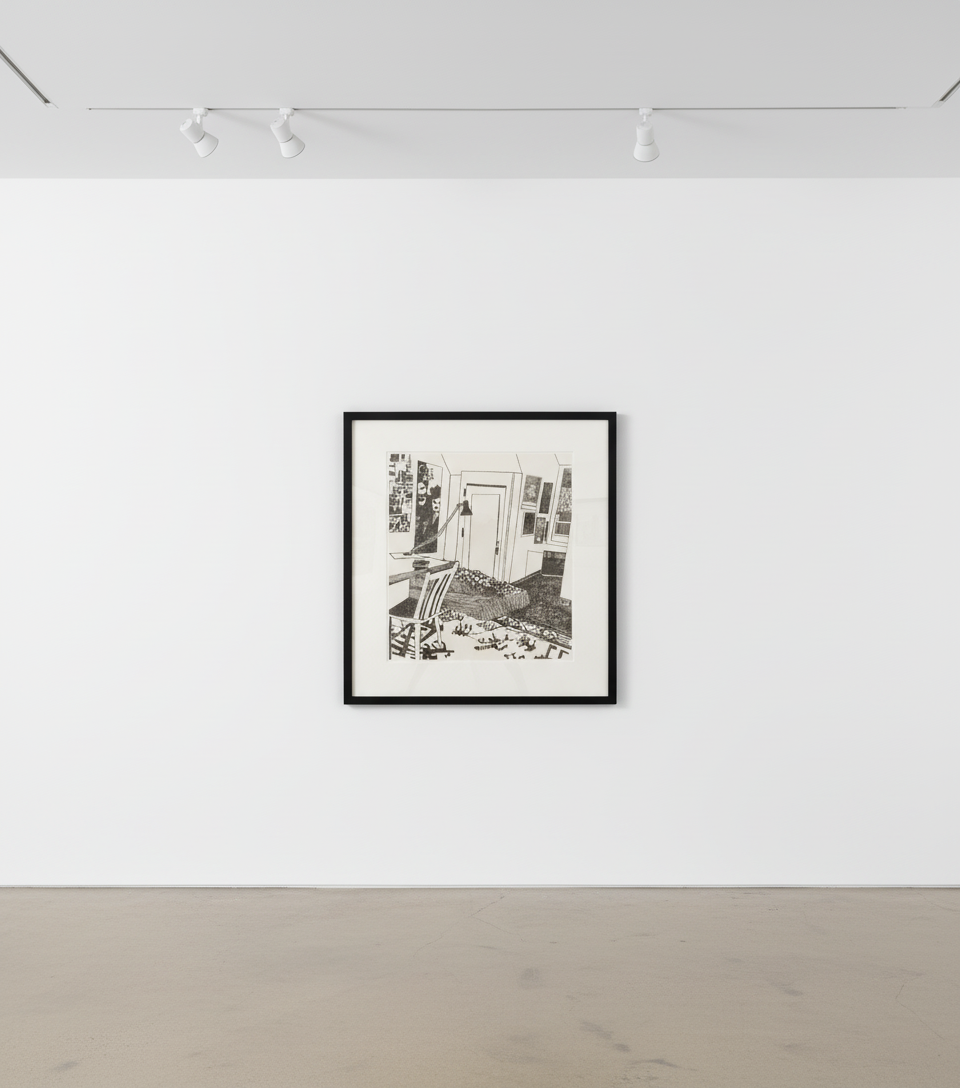
Alexis's Room — Jonas Wood. Available at Guy Hepner, New York.
Wood's print output can be loosely organised into five thematic categories, each of which maps directly onto the dominant subjects of his painting practice. Understanding these categories helps collectors identify which areas of the market best align with their interests and budgets.
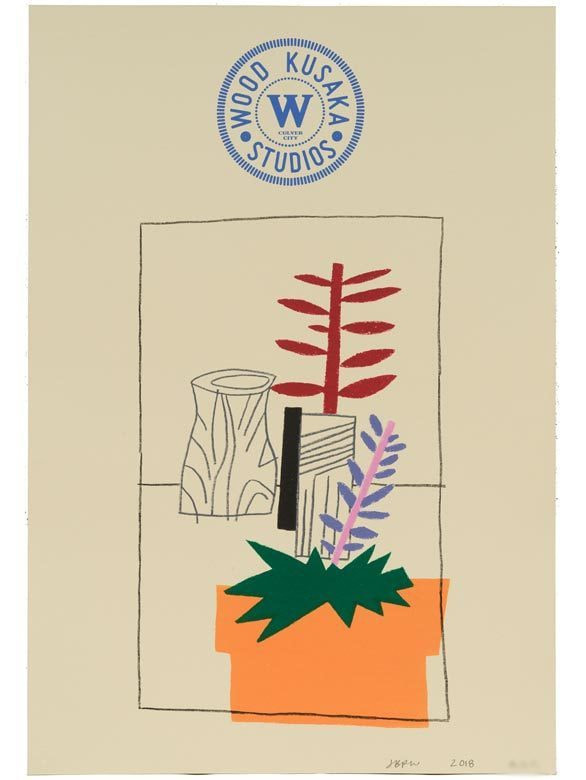
The plant pot prints are among Wood's most recognisable and widely collected editions. They depict the ceramic vessels — Japanese, Mexican, European, and American — that fill Wood's home and studio, each rendered with the same combination of documentary precision and graphic flatness that characterises all his work. The pots themselves become portraits: individual, characterful, deeply specific. Works such as 8 Pots exemplify the category, presenting an arrangement of ceramic vessels as a kind of still life that is simultaneously a study in pattern, colour, and the cultural biography of objects. These editions tend to be among the most accessible entry points for new collectors, both in terms of scale — many are medium-format works — and price.
Related to the pot prints are the botanical works, in which cut flowers, stems, and clippings become the subject. 3 Clippings is a characteristic example: three botanical specimens rendered against a stark ground, their forms simultaneously naturalistic and geometrically resolved. These works recall the tradition of scientific illustration while operating entirely within the logic of contemporary printmaking.
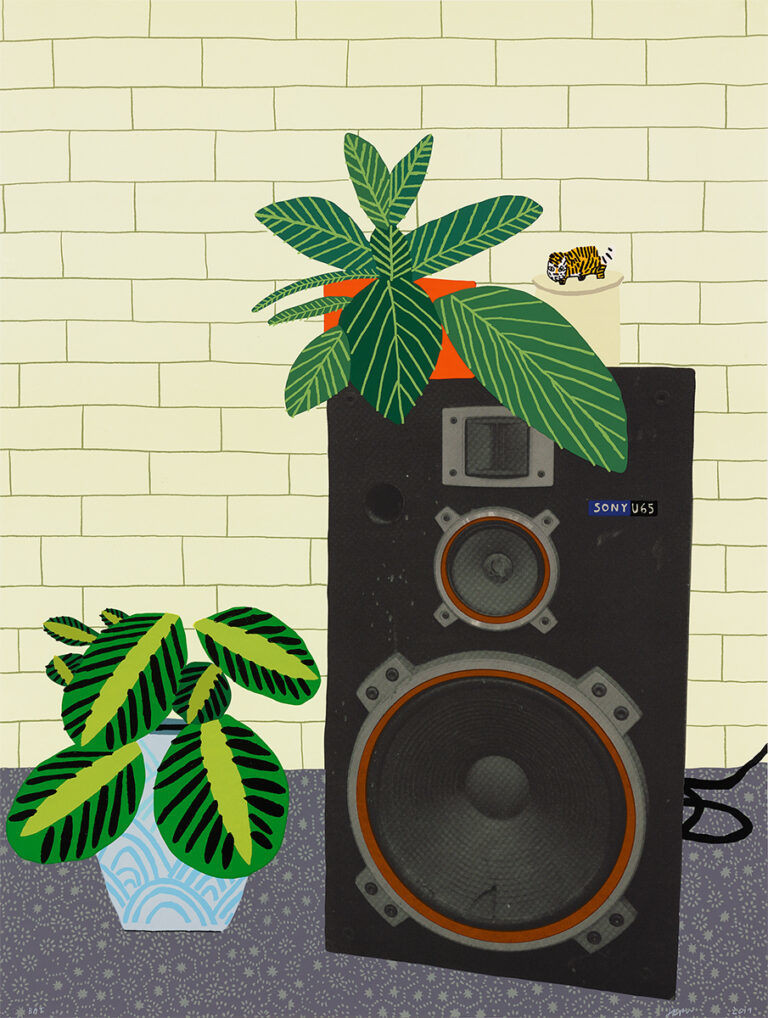
The interior prints represent Wood's most ambitious and art-historically rich strand of print production. Works such as Alexis's Room — depicting the bedroom of his daughter with its characteristic mix of toy clutter, hanging artwork, and patterned textiles — demonstrate the full complexity of his spatial language. These prints typically involve the highest number of colour layers, the greatest compositional ambition, and consequently the longest production time. They also tend to command the highest prices in both primary and secondary markets, and represent the most direct translation of his large-scale painting concerns into print.
The interior series draws explicitly on the tradition of Matisse's interior paintings, but Wood's rooms are populated with specific cultural objects — artworks by artists he admires, ceramics he has collected, furniture that carries personal history — that give them a density and specificity quite distinct from the French master's more generalised domestic spaces. For collectors interested in the conceptual dimension of his practice as well as its formal achievement, the interior prints are the most rewarding area of his edition output.
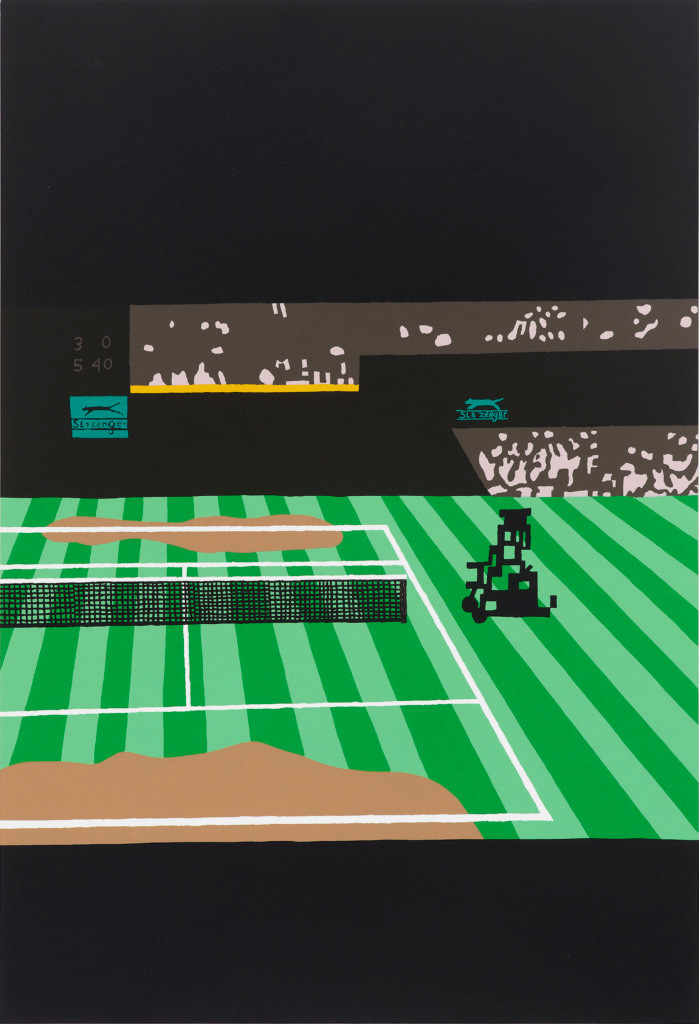
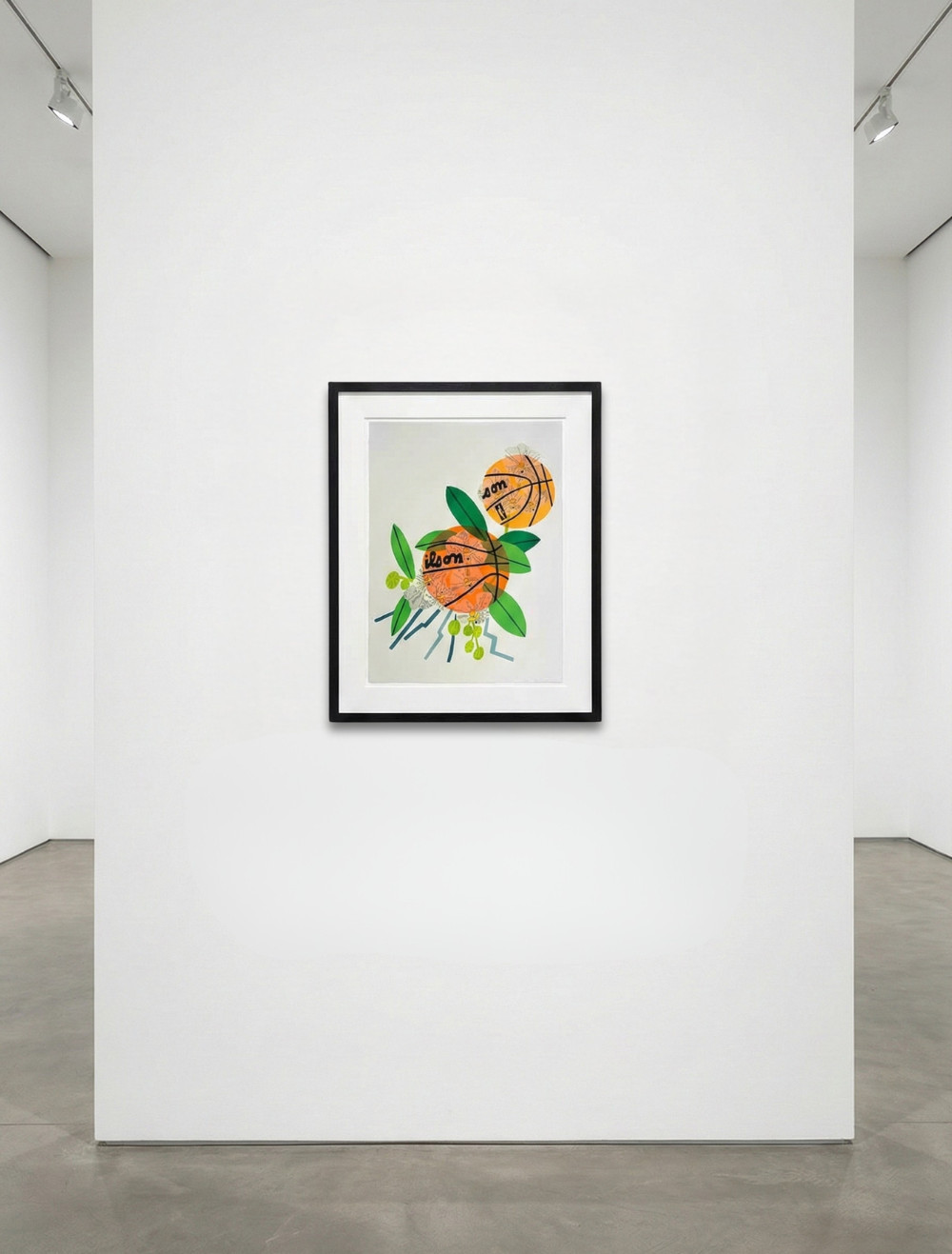
Wood's engagement with basketball is both biographical and formal. A devoted player since childhood, he has made the sport one of his recurring subjects across paintings, drawings, and prints. Works such as B-Ball translate the specific visual quality of the outdoor basketball court — the flat planes of painted tarmac, the graphic geometry of the key, the chain-link fence behind the hoop — into the same formal vocabulary he applies to domestic interiors. The results are among his most graphically immediate prints: bold, cheerful, and possessed of a kinetic energy that his more contemplative interior works deliberately suppress.
The sports prints have attracted a collector base that extends beyond the traditional fine art market into the overlap between contemporary art and sports culture, which has contributed to their strong secondary market performance. Limited availability combined with crossover appeal makes them particularly sought after.
Wood's still life prints occupy a position somewhere between the pot works and the interior scenes: objects are arranged on surfaces and depicted with precision, but without the full spatial complexity of a room. Works such as Bananas — a deceptively simple image of yellow fruit rendered in flat graphic colour — demonstrate his ability to find formal interest in the most quotidian subject matter. These works have deep roots in the history of Western art, from Cézanne through Morandi, but Wood's treatment is entirely his own: lighter in tone, more graphic in execution, more interested in colour relationships than in the philosophical weight of objects in time.
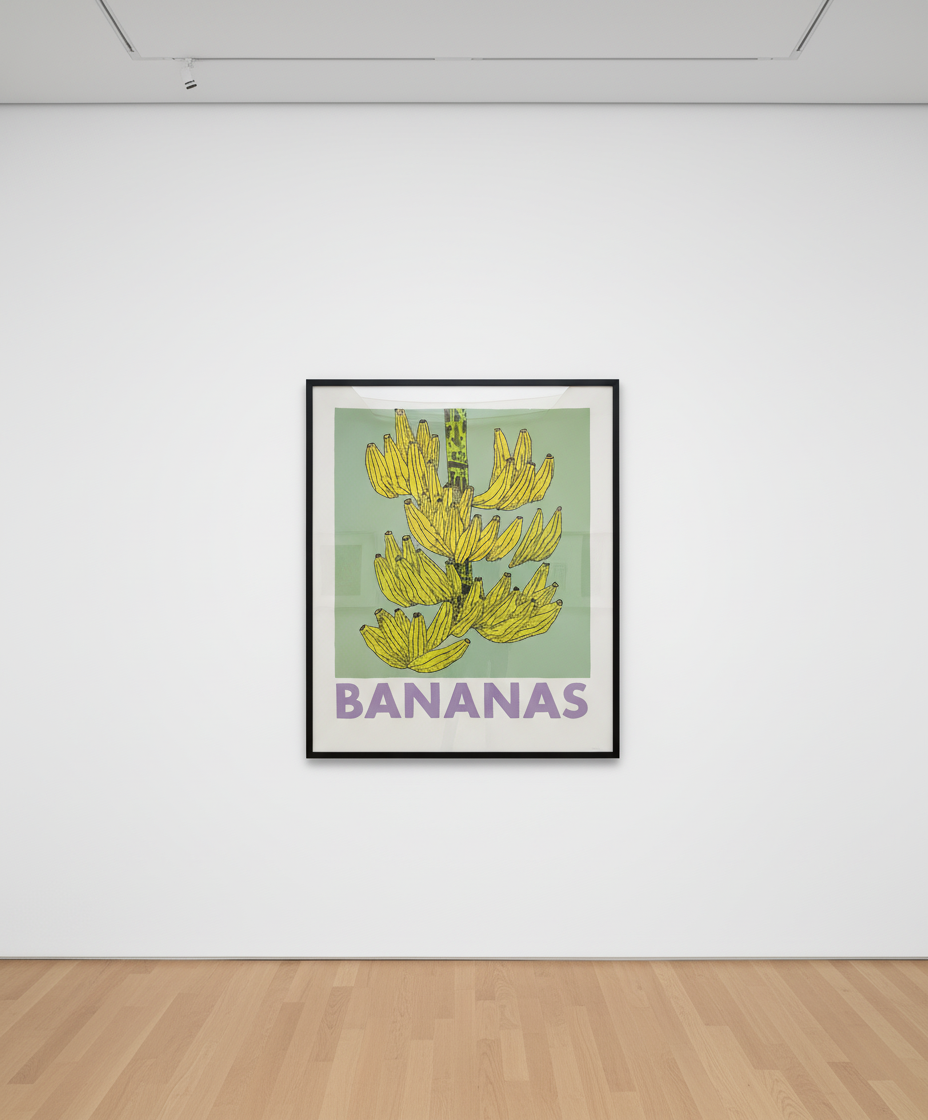
Bananas — Jonas Wood. Available at Guy Hepner, New York.
Understanding how Wood's editions are produced and structured is essential for collectors evaluating works in both primary and secondary markets. The majority of his prints are screenprints — a medium particularly well suited to his flat-colour visual language — though he has also produced linocuts, etchings, and lithographs at various points in his career.
Screenprints are produced by pushing ink through a fine mesh screen onto paper, with each colour requiring a separate screen. Wood's more complex editions can involve thirty or more colour passes, each requiring precise registration to maintain the crisp edges and clear colour relationships that define the work. The screenprints are typically produced in collaboration with specialist print studios, most notably with specialist G.E.L. in Los Angeles — one of the world's preeminent print workshops, with a history that includes collaborations with Jasper Johns, Robert Rauschenberg, and Roy Lichtenstein — as well as with other respected workshops in the United States and Europe.
Edition sizes vary but are consistently limited. Most editions run to between twenty and fifty impressions, with additional artist's proofs (typically designated AP and numbering around ten per cent of the edition size) and occasionally printer's proofs. All impressions are hand-signed by the artist and numbered in pencil, typically in the lower margin. The combination of limited edition sizes, hand-signing, and production through prestigious workshops ensures both authenticity and long-term value stability.
Primary distribution is handled through leading galleries in Los Angeles and leading international galleries, with additional editions occasionally released through museum stores and other institutional partners. Both galleries maintain detailed records of edition production and can provide provenance documentation for works they have handled.
The pricing of Jonas Wood prints in 2026 reflects both the consistent strength of his primary market and the robust appreciation that has characterised secondary market trading over the past decade. As with any artist at his level, prices vary significantly according to subject, edition size, date of production, and condition.
At the entry level, smaller-format still life and botanical prints from earlier in his career can be found on the secondary market for between $3,000 and $8,000. These represent the most accessible point of entry for collectors building a position in his work, and their relative abundance on the market means that condition and provenance can be carefully assessed before purchase.
Mid-range editions — the plant pot screenprints, the sports works, and the medium-format interior scenes — typically trade in the $8,000 to $20,000 range on the secondary market, with primary market prices for new editions from leading galleries and leading international galleries generally falling in a similar bracket. These works represent the core of the Jonas Wood print market and constitute the most actively traded segment.
The most significant interior prints and large-format works regularly achieve $20,000 to $40,000 at auction and through private sales, with exceptional examples from landmark series occasionally exceeding this range. Works from the earliest years of his edition production — when his market was still establishing itself and editions were smaller — can command premiums that reflect their scarcity relative to later, better-known works.
It is worth noting that Jonas Wood's print market has demonstrated unusual resilience during periods of broader art market softness. The combination of institutional validation, consistent critical attention, and a collector base that crosses traditional market demographics has produced a stability that many artists at comparable price points do not enjoy.
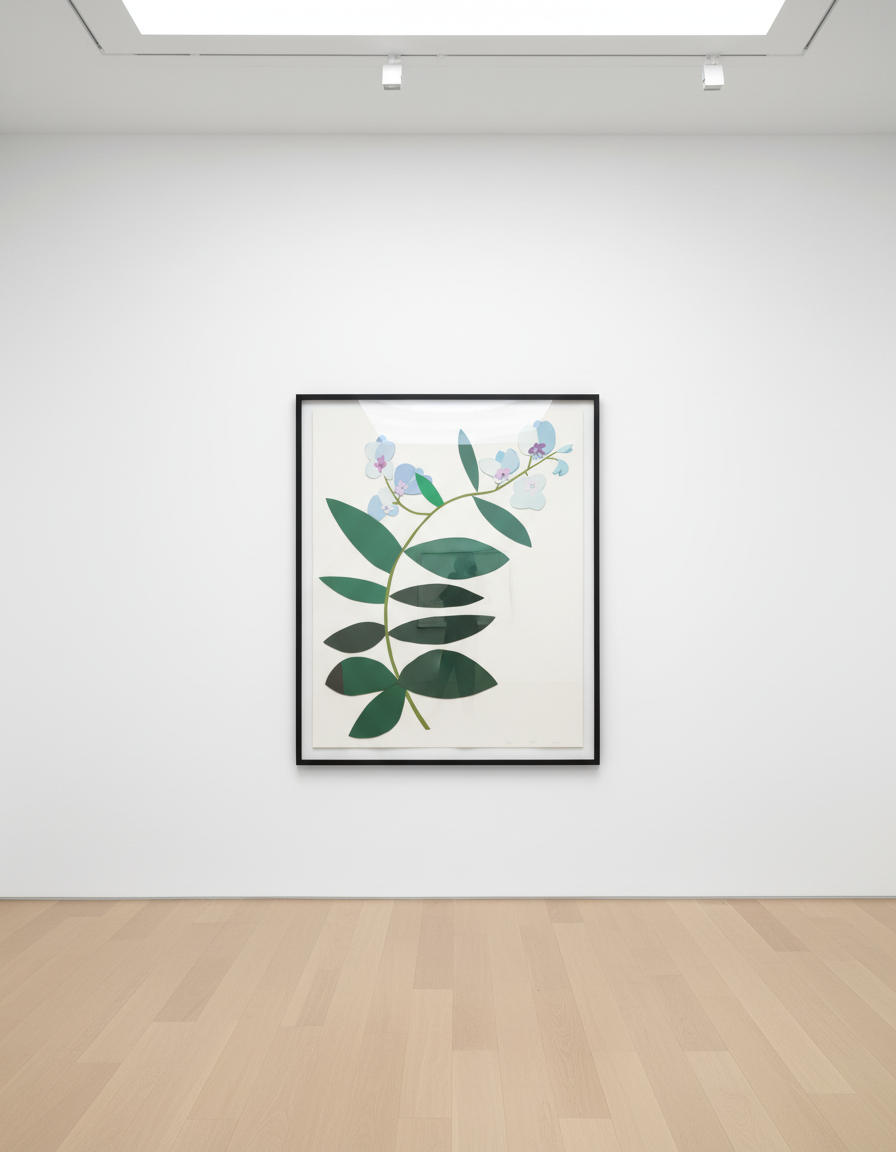
3 Clippings — Jonas Wood. Available at Guy Hepner, New York.
The authentication of Jonas Wood prints is considerably more straightforward than that of many artists at comparable market levels, owing to the rigorous documentation maintained by his primary galleries. Any work issued through leading galleries or leading international galleries will have been accompanied at time of sale by a certificate of authenticity, and both galleries maintain detailed edition records that can be cross-referenced against specific impression numbers.
When purchasing on the secondary market, collectors should request the original certificate of authenticity and any available correspondence or receipts documenting the work's chain of ownership from primary gallery to present. Works that lack this documentation are not necessarily inauthentic — older works may have changed hands multiple times before the current emphasis on provenance documentation became standard practice — but they require additional scrutiny.
Physically, Wood's prints are distinguished by the quality of their production: clean registration, deep and consistent ink saturation, and the characteristic texture of screenprinting on archival paper. Edition numbers and signatures are handwritten in pencil, typically with consistent letterforms across an edition. Collectors unfamiliar with his work should, if in any doubt, seek the opinion of a specialist before purchasing from secondary market sources.
For the avoidance of doubt: Guy Hepner sources works with full provenance documentation and can provide authentication support for any work purchased through the gallery.
The case for collecting Jonas Wood in 2026 rests on several converging factors that together suggest continued strength in both the critical and commercial dimensions of his market.
Institutionally, Wood has achieved a level of museum representation that most artists never reach. His paintings hang in the permanent collections of the Whitney, MoCA Los Angeles, the Hammer, the Broad, and many other major institutions. This institutional presence provides both validation and a degree of market floor that is difficult to displace: when a significant portion of an artist's major work is in permanent collections, the available supply in the market contracts over time, supporting prices for the works that remain in private hands.
Critically, Wood occupies a position of unusual consensus. In a contemporary art world often marked by sharp disagreements about value and significance, his work attracts consistent appreciation across critical, curatorial, and collector communities. His refusal of irony and his commitment to the pleasures of looking — to colour, pattern, and the contemplation of everyday objects — has proved to be a position of considerable durability rather than the limitation it might have appeared when he emerged in the mid-2000s.
Generationally, Wood sits at the centre of the Los Angeles art scene that has come to dominate international contemporary art over the past two decades. His relationships with other artists in that community — many of whom appear as subjects in his paintings or as collectors of his work — have contributed to his centrality within a broader cultural moment that shows no signs of losing its influence on global taste.
For print collectors specifically, the combination of accessible entry prices at the lower end of the market, consistent production through prestigious workshops, and a track record of secondary market appreciation makes Wood's editions among the most compelling propositions available in the current market.
Guy Hepner is a leading contemporary art gallery with locations in New York and Los Angeles, specialising in works on paper, prints, and editions by the most significant artists of the post-war and contemporary periods. The gallery maintains an active inventory of Jonas Wood prints across multiple series and price points, sourced with full provenance documentation and offered with comprehensive advisory support.
For collectors new to Jonas Wood, the gallery's specialist team can provide detailed guidance on edition history, condition reports, and current market values. For established collectors looking to add specific works or refine their existing holdings, the gallery offers access to works not currently listed publicly through its network of private and institutional clients.
All works sold by Guy Hepner are accompanied by complete provenance documentation and condition reports. The gallery offers secure international shipping, installation services in the New York metropolitan area, and ongoing advisory support for collectors building long-term positions in Wood's work or in contemporary prints more broadly.
To enquire about currently available Jonas Wood prints, visit the Jonas Wood artist page at guyhepner.com, or contact the gallery directly. The team responds to all serious enquiries within one business day.
Explore Jonas Wood prints for sale at Guy Hepner: Basketball, Four Majors, Interiors, Landscapes, Notepad Doodles.
Related Series