Paintings

September 1, 2026
There's something sacred about a stack of old books—the worn spines, the yellowed pages, the smell of decades. James Mcqueen artist takes that reverence and flips it on its head. His book sculptures and paintings are part homage, part provocation: vintage paperbacks reimagined with contemporary wit, literary history transformed into objects you want to hold, display, and live with. It's Pop Art for the bookshelf—and the gallery wall. In an art world often dominated by digital screens and fleeting images, McQueen's insistence on the physical presence of the book feels almost radical, a declaration that some objects carry meaning that cannot be replicated or downloaded.
The anonymous British artist has spent years perfecting a visual language that speaks to anyone who has ever loved books, while simultaneously engaging with the heavyweight legacy of twentieth-century Pop Art. His canvases retain the typographic punch and bold color blocks of mid-century popular fiction while introducing layered painterly interventions that complicate their apparent simplicity. The result is work that rewards both the casual glance and sustained contemplation—accessible enough to draw collectors from outside traditional art circles, yet sophisticated enough to hold its own in serious critical conversation.
James McQueen operates with a deliberate distance from the personality-driven machinery of the contemporary art market. Unlike artists who cultivate elaborate public personas or maintain highly active social media presences, McQueen allows his work to speak without the interference of biography. This anonymity is neither gimmick nor affectation; rather, it reflects a genuine belief that the paintings themselves should carry the full weight of meaning. In an era when an artist's Instagram following can sometimes matter as much as their studio output, McQueen's reticence feels almost countercultural.
What we do know about McQueen comes primarily through the work itself. His paintings reveal an artist steeped in both art history and popular culture, equally conversant with Jackson Pollock's gestural abstraction and the graphic design of mass-market paperbacks. The anonymous British artist has built his reputation on reworking mid-century paperback design—a visual shorthand for mass production and instant consumption—treating that language as both subject and surface. His process involves extensive layering and physical intervention, building up paint before sanding it back down, creating surfaces that carry the authentic wear of objects that have been loved and handled.
The choice to work primarily with book imagery connects McQueen to a long tradition of artists who have found meaning in the printed word as visual form. From the Cubist collages of Picasso and Braque, which incorporated newspaper fragments, to the text-based works of Ed Ruscha and Jenny Holzer, language has served as both medium and message. McQueen's contribution to this lineage is distinctive in its specificity: he focuses not on language in the abstract but on the particular artifact of the paperback book, with all its cultural associations of accessibility, portability, and democratic knowledge-sharing.

One of the most striking aspects of James McQueen art is its physical presence. These are not flat, screen-ready images but objects that demand to be experienced in person. McQueen applies paint in heavy layers, allowing each stratum to dry before sanding it back. The process produces a coarse, weathered skin that mirrors the scuffed covers of second-hand books. Lacquer is often added, intensifying color and sealing the evidence of abrasion. Standing before a McQueen painting, one encounters not just an image of a book but the material history of reading itself—the accumulated evidence of hands turning pages, coffee cups leaving rings, sun fading spines on shelves.
This attention to surface distinguishes McQueen's book sculptures and paintings from mere nostalgia. He paints books as they exist now: stained, faded, annotated, and dog-eared. Fingerprints, rings from tea mugs, torn corners, and broken spines are rendered with care. Scribbles from imagined readers interrupt the graphic clarity. The paintings register the life of an object handled, passed on, and worn down. In this way, McQueen's work becomes a meditation on time itself—how objects accumulate meaning through use, how they become repositories of memory even as they physically degrade.
The materiality of McQueen's process also serves to complicate easy readings of his work as mere appropriation. Unlike the cool, mechanical reproduction that characterized much of Warhol's practice, McQueen's surfaces appear highly emotionally charged. The thick layers of paint, the visible abrasion, the obvious reworking—all introduce a distinctly human element, evidence of the artist's hand that defies the flatness typical of mass reproduction. The result is a tactile, humanized version of Pop Art, one that honors the movement's fascination with commercial imagery while reasserting the value of individual craft.
James McQueen's evolving practice remains rooted in an active dialogue with Pop Art. By adopting the visual language of vintage book covers, advertising typography, and instantly recognizable phrases, McQueen works within the same terrain that Pop artists first claimed in the mid-twentieth century—a space where mass culture, consumerism, and identity intersect. Like Pop Art, his paintings resonate through their immediate accessibility, citing recognizable and universal themes. Beneath their bold, painterly surfaces lie questions about value, desire, romance, and belief—subjects that Pop artists continually sought to address.
The connection to Andy Warhol is perhaps most obvious. Warhol's legacy lies in his ability to elevate the ordinary into the iconic, forcing us to confront the systems of desire and consumption that shape everyday life. His images of Campbell's Soup cans, dollar signs, and celebrities transformed mass-produced imagery into both mirror and critique of post-war capitalism. McQueen's work engages directly with this concept, particularly in paintings that explore the uneasy relationship between emotional fulfillment and material value. Works with titles like "HAPPINESS IS EXPENSIVE" and "I DID IT FOR THE MONEY" cite Warhol's fascination with commerce while adding McQueen's characteristic verbal wit.
Warhol famously remarked that "making money is art and working is art and good business is the best art." His unapologetic embrace of commerce finds an echo in McQueen's blunt acknowledgment of the transactional nature of art and life. Yet where Warhol sought to maintain a cool, detached, almost machine-like distance, McQueen's surfaces appear far more emotionally charged. The tension between the slick associations of advertising imagery and the obvious evidence of handwork creates a productive friction—Pop Art's critical distance combined with Abstract Expressionism's commitment to gesture and surface.
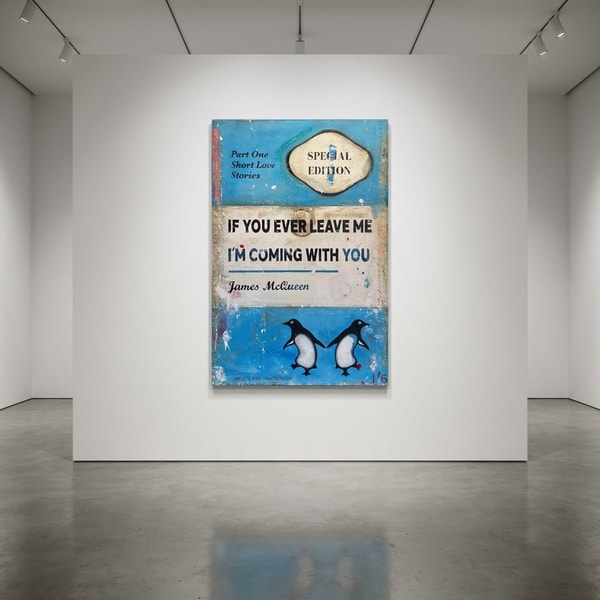
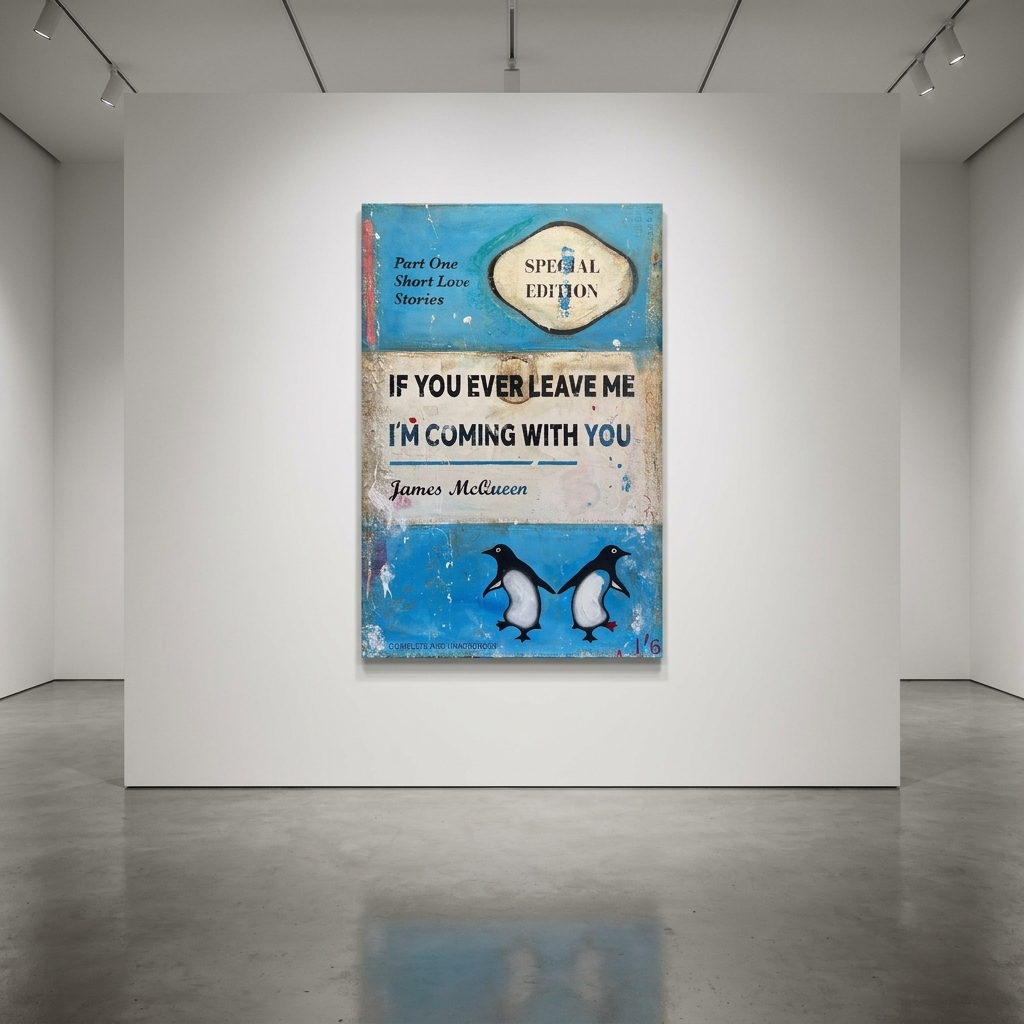
James McQueen, If You Ever Leave Me I'm Coming With You, Mixed Media on Canvas. Available at Guy Hepner, New York.
McQueen's affinity with Robert Indiana lies in his ability to transform language into universally recognizable symbols. Indiana's iconic single-word works like "LOVE" and "HOPE" condensed complex emotional states into graphic forms that exist culturally as both fine art and public sculpture. McQueen draws directly from this lineage in works that reduce entire emotional narratives to bold, declarative statements. The stacked typography, the vibrant color blocking, the monumental scale—all reference Indiana's approach while filtering it through the specific visual vocabulary of pulp publishing.
Indiana's "LOVE" image was first conceived in 1964 when he sent printed cards with the design to friends and acquaintances. The following year, MoMA commissioned a version for their annual Christmas card, launching one of the most reproduced images in art history. McQueen's engagement with this legacy is neither pure homage nor ironic critique but something more complex—a recognition that certain visual forms have achieved a kind of universal legibility while still carrying art-historical weight. When McQueen transforms phrases like "STUPID CRAZY LOVE" into monumental paintings, he taps into this visual tradition while claiming new territory for his own concerns.
Roy Lichtenstein's influence appears in McQueen's attention to the graphic conventions of commercial printing. Lichtenstein famously appropriated the Ben-Day dots and bold outlines of comic books, transforming low-culture imagery into high-art painting. McQueen performs a similar operation on paperback book covers, treating their particular design conventions—the sans-serif typography, the color-blocked backgrounds, the promise of dramatic content—as worthy subjects for serious painterly investigation. The effect is to dignify forms typically dismissed as ephemeral while revealing the sophisticated visual thinking embedded in supposedly disposable design.
McQueen's 2025 exhibition at Halcyon Gallery in Mayfair, titled "A Beautiful Waste of Time," presented a comprehensive survey of his recent development. The show brought together established signature titles alongside new phrases shaped by personal memory and popular culture, delivered with the artist's characteristic wit and confrontation. Critics noted the exhibition's successful balance between accessibility and depth—paintings that could be immediately enjoyed for their graphic impact while rewarding sustained attention with layers of art-historical reference and painterly nuance.
The exhibition also marked a more overt dialogue with art history than McQueen had previously undertaken. Echoes of Keith Haring, Yayoi Kusama, Banksy, Damien Hirst, Jackson Pollock, and Takashi Murakami surfaced within the book-cover format, joining the more established references to Warhol, Indiana, and Lichtenstein. These references function not as quotations so much as absorptions—McQueen folds their visual codes into his own gestural process, allowing high art and pulp design to occupy the same plane without hierarchy.
Thematically, the works oscillated between the universal and the intimate. Love, hope, vulnerability, and defiance recurred, though rarely in sentimental form. Instead, they were filtered through humor that could feel both self-deprecating and barbed. The title of the show itself captures this tonal complexity: reading can be dismissed as a beautiful waste of time by those who prize productivity above all else, yet for book lovers, that "waste" is precisely the point—time spent in imaginative transport, temporarily freed from the demands of utility.
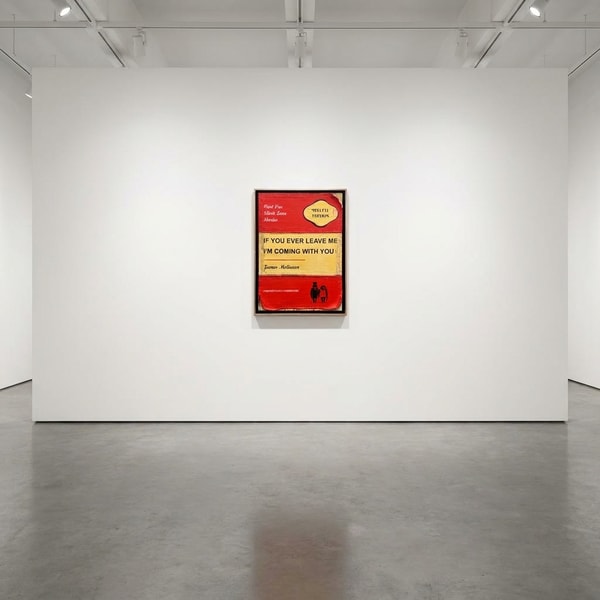
James McQueen, Gallery Installation View. Available at Guy Hepner, New York.
To understand James McQueen artwork fully, one must consider the particular status of the book in contemporary culture. We live in an age of anxiety about the future of reading, when predictions of the book's death arrive with metronomic regularity. Yet physical books persist, not merely as delivery systems for content but as objects invested with emotional and aesthetic significance. The rise of "shelfies"—photographs of carefully curated personal libraries shared on social media—suggests that books retain powerful symbolic value even in digital culture. McQueen's work draws energy from this tension, celebrating the book as artifact while acknowledging that celebration's potentially elegiac quality.
The paperback specifically carries associations that hardcovers do not. Paperbacks democratized reading, making literature affordable and portable in ways that transformed cultural life in the twentieth century. The design conventions of mass-market paperbacks evolved their own visual language—lurid colors, dramatic typography, promises of escape and excitement. McQueen's focus on these conventions honors the egalitarian promise of paperback publishing while recognizing that promise's embedding within commercial structures. His paintings remind us that even our most intimate reading experiences have been shaped by marketing decisions and design trends.
The vintage quality of McQueen's source material adds another dimension. He works not with contemporary book design but with the aesthetics of mid-century publishing—the Penguin paperback, the pulp thriller, the dog-eared novel passed between friends. This historical focus creates productive temporal confusion: the paintings look simultaneously old and new, their weathered surfaces suggesting objects recovered from attics or used bookshops while their scale and presentation assert their status as contemporary art. Collectors respond to this temporal ambiguity, finding in McQueen's work both nostalgia for remembered reading experiences and excitement about painting's ongoing possibilities.
James McQueen contemporary artist occupies an interesting position in the current market. His work appeals to traditional art collectors who appreciate the technical sophistication and art-historical awareness of his practice, while also attracting buyers from outside typical collecting circles—bibliophiles, design enthusiasts, people who simply respond to the wit and warmth of his titles. This dual appeal has created growing demand for McQueen's paintings and book sculptures, with works appearing in both gallery exhibitions and private collections internationally.
The accessibility of McQueen's imagery does not diminish its collectability; if anything, it enhances it. Unlike art that requires extensive explanation or contextual framing, McQueen's paintings communicate immediately while continuing to reward attention. A collector can hang a McQueen in a living room confident that visitors will respond to it, while also knowing that the work bears serious critical consideration. This combination of approachability and depth makes McQueen particularly attractive to collectors building thoughtful collections rather than merely accumulating assets.
For collectors interested in contemporary British art, McQueen represents an important voice. His anonymity connects him to the tradition of street art—think Banksy's strategic disappearance—while his engagement with art history places him firmly within gallery-based practice. He bridges worlds that sometimes seem antagonistic, finding common ground between populist accessibility and institutional validation. As the contemporary art market continues to evolve, artists who can speak to multiple audiences while maintaining artistic integrity become increasingly valuable.
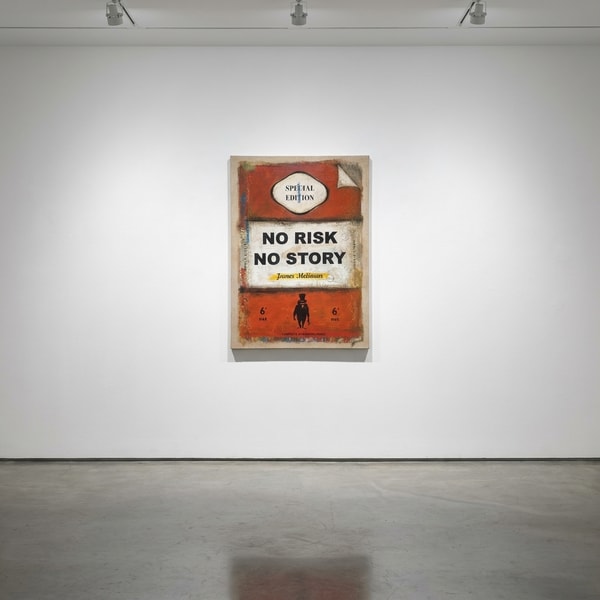
James McQueen, No Risk No Story, Mixed Media. Available at Guy Hepner, New York.
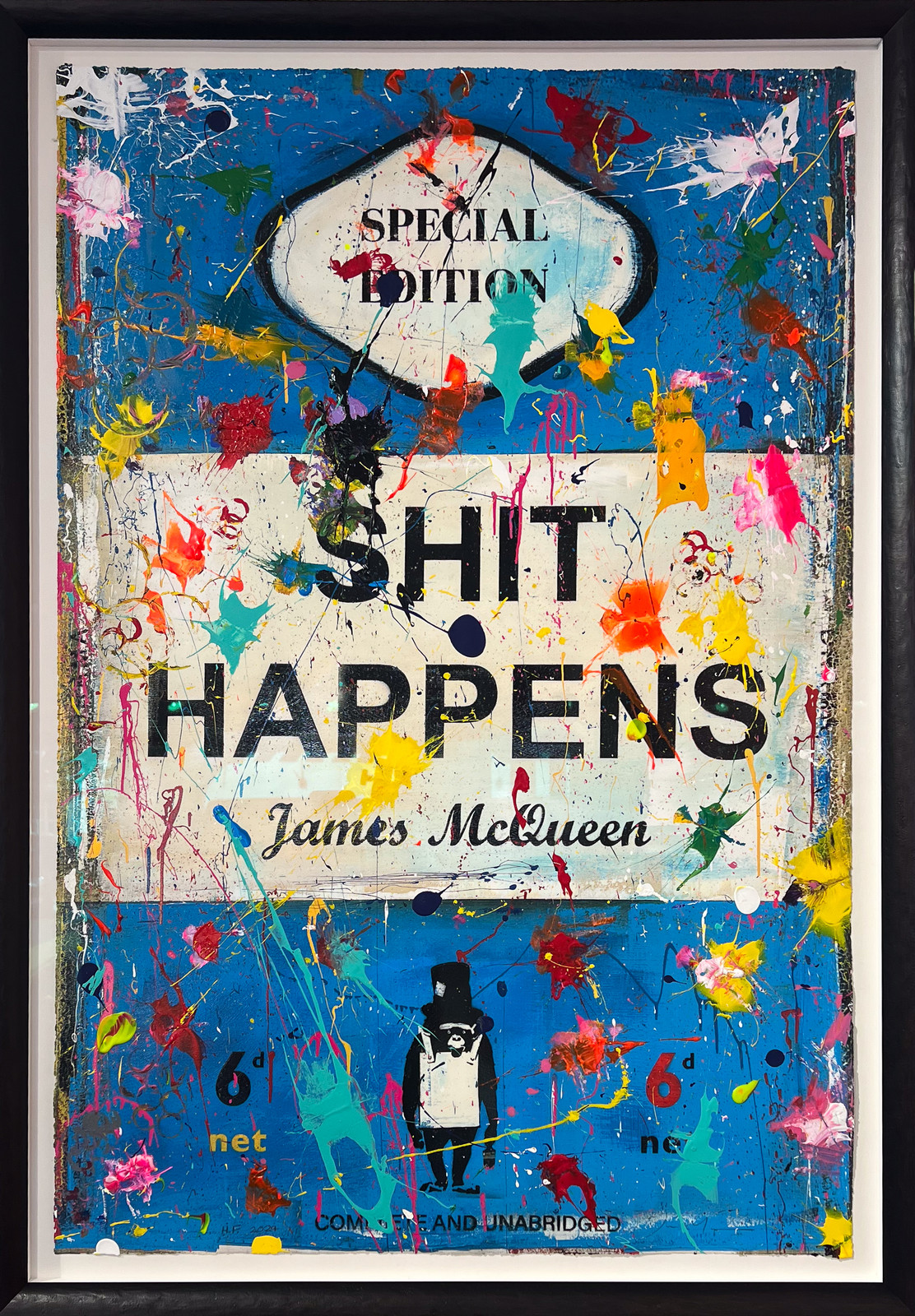
McQueen's titles deserve particular attention. Each painting operates as a kind of invented book, complete with title and visual design, as though fragments of an alternative literary history have somehow materialized on canvas. Phrases like "If You Ever Leave Me I'm Coming With You" and "No Risk No Story" and "Shit Happens" function as miniature poems, their meanings shifting depending on the viewer's mood and circumstances. The titles are funny and sad, confrontational and tender, universal and oddly specific—they capture the tonal range of actual pulp fiction while achieving something more concentrated and lasting.
The selection of titles reveals McQueen's attentiveness to language's power to evoke emotional states. He seems particularly drawn to phrases that operate at the intersection of sincerity and irony—statements that could be read as genuine affirmations or knowing commentary on such affirmations. This tonal ambiguity gives the work its particular texture, inviting viewers to bring their own emotional histories to the interpretation. A painting titled "Stupid Crazy Love" will mean different things to someone in the first flush of romance and someone recovering from heartbreak, yet both responses feel anticipated and accommodated by the work.
The invented book covers also invite speculation about their imagined contents. What story would "Happiness Is Expensive" tell? What characters populate "I Did It For The Money"? McQueen's paintings gesture toward narratives without providing them, activating the viewer's imagination in ways that more explicit storytelling might foreclose. This is the particular magic of book covers as a visual form—they promise experience without delivering it, creating desire for stories that may not exist. McQueen exploits this promissory quality, producing paintings that are simultaneously complete objects and invitations to imagine further.
Understanding James McQueen resin art and mixed-media process enriches appreciation of the finished works. McQueen builds his surfaces through extensive layering, applying paint and allowing it to dry before adding subsequent layers. The sanding back of these accumulated layers creates the weathered, time-worn quality that distinguishes his work from flatter graphic approaches. Each painting bears the evidence of its own making—the history of addition and subtraction that produced its final appearance remains legible in the surface.
The use of lacquer intensifies colors while sealing the abrasion marks that record the painting's process. This combination of vivid hue and physical wear creates the distinctive McQueen aesthetic—paintings that pop with graphic punch while also feeling authentically aged, as though they have survived decades of handling. The effect is enhanced by McQueen's rendering of specific damage marks: coffee rings, torn corners, fingerprints, and annotations that suggest previous owners with their own relationships to the books these paintings represent.
The physical presence of McQueen's work matters. While reproductions can convey the graphic impact of his compositions, they cannot capture the tactile quality of the surfaces or the way light plays across lacquered areas. Collectors who have seen McQueen's work only in photographs are often surprised by the paintings' material richness when encountered in person. This distinction between reproduction and original connects McQueen to traditional concerns of painting even as his imagery draws from mass-produced sources. The paintings insist on their status as unique objects even while celebrating the aesthetic of mechanical reproduction.
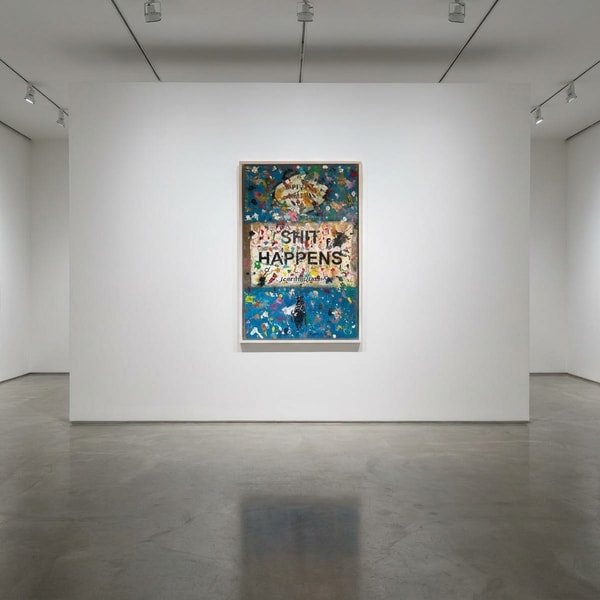
James McQueen, Shit Happens, Mixed Media. Available at Guy Hepner, New York.
Critical response to James McQueen books and paintings has emphasized their successful navigation between accessibility and sophistication. Reviewers consistently note the work's ability to engage viewers across different levels of art-historical knowledge—the casual viewer can enjoy the humor and graphic punch, while the informed viewer can trace references and engage with the paintings' dialogue with Pop Art traditions. This layered accessibility has become a hallmark of McQueen's practice and a significant factor in his growing reputation.
The work's engagement with nostalgia has attracted particular critical attention. McQueen neither indulges nostalgia uncritically nor dismisses it as mere sentimentality. Instead, his paintings seem to investigate nostalgia as a cultural phenomenon—exploring why certain objects and aesthetics trigger emotional responses, how memory becomes attached to material forms, and what we seek when we turn to the past. This analytical quality prevents the work from becoming merely pleasant, introducing a edge that distinguishes McQueen from artists who simply exploit retro aesthetics for easy appeal.
McQueen's anonymity has generated its own critical discourse. Some see it as strategic marketing, comparable to Banksy's cultivation of mystery. Others read it as genuine philosophical commitment, a refusal to allow biographical narrative to substitute for engagement with the work itself. The truth likely involves elements of both—McQueen clearly understands the market value of mystique while also demonstrating authentic commitment to letting paintings speak without the interference of personality. Whatever the motivation, the anonymity has not hindered critical engagement or commercial success.
For collectors considering James McQueen for sale, several factors merit consideration. The artist's limited editions and unique works occupy different positions in terms of accessibility and investment potential. Unique paintings command premium prices and offer the distinctive surface qualities that define McQueen's practice. Editions provide more accessible entry points while still bearing the graphic punch and verbal wit that characterize the artist's vision.
Condition remains important for any contemporary art acquisition, though McQueen's deliberate aesthetic of wear creates interesting complications. The paintings are meant to look weathered, so distinguishing intended aging from actual damage requires knowledgeable assessment. Working with established galleries that specialize in McQueen's work ensures proper handling and accurate condition reporting, protecting the collector's investment while guaranteeing authenticity.
Provenance matters increasingly as McQueen's market develops. Works with documented exhibition history and clear chains of ownership command stronger prices and inspire greater collector confidence. The relationship between primary and secondary market pricing also warrants attention—collectors buying from reputable galleries at primary prices often find their acquisitions appreciate as McQueen's reputation continues to grow.
James McQueen's work arrives at a moment of particular resonance. As debates about artificial intelligence and the future of creative work intensify, McQueen's emphasis on handcraft and material presence feels pointed. His paintings assert values that automated production cannot replicate—the evidence of human decision-making, the accumulation of gesture over time, the particularity of individual touch. They remind us that some aesthetic experiences remain bound to physical objects, that not everything of value can be digitized and distributed.
Simultaneously, McQueen's celebration of reading and books responds to genuine cultural anxiety. Independent bookstores have experienced a surprising renaissance in recent years, suggesting that the book's death has been greatly exaggerated. McQueen's paintings participate in this broader cultural moment, treating books not as obsolete technologies but as enduring sources of meaning and pleasure. His work suggests that the future will involve not the disappearance of physical objects but their continued transformation and revaluation.
For collectors, McQueen represents an opportunity to acquire work that speaks to significant contemporary concerns while offering genuine visual pleasure. His paintings are serious without being solemn, intellectually engaged without being exclusionary, aesthetically sophisticated without being difficult. They belong in collections that value both thought and beauty, that seek art capable of sparking conversation while also providing lasting satisfaction.
Guy Hepner Gallery at 529 West 20th Street in New York presents an exceptional selection of James McQueen artwork for discerning collectors. The gallery's commitment to emerging and established contemporary artists makes it an ideal environment for discovering McQueen's distinctive fusion of literary culture and painterly craft. Whether you are drawn to the wit of his invented titles, the material richness of his surfaces, or the art-historical sophistication of his Pop Art dialogue, the experienced consultants at Guy Hepner can guide you toward works that resonate with your collecting vision.
The current selection includes paintings that demonstrate the full range of McQueen's practice—from intimate scale pieces suitable for private study to monumental works commanding presence in larger spaces. Each work has been selected for quality and significance, ensuring that collectors acquire not merely objects but meaningful additions to considered collections. For those new to McQueen's work, the gallery offers an opportunity for extended viewing and discussion, allowing the paintings' subtle qualities to emerge beyond the limitations of reproduction.
We invite collectors interested in James McQueen art to contact Guy Hepner Gallery for detailed information about available works, pricing, and acquisition options. In a market where authenticity and provenance matter increasingly, working with a gallery of established reputation provides essential protection and peace of mind. James McQueen's paintings reward the attention of serious collectors—they are works that grow richer with time, revealing new dimensions as familiarity deepens. The book, after all, has always been an object that rewards return visits.
Related Series