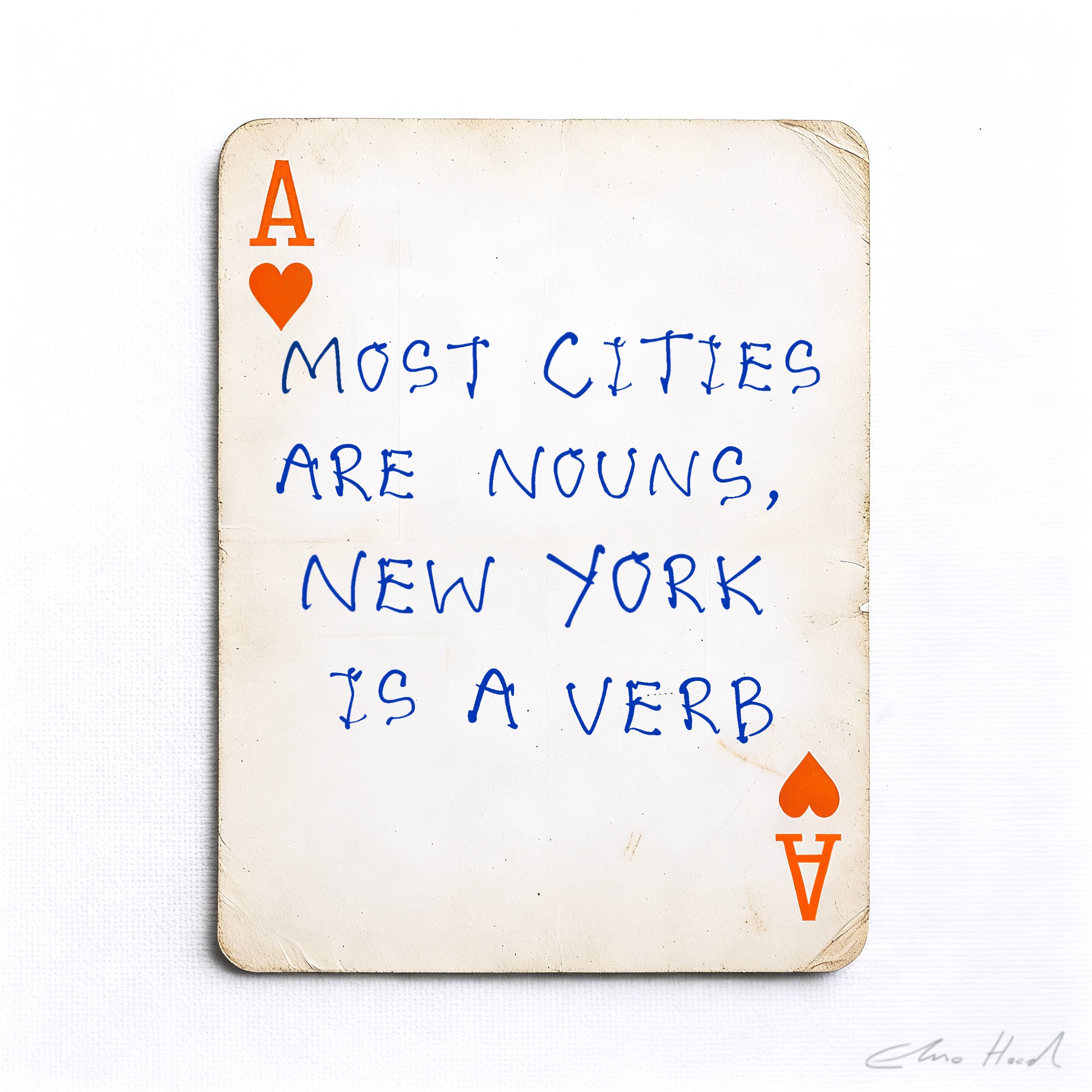
Playing Cards

July 29, 2026
Two Playing Cards. A pair of scissors. A moment of grief transformed into art.
In 2013, Elmo Hood—artist, self-taught provocateur, and accidental viral sensation—cut apart two cards from an ordinary deck and created something that would ricochet across the internet, land in celebrity collections, and eventually hang in galleries from New York to Munich. No MFA. No gallery representation. No plan. Just a collage that captured something raw about human connection, and an algorithm that decided the world needed to see it.
A decade later, Hood's playing card art has become a genre unto itself. His work sits at a peculiar intersection: too accessible for the art world's gatekeepers, too emotionally direct for critics who prefer their meaning obscured, and too successful to ignore. The cards have been shared by P. Diddy, collected by The Game, and hung in the homes of Girls Aloud's Nicola Roberts. They've been auctioned at the Houses of Parliament. And now, they're arriving at Guy Hepner Gallery in New York, where a new series of mixed media playing card works marks Hood's most ambitious statement yet.
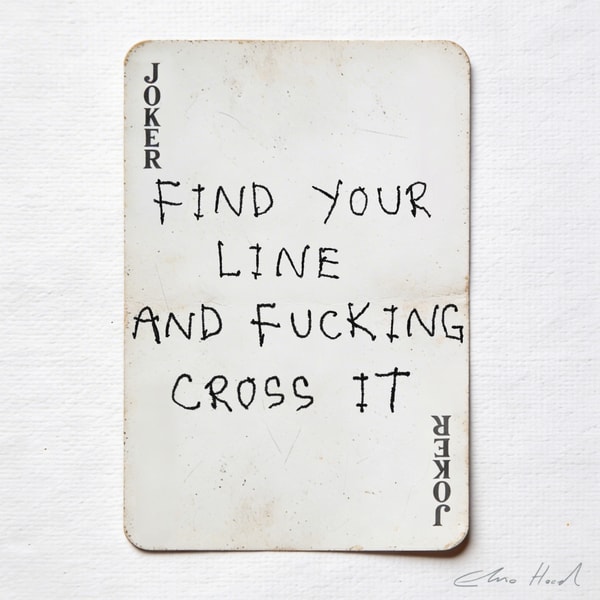
This is art that doesn't apologize. It doesn't require a decoder ring or a PhD in semiotics. It says what it means, and it means what it says—sometimes profanely, always directly. "Find Your Line And Fucking Cross It" isn't just a title. It's a dare.
Elmo Hood was born in 1989 in Southampton, England—a port city with more maritime history than contemporary art infrastructure. He didn't grow up surrounded by galleries or attend prestigious art schools. The formal training that shapes most artists' early careers simply wasn't part of his story. What he had instead was a move to London in 2011, a wandering day through Shoreditch, and an encounter with street art that changed everything.
"The street art and graffiti seemed to interest me more than the world-famous landmarks," Hood recalled in an early interview with Made in Shoreditch magazine. It's a telling admission. Here was someone who looked at Big Ben and the Tower of London and felt nothing, then turned a corner into some graffiti-tagged alley in East London and felt the world crack open. He decided to give it a go. The snowball started rolling.
His early work was typical of the Shoreditch scene—letter work, stencils, bright colors, the visual language of urban walls. But it was a personal tragedy that pushed him toward something more intimate. Following a family bereavement, Hood found solace in making art, and his focus shifted from large-scale murals to something he could hold in his hands. The playing cards emerged from grief, not strategy. They were small enough to work on quietly, loaded with pre-existing symbolism, and cheap enough to experiment with freely.
The viral piece from 2013 featured the King and Queen of Hearts—those two figures that sit in every deck, frozen in their royal profiles, suddenly animated by Hood's intervention. He cut them, burned them, wrote on them. He made them speak to each other. And somehow, millions of people on the internet decided this was the image that captured their own experiences of love, loss, and the violence of emotions that playing cards—with their gambling connotations—have always whispered about.

Elmo Hood
To understand what makes Elmo Hood's playing card art distinctive, you need to understand what he's actually doing with the materials. This isn't collage in the Cubist sense, where fragments create dissonance. It's not appropriation in the Warholian mode, where the found object comments on consumer culture. Hood's approach is more like conversation—the cards become characters, and his interventions give them voices they never had.
The process begins with sourcing. Hood works with vintage playing cards when possible, their aged surfaces providing a patina that fresh decks lack. The wear matters. A card that's been shuffled through thousands of poker games carries a history in its texture—oils from countless fingers, slight creases from careless dealers, the institutional weariness of something designed for use and discarded after. Hood preserves this history even as he transforms it.
Next comes the physical manipulation. Hood cuts, burns, tears, and reassembles. The burning is particularly important—it introduces chance and danger into what could otherwise be a purely controlled process. Fire doesn't negotiate. It takes what it wants and leaves charred edges that no amount of planning could replicate. These burns become metaphors in themselves: relationships that run too hot, emotions that consume, the destruction that sometimes precedes renewal.
The text arrives last. Hood's handwritten phrases cover the card surfaces in looping script that feels urgent, as if written quickly before the thought escaped. "May flowers grow in the saddest parts of you." "In the war of ego the loser always wins." These aren't art titles applied after the fact—they're the work's content, its reason for existing. The playing card becomes a surface for statements that might feel overwrought in another context but achieve a strange power when written across the face of a King or the heart of an Ace.
The finished works are then mounted on wooden-backed canvas, scaling the intimate card size up to something more suited for gallery walls. The current series at Guy Hepner measures 12 x 16 inches—large enough to command attention, small enough to retain the intimacy of holding a card in your hand.
Critics have struggled to place Elmo Hood's work within established art historical frameworks, and that struggle is revealing. He's frequently compared to Pop Art masters—Warhol, Hamilton, Lichtenstein—and the comparison makes surface sense. Like those artists, Hood works with found imagery from popular culture. Like them, he's comfortable with celebrity attention and commercial success. Like them, he operates at the boundary between fine art and mass culture.
But the comparison also misses something essential. Pop Art was fundamentally about distance and irony. Warhol's Marilyn paintings don't mourn the actress—they critique the machinery that produced and consumed her image. Lichtenstein's comic panels aren't sincere romance; they're commentary on the absurdity of illustrated emotion. The Pop Art stance is cool, removed, analytical.
Hood's work operates in the opposite emotional register. There's no ironic distance in "May flowers grow in the saddest parts of you." The statement means exactly what it says. The sentiment is earnest, even vulnerable—qualities that art world sophistication typically treats with suspicion. This earnestness connects Hood more closely to outsider art traditions, to the visionary environments built by self-taught artists who never learned that sincerity was unfashionable.
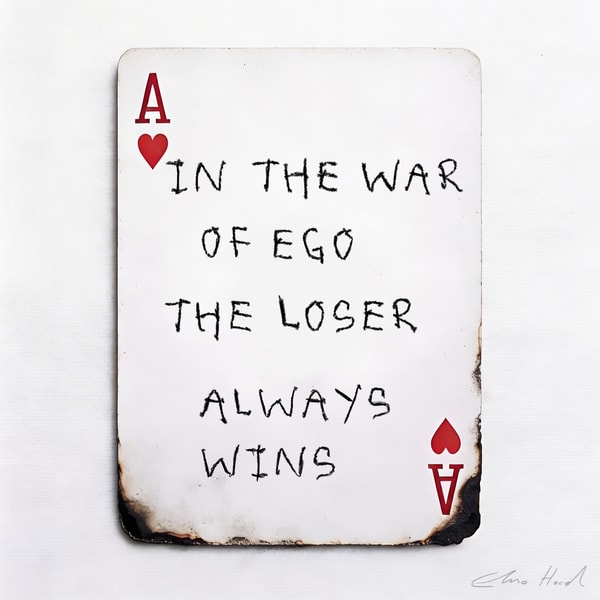
Elmo Hood, In The War of Ego, Mixed Media on Playing Card. Available at Guy Hepner, New York.
The text-based contemporary art tradition offers another context. Artists like Jenny Holzer, Barbara Kruger, and Ed Ruscha have made language central to visual art, embedding phrases in public spaces and gallery walls. Hood's aphorisms share their directness but differ in function. Where Holzer's Truisms and Kruger's interrogations operate as social critique, Hood's phrases function as affirmations—motivational art in the most literal sense, designed to be absorbed and applied to the viewer's own life.
This hybrid position—between Pop irony and outsider sincerity, between text art critique and self-help affirmation—is precisely what makes Hood's work resistant to easy categorization. It's also what makes it successful with audiences who don't typically engage with contemporary art. You don't need an art history degree to feel this work. You just need a pulse.
The 2013 viral moment didn't just introduce Elmo Hood to a wider audience—it created a template for how his career would develop. In the traditional art world trajectory, an artist builds a reputation slowly through gallery shows, critical attention, and the gradual cultivation of collector relationships. The internet collapses this timeline. Hood went from unknown to internationally recognized in the span of a share cycle, and the consequences of that acceleration have shaped everything since.
The celebrity collectors arrived quickly. Nina Dobrev, the Vampire Diaries actress, acquired work. The Game, the West Coast rapper known for his confrontational style, became a collector. These aren't traditional art world names—they're figures whose collecting decisions reflect personal taste rather than investment strategy or cultural positioning. When they buy art, they buy what they like, and they liked Hood's cards.
The social media amplification continued. P. Diddy shared Hood's work. Jessie J did the same. Each share introduced the playing card collages to new audiences, creating a feedback loop where visibility generated more visibility. This is the viral art Instagram dynamic that Hood navigated more successfully than almost any artist of his generation—he understood that the work's emotional directness was an asset in the scroll, not a liability.
Exhibitions followed the attention. New York, Paris, Munich, Ibiza, Miami, Bahrain—the international circuit opened up. In 2014, Hood showed at "The Allies" group exhibition in New York alongside the established British graffiti artist Inkie. The Teenage Cancer Trust commissioned him to paint murals in their Southampton hospital ward, a project Hood describes as particularly meaningful. Working with young cancer patients to design pieces they would want to see during treatment grounded the motivational aspects of his work in real-world application.
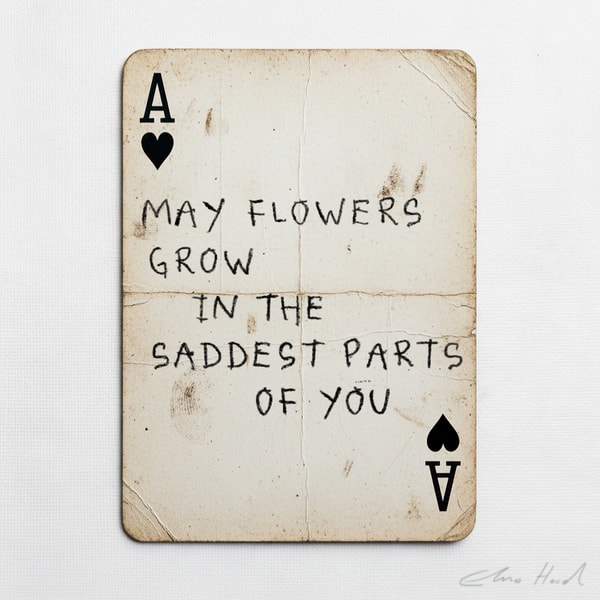
Elmo Hood, May Flowers Grow, Mixed Media on Playing Card. Available at Guy Hepner, New York.
The auction at the Houses of Parliament represents perhaps the strangest institutional validation. British political halls are not natural settings for playing card art from a self-taught artist who got famous on Instagram. But there it was, Hood's work finding its way into one of the world's oldest democratic institutions. The art world's gatekeepers might have been skeptical, but the collectors had already decided.
The phrases on Hood's cards deserve examination on their own terms. They represent a particular mode of text-based contemporary art that prioritizes accessibility over ambiguity, motivation over meditation. Consider the range:
These statements share common qualities. They're short—rarely more than ten words. They address the reader directly, either through imperatives ("Find," "Cross") or through the second person ("you"). They traffic in paradox and inversion, the rhetorical moves that make phrases memorable. And they're designed for extraction—you could lift any of these from the card surface and use them as Instagram captions, tattoo text, or wall decals without losing their impact.
This extractability is intentional. Hood creates motivational art in the truest sense: art that provides motivation, that functions as a tool for the viewer's own psychological work. The art historical parallel might be medieval illuminated manuscripts, where sacred texts were rendered beautiful to enhance their spiritual power. Hood's cards perform similar work in secular terms—they make emotional truths beautiful to enhance their psychological utility.
The critical response to this approach splits predictably. Skeptics see sentimentality, the kind of inspirational content that floods social media without artistic distinction. Defenders see radical accessibility, work that refuses the art world's exclusionary tendencies in favor of direct communication with anyone who encounters it. Both readings have validity. The question isn't whether Hood's text art is good or bad by traditional standards, but whether those standards adequately account for what the work is trying to do.
Elmo Hood's geography has shifted since the Shoreditch years. He now lives and works in Brisbane, Australia—a continent away from the London streets that first inspired him, a hemisphere away from the New York galleries that represent contemporary art's commercial center. This distance hasn't diminished his presence in the market. If anything, it's created a mystique that purely local artists lack.
The current series at Guy Hepner represents Hood's most refined articulation of the playing card concept. All fifteen works share uniform dimensions (12 x 16 inches), uniform pricing ($5,160), and uniform medium (mixed media playing card on wooden backed canvas). This standardization isn't accidental. It removes variables that might distract from the works' content, creating a series where differences emerge purely from the text, imagery, and specific physical interventions on each piece.
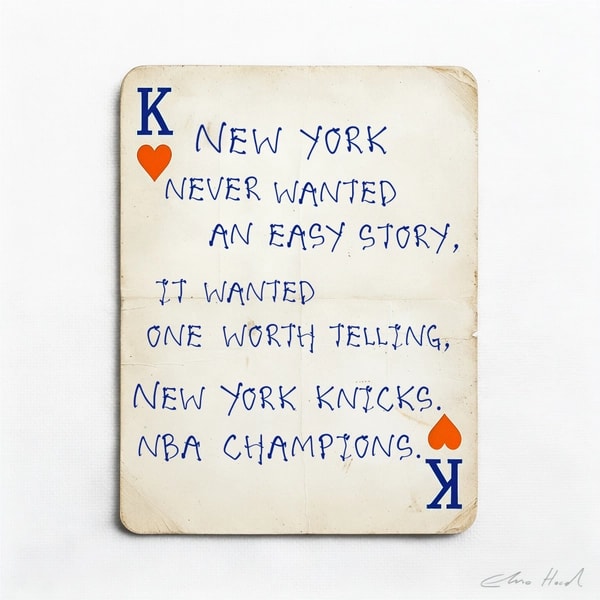
Elmo Hood, New York King, Mixed Media on Playing Card. Available at Guy Hepner, New York.
The 2025-2026 dating indicates these are fresh works, not archival material being brought to market years after creation. Hood continues to produce, continues to refine the format that made him famous, continues to find new things to say through the constrained vocabulary of hearts, diamonds, clubs, and spades. The kings and queens that feature heavily in his work have accumulated additional meanings through repetition—they've become Hood's repertory players, returning in piece after piece to enact new dramas.
All works in the current series are signed, addressing the authentication concerns that inevitably arise with artists who achieve fame through reproducible imagery. A photograph of a Hood playing card can be shared infinitely; the original object, with Hood's signature confirming its status, cannot be replicated. This distinction matters increasingly as the artist's profile rises and the incentive to produce unauthorized versions grows.
For collectors considering Elmo Hood's playing card paintings, several factors warrant attention:
The market trajectory for Hood's work suggests continued collector interest. His combination of viral visibility, celebrity endorsement, and genuine artistic development creates demand across collector demographics that rarely overlap. Traditional contemporary art collectors, Instagram-era enthusiasts, and decorative buyers all find different values in the work, creating a broader demand base than most artists achieve.
Why playing cards? The question deserves consideration beyond Hood's personal origin story. Cards carry symbolic weight that other found objects lack. They represent chance and skill, luck and strategy—the eternal negotiation between what we control and what controls us. They're associated with gambling, with risk-taking, with the moment when fortunes change on a single draw.
The royal cards are particularly loaded. Kings, Queens, and Jacks represent power hierarchies, gendered social structures, and the game-theory dynamics of competition. When Hood writes relationship truths across their faces, he's activating these associations even as he transforms them. The King of Hearts becomes every powerful figure brought low by emotion. The Queen of Diamonds becomes every valuable thing we risk losing.
The Joker occupies special status. Outside the ranked hierarchy, unpredictable in function, the Joker represents wildcard energy—the force that disrupts ordered systems. "Find Your Line And Fucking Cross It" written across a Joker's face merges the card's traditional meaning with an explicit command, making the transgressive energy verbal as well as visual.
These cultural resonances give Hood's work depth that its emotional directness might seem to preclude. The cards aren't blank surfaces receiving text—they're collaborative partners in meaning-making, contributing centuries of accumulated symbolism to each piece's final effect.
British GQ called Hood "one to watch" as early as 2016, placing him in the Pop Art tradition while noting his distinctive fusion of celebrity imagery and street art symbolism. The publication's attention reflected Hood's unusual position as an artist whose commercial success preceded critical validation rather than following it.
The publications that have covered Hood's work—GQ, Forbes, Glamour, Wall Street International, Made in Shoreditch—represent a cross-section that mirrors his collector base. These aren't specialist art magazines but lifestyle publications whose readers engage with culture broadly rather than professionally. This coverage pattern reinforces Hood's role as a bridge figure, connecting contemporary art's conceptual concerns with general audiences.
Art world skeptics remain. The earnestness of Hood's statements, the accessibility of his approach, and the viral origin of his fame all trigger suspicions in contexts where difficulty and exclusivity are valued. But these suspicions increasingly seem outdated, artifacts of a gatekeeping mentality that social media has eroded. The audience has voted, repeatedly and enthusiastically, for work that speaks to them directly. Hood is simply one of the most successful examples of what direct speech can achieve.
Ten years after the viral moment that launched his career, Elmo Hood has proven that internet fame can translate into sustained artistic practice. The playing card collage artist who emerged from Shoreditch's street art scene has become something more durable—a brand, certainly, but also a genuine artistic voice with a distinctive perspective on emotion, language, and visual culture.
The motivational art category that Hood occupies will only grow as social media continues reshaping how people encounter and use images. Younger collectors especially seek art that functions—that does something for them psychologically, that integrates into their daily lives rather than hanging passively on walls. Hood's work was designed for this kind of active use before the demand was fully articulated.
The New York presence at Guy Hepner marks a significant moment in this ongoing story. Manhattan remains contemporary art's commercial center, and visibility at 529 West 20th Street connects Hood to collector networks that Brisbane or even London cannot access as directly. The fifteen works currently available represent an opportunity to acquire material from an artist whose trajectory continues upward and whose best-known imagery has already proven its cultural staying power.
For collectors moved by Elmo Hood's playing card paintings—by their directness, their emotional resonance, their unusual position in contemporary art's landscape—the current series at Guy Hepner offers clear entry points. The uniform pricing eliminates haggling anxiety. The uniform quality assures that any selection from the available works will represent Hood's mature practice.
Visit Guy Hepner at 529 West 20th Street in New York to view the available mixed media playing card works in person. The physical presence of these objects—the texture of vintage cards, the evidence of fire, the handwritten text that photographs cannot fully capture—matters to the experience. Alternatively, contact the gallery directly for detailed condition reports, additional images, and assistance with acquisition.
Art that speaks directly is rare. Art that speaks directly and survives its own accessibility is rarer still. Elmo Hood has managed both. The cards are on the table. The move is yours.
Explore Elmo Hood prints for sale at Guy Hepner: Playing Cards.
Related Series