H20/sio2 Water Bags

July 29, 2026
Your fingers meet solid glass, cool and unyielding, yet your eyes insist you are touching a water-filled plastic bag, soft and yielding, the kind you might have carried home from a carnival with a goldfish darting inside. This is the precise moment that Dylan Martinez glass artist has spent his career engineering—the instant when the eye is betrayed by the hand, when certainty dissolves into wonder. Working entirely without molds at temperatures between 650 and 1,150 degrees Fahrenheit, Martinez has established himself as one of contemporary glass art's most technically accomplished and conceptually engaging practitioners. His hyperrealistic glass sculptures of water bags, balloons, and nostalgic objects occupy a unique space in the material culture conversation, asking us to consider what we think we know about the objects that surround us.
In an era when digital illusion saturates our visual environment, Martinez returns us to a fundamentally analog form of trickery. His trompe l'oeil glass art operates not through pixels or algorithms but through the ancient alchemy of silica and heat, hand and breath. The deception feels earned, almost generous—a gift rather than a manipulation. When you encounter a Martinez water balloon resting on a pedestal, the pleasure derives not merely from being fooled but from understanding the extraordinary skill required to accomplish that fooling. The work rewards extended looking, revealing its secrets gradually: the subtle opacity where you expect transparency, the impossibly perfect surface tension, the weight that seems both right and wrong simultaneously.
Dylan Martinez arrived at glass through what he has described as a fortuitous accident. While pursuing a Bachelor of Science at the University of Wisconsin-River Falls, studying broad field science with a minor in outdoor education, he enrolled in a glassblowing course as an elective. The experience was transformative in the most immediate sense—within the first session at the furnace, Martinez recognized that he had discovered not merely a hobby but a vocation. The scientific mind that had drawn him to the natural world found unexpected application in understanding the chemistry of molten glass, the physics of heat transfer, the precise calibrations required to coax a gather of glowing material into recognizable form.
This scientific foundation distinguishes Martinez's approach from artists who come to glass through purely aesthetic channels. He thinks about his material in terms of molecular behavior, expansion coefficients, and annealing schedules. His undergraduate background in outdoor education also left traces in his work—a deep attention to natural phenomena, the way water behaves in containment, how light moves through transparent and translucent substances. When Martinez creates a water bag sculpture, he is drawing on years of observing actual water in actual bags, understanding the physics of how liquid distorts whatever contains it, how surfaces catch and bend light in predictable yet endlessly variable ways.
After completing his undergraduate degree, Martinez pursued advanced training at Ball State University in Muncie, Indiana, where he earned a Master of Fine Arts in Glass. The graduate program provided both technical refinement and conceptual grounding, pushing him to articulate why his chosen material mattered, what glass could do that other materials could not. During this period, Martinez also trained with masters in Murano, the legendary Venetian island where glass has been made for over a thousand years. This Murano training connected him to centuries of accumulated knowledge, techniques passed from master to apprentice across generations, an unbroken chain of material wisdom that continues to inform his practice.
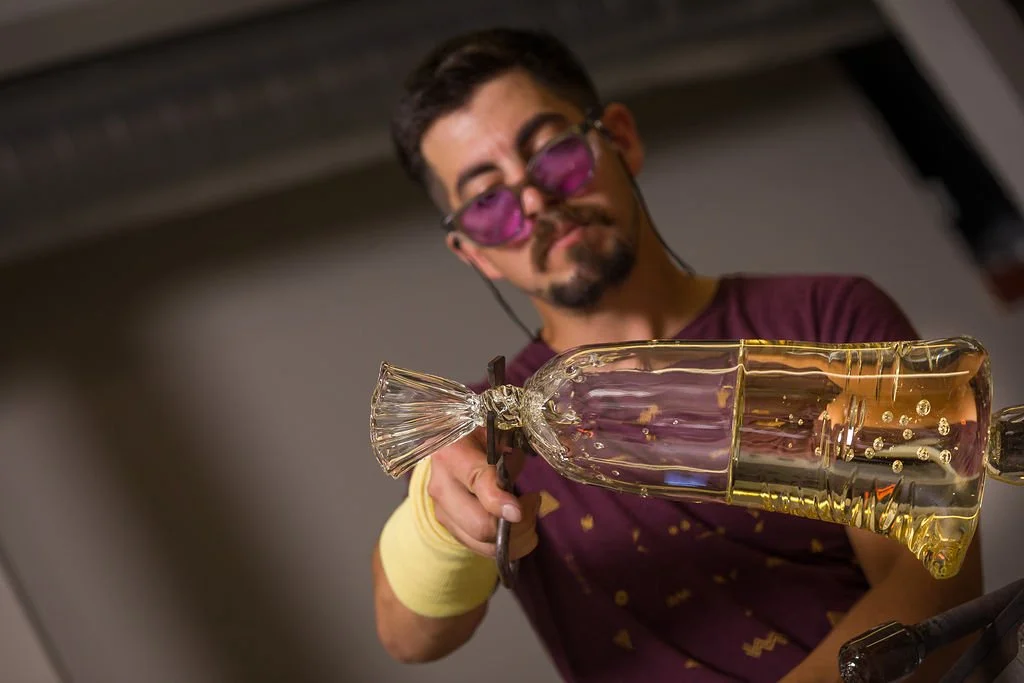
Dylan Martinez at work in his studio. Contemporary glass art in progress.
The series that established Martinez's reputation emerged from memory—specifically, from the memory of winning a goldfish at a county fair, carrying it home in a plastic bag of water, watching the fish navigate its temporary prison. This childhood experience, shared by millions who grew up in America, carries enormous emotional resonance. The goldfish-in-a-bag represents a constellation of feelings: the excitement of the carnival, the anxiety of keeping a living creature alive, the bittersweet knowledge that the fish probably would not survive long, the strange beauty of that orange body suspended in that clear water in that plastic membrane.
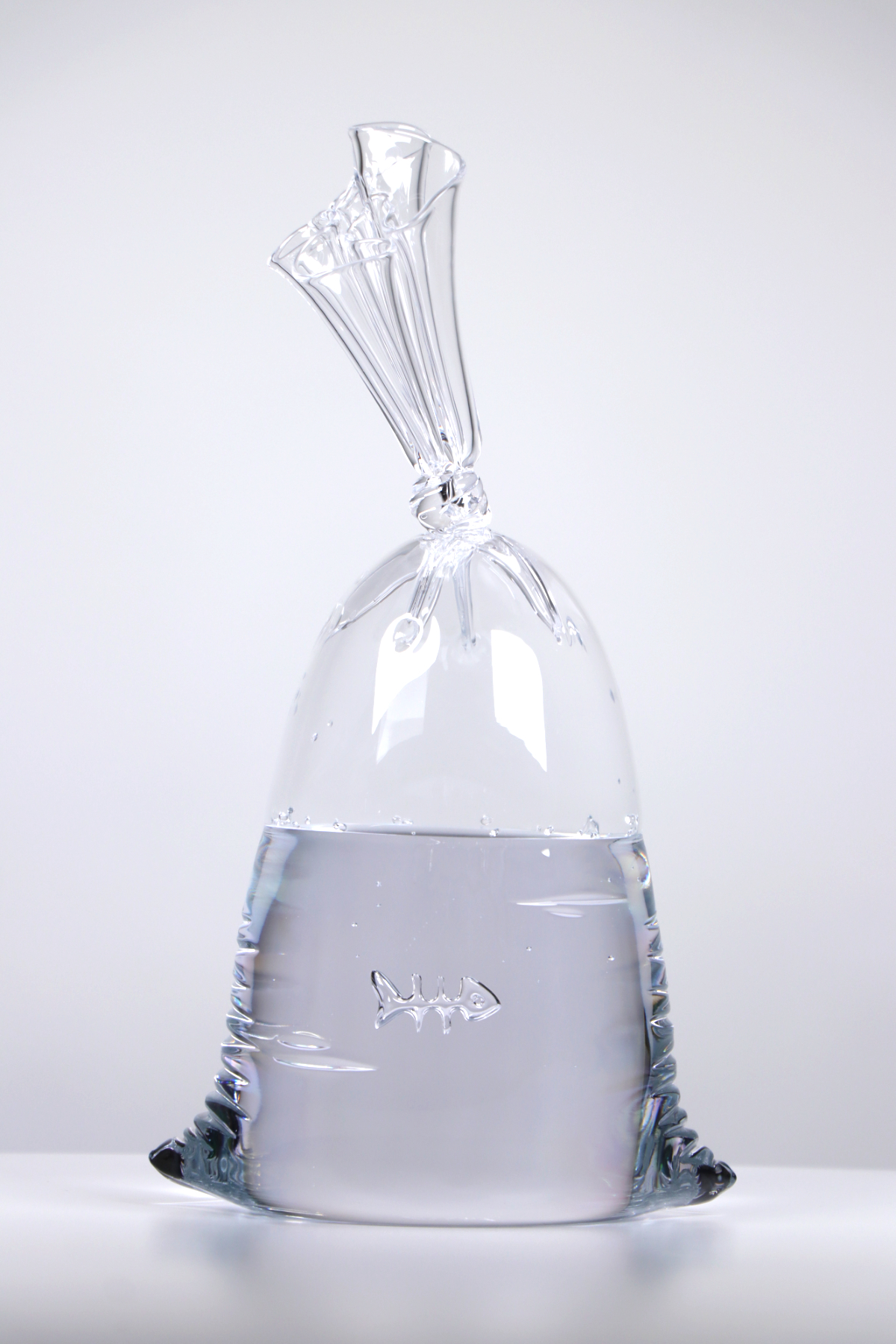
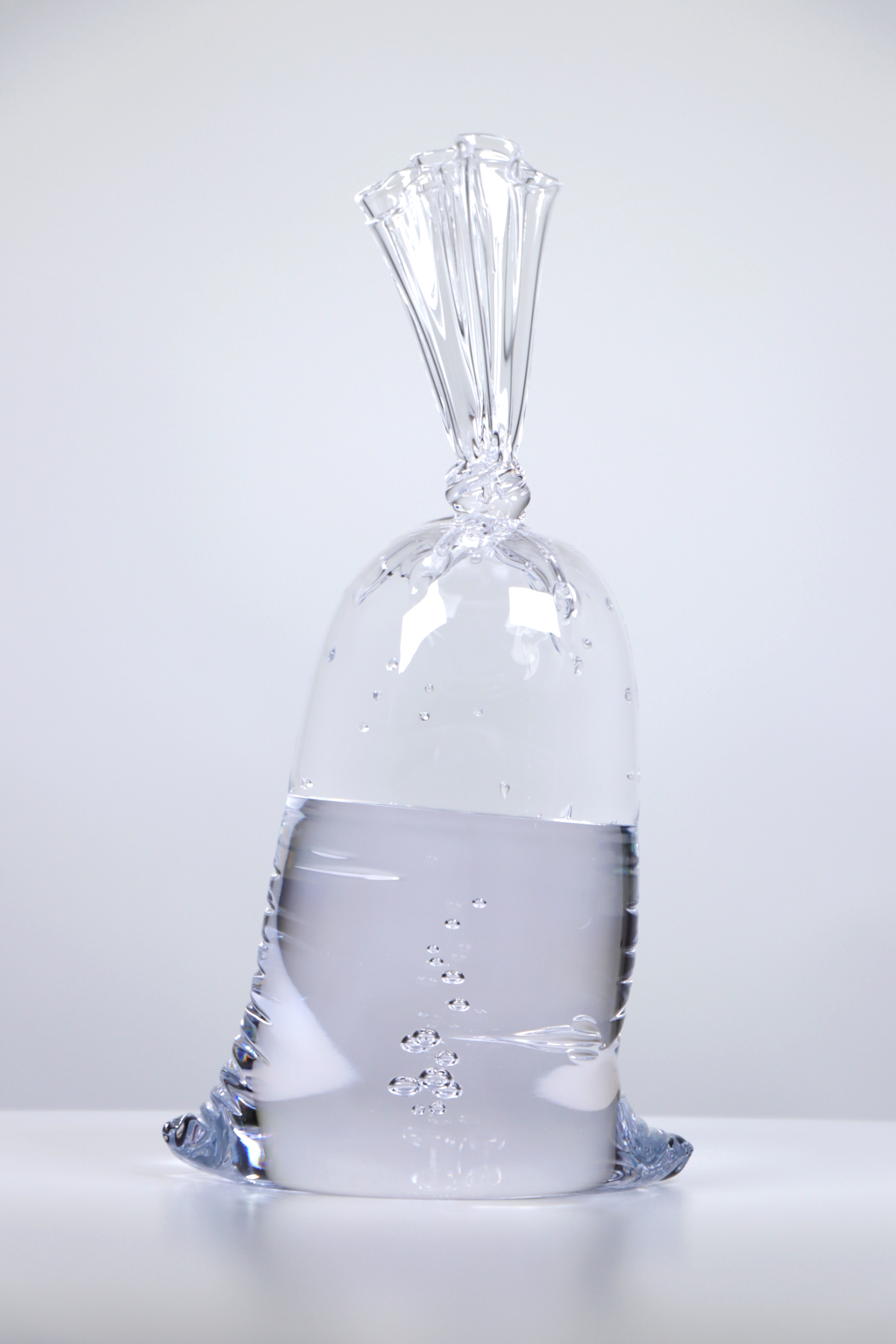
Martinez's Dylan Martinez water bag sculpture series, known as H2O/SiO2 Water Bags, transforms these ephemeral objects into permanent monuments. The title itself announces the conceptual game: H2O (water) and SiO2 (silicon dioxide, the primary component of glass) are revealed as partners in deception. The sculptures appear to contain water but are solid glass throughout. The apparent plastic bag, with its characteristic gathered and tied top, is also glass. Even the goldfish, their scales catching light, their eyes black and alert, are glass. Everything you see is glass, yet nothing looks like glass. The trompe l'oeil effect is so convincing that viewers regularly attempt to verify the illusion by touch, reaching out to confirm what their eyes refuse to accept.
The technical requirements for achieving this level of realism are staggering. Martinez works entirely in hot glass, meaning each piece is shaped while the material is molten and malleable, without recourse to casting or cold-working. He hand-sculpts every element—the bag, the tie, the water surface, the fish—at the furnace, manipulating glass at temperatures that would instantly vaporize human flesh. The margin for error approaches zero; a moment's hesitation or a miscalculated movement can ruin hours of work. Because glass must be kept in constant motion while hot, Martinez must visualize the entire finished piece while working on individual components, holding the complete image in mind even as he focuses on a single detail.
Critics have sometimes dismissed nostalgia as a lesser artistic impulse, a sentimental retreat from the difficulty of engaging the present. Martinez's work complicates this dismissal by demonstrating that nostalgia can serve as a legitimate starting point for rigorous artistic investigation. His subjects—goldfish bags, Water Balloons, Swedish Fish candy, Pac-Man ghosts—all derive from childhood experience, yet the work that emerges from these memories operates on multiple levels simultaneously. The nostalgia provides an entry point, a moment of recognition and emotional connection, but the sculptures reward continued engagement with their formal qualities, technical virtuosity, and philosophical implications.
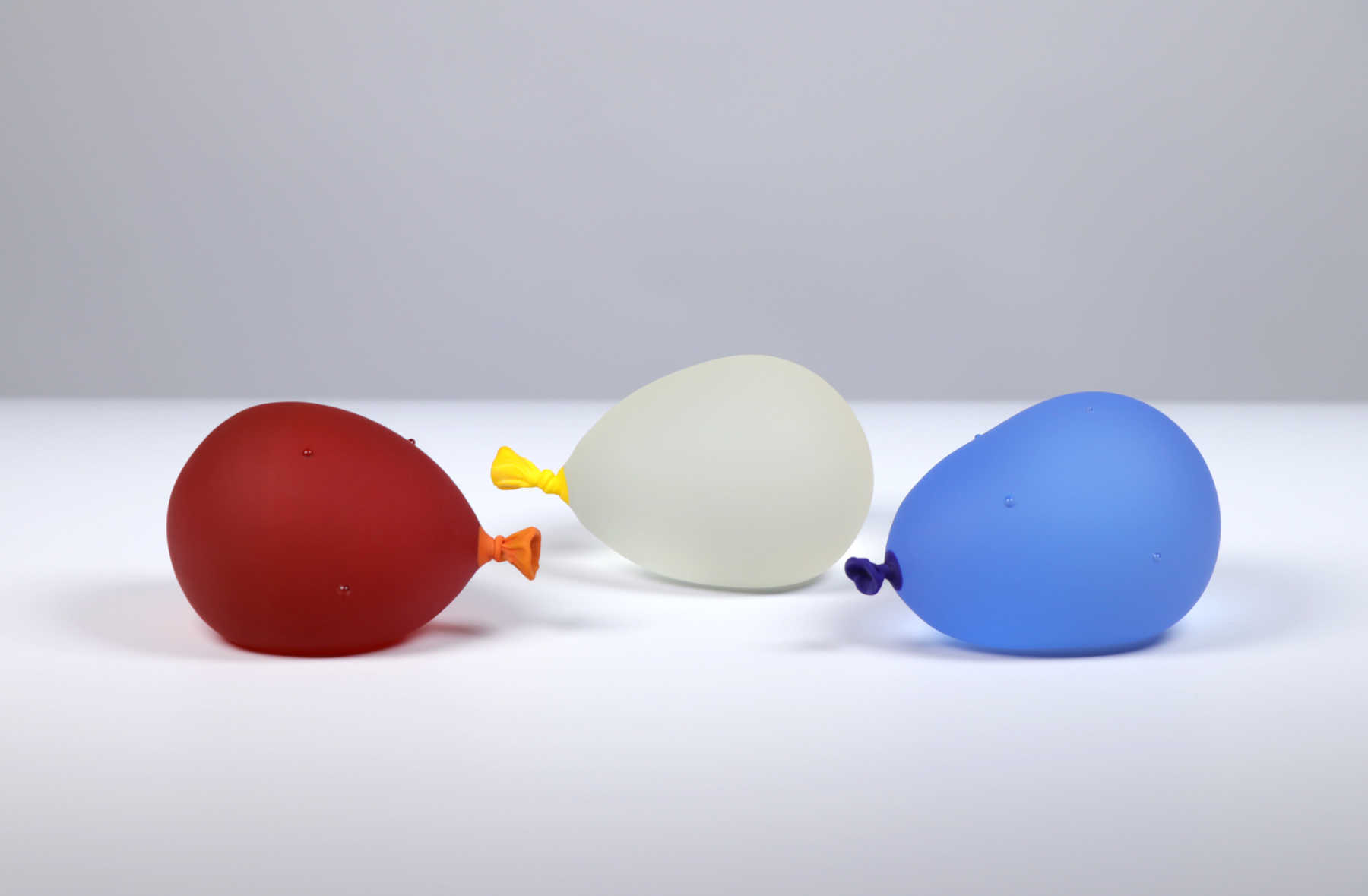
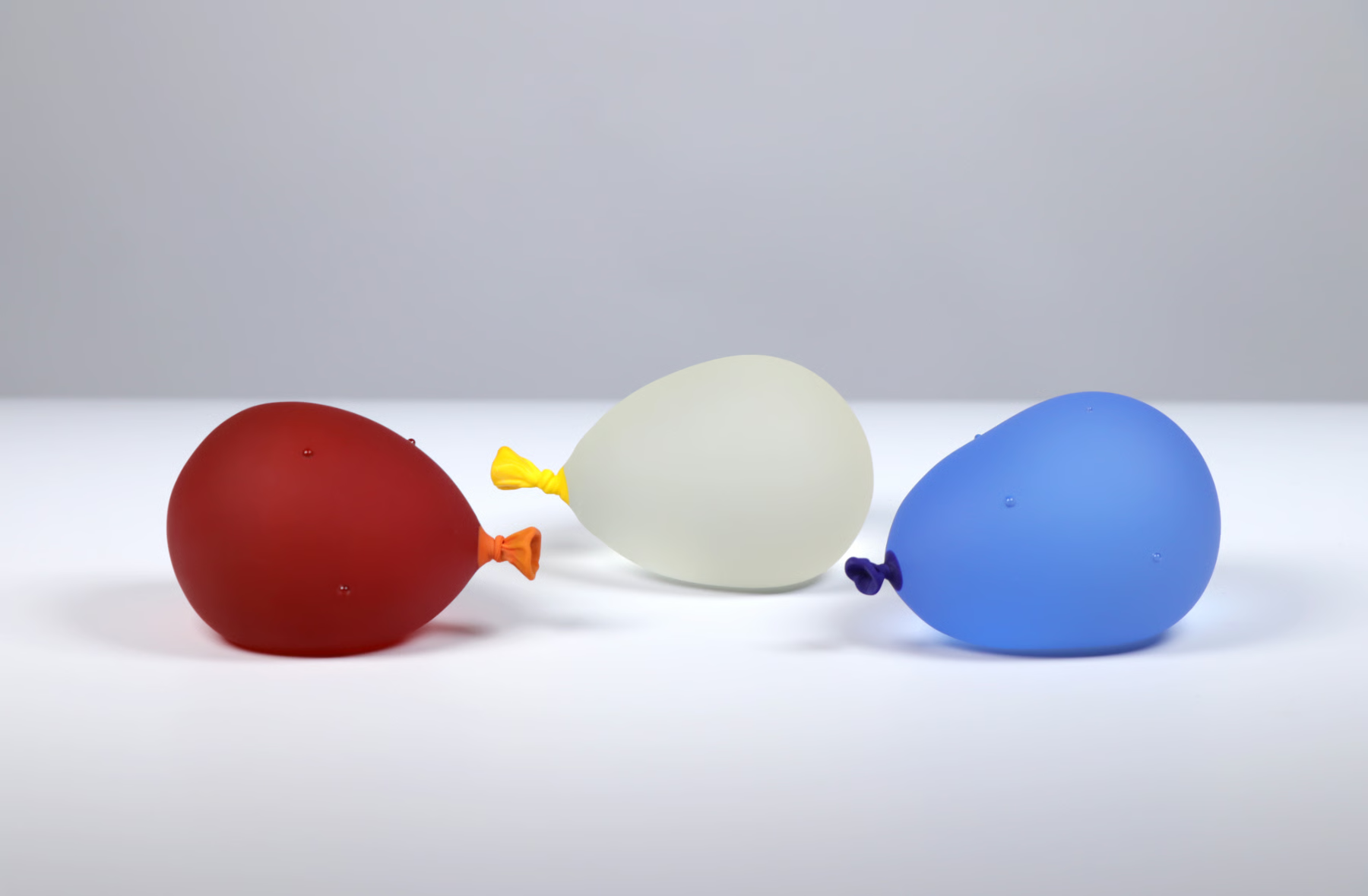
The water balloon glass sculpture series exemplifies this multilayered approach. Anyone who has held a water balloon knows its particular haptic qualities: the taut skin, the yielding pressure, the slight translucency where the rubber stretches thin, the dangerous pleasure of potential rupture. Martinez's glass balloons capture these qualities with almost painful precision. They look so much like actual water balloons that the body anticipates squishiness, only to encounter solid resistance. This moment of tactile surprise forces reconsideration of everything previously assumed about the object. If the eye can be so thoroughly deceived, what else might we be seeing incorrectly?
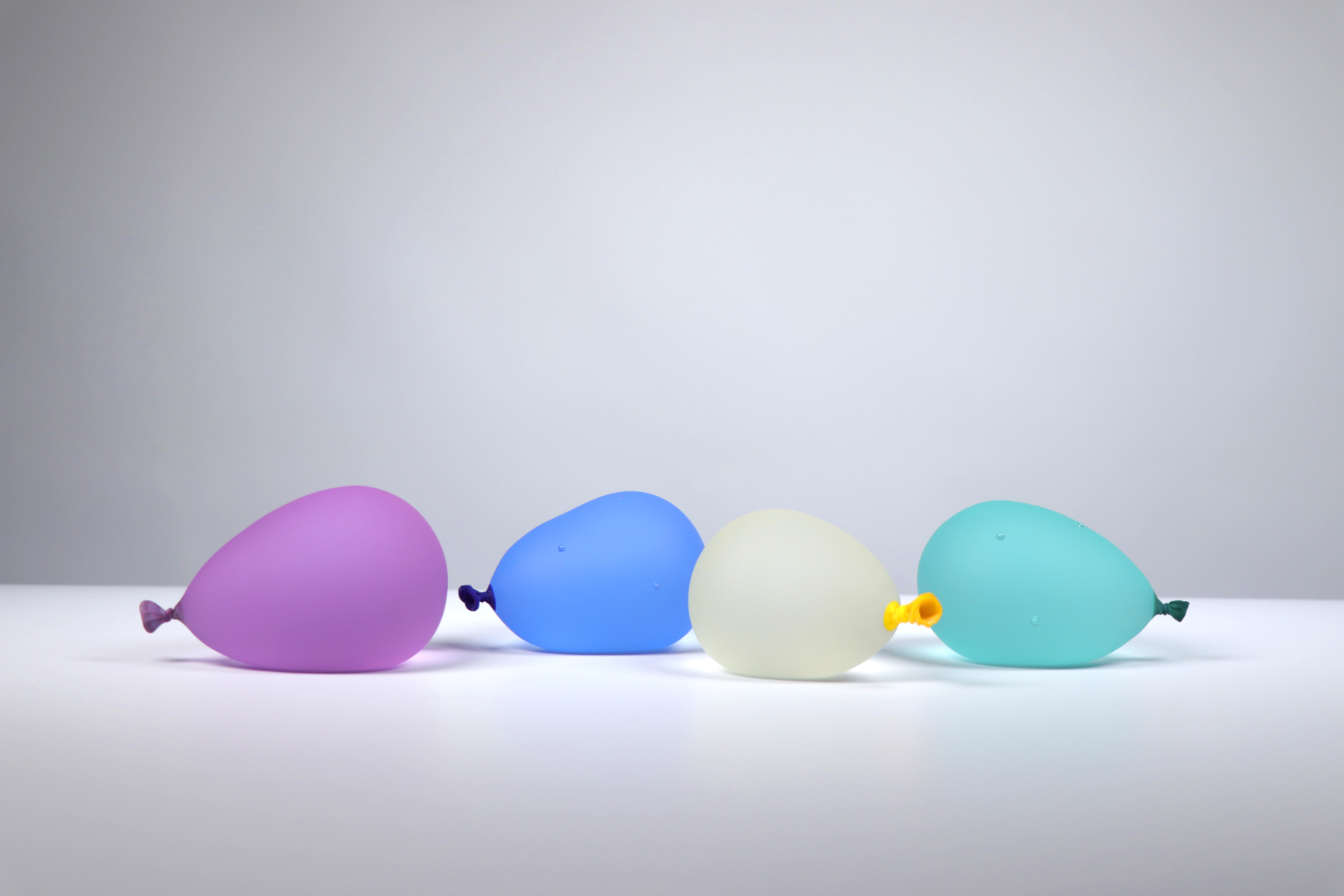
Dylan Martinez, Water Balloon Group, Glass Sculpture. Available at Guy Hepner, New York.
The balloons also engage questions of time and permanence. An actual water balloon exists in a state of constant potential dissolution—it will pop, it will leak, it will deflate. Martinez's glass balloons freeze this precarious moment, preserving permanently what would otherwise disappear in seconds. The tension between the balloon's apparent fragility and its actual permanence generates a productive unease. We know intellectually that the sculpture is solid and stable, yet emotionally we cannot shake the sense that it might burst at any moment. This sustained tension distinguishes art from mere craft; the object continues to work on us long after the initial surprise fades.
Understanding how Martinez achieves his effects requires some familiarity with glass as a material. Glass is not merely melted sand; it is a precisely calibrated mixture of silica, fluxes, and stabilizers, each component contributing specific properties to the finished material. Different formulations produce different characteristics—lead crystal for clarity and refractive brilliance, soda-lime glass for everyday durability, borosilicate for thermal resistance. Martinez selects his glass chemistry based on the specific demands of each piece, sometimes combining multiple formulations within a single work to achieve desired optical effects.
The process begins at the furnace, where crucibles of molten glass glow at temperatures exceeding 2,000 degrees Fahrenheit. Using a blowpipe or solid rod called a punty, Martinez gathers a mass of this molten material and begins shaping it while maintaining constant rotation to prevent sagging. Additional gathers can be added to build volume, and color can be introduced through pre-made canes, powder, or solid pieces incorporated into the hot glass. The working window—the time during which the glass remains soft enough to manipulate—varies depending on the piece's size and complexity but typically measures in minutes rather than hours.
For his hyperrealistic glass sculpture work, Martinez has developed proprietary techniques for creating specific illusions. The apparent water in his bag sculptures, for instance, derives from careful control of the glass's transparency, including strategic introduction of subtle distortions that mimic how actual water bends light. The "plastic" of the bags requires creating thin shells of glass that maintain realistic proportions while remaining structurally sound. The goldfish demand intimate knowledge of piscine anatomy, since any anatomical error would undermine the illusion's credibility. Each element must be convincing in isolation and coherent with every other element in the finished composition.
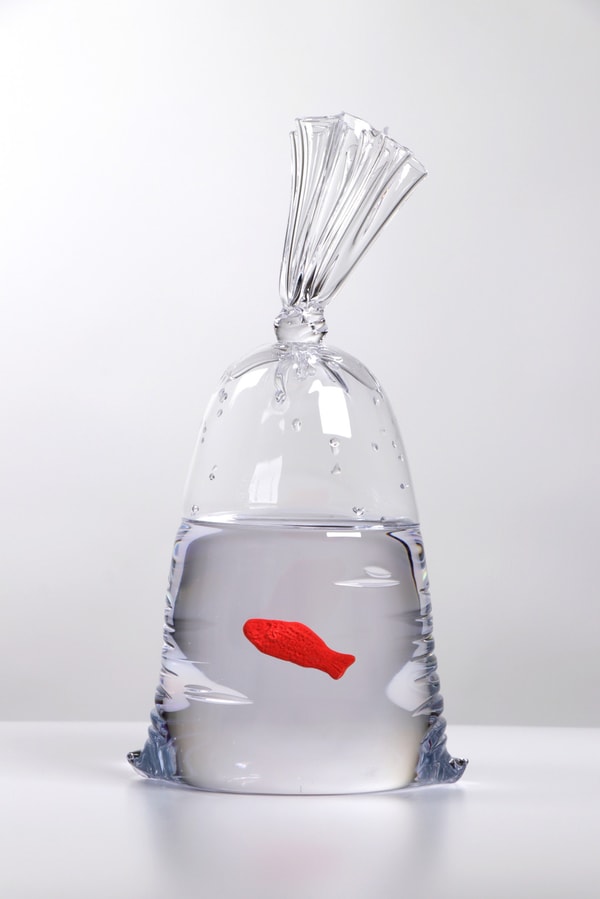
Dylan Martinez, Swedish fish Water Bag, Glass Sculpture. Available at Guy Hepner, New York.
Martinez works within a tradition of contemporary glass art that emerged from the Studio Glass Movement of the 1960s. Before this period, glass was primarily an industrial material, produced in factories by teams of specialized workers. The movement's founders—figures like Harvey Littleton and Dominick Labino—demonstrated that individual artists could work glass independently, outside factory settings, using smaller furnaces and more intimate processes. This democratization enabled generations of artists to explore glass as an expressive medium rather than merely a functional one.
Within this tradition, Martinez occupies a specific niche. Unlike artists who emphasize glass's unique optical properties through abstract forms, he uses the material's capabilities to represent recognizable objects. Unlike those who push glass toward sculptural monumentality, he works at human scale, creating objects sized for domestic spaces. Unlike those who celebrate the handmade through visible traces of process, he effaces his hand to achieve seamless illusion. His nearest relatives might be hyperrealist painters like Audrey Flack or Richard Estes, artists who used traditional mediums to achieve photographic fidelity, though Martinez's work in three dimensions creates additional complications and opportunities.
The trompe l'oeil tradition itself extends back centuries, finding expression in Roman frescoes, Dutch Golden Age still lifes, and American nineteenth-century money paintings. What distinguishes Martinez's contribution is his use of glass for this purpose. Glass is typically experienced as transparent or translucent, as something we look through rather than at. By making glass impersonate opaque objects, Martinez inverts our normal relationship with the material. We find ourselves looking at glass pretending to be plastic pretending to contain water—a Russian nesting doll of material identity that keeps the mind pleasantly occupied.
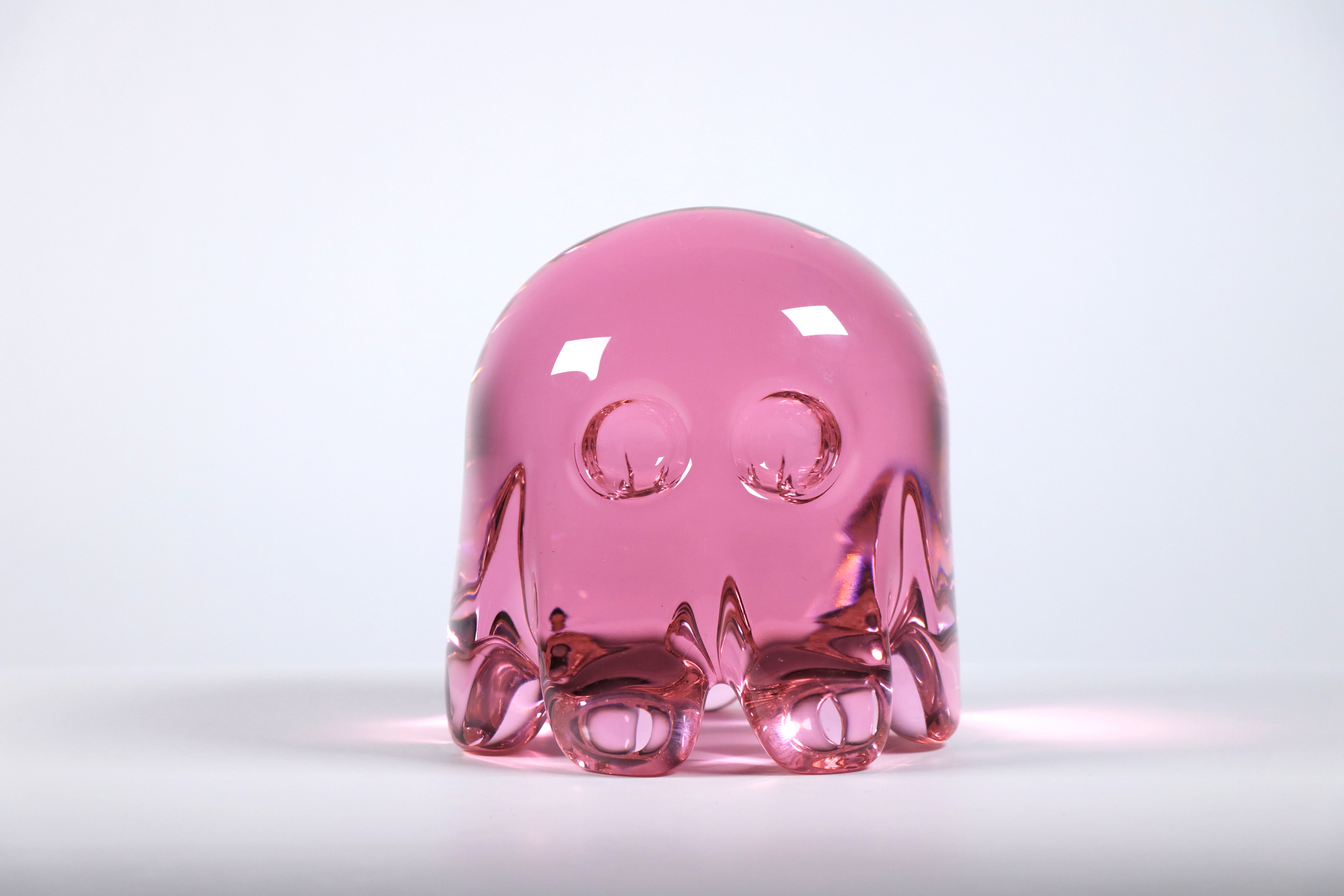
Martinez's Dylan Martinez Pac-Man Ghost series represents a departure from naturalistic subjects toward explicitly pop cultural references. The ghosts—Blinky, Pinky, Inky, and Clyde—constitute one of video gaming's most recognizable iconographies, familiar to multiple generations who grew up playing the original arcade game or its countless successors. In Martinez's hands, these pixelated characters become solid glass objects, their simple geometric forms rendered with the same technical precision he applies to his more realistic subjects.
The choice of Pac-Man ghosts as subject matter extends the nostalgic project while adding new dimensions. Where the water bags and balloons recall physical childhood experiences—county fairs, backyard games—the ghosts evoke mediated childhood experiences, hours spent in front of screens, the particular satisfactions and frustrations of early video games. This expansion acknowledges that contemporary nostalgia encompasses not only natural and handmade objects but also digital and mass-produced ones. The ghosts are as much artifacts of growing up in late-twentieth-century America as any water balloon.
Technically, the ghosts present different challenges than the water bags. Their forms are simpler—essentially rounded cylinders with waving bases and two dark circles for eyes—but this simplicity demands precision. Any deviation from the expected proportions would register immediately as error. Martinez must also capture the ghosts' curious combination of menace and cuteness, the way their blank expressions somehow communicate personality. The translucent quality of the glass enhances this effect, giving the ghosts an otherworldly presence that suits their spectral identities.
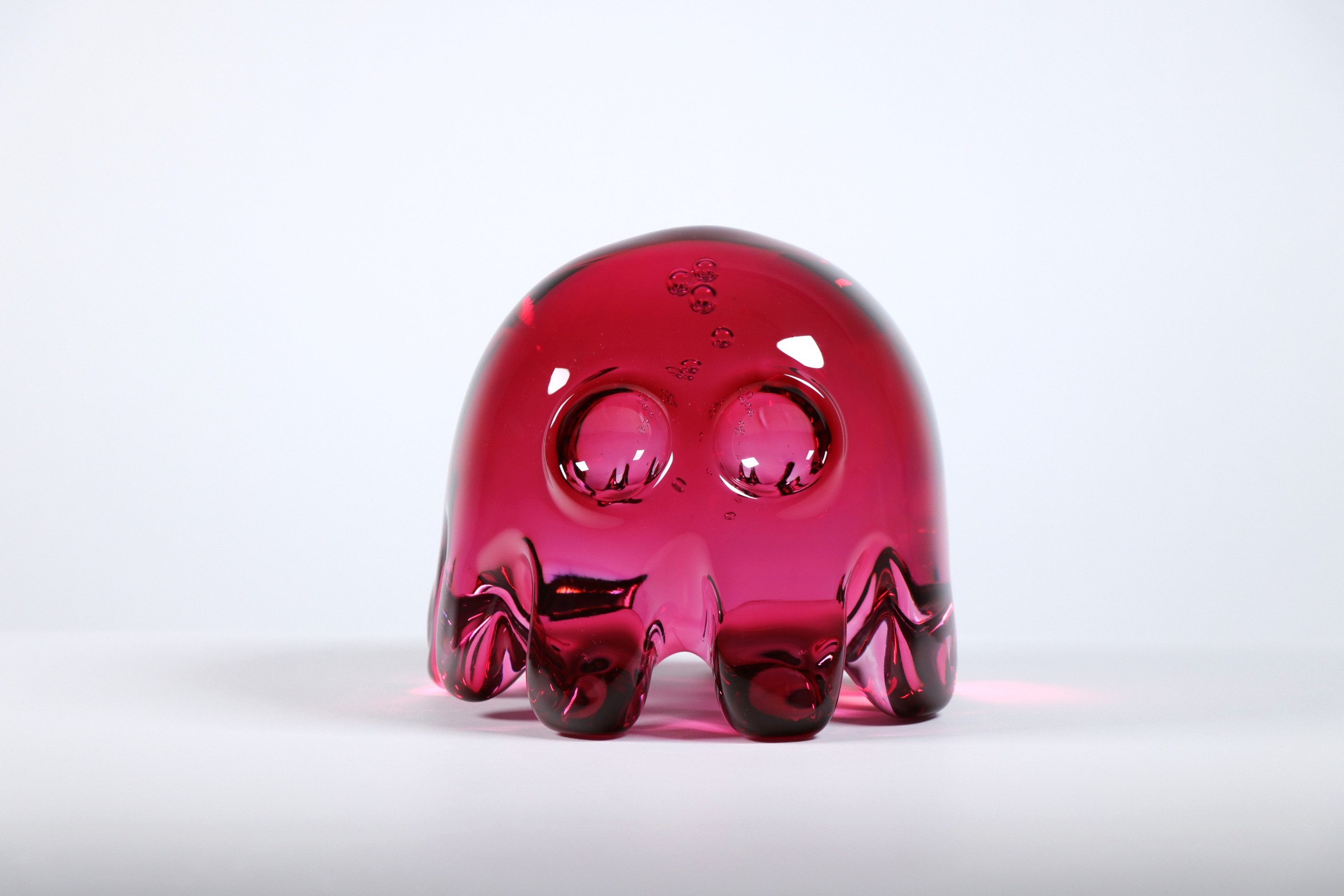
Dylan Martinez, Pac- Man G, Glass Sculpture. Available at Guy Hepner, New York
The Swedish Fish Water Bags series combines two childhood signifiers into a single object: the candy and the carnival bag. Instead of living goldfish, these bags contain the red fish-shaped candy familiar from movie theaters, vending machines, and Halloween hauls. The substitution creates productive confusion—are these fish alive or edible? Real or artificial? The answer, of course, is neither; they are glass sculptures of plastic bags containing gelatinous candy shaped like fish, several removes from any actual fish but somehow more affecting for all the mediation.
This series highlights Martinez's interest in the artificial. The original Swedish Fish candy is already a stylized representation of a fish, its form simplified to basic curves, its texture smooth and uniform, its color a vivid red that no actual fish species possesses. By rendering this artificial fish in glass, Martinez adds another layer of abstraction while paradoxically making the object feel more real. The glass Swedish Fish have weight and presence that the candy lacks; they invite contemplation rather than consumption. The play between artifice and reality, between representation and thing, generates much of the work's intellectual interest.
As a Murano trained glass artist working in the hyperrealist tradition, Martinez occupies a favorable position in the current market for contemporary decorative arts. Collectors have shown sustained interest in his work, responding to both its technical accomplishment and its emotional accessibility. The pieces function well in domestic settings, providing conversation-starting focal points that reward extended engagement without demanding the contemplative silence of more austere contemporary art. They also photograph well, an increasingly important consideration in an era when collectors often discover artists through social media.
For collectors considering a Martinez acquisition, several factors merit attention:
Critical response to Martinez's work has been overwhelmingly positive, with reviewers consistently praising his technical mastery while engaging seriously with his conceptual project. The work has been featured in numerous publications and exhibited at galleries and museums across the country. Critics have noted the democratic appeal of his subjects—unlike art that requires specialized knowledge to appreciate, Martinez's pieces communicate immediately to anyone who has carried home a carnival goldfish or launched a water balloon at a sibling.
This accessibility has occasionally provoked skepticism from critics who associate difficulty with value, but such skepticism misunderstands Martinez's achievement. The apparent simplicity of his subjects belies the complexity of their execution and meaning. The work operates simultaneously as feat of craft, meditation on material, exploration of memory, and commentary on perception. That it accomplishes all this while remaining approachable and even joyful represents a significant artistic achievement, not a limitation.
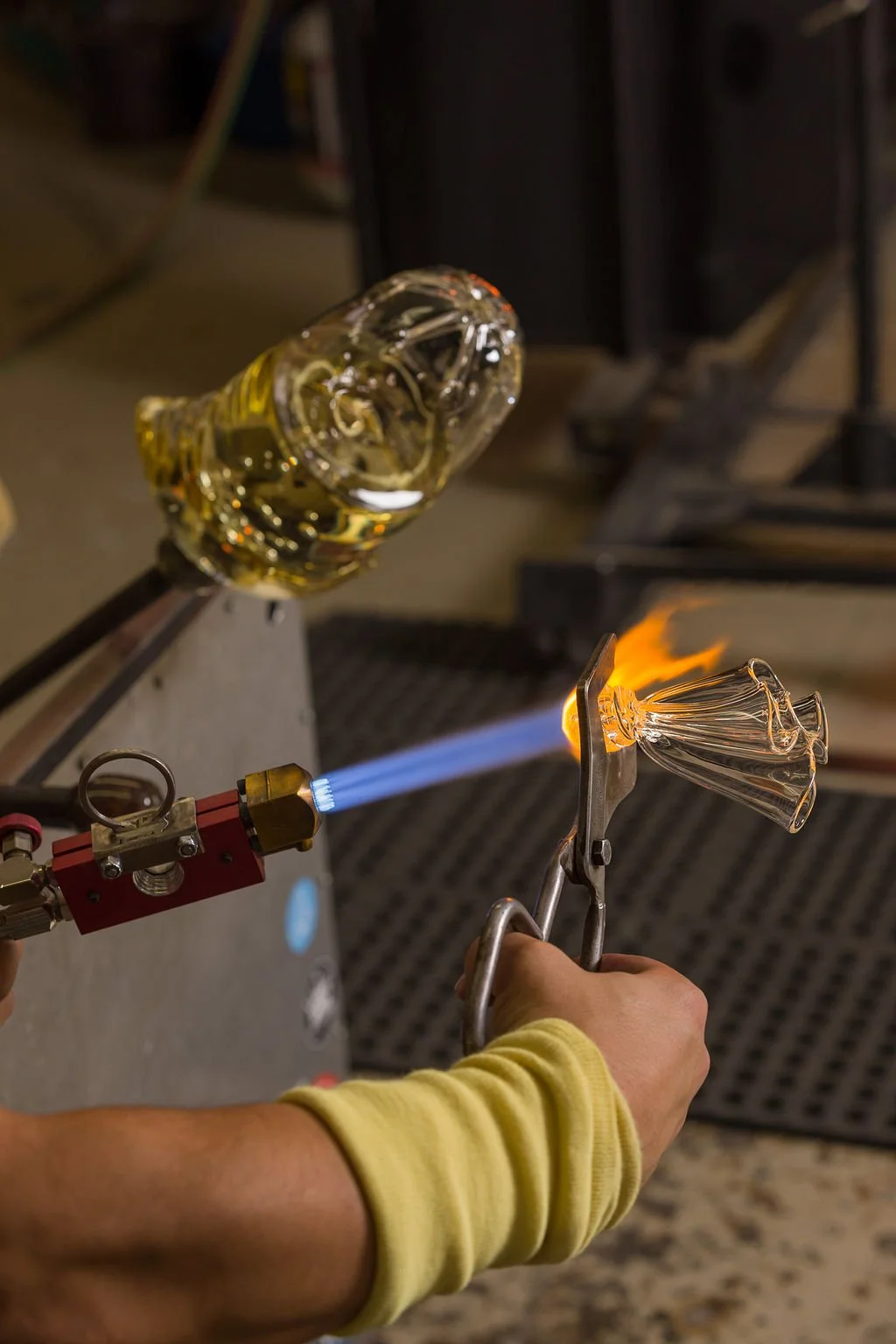
Dylan Martinez working with molten glass at the furnace.
At its deepest level, Martinez's work raises questions about the nature of perception and the ethics of illusion. We live in an age of unprecedented capacity for visual manipulation—deepfakes, photoshopped bodies, algorithmically generated images that never existed as physical objects. Against this backdrop of digital unreality, Martinez's analog illusions feel almost wholesome. His deceptions are transparent in their intentions even when opaque in their execution. We know we are being fooled; the pleasure derives from appreciating the skill required to fool us.
This transparency distinguishes art from fraud. Martinez does not sell his water bags as actual water bags; he sells them as glass sculptures of water bags. The illusion is the point, not the means to some other end. When we stand before one of his pieces, we enter a kind of game, willingly suspending our knowledge of the object's true nature to experience the pleasure of being deceived. This willing suspension recalls theatrical experience, where audiences choose to believe that actors are characters and stages are locations. Martinez extends this theatrical logic to physical objects, creating props for imaginary scenarios that viewers construct in their own minds.
The work also engages broader questions about authenticity and reproduction. In an age when three-dimensional printing can reproduce almost any form, when mass production makes individual craftsmanship increasingly rare, Martinez's hand-sculpted pieces assert the continuing value of human skill and attention. Each water balloon, each goldfish, each Pac-Man ghost bears the evidence of its maker's decisions, even when those decisions aim at effacing themselves. The paradox of hyperrealism—that enormous skill goes into making skill invisible—becomes itself a subject for contemplation.
Dylan Martinez understands that wonder and nostalgia are not opposites of intellectual rigor—they are its companions. His sculptures invite us to remember the first time we held a water balloon, the first time we carried home a carnival goldfish, the first time we guided Pac-Man through a maze of pursuing ghosts. But they also ask us to consider what we see when we see, what we know when we know, how material and illusion collaborate to create meaning. These are not simple questions, and Martinez's work does not offer simple answers. Instead, it holds the questions open, allowing us to dwell in uncertainty, to enjoy the productive confusion of materials that refuse to be what they appear.
From his Pacific Northwest studio, Martinez continues to push the boundaries of what hot glass can achieve. His Murano training provides a foundation of traditional technique; his scientific background supplies analytical rigor; his childhood memories furnish endless subjects for transformation. The combination has produced a body of work that stands alone in contemporary glass art, immediately recognizable and consistently surprising. Each new series extends the project while remaining faithful to its core commitments: technical excellence, emotional resonance, intellectual provocation.
For collectors drawn to contemporary glass art that rewards both immediate appreciation and sustained contemplation, Martinez's sculptures represent exceptional opportunities. His water bags recall the universal experience of childhood fair prizes; his water balloons capture moments of precarious joy; his Pac-Man ghosts bridge generational divides through shared cultural memory. Each piece demonstrates what becomes possible when mastery meets imagination, when ancient craft engages contemporary subjects, when the hand serves the eye in creating objects that question everything we think we see.
Guy Hepner is pleased to offer a selection of Dylan Martinez sculptures at our gallery at 529 West 20th Street, New York. We invite collectors to experience these remarkable works in person, where their full illusionistic power can be appreciated. To discuss availability or request additional information about specific pieces, please contact our gallery team at info@guyhepner.com or call +1 (212) 226 8680. Discover for yourself why critics and collectors alike have recognized Dylan Martinez as one of the most distinctive voices in contemporary glass art.
Explore Dylan Martinez prints for sale at Guy Hepner: H20/sio2 Water Bags, Pac- Man Ghosts, Swedish Fish Water Bags, Water Balloons.
Related Series