Painting

September 1, 2026
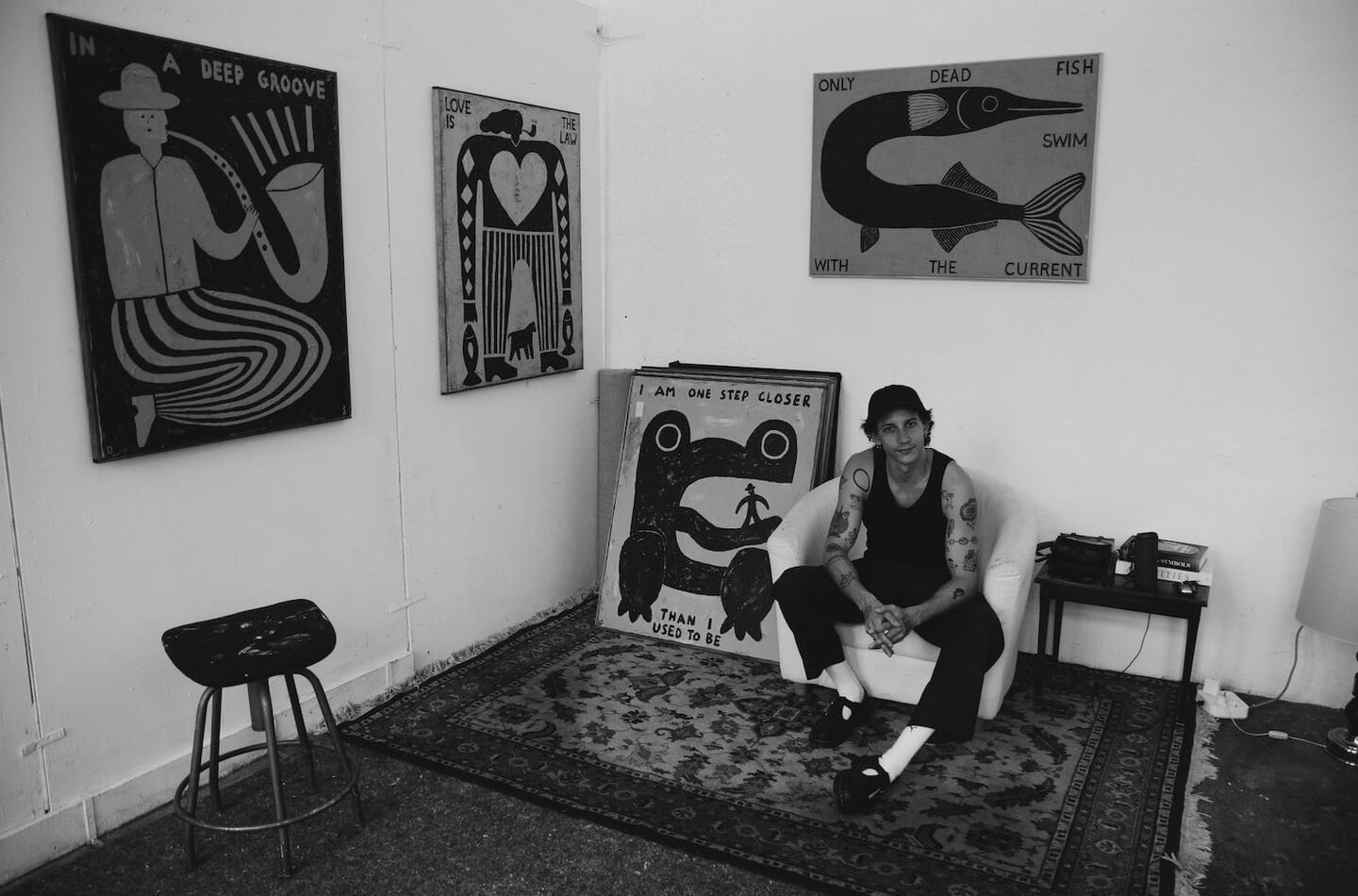
In an art world increasingly dominated by algorithmic curation and digital reproduction, something remarkable happens when you encounter a Painting that feels like it was made by firelight. David Schmitt artist and self-taught painter working from his Barcelona studio, creates work that operates on this frequency—images that seem to have existed long before they were painted, stories that feel inherited rather than invented. His canvases arrive with the weight of fables, the directness of street art, and the rough-hewn honesty of someone who learned to paint by painting, not by following instructions.
This is art that refuses to be slick. Born in Bamberg, Germany, Schmitt trained in graphic design before abandoning the commercial path to pursue something more essential. He moved to Barcelona, picked up brushes, and began making work that sits at the intersection of folk art, pop imagery, and something much older—what he calls "cave art," that primal human impulse to mark walls with meaning. His paintings feature animals that carry wisdom, text that reads like half-remembered proverbs, and a visual language that children and philosophers can read with equal clarity.
David Schmitt's journey to becoming a contemporary artist follows no conventional trajectory. After completing his studies in Graphic Design at the University of Applied Sciences in Augsburg, he made a decision that would define his artistic identity: rather than pursue the expected career in commercial design, he relocated to Barcelona and committed himself to painting. Without formal art school training, without the network of gallery connections that MFA programs provide, he began developing a visual vocabulary entirely his own.
This self-taught path is not incidental to understanding Schmitt's work—it is central to it. Artists who come to painting through institutional channels often spend years unlearning what they've been taught, trying to recover the directness that formal training can inadvertently suppress. Schmitt never had anything to unlearn. His aesthetic emerged from looking, from making, from the accumulation of images absorbed through a life spent paying attention to folk traditions, street culture, and the visual residue of human storytelling across centuries.
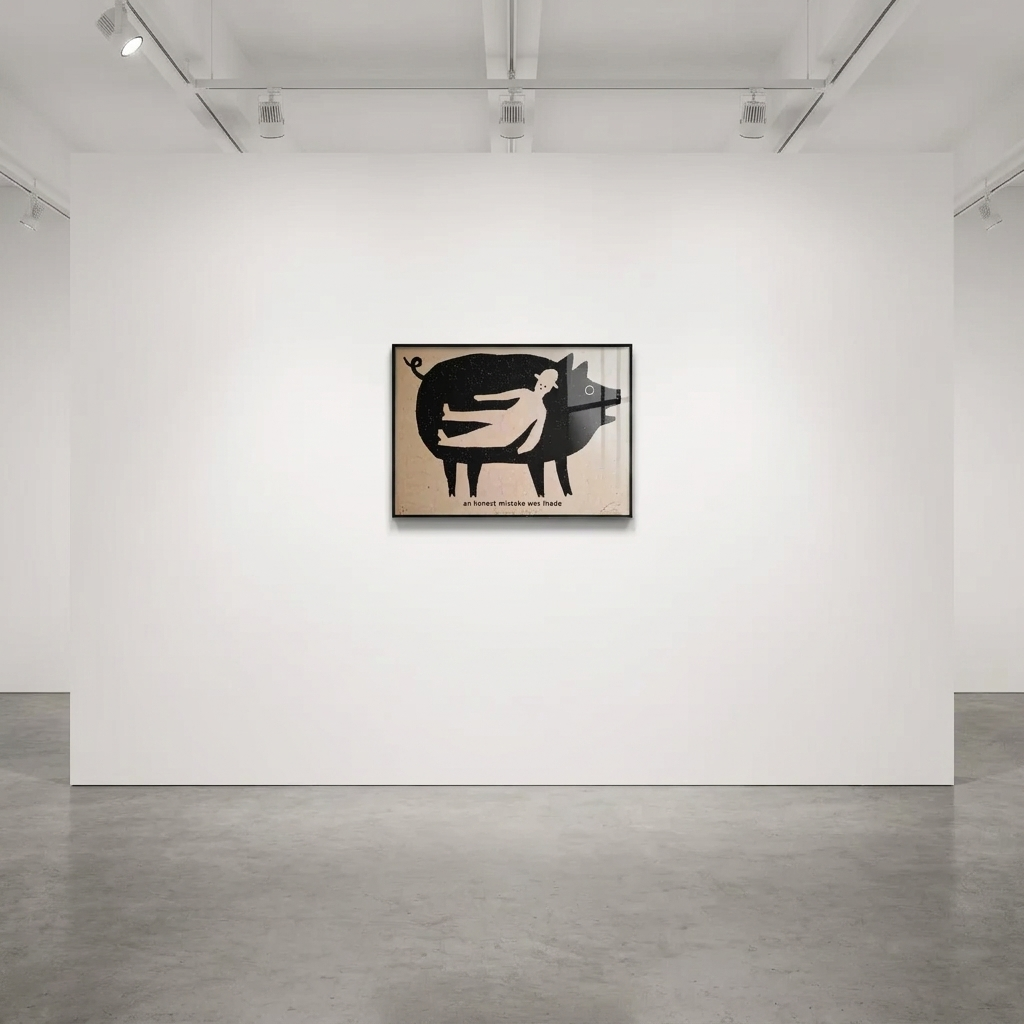
The result is work that possesses what might be called "informed naivety"—paintings that appear simple but reveal sophisticated compositional thinking, images that seem childlike but carry adult complexity. His figures are rendered with deliberate roughness, their forms chunky and imperfect in ways that feel intentional rather than unskilled. Elephants lumber across canvases with the solidity of woodcut prints. Fish swim through spaces that could be water or sky or the interior of memory itself. Human figures appear with the simplified features of folk dolls, their expressions readable at a glance yet somehow inexhaustible.
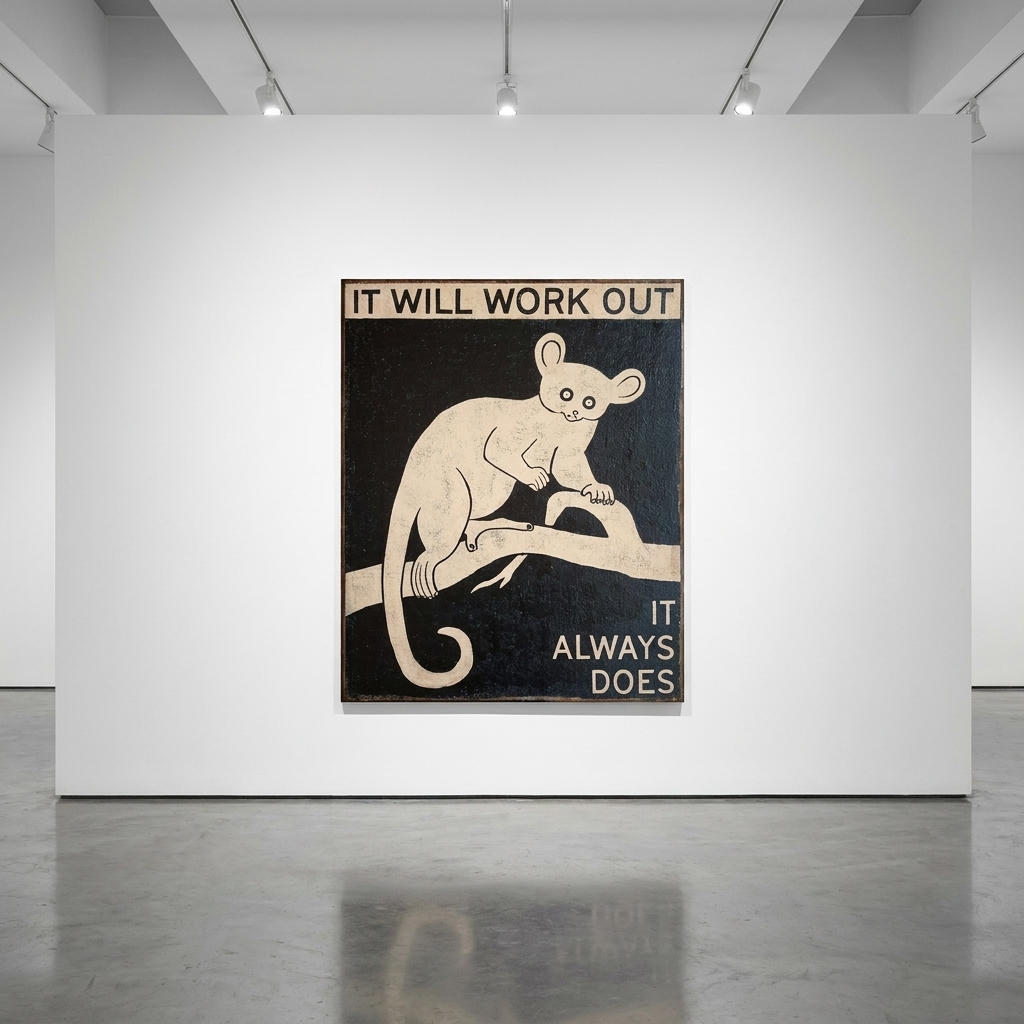
David Schmitt, It Will Work Out, Acrylic on canvas. Available at Guy Hepner, New York.
Barcelona itself seems to have shaped this sensibility. The city's relationship to Catalan folk traditions, its history of artistic radicalism from Gaudí to Miró, its streets where graffiti and Gothic architecture coexist—all of this enters Schmitt's work through osmosis rather than quotation. He is not illustrating Barcelona; he is making art in a place where the handmade has always been valued, where craft traditions persist alongside contemporary innovation.
To understand David Schmitt's paintings, you must first understand what he means by storytelling. This is not narrative painting in the traditional sense—there are no sequential scenes, no identifiable moments from recognizable tales. Instead, Schmitt creates images that function like the distilled essence of stories, the single frame that captures an entire fable's meaning. His paintings work the way proverbs work: compact, memorable, carrying more wisdom than their brevity suggests.
Consider the recurring presence of animals in his work. An elephant appears with text declaring "Who follows the elephant will have no problems"—a phrase that sounds like it could come from African folklore, Indian mythology, or a fortune cookie, yet belongs to none of these sources specifically. Schmitt invents his own proverbs, creates his own folk wisdom, and in doing so reveals something important about how folk traditions actually function. They are not fixed texts passed down unchanged; they are living forms that each generation reinvents while maintaining the appearance of timelessness.
His fish carry similar weight. A simple black fish silhouette accompanied by the words "Rescued from Drowning" creates an instant paradox—fish cannot drown, which means the rescue must be metaphorical, which means we are suddenly thinking about what it means to be saved from the very element that should sustain us. Another recurring image features a fish swimming against an implied current with text about dead fish being the only ones that go with the flow. These are not subtle messages, and Schmitt does not intend them to be. Folk art speaks directly; it does not require art historical training to decode.
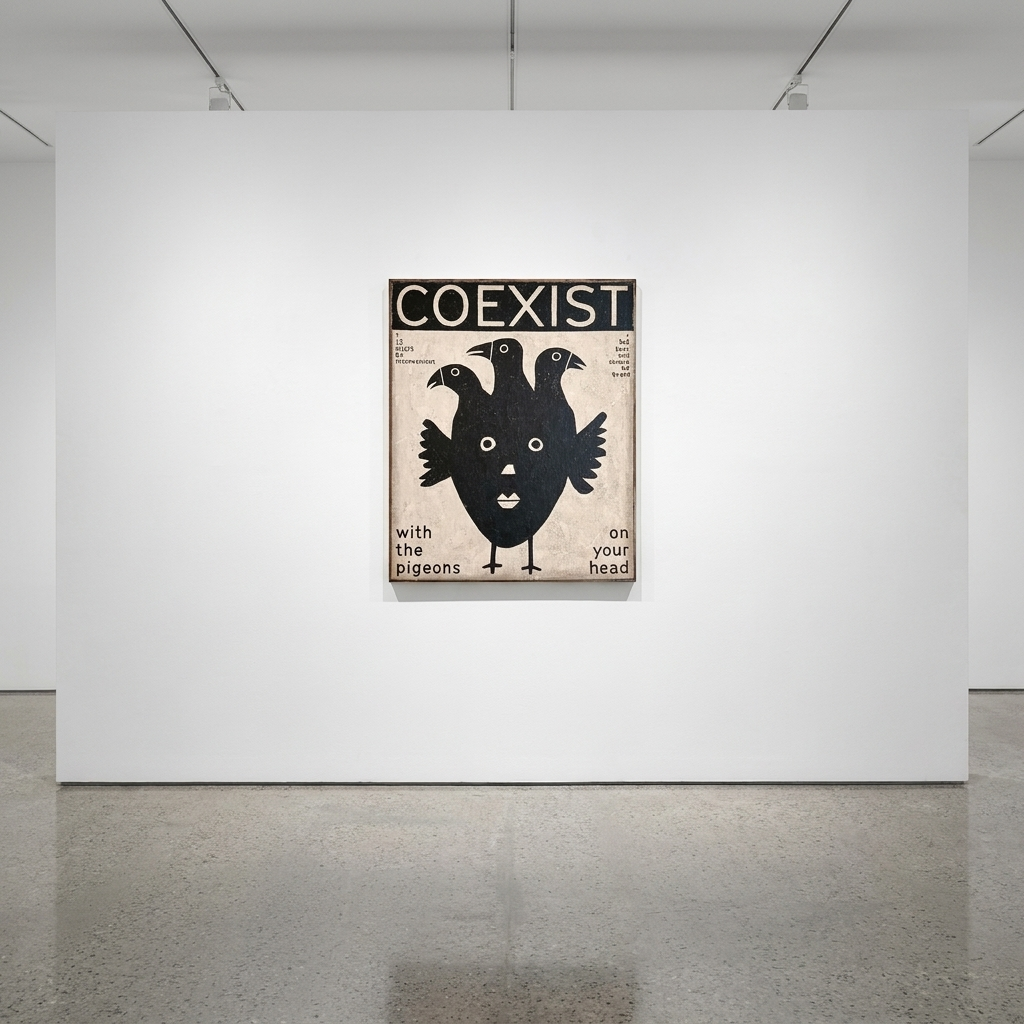
David Schmitt, Coexist, Acrylic on canvas. Available at Guy Hepner, New York.
The street sensibility Schmitt references in describing his work manifests most clearly in his use of text. Unlike traditional paintings where text might appear as a title card or signature, Schmitt's words are integral to the image itself, rendered in hand-drawn letters that wobble and vary like vintage sign painting. The typography is never perfect, never mechanically reproduced—each letter carries the evidence of the hand that made it. This approach borrows from street art's democratic impulse, the idea that messages should be legible to anyone passing by, not just to those with specialized visual literacy.
Yet Schmitt's work lacks street art's typical urgency and aggression. His messages tend toward the philosophical rather than the political, the encouraging rather than the confrontational. "It will work out / It always does" reads one piece featuring a possum rendered with almost totemic simplicity. This is not ironic; Schmitt genuinely seems to believe in the reassurance his work offers. In an art world that often rewards cynicism and critique, this sincerity feels almost radical.
At the heart of David Schmitt's artistic philosophy lies a commitment to imperfection that goes beyond aesthetic preference into something approaching ethical position. In his own words, he believes that "preserving the involvement of the human hand and mind, with all its imperfections, is a way of preserving the soul in the world around us." This is not merely a defense of handcraft against mechanical reproduction—it is a claim about what makes objects meaningful, about what connects us to the things we live with.
This philosophy manifests in every material choice Schmitt makes. His paintings are executed on unprimed canvas, allowing the raw texture of the fabric to show through the acrylic paint. The edges remain rough; the surfaces carry visible brushwork. When frames are added, they are hand-built from oak, their construction honest and unpretentious. Nothing is hidden, nothing is finished to a high gloss that would conceal the making. You can see how these objects came into being, can almost feel the presence of the artist's hand in their surfaces.
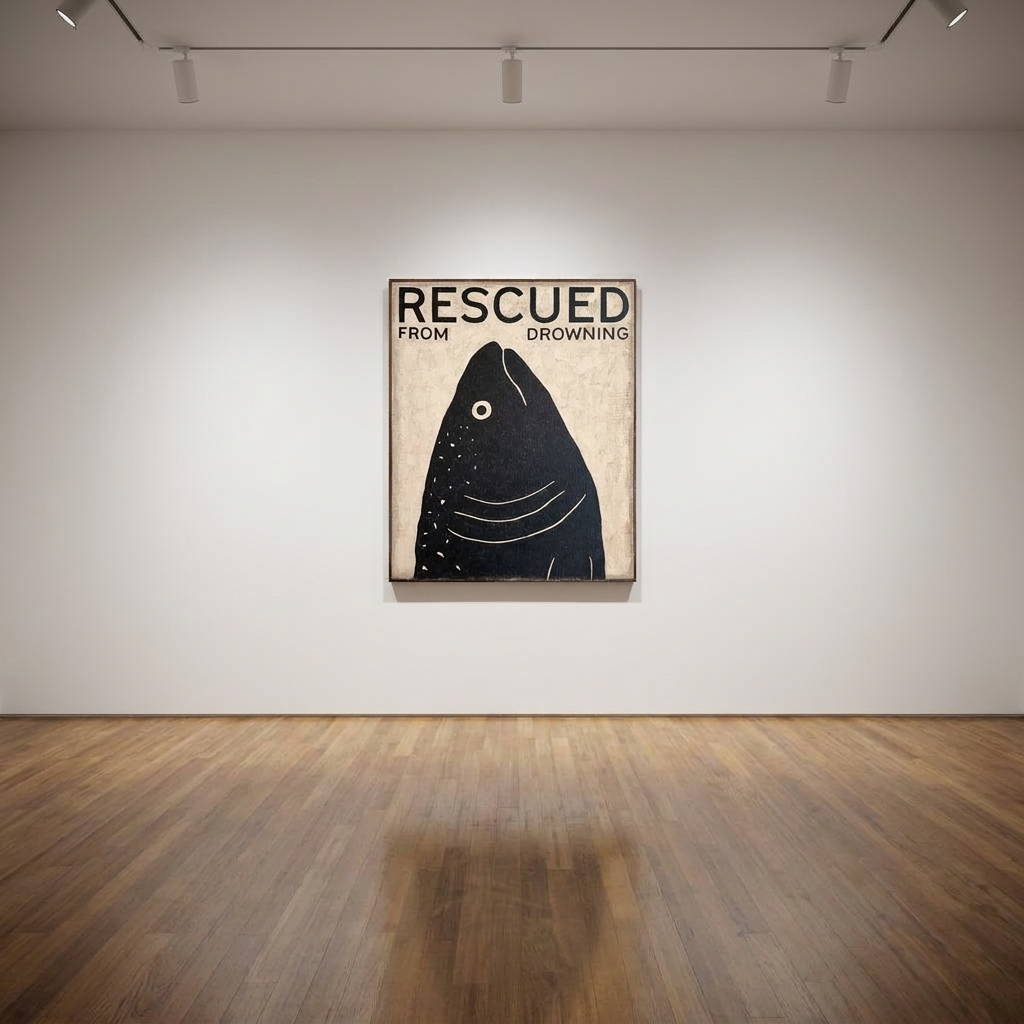
David Schmitt, Rescued from Drowning, Acrylic on canvas. Available at Guy Hepner, New York.
The prints extend this philosophy through their choice of substrate. Schmitt works extensively with Lokta paper, a handmade material produced in Nepal from the bark of the Daphne plant. Each sheet of Lokta paper is unique, carrying the irregularities of its handmade production—variations in thickness, subtle texture changes, the occasional inclusion of plant fibers visible at the surface. When Schmitt's images are printed on this material, they acquire an additional layer of human involvement, the craft of papermaking joining the craft of image-making.
This commitment places Schmitt's work in conversation with broader movements in contemporary culture that value authenticity, craft, and the handmade over the mass-produced and the perfect. From the resurgence of interest in traditional craft practices to the growing market for artisanal goods, there is clearly an appetite for objects that carry human traces. Schmitt's work speaks directly to this desire, offering paintings and prints that could never be mistaken for digital reproductions, that announce their handmade origins in every mark.
Schmitt describes his work as existing "somewhere between folk-, pop-, and cave art," and this three-part formulation deserves careful unpacking. Each term points to a different aspect of what makes his paintings distinctive, and together they map the territory where his art operates.
Folk art provides the most obvious reference point. The simplified forms, the didactic text, the use of animals as meaning-carriers, the sense of anonymous tradition rather than individual expression—all of these connect Schmitt's work to folk art traditions from around the world. Folk art is typically understood as art made by self-taught artists within traditional communities, art that serves social and spiritual functions beyond pure aesthetics. Schmitt, though working as an individual contemporary artist rather than within a living folk tradition, captures something of this spirit. His work feels communal even when it is personal, traditional even when it is invented.
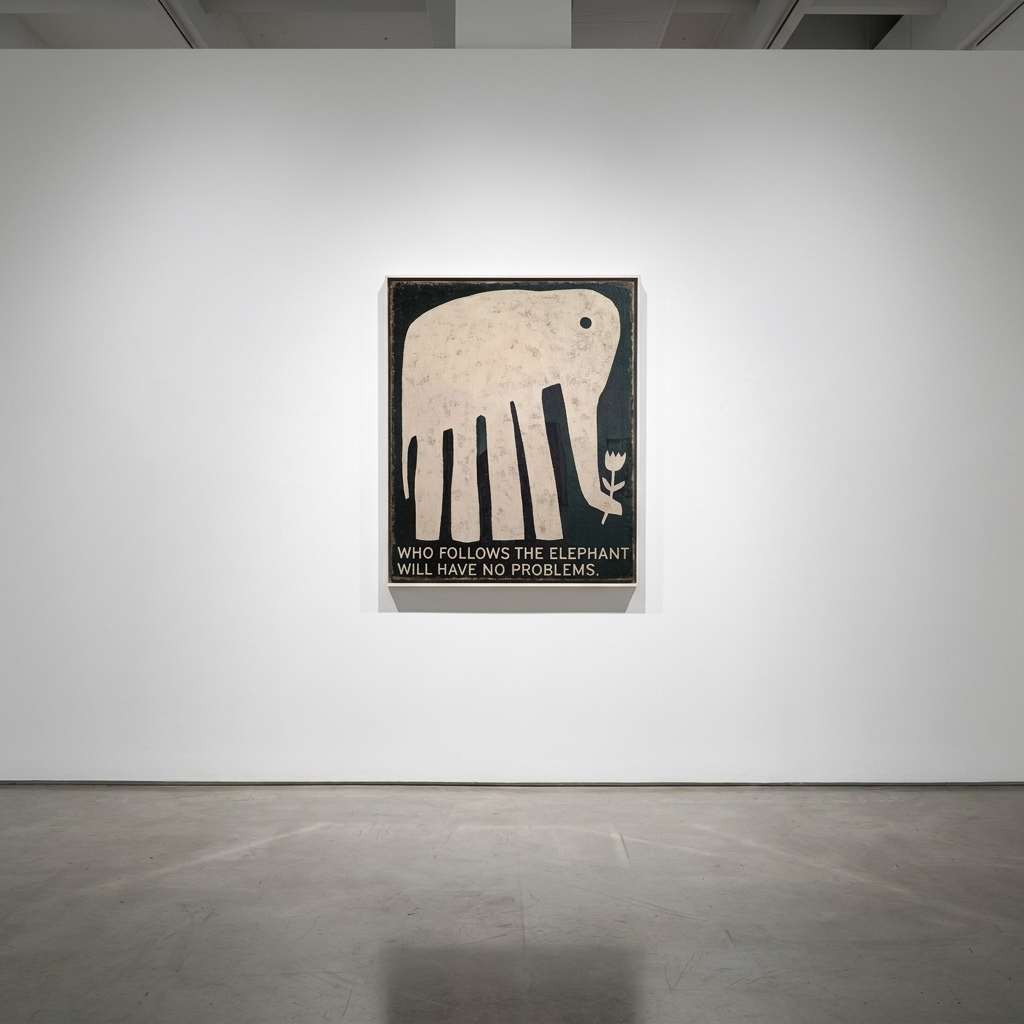
David Schmitt, Who Follows the Elephant, Acrylic on canvas. Available at Guy Hepner, New York.
Pop art enters through Schmitt's use of bold graphics, readable imagery, and text as visual element. Like Warhol and Lichtenstein, he works with images that communicate instantly, that don't require contemplation to understand. Unlike classical pop art, however, Schmitt shows no interest in ironic distance or critique of consumer culture. He borrows pop's visual directness while rejecting its characteristic coolness. His work is warm where pop art is often cold, earnest where pop art tends toward the knowing wink.
Cave art might seem like the oddest reference in the trio, yet it may be the most essential. Schmitt is pointing toward something primal about the impulse to make images—the idea that human beings have always marked their environments with meaningful forms, have always needed to externalize their inner lives in visual terms. Cave paintings were not made for museums or markets; they were made because making them fulfilled some deep human need. When Schmitt invokes cave art, he is claiming kinship with this original impulse, suggesting that his paintings participate in something fundamental about human nature rather than something specific to contemporary art history.
David Schmitt's decision to base himself in Barcelona rather than a more obvious art market capital like London, Berlin, or New York reflects his priorities as an artist. Barcelona offers a quality of life conducive to sustained creative work—Mediterranean light, a culture that values craft and making, a cost of living that allows artists to focus on their practice rather than scrambling to meet expenses. The city also maintains some distance from the art world's centers of power, which can be liberating for an artist more interested in making than in networking.
From his Barcelona studio, Schmitt maintains a practice that balances painting and printmaking. The paintings are typically executed in acrylic on canvas, with dimensions that remain accessible—often around 82 by 102 centimeters, a size that can live comfortably in domestic spaces without overwhelming them. This scale feels intentional, part of Schmitt's commitment to making art that can be lived with rather than art that demands institutional walls and museum lighting.
The printmaking practice allows Schmitt's images to reach a broader audience at lower price points. His prints, particularly those pulled on handmade Lokta paper, offer collectors an entry point into his work that doesn't require the investment a unique painting demands. This democratic impulse—making art available to people who love it regardless of their budgets—aligns with the folk art tradition Schmitt draws from, where art was made for communities rather than exclusively for wealthy patrons.

Schmitt's working process appears to favor intuition over extensive planning. His compositions arrive with the immediacy of ideas that emerged whole rather than being constructed piece by piece. An image of pigeons arranged to suggest a human face, accompanied by text about coexisting with the pigeons on your head, feels like something seen in a flash of insight rather than developed through sketches and revisions. This spontaneity contributes to the work's vitality—these paintings feel alive because they were made quickly, while the initial inspiration still burned.
Certain subjects return again and again in David Schmitt's work, forming a vocabulary of images that collectors and viewers come to recognize. Animals predominate: elephants, fish, horses, birds, and various creatures rendered with the simplified solidity of folk carvings. These animals function symbolically but resist fixed interpretation—Schmitt's elephant might evoke wisdom, strength, memory, or something entirely personal to each viewer. The openness of the symbolism is part of the work's power; these images can mean different things to different people while still communicating clearly.
Text appears in nearly every painting, sometimes as titles, sometimes as complete statements, sometimes as fragments that suggest larger meanings. The writing tends toward the aphoristic and the encouraging. "I need dreams" declares one painting. "I am one step closer than I used to be" states another. These phrases could be read as self-help platitudes, but Schmitt's rough execution and the context of handmade objects transform them into something more authentic. Coming from a mass-produced poster, these words might feel empty; emerging from a hand-painted canvas, they carry weight.
Human figures appear less frequently than animals but make powerful impressions when they do. Rendered with the simplified features of folk dolls or children's drawings, Schmitt's people possess a universality that more realistic representation would destroy. A girl with a butterfly in her hair becomes every girl, every moment of wonder, every encounter between human consciousness and natural beauty. The abstraction serves the storytelling, allowing viewers to project themselves into the images.
Poetry and childhood emerge as persistent themes, often intertwined. "This is how a child becomes a poet," reads one work, suggesting that the capacity for poetic vision is developed rather than innate, that certain experiences or ways of seeing can transform a child into someone who perceives the world differently. Schmitt's own work seems to embody this transformation—his paintings look at the world with a child's directness while bringing an adult's accumulated experience to bear on what is seen.
For collectors interested in acquiring work by David Schmitt, several factors deserve consideration. His practice divides roughly into two categories: unique paintings and limited edition prints, each offering different collecting opportunities and price points.
The paintings represent Schmitt's primary artistic output and command prices typically ranging from approximately $2,000 to $3,000. At this level, collectors can acquire substantial original works by an artist whose profile continues to rise. For new collectors or those building collections on budgets, this price range offers genuine accessibility—these are not token works or minor sketches but fully realized paintings that represent Schmitt's vision at its most complete.
Key considerations when evaluating Schmitt paintings include:
The prints offer a more accessible entry point, typically priced around $1,200 for editions on handmade Lokta paper. These are not mere reproductions but works in their own right, the handmade paper adding material value and uniqueness to each impression. For collectors who appreciate Schmitt's imagery but aren't ready to invest in paintings, the prints provide an excellent alternative.
David Schmitt occupies an interesting position in the contemporary art landscape. His self-taught background and folk-inflected style place him outside the mainstream of academically trained contemporary artists, yet his work has found enthusiastic reception among collectors who respond to its warmth and accessibility. He has sold through multiple galleries and platforms, building a collector base that spans Europe and North America.
The market for self-taught and outsider artists has grown significantly in recent decades, with major museums and serious collectors increasingly recognizing the value of work created outside institutional frameworks. Schmitt benefits from this expanded appreciation while distinguishing himself from classic outsider art through his design training and intentional engagement with art historical traditions. He is self-taught as a painter but not naive; his choices are informed even when his execution is deliberately rough.
Critical response has emphasized the genuineness of Schmitt's vision and the appealing combination of accessibility and depth in his work. Reviewers frequently note the tension between the apparent simplicity of his images and the complexity of response they generate—paintings that look easy prove difficult to forget. The textual elements draw comparison to artists like Ed Ruscha and Lawrence Weiner, though Schmitt's tone is warmer and less conceptually austere than either.
Schmitt's emergence as a collectible artist occurs at a moment when folk traditions and handcraft practices enjoy renewed cultural prestige. From the ceramics revival to the boom in hand-woven textiles, from the popularity of traditional fermentation to the flourishing of small-batch production across industries, contemporary culture shows sustained appetite for the handmade, the imperfect, the human-scaled. This is not mere nostalgia but a response to the increasing dominance of algorithmic production and digital mediation in daily life.
Art that announces its handmade origins—that celebrates rather than conceals the marks of human making—offers something that mass-produced images cannot provide. Schmitt's paintings, with their visible brushwork, their raw canvas edges, their hand-lettered text, participate in this broader cultural reassertion of craft values. When collectors hang his work in their homes, they are not only acquiring images they find beautiful but also making statements about what they value, about the kinds of objects they want to live with.
The folk art connection also speaks to widespread interest in authenticity and tradition at a time when both feel threatened. Folk traditions worldwide face pressure from globalization, urbanization, and the displacement of traditional communities. When contemporary artists like Schmitt engage with folk aesthetics and values, they help keep these traditions alive in new forms, translating their wisdom for contemporary audiences who may have no direct connection to living folk practices.
Guy Hepner Gallery at 529 West 20th Street, New York, currently offers a selection of works by David Schmitt that spans his practice. The available pieces include both unique paintings and limited edition prints on handmade Lokta paper, providing options for collectors at various entry points.
The paintings in the current selection feature Schmitt's characteristic combination of bold imagery and text-based messaging. Canvases bearing encouraging phrases pair with his signature animal motifs—elephants promising guidance, fish suggesting resilience, possums offering reassurance. Each painting arrives on unprimed canvas with the visible texture and honest materiality that defines Schmitt's approach.
The print editions offer collectors access to Schmitt's imagery at more accessible price points without sacrificing the handmade quality central to his vision. Pulled on Lokta paper whose production in Nepal represents its own tradition of craft excellence, these prints carry the irregularities and character of handmade objects while making Schmitt's work available to a broader collecting audience.
David Schmitt's claim that his work represents a form of storytelling deserves one last consideration. Stories, in their most essential form, are how human beings make sense of experience. We tell stories to explain the world, to transmit wisdom across generations, to connect with others through shared narrative. The power of stories lies not in their complexity but in their ability to resonate, to feel true even when they are invented.
Schmitt's paintings tell stories in this essential sense. An elephant walking across a canvas, accompanied by words about following and not having problems, is a story about trust, about guidance, about letting something larger than yourself show the way. A fish rescued from drowning is a story about salvation in unexpected forms, about finding yourself unable to survive in the very element that should sustain you. These are not stories with beginnings, middles, and ends; they are stories distilled to their essential images, their core truths.
In a world saturated with content, flooded with images competing for attention, there is something valuable about art that operates on this simpler frequency. Schmitt's paintings don't demand extensive art historical knowledge to appreciate; they don't require wall texts to explain their meaning. They communicate the way folk art has always communicated—directly, honestly, with faith that human beings still want to encounter images that feel deeply human.
For collectors seeking work that offers both aesthetic pleasure and genuine meaning, that celebrates craft while engaging with timeless themes, David Schmitt represents a compelling opportunity. His paintings carry the warmth of objects made with care, the weight of stories that matter. To inquire about available works or discuss building a collection that includes Schmitt's Barcelona-based vision, contact Guy Hepner Gallery in New York, where advisors stand ready to help collectors find the pieces that speak most directly to their own stories.
Explore David Schmitt prints for sale at Guy Hepner: Painting, Screenprints.
Related Series