The Arrival of Spring in Woldgate

August 5, 2026
When David Hockney returned to East Yorkshire in the late 1990s after decades in sun-drenched Los Angeles, he did not arrive as a nostalgic exile seeking comfort in familiar terrain. He came as an artist whose eyes had been sharpened by California's relentless light, now ready to see his childhood landscape with the intensity of a stranger. The David Hockney Yorkshire prints that emerged from this homecoming—particularly the celebrated Woldgate and Arrival of Spring series—represent one of the most significant bodies of landscape work produced by any living artist. These are not quaint pastoral scenes but radical acts of attention, documenting the English countryside with a fervor that recalls Van Gogh's obsessive studies of Provence.
What makes these Yorkshire works so compelling for collectors is their synthesis of tradition and innovation. Hockney brought to the rolling Wolds the same analytical rigor he had applied to swimming Pools and double portraits, but he also embraced new technologies—most famously the iPad—to capture nature's fleeting transformations. The result is a body of work that speaks to art history while pushing contemporary practice forward, offering collectors entry points ranging from monumental oil paintings to accessible digital prints.
The story of Hockney's return begins with friendship and mortality. In the mid-1990s, the artist learned that Jonathan Silver, his close friend and the entrepreneur who had revitalized Salts Mill in Saltaire, was dying of cancer. Hockney flew back to Bradford to see him, and during these visits, Silver made a pointed observation that would change the direction of Hockney's career. "You've neglected it for so long," Silver said of Yorkshire, suggesting it was time for the artist to paint his native landscape. The challenge lodged itself in Hockney's mind, and by the time he turned sixty, he had traded Beverly Hills for Bridlington, the modest seaside town on the East Yorkshire coast where he would establish a studio.
This was not a simple act of retirement or retreat. Hockney had spent three decades celebrating California's hedonistic pleasures—the turquoise swimming pools, the clean modernist architecture, the beautiful young men basking in perpetual sunshine. His paintings of Los Angeles were characterized by hard edges, flat planes of color, and a kind of stylized glamour that made them instantly recognizable. Yorkshire offered something entirely different: subtle shifts of light filtered through cloud cover, ancient woodlands with gnarled trees, and agricultural land that had been worked for centuries. The challenge was not merely to paint this landscape but to find a visual language adequate to its particular beauty.
What Hockney discovered, driving across the Wolds and recalling childhood bicycle rides with his brother John, was that the English countryside was not dull or muted but explosively alive. "Some days were just glorious," he later reflected. "The colour was fantastic." East Yorkshire's relative obscurity—it lacks the dramatic scenery of the Lake District or the tourist appeal of the Cotswolds—meant it had remained largely unpainted by major artists. Hockney saw an opportunity to do for this corner of England what Van Gogh had done for Provence: to create a comprehensive visual record that would reveal hidden magnificence.
Among the most celebrated of Hockney's David Hockney Woldgate prints are those depicting a single stretch of road through ancient woodland near the village of Kilham. Woldgate is an old Roman road, and Hockney returned to it obsessively, painting and filming it through every season. The road became both subject and compositional device—a path leading the viewer's eye into depth while simultaneously flattening into pattern. Hockney painted the same tunnel of trees in winter's skeletal bareness, spring's tentative budding, summer's dense green canopy, and autumn's fiery decline.
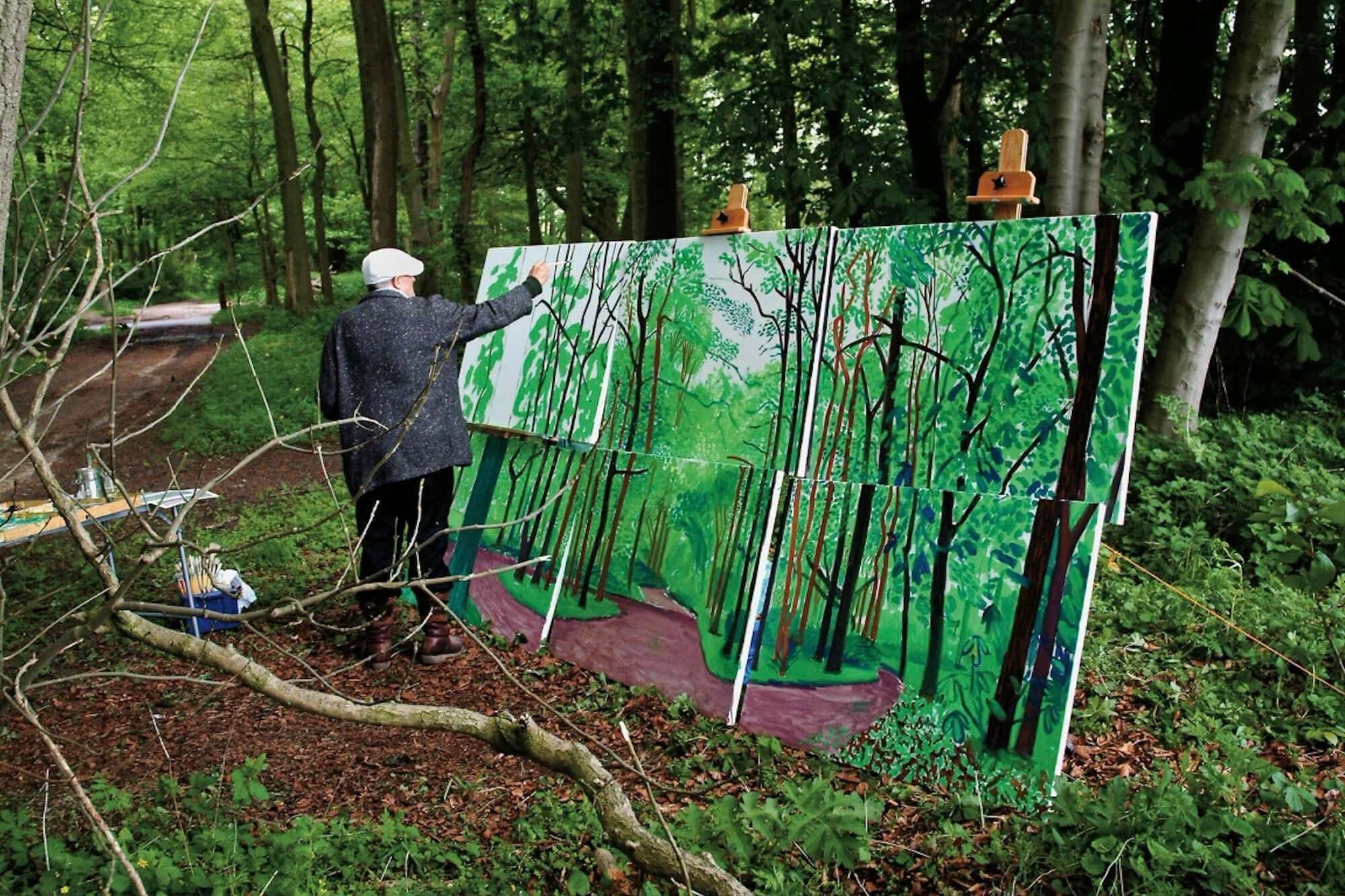
David Hockney working on his painting Woldgate Woods in east Yorkshire. Photograph: Jean-Pierre Goncalves/PA
The Woldgate paintings represent Hockney's most sustained engagement with the tradition of plein air landscape painting. Working from a specially designed vehicle that allowed him to paint outdoors regardless of weather, he produced canvases of increasing scale, eventually creating multi-panel works that wrapped around viewers like panoramic environments. These monumental paintings—some composed of six or more joined canvases—demanded a new kind of looking, one that acknowledged the impossibility of capturing landscape from a single fixed viewpoint. Hockney's solution drew on his long interest in Cubism and Chinese scroll painting: he combined multiple perspectives into unified compositions that felt truer to the experience of moving through space than any single-point perspective could achieve.
For collectors, the Woldgate works exist in several formats. The original paintings are museum-scale and largely held in institutional collections or by major collectors. However, Hockney produced significant editions of prints based on these compositions, allowing wider access to this important body of work. The David Hockney landscape prints derived from Woldgate subjects demonstrate the artist's mastery of color and his ability to translate the luminosity of his paintings into the print medium. These editions have proven increasingly valuable as Hockney's market has strengthened and as collectors recognize the art-historical significance of his Yorkshire period.
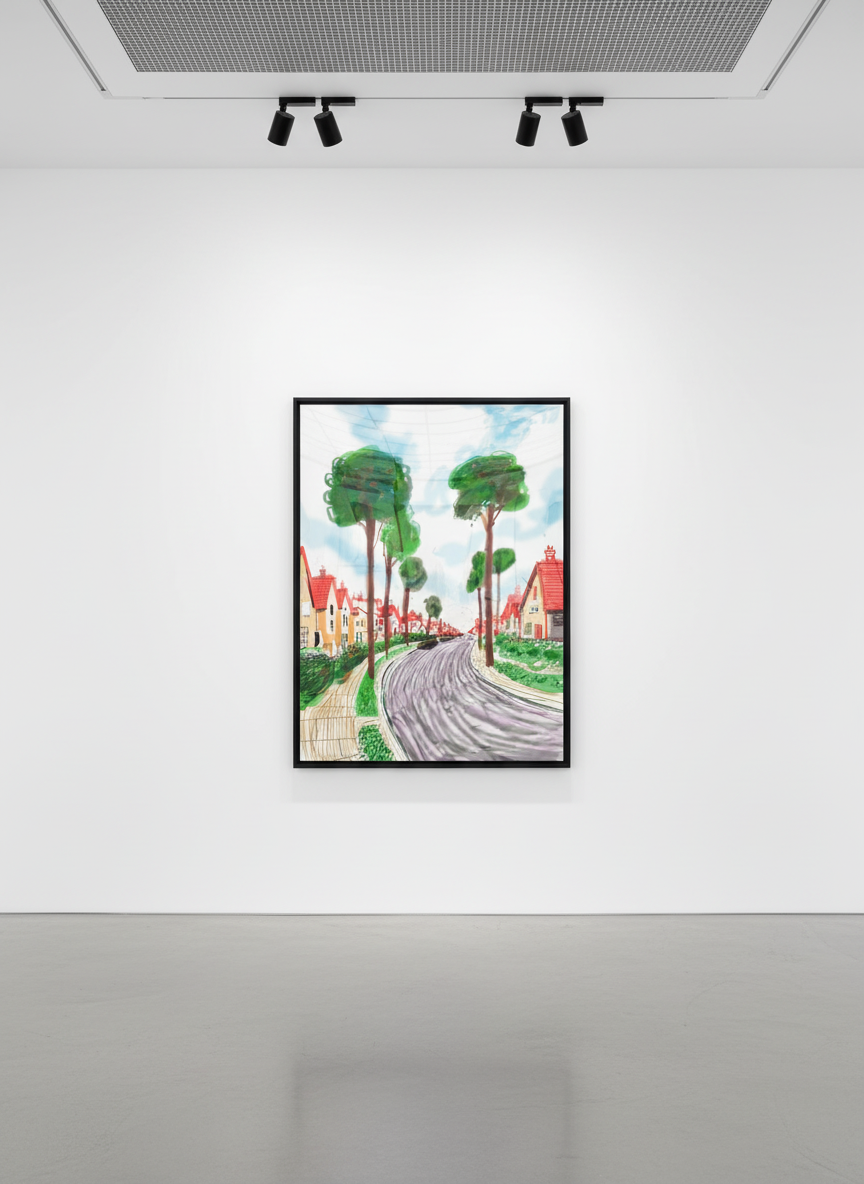
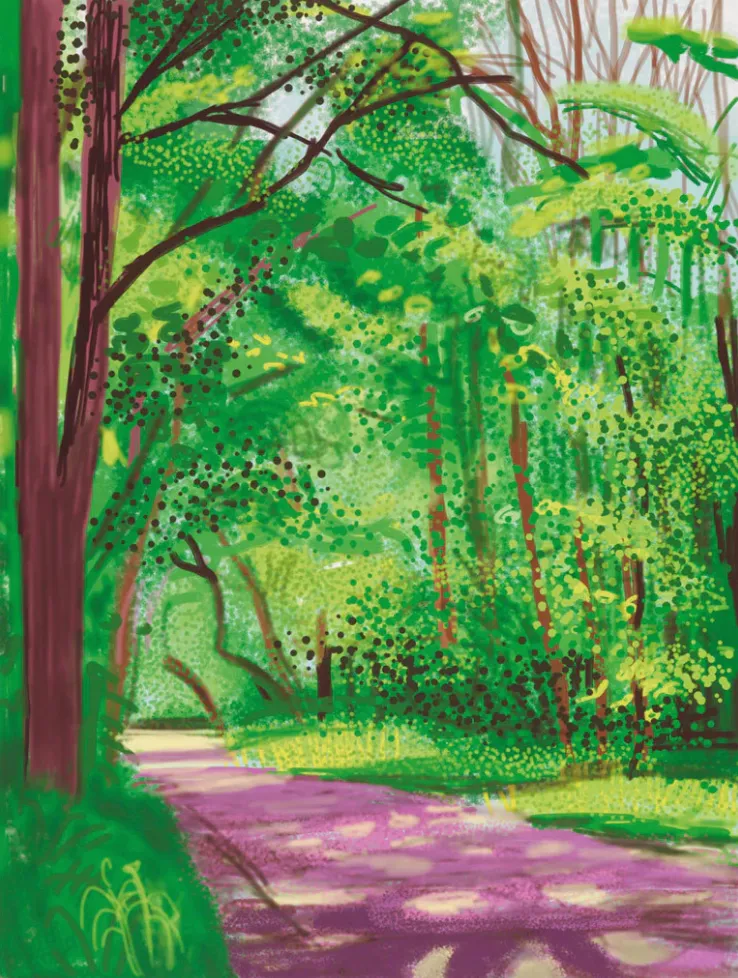
If the Woldgate paintings demonstrated Hockney's engagement with traditional landscape practice, The Arrival of Spring in Woldgate, East Yorkshire series announced his embrace of digital technology as a serious artistic tool. Created in 2011, when the artist was seventy-three years old, this extensive body of work comprises over one hundred individual pieces documenting the progressive transformation of the countryside through spring's fleeting weeks. Working primarily on an iPad using the Brushes application, Hockney produced multiple images daily, each bearing a precise date in its title—a visual diary tracking nature's awakening from early March through late May.
The David Hockney Arrival of Spring series challenged prevailing assumptions about digital art. At a time when many questioned whether work made on a tablet could constitute serious fine art, Hockney's Ipad Drawings demonstrated that the tool matters far less than the eye and hand guiding it. His command of color, developed over six decades of painting, translated seamlessly to the digital medium. Indeed, the iPad's luminous screen allowed him to achieve chromatic intensities impossible in traditional paint—electric greens of new growth, brilliant yellows of rapeseed fields, deep purples of tree shadows rendered with jewel-like saturation.
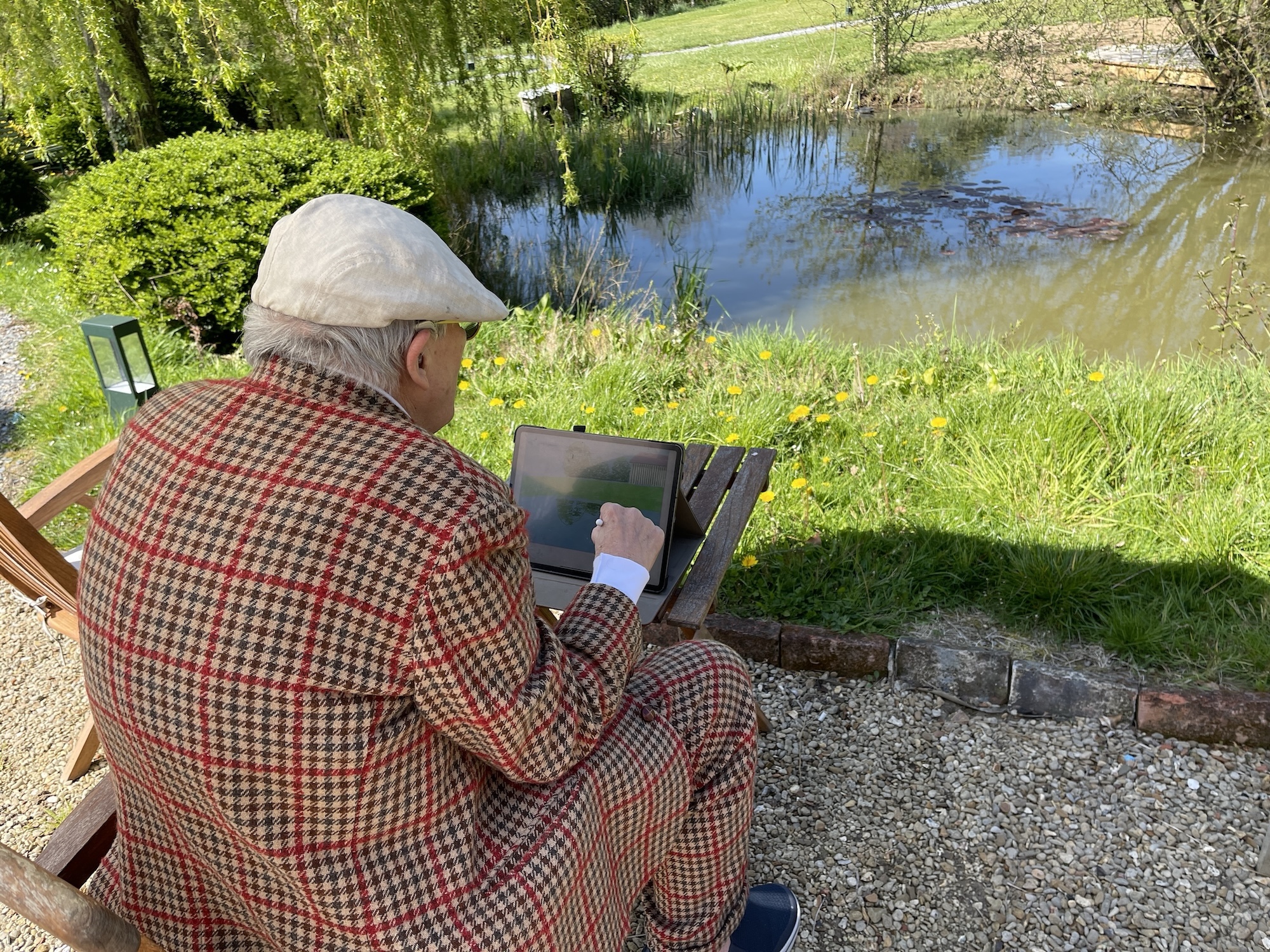
David Hockney working on iPad: David Hockney, Normandy, 2021 © David Hockney Photo Credit: Jonathan Wilkinson
What distinguishes these David Hockney iPad drawings from mere digital sketches is their sophistication as compositions. Hockney exploited the medium's immediacy to work quickly, capturing transient effects of light before they vanished, but he brought to each image the spatial intelligence refined over a lifetime. The bold, confident strokes demonstrate his understanding of how color relationships create depth, how marks can simultaneously describe form and assert the picture's flatness. These are not experiments by an artist learning a new tool but fully realized works by a master applying hard-won knowledge to unprecedented technology.
The series' documentary nature—its commitment to recording the specific appearance of specific places on specific days—connects it to venerable traditions of naturalist observation while feeling utterly contemporary. Hockney was making what he called a "visual diary," and the discipline of daily image-making produced subtle variations that accumulate into a profound meditation on time's passage. Watching spring arrive across these images, collectors encounter not just beautiful pictures but a philosophy of attention, an argument that careful looking is itself a form of devotion.
Collectors interested in acquiring David Hockney nature prints from the Yorkshire series should understand the various formats in which this work exists. The Arrival of Spring images were produced as inkjet prints on paper in editions of twenty-five, plus artist's proofs. These prints were made under Hockney's supervision using high-quality archival inks and papers, ensuring both fidelity to the original digital images and long-term stability. The editions sold briskly upon release and have appreciated significantly in the secondary market as Hockney's status has solidified.
When evaluating David Hockney digital art prints for purchase, collectors should consider several factors:
The David Hockney iPad art for sale through reputable galleries represents an important category within his market. As digital art has gained acceptance—accelerated by recent developments in the NFT space, though Hockney's prints are traditional physical objects—early examples by canonical artists command increasing attention. These works occupy a unique position: they are simultaneously accessible (relative to unique paintings) and historically significant (as pioneering examples of digital fine art by a major artist).
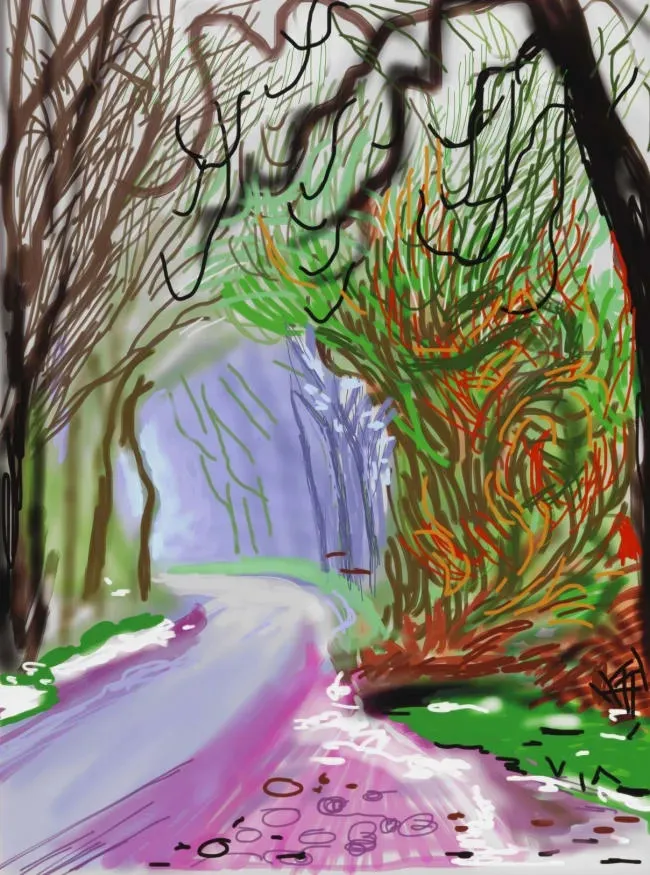
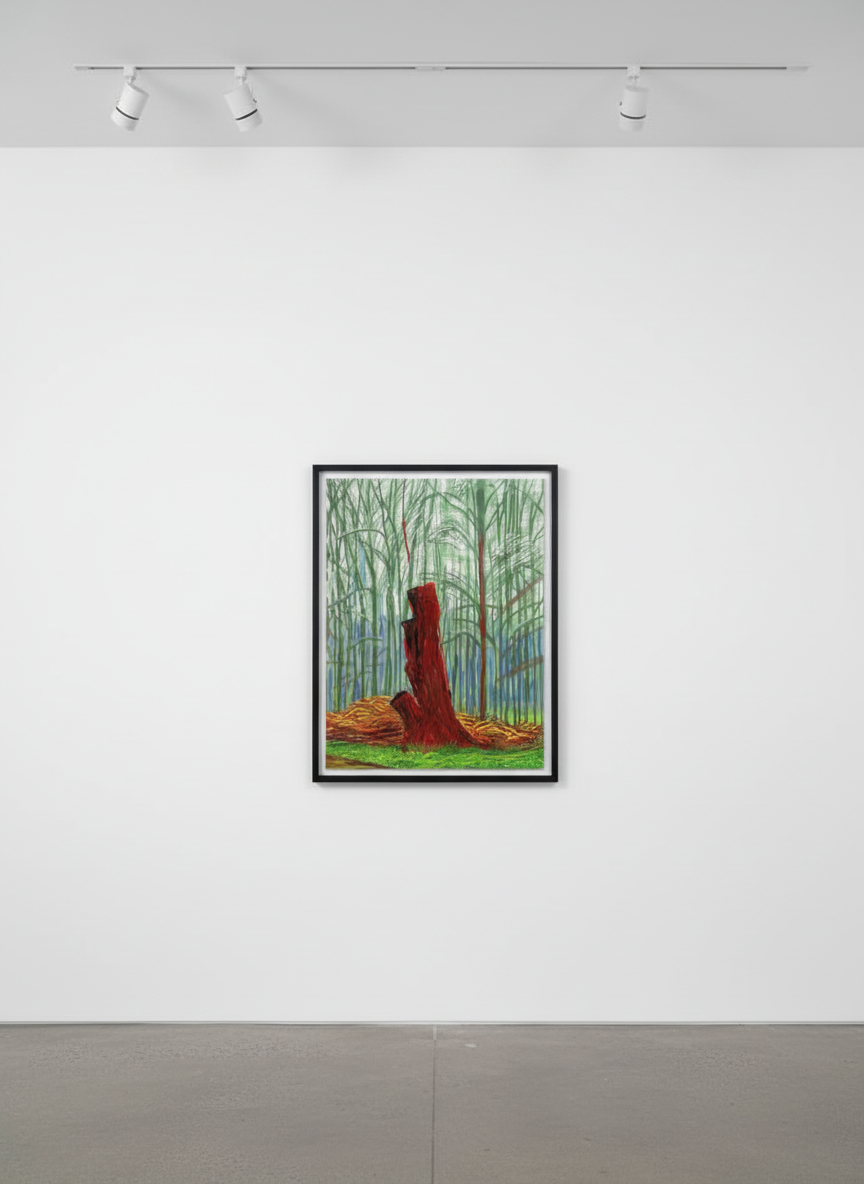
David Hockney, 1st of January, The Arrival of Spring in Woldgate. Available at Guy Hepner, New York.
David Hockney's market position provides important context for collectors considering Yorkshire works. His paintings have achieved record prices at auction—his 1972 painting "Portrait of an Artist (Pool with Two Figures)" sold for $90.3 million in 2018, then a record for a living artist. While this figure reflects the market for unique paintings from his celebrated 1970s period, it indicates the overall strength of collector demand for Hockney's work across all mediums and periods.
The Yorkshire landscapes have achieved their own notable results. At Christie's London in March 2025, the oil painting "Between Kilham and Langtoft" (2006) sold for £5,122,000, demonstrating sustained institutional and collector interest in this body of work nearly two decades after its creation. The video installation "Woldgate Woods, Winter, 2010" has also appeared at major sales, reflecting the breadth of formats in which collectors can engage with Hockney's Yorkshire vision.
For collectors seeking entry points below the level of unique paintings, the David Hockney landscape prints value proposition is compelling. The Arrival of Spring editions offer works by a canonical artist at price points accessible to serious collectors without seven-figure budgets. These are not minor works or afterthoughts but central statements within Hockney's oeuvre, representing his most significant technological innovation and his most sustained engagement with seasonal change. As prints, they benefit from the established infrastructure of the art market: clear edition sizes, documented provenance, and the imprimatur of major galleries and auction houses.
The question of "Why did David Hockney return to Yorkshire" is not merely biographical but directly relevant to valuation. These works emerged from a specific set of circumstances—the encounter with mortality through Silver's illness, the artist's own advancing age and desire to create a lasting record of his homeland, the technical challenge of representing England's subtle light after California's clarity. This confluence of personal history and artistic ambition gives the Yorkshire works an emotional depth that collectors respond to. They are, as one critic described them, "a kind of prayer of thanks to nature and the life force."
Understanding how Hockney created The Arrival of Spring series illuminates what makes these works significant. The artist would rise early, often before dawn, and drive to locations he had identified as promising—stretches of road, copses of trees, fields of emerging crops. He worked with the iPad held like a sketchbook, drawing directly with his finger or a stylus, building images through layers of color and mark. The immediacy of the process allowed him to capture light effects that would have been impossible with traditional materials: the specific pink of dawn sky, the exact moment when hawthorn blossom peaks, the way shadows pool beneath hedgerows at midday.
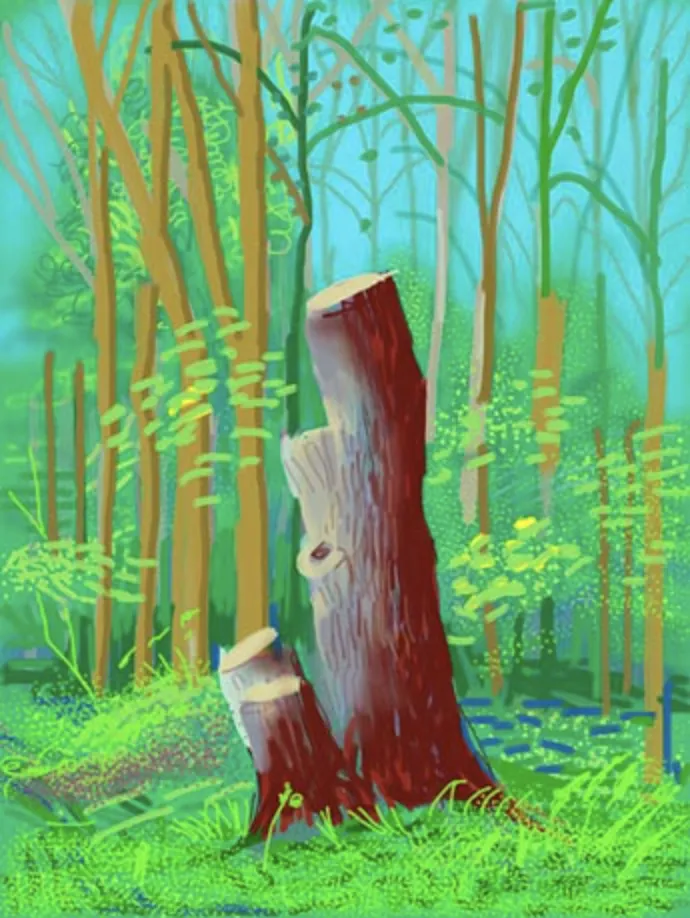
David Hockney, 2nd May, The Arrival of Spring in Woldgate. Available at Guy Hepner, New York.
Hockney's enthusiasm for the iPad was genuine and infectious. He spoke publicly about the device as a serious artistic tool, demonstrating its capabilities in interviews and sending images directly to friends from the field. This evangelical embrace of technology was consistent with his career-long interest in new image-making devices—he had previously explored photocopiers, fax machines, and computer programs—but the iPad proved uniquely suited to his working methods. Its portability, its luminous screen, and the Brushes app's ability to record every stroke as a video allowed him to work outdoors with unprecedented freedom.
The David Hockney iPad drawings explained in their full context represent more than technical novelty. They are the culmination of Hockney's decades-long investigation into how we see and how pictures can represent visual experience. His earlier experiments with multi-panel paintings and photographic collages had established his interest in moving beyond single-point perspective. The iPad's immediacy allowed him to synthesize these concerns with direct observation of nature, producing works that feel simultaneously traditional (landscape painting has centuries of history) and radically contemporary (made on a device that didn't exist five years earlier).
To appreciate the David Hockney East Yorkshire works fully, collectors benefit from understanding the terrain itself. The Yorkshire Wolds are a range of low chalk hills stretching from the Humber estuary to the coastal cliffs at Flamborough Head. Unlike the more dramatic landscapes of the Yorkshire Dales or North York Moors, the Wolds present gentle undulations, deep-cut valleys called "dales," and extensive agricultural land. This is not wilderness but a thoroughly human landscape, shaped by millennia of farming, yet retaining ancient hedgerows, mature woodlands, and a sparse population that allows for surprising solitude.
Hockney chose this landscape deliberately. Its lack of conventional picturesqueness required viewers to look more carefully, to find beauty in subtlety rather than spectacle. The Wolds change constantly through the seasons and even through single days as weather fronts move across from the coast. This variability became central to Hockney's project: he was not painting a static place but documenting transformation, using the landscape as a laboratory for studying time's visible effects. The recurring appearance of the same roads and trees across different works invites comparison, encouraging viewers to notice how a bare branch in March becomes a leafy canopy by May.
The region's agricultural rhythms also shaped the work. Hockney painted the patchwork of fields—bright yellow rapeseed, green wheat, brown plowed earth—as abstract patterns from elevated viewpoints while also descending into intimate woodland scenes. The David Hockney Woldgate East Yorkshire connection is specific: Woldgate itself is an ancient track, possibly Roman, that cuts through Dalby Forest near the village of Kilham. This particular road, with its tunnel-like canopy of trees, became Hockney's signature Yorkshire subject, painted and filmed repeatedly as a motif rich enough to sustain endless variation.
Hockney's Yorkshire works participate in venerable traditions while transforming them. The English landscape painting tradition extends from Constable and Turner through the Norwich School and the Neo-Romantics, and Hockney was certainly aware of these precedents. However, his most explicit references were to continental artists: Van Gogh's Provence, Monet's Giverny, and particularly Chinese landscape scrolls with their extended temporal and spatial formats. The multi-panel paintings that combine multiple perspectives draw directly on Hockney's long interest in Cubist fragmentation and Asian pictorial traditions.
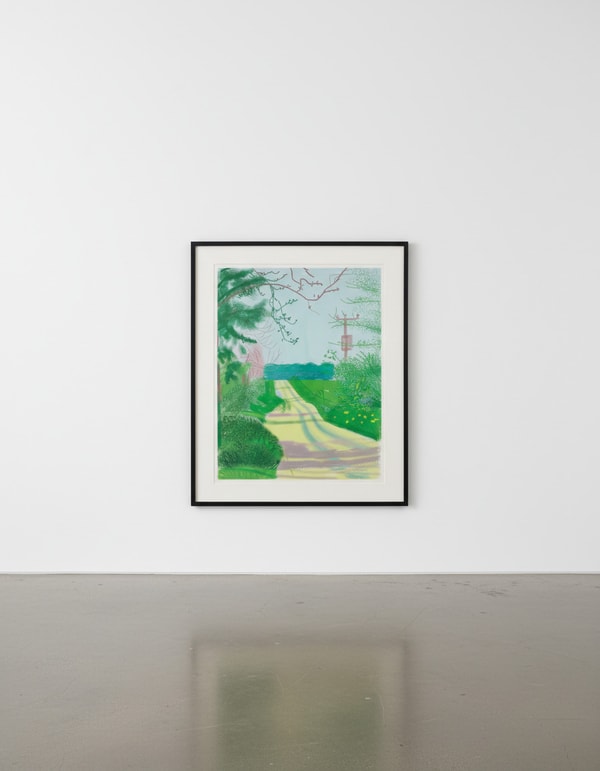
David Hockney, 23rd April, The Arrival of Spring in Woldgate. Available at Guy Hepner, New York.
The technological dimension adds another layer of significance. Art history has repeatedly been transformed by new tools—oil paint, photography, video—and Hockney positioned his iPad work as the latest chapter in this ongoing story. His embrace of digital technology was not merely practical but theoretical: he argued that the iPad returned drawing to immediacy after the interventions of photography had made artists doubt their eyes. The backlit screen's luminosity, he suggested, recalled stained glass and medieval illumination, connecting digital art to traditions far older than Renaissance perspective.
This art-historical positioning matters for collectors because it affects how institutions and scholars evaluate the work. Hockney's Yorkshire period is now recognized as one of the major phases of his career, receiving substantial exhibition attention and scholarly analysis. The Arrival of Spring series has been shown at the Royal Academy, the Bilbao Guggenheim, and numerous other major venues, establishing its canonical status. For collectors, this institutional embrace provides confidence that these works will continue to be valued and discussed as important contributions to contemporary art.
For collectors interested in acquiring David Hockney Arrival of Spring prints for sale, several strategic considerations apply. The market for Hockney prints is mature and well-documented, with extensive auction records providing price transparency. The Arrival of Spring editions, with their limited sizes and strong institutional provenance, represent works that are both aesthetically compelling and financially sound as acquisitions.
Collectors might consider the following approaches:
The David Hockney digital art prints market continues to evolve as attitudes toward digital art shift. Collectors who acquired early examples of The Arrival of Spring have seen significant appreciation, and the series' importance within Hockney's oeuvre—and within the broader history of digital art—suggests continued strength. These are not speculative acquisitions in an emerging category but established works by a canonical artist, backed by decades of market history and institutional validation.
Guy Hepner Gallery maintains an extensive inventory of David Hockney Yorkshire prints, including works from The Arrival of Spring in Woldgate, East Yorkshire series. These prints offer collectors direct access to one of the most significant bodies of landscape work produced in the twenty-first century, at price points that reflect both artistic importance and accessibility. Each work comes with full documentation of provenance and condition, and the gallery's specialists can advise on framing, installation, and collection building.
The Arrival of Spring works available through the gallery span the full chronological range of the series, from early March's bare branches to late May's abundant growth. Collectors can select individual images or build groups that trace seasonal progression. The gallery also handles works from Hockney's other Yorkshire series, including Woldgate subjects and related landscapes, allowing collectors to engage comprehensively with this phase of the artist's career.
David Hockney's return to Yorkshire produced a body of work that will endure as one of the major achievements of contemporary landscape painting. The Woldgate paintings and Arrival of Spring series represent an artist at the height of his powers, applying decades of accumulated skill to subjects that demanded both technical mastery and emotional engagement. These are works about time—the seasons' cycles, a day's passing light, an artist's advancing years—but they feel timeless in their commitment to looking carefully at the world.
For collectors, these Yorkshire works offer something rare: entry into a canonical artist's major late statement, accessible through prints while connected to the larger project of monumental paintings and video installations. The market values reflect this significance, but the works themselves offer something beyond market positioning. They are invitations to look, to notice, to find in the English countryside a beauty that rewards attention. Hockney made these works as acts of gratitude for what nature offers those willing to see, and acquiring them is a way of participating in that gratitude.
To explore David Hockney Yorkshire prints and The Arrival of Spring in Woldgate, East Yorkshire series, visit Guy Hepner Gallery at 177 Tenth Avenue, New York, or contact our specialists for detailed information on available works, pricing, and collection advisory services.
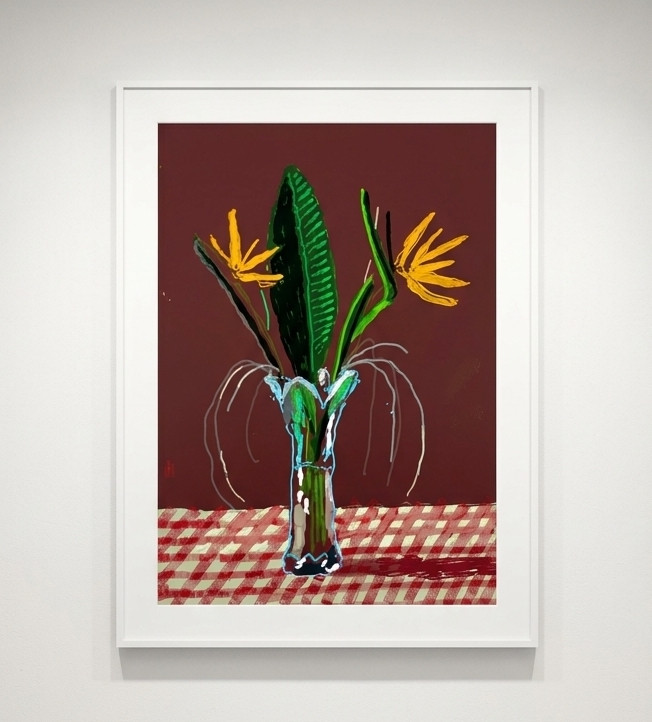
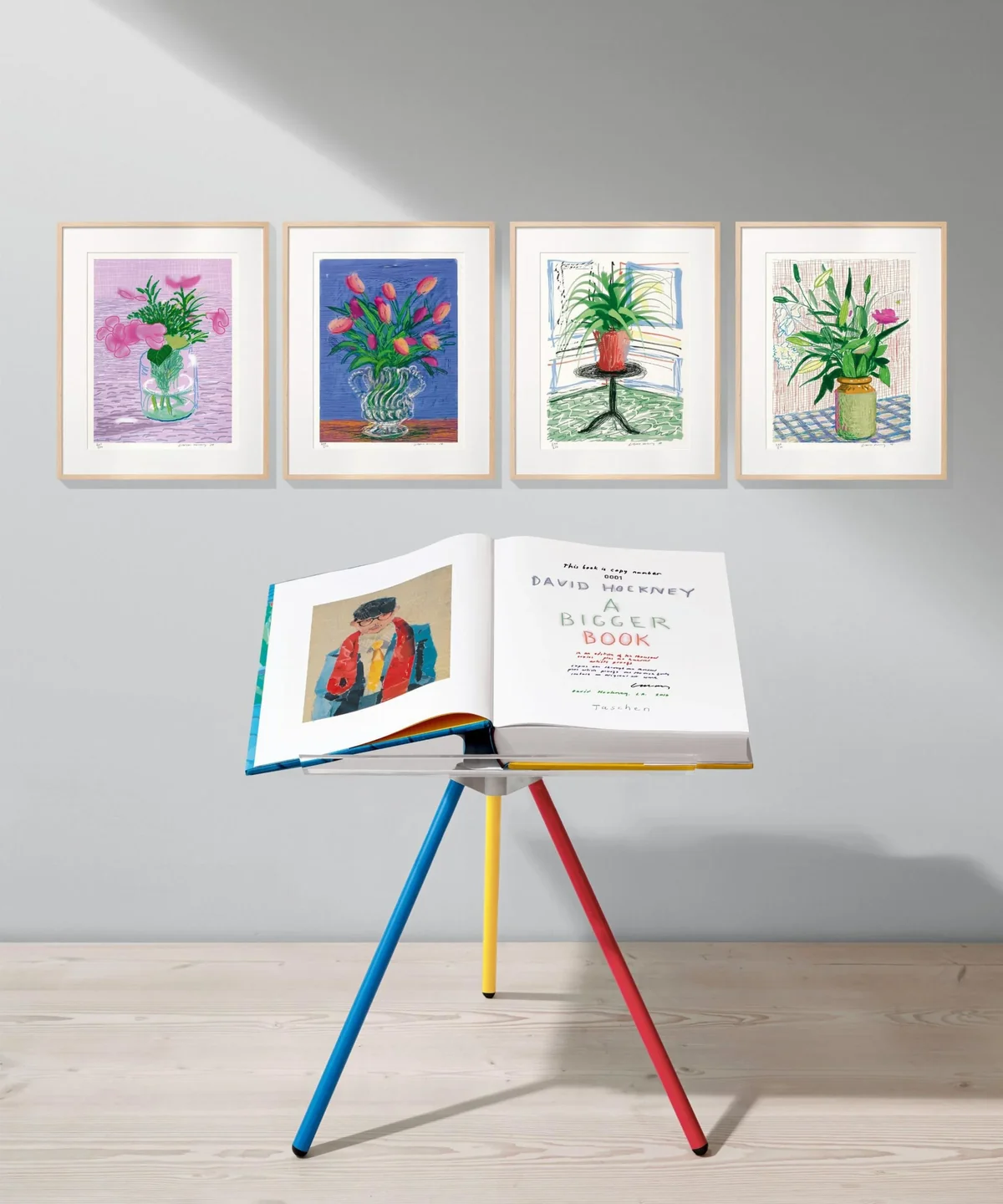
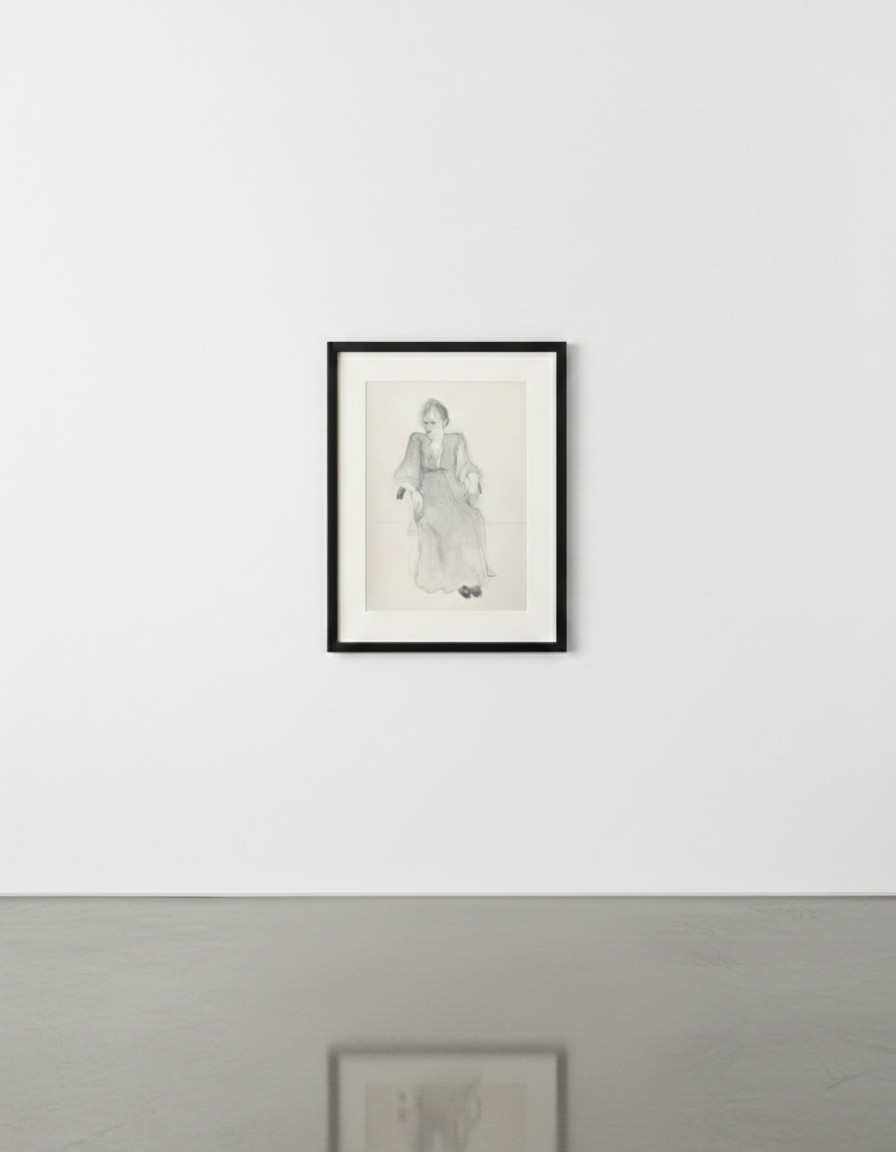
Explore David Hockney prints for sale at Guy Hepner: The Arrival of Spring in Woldgate, 20 Flowers, A Bigger Book & My Window, Celia, Computer Drawings.
Related Series