20 Flowers

August 3, 2026
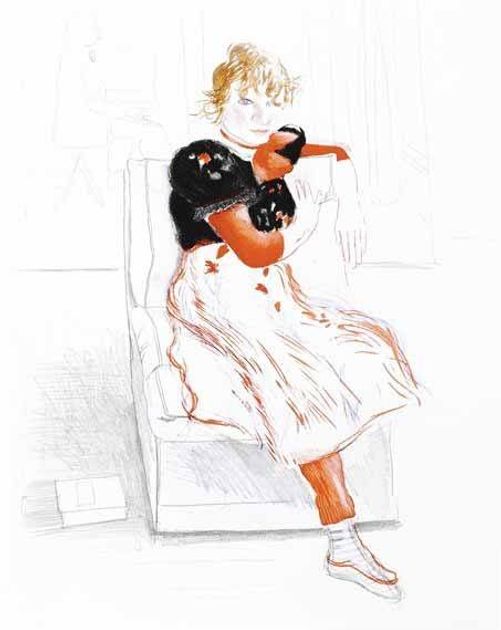
In the annals of twentieth-century art, few relationships between artist and muse have proven as enduring, as creatively fertile, or as genuinely affectionate as that between David Hockney and Celia Birtwell. The David Hockney Celia portraits represent not merely a body of work spanning more than five decades, but an ongoing conversation between two individuals whose friendship has weathered the shifting tides of fashion, geography, and personal circumstance. Where other artistic relationships have combusted in passion or dissolved in acrimony, Hockney's sustained engagement with Celia as a subject speaks to something rarer: a mutual respect that has deepened rather than diminished with time.
Celia Birtwell has sat for Hockney on more than eighty occasions since they first met in 1960s London, and her likeness appears in approximately a quarter of all his printed portraits. This remarkable statistic alone would secure her place in the artist's biography, but the significance of the Celia works extends far beyond their quantity. Through these portraits—rendered in pencil, crayon, ink, lithograph, and etching—we can trace the full arc of Hockney's stylistic evolution, from the confident linearity of his early drawings to the fractured perspectives of his Moving Focus experiments and the vibrant chromatic explorations of his later print editions. To collect David Hockney Celia prints is to possess a concentrated history of one of Britain's most influential living artists.
Celia Birtwell was born in Bury, Greater Manchester, in 1941, the same year as Hockney himself. She studied textile design at the Royal Technical College in Salford, where her talent for pattern and color would eventually establish her as one of the most celebrated fabric designers of the 1960s and 1970s. Her work, with its flowing botanical motifs and jewel-toned palettes, became synonymous with the era's most glamorous fashion moments, appearing on the garments created by her then-partner, the designer Ossie Clark. The swinging London scene brought together artists, musicians, and designers in a heady atmosphere of mutual admiration and collaborative energy, and it was within this milieu that Birtwell and Hockney forged their lasting bond.
The precise circumstances of their first meeting remain somewhat shrouded in the pleasant haze of a busy social calendar, but by the late 1960s, Birtwell had become a fixture in Hockney's circle. She was introduced to him through Ossie Clark, whom Hockney had known since their student days. Clark's flamboyant personality and undeniable talent had captured Hockney's attention early on, and the designer's likeness appeared in the 1963 painting Domestic Scene, Notting Hill. But where Clark would eventually become associated with a single, iconic image—the monumental double portrait Mr and Mrs Clark and Percy—Celia would become the subject of an ongoing project that continues to this day.
The first dedicated portraits of Celia date from 1969, the year she married Ossie Clark in a ceremony at which Hockney served as best man. An ink drawing titled simply Celia, Paris, 1969 captures the twenty-eight-year-old textile designer seated somewhat stiffly on a chair in a sparsely furnished Parisian apartment. Birtwell later recalled feeling nervous during this early sitting, an anxiety that shows in her posture. Yet even in this relatively tentative beginning, Hockney's characteristic attention to the specificity of his sitter's features is evident, as is his ability to convey personality through the most economical of means.
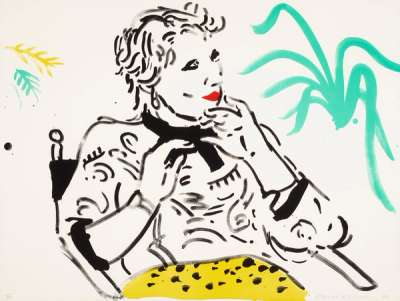
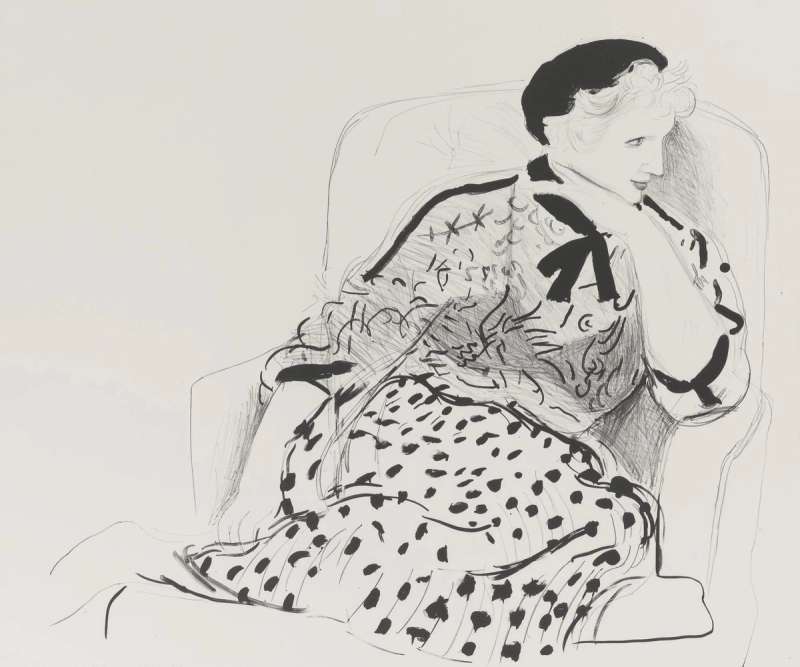
David Hockney, Celia Portrait Study, Line Drawing with Color Accents. Available at Guy Hepner, New York.
No discussion of the David Hockney Celia Birtwell portraits can proceed without addressing the work that introduced her to the wider public consciousness. Mr and Mrs Clark and Percy, completed in 1971, remains one of the most visited paintings in the Tate Collection and one of the most recognizable British artworks of the twentieth century. The large-scale double portrait depicts Celia and Ossie Clark in the sitting room of their Notting Hill flat, bathed in the soft light filtering through sheer curtains. A white cat—Percy—sits alert on Ossie's lap, while Celia stands to the left of the composition, her hand resting assertively on her hip, her gaze directed unflinchingly at the viewer.
The painting's power derives from its subtle psychological complexity. Where conventional marriage portraits might emphasize unity and harmony, Hockney's composition hints at the tensions that would eventually dissolve the Clark union. Celia's stance conveys confidence and self-possession, while Ossie appears more passive, almost languid, in his seated position. Individual strands of Celia's hair are picked out by the sunlight, a detail that speaks to Hockney's extraordinary technical facility and his particular fascination with rendering her distinctive appearance. The work established Celia as a figure of public interest in her own right, separate from her identity as Ossie Clark's wife or collaborator.
Yet for all its fame, Mr and Mrs Clark and Percy represents just one moment in a relationship that would prove far more productive for both artist and subject. The painting captured the Clarks at what appeared to be a pinnacle of fashionable success, but the marriage was already showing signs of strain. By 1973, when Celia visited Hockney at a beach house he had rented in Malibu, California, bringing her two young sons along, the dissolution of her marriage was well underway. This difficult period, paradoxically, marked an intensification of the creative bond between artist and muse.
The time Celia spent with Hockney in California in 1973 proved remarkably generative for the artist. Removed from the pressures and associations of London, both artist and subject seemed to relax into a deeper understanding. Hockney produced numerous portraits of Birtwell during this period, including the exquisite drawing Celia Smoking, which captures her in a moment of private contemplation. The work focuses intensely on her face, rendered through fine monochromatic lines and delicate shading, while her body and surroundings dissolve into suggestion. A barely visible cigarette in her left hand provides the work's title, but the true subject is the mood of pensive introspection that Hockney observed in his friend during this transitional moment in her life.
The David Hockney Celia lithographs and drawings from this period reveal an artist increasingly confident in his ability to capture psychological states through minimal means. Where the painted portraits required weeks or months of work, the drawings could be completed in a single sitting, allowing Hockney to record fleeting expressions and momentary configurations of light and shadow. This immediacy became central to his portrait practice, and Celia's willingness to sit repeatedly allowed him to refine his approach through sustained observation of a single, well-known subject.
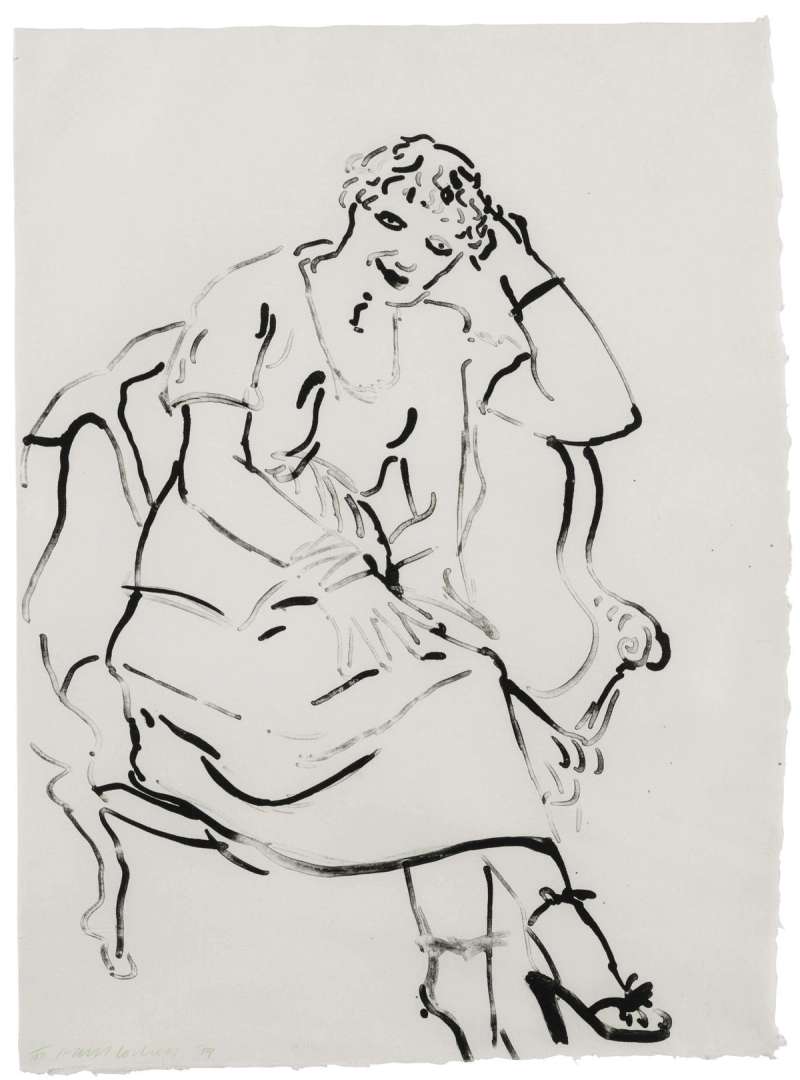
David Hockney, Celia Seated in Patterned Dress, Ink Drawing. Available at Guy Hepner, New York.
Hockney himself articulated the significance of this sustained engagement: "Portraits aren't just made up of drawing, they are made up of other insights as well. Celia is one of the few girls I know really well. I've drawn her so many times and knowing her makes it always slightly different." This statement encapsulates the philosophy underlying the entire Celia project—the belief that true portraiture requires not merely technical skill but genuine knowledge of and affection for the subject. Each sitting adds to the accumulated understanding, and each new portrait reflects not only how Celia appears at that moment but how she has changed since the last encounter, how the relationship itself has evolved.
While Hockney's unique drawings and paintings of Celia are largely held in museum collections or private hands, his print editions offer collectors the opportunity to acquire works from this extraordinary series. The David Hockney Celia prints span multiple techniques and periods, from early lithographs executed with classical restraint to later experiments in color and form. These editions represent some of the finest examples of Hockney's printmaking practice, a medium he has explored with consistent dedication throughout his career.
The lithographs from the 1970s and 1980s display Hockney's mastery of the medium's tonal possibilities. Working with master printers at workshops in Los Angeles and later in London, he developed techniques for rendering the subtle gradations of light on skin, the texture of hair, the drape of fabric. The David Hockney Celia lithographs from this period often feature the designer in characteristic poses—seated in an armchair, dressed in one of her own textile designs, her expression alternating between direct engagement with the viewer and moments of inward reflection.
The print medium also allowed Hockney to explore variations and series in ways that would be impractical with unique works. Multiple states of the same image, printed in different colors or on different papers, enabled him to investigate how alterations in context change our perception of a familiar face. For collectors, these variations offer the chance to observe Hockney's creative process in action, to see how he refined and reconsidered his approach to a subject he knew intimately.
In the early 1980s, Hockney's work underwent a dramatic transformation as he began incorporating multiple perspectives into single compositions, drawing inspiration from Cubism and challenging the conventions of Renaissance perspective that had dominated Western art for centuries. This period produced some of his most visually striking and intellectually ambitious work, and Celia featured prominently in these experiments. The Hockney Moving Focus series Celia works represent a fascinating intersection of formal innovation and personal subject matter.
These portraits fracture Celia's image into multiple viewpoints, suggesting the experience of looking at someone over time rather than capturing a single frozen instant. Eyes appear at slightly different angles, suggesting the shift of attention as we look from one feature to another. Backgrounds dissolve into geometric patterns that echo the fragmented figure they surround. The effect is both disorienting and strangely truthful—closer, perhaps, to how we actually experience the presence of someone we know well than the static image of a conventional portrait.
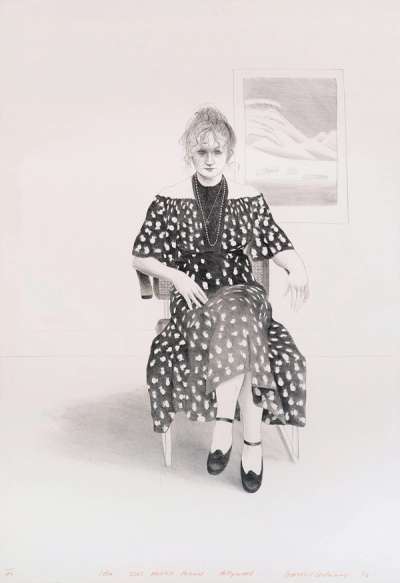
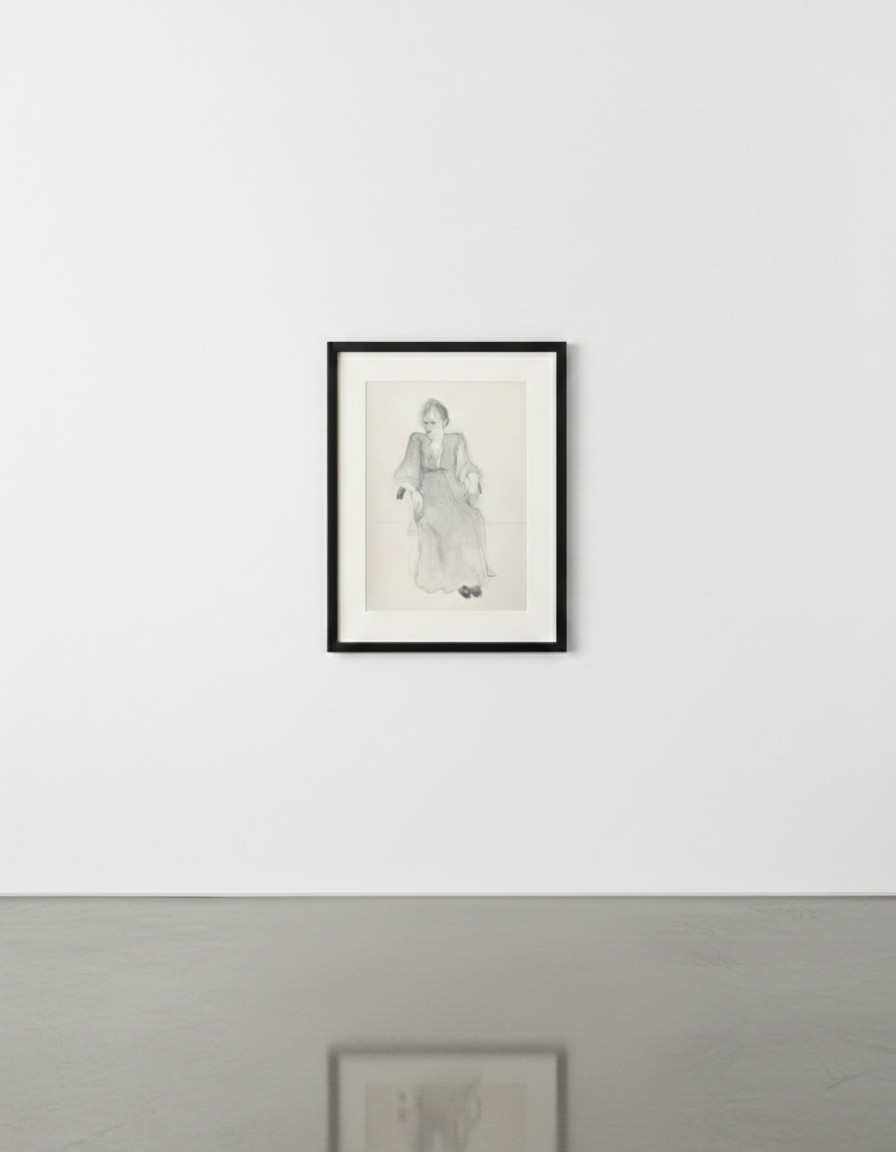
David Hockney, Celia Portrait Study, Pencil Drawing. Available at Guy Hepner, New York.
For Celia, who had sat through so many traditional portrait sessions, these experimental works must have represented a strange new experience. Yet her continued willingness to participate speaks to the trust that had developed between artist and subject over decades. She understood, perhaps better than anyone outside Hockney's immediate circle, that these formal experiments were not departures from portraiture but rather attempts to capture something more essential about the experience of presence and recognition.
The sustained importance of the David Hockney Celia series derives from several intersecting factors that collectors and scholars continue to find compelling. First, the sheer duration of the project—spanning more than half a century—allows us to observe both the aging of the subject and the evolution of the artist's style in parallel. Few artist-muse relationships have been documented with such consistency over such an extended period.
Second, the range of media Hockney employed in depicting Celia provides a comprehensive overview of his technical abilities and interests. From the confident linearity of his ink drawings to the soft tonal gradations of his lithographs, from the precise observation of his pencil portraits to the fractured geometries of his Moving Focus works, the Celia portraits span virtually every technique in Hockney's repertoire. A collection of these works would represent, in miniature, a survey of late twentieth-century printmaking and drawing.
Third, and perhaps most importantly, the portraits document a friendship of unusual depth and duration between two creative individuals. In an art world often characterized by transactional relationships and competitive dynamics, the Hockney-Birtwell collaboration stands as a model of mutual support and genuine affection. Hockney has spoken movingly of what draws him to Celia as a subject: "Celia has a beautiful face, a very rare face, with lots of things in it which appeal to me… It shows her intuitive knowledge and kindness, which I think is the greatest virtue. To me she is such a special person."
The current market for David Hockney Celia prints reflects the broader appreciation for the artist's work that has developed over the past two decades. Hockney's auction records have soared, with his painting Portrait of an Artist (Pool with Two Figures) briefly holding the record for the highest price achieved by a living artist when it sold in 2018. This attention has naturally increased interest in his printed editions, which offer collectors an entry point into an otherwise stratospheric market.
The David Hockney Celia series for sale through reputable galleries represents some of the most desirable material in his print oeuvre. Factors affecting value include the period of creation, the technique employed, the edition size, and the condition of individual impressions. Early lithographs from the 1970s, produced in relatively small editions, command premium prices, while later print editions, though equally accomplished technically, may be more accessible to newer collectors.
Condition remains paramount when evaluating any work on paper. Factors to consider include:
David Hockney, Celia Figure Study, Expressive Line Drawing. Available at Guy Hepner, New York.
The critical response to Hockney's portrait practice has evolved considerably over the decades. In the 1960s and 1970s, when Conceptual Art and Minimalism dominated the avant-garde, his commitment to figuration and traditional techniques was sometimes dismissed as retrograde or merely decorative. The intimacy and warmth of works like the Celia portraits seemed out of step with the prevailing critical climate, which favored impersonality and systematic approaches to art-making.
Yet Hockney persisted, and the passage of time has vindicated his choices. The return to figuration that characterized much art of the 1980s and beyond made his sustained engagement with portraiture appear prescient rather than nostalgic. Critics who had dismissed him as a lightweight or a society artist began to recognize the depth of his investigation into the act of representation itself. The Celia portraits, in particular, came to be seen as a sustained meditation on the nature of knowledge, attention, and affection—how we come to know another person, how that knowledge changes what we see when we look at them.
Art historian Marco Livingstone, who has written extensively on Hockney's work, has emphasized the importance of the repeated sittings to the artist's understanding of portraiture. Each encounter adds a layer of observation, and the accumulated portraits constitute something like a visual journal of a friendship. This longitudinal approach distinguishes Hockney's practice from that of most portrait painters, who typically engage with a subject intensively for a brief period before moving on to the next commission.
For collectors interested in acquiring works from this important series, several strategies merit consideration. The market offers opportunities at various price points, and building a coherent collection requires careful attention to both aesthetic and practical factors.
The David Hockney muse Celia Birtwell continues to feature in the artist's work even now, as both artist and subject enter their ninth decade. Recent drawings and prints demonstrate that Hockney's interest in capturing her likeness remains undimmed, even as both faces have changed with the passage of years. This ongoing engagement gives the series a quality rare in contemporary art—a sense of genuine human continuity in an art world often characterized by transience and reinvention.
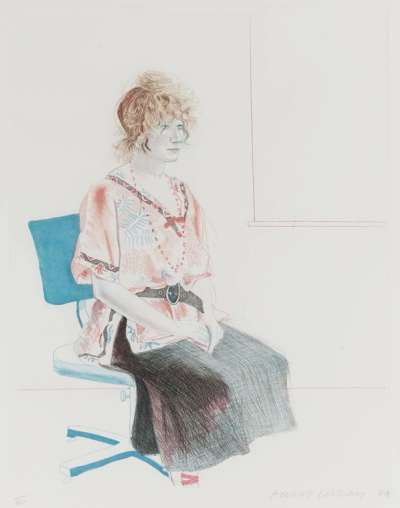
David Hockney, Celia Seated Portrait, Colored Pencil and Ink. Available at Guy Hepner, New York.
It would be remiss to discuss these portraits without acknowledging Celia Birtwell's achievements independent of her role as Hockney's muse. Her textile designs have influenced generations of fashion and interior designers, and her patterns continue to be sought after by collectors of vintage fabrics and contemporary reissues alike. The distinctive look she cultivated—flowing dresses in her own prints, carefully arranged hair, expressive makeup—became an icon of 1960s and 1970s style.
Birtwell has reflected on her experience as Hockney's subject with characteristic grace. "Hockney? He has immortalized me," she has said, acknowledging the strange position of being known primarily through another artist's vision while maintaining her own creative identity. The relationship has been genuinely reciprocal; Hockney has collected her textiles and incorporated them into his domestic spaces, while she has surrounded herself with his images of her. This mutual appreciation gives the Celia portraits a warmth that distinguishes them from more conventional artist-model relationships.
The tragedy of Ossie Clark's murder in 1996 cast a retrospective shadow over Mr and Mrs Clark and Percy, but the many portraits of Celia alone have taken on a different resonance—celebrating an individual who survived personal difficulties and professional challenges to maintain both her creative practice and her essential character. In Hockney's later portraits, we see not just an aging face but a personality that has remained recognizably itself across decades of change.
In an art market often driven by spectacle and novelty, the David Hockney Celia Birtwell portraits offer something increasingly valuable: evidence of sustained attention and genuine affection. These works reward extended looking precisely because they themselves are products of extended looking, accumulated over more than fifty years of friendship and creative exchange. Each portrait contains within it the memory of all the portraits that came before, each sitting informed by the knowledge gained in previous encounters.
For collectors, these works offer an opportunity to participate in one of the most significant artist-muse relationships of the past century. The David Hockney print editions featuring Celia represent the intersection of technical mastery, art historical importance, and human meaning—qualities that ensure their continued relevance to new generations of viewers and collectors. They remind us that portraiture, at its best, is not merely the reproduction of appearance but the documentation of relationship, the visible trace of attention paid and affection maintained over time.
Guy Hepner is pleased to offer a selection of David Hockney Celia works for collectors seeking to acquire examples from this remarkable series. Our specialists at the gallery's Tenth Avenue location in New York are available to discuss available works, assist with authentication questions, and help collectors identify pieces that align with their aesthetic preferences and collecting goals. We invite you to contact us to learn more about current availability and to explore the enduring appeal of Hockney's portraits of his most celebrated muse.
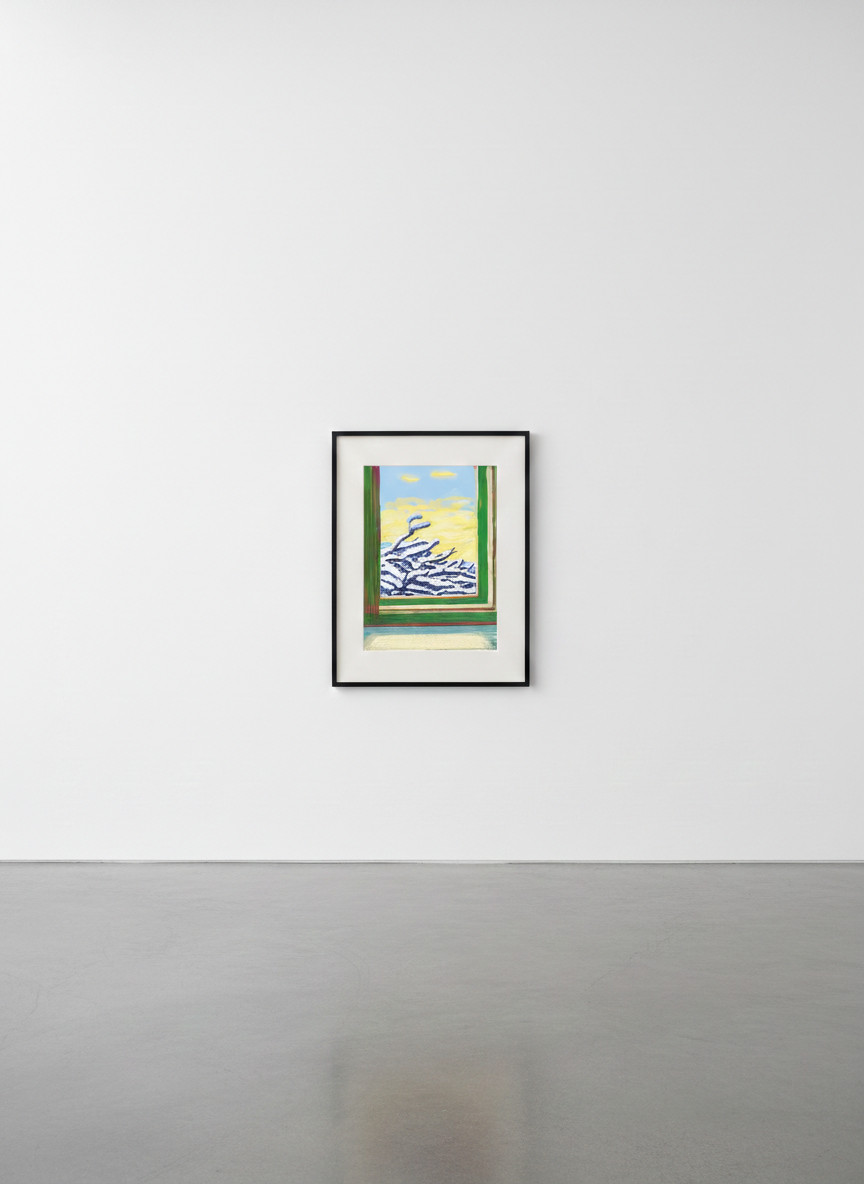
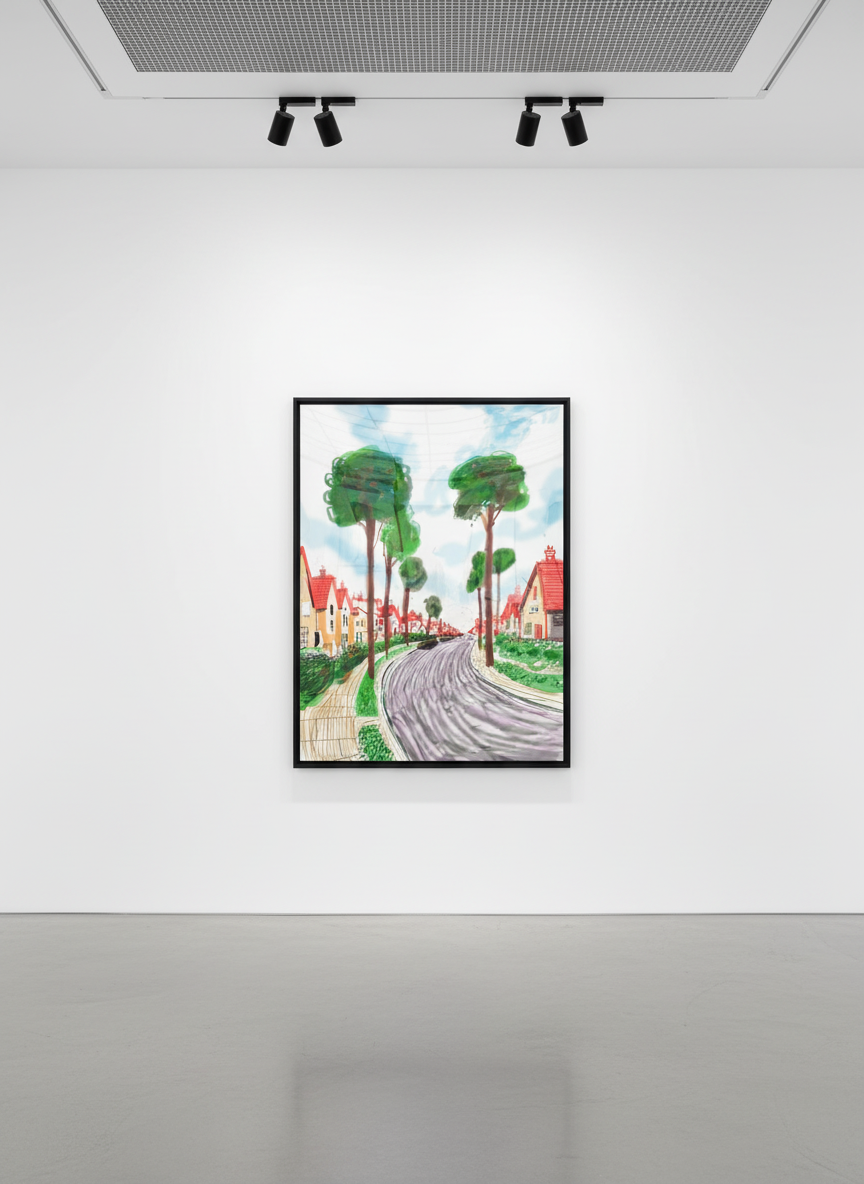
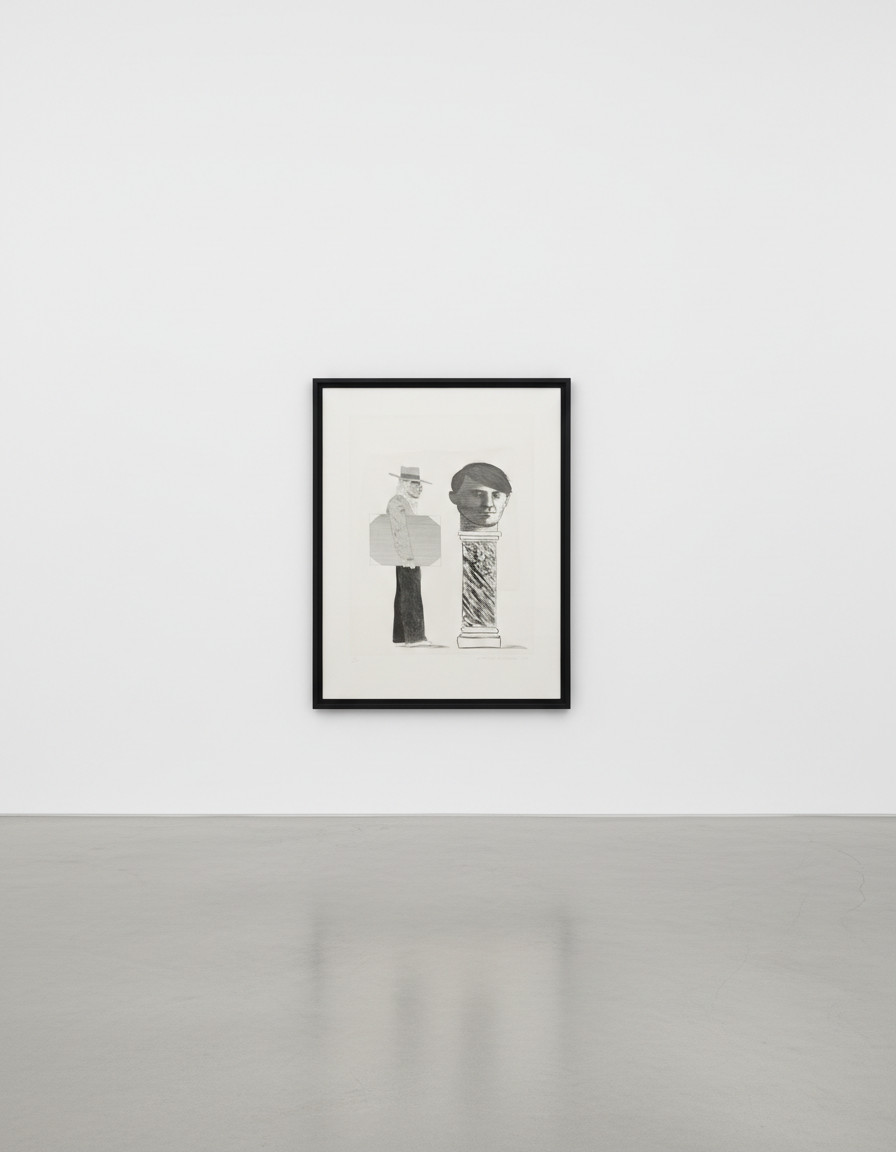
Explore David Hockney prints for sale at Guy Hepner: 20 Flowers, A Bigger Book & My Window, Celia, Computer Drawings, Homage to Picasso.
Related Series