The Arrival of Spring in Woldgate

April 29, 2026
Few bodies of work in contemporary printmaking have captured the art world's imagination quite like David Hockney's The Arrival of Spring in Woldgate, East Yorkshire. If you are searching for David Hockney Arrival of Spring for sale, this guide covers everything you need to know — the history of the series, how the prints were made, recent auction results, and how to acquire and authenticate a work with confidence. Whether you are a seasoned collector or approaching Hockney's prints for the first time, this is the resource to start with.
Inquire About Available Works Browse available works from The Arrival of Spring in Woldgate series at Guy Hepner, New York.
In 2010, David Hockney returned to his home county of Yorkshire after decades living in Los Angeles and London. He settled near Bridlington, a coastal town on the East Yorkshire coast, and began spending long hours in Woldgate Woods — a stretch of ancient country lane lined with towering trees that changes dramatically with every passing week. What followed was one of the most sustained acts of close looking in Hockney's long career.
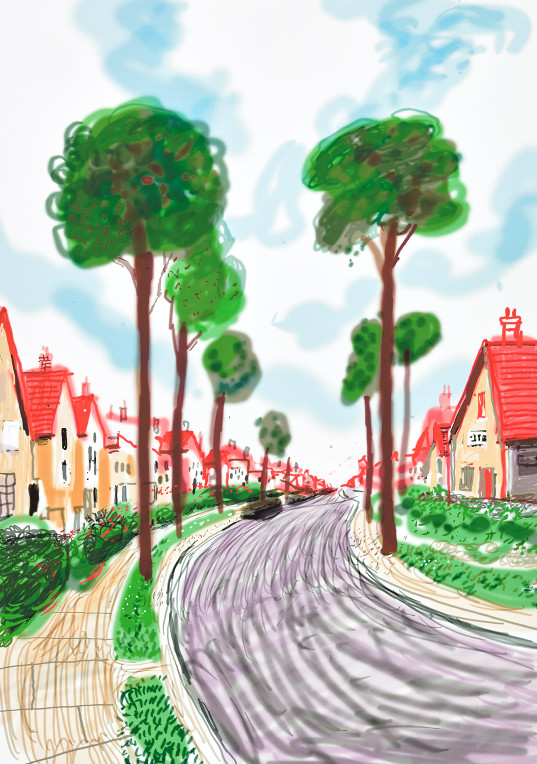
Over the course of a full year, from winter through to the following winter, Hockney documented the lane, the hedgerows, the light and the mud in extraordinary detail. He worked on an iPad — then a relatively new device — using the Brushes application to create drawings directly on the screen, often working outside in the cold, his finger moving across the glass to capture the precise quality of morning light or the burst of blossom on a hawthorn branch. The date and time were automatically recorded by the app, lending every image an almost diary-like intimacy.
The resulting series, The Arrival of Spring in Woldgate, East Yorkshire in 2011 (twenty eleven), comprises 52 individual works — one for most weeks of the year, with some dates producing multiple compositions. Together they constitute a complete seasonal record: the bare brown lanes of January giving way to the acid greens of April, the full-leafed canopy of high summer, and the golden collapse of autumn. It is, in effect, a portrait of a single place across time — an idea with deep roots in art history, from Monet's haystacks to Constable's studies of Hampstead Heath, but executed with a thoroughly twenty-first-century tool.
The series was first exhibited at the Royal Academy of Arts in London in 2012, as part of the landmark exhibition David Hockney RA: A Bigger Picture, which drew nearly 600,000 visitors and cemented Hockney's reputation as the defining British painter of his generation. International tours followed, bringing the works to audiences across Europe and North America.
31st May, The Arrival of Spring in Woldgate, East Yorkshire in 2011. Available at Guy Hepner, New York.
Each work in the series exists as a pigmented inkjet print on four sheets of paper, mounted on four sheets of Dibond aluminium. The finished dimensions are 139.7 × 105.4 cm (55 × 41.5 in) — a scale that fills a wall and allows the viewer to move into the image in a way that a smaller reproduction never could. The format is consistent across the entire series, giving the 52 works a strong visual coherence when seen together, whilst each individual print rewards extended, close study.
The process by which an iPad drawing becomes a museum-quality print is worth understanding in detail. Hockney's team used the original digital files — drawn at the highest resolution available in the Brushes application — and printed them using archival-quality pigmented inks on acid-free paper. The resulting prints carry the full tonal range and luminosity of the original digital compositions, with colours that remain stable over decades under normal display conditions.
What makes the process significant is not merely technical. By drawing on an iPad in real time — in the field, at the actual moment of observation — Hockney bypassed the traditional studio mediation between observation and execution. The lines you see in these prints are the lines he made as he looked. They record the gesture of looking as much as the thing looked at. In this respect, the series has more in common with plein-air drawing than with conventional printmaking, even though the final objects are prints.
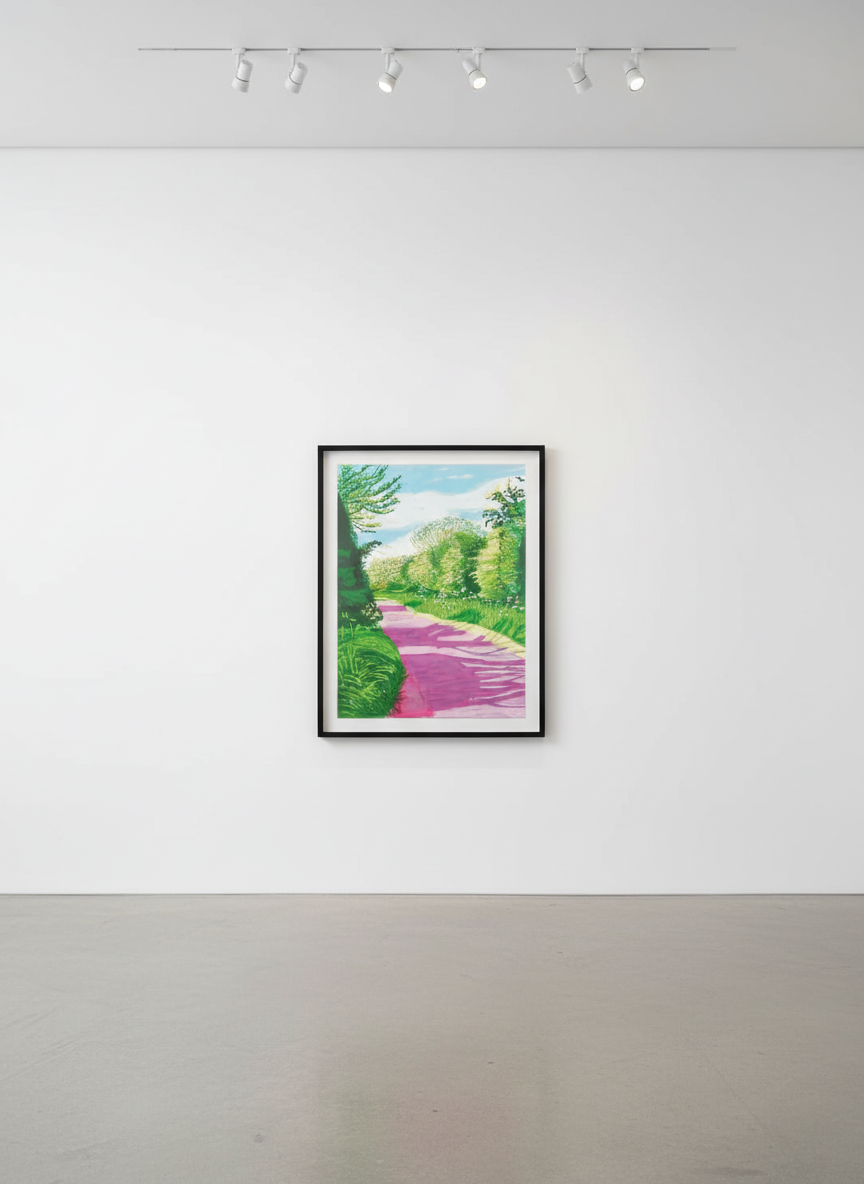
 16 May, The Arrival of Spring in Woldgate, East Yorkshire. Available at Guy Hepner, New York.
The significance of documenting seasonal change week by week cannot be overstated. Most representations of nature in art freeze a single moment or generalise across seasons. Hockney's series does something different: it insists on specificity. The 22nd of March is not simply early spring — it is that morning, those exact trees, that quality of pale light. The 31st of May is not simply late spring — it is the precise tipping point between the bright lime greens of young growth and the darker, heavier greens of full summer. Collectors who live with these works often speak of developing a more attentive relationship to the natural world around them — noticing, as Hockney does, the difference between one week and the next.
Speak With a Specialist Our team can help you identify the right work from the series for your collection. Contact Guy Hepner, New York.
The secondary market for The Arrival of Spring series has shown sustained strength, with 2026 results confirming the series' position as one of the most sought-after bodies of Hockney's printed work.
At Sotheby's in March 2026, three works from the series achieved the following results:
At Christie's in March 2026, 4 May sold for $326,000. A further Christie's sale in April 2026 saw 2 January achieve $309,000.
These results reflect several converging factors. Hockney's market has remained exceptionally robust in the years following his record-breaking 2018 sale of Portrait of an Artist (Pool with Two Figures), which established him as the most expensive living artist at auction at that time. The Arrival of Spring series benefits from its museum exhibition history, its documentary significance, and the clarity of its narrative — all factors that appeal to both institutional and private buyers.
Spring dates — particularly those from April, May, and early June — have historically attracted the strongest interest, which aligns with the works' subject matter: the explosion of colour and growth that defines the Yorkshire spring is most vivid in those compositions. However, the winter and early-spring works (January, February, March) offer collectors an opportunity to acquire works at the quieter end of the market whilst still securing a piece of the complete narrative.
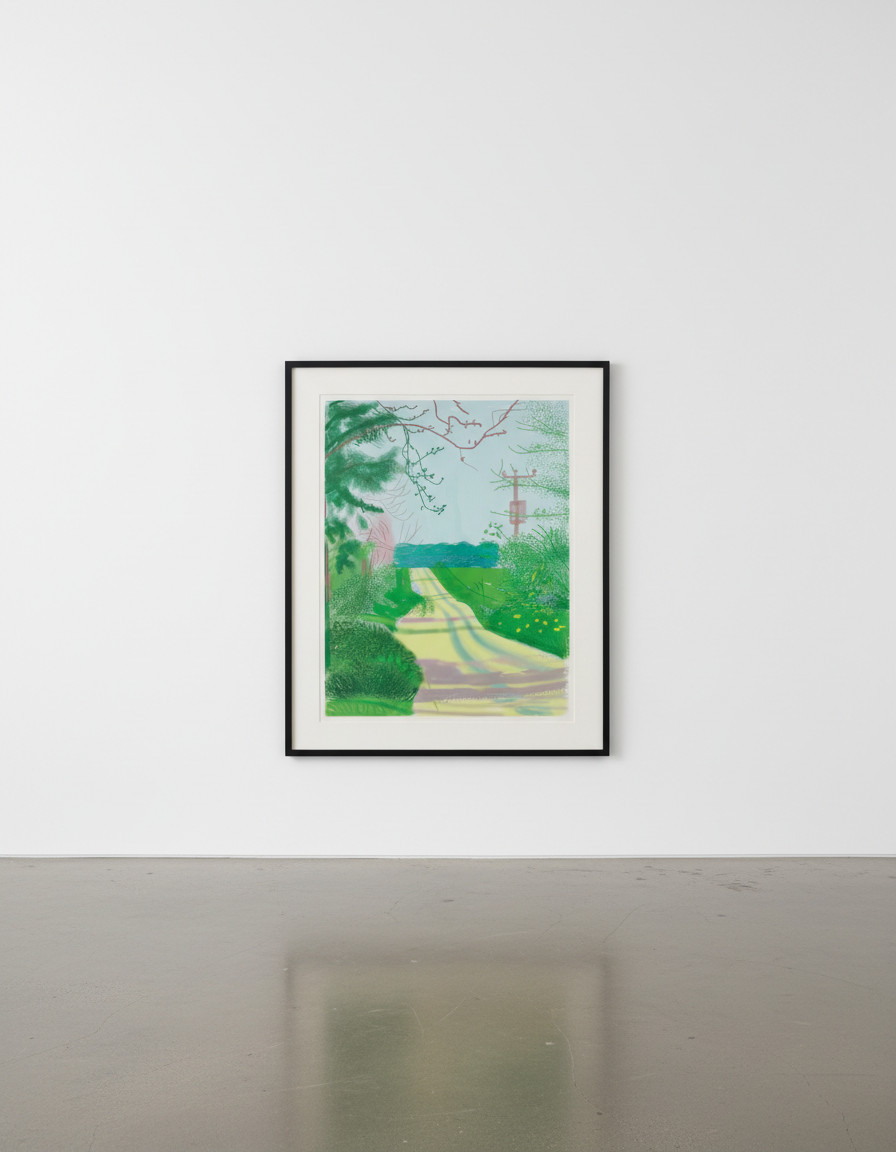
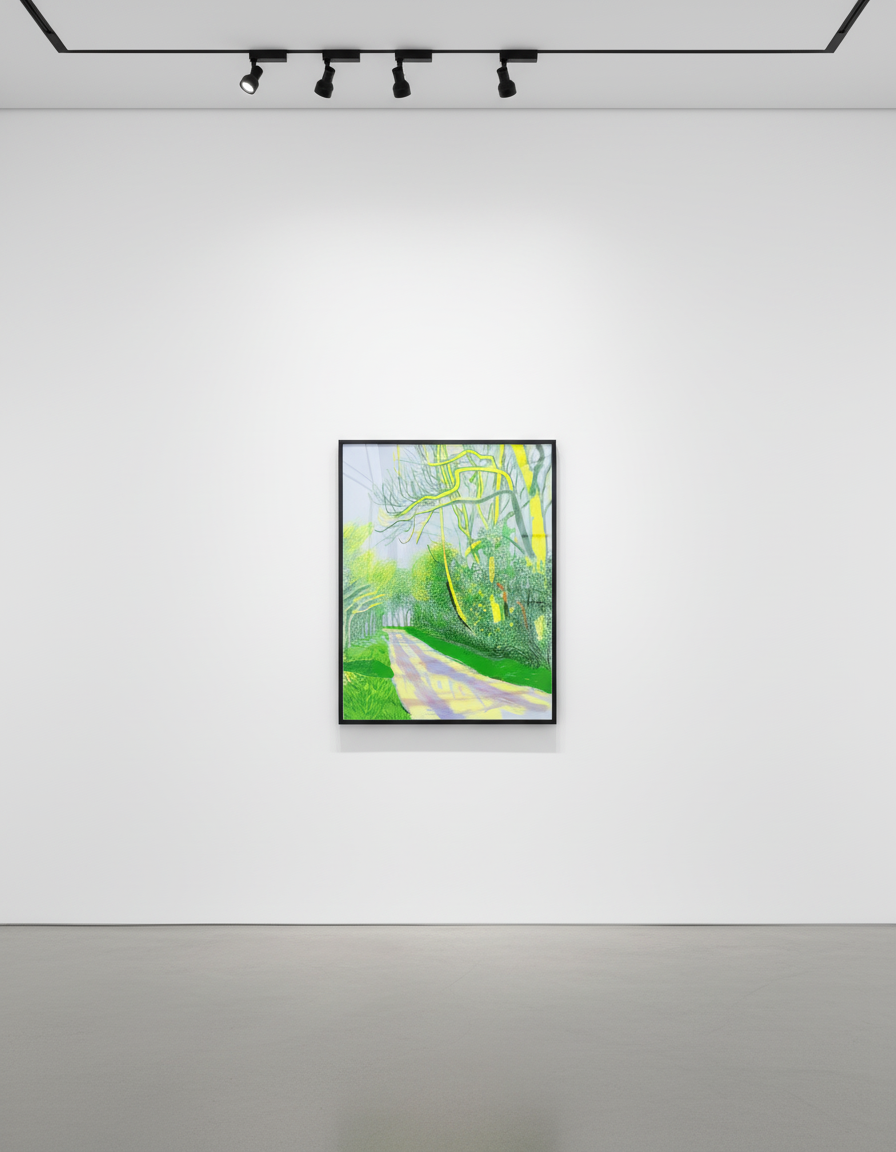 12 April No. 2, The Arrival of Spring in Woldgate, East Yorkshire. Available at Guy Hepner, New York.
Collectors considering David Hockney Arrival of Spring value over the medium to long term should understand the specific factors that drive price within this series.
Date specificity. Within the 52 works, spring dates — particularly May — command a premium, reflecting the visual drama of those compositions. The fully leafed canopy works, with their extraordinary chromatic richness, are the most immediately striking and the most widely reproduced. January and February works offer relative value whilst remaining part of the same museum-exhibited body of work.
Edition context. Each work in the series exists in an edition of 25, with additional artist's proofs. Edition number matters: lower numbers (particularly 1/25 and 2/25) have historically attracted collector interest, though condition and provenance are more significant factors in practice.
Condition. The pigmented inkjet prints are archival and stable, but they are paper-mounted on Dibond, which means improper framing or storage can cause issues over time. Works that have been professionally framed and stored in stable, climate-controlled environments — and can document this history — command a premium over those with uncertain storage histories.
Provenance. Works acquired directly from the original publisher or from reputable primary market galleries carry the clearest provenance chains. Secondary market works with documented auction or gallery history are similarly strong. Gaps in provenance — particularly for works that have passed through private hands multiple times — require additional scrutiny.
Market positioning. The Arrival of Spring series occupies a specific position in the Hockney market: it is more affordable than his major oil paintings, more significant than his commercial poster prints, and more narratively coherent than isolated works from other print series. This positioning makes it attractive to collectors who want substantial Hockney works without committing to the seven-figure primary market for paintings.
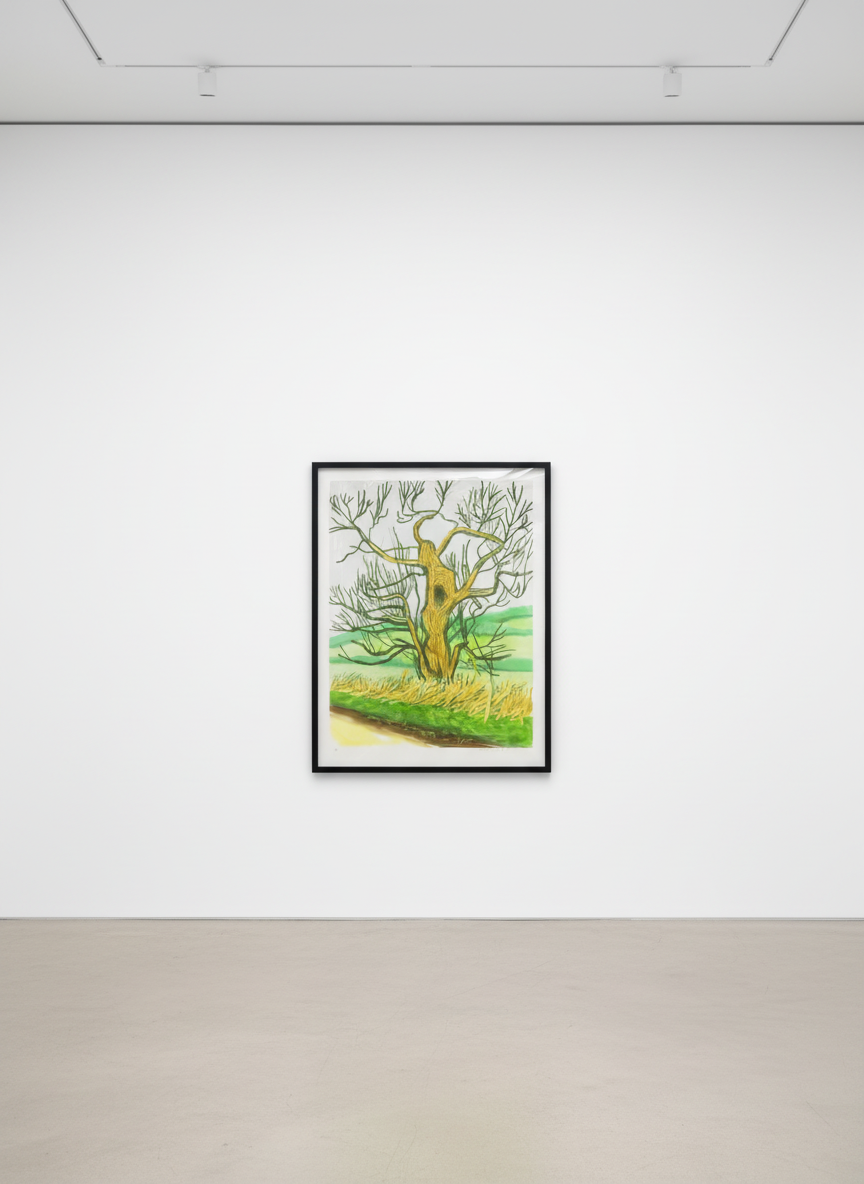 22 March, The Arrival of Spring in Woldgate, East Yorkshire. Available at Guy Hepner, New York.
Authentication is a critical step for any collector acquiring works from this series, particularly in the secondary market. Here is what to look for and how to proceed.
Certificate of Authenticity. Every work in the series should be accompanied by a certificate of authenticity. The certificate should identify the specific date (e.g., 31 May No. 1), the edition number (e.g., 5/25), and carry appropriate documentation from the issuing source. Examine the certificate carefully: the text should be precise, the paper should be of quality commensurate with the work, and there should be no alterations or inconsistencies.
Hockney Studio. For works with direct provenance from the original publication, the Hockney studio can sometimes assist with verification. Enquiries should be made formally and in writing, with full documentation of the work's provenance and condition.
David Hockney Foundation. The David Hockney Foundation maintains records relating to Hockney's work and can be a resource for authentication queries, particularly for works with uncertain histories. The Foundation does not authenticate works commercially, but it can provide contextual information that assists in establishing legitimacy.
Physical examination. Works should be examined under proper lighting conditions. The printing quality of authentic works is exceptionally fine — the resolution of the pigmented inkjet prints reproduces Hockney's iPad lines with precision. Any blurring, colour banding, or inconsistency in the Dibond mounting should prompt further investigation. The Dibond backing should be clean and unmarked, with the four panels mounted evenly and securely.
Provenance chain. Request the full provenance documentation: purchase receipts, auction catalogues, gallery invoices, and any export or import paperwork if the work has crossed international borders. A clean, documented provenance chain from original publication to the present day is the strongest possible authentication.
Working with specialists. For significant acquisitions, engaging an independent art advisor with specific expertise in Hockney's printed work is strongly recommended. The cost of professional due diligence is modest relative to the value of the works.
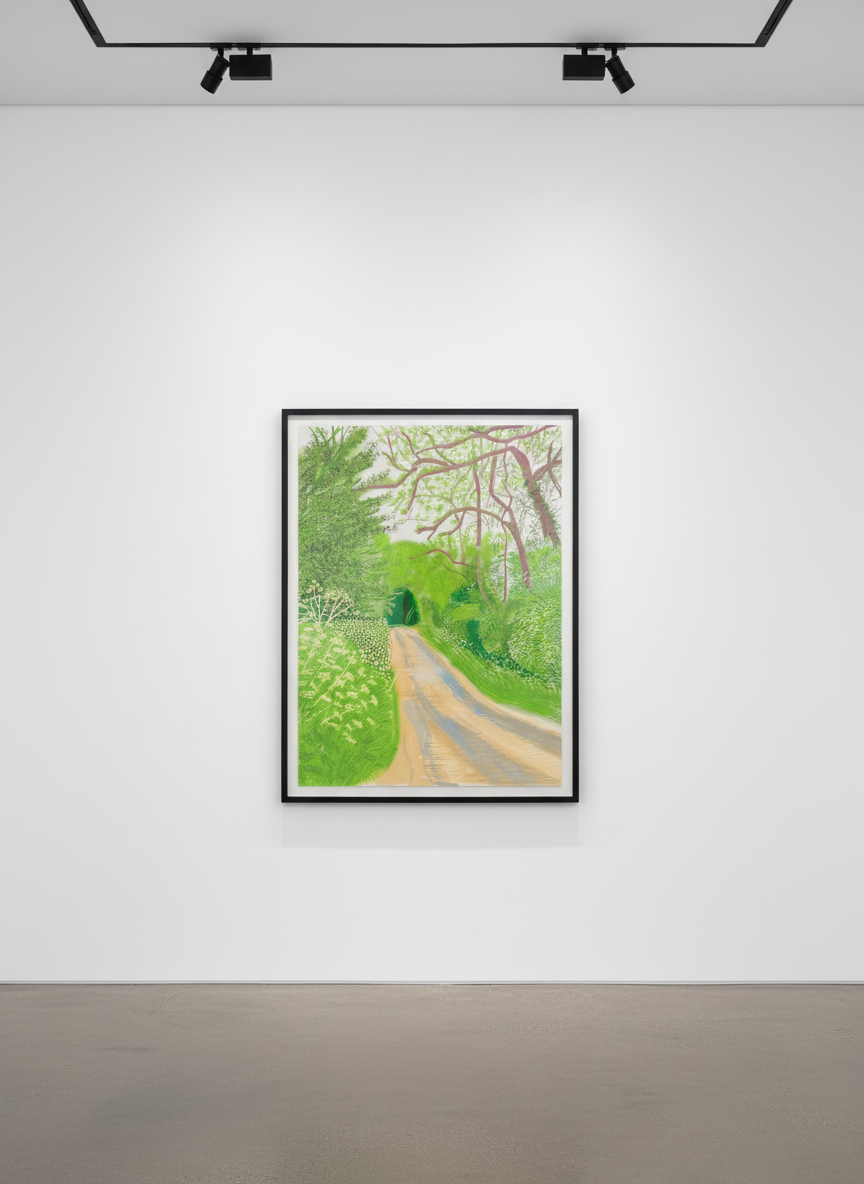
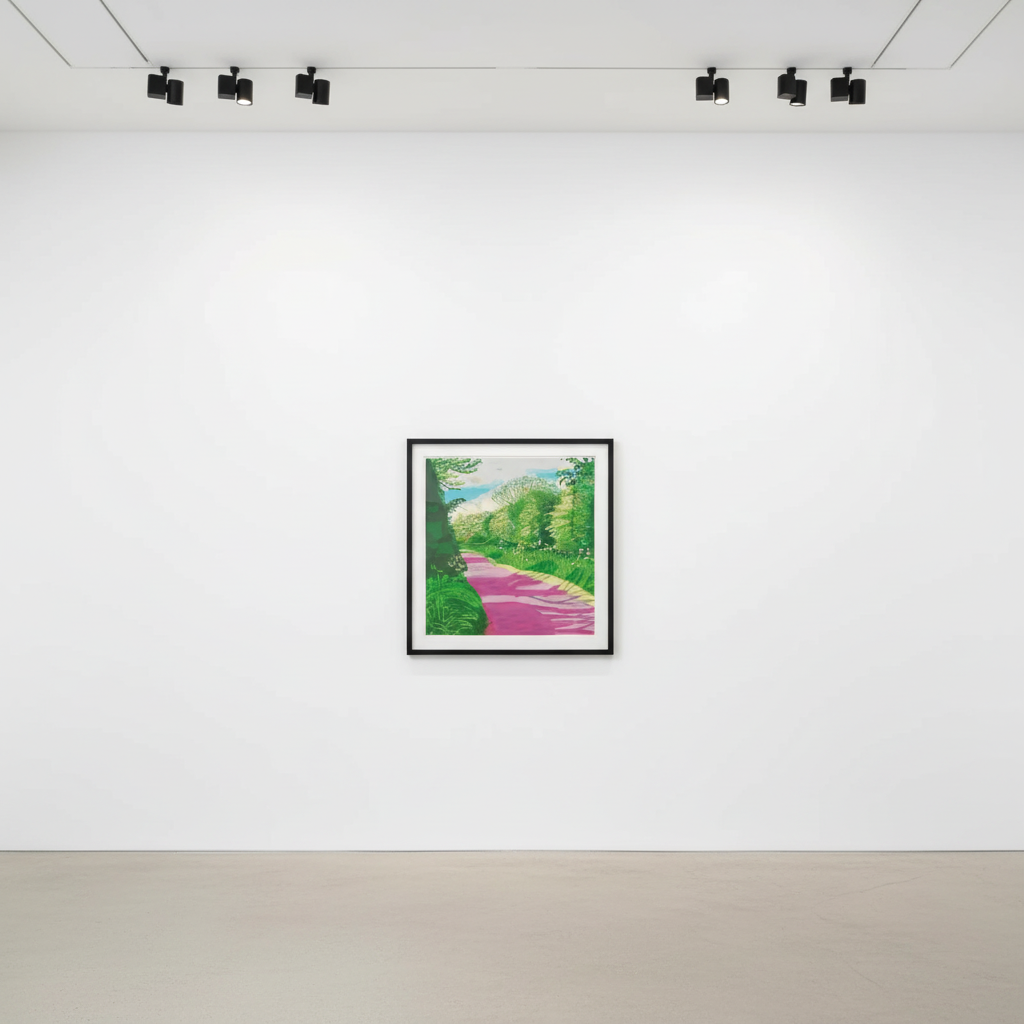 31 May No. 2, The Arrival of Spring in Woldgate, East Yorkshire. Available at Guy Hepner, New York.
Inquire About Available Works Browse available works from The Arrival of Spring in Woldgate series at Guy Hepner, New York.
What are David Hockney's Arrival of Spring prints? The Arrival of Spring in Woldgate, East Yorkshire in 2011 (twenty eleven) is a series of 52 works by David Hockney, each documenting a specific date in Woldgate Woods near Bridlington, East Yorkshire. The works record the changing seasons week by week over the course of a full year — from the bare lanes of January through to the leafy depths of summer and back to winter. They were first exhibited at the Royal Academy of Arts, London in 2012 as part of the major retrospective David Hockney RA: A Bigger Picture.
How were they made? Hockney made each work using the Brushes application on an Apple iPad, drawing directly from observation in Woldgate Woods. He worked on the device in the field — outside in all weathers — using his finger to draw the lines and colours he saw in front of him. The date and time of each drawing were automatically recorded by the app. These digital files were subsequently printed as large-scale pigmented inkjet prints on paper, mounted on Dibond aluminium.
What is the iPad to print process? The original Ipad Drawings were created at the maximum resolution available in the Brushes application. Hockney's studio used these digital files to produce pigmented inkjet prints — a printing process that uses archival-quality inks capable of lasting well over 100 years under normal display conditions. The resulting prints are on four sheets of paper, mounted on four sheets of Dibond aluminium, with each finished work measuring 139.7 × 105.4 cm (55 × 41.5 in). The process preserves the precise character of Hockney's drawn line, including the variation in pressure and speed that gives the works their handmade quality.
How many works are in the series? The series comprises 52 individual works. Some dates produced a single composition; others produced two (denoted No. 1 and No. 2). Together they constitute a complete annual cycle — one of the most sustained, systematic, and intimate engagements with landscape in Hockney's long career.
Which dates are most sought after by collectors? Spring dates — particularly May — have attracted the strongest auction interest, reflecting the visual impact of those compositions. The full-canopy works, in which Woldgate Lane is completely enclosed by vivid green foliage, are the most widely reproduced and the most immediately striking. However, sophisticated collectors often find the winter and early-spring works equally compelling: the January compositions have a stark, graphic quality that holds its own in any interior, and the February and March works chart the precise moment at which the landscape begins to stir. The 2026 auction results show that May dates continue to lead on price, but the market for the full series remains active.
What condition should I look for when buying? Look for works that have been professionally framed under UV-protective glazing and stored in a stable, climate-controlled environment. The Dibond backing panels should be flat, clean, and evenly mounted. The print surface should be examined for any signs of fading, moisture damage, or abrasion. Provenance documentation is important: ask for the full chain of ownership from original publication. Works with gaps in their provenance history — particularly those that have passed through multiple private hands without documentation — should be approached with caution, and independent authentication is recommended before purchase.
How do I buy a work from the Arrival of Spring series? Works from the series appear at major international auction houses (Sotheby's, Christie's, Phillips) and are held by specialist galleries with expertise in Hockney's printed work. Guy Hepner, New York, holds a significant inventory of works from the series with full provenance documentation. To enquire about available works, contact the gallery directly for current availability and pricing.
What makes this series significant in Hockney's wider practice? The Arrival of Spring series represents the convergence of several major themes in Hockney's work: his lifelong engagement with landscape, his persistent interest in the question of how we see (and how art represents the act of seeing), and his enthusiasm for new mark-making technologies. Throughout his career, Hockney has embraced whatever tools were available — oil paint, lithography, photography, fax machines, photocopiers, iPhones, and finally the iPad — using each to ask what representation can do. The Arrival of Spring is the fullest and most sustained example of what the iPad, in his hands, could achieve. Its museum exhibition history, its connection to the tradition of British landscape, and its documentary completeness give it a significance that extends well beyond the novelty of its medium.
Guy Hepner, New York holds an inventory of 30 published works from The Arrival of Spring in Woldgate, East Yorkshire in 2011, all with full provenance documentation and images. Whether you are looking for a specific date, a particular season, or guidance on which work best suits your collection and space, our team has the expertise to assist.
Inquire About Available Works Browse available works from The Arrival of Spring in Woldgate series at Guy Hepner, New York.
Speak With a Specialist Contact Guy Hepner, New York, to discuss acquiring a work from this series.
Explore David Hockney prints for sale at Guy Hepner: The Arrival of Spring in Woldgate, 20 Flowers, A Bigger Book & My Window, Celia, Computer Drawings.
Related Series