H9 - the Virtues

June 9, 2026
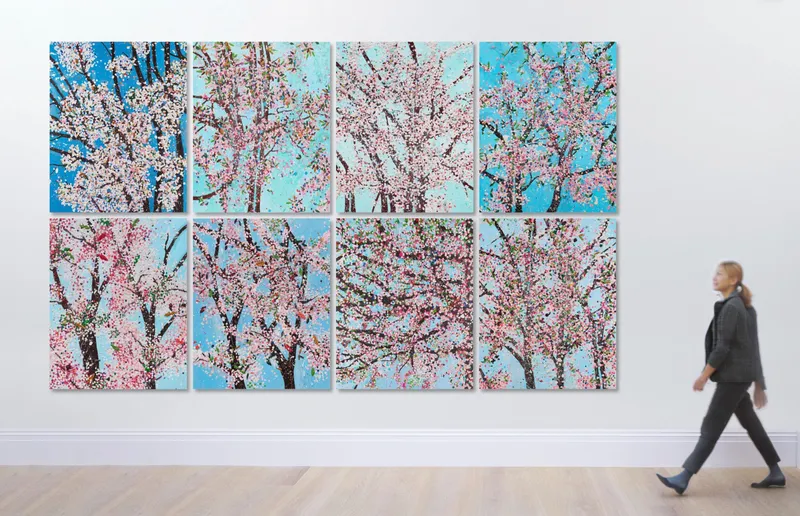
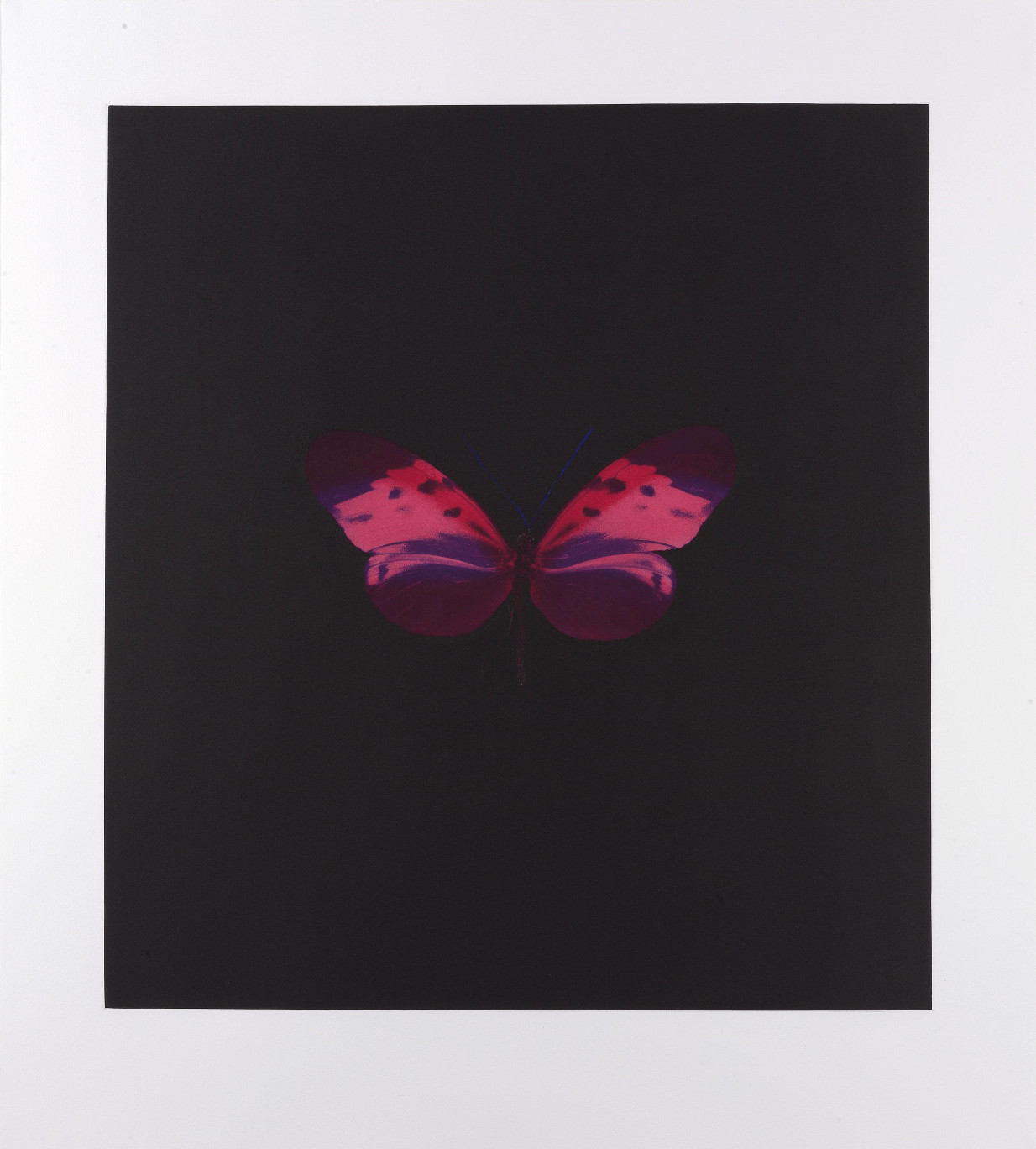
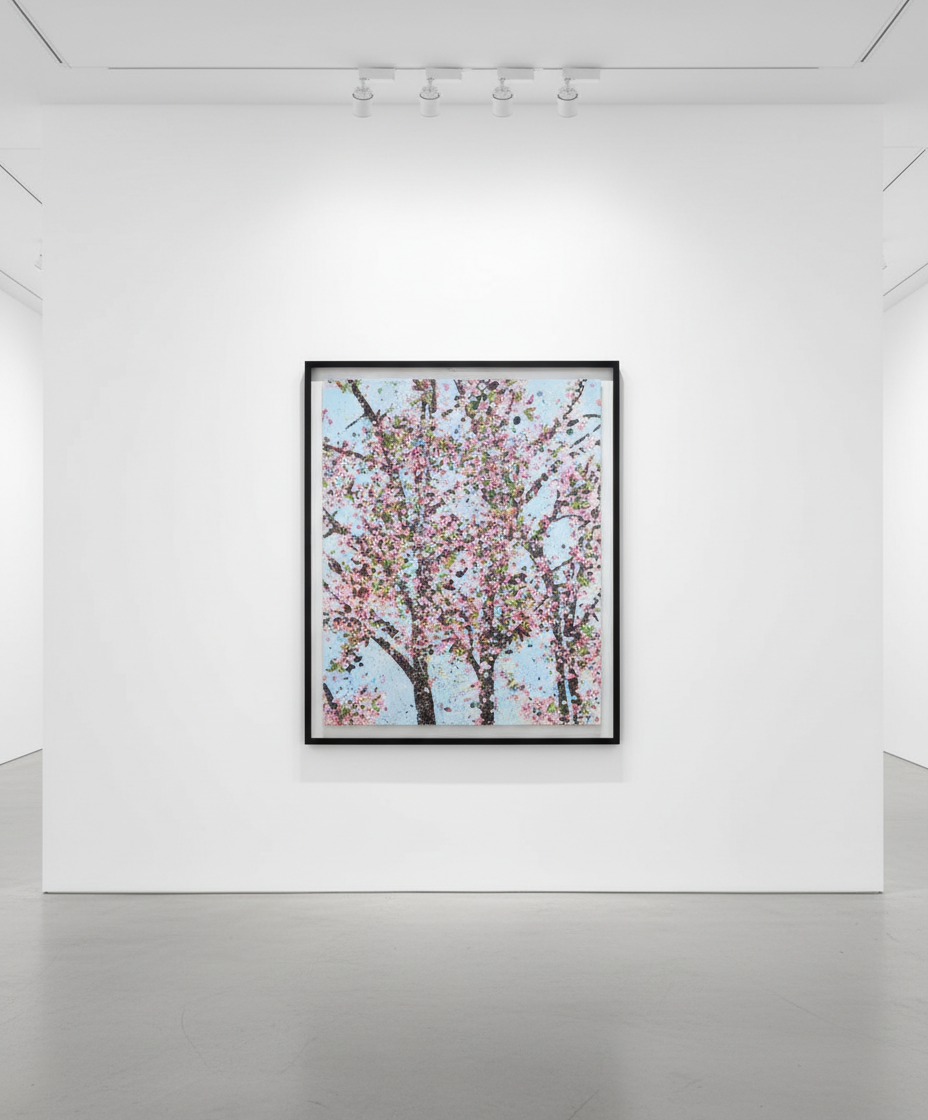
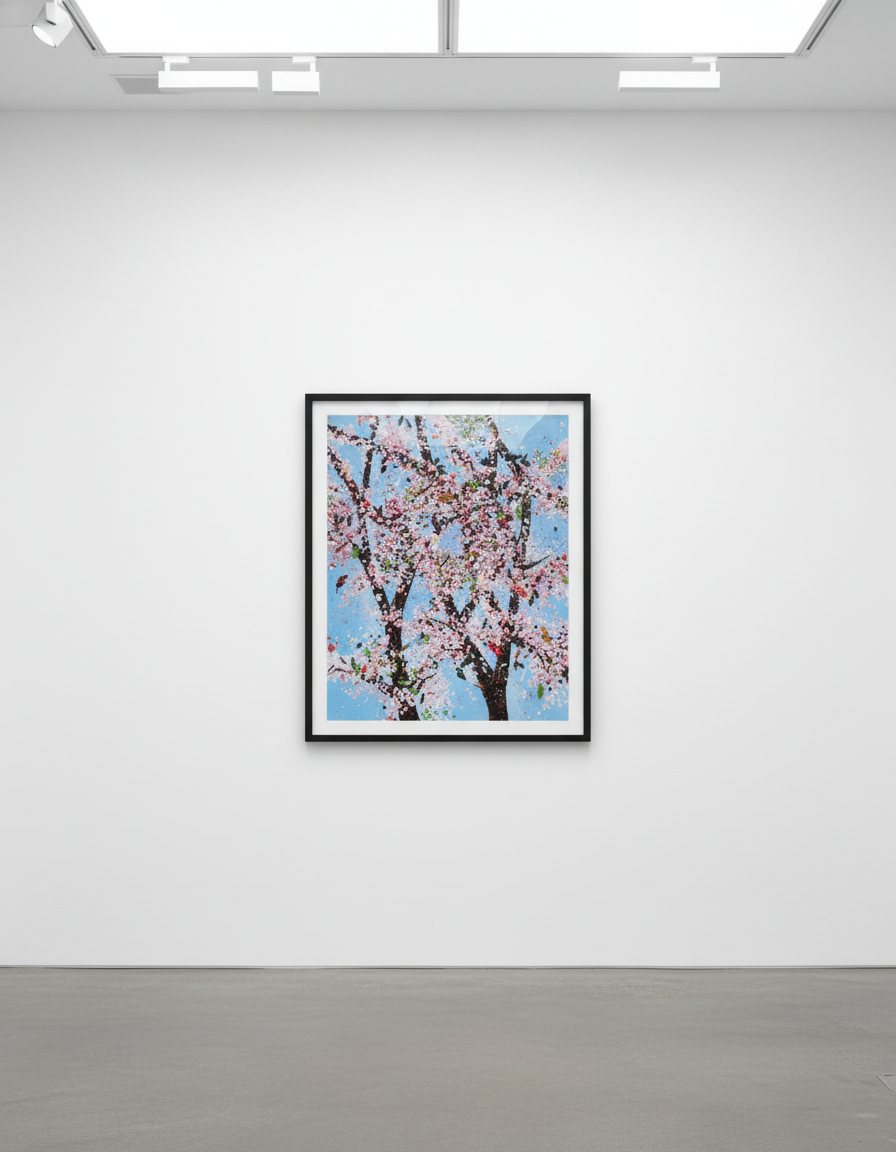
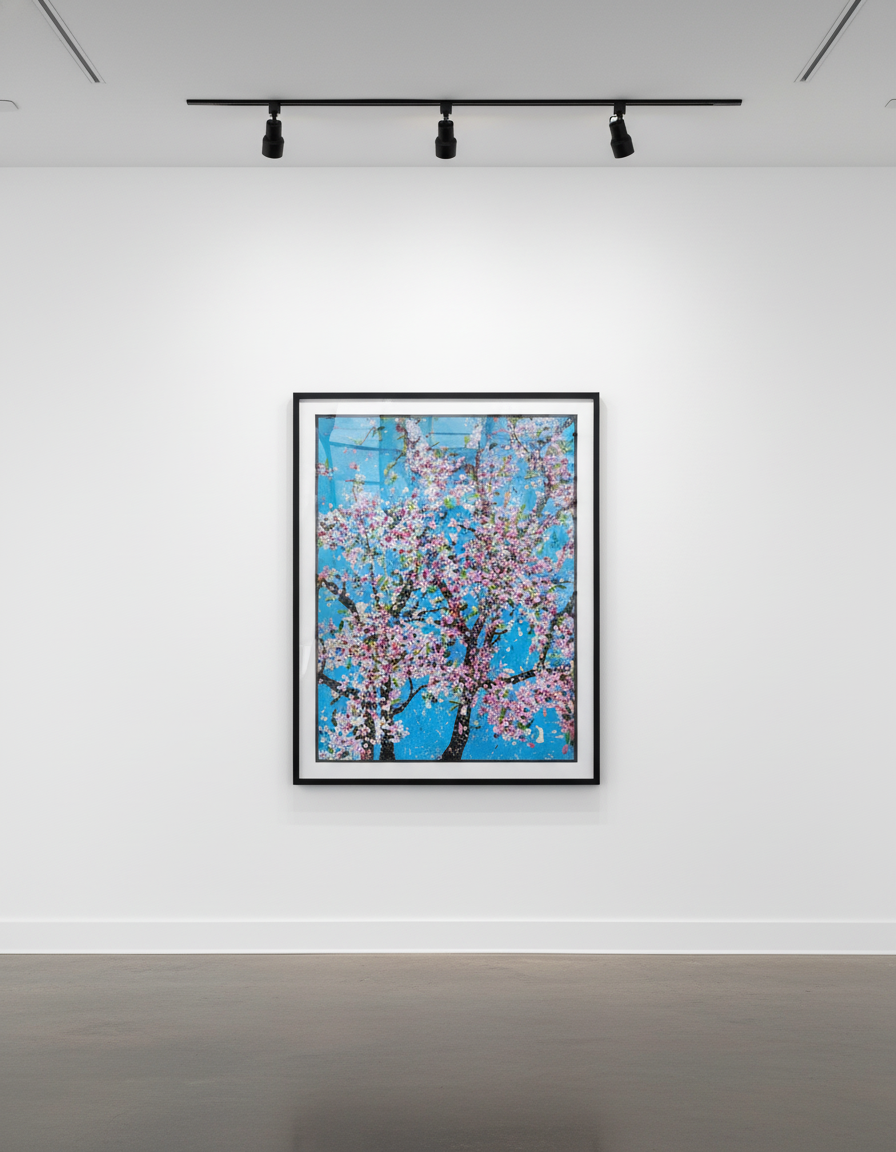
In 2021, Damien Hirst released The Virtues (H9) — eight laminated giclée prints on aluminium composite panel, each named for one of the classical virtues: Justice, Courage, Mercy, Politeness, Honesty, Honour, Loyalty, and Control. The series emerged directly from his Cherry Blossom paintings, a monumental body of work Hirst produced during the pandemic period of 2020 and 2021. Where most artists contracted during lockdown, Hirst expanded — returning to direct painterly practice after years of conceptual and fabrication-led work, producing hundreds of canvases depicting explosions of sakura Blossoms in an intensive, immersive studio effort unlike anything he had undertaken before.
The H9 editions translate that painterly energy into a format designed for collectors who want to live with this work without acquiring a unique canvas. Laminated giclée on aluminium composite panel is a serious production choice: it captures the chromatic density and luminosity of Hirst's blossom compositions with fidelity that paper-based print processes cannot match, while the substrate provides dimensional stability and archival permanence that conventional editions lack. The result is something that sits between a print and a painting in physical terms — more surface presence than you expect from a reproduction, less than you'd get from the unique works, but entirely its own object.
For collectors, the H9 series represents a carefully considered entry point into one of the most significant bodies of work Hirst has produced in the past decade. The Cherry Blossom paintings were not a minor side project — they consumed years of studio time, attracted substantial institutional attention, and have been widely read as one of the most substantial late-career pivots any major British artist has made. The editions connect directly to that significance. This guide examines every dimension of the series that a serious collector needs to understand: the origins, the visual language, the technical specifications, the individual works, the market, and the long-term considerations for anyone acquiring these pieces.
To understand the H9 series, you have to understand where it came from. In 2019 and 2020, Hirst began what became a years-long engagement with cherry blossom as a subject — vast canvases depicting sakura in full, explosive bloom. The works drew on the Japanese tradition of mono no aware, the bittersweetness of transience, but filtered it through Hirst's characteristic formal ambition. These were not delicate studies in the manner of traditional botanical illustration. They were confrontational, chromatic events: blossoms rendered at overwhelming scale, hurled against dark skies, dense and almost violent in their proliferation.
Hirst has spoken about the Cherry Blossom project as a return — to direct painting, to handmade mark-making, to the physical studio practice he had moved away from during the years in which his major work was fabricated by teams of assistants. Whether you take that narrative entirely at face value or not, the visible results are undeniable. The Cherry Blossom canvases have a physical presence and atmospheric depth that is distinct from earlier Hirst series. The paint is worked and reworked, built up in layers, alive to accident and correction in a way that the Spot Paintings and Spin Paintings are not.
The pandemic context is inseparable from these works. Hirst has connected the blossoms explicitly to themes of mortality, fragility, and the impermanence of living things. Cherry blossoms in Japanese aesthetics bloom and fall within two weeks — their beauty is constitutively brief. In 2020, with death figures appearing daily across every screen and the world's systems visibly strained to breaking point, Hirst's turn to that subject was not decorative. The Cherry Blossom paintings are about the fact that beautiful things end. That the series arrived at exactly the moment it did, and was met with serious critical attention rather than dismissal, reflects something real in the works themselves.
By 2021, Hirst had begun translating selected Cherry Blossom compositions into the H-numbered editions that Science Ltd manages. The Virtues was one of the most substantial of these translation projects — eight separate editions, each deriving from distinct source compositions, each named for a virtue from the classical catalogue that stretches from Plato and Aristotle through to contemporary moral philosophy. The naming is not incidental. Hirst was explicitly framing these works as a moral suite — a series that asks what qualities make a life well-lived, using the Japanese emblem of beautiful transience as its visual vocabulary.
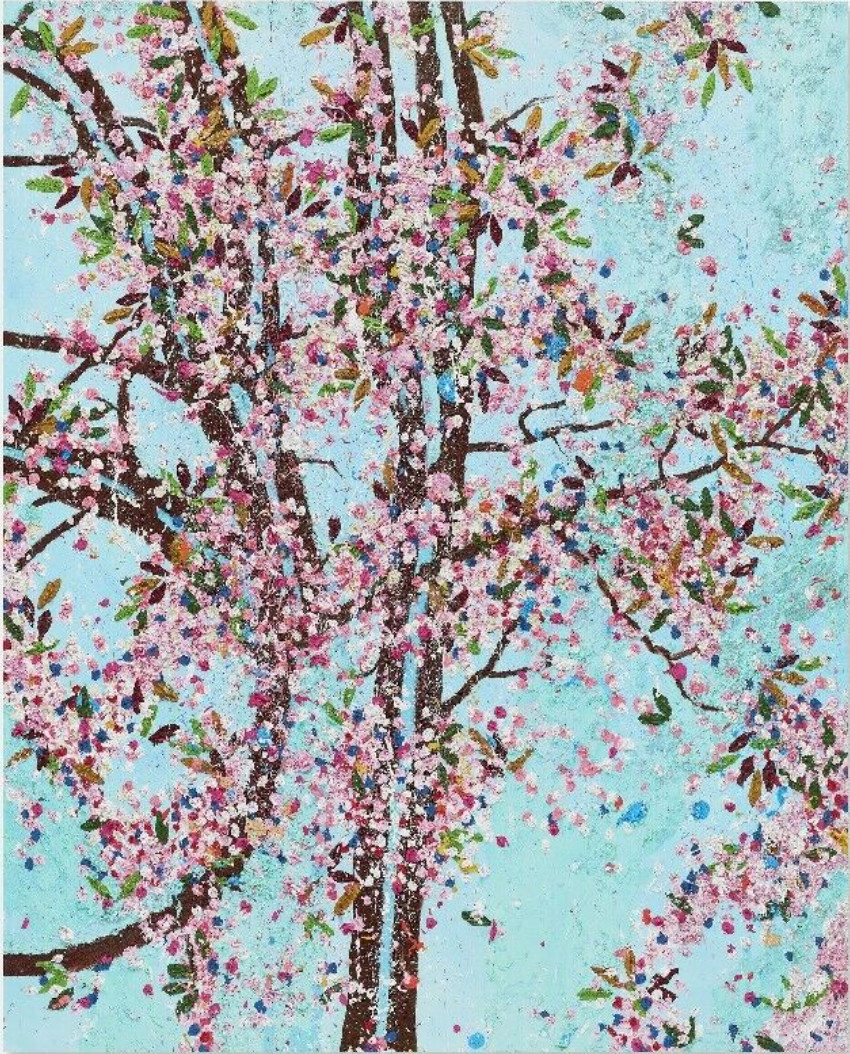
What does a Virtues print actually look like? Each of the eight works depicts a dense, close-up view of cherry blossom in full flower — petals in shades ranging from deep rose and carmine through to pale shell pink and near-white, set against grounds that shift between deep navy, charcoal, and black. The compositional effect is of something explosive: blossoms that appear to be pushing out toward the viewer, filling the picture plane, refusing to leave space for calm or restraint. The darkness behind them is not empty — it functions as a kind of pressure, making the blossoms seem more urgent by contrast.
Hirst's colour handling in the Cherry Blossom paintings, and by extension in the H9 editions, is more complex than it initially appears. The blossoms are not uniformly pink. Within each composition there are yellows, oranges, creams, lavenders, and occasional greens — the full chromatic range you encounter when you look carefully at real sakura, rather than the simplified pink of popular representation. This chromatic fidelity gives the works a naturalistic depth that prevents them from reading as simply decorative. They are recognisable as blossom, but they are also something more formal — studies in colour relationships, in how warm and cool tones interact at high saturation, in how light behaves when it passes through translucent petals.
The compositions vary across the eight works in ways that reward close looking. Some are denser, with blossom filling almost the entire surface and very little ground showing through. Others are slightly more open, with branches more legible within the mass of flowers, giving a stronger sense of structure beneath the explosion of colour. These differences are not cosmetic — they reflect the underlying Cherry Blossom canvases from which each edition derives, and they give the series its internal variety. A collector who lives with all eight works discovers that each has a distinct atmospheric register despite their shared visual language.
The medium deserves careful attention because it is one of the things that distinguishes the H9 series from comparable editions. The term "giclée" — from the French for "to spray" — refers to inkjet printing using archival pigment inks on high-quality substrates. It has become the standard production method for serious fine art editions that require faithful colour reproduction, and at the top end of the market it produces results that can be startlingly close to the original work's chromatic character. What Hirst's team has done with the H9 series is take that production quality and mount it on aluminium composite panel, then laminate the surface.
Aluminium composite panel — often known by the trade name Dibond — is a material that was originally developed for architectural signage and exterior cladding. It consists of two thin aluminium sheets bonded to a solid polyethylene core. The result is extremely rigid and dimensionally stable: it does not flex, warp, or respond to humidity changes in the way that paper, canvas, or wooden stretcher frames do. For fine art applications, this means a print surface that holds its geometry precisely over time, without the undulation or cockle that affects unframed works on paper, and without the potential for cracking or warping that affects gesso-ground canvases in unstable environments.
The lamination applied over the printed surface serves multiple purposes. It protects the pigment layer from UV exposure, from surface abrasion, and from atmospheric contamination — the particulates and gases that slowly degrade unprotected prints over time. High-quality lamination also contributes to the visual character of the finished work. The H9 editions have a surface that is subtly luminous without being glossy in the crude sense — there is depth and sheen without the mirror-like reflectivity that would compete with the imagery. This surface quality is part of what gives the editions their presence as physical objects.
The practical archival implications are significant. Properly stored and displayed, laminated giclée on aluminium composite is considered among the most durable print formats currently available. Conservation estimates for high-quality pigment inks on appropriate substrates, with UV-protective lamination, typically run to several hundred years before visible degradation under normal display conditions. This is substantially better than most historical print media, including many screenprints and lithographs from the post-war period that are already showing significant colour shift. For collectors thinking about long-term value — both aesthetic and financial — the production quality of the H9 series is a genuine point in its favour.
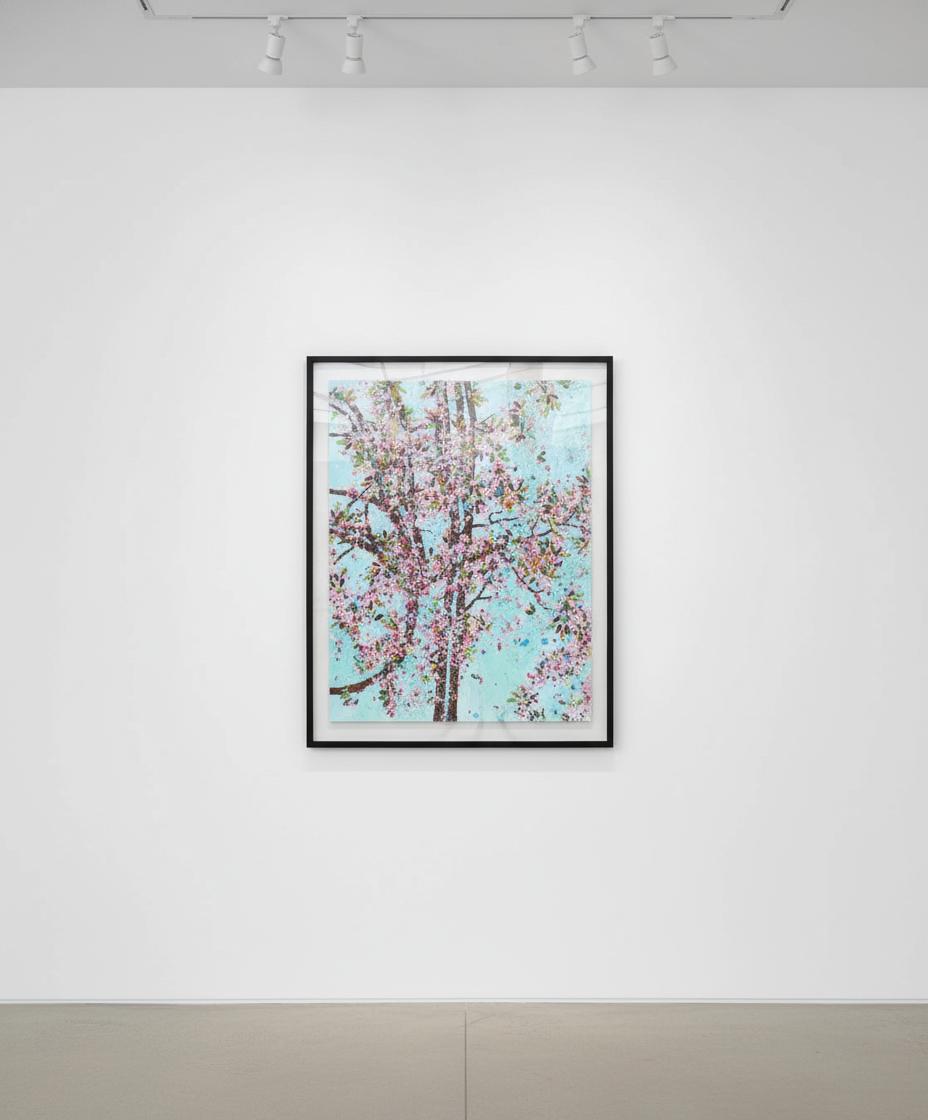
The series runs from H9-1 (Justice) through H9-8 (Control), with each work exploring a distinct virtue through a distinct Cherry Blossom composition. The ordering is not random — there is a logic to the sequence that becomes more apparent when you spend time with the individual works. What follows is an analysis of each piece in terms of its visual character, its compositional approach, and its relationship to the virtue it names.
Justice opens the series and in some respects sets its terms. The composition is among the most densely packed of the eight, with blossom filling the picture plane almost entirely — there are branches visible, but they are secondary to the mass of flowers that surrounds them. The palette runs toward the cooler end of the blossom range, with a prevalence of pale pink and white petals against a dark ground, giving the work an austerity that suits its subject.
Justice is among the most abstract of the classical virtues — harder to illustrate than courage or mercy, more systemic in its application. Hirst's approach here seems to acknowledge that difficulty. The composition does not resolve easily into a single focal point; instead it presents a kind of equipoise, a balance of forces across the picture plane that could be read as a visual rendering of the scales that are Justice's traditional emblem. Whether you accept that reading or prefer to approach the work on purely formal terms, it functions as a strong compositional statement and a confident opening for the suite.
Courage is the most kinetically charged of the eight works. The blossom arrangement has a directionality that the others largely lack — there is a sense of movement through the composition, of blossoms caught in the moment of release rather than stationary. The palette here is warmer, running through deeper pinks and roses toward what approaches red in places, against a ground that is particularly dark.
The visual energy of the work suits its subject. Courage in the philosophical tradition is not simply the absence of fear — it is the capacity to act in the face of fear, to move forward despite the knowledge of risk. A composition that is itself in motion, that has forward momentum built into its arrangement of elements, seems to enact rather than merely depict the quality it names. Among collectors who have acquired individual works from the series rather than the complete suite, Courage has been consistently among the most sought-after pieces.
Mercy shifts register entirely. Where Courage is charged and directional, Mercy is diffuse and open. The blossom arrangement is looser than in most of the other works, with more space between flowers and more of the dark ground visible. The palette is lighter — more white and pale pink, less of the deeper roses that characterise Courage and some of the later works. There is something atmospheric, almost mist-like, about how the blossoms sit against the background in this composition.
Mercy is a virtue with a complex philosophical history — at various points in Western thought it has been seen as opposed to justice rather than complementary to it, as a weakness that undermines the order that justice maintains. The contemporary understanding tends toward integration rather than opposition, with mercy as the capacity to recognise the particularity of individual circumstances within the general application of rules. Hirst's composition captures something of that more textured understanding — there is nothing soft or weak about the work, but there is spaciousness, a willingness to let things breathe.
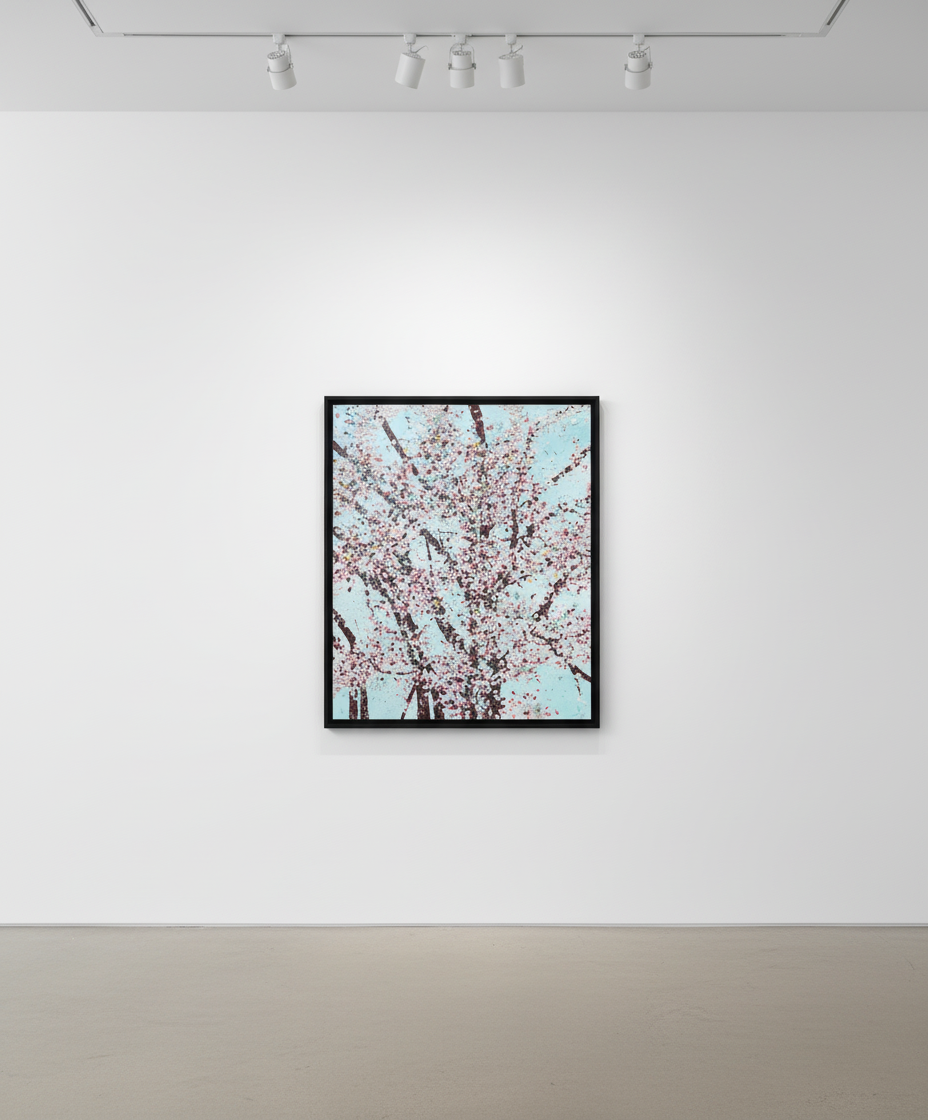
Politeness is in many respects the most understated work in the series, and it is the better for it. The composition is the most restrained of the eight — carefully arranged, with a sense of order and considered placement that the more explosive works deliberately avoid. The palette is controlled: creams, pale pinks, and whites dominate, with the deeper tones that create drama elsewhere used sparingly here.
Politeness occupies an interesting position in any survey of the classical virtues. It is often treated as minor — a social grace rather than a moral virtue of the first order. But there is a serious philosophical case that politeness is foundational rather than superficial: the practice of acknowledging others' dignity in every small interaction, the daily exercise of restraint and consideration that makes sustained social life possible. Hirst's composition doesn't shout its virtue; it demonstrates it through its own composure. It is perhaps the work that rewards closest looking, because what it offers is not immediate impact but sustained attention to detail.
Honesty sits at the centre of the series numerically, and it has a clarity to it that suits that central position. The composition presents blossom at something close to a direct, unmediated angle — the viewer feels they are looking at the blossoms as they actually are, without the angular complexity or dense layering that gives some of the other works their mystery. The palette is balanced, with neither the warmth of Courage nor the coolness of Justice dominating, but with both present in something closer to equilibrium.
Honesty is philosophically interesting in that it has both a positive content (telling the truth, being transparent) and a structural relationship to all the other virtues — a person who lacks honesty cannot be genuinely just, courageous, or merciful, because those virtues require accurately understanding and representing the situations they respond to. Placing a compositionally direct, balanced work at the series' centre seems to acknowledge that structural role: Honesty as the work against which the others can be measured.
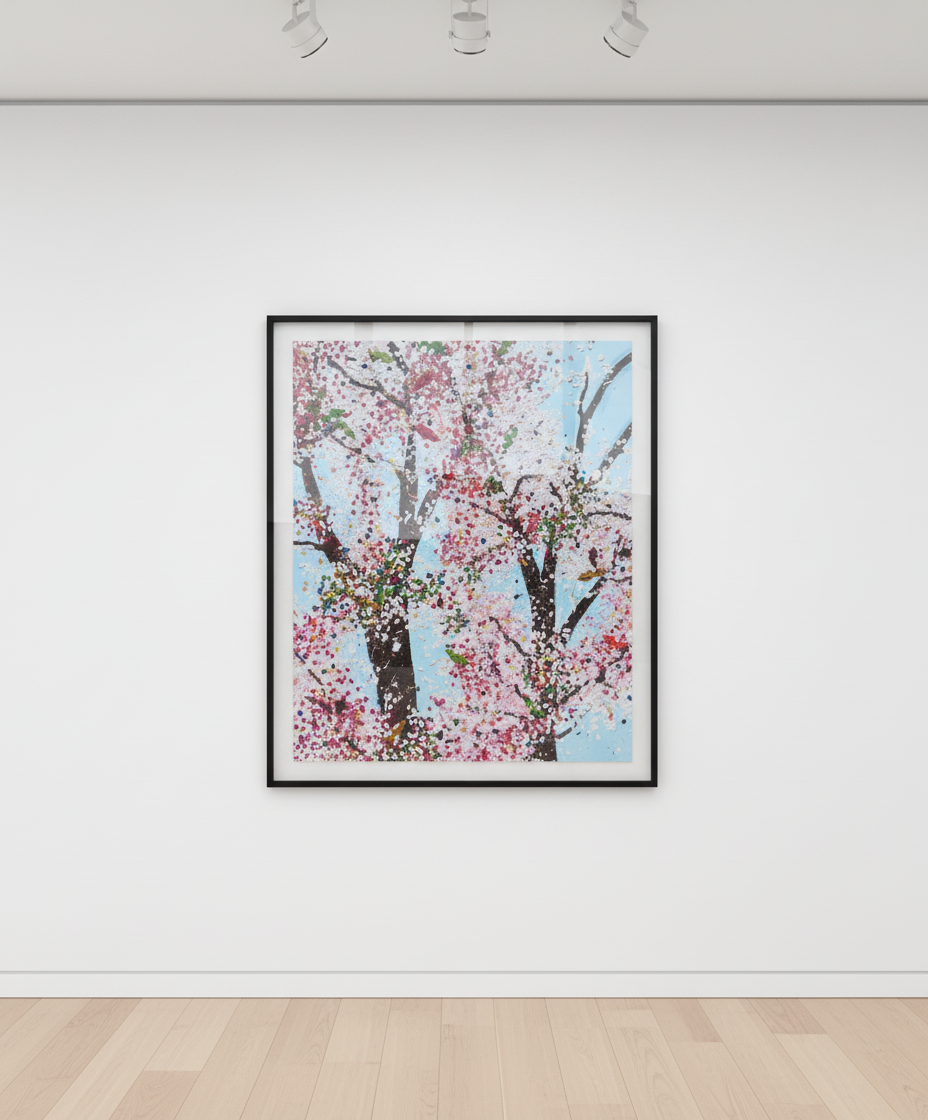
Honour brings a more formal, structured quality back into the series after the central clarity of Honesty. The composition is among the most architecturally organised of the eight: blossom clusters are arranged with a sense of hierarchy and weight distribution that recalls the formal balance of the greatest Renaissance compositions. The palette is richer than in many of the earlier works — there are deeper roses and pinks, and the contrast between blossom and ground is more pronounced.
Honour in the classical tradition is a virtue that has its most natural home in public life — it concerns the reputation one has earned through consistent virtuous action, and the obligations that reputation creates. It has a more social, more visible character than virtues like mercy or honesty, which can in principle be practised in private. Hirst's composition registers that public dimension through its formality and visual weight. It is the work in the series that most demands to be displayed prominently, that most insists on its own occasion.
Loyalty is compositionally dense — more so than most of the other works — with blossom pressed close against the picture plane and the sense of depth that characterises some of its neighbours largely suppressed. The palette here is notably warm: pinks and roses at high saturation, with the ground providing contrast rather than the airy spaciousness it contributes in Mercy.
Loyalty is a virtue with genuine philosophical complexity. At first glance it appears uncomplicated: the commitment to maintain relationships and obligations over time, to be reliable and steadfast. But the complications emerge quickly — loyalty to what? to whom? at what cost to other values? The history of ethics is full of cases in which loyalty to one thing required betraying another. Hirst's dense, warm, pressing composition captures the quality without resolving its complexity: this is something full and close, something that does not recede, something that stays in your face. Whether that feels like comfort or demand depends on where you stand.
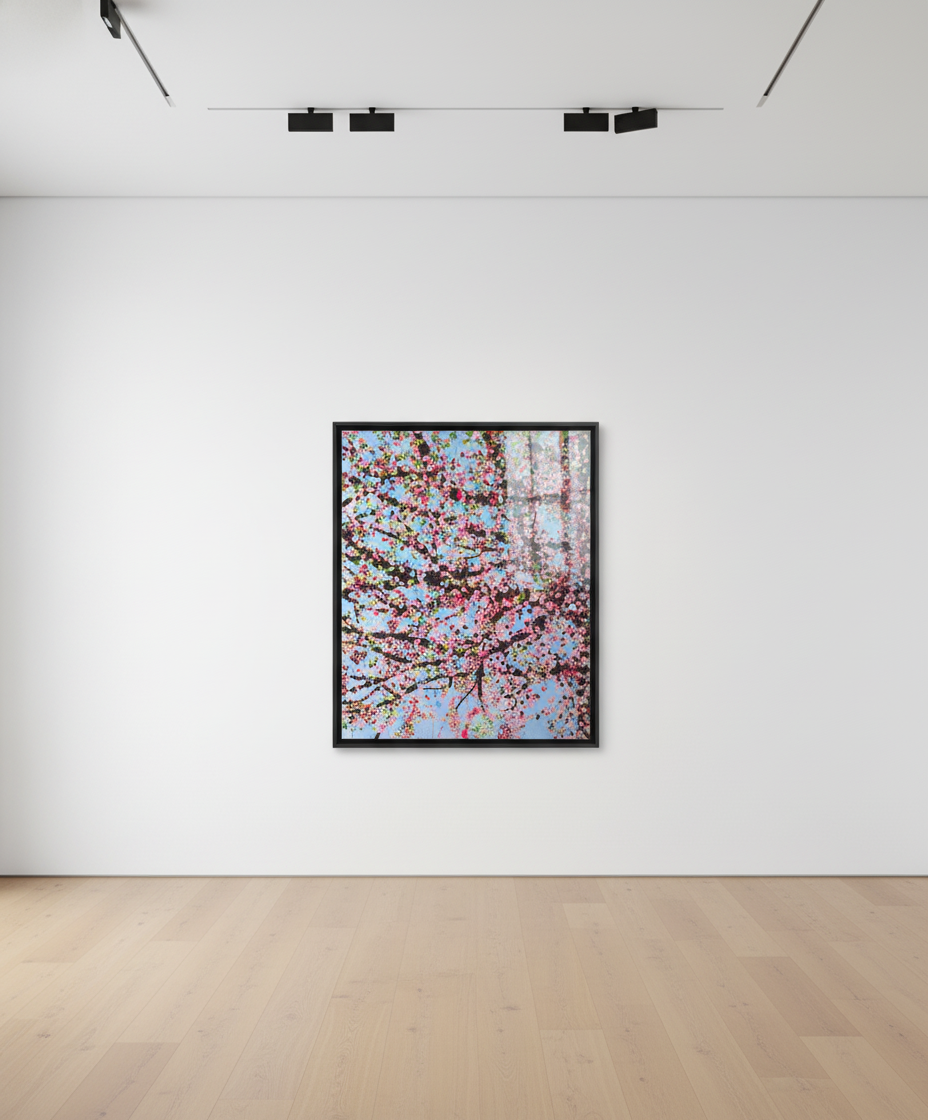
Control closes the series and it does so with what feels like deliberate compositional argument. After seven works of varying density, temperature, and directionality, Control presents the most formally contained arrangement in the suite. The blossom is held within the composition rather than spilling toward its edges; the palette is carefully managed, with no single colour dominating; the overall effect is of equilibrium achieved rather than given.
Control in the virtue tradition — understood as self-mastery, as the capacity to govern one's responses rather than being governed by them — is often placed last in catalogues of the virtues because it is in some sense the precondition for the others. You cannot reliably be just or courageous or honest without the capacity for self-regulation. Hirst's decision to end the series with the virtue that in philosophical terms makes all the others possible reflects a considered understanding of what he was doing. The work is not the most immediately dramatic of the eight, but it may be the most philosophically astute.
All works in the H9 series are authenticated through Science Ltd, the authentication and estate management body Hirst established to manage his own work. Science Ltd issues certificates of authenticity for Hirst editions and has responsibility for maintaining the register of legitimate works. For collectors, Science Ltd authentication is the definitive standard — it is more authoritative than third-party authentication services and provides the clearest possible documentation of a work's provenance.
The H9 series was distributed through White Cube, the gallery that has represented Hirst throughout his career and which handles his primary market releases. White Cube's involvement in the distribution of the editions provides an additional layer of provenance documentation — works sold through legitimate gallery channels carry the kind of transactional record that supports both insurance valuations and secondary market liquidity.
For collectors acquiring H9 works on the secondary market — through auction houses, dealers, or private sales — the documentation chain to verify consists of: the Science Ltd certificate of authenticity, the original sales receipt or gallery documentation from White Cube or an authorised secondary dealer, and any subsequent provenance documentation. All three categories should be present for a work to be considered fully documented. Guy Hepner's team can advise on documentation verification for any H9 work under consideration.
It is worth noting that the Science Ltd authentication system is specific to Hirst's editions — it does not authenticate unique works, which go through different processes — and that Science Ltd maintains records that can be cross-referenced against certificates presented by sellers. Collectors who have any doubt about a certificate's authenticity can request verification through appropriate channels before completing a purchase.
Understanding the H numbering system helps locate the Virtues series within Hirst's broader edition output. The "H" prefix followed by a number designates a specific edition series. The numbers are not strictly chronological — the system has evolved over time and different H series were released in different contexts and through different channels. H9 as a designation places the Virtues series within a specific group of releases and allows collectors and the market to track and reference the works precisely.
Within the H9 series, the individual works are designated H9-1 through H9-8, corresponding to the eight virtues in their series order: Justice (H9-1), Courage (H9-2), Mercy (H9-3), Politeness (H9-4), Honesty (H9-5), Honour (H9-6), Loyalty (H9-7), and Control (H9-8). This designation system means that when a work appears at auction or in a dealer's inventory, it can be precisely identified without ambiguity — H9-2 is always Courage, and Courage is always H9-2.
The editions were produced in a limited number of examples. Limited edition status in the context of serious contemporary editions — as opposed to open-edition prints — means that the total number of authorised examples is capped and registered, and that no additional works can be produced after the edition is closed. The precise edition size for the H9 series should be verified with Science Ltd or through authorised dealer documentation, as exact figures may vary by work within the series. What can be confirmed is that the works were produced in genuinely limited quantities consistent with Hirst's practice for significant print editions.
The complete H9 suite — all eight works — is available as a single acquisition and represents the most coherent presentation of the series as Hirst conceived it. Individual works can also be acquired separately, and many collectors have built up the complete suite over time rather than acquiring all eight simultaneously. Both approaches are legitimate, and the market supports both individual work pricing and suite premium pricing at secondary level.
Damien Hirst's career divides, broadly, into three phases. The first runs from his emergence on the YBA scene in the late 1980s and early 1990s through to the landmark "Beautiful Inside My Head Forever" single-artist auction at Sotheby's in September 2008, in which he achieved $198 million in sales — an event that disrupted conventional understanding of how the primary market operates and that demonstrated, definitively, the scale of appetite for his work. This period includes the Natural History series (the shark, the sheep, the cow), the Medicine Cabinets, the Spot Paintings, the Butterfly Works, and the Spin Paintings — the works that established his reputation and set his auction records.
The second phase, running roughly from 2008 through to the late 2010s, was more uneven. Major projects — the Treasures from the Wreck of the Unbelievable installation and its accompanying Sotheby's sale in 2017 — attracted significant attention but also significant critical scepticism. The market for his work continued but showed more variation, and there were periods in which secondary market performance was substantially below the peaks of the first decade. This is not unusual for artists of his generation who achieved extreme valuations in the pre-2008 market — the correction was broad and his experience of it was not exceptional — but it did create a perception, in some quarters, that the work had lost direction.
The Cherry Blossom paintings represent the beginning of a third phase, and the critical response has been substantially more positive than the Wreck installation received. The return to direct painting, the engagement with Japanese aesthetic tradition, the explicit confrontation with mortality and beauty — these are not trivial artistic moves, and they have been received accordingly. Major museum presentations and significant auction results for the unique Cherry Blossom canvases have reestablished Hirst's position at the top of the market in a way that feels based on the work rather than simply on momentum.
The H9 series sits within this third phase and connects directly to its central project. Collectors acquiring Virtues prints are not buying heritage Hirst — they are buying into an active, ongoing body of work with its own momentum and critical support. That context matters for long-term considerations of any kind.
The market for Hirst editions has a well-documented history that provides context for thinking about H9 values. His printed editions trade regularly through the major auction houses — Christie's, Sotheby's, Phillips, Bonhams — as well as through specialist print dealers and secondary market galleries. The depth of secondary market activity means there is genuine price discovery rather than the opacity that affects the secondary market for less frequently traded artists.
A few observations about the market dynamics relevant to H9 collectors:
Cherry Blossom premium: Works from the Cherry Blossom period — both unique paintings and editions — have shown stronger secondary market performance in recent years than comparable works from earlier phases of Hirst's career. The critical revaluation of this body of work has had market consequences, and editions connected to the Cherry Blossom paintings benefit from that association.
Technical quality as market factor: The laminated giclée on aluminium composite medium, while not as historically established as screenprint or lithograph, has increasingly gained acceptance in the collector community as a serious fine art format. As the market's understanding of its archival properties has grown, the price discount that some buyers historically applied to non-traditional print media has narrowed. H9 works do not suffer the valuation penalty that inferior production quality might justify.
Suite completeness: Complete suites consistently command premiums at auction over the sum of individual work values. This is a well-established pattern across print series by all major artists. A collector who acquires the complete H9 suite is better positioned than one who holds four or five individual works, both in terms of display coherence and potential sale value.
Science Ltd authentication: Works with complete, clean Science Ltd documentation are more liquid than those with incomplete or ambiguous provenance. This is true of all Hirst editions but is worth emphasising for H9 given its relatively recent release — the documentation chain is intact and verifiable, which is an advantage over older works where documentation may have been lost.
Gallery positioning: Guy Hepner's documented transactional history with Hirst works — over $4.2 million in authenticated Hirst transactions — provides the kind of market expertise that translates into informed acquisition guidance. Collectors working with established specialists in Hirst are better positioned to navigate the market than those working without specialist support.
None of this constitutes investment advice. Art markets are illiquid, unpredictable, and subject to movements that have nothing to do with the underlying quality of the work. The appropriate reason to acquire H9 works is that you want to live with them. The market considerations are secondary, and should be treated as secondary.
The question of whether to acquire individual works or the complete suite depends on several factors that are specific to each collector's situation.
Individual works: If your primary interest is in a particular virtue — if Control or Justice speaks to you more than the others, or if you are responding to a specific compositional quality that appears in one or two of the eight works — there is no reason to feel obligated to acquire the complete series. Individual works are entirely coherent on their own terms; they do not require the others to make sense. Many serious collectors who have followed Hirst's work closely hold one or two Virtues prints rather than the complete suite, and there is nothing incomplete about that approach.
Complete suite: The argument for the complete suite is that Hirst conceived it as a unified statement. The sequence from Justice to Control is not arbitrary — it reflects a thinking about the relations between virtues that only becomes fully visible when all eight are present. If you have the space to display all eight works, the suite as a complete installation is substantially more powerful than any subset of it. The display opportunities are considerable: eight works of consistent size and medium can anchor a room in a way that individual works cannot.
Building over time: Many collectors begin with one or two works and add to the series as opportunity and budget allow. This approach is entirely viable. The works are produced in consistent sizes and the medium is consistent across all eight, so works acquired at different times will install coherently together. The only risk is that specific works become harder to find on the secondary market as time passes — Courage and Control, in particular, have been among the most sought-after works in the series.
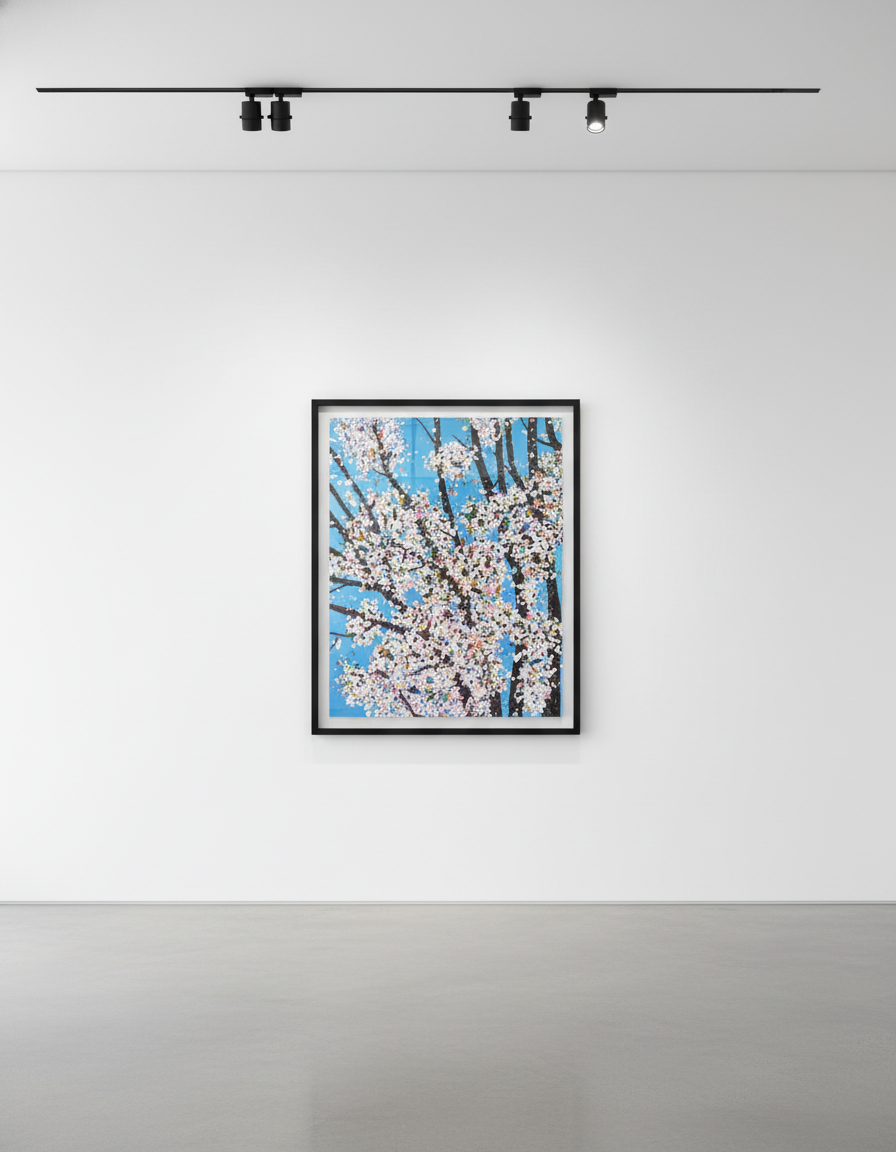
Display: Aluminium composite panel editions do not require framing in the conventional sense — the panel provides its own structural rigidity and can be wall-mounted directly, or framed if preferred for aesthetic reasons. The works look well in contemporary spaces with clean walls and controlled lighting. UV-filtered lighting is recommended to maximise the already considerable archival properties of the lamination. The works should not be displayed in direct sunlight.
The long-term care requirements for laminated giclée on aluminium composite panel are minimal by comparison with many print media, but they are not zero. The following guidance covers the primary considerations for collectors who want to maintain their H9 works in optimal condition over decades.
The lamination on H9 works provides substantial UV protection, but this should not be treated as licence for unrestricted light exposure. Direct sunlight — particularly through south-facing windows without UV-filtering glass — will degrade any print surface over time. Display under artificial lighting that includes a UV filter, or in spaces with UV-filtering window glass, is recommended. Museum-standard lighting systems designed for fine art display are ideal but not required for domestic settings; the practical requirement is simply to avoid prolonged direct sunlight.
Aluminium composite panel is far less sensitive to temperature and humidity fluctuation than paper-based or canvas-based works. The material will not warp or cockle in response to seasonal environmental changes that would damage conventional prints. However, extreme temperatures should be avoided: very high heat can potentially affect the lamination adhesive over time, and very cold conditions followed by rapid warming create condensation risks that are bad for any artwork. Normal domestic temperature ranges — 18–23°C — are entirely appropriate.
The laminated surface can be gently cleaned with a soft, dry cloth to remove dust. Avoid wet cleaning, abrasive materials, or chemical cleaning products. For any significant cleaning requirement beyond routine dust removal, consult a professional art conservator rather than attempting cleaning yourself. The lamination surface is durable but not impervious — it will scratch under abrasion, and scratches cannot be repaired without specialist intervention.
Handle works with clean cotton gloves when moving or re-hanging them. Fingerprints contain oils and acids that, while they will not damage the laminated surface in the short term, can accumulate over years of handling and create staining that is difficult to remove without professional treatment. The panels are rigid and do not require special support during handling beyond ensuring they are held securely at the edges.
If works need to be stored rather than displayed — during a move, renovation, or change of collection — they should be wrapped in acid-free tissue paper, not in bubble wrap or foam that may leave impressions on the laminated surface. Store vertically rather than horizontally if possible, and avoid stacking works directly against each other without protective interleaving. A climate-controlled storage environment is preferable to a standard domestic storage space.
H9 works should be insured at current market replacement value. This requires a formal valuation from a qualified appraiser or established fine art dealer, ideally updated every three to five years or whenever market conditions for Hirst editions change significantly. Specialist fine art insurance — rather than household contents policies, which frequently undervalue or exclude fine art — is recommended. Guy Hepner can provide current market valuations for insurance purposes.
The H prefix followed by a number is Hirst's edition series designation system, managed through Science Ltd. Different H series represent distinct groups of editions released at different times and through different channels. H9 designates the Virtues series specifically — eight laminated giclée prints on aluminium composite panel, released in 2021 and derived from the Cherry Blossom paintings. The individual works within the series are designated H9-1 through H9-8. The H numbering system allows works to be precisely identified and distinguished from other Hirst editions without ambiguity.
No. This is a point of frequent confusion in the market. The H9 Virtues series are laminated giclée prints — produced using archival inkjet printing technology on aluminium composite panel, not screenprinting. Screenprinting involves pushing ink through a mesh screen onto a substrate, producing a characteristically flat, layered surface. Giclée printing involves spraying fine droplets of archival pigment ink onto a substrate, producing a continuous-tone image with the chromatic fidelity necessary to capture the complexity of Hirst's blossom compositions. The two processes produce visually and technically different results, and understanding the distinction matters for both authentication and conservation purposes.
It means the works have extremely good long-term archival properties. Aluminium composite panel — the mounting substrate — is dimensionally stable, non-reactive, and resistant to the warping and physical degradation that affects paper-based and canvas-based works. The lamination applied over the print surface provides UV protection and guards against surface abrasion and atmospheric contamination. Together, these properties mean that properly displayed and stored H9 works will maintain their colour and surface integrity for far longer than most historical print media. Conservation estimates for this class of material, under normal display conditions, typically extend to several centuries before visible degradation.
The definitive authentication for any H9 work is the Science Ltd certificate of authenticity. Science Ltd is Hirst's own authentication body and maintains a register of all authenticated works. A certificate should accompany any legitimate example. Beyond the certificate, full provenance documentation should include the original sales receipt or gallery documentation showing the work's initial sale through White Cube or an authorised secondary dealer. If you are acquiring on the secondary market and have any doubts about documentation, Guy Hepner's team can assist with verification, and Science Ltd can be contacted directly to cross-reference certificate numbers against their records.
The H9 Virtues prints derive directly from the Cherry Blossom paintings that Hirst produced during the pandemic period of 2020 and 2021. Each edition is based on a specific Cherry Blossom canvas, translating its composition and chromatic character into the laminated giclée format. The Cherry Blossom paintings themselves represent a significant phase in Hirst's career — a return to direct painting practice after years of primarily conceptual and fabrication-based work. The editions allow collectors to connect with that body of work and its themes — the Japanese aesthetics of transience, the pandemic confrontation with mortality, the return to gestural mark-making — through a format accessible outside the unique painting market.
Both approaches are legitimate, and the right answer depends on your collection priorities, available space, and budget. Individual works are entirely coherent on their own — each has its own compositional identity and does not require the others to make sense. The complete suite offers the experience Hirst intended when he conceived the series: a complete moral vocabulary, eight works in dialogue, a room-anchoring installation with considerable cumulative impact. Complete suites also command premiums at auction over the sum of individual values — a well-documented pattern for Hirst series and for print suites more generally. For collectors with the means and space, the suite is the more powerful acquisition; for collectors drawn to a specific virtue or composition, the individual work is entirely appropriate.
The Cherry Blossom period produced several edition series, of which H9 is among the most ambitious in scope — eight separate works constituting a thematically unified programme is a larger undertaking than most of Hirst's contemporary editions. The conceptual ambition of the naming — grounding the visual in the philosophical vocabulary of classical virtues — is also more explicit than in many comparable releases. Among collectors who have followed the Cherry Blossom editions closely, the Virtues series has been well-regarded both for its compositional range and for the coherence of its thematic framework. The aluminium composite medium is consistent with other serious editions from this period, and the Science Ltd / White Cube provenance is the strongest available for Hirst editions.
H9 Virtues works are available through Guy Hepner in New York. Guy Hepner has documented transactional expertise with Hirst editions — over $4.2 million in authenticated Hirst transactions — and can advise on available inventory, current market valuations, authentication verification, and collection strategy. Individual works and the complete suite can be discussed. Contact Guy Hepner at 177 Tenth Avenue, New York, NY 10011, by telephone at +1 (212) 226 8680, or by email at info@guyhepner.com.
Explore Damien Hirst prints for sale at Guy Hepner: H9 - the Virtues, Blossoms, Colour Chart, H1 - Enter the Infinite, H10 - the Empresses.
Related Series