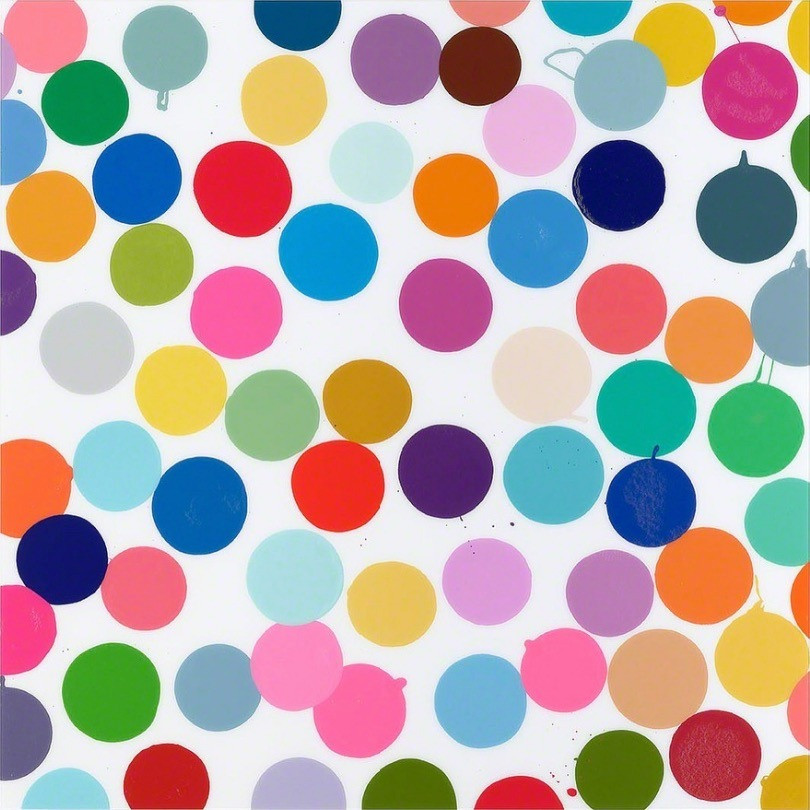
H4 - Veil Spots

June 8, 2026
The definitive resource for buying, authenticating, and valuing Damien Hirst Spot Prints in the current market.
Inquire About Available Damien Hirst Spot Prints Browse current Damien Hirst spot prints and pharmaceutical editions available through Guy Hepner, New York.
Few bodies of work in contemporary art have generated as much sustained collector demand — or as much debate — as Damien Hirst's Spot series. Since the first spots appeared on the walls of a disused Docklands warehouse in 1988, the format has expanded into one of the most documented and widely traded print categories in the secondary market. Hirst's own company, Science Ltd., catalogued exactly 1,365 Spot Paintings in the 2013 catalogue raisonné — and the editions derived from that tradition now span five different printmaking techniques, edition sizes ranging from 24 to 500, and a price band at auction running from under $2,500 to over $100,000 for a complete set.
This guide covers everything a serious collector needs to know: the origins of the series, how the different print formats compare, what auction records actually show, how to authenticate correctly, and where value has concentrated in the 2024–2026 market.
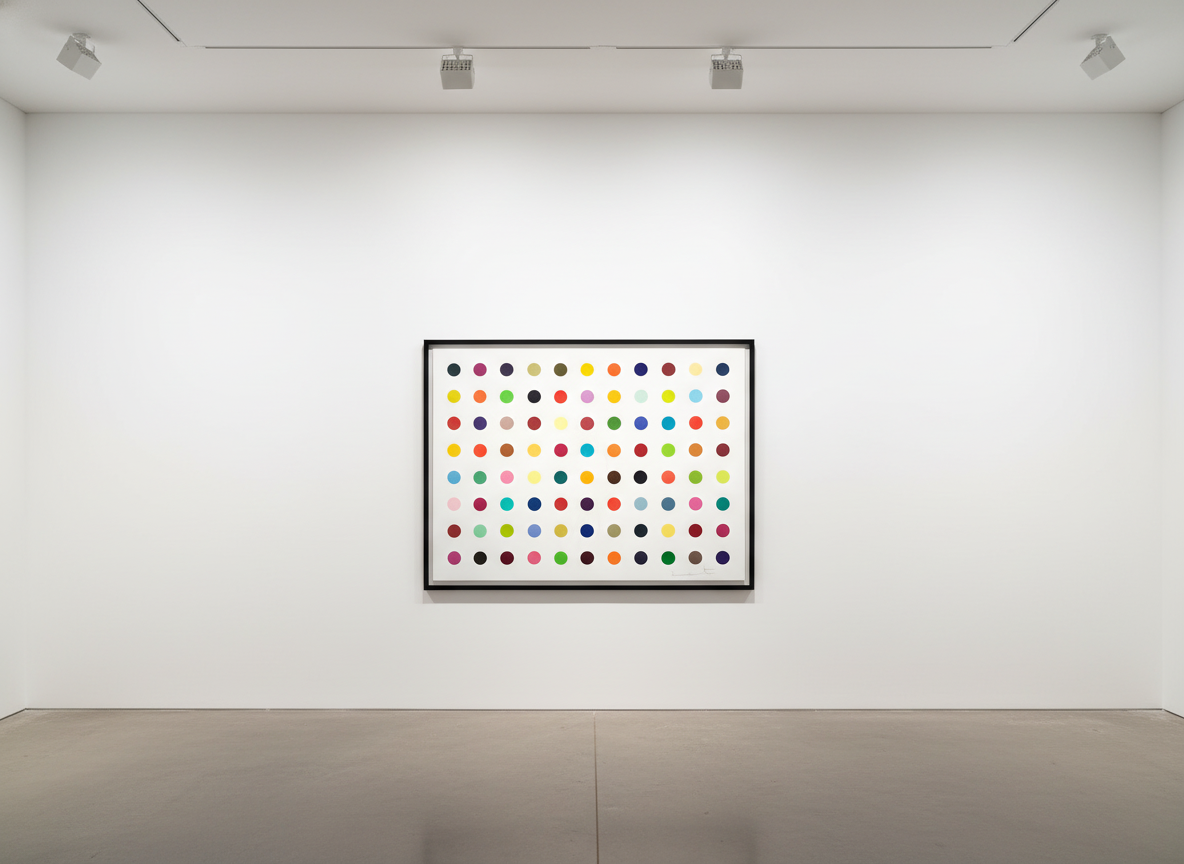
The spot format was not planned. During his second year at Goldsmiths, Hirst co-organised the now-legendary Freeze exhibition of 1988 — a student-run show in an empty Port of London Authority building in the Surrey Docks. Among his contributions were two paintings applied directly to the warehouse walls: Row (1988) and Edge (1988). Both comprised grids of evenly-spaced, differently-coloured circles. The spots were painted expressively, with colour dripping freely — closer in spirit to American Abstract Expressionism than to the mechanical precision that would define the series. But the compositional rules that would govern every subsequent spot painting were established here: no two colours the same, perfect circles, regular spacing, grid arrangement.
What turned a student experiment into a career-defining body of work was a chance encounter with a catalogue. Sometime in the early 1990s, Hirst came across the Sigma-Aldrich Biochemicals for Research and Diagnostic Reagents catalogue — a dense trade directory of pharmaceutical compounds used by research laboratories. He began using it as a title source, assigning chemical names like Acetaldehyde, Albumin Human Glycated, and Androstanotone to his spots at random. The naming convention was deliberate in its arbitrariness: it gave each painting an apparent identity without constraining the visual system. More importantly, it embedded the spots in the same symbolic territory as Hirst's broader practice — medicine, mortality, the human body, the clinical management of life and death.
By 1992, Hirst had formalised the connection in a room-sized installation titled Pharmacy, which arranged pharmaceutical products in cabinets organised anatomically, medicines for the head at the top, those for the body below. The grid logic of the pharmacy shelf and the grid logic of the spot painting were the same logic. The series became known formally as the Pharmaceutical Paintings, and the spots were understood as pills: standardised, interchangeable, arrayed in rows, promising something the label couldn't guarantee.
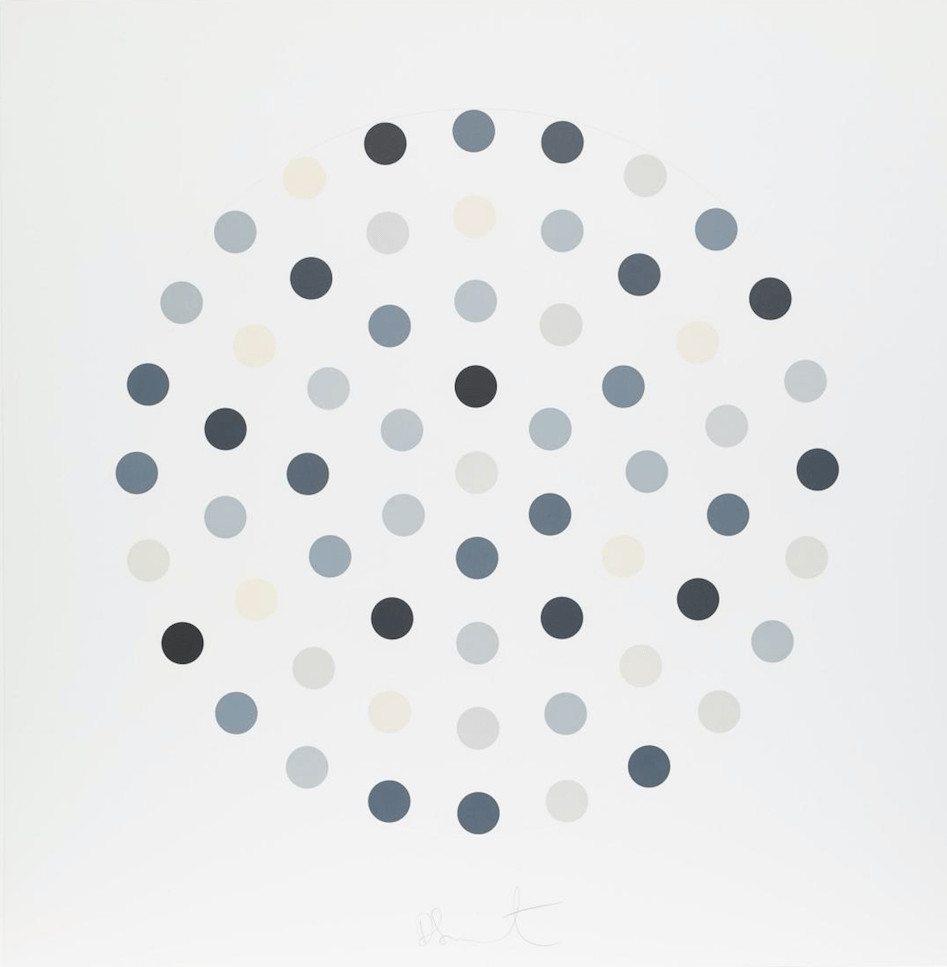
Damien Hirst, Cinchonidine, 2004. Etching in colours, Edition of 145. Available at Guy Hepner, New York.
By the mid-1990s, Hirst had largely stopped painting spots himself. After producing the first five with his own hand, he transferred the task to studio assistants — a decision that provoked both criticism and admiration, and that Hirst addressed with characteristic directness:
"The best person who ever painted spots for me was Rachel. She's brilliant. Absolutely fucking brilliant. The best spot painting you can have by me is one painted by Rachel."
The removal of the artist's hand was not an accident but a conceptual position. Hirst was working squarely in the tradition of Warhol's Factory model: the artist as author of a system, not executor of individual marks. The spots are a method, not a performance of painterly skill. That method — no two colours repeated, uniform circles, regular grid — is enforced regardless of who executes it. An edition printed in 2004 adheres to precisely the same rules as a canvas from 1991.
For collectors, this matters. The value of a spot print is not in the autographic trace of Hirst's hand. It is in the rigorous execution of a conceptual system — and in the documented history that confirms it belongs to that system. Authentication, edition documentation, and publisher provenance carry more weight here than in most other categories of contemporary prints.
Hirst's print output spans five distinct techniques. Each has its own edition structure, price band, and collector base.
The most recognisable and widely traded entry point. In 2000, Hirst collaborated with the online gallery Eyestorm on three limited edition Pharmaceutical Spot prints: Valium, Opium, and Lysergic Acid Diethylamide (LSD). The titles were chosen deliberately — drug names that were both scientifically specific and culturally loaded.
The Eyestorm works remain the standard entry point for the Hirst spot print market. Their larger edition sizes (300–500) mean supply is relatively plentiful, but consistent demand keeps prices firm and rising. LSD, with its smaller edition of 300 and larger sheet size, commands a meaningful premium over Valium and Opium.
Auction record highlights (Eyestorm series):
The Eyestorm works represent the accessible entry point of the market — consistent performers that regularly exceed estimates at regional houses. To understand the ceiling, look at what Hirst pharmaceutical and edition prints achieve at the major houses.
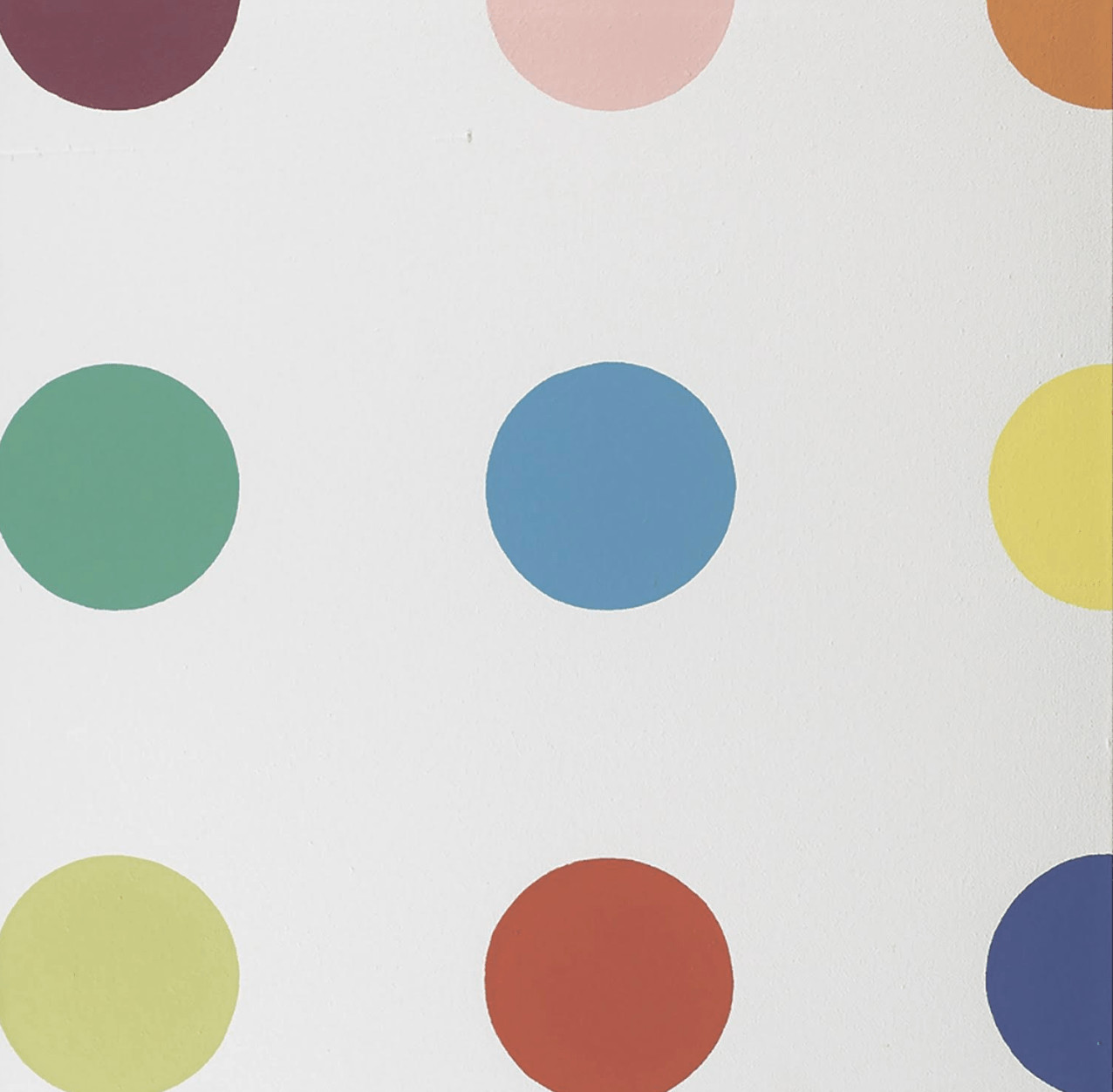
Damien Hirst, Tyloxapol, 2010. Woodcut in colours, Edition of 48. Available at Guy Hepner, New York.
From 2004 onwards, Hirst began producing spot prints in etching — a technique that introduced an entirely different physical character to the format. Where screenprints and lambda works have a flat, photographic surface, the etchings show plate marks, paper texture, and the slight relief of intaglio printing.
The most significant series from this period includes:
The etching editions occupy a mid-market position: smaller editions than the Eyestorm screenprints (145 vs 500), more complex technique, and a different collector profile — buyers who are drawn to the craft of printmaking as well as the conceptual content. Bromphenol Blue has appeared frequently at auction with strong results in the $12,000–$38,000 range, and the broader 2004–2005 etching series has shown consistent demand at the $20,000–$50,000 level in recent years.
Damien Hirst, M-Fluorobenzoyl Chloride, 2018. Woodcut in colours, Edition of 55. $48,000. Available at Guy Hepner, New York.
Published in 2010–2011, the 12 Woodcut Spots series represents the highest-craft end of the spot print market. Woodcut — a relief technique in which the image is carved into a wooden block and printed by hand — produces a distinctly different surface to screenprint or etching: richer in texture, more variable across the edition, and carrying an explicit reference to the history of printmaking that the clinical screenprints deliberately avoid.
The 12 Woodcut Spots comprise twelve individual prints, each named after a pharmaceutical compound. Edition sizes are deliberately small — 24, 34, and 48 depending on the individual print — making these among the most limited spot editions in existence. Individual works include Tyloxapol (Edition of 48), Perillartine (Edition of 55), and M-Fluorobenzoyl Chloride (2018, Edition of 55 — a later single woodcut in the same tradition).
The combination of low edition counts, handmade technique, and the prestige of the spot format has made woodcuts the strongest-performing individual spot prints at auction. The series is the first place serious collectors look when they want to move up from the Eyestorm entry tier.
Damien Hirst, Perillartine, 2011. Woodcut in colours, Edition of 55. Available at Guy Hepner, New York.
In 2009, Hirst produced the Spot Deck series — screenprints in colours, offered both as individual works and as a Spot Deck Set of 5. These are more playful in concept than the pharmaceutical editions: the format references card decks and consumer multiples as much as high-end printmaking. They are not the strongest performer at auction among the spot editions but offer accessible acquisition at the entry level of the market.
Hirst's ongoing collaboration with HENI Editions has produced a large body of giclée and diasec-mounted spot works, including the H-series prints (H6, H9, H14, H18, etc.). These are technically accomplished, often large-scale, and sold in editions typically of 100–600. Authentication is via a signed and numbered label on the reverse rather than a traditional COA. HENI editions have been commercially successful but have shown more price volatility on the secondary market compared to the earlier pharmaceutical editions, particularly at the individual print level.
In January 2012, Gagosian Gallery staged one of the most audacious exhibitions in the history of contemporary art. The Complete Spot Paintings 1986–2011 opened simultaneously across all eleven of Gagosian's locations worldwide — New York (both spaces), London (both spaces), Paris, Los Angeles, Rome, Athens, Geneva, and Hong Kong — on the same day: January 12, 2012. Over three hundred individual spot paintings were displayed collectively, including the first spot on board Hirst made in 1986 and a monumental canvas covering an entire gallery wall.
The exhibition was both a scholarly retrospective and a market event. It coincided with the forthcoming publication of the catalogue raisonné (released in 2013 by Other Criteria and Gagosian, 1,074 pages, documenting 1,365 works). For collectors, it established the spots as a serious art-historical body of work with institutional support — not merely a commercially successful format. Prices on the secondary market responded accordingly in the years following.
The Hirst authentication market is unusually complicated. Unlike Warhol — where the Authentication Board closed in 2012 and the field moved to provenance and catalogue raisonné reliance — Hirst's situation involves an active but disputed system.
Science Ltd., Hirst's production company, maintains a comprehensive database of spot paintings and editions, and has historically issued certificates of authenticity. However, Science Ltd. has also been involved in controversies around withholding certificates — most notably a 2015 case in which a collector was unable to sell a genuine early spot painting because Science Ltd. claimed the certificate had been returned and declined to reissue one.
For print collectors, the authentication picture is more straightforward than for paintings but still requires care:
For Eyestorm editions (2000): Authentic works carry Eyestorm London publisher stamps on the reverse alongside Hirst's pencil signature on the front. The edition number is on the verso. Eyestorm COAs were issued at the time of sale but are not always present with works in the secondary market. The signature should be assessed by a specialist — in pencil, lower right on the print face.
For etching editions (2004–2005): These were published through Other Criteria (Hirst's own publishing house) and carry Other Criteria stamps. Signed front in pencil, numbered verso. Authenticity rests on publisher documentation + signature examination.
For woodcut editions (2010–2011): Similarly published through Other Criteria / Science Ltd. Low edition counts mean each print should be traceable to a specific number. The woodcut surface is physically distinctive and harder to replicate convincingly.
A critical warning on fakes: In 2016, a significant volume of counterfeit Hirst prints entered the market bearing fake signatures and studio stamps. These were particularly prevalent at regional auction houses with limited Hirst expertise. Forgeries characteristically lack credible provenance — no chain back to Eyestorm, Other Criteria, or a named primary gallery — and use incorrect framing, paper weights, or printing substrates. Always verify publisher provenance before buying, and avoid works where the only authentication is a secondary-market COA from an unknown issuer.
HENI editions (2016–present): These do not carry a traditional COA. Authentication is via the hand-signed and numbered label on the reverse of the aluminium-mounted substrate. HENI maintains records of edition numbers.
Damien Hirst, Cinchonidine / Ciclopirox Olamine / Cineole, 2004. Set of three etchings in colours, Edition of 145. Available at Guy Hepner, New York.
The Hirst spot print market is liquid but not uniform. These are the specific factors that determine where in the price band a given work sits:
Edition size is the primary driver. A Tyloxapol woodcut (Edition of 48) commands a significantly higher price than a Valium screenprint (Edition of 500) irrespective of their similar aesthetic. Scarcity within the spot category is directly correlated with price — buyers at the serious level are tracking edition counts precisely.
Technique comes second. Woodcuts outperform screenprints; etchings occupy the middle ground. The hierarchy reflects both the physical complexity of the works and the cultural status of each technique — woodcut carries more art-historical weight than screenprint in the collector imagination.
Complete sets vs individual prints. Where a set exists (the 12 Woodcut Spots, the Cinchonidine/Ciclopirox/Cineole trio), complete sets consistently trade at a premium over the sum of their parts. Buyers assembling sets from the secondary market often pay more per print than the complete set commands as a unit. This creates a persistent pricing inefficiency that informed collectors exploit.
Title and cultural resonance. Valium, Opium, and LSD carry a cultural charge that a neutral pharmaceutical compound title like Cinchonidine does not. The Eyestorm three trade at premiums within their format category partly because the titles are immediately legible to non-specialist buyers, which sustains a wider demand pool.
Condition. Spot prints are particularly vulnerable to UV fading — the saturated pigments that define their visual impact degrade under prolonged light exposure. Works that have been stored in darkness or with UV-protective glass command meaningful premiums. A faded Valium can lose 20–30% of its market value against a pristine example. Inspect before buying; insist on condition reports.
Provenance. Works with direct gallery provenance (Eyestorm, Other Criteria, White Cube, Gagosian) trade at a premium over works that have changed hands multiple times through secondary channels where documentation may be incomplete.
The headline result for Hirst print editions came at Phillips in October 2024, when a dedicated Damien Hirst prints and editions auction delivered the two strongest results in the category's history. Day In Day Out — a pharmaceutical pill cabinet edition from 2003 — sold for $293,000. End Of Days, the companion black cabinet edition, achieved $161,000. Both exceeded their estimates significantly and established new benchmarks for what Hirst editions can achieve at a major auction house.
For pharmaceutical spot prints specifically, the record came at Christie's in April 2023: Methamphetamine (2004, aquatint in colours) sold for $69,300 — an 84% increase over its previous auction result in 2020, and one of the strongest individual spot print results on record at a major house.
Complete sets represent the upper tier of the print market. H9: The Virtues (complete set of 8, 2021) has been the benchmark series: a complete set sold at Phillips in February 2024 for $154,000, followed by another in June 2024 at $129,000. The record for the series stands at $191,000 — the highest price ever paid for a Hirst print-multiple at auction. The Love Poems complete set, even rarer on the secondary market with only three appearances to date, achieved $100,000 at Phillips in January 2024.
Across the broader print market, Hirst reached $3 million in total print sales in 2024 — a slight increase over 2023 — with the average selling price rising 12% year-on-year to $10,800. The market has bifurcated: complete sets and premium pharmaceutical editions at the top are outpacing high-edition individual prints at the base.
The woodcut spot editions remain underrepresented at public auction simply because so few come to market — low edition counts mean most are held by collectors who acquired them directly. When they surface, results are firm.
It would be easy to dismiss the spot paintings as decorative — colourful, repetitive, commercially successful. The art world has tried that dismissal periodically for thirty years and the market has consistently rejected it. Why?
Part of the answer is the conceptual rigidity of the system. The spots work because they are a closed formal argument: no colour repeated, perfect circles, absolute regularity. That argument is legible to anyone, regardless of their relationship to contemporary art, which is exactly what Eyestorm's Henrik Riis identified when he described their "wow factor" — the instant recognisability that makes a spot print a Hirst before you've read the label.
But the spots are not merely decorative. The pharmaceutical titles are not incidental. The spots hang in the same conceptual space as Hirst's formaldehyde tanks and pill cabinets — works about the human need to organise, contain, and name the things that frighten us. A wall of coloured circles is also a medicine cabinet, a periodic table, a cemetery, a chromatic catalogue of things we consume to stay alive. Lucian Freud, reportedly seeing Hirst's early work, said: "I think you started with the final act." The spots are the beginning of the same thought.
For collectors, that dual register — immediate pleasure and sustained meaning — is exactly the combination that sustains long-term value. The work gives something at first glance and more on return. That is a rare quality.
Entry tier ($2,500–$15,000): Individual Eyestorm works, primarily Opium and smaller-format examples. High edition counts (500) limit scarcity, but consistent demand and cultural legibility make these reliable introductions to the category. Buy in pristine condition only; condition matters more here because the entry price doesn't absorb the discount of a damaged work.
Mid-market ($15,000–$45,000): Valium and LSD from Eyestorm, etching editions (Cinchonidine, Bromphenol Blue, Diacetoxyscirpenol). This is where the quality of documentation starts to matter as much as the work itself. Demand provenance. The etchings in this tier offer better edition scarcity than equivalent-priced Eyestorm works and have a slightly smaller but more committed buyer base.
Upper market ($45,000–$100,000+): Woodcut editions, complete sets (12 Woodcut Spots as a portfolio, the Cinchonidine trio), and AP (artist's proof) examples of any format. APs trade at a premium over the numbered edition — typically 10–25% — because they are rarer and carry a slightly different status in the market. A complete set of 12 Woodcut Spots acquired as a unit, correctly documented and in exhibition condition, is among the strongest holdings in the Hirst print category.
What to avoid: HENI editions acquired at primary market retail for investment purposes. The secondary market for HENI spot-adjacent works (H-series) has shown volatility and inconsistent performance. These are excellent works to live with; they are less reliable as investment-grade holdings at their primary price points. Buy them because you want them, not because you expect the secondary market to reward you.
How many Damien Hirst spot prints exist? The 2013 catalogue raisonné (The Complete Spot Paintings 1986–2011, Other Criteria/Gagosian) documents 1,365 spot paintings. Print editions derived from the spot format number in the dozens of distinct works, with individual edition sizes ranging from 24 (woodcuts) to 500 (Eyestorm screenprints). The total number of impression across all spot print editions runs to several thousand, which is why edition size and technique are so important to value assessment.
What is a Damien Hirst spot print worth? At auction in 2024, signed Hirst prints sold in a range of $380–$154,000 depending on series, format, and condition. Specifically for spot editions: Eyestorm screenprints (Valium, Opium) typically trade at $8,000–$25,000; the LSD lambda print at $15,000–$25,000; etching editions at $20,000–$50,000; woodcuts at $25,000–$100,000 for individual works and more for complete sets.
Are Damien Hirst spot prints a good investment? Hirst's print market has shown 4.5% compound annual growth over the past five years. The pharmaceutical spot editions — particularly the Eyestorm three, the 2004–2005 etchings, and the woodcuts — have demonstrated consistent secondary-market demand with results regularly exceeding pre-sale estimates. The key risk is edition size: large-edition works have more supply entering the market and are more susceptible to price erosion if collector sentiment shifts. Woodcut editions, with their low edition counts and handmade character, carry the best structural case for value preservation.
How do I know if my Damien Hirst spot print is authentic? For Eyestorm prints (2000): look for the pencil signature on the front face of the print, the edition number on the verso, and the Eyestorm London publisher stamp. For etching editions: Other Criteria publisher stamp, pencil signature front, number verso, on Hahnemühle paper. For HENI editions: signed and numbered label on the reverse of the aluminium substrate. If any of these elements are missing or inconsistent, have the work assessed by a Hirst specialist before proceeding. Following the 2016 surge of counterfeit Hirst prints, provenance verification is non-negotiable.
What is the difference between a spot painting and a spot print? A spot painting is an original work on canvas or board — either by Hirst himself (the first five) or by a studio assistant under his direction. Spot prints are published limited editions in a stated medium (screenprint, etching, woodcut, lambda print, etc.) with a fixed edition number. Spot paintings start at several hundred thousand dollars for early examples and reach into the millions for large canvases. Never conflate the two markets when assessing value.
What are the titles on Hirst spot prints? All titles in the pharmaceutical spot series are taken directly from the Sigma-Aldrich Biochemicals for Research and Diagnostic Reagents catalogue — a trade directory Hirst came across in the early 1990s. Titles include actual chemical compound names (Cinchonidine, Bromphenol Blue, Tyloxapol, Perillartine, M-Fluorobenzoyl Chloride) as well as more culturally recognisable pharmaceutical names like Valium, Opium, and Lysergic Acid Diethylamide (LSD). The naming was deliberate but arbitrary — compounds were not chosen for any specific symbolic reason beyond their pharmaceutical identity.
Should I buy a complete set or individual prints? Where a complete set exists and can be acquired as a unit, it is almost always the superior financial decision. Complete sets trade at premiums over the sum of their parts, are more likely to attract institutional and major private collector interest, and are rarer on the secondary market than individual prints. The 12 Woodcut Spots as a complete portfolio, for example, represents a meaningfully different holding than twelve individual woodcuts assembled from multiple secondary sources.
M-Fluorobenzoyl Chloride, 2018 — $48,000 Woodcut in colours. Edition of 55. Signed. One of the most recent woodcut spot prints and among the scarcest in the tradition.
Tyloxapol, 2010 Woodcut in colours. Edition of 48. Signed. From the 12 Woodcut Spots series.
Perillartine, 2011 Woodcut in colours. Edition of 55. Signed. 12 Woodcut Spots series.
Cinchonidine, 2004 Etching in colours. Edition of 145. Signed. Other Criteria, London.
Cinchonidine / Ciclopirox Olamine / Cineole, 2004 Set of three etchings in colours. Edition of 145. A complete portfolio of three pharmaceutical spot etchings.
Spot Deck Set of 5, 2009 Screenprint in colours. Entry-level spot edition — an accessible introduction to the series.
Inquire about all available Damien Hirst works
Guy Hepner | 529 West 20th Street, New York
Browse Damien Hirst prints and editions at Guy Hepner: Damien Hirst art for sale | Sell your Damien Hirst
Explore Damien Hirst prints for sale at Guy Hepner: H4 - Veil Spots, H5 - Colour Space Spots, Spot Paintings, Spot Prints, Blossoms.
Related Series