Anatomy

June 5, 2026
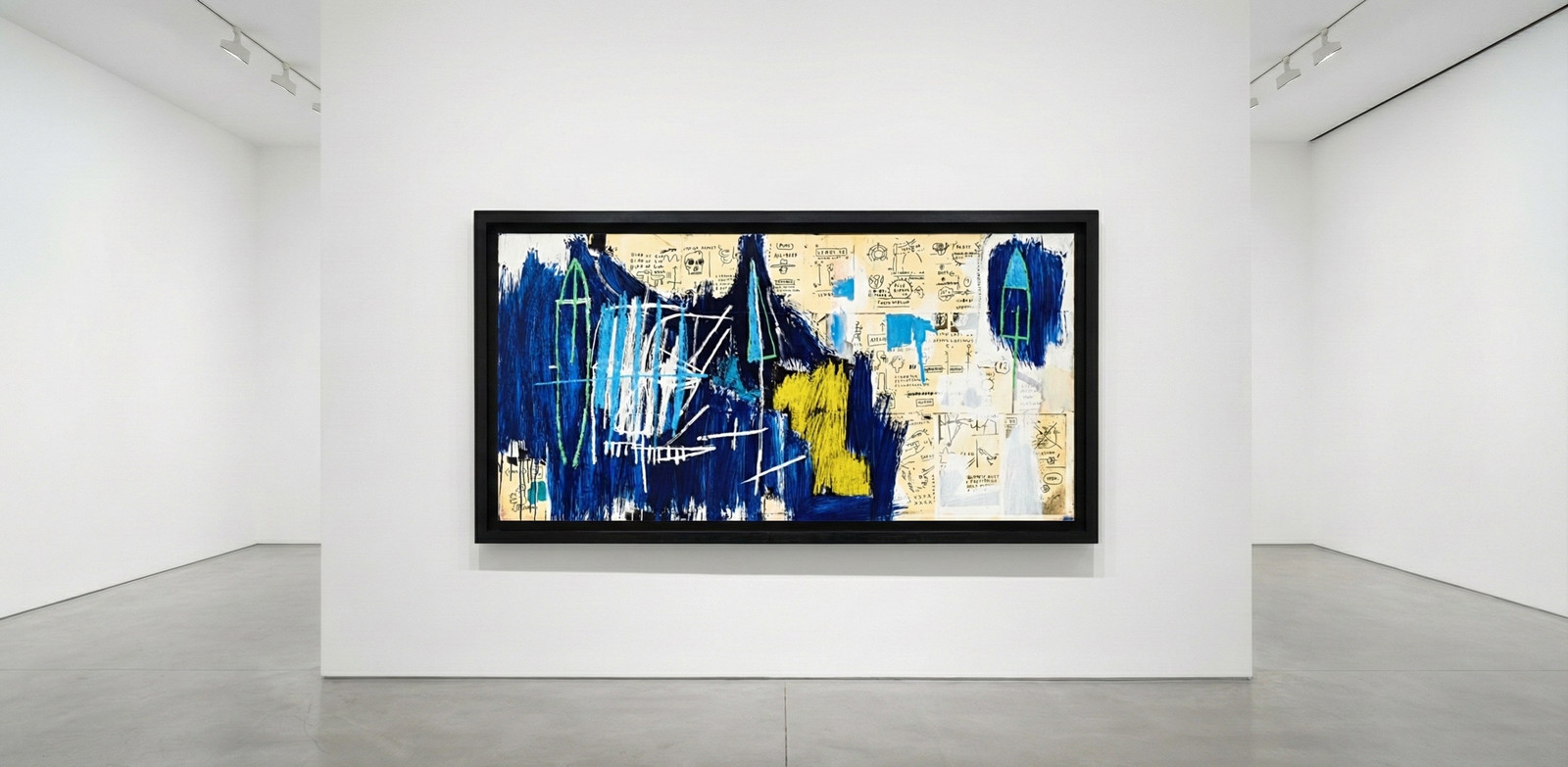
Jean-Michel Basquiat produced some of the most electrifying paintings of the twentieth century in a career that lasted barely a decade. His most famous paintings now sell for tens of millions of dollars at auction, hang in the permanent collections of the Whitney, the Broad and MoMA, and continue to shape how we think about race, identity and the art market. Understanding Basquiat's famous paintings — their imagery, their context and their place in his short, explosive output — is essential reading for any serious collector or student of contemporary art.
Born in Brooklyn in 1960, dead at twenty-seven in 1988, Basquiat compressed a lifetime of work into roughly eight years of serious painting. His output was enormous and uneven, but at its peak — roughly 1981 to 1985 — he produced a body of work that stands alongside the greatest American painting of any era. These are his most famous paintings, and what makes them matter.
Jean-Michel Basquiat was born on 22 December 1960 in Brooklyn, New York, to a Haitian father and a Puerto Rican mother. He was raised between Brooklyn and Puerto Rico, briefly attended Saint Ann's School in Brooklyn Heights, and ran away from home at fifteen following his parents' separation. He lived for a period on the streets of Manhattan, sleeping in cardboard boxes in Tompkins Square Park, selling handmade postcards and sweatshirts to survive.
Between 1978 and 1980 he operated as SAMO© — a graffiti persona whose cryptic, poetic tags appeared across the walls of SoHo, Tribeca and the Lower East Side. SAMO© announced his presence to a downtown art world that was just beginning to take street culture seriously. By 1980 he had participated in the legendary Times Square Show alongside Jenny Holzer, Kiki Smith and Keith Haring. By 1982 he was the youngest artist ever shown at Documenta in Kassel, Germany. He died on 12 August 1988, aged twenty-seven, from a heroin overdose.
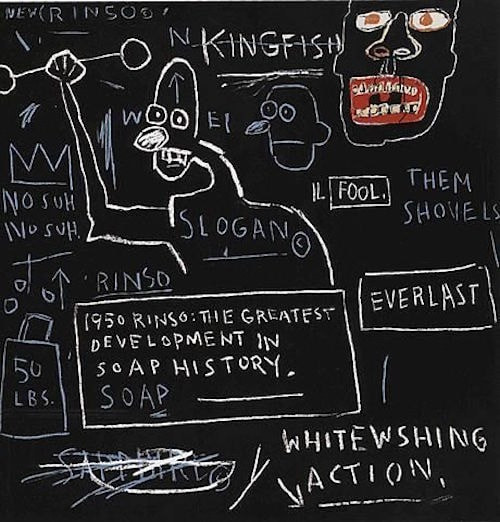
Basquiat synthesised sources that no one had successfully brought together before: street graffiti and gestural Abstract Expressionism; African-American vernacular culture and European art history; medical Anatomy textbooks and jazz liner notes. He painted on doors, refrigerator panels, windows and wooden supports as well as canvas, treating every surface as a site of inscription. His raw Neo-Expressionist style — crowns, skulls, anatomical diagrams, crossed-out words, repeated fragments — operated simultaneously as autobiography, political protest, art-historical critique and pure visual energy.
What set Basquiat's jean-michel basquiat paintings apart was their insistence on the Black body as a subject with history, complexity and dignity at a moment when that was still a radical proposition in the gallery system. His recurring figures — the athlete, the musician, the skeleton, the saint — were drawn from Black history that mainstream culture had suppressed or erased. The crown he placed on Charlie Parker and Sugar Ray Robinson was an act of restitution as much as homage.
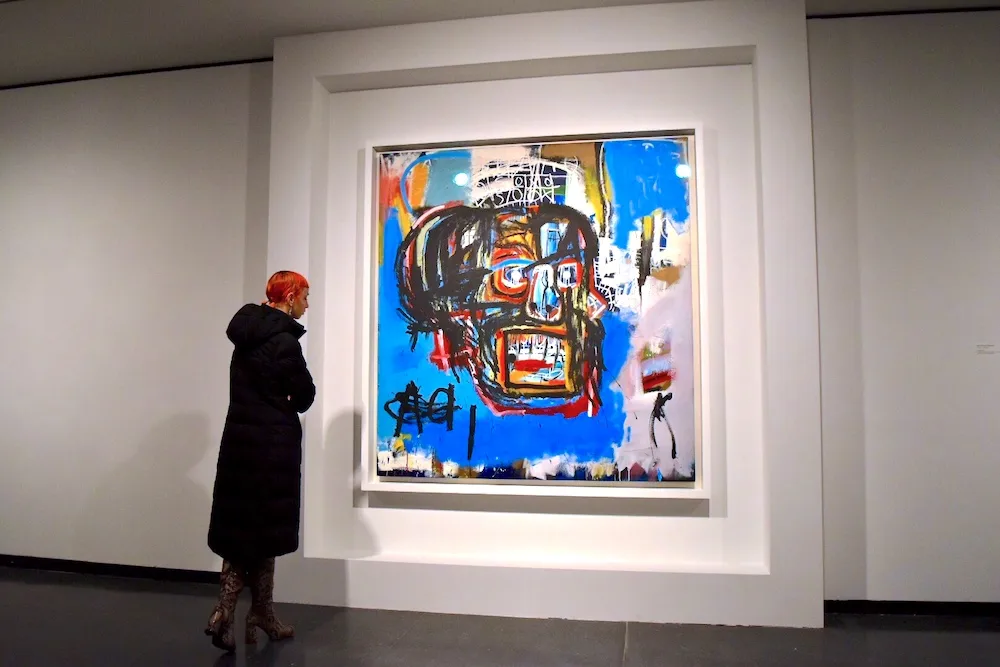
Untitled (Skull), 1982 — The most expensive Basquiat ever sold, and at the time of its sale the highest price achieved by an American artist at auction. Sold at Sotheby's New York in May 2017 for $110.5 million to Japanese entrepreneur Yusaku Maezawa, the three-panel skull painting is the defining Basquiat: raw, confrontational, technically overwhelming. It had been purchased directly from the artist by the gallerist Larry Gagosian for $19,000 in 1982.
Dustheads, 1982 — Sold at Christie's New York in 2013 for $48.8 million. Two wildly gesticulating figures painted in neon colours against a dark ground, their bodies dissolving into pure painterly energy. One of his most kinetic and visually electric canvases.
In This Case, 1983 — Sold at Christie's New York in May 2021 for $93.1 million, making it the second-highest price ever achieved for a Basquiat. The painting features a skull with exposed anatomy, teeth, layered text and crossed-out words — a characteristic accumulation of the motifs that define his mature style.
Hollywood Africans, 1983 — Now in the permanent collection of the Whitney Museum of American Art. A direct confrontation with racism in the Hollywood entertainment industry, the painting features Basquiat himself alongside his friends Toxic and Rammellzee. The text — "Hollywood Africans," "Sugar Cane," "Tobacco," "200 yen," "Gangsterism" — forms an indictment of how Black talent has been exploited and caricatured by the entertainment industry. Among his most autobiographical and politically charged works.
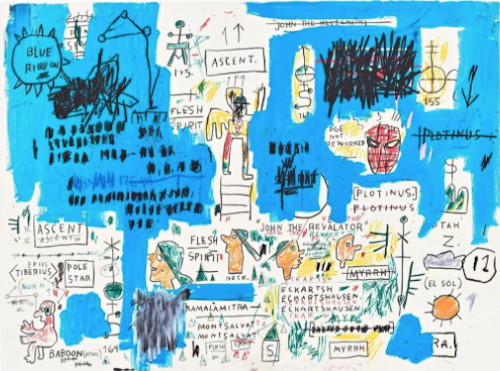
Charles the First, 1982 — Named after Charlie "Bird" Parker, the bebop alto saxophonist whom Basquiat regarded as royalty. The painting places a three-pointed crown above the canvas as a mark of genius and canonisation. The crossed-out words throughout the composition — a recurring Basquiat technique — simultaneously acknowledge and undermine the systems that define artistic value. A print edition from Portfolio Ii is available through Guy Hepner.
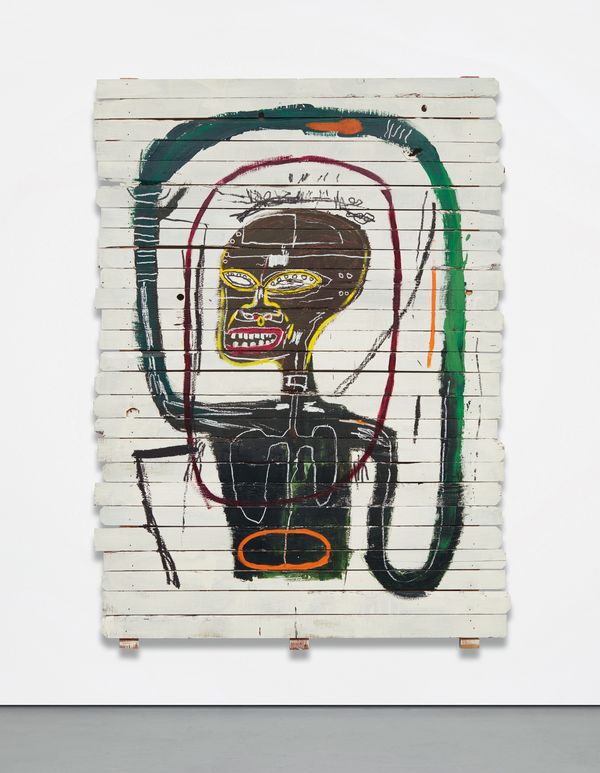
Flexible, 1984 — A dense, layered canvas covered in overlapping text, symbols and anatomical references. One of his most complex compositional achievements, Flexible demonstrates Basquiat's ability to build a painting in geological strata — each layer adding meaning without obliterating what came before. A print edition is available through Guy Hepner.
Riding with Death, 1988 — His final major painting, completed weeks before his death. A Black figure — rendered in simple, almost childlike strokes — rides a skeletal horse across a bare canvas. The work is stripped of the dense layering that characterises his earlier paintings; it feels quiet, prophetic, stripped down to essentials. Widely read as a premonition of his own death, it is among the most haunting final statements in modern art.
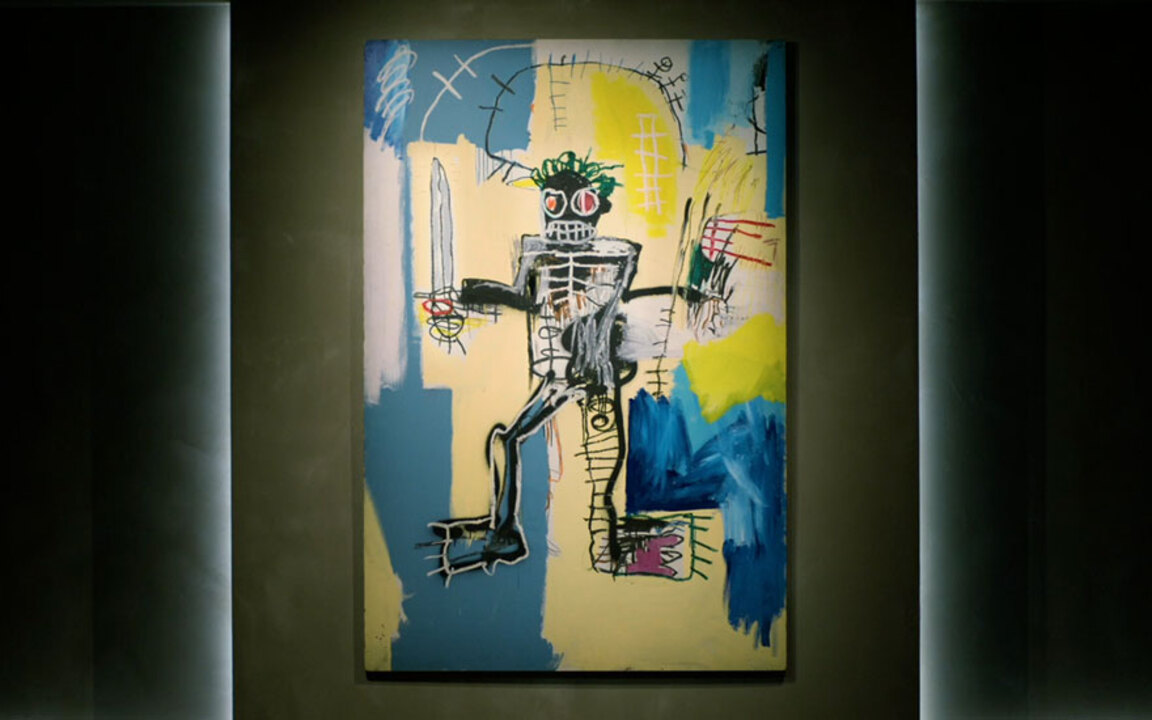
Warrior, 1982 — A central armoured figure, defiant and imposing, flanked by the symbols and text that populate his best canvases. One of his most powerful representations of Black masculinity and resistance, Warrior draws on African warrior traditions and contemporary urban identity simultaneously.
The Nile, 1983 — A large, loose gestural figure rooted in African history and mythology. The painting reaches beyond the streets of New York to claim a longer heritage for Black identity — one that predates and transcends the violence of the American experience. Among his most spiritually charged works.
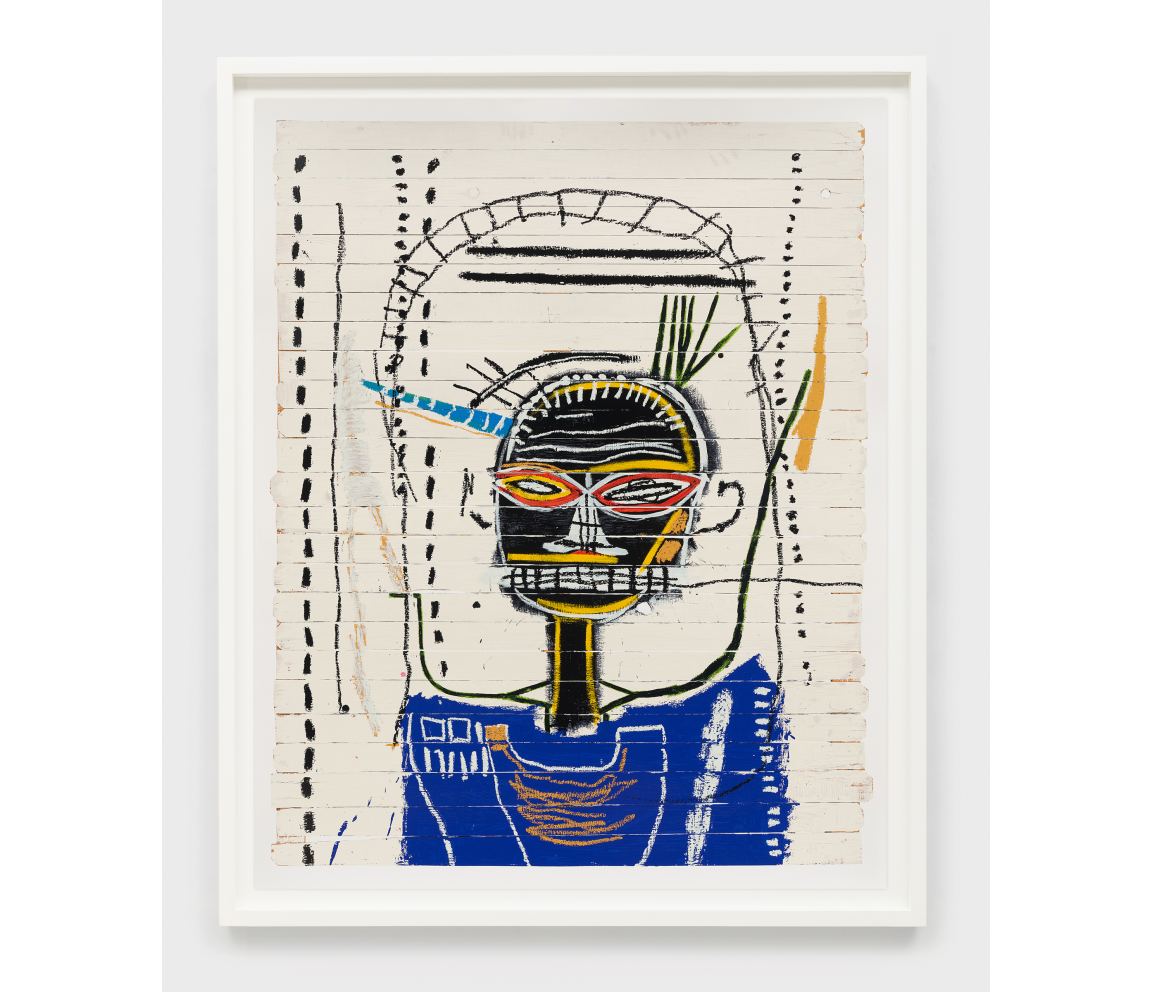
Self-Portrait, 1984 — Raw, confrontational, undeniable. Basquiat's self-portraits are among the finest of the twentieth century: direct encounters with the artist as subject, as Black man, as phenomenon. The 1984 self-portrait in particular — with its wild crown of hair, its XX eyes, its insistence on being seen — ranks among the great self-portraits in American art history.
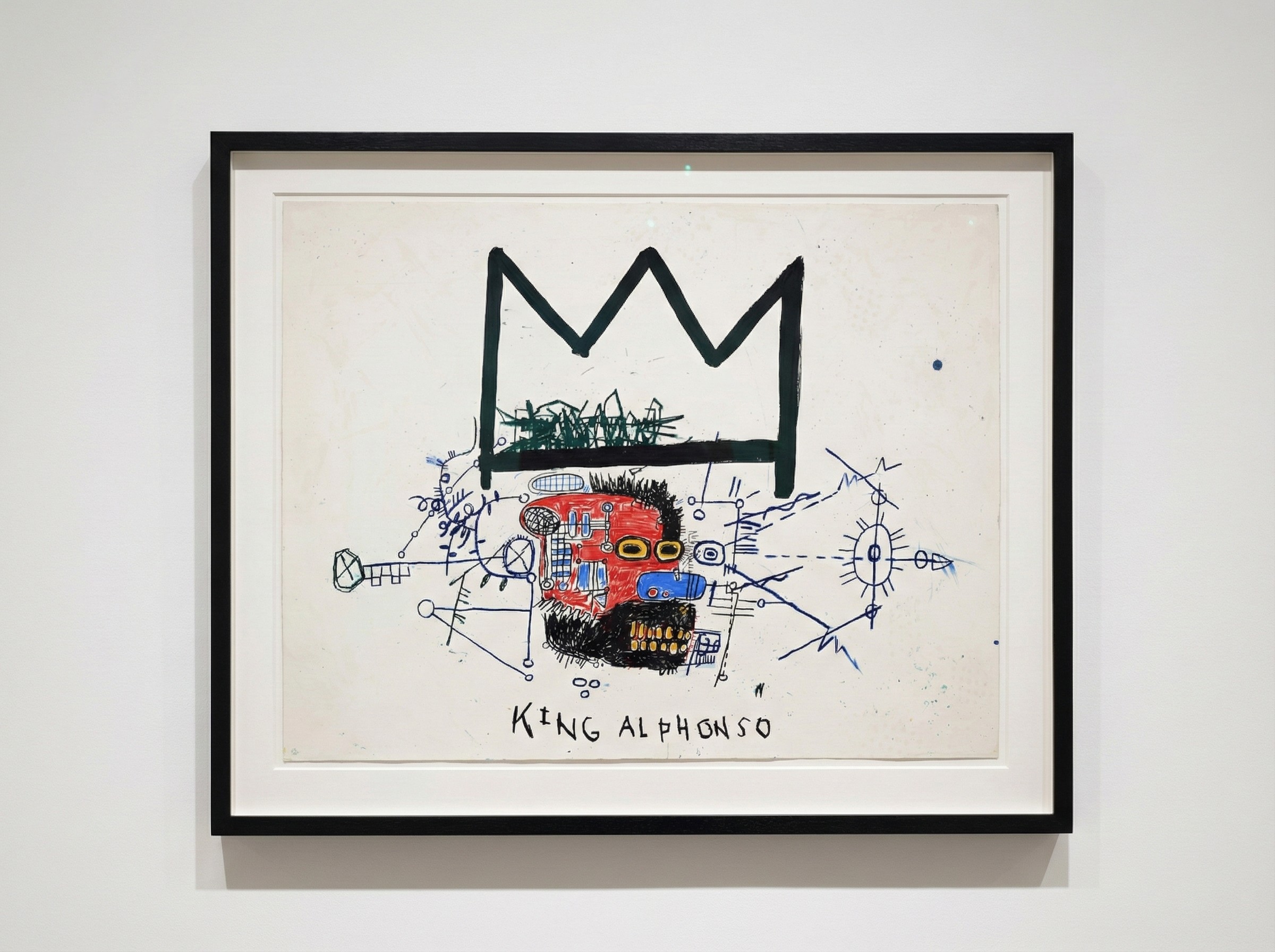
Across his basquiat art, certain motifs recur with the insistence of obsession. The crown appears in dozens of works — placed above figures Basquiat considered royalty: Charlie Parker, Sugar Ray Robinson, Joe Louis, himself. It was an act of restitution, returning dignity to those the mainstream had diminished or erased. The skull — whether the three-panelled masterwork that sold for $110.5 million or the smaller, sketchier versions in works on paper — speaks to mortality, to the Black body as a site of violence, to what lies beneath the surface of both flesh and history.
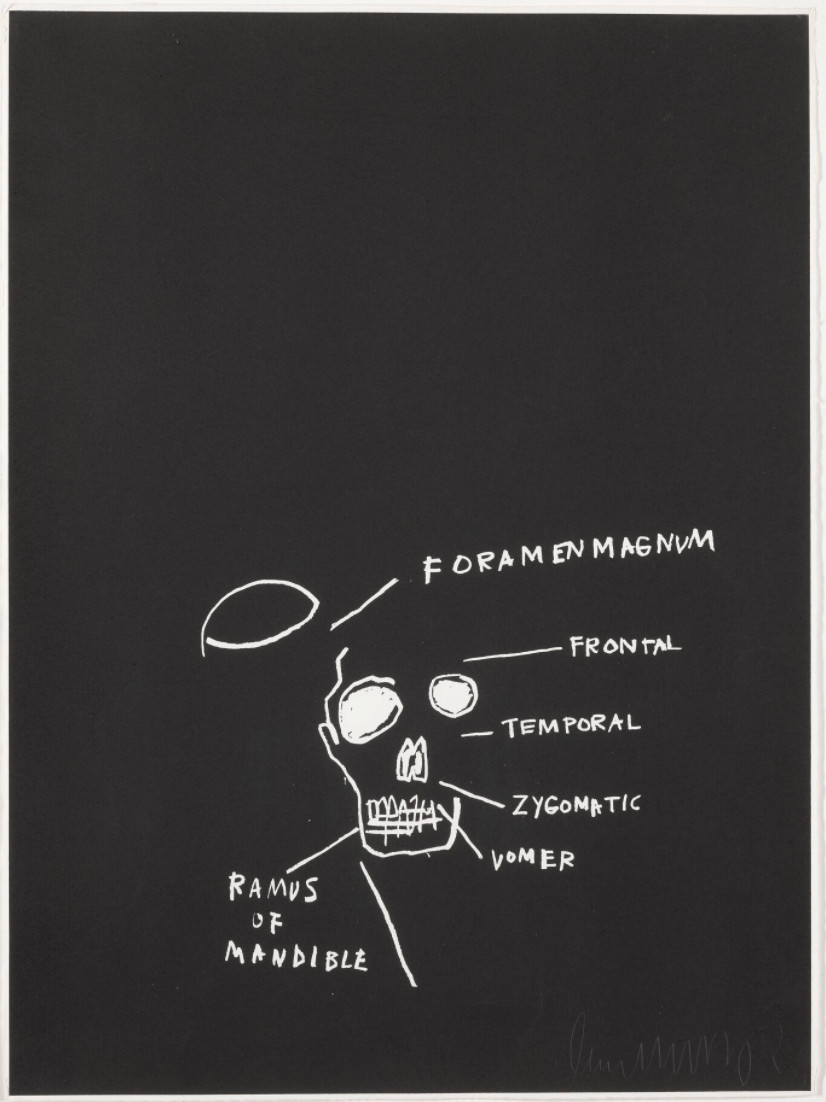
Medical diagrams from Gray's Anatomy appear throughout his paintings: dissected figures, labelled body parts, exposed organs. These anatomical references are deeply ambivalent — they speak simultaneously to Basquiat's own intellectual curiosity and to a history of medical racism in which Black bodies were dissected, studied and exploited without consent. The crossed-out words — SAMO's legacy, carried into the paintings — perform erasure and emphasis at once: to cross something out is to call attention to it.
The demand for Basquiat's work shows no signs of abating. His paintings increasingly attract buyers from Asia — particularly Hong Kong and mainland China — as well as the established New York and European collector base. Works on paper and authorised print portfolios provide more accessible entry points into the market for collectors who cannot compete at the major auction level.
Basquiat's original paintings are largely held by museums or major private collections, with prices ranging from around $5 million for smaller or earlier works to well over $100 million for the finest examples. Works on paper — drawings, pastels, mixed-media pieces — offer a more accessible route into the primary market, with prices typically in the $200,000 to $5 million range depending on size, period and provenance.
For collectors seeking an entry point into the Basquiat market, the Estate-authorised print portfolios are significant. These editions — produced with the oversight of the Basquiat Estate and authenticated accordingly — bring his imagery to a broader collector base while maintaining strict controls on edition size and quality. Key portfolios include Portfolio I (2001), Portfolio II (2004), the Anatomy series (1982/2021), the Superhero Portfolio (2022) and The Figure Portfolio (2023).
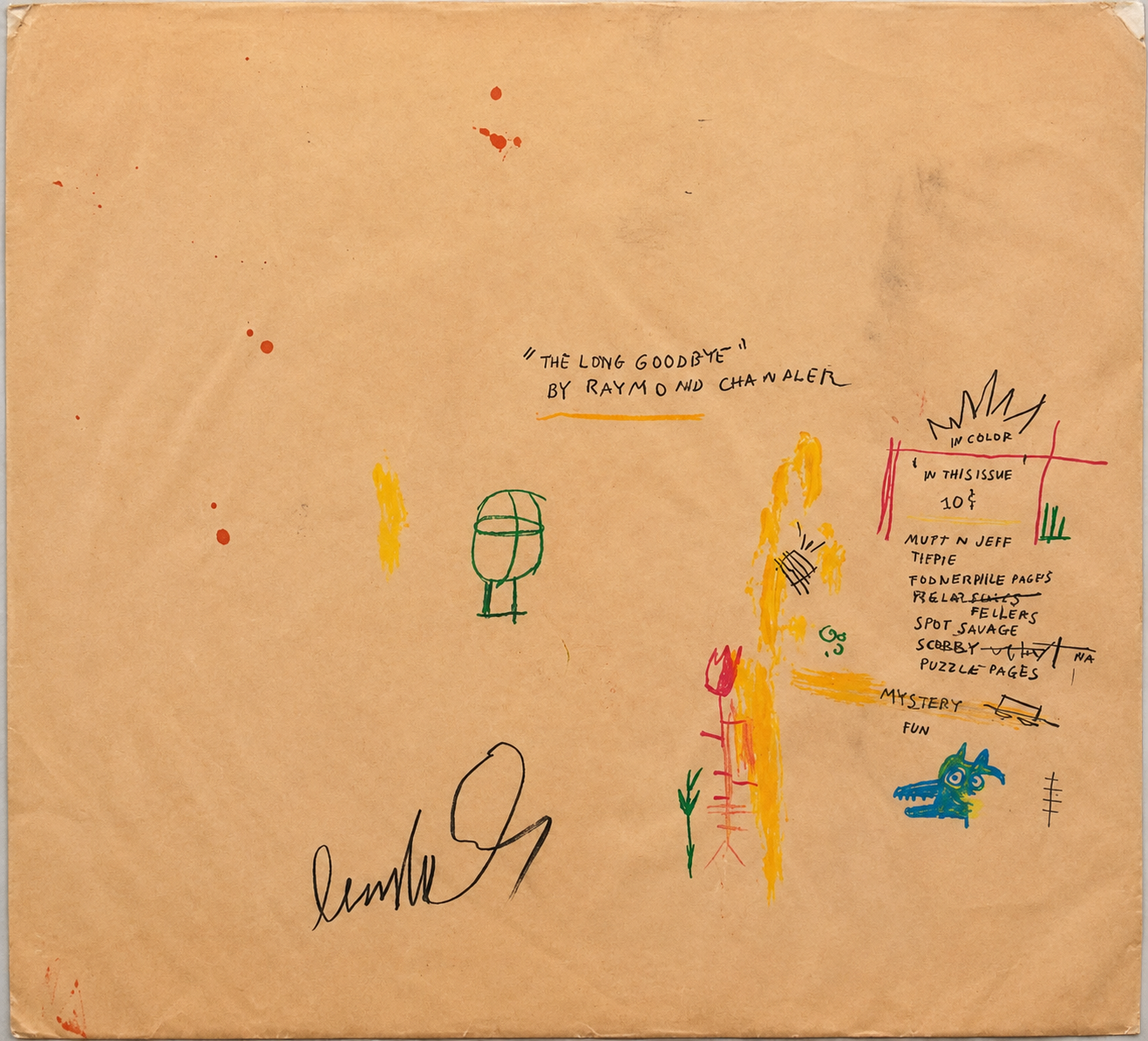
Guy Hepner Gallery holds an important selection of Jean-Michel Basquiat print editions and works on paper, including the Anatomy portfolio, the Superhero Portfolio, and key individual prints from Portfolio I and Portfolio II. These Estate-authorised editions allow collectors to engage with Basquiat's most iconic imagery — the crowns, the skulls, the anatomical figures — with full authentication and provenance. Whether you are building a serious collection or making your first acquisition, Guy Hepner's team is available to advise on the current market and available inventory.
View available Jean-Michel Basquiat works at Guy Hepner
Explore Jean Michel Basquiat prints for sale at Guy Hepner: Anatomy, Daros Suite, Estate Prints, King Alphonso, Original Works.
Related Series