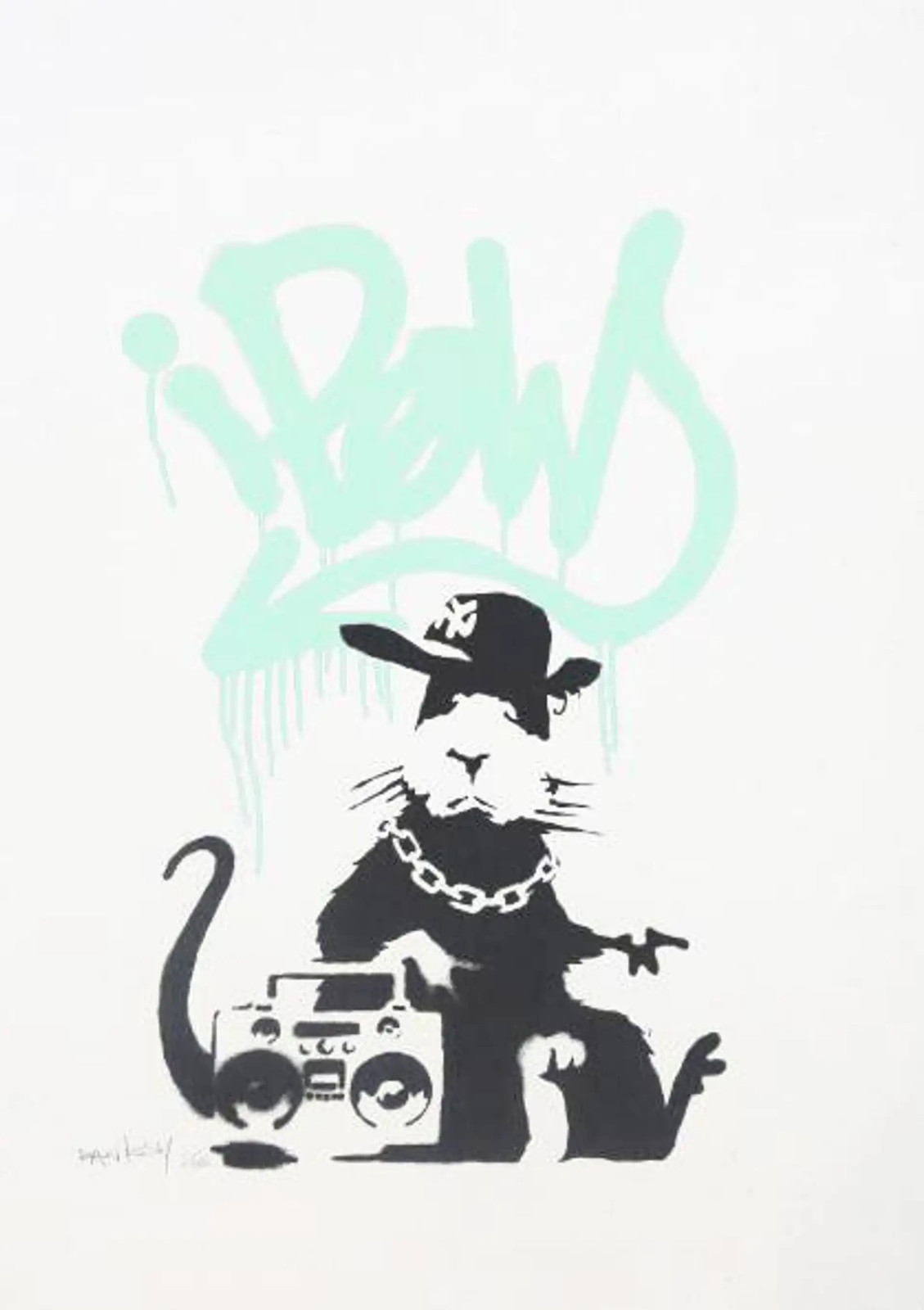
Gangsta Rat

May 31, 2026
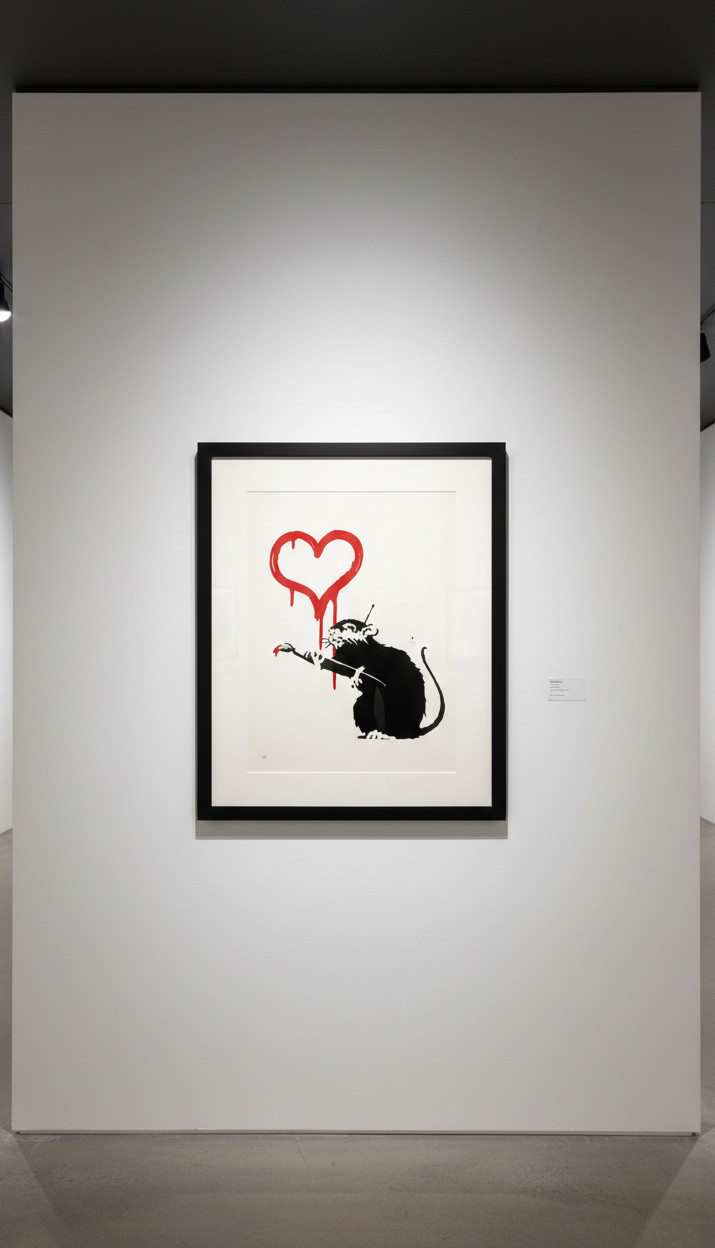
The Banksy rat print is one of the most consistently traded motifs in the contemporary print market — not because of hype, but because of structure. A small number of editions, most produced in 2004 by Pictures on Walls in London, have now been actively resold for over two decades. The Love Rat alone has sold at auction 56 times since 2015. That level of market activity, across a single print edition, tells you something about durability.
This guide covers every major rat edition — Love Rat, Gangsta Rat, Radar Rat, and the Placard Rats — with full edition specs, confirmed auction data, authentication requirements, and the factors that currently separate high-value examples from the rest of the market.
Inquire About Available Banksy Rat Prints
Browse current rat editions available through Guy Hepner, 177 Tenth Avenue, New York.
Banksy did not invent the rat as a street art motif. That credit belongs to Blek le Rat — the pseudonym of Xavier Prou — a French stencil artist who began spraying rats across the walls of Paris in the 1980s. Banksy has been candid about this debt:
"Every time I think I've painted something slightly original, I find out that Blek le Rat has done it as well, only 20 years earlier."
This isn't false modesty. Blek le Rat is widely recognised as the originator of stencil-based street art, and his rat imagery — placed as a subversive presence in public space — directly shaped Banksy's early thinking about what the animal could mean.
Banksy came up through Bristol's underground art scene in the early 1990s, initially producing freehand work. The switch to stencils came out of practical necessity. According to his own account, while hiding from police under a train carriage, he noticed stencilled lettering on the fuel tanks — and recognised that stencils were faster, cleaner, and less likely to get him arrested. From that point on, stencils became his primary method, and the rat became one of his primary subjects.
The technique suited the subject. A stencil rat could be placed on a wall in seconds: a single spray, a clean image, and gone before anyone noticed. The rat arrived, did its work, and disappeared — which is more or less the point.
Banksy's rat imagery carries explicit ideological weight. The most often-quoted passage from his 2005 book Wall and Piece sets out the terms directly:
"Rats exist without permission. They are hated, hunted and persecuted. They live in quiet desperation amongst the filth. And yet they are capable of bringing entire civilisations to their knees. If you are dirty, insignificant and unloved then rats are the ultimate role model."
This is not incidental. The rat, in Banksy's framework, is a stand-in for anyone who operates outside sanctioned systems — the outsider who nonetheless exerts power. Street artists, by that logic, are rats: uncredentialed, unwelcome, and impossible to fully suppress.
There is also a linguistic dimension. The word "rat" is an anagram of "art" — a fact Banksy discovered after the fact, and incorporated retrospectively. As he noted in Wall and Piece: "I'd been painting rats for three years before someone said 'that's clever, it's an anagram of art' and I had to pretend I'd known that all along."
The rats Banksy stencilled on London walls — on Tooley Street, Chiswell Street, in Farringdon, as well as locations in Los Angeles and New York — were acts of civic occupation. They placed an unwanted presence in public space and dared the authorities to remove it. Many were painted over. Some remain visible to this day.
All the major Banksy rat print editions were published in 2004 by Pictures on Walls (POW), London — Banksy's primary print publisher during this period. The editions were produced as screenprints on paper, sold initially through Banksy's own channels including the Santa's Ghetto pop-up shops. Secondary market prices are now substantially higher than original release prices in every case.
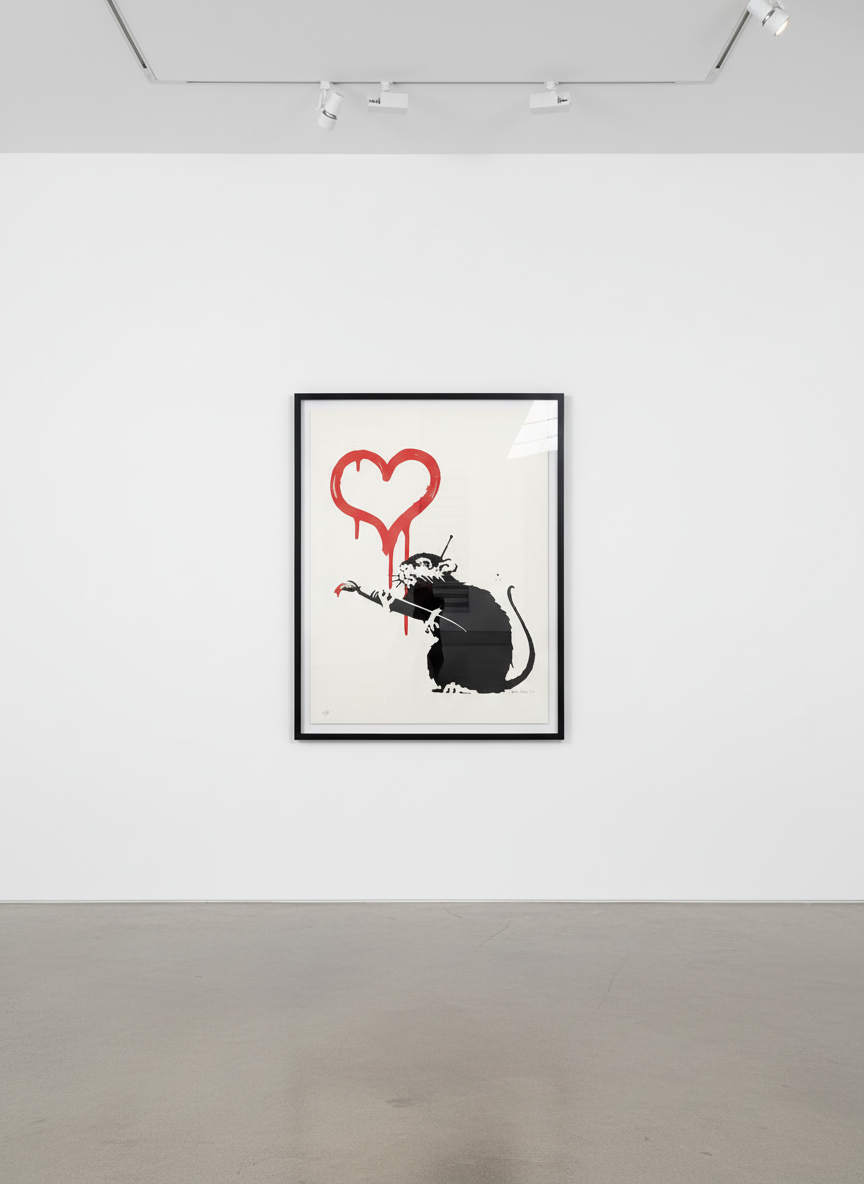
The Love Rat first appeared as a mural in Liverpool before being released as a print. It is widely considered the first Banksy rat print edition. The image shows a rat holding a paintbrush, having painted a dripping red heart on the wall behind it — the only pop of colour in an otherwise monochrome composition. Banksy marketed it with characteristic deadpan: "ideal for a cheating spouse."
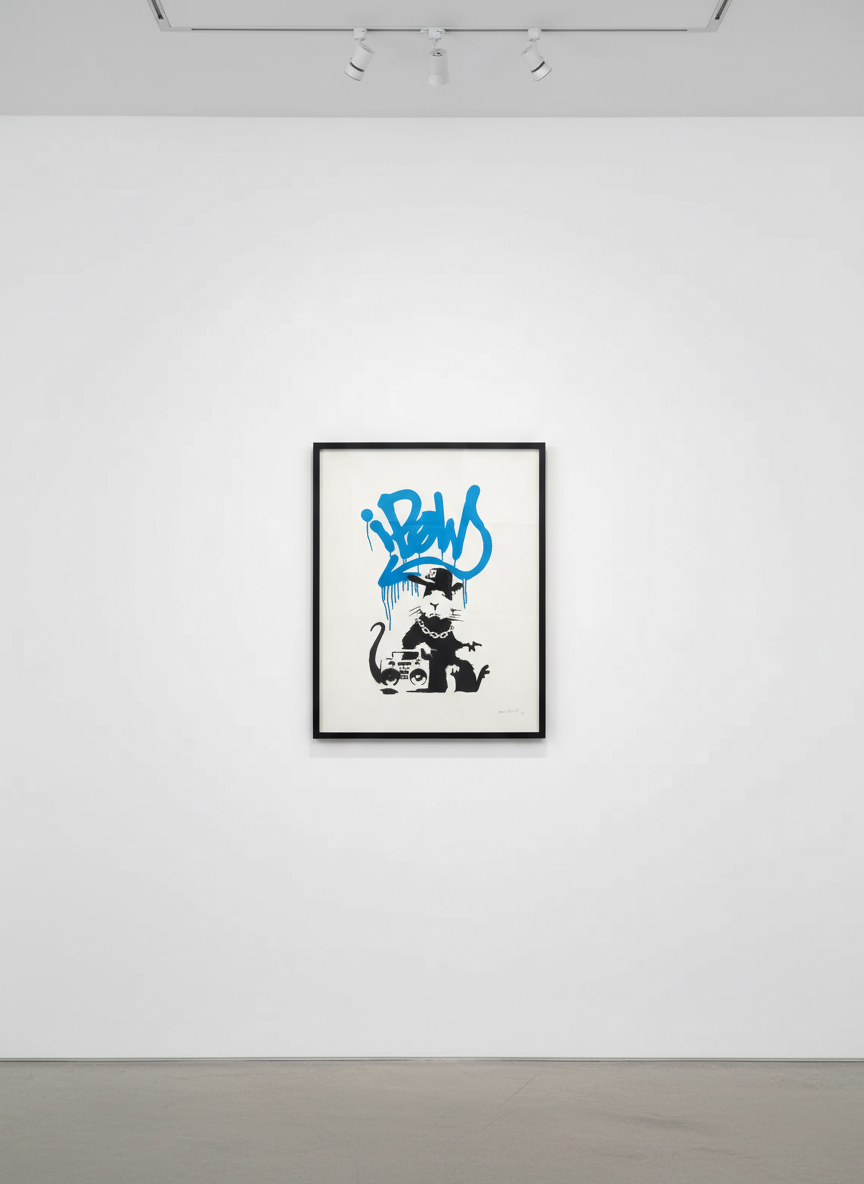
The Gangsta Rat first appeared as a London mural in 2004 and was also painted on walls in Los Angeles and New York. The image depicts a rat wearing a New York Mets baseball cap and chain necklace, holding a boombox. The boombox carries the tag "iPOW" — a compound of Apple's "i" branding and "POW" (Pictures on Walls). The edition was subsequently released as a print.
In 2015, Banksy released six additional colourways of the Gangsta Rat exclusively for VIP guests at Dismaland, his large-scale temporary installation in Weston-super-Mare. These were released as Artist's Proofs only, in the following colourways: pink, mint green, green, orange, blue, and grey — seven total colour variants counting the original. The AP Blue edition, with 61 examples, currently carries an estimated value of £100,000–£150,000.
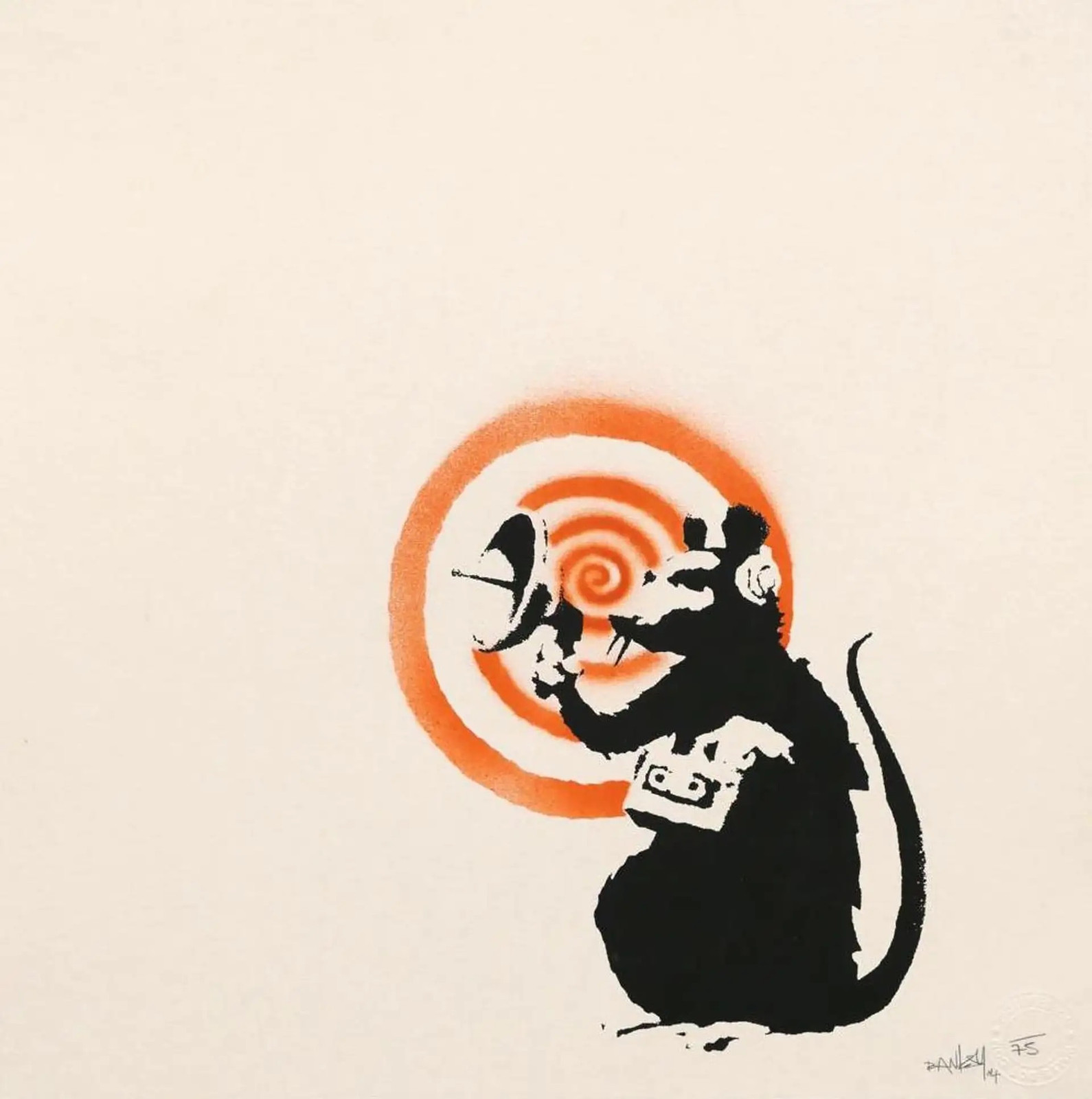
The Radar Rat image originated as a stencil on London walls around 2002 — earlier than most of the print editions. The rat stands on its hind legs, wearing headphones and holding a radar dish, combining surveillance technology with the motif of the rat-as-outsider. The print was released in a notably small edition, exclusively at Banksy's Santa's Ghetto pop-up shop.
In 2008, the Radar Rat image appeared on the cover of Dirty Funker's album Future, released across five colour vinyl variations — extending the image into a different medium while the print edition remained unchanged.
Three separate print editions, each depicting a rat in a peace sign necklace holding a protest placard. The three titles are:
A more recent rat print, distinct from the 2004 POW editions. The Rat Clock sold at Christie's London in October 2024 for a hammer price of £48,000 (£60,480 with buyer's premium), confirming that the rat motif continues to command serious prices across different periods of Banksy's output.
The following prices are drawn from confirmed public auction results. All figures include buyer's premium where noted.
| Edition | Sale | Hammer | With Fees | Notes |
|---|---|---|---|---|
| Love Rat (Unsigned, ed. 600) | Christie's London, Sep–Oct 2024 | £10,000 | £12,600 | — |
| Love Rat (Unsigned) | Peak sale, March 2022 | — | £55,440 | Five-year high |
| Love Rat (Signed, ed. 150) | Peak, December 2020 | — | £110,000 | Five-year high |
| Love Rat (Signed) | August 2022 | — | £40,320 | Five-year low |
| Gangsta Rat (Unsigned, ed. 350) | Recent avg. (last 12 months) | — | £12,487 | Based on 2 sales |
| Gangsta Rat (Unsigned) | Peak, March 2021 | — | £60,000 | Five-year high |
| Gangsta Rat (Unsigned) | August 2025 | — | £9,824 | Five-year low |
| Welcome To Hell (Red Unsigned, ed. 175) | Christie's London, Sep–Oct 2024 | £11,000 | £13,860 | — |
| Rat Clock (2021) | Christie's London, Oct 2024 | £48,000 | £60,480 | — |
Current MyArtBroker estimates for the Love Rat Unsigned: £14,000–£21,000 ($28,000–$45,000). The signed edition range over five years — £40,320 to £110,000 — reflects the scale of premium collectors apply to signature.
Market context: 2021–2022 represented a peak across almost all Banksy print editions, driven by pandemic-era demand. Prices have normalised since but remain well above pre-2020 levels. The Love Rat's 56 auction appearances since 2015 give it one of the deepest secondary market records of any contemporary screenprint edition.
Pest Control is Banksy's sole authentication body and the only entity authorised to certify his work. Print editions published through Pictures on Walls in 2004 were issued with Pest Control authentication cards at the time of sale. These cards are a core component of provenance for any original edition print.
Several points collectors must understand:
For any purchase above the entry-level price point, insisting on the original Pest Control documentation is non-negotiable. Without it, the work is effectively unverifiable.
The premium for a signed Banksy print is significant and consistent. For the Love Rat: the unsigned edition (600 examples) has peaked at £55,440; the signed (150 examples) reached £110,000. That gap — roughly 2x at peak — reflects both rarity and the additional authentication layer a genuine signature provides. Banksy signed sparingly and has not made himself available for post-publication signing, so the existing signed inventory is genuinely finite.
Smaller editions trade at higher multiples. The Radar Rat, issued in an edition of just 75 signed examples with no unsigned counterpart, has one of the most restricted supplies of any rat edition. The Placard Rats (75 signed / 175 unsigned each) sit between the Radar Rat and the larger Love Rat and Gangsta Rat editions in terms of scarcity.
The 2015 Dismaland Gangsta Rat Artist's Proofs represent a separate category. Released exclusively to VIP guests at Banksy's temporary installation, they were never available through standard retail channels. The AP Blue edition of 61 carries an estimated value of £100,000–£150,000 — substantially above the standard Gangsta Rat unsigned. The pink, mint, green, orange, and grey colourways have similar scarcity but different demand profiles depending on the specific colour.
These are paper-based screenprints, now over 20 years old. Condition issues — foxing, light damage, creasing, handling marks — directly affect value. Prints that have been professionally framed with UV-protective glass and stored appropriately command a meaningful premium over examples with visible condition issues.
Prints with an unbroken ownership record — ideally from original POW release to present — are more straightforward to resell. Gaps in provenance, or prints that passed through multiple hands without documentation, require more due diligence and typically attract lower bids at auction.
The Banksy rat market is mature and well-documented, which is both an advantage and a constraint. The advantage: pricing is transparent, auction history is deep, and the authentication structure (Pest Control) is clear. The constraint: the days of acquiring these prints below market are largely over. This is a well-covered secondary market.
Entry point: The Love Rat Unsigned (edition of 600) is the most liquid of the rat prints, with 56 auction sales since 2015. At current estimates of £14,000–£21,000, it offers the most accessible entry to the rat category with a documented resale history. Its size (50 × 35 cm) also makes it practical to display.
Mid-tier: The Placard Rats — particularly Welcome To Hell and Because I'm Worthless — have lower public auction frequency than Love Rat, which can work in a buyer's favour when they do come to market. The sardonic wit of "Because I'm Worthless" has made it one of the more culturally discussed of the three, which historically correlates with stronger demand at sale.
Upper tier: The Radar Rat Signed (edition of 75, no unsigned counterpart) is the rarest of the 2004 POW rat editions as a standalone print. Its surveillance theme is consistent with Banksy's broader political concerns, and its scarcity makes it a long-term hold rather than a liquid trade.
Specialist category: The Dismaland Gangsta Rat AP colourways are a distinct market segment. They trade rarely, they require specific provenance linking back to the Dismaland event, and their valuations are high. For collectors already holding standard Banksy print editions and looking for exposure to a genuinely scarce variant, they are worth considering — but due diligence requirements are correspondingly more intensive.
What to avoid: Unsigned works without Pest Control authentication cards, prints offered significantly below current auction estimates without a clear explanation, and any work where the seller is reluctant to provide full provenance documentation.
Among the print editions, the Love Rat Signed (edition of 150) achieved £110,000 at auction in December 2020 — the highest confirmed sale price for an individual rat print from the 2004 POW editions. The Gangsta Rat AP Blue (Dismaland, edition of 61) is currently estimated at £100,000–£150,000. The Rat Clock (2021) sold at Christie's London in October 2024 for £60,480 with buyer's premium.
All 2004 Pictures on Walls editions were issued with Pest Control authentication cards at the time of sale. Pest Control — Banksy's sole authentication body — does not issue retroactive certificates for works that were not certified at original sale. A print without its original Pest Control card cannot be authenticated through any alternative channel. Buying an uncertified rat print carries substantial risk.
The Love Rat was published in two parts: a signed edition of 150 and an unsigned edition of 600. The signed edition commands a significant premium — roughly 2–3x at comparable market conditions. At peak (2020–2022), the signed edition reached £110,000; the unsigned peaked at £55,440. Current estimates place the unsigned at £14,000–£21,000 ($28,000–$45,000).
In 2015, Banksy released six Artist's Proof colourways of the Gangsta Rat exclusively for VIP guests at Dismaland: pink, mint green, green, orange, blue, and grey. These were never available through retail channels and were not part of the original 2004 edition. Together with the original, there are seven colour variants. The AP Blue (edition of 61) carries an estimated value of £100,000–£150,000.
Banksy has cited Blek le Rat (Xavier Prou), the French stencil pioneer who began spraying rats in Paris in the 1980s, as a primary influence. Banksy began incorporating rats into his own work as part of the Bristol underground scene. The rat appealed as a symbol because of its status as a social outsider — hunted, persecuted, and yet capable of significant impact. He later noted that "rat" is also an anagram of "art," though he has said he discovered this after the fact.
The Love Rat Unsigned has sold 56 times at auction since 2015, giving it one of the deepest public resale records of any contemporary screenprint edition. Prices across all rat editions peaked in 2021–2022 and have since normalised. The current market reflects active but measured demand. Signed editions, the Radar Rat (edition of 75), and the Dismaland AP colourways carry the strongest scarcity argument. As with any art investment, condition and authentication documentation are fundamental to resale value.
Guy Hepner | 177 Tenth Avenue, New York
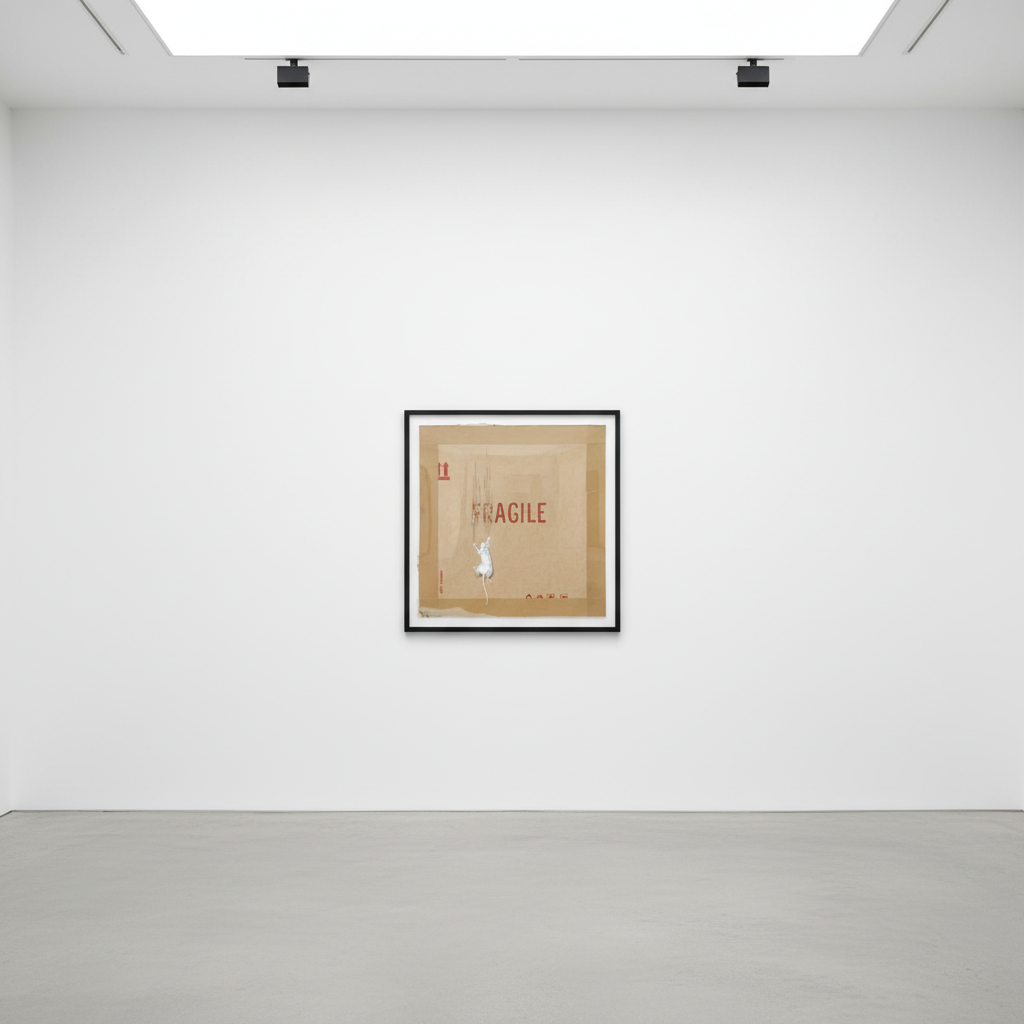
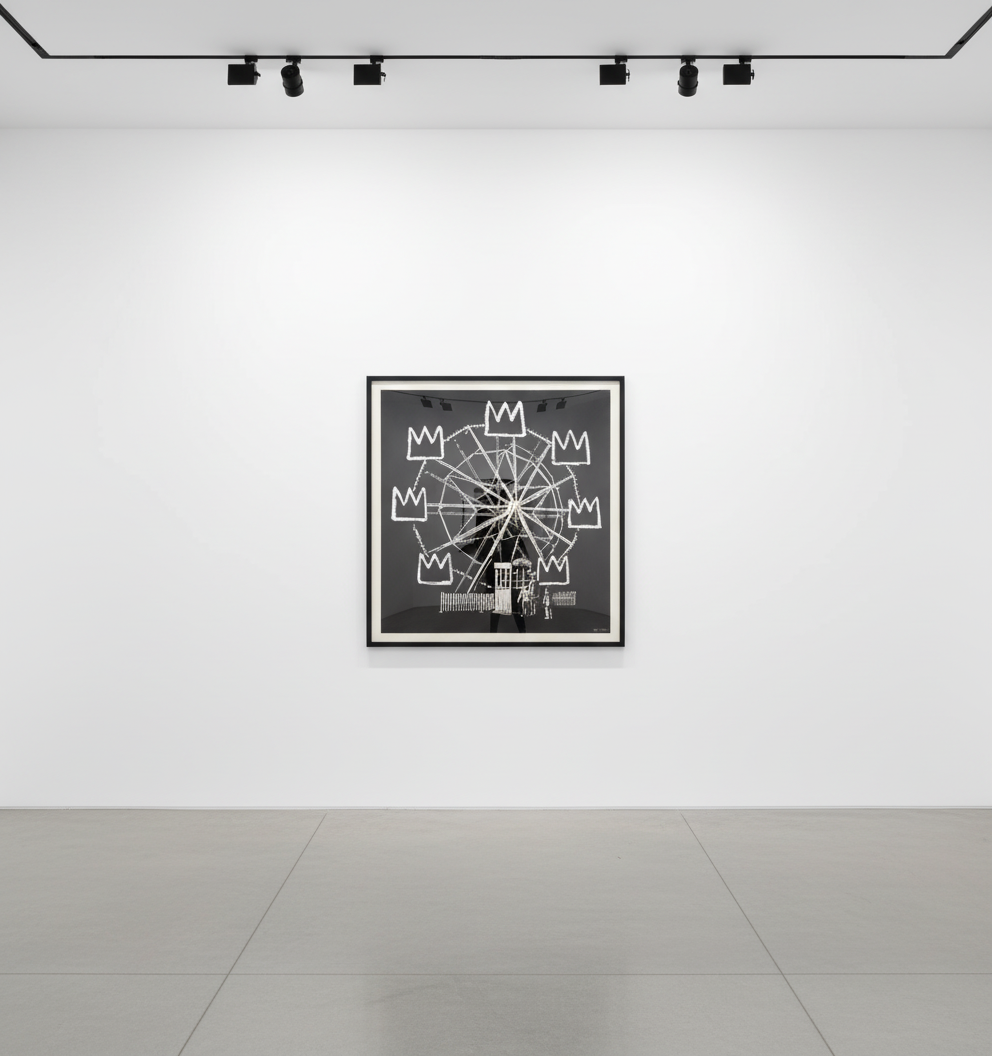
Explore Banksy prints for sale at Guy Hepner: Gangsta Rat, Love Rat, Radar Rat, (Fr)agile, Applause.
Related Series