Lenticular

September 18, 2026

There is something uncanny about standing before a Julian Opie LED sculpture in a darkened gallery. The figure walks endlessly, trapped in an eternal loop of forward motion — legs scissoring, arms swinging, hair bouncing with each stride. You find yourself waiting for something to change, for the walker to arrive somewhere, but of course they never do. This is Julian Opie art at its most hypnotic: the reduction of human movement to its essential rhythm, stripped of destination but not of purpose.
For more than four decades, this British artist has refined a visual language so distinctive that his work needs no signature to be recognised. From the iconic Blur album cover that introduced millions to his aesthetic, to monumental LED installations in public spaces across the globe, Opie has carved out a singular position in contemporary art — one that straddles the boundaries between painting and sculpture, fine art and design, the gallery and the Street. His Lenticular prints and LED works represent perhaps the purest expression of his ongoing fascination with movement, perception, and the way images function in modern life.
Julian Opie was born in London in 1958 and raised in Oxford, attending the Dragon School before moving on to Magdalen College School. This thoroughly English upbringing — steeped in tradition, medieval architecture, and the particular quality of light that filters through leaded windows — might seem an unlikely foundation for an artist whose work would later be compared to Japanese woodblock prints, Egyptian hieroglyphics, and digital interfaces. Yet there is something distinctly English in Opie's reserve, his reluctance to over-explain, his preference for letting images speak without commentary.
The formative experience, however, came at Goldsmiths in London, where Opie studied under the conceptual artist Michael Craig-Martin. Graduating in 1982, Opie emerged into an art world on the cusp of transformation. Craig-Martin's influence proved decisive — not in terms of style, but in approach. The older artist taught his students to think rigorously about how images communicate, to question every assumption, to understand that the line between high art and everyday visual culture was far more permeable than the establishment liked to admit. This lesson would shape everything Opie subsequently produced.
The early work bore little resemblance to the Walking figures that would later make Opie famous. He was grouped with the New British Sculpture movement in the 1980s, creating painted metal constructions that played with ideas of representation and illusion. These works — which included rendered images of everyday objects like stepladders and night lights — already demonstrated Opie's interest in how simplified forms could carry meaning. The journey from these early sculptures to the LED panels of today reveals not a rupture but a gradual refinement, a progressive stripping away of everything extraneous.
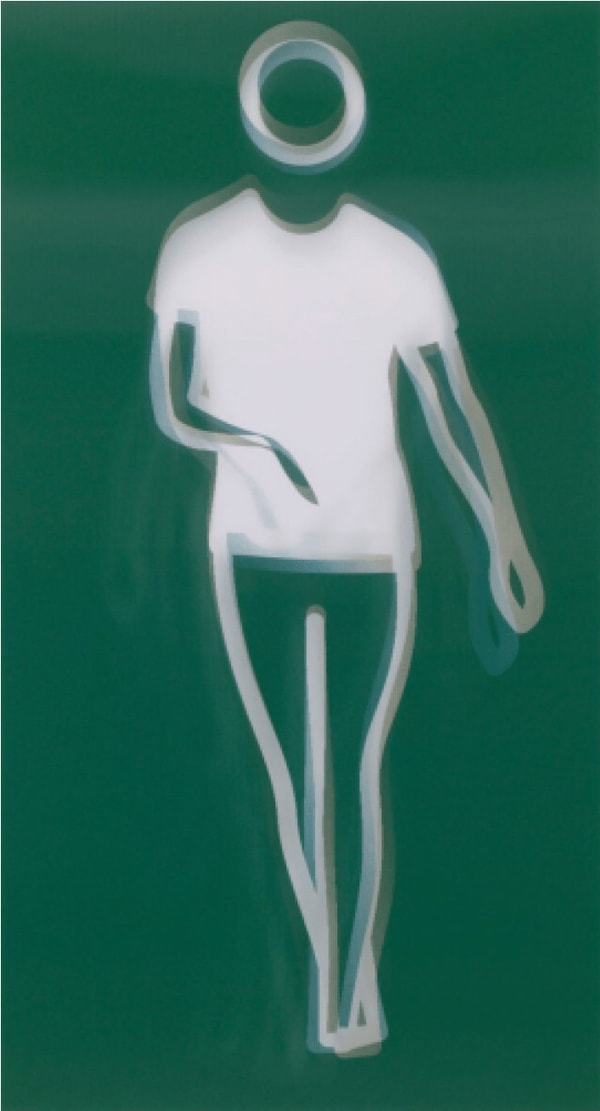
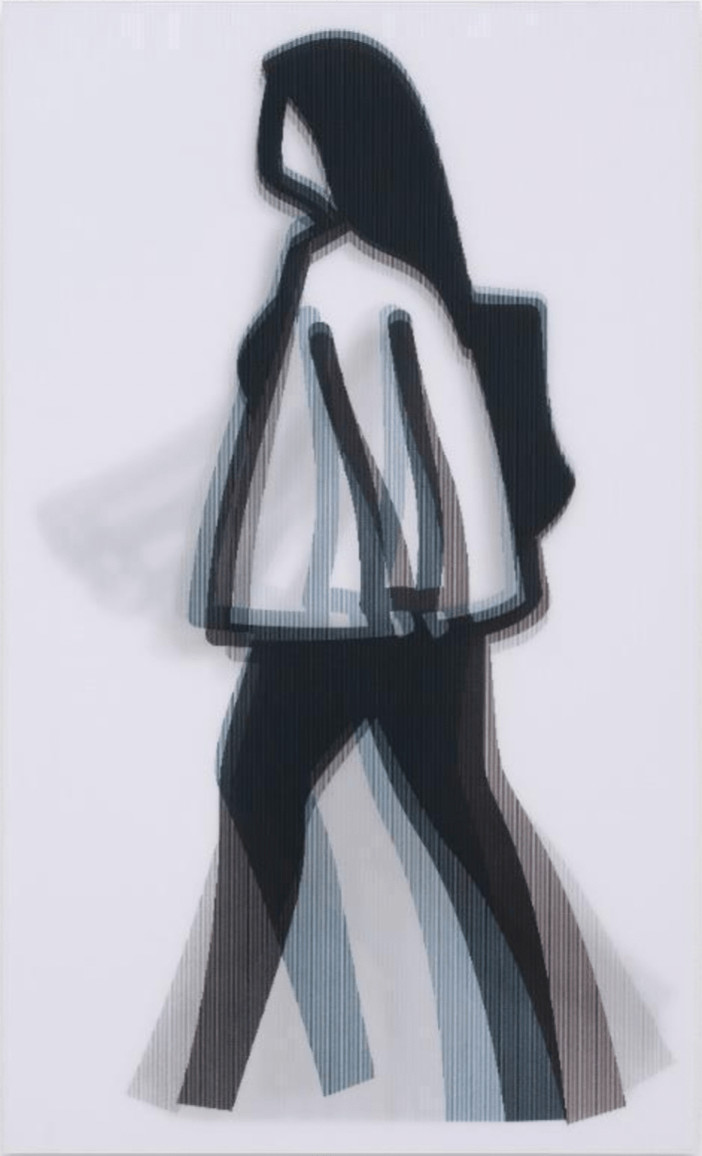
Julian Opie, Walking Figure (White/Gray), Screenprint. Available at Guy Hepner, New York.
By the mid-1990s, Opie had begun moving toward the figure-based work that would define his mature practice. The shift was not arbitrary but arose from a deep engagement with art history and a growing conviction that portraiture — one of painting's oldest genres — remained relevant in an age of photography and digital reproduction. The question that seemed to drive him was deceptively simple: how little information does an image need to remain recognisable as a specific person?
The answer, Opie discovered, was remarkably little. Working from photographs, he developed a method of reduction that eliminated everything but the most essential contours. Eyes became simple black dots or short lines. Noses were reduced to a single stroke or omitted entirely. Hair was rendered as a solid mass of colour. Yet despite this radical simplification — or perhaps because of it — the resulting portraits remained identifiable. When Blur commissioned Opie to create the cover for their 2000 compilation album The Best Of, the images he produced were unmistakably Damon Albarn, Graham Coxon, Alex James, and Dave Rowntree. The album cover became one of the most recognised pieces of graphic design of the early 2000s, introducing Opie's aesthetic to an audience far beyond the gallery world.
The Blur connection exemplifies something crucial about Opie's position in contemporary culture. His work operates at the intersection of fine art and design, demanding to be taken seriously as both. The simplified figures that first appeared on that album cover have since walked across LED screens in Seoul, stood frozen in lenticular prints in private collections, and been rendered in vinyl on wood for museum retrospectives. The same visual language functions equally well on a record sleeve and in a white cube gallery — a versatility that some critics view with suspicion but that Opie embraces without apology.
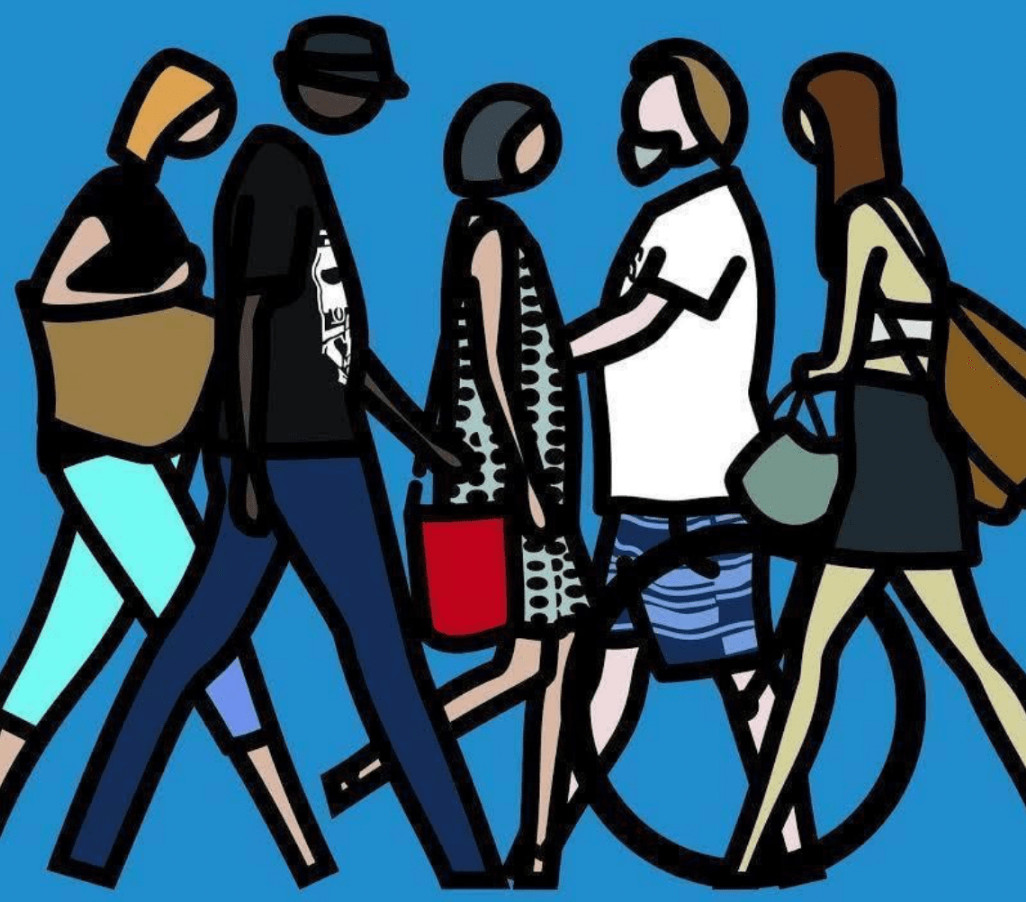
The walking figures that have become Opie's most celebrated subject matter emerged from his ongoing observation of city life. Standing on a London street corner, watching the endless parade of commuters, Opie began to see patterns in their movement — the particular way a woman in heels navigates a crosswalk, the distinctive stride of a man late for a meeting, the casual amble of Tourists consulting their phones. These figures are anonymous yet specific, generic yet individual. They represent Everyone and no one.
What distinguishes Opie's walking figures from mere illustration is his treatment of movement itself. In his LED works and lenticular prints, the figures actually walk. They are not frozen in mid-stride like conventional paintings but cycle through a continuous loop of motion. The effect is mesmerising — part animation, part sculpture, part some new category that doesn't quite have a name yet. Viewers find themselves watching these figures for far longer than they would spend contemplating a static image, drawn into the rhythm of the walking cycle, waiting for a resolution that never arrives.
The philosophical implications are significant. Opie's walkers embody something essential about modern urban existence: the constant movement, the anonymity of crowds, the way individuals become interchangeable within the flow of city life. Yet they also celebrate this condition. There is nothing melancholy about these figures. They walk with purpose and energy, their simplified forms suggesting not dehumanisation but a kind of universality. Stripped of identifying details, they could be anyone — which means they could be you.
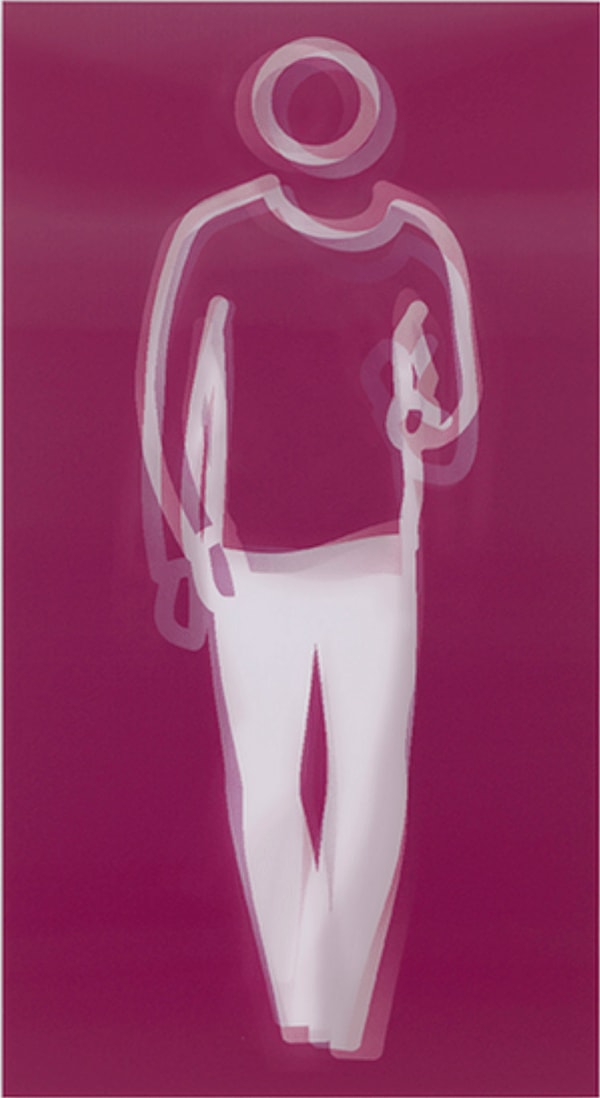
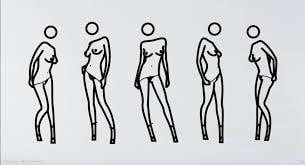
Julian Opie, Standing Figure (Pink), Screenprint. Available at Guy Hepner, New York.
Opie's LED works represent a technical and conceptual breakthrough in his practice. The technology allows him to create images that genuinely move, fulfilling the promise implicit in all his walking figures. Unlike video art, which exists in the dematerialised space of projection, LED sculptures are physical objects — luminous panels that occupy real space and command attention with the particular quality of their light.
The first major LED commission came in 2007 with Ann Dancing, installed in Indianapolis as part of the city's Cultural Trail. This four-sided sculpture depicts a woman dancing, her movements looping endlessly on LED screens visible from all directions. Standing twelve feet tall, the work transformed a piece of urban infrastructure into a site of contemplation and wonder. Office workers on their lunch breaks paused to watch Ann dance. Children mimicked her movements. The work demonstrated that Opie's aesthetic, often dismissed as commercial or slight, could hold its own in the most demanding of contexts — the distracted environment of public space.
Subsequent LED works have explored variations on this theme. Some feature single figures walking or running. Others present multiple figures, creating the impression of a crowd in motion. The technology has advanced significantly since that first Indianapolis installation, allowing for greater resolution and more nuanced colour gradation. Recent LED works incorporate the increased painterliness that has characterised Opie's evolution over the past decade, with figures rendered not just in flat colour but with subtle shadows and highlights that suggest volume and depth.
For collectors, LED works present unique considerations. They require electrical connections and controlled lighting conditions. They generate heat and have components that may eventually need replacement. They blur the traditional categories of painting, sculpture, and video. Yet for those with the space and infrastructure to accommodate them, LED works offer an experience that no other medium can match — the presence of a figure that truly moves, that occupies your peripheral vision with its endless walking, that transforms any room into a theatre of perpetual motion.
If LED sculptures represent the technological pinnacle of Opie's moving images, lenticular prints offer a more accessible alternative that nonetheless delivers a genuine sense of motion. The technology is familiar from novelty postcards and promotional items — a ribbed plastic surface that reveals different images depending on the viewing angle — but Opie has elevated it to a medium capable of real aesthetic power.
Lenticular prints work by interlacing multiple images beneath a lens array. As the viewer moves, different parts of each image become visible, creating the illusion of movement or depth. Opie typically uses this technology to present walking cycles, with each step in the sequence revealed as the viewer shifts position. The effect is subtler than LED animation but no less compelling. You find yourself swaying back and forth in front of the work, bringing the figure to life through your own motion.
The lenticular editions occupy an interesting position in Opie's output. They are multiples, produced in editions that make them more accessible than unique works, yet they retain the object-quality that distinguishes them from simple prints. The plastic surface has its own material presence — cool and smooth, catching light in ways that paper cannot. Some collectors view them as entry points into Opie's practice, stepping stones toward larger works. Others prize them for exactly what they are: elegant solutions to the problem of representing motion in a medium that traditionally cannot move.
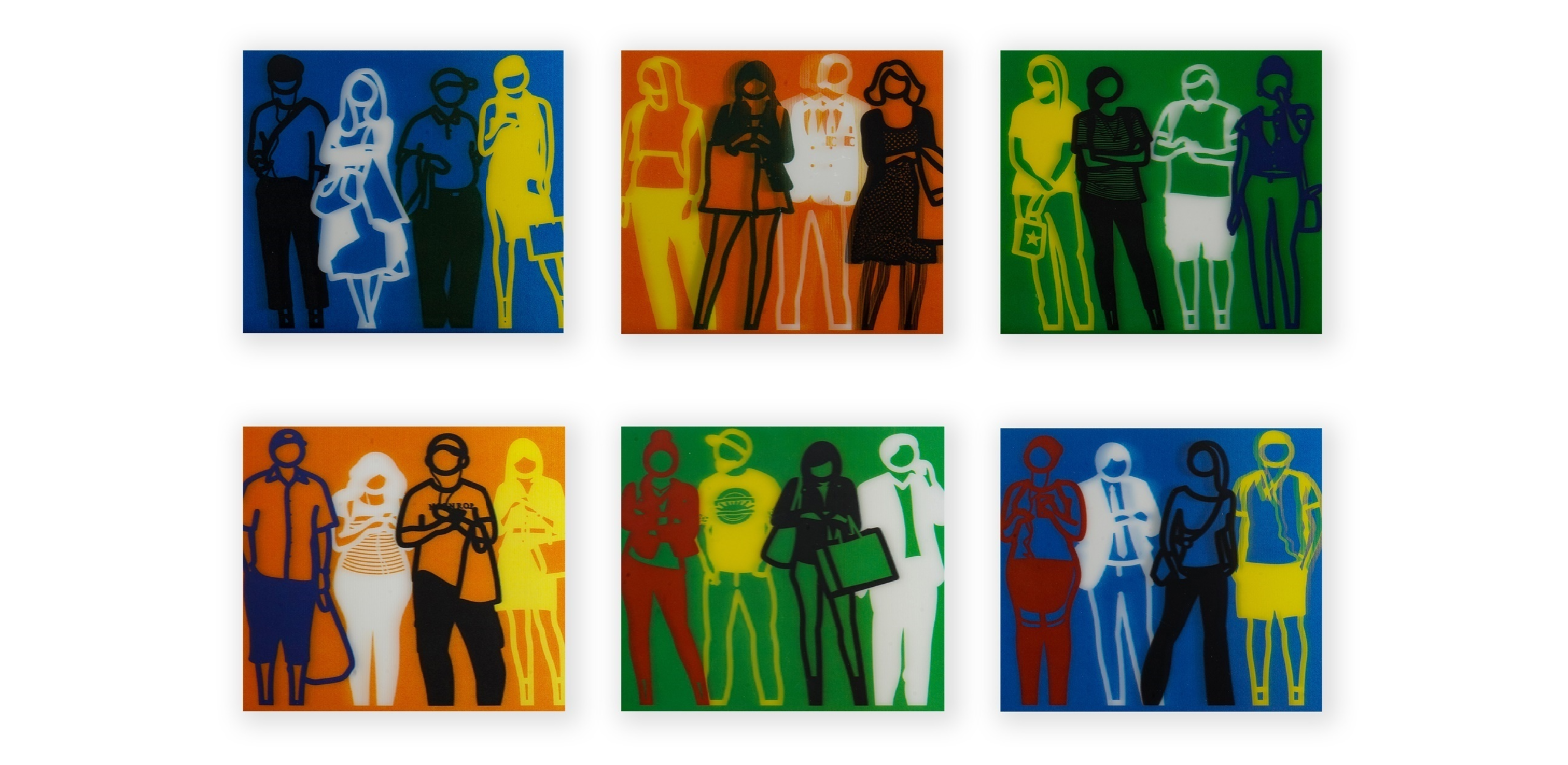
Opie's technical range extends far beyond LED and lenticular technologies. Over the course of his career, he has worked in screenprint, vinyl on wood, auto paint on aluminum, mosaic, stained glass, and numerous other materials. Each medium brings its own qualities to his visual language, revealing different aspects of images that might otherwise seem simple.
Screenprints remain central to his practice, offering the flatness and graphic clarity that his imagery demands. Unlike traditional painting, screenprinting produces areas of perfectly even colour without brushstrokes or texture. This mechanical quality suits Opie's aesthetic — the figures are meant to look somewhat artificial, closer to signage than to traditional portraiture. Yet within this constraint, considerable subtlety is possible. Recent screenprints incorporate multiple layers of transparent colour that create depth and modulation without sacrificing the essential flatness of the image.
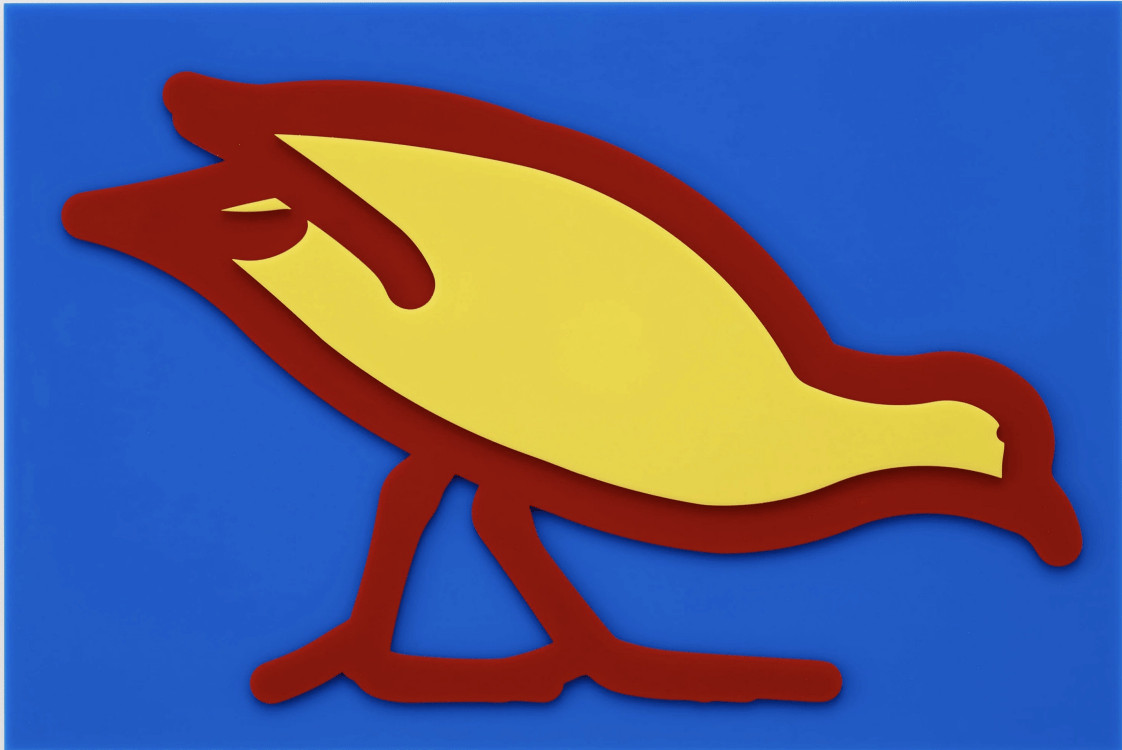
The vinyl on wood works push this aesthetic further. Here, shapes are cut from adhesive vinyl and applied to painted wooden panels, creating a surface that is physically flat yet reads as dimensional. The technique derives from signmaking rather than fine art, yet Opie uses it to create works of considerable sophistication. The hard edges of vinyl-cut shapes have a different quality than printed edges — crisper, more definite, almost architectural in their precision.
Auto paint on aluminum represents another important material category. These works have the lustre and depth of car bodywork — a decidedly non-art-world reference that Opie embraces. The aluminum surface is sprayed with automotive lacquers in multiple layers, building up a finish that seems to glow from within. The imagery is typically applied via vinyl or direct painting, combining industrial technique with the gesture of the artist's hand.
Opie's work has always attracted a divided critical response. Admirers praise his visual intelligence, his engagement with art history, and his ability to create images that function across multiple contexts. Detractors dismiss the work as superficial, commercial, or — in the words of Christopher Allen, writing in The Australian — "slight and ultimately commercial, if not actually kitsch." This criticism misses the point, but it reveals something important about the uncomfortable position Opie occupies.
The issue is accessibility. Opie's work is immediately comprehensible in a way that much contemporary art is not. You do not need a degree in art history to recognise a walking figure or to be captivated by an LED animation. This legibility is intentional — Opie draws explicitly on the visual language of public signage, which must communicate instantly to everyone — but it triggers suspicion in a art world that often equates difficulty with seriousness.
Yet accessibility is not the same as simplicity. Opie's engagement with art history is deep and sustained. His portraits participate in a tradition stretching back through Pop Art to classical antiquity. His walking figures echo the frieze figures of Greek sculpture, the processional murals of Egyptian tombs, the woodblock prints of Hiroshige and Hokusai. The simplified faces draw on Byzantine icons, which also used minimal features to convey spiritual presence. To dismiss this work as mere graphic design is to ignore centuries of visual culture that Opie consciously invokes.
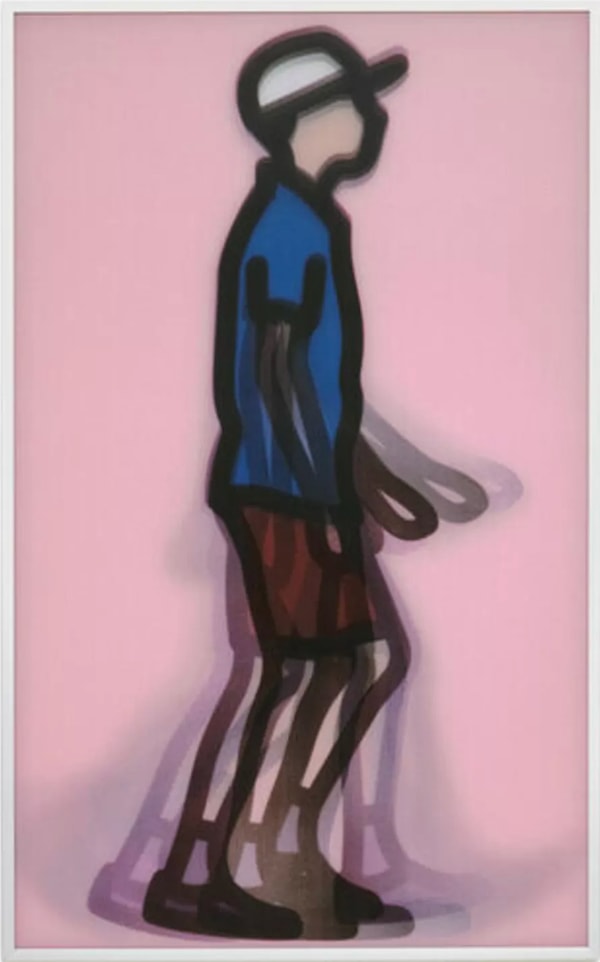
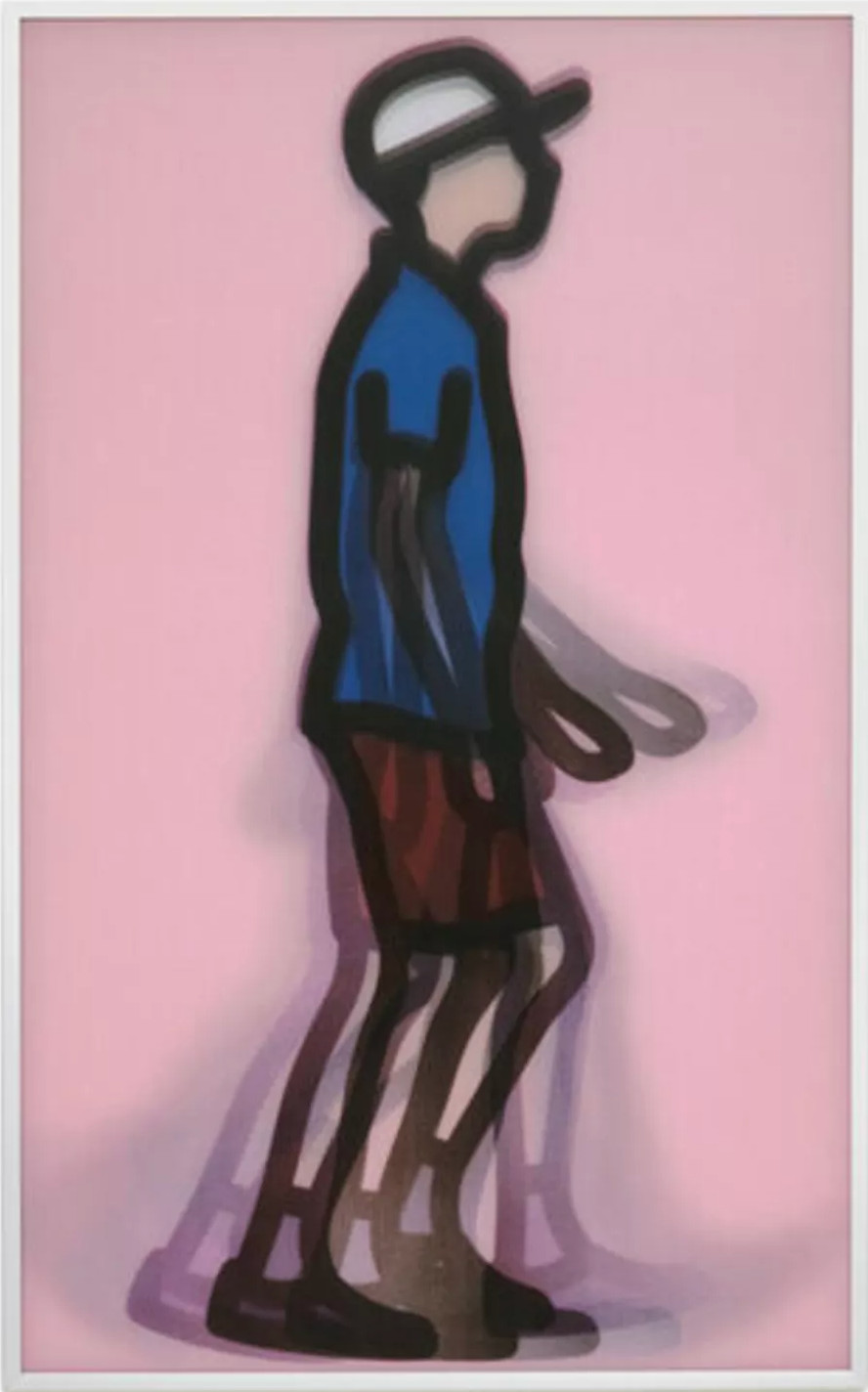
Julian Opie, Figure Study (Blue Jacket), Screenprint. Available at Guy Hepner, New York.
For collectors considering an acquisition, the question inevitably arises: how much is a Julian Opie worth? The answer varies dramatically depending on the medium, scale, edition size, and subject matter of the work in question. Screenprints in larger editions might be acquired for several thousand pounds, while unique LED sculptures command six-figure sums. Understanding this range requires attention to the specific categories within Opie's output.
Edition sizes are a crucial factor. Opie produces prints in editions ranging from as few as twenty to as many as several hundred. Smaller editions command premium prices, as basic supply and demand would predict. However, the relationship is not straightforward — a particularly iconic image in a larger edition might outperform a less significant work in a smaller run. The Blur portraits, for instance, retain strong demand despite being produced in relatively accessible quantities, because of their cultural resonance and immediate recognisability.
Walking figures represent the most sought-after category among Opie's subjects. The combination of movement (in LED or lenticular works) and the universality of the walking theme creates broad appeal. Portraits of specific individuals can be equally valuable, particularly when the subject is notable — Opie has depicted musicians, artists, and public figures throughout his career. Landscapes and architectural subjects, while significant within his oeuvre, typically generate less collector enthusiasm than the figurative work.
Condition matters significantly for all categories. Screenprints should be free of fading, foxing, and handling damage. Lenticular works must have intact lens surfaces — scratches compromise the viewing experience and are essentially impossible to repair. LED works require functioning electronics and should be examined for any degradation in brightness or colour consistency. Given the technological nature of much of Opie's output, condition assessment often requires more technical knowledge than traditional print evaluation.
Those new to collecting Julian Opie face an enviable range of entry points. The diversity of his output in terms of both medium and price means that meaningful works are accessible at various levels of investment. However, certain principles can guide acquisition decisions toward works likely to deliver both aesthetic satisfaction and long-term value retention.
First, prioritise works that exemplify Opie's most distinctive contributions. The walking figures — particularly in LED or lenticular formats that incorporate actual movement — represent his signature achievement. These works do something that no other contemporary artist has achieved with comparable success, giving them a conceptual irreplaceability that supports long-term interest.
Second, consider the relationship between image and medium. Opie's genius lies partly in matching visual ideas to appropriate materials. A walking figure in lenticular print gains meaning from the viewer's movement; an LED sculpture gains from its luminous presence in space. Static screenprints of walking figures are visually striking but miss the kinetic dimension that elevates the same imagery in time-based formats.
Third, attend to provenance and documentation. Works purchased directly from established galleries come with certificates of authenticity and clear ownership history. Given the technical nature of much of Opie's output — particularly LED works that may require future maintenance — documentation of original specifications and any subsequent servicing is particularly valuable.
Opie's work is held in major museum collections worldwide, confirming his position within the contemporary art canon despite critical debates about his significance. The Tate in London holds multiple works, as do the Museum of Modern Art in New York, the National Portrait Gallery in London, and numerous other institutions across Europe, Asia, and the Americas. This institutional presence provides a foundation of scholarly attention and long-term preservation that benefits the broader market.
Public commissions have extended his reach beyond the traditional gallery context. The Reclining Nude at Gateshead Millennium Bridge in England and Ann Dancing in Indianapolis demonstrate Opie's ability to create work that engages general audiences rather than art-world specialists alone. These prominent placements function as permanent advertising for his practice, introducing new viewers to his aesthetic and potentially converting them into collectors.
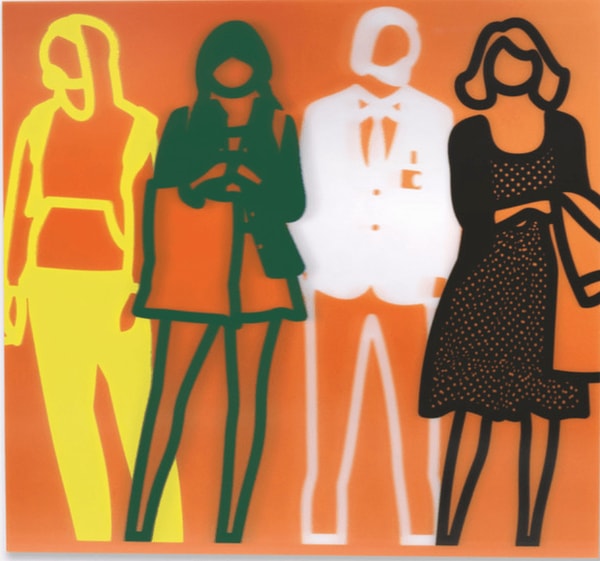
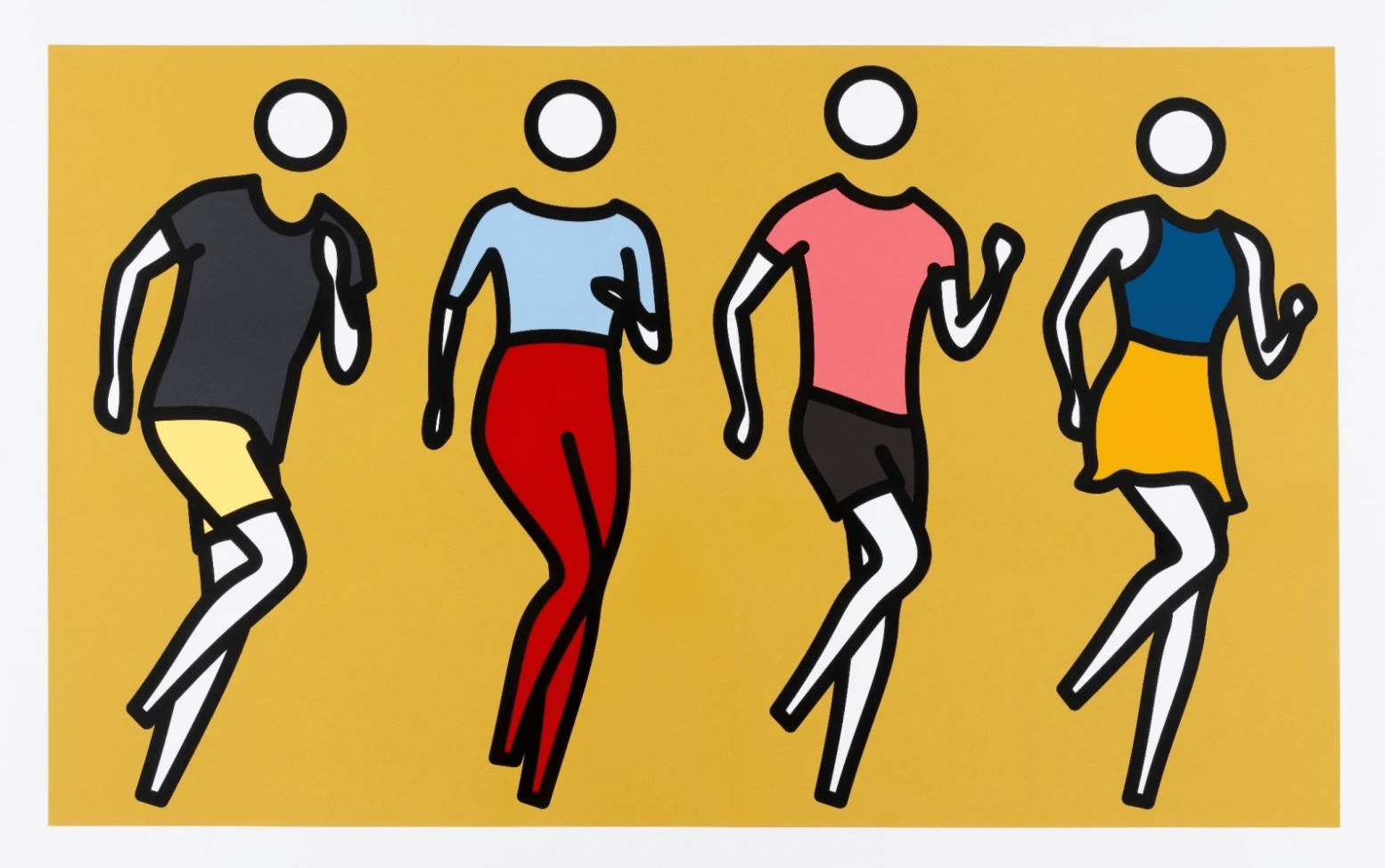
Julian Opie, Four Figures (Orange), Screenprint. Available at Guy Hepner, New York.
In recent years, Opie's work has grown more complex without abandoning its essential clarity. The figures that once appeared in pure flat colour now incorporate layers of shadow and highlight, suggesting volume and weight. Backgrounds have become more atmospheric. The range of poses and activities has expanded beyond walking to include running, dancing, standing, and various everyday actions. This evolution demonstrates that the apparent simplicity of Opie's style was never a limitation but a foundation upon which to build.
The technological dimension continues to develop as well. As LED technology improves, new possibilities emerge for resolution, colour depth, and scale. Opie has consistently embraced these advances, using them to refine rather than fundamentally alter his vision. The walking figures that appeared in early LED works were necessarily crude by current standards; contemporary pieces achieve a smoothness and subtlety that earlier technology could not support. Future developments will doubtless open further possibilities.
What has remained constant throughout this evolution is Opie's fundamental question: how do images work? Whether in paint, vinyl, or light, his figures ask us to consider the relationship between representation and recognition, between what we see and what we understand. The walking figures that loop endlessly through his LED panels and lenticular prints are not just images of people — they are investigations into the nature of imagery itself, into how a few lines and colours can conjure human presence.
Guy Hepner Gallery at 177 Tenth Avenue in New York maintains an active inventory of Julian Opie works spanning his various media and periods. For collectors interested in acquiring pieces for their personal collections or interior design projects, the gallery offers informed guidance on available works, condition, provenance, and appropriate placement.
The current inventory includes screenprints, lenticular editions, and works on panel, representing the range of Opie's output from iconic walking figures to portrait studies and standing figures in various poses. Each work comes with full documentation and the gallery's assurance of authenticity. For those considering larger acquisitions, including LED works, the gallery can advise on technical requirements and installation considerations.
Whether you are building a collection focused on contemporary British art, seeking a statement piece for a specific architectural context, or simply drawn to the particular magic of Opie's simplified figures, a conversation with the specialists at Guy Hepner can help clarify options and facilitate acquisition. In an art market where knowledge and access matter, working with an established gallery ensures that your investment is protected and your aesthetic aspirations are met.
The figures will keep walking — on screens in Seoul and panels in New York, in private collections and public spaces, in the imaginations of viewers who pause, even briefly, to watch them pass. Julian Opie has given contemporary art a new vocabulary for representing human movement and urban life. To own a piece of that vocabulary is to participate in one of the most distinctive artistic projects of our time.
Explore Julian Opie prints for sale at Guy Hepner: Lenticular, Old Street Walkers, Walking, Bijou Gets Undressed, Birds.
Related Series